ros sereysothea – i will starve myself to death/ shave your beard

I hardly ever put on a cd or listen to an LP these days (last is prolly due to the fact,that I killed my speakers/amplifier). In fact i am totally addicted to the net when it comes to music. I also am an avid KCRW listener. I often tune in to Henry Rollins’s radio show on KCRW. Henry does all the searching, comes up with all the cool tunes from every genre all over the place and all I have to do is listen. It was due to his radio show that i started listening to Sinn Sisamouth. This led me to Ros Sereysothea. I am 100% fascinated with her singing and music.

For the last days, I keep playing over and over this on Spotify:’ ‘Dengue Fever Presents Electric Cambodia”. Sounds amazing,and wished that i could understand the language. All performers on this compilation are dead,or ”vanished”. Killed/died during the communist Khmer Rouge regime.

”Electric Cambodia may be one of the saddest and most enraging compilations released this year—not for the music, but for the history. The performers are dead, all dead, or “vanished” into the Killing Fields—murdered, presumably, although the how is a mystery. Did they die quickly or slowly? ” – read more of this review HERE.

Ros Sereysothea – Shave your Beard

on buried treasure (5 june 2012)

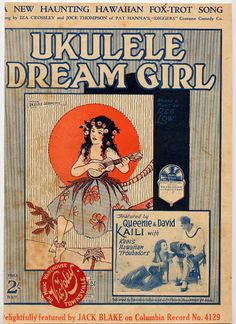
ukulele dream girlTo research (English definition): “To search for something.”

Rechercher (French definition): “To search for, to look for” and also “to search again, to look for again”.

Both “search” and “research” are the same word in French, it seems.  This makes sense: even if something was once common knowledge, after it is hidden it is no longer “there”; it has fallen from awareness. So you have to seek for it again, that which is not there. In “research”, you never know what is actually there until you find it, or there would be no need to look. You dis-cover it again, un-cover it anew.

Archives are fascinating places of preservation-with-intent to look in, and they are always tantalisingly incomplete, however exhaustive… But nothing beats the thrill of finding a treasure hoard saved by happenstance.

To “ondersoek” , in Afrikaans, is to look under other things… The term implies a palimpsestic patina, an accretion, a build-up of layers that must be lifted, peeled off to see underneath… the mother lode, the genealogy. Sometimes you know exactly what you are looking for; sometimes you don’t. You may only have a misty hope that there is anything there at all. It can be useful to lose focus, too, because you become open to other routes, other offshoots, that may take you further than your original hunch.

On Saturday, in a poky little shop in Kalk Bay, I found a trove of old sheet music: popular tunes from the 1920s and 1930s, the top few layers of it in torn, grubby disarray. A thrill ran through my fingertips as I started re-moving each sheet from the pile, putting it aside systematically. There was nothing of great interest until I got quite a way below the dusty surface layers, where most people’s patience obviously runs out (this is the trick with digging – to delve deeper, to expend more energy, more time than everyone else – om onder te soek, for there lies the gold). There was no way I could stop.

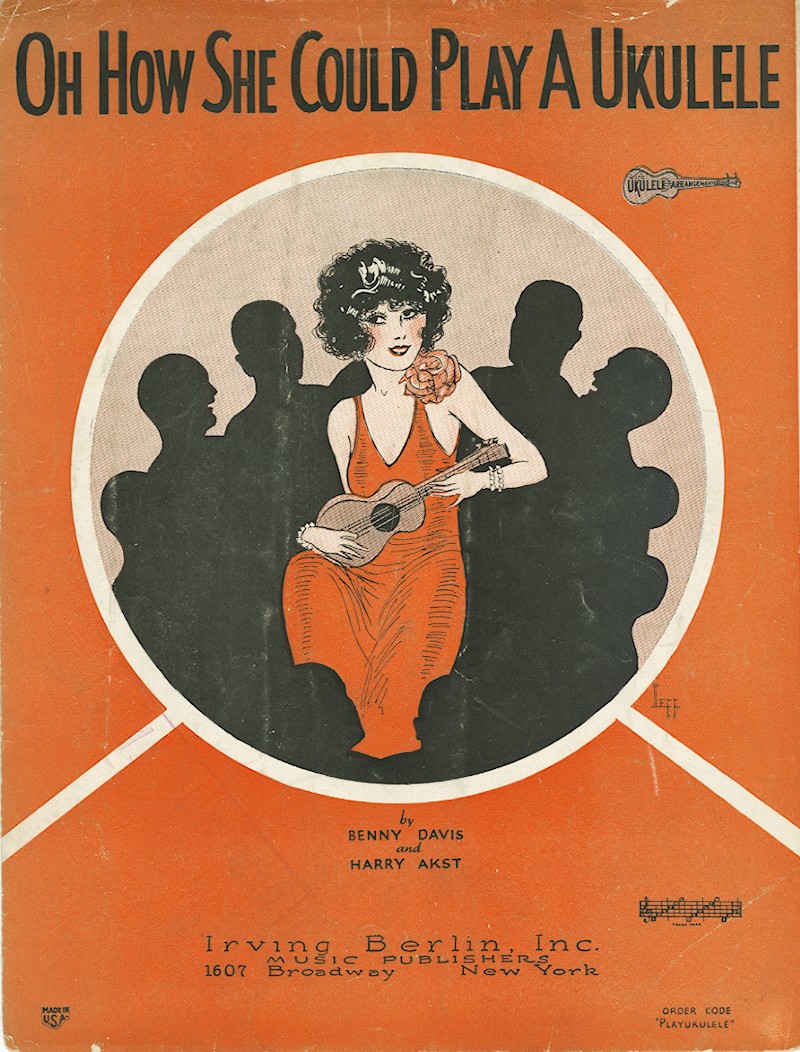
Buried in the pile, under piano exercise books, I found something that really astounded me… it almost made me shout for joy: many, many of the scores had ukulele chord diagrams on them! In all the popular sheet music I had ever been acquainted with before this, these diagrams were provided for guitar – with five lines for the five strings. These all had only four lines. It became clear to me on seeing this that, along with piano, ukulele was most likely the popular amateur instrument of choice back in the 1920s to 1940s, and not guitar. It makes sense when you listen to the jazziness of the pop arrangements of the time, and how well the chord progressions work technically with a ukulele’s tuning – GCEA. I would suppose that the guitar ousted the uke in popularity with the ascent of blues and rock and folk, in which different chords and tunings predominate, and for which the guitar’s EADGBE tuning is a more natural fit… How lovely to realise that this instrument I play very amateurishly, considered a funny curiosity by most these days, was accorded far more value in the past!oh how she could
What this little discovery means for me, practically, is that I can now play all these very old jazzy tunes with no in-depth knowledge of musical theory. Even the songs I have never heard before can be found with a bit of effort on the internet, listened to, and re-played, provided someone else along the way has seen their value. As long as they were ever recorded, be it on wax cylinder or 78rpm, they may have been digitised. And, as they spin up on my hard drive, a vortex is created, opening a wormhole back to the instant that band played for the first time as the cylinder turned. And the song comes back from the dead as my fingers form the chord shapes, stutters back to life as I sing my breath into the words. Technology is powerful magic, all the more so when it takes account of its historicity.

Information technology is not only about making the future more slick and manageable; it is also about keeping the past accessible… Essentially it is about conquering linear time and space. The prolific recording of moments allows us to live unconstrained by the present moment and space we’re in, almost continuously if we so wish… (For example, people sit on Facebook as they are out for coffee with a friend. Once they have “checked in” at the cafe, they check out what other people are doing elsewhere on their phones, then frame themselves carefully for a photo in that space and capture the moment, uploading it to join the feed for others who are moving through spaces connected via radio waves to know about. Very little other than eating, drinking and self-referential preening is going on in most coffee spots.)

The sheer volume of recording that goes on now is unprecedented. Imagine reading Twitter logs in a century – every ordinary so-and-so with a Twitter account, with their own account of an event… The hyper(in)significance of every moment of our lives being documented is overwhelming to think about. How will historians of the future ever manage to filter out the noise from the signal and deduce anything?

Or, will the noise be the signal – the fragments the whole? How does this affect our memories, our critical faculties, our creativity, our relationships? New technologies confer on us immense power that should be used wisely and with sober discernment, not trivially… as that dumb what’s-her-face model Leandra found out last week when tweeting 140 racially offensive characters cost her her modelling career and dignity, with satisfying, devastating swiftness!

So, anyway, I pulled out a large wad of music sheets; slowly, carefully replaced what I didn’t take for someone else to find. Tried to conceal my excitement as I got to the till; thwacked the pile down and asked nonchalantly, “How much for this old stuff?”

“Two rand a sheet.” After counting to fifteen the old guy stopped and said “I can’t be bothered to count higher than fifteen – it’s yours for thirty bucks.”

I paid thirty rand for all of it. That’s less than a cocktail or a sandwich in the seaside cafes lining that road. So few people seem to see value in this stuff. Not even antique dealers. To them it’s just quaint ephemera.

Research involves following the intuition, the hunch that something lies hidden out of time, out of sight, out of mind: perhaps recorded imperfectly, decaying, deliberately saved. Or, like these priceless music sheets, just debris left in a place where it makes no sense to anyone who has stumbled across it yet… In danger of being lost forever if someone doesn’t come along with enough focused curiosity to re-cognise it as valuable, to think it back into meaningful connection with right now.

To me, the serendipity of finds like Saturday’s feels more than coincidental. If the person looking didn’t happen to be me there at that precise moment, it would probably have been a non-event. Even if it were the me of last year leafing through, I wouldn’t have known what I was looking for. Would have seen the music but not had a ukulele and maybe not noticed that the chord diagrams had only four strings, not five. The me of just a few months back would have seen the music with interest but not known the extent of the 78rpm archive online (having become aware of the degree of coverage of obscure songs through something I have been working on in the past month) and so left it because I didn’t know the songs and didn’t know there was a way to hear them. I don’t often look through second hand stores these days, broke as I am. On Saturday, something compelled me to step inside as I was passing. It felt as if me and the music were drawn together. It felt magical.
brian eno: imaginary landscapes (1989)

“I thought: I want to make a kind of music that had the long Now and the big Here in it, and for me that meant this idea of expanding the music out to the horizons. In terms of space, you were not aware of the edges of the music. I wanted to make a music where you just wouldn’t know what was music and what wasn’t… a music that included rather than excluded; a music that didn’t have a beginning and an end… This is the sense of making the Now longer.”

A 1989 documentary on Brian Eno’s work in ambient sound.


hunx and his punx – you don’t like rock ‘n roll

Hunx and his Punx-You dont like rock n roll (from the album:gay singles).

If im not mistaken,the boyfriend in this videoclip is Nobunny .
On drums :Tina Lucchesi (who formed:The Trashwomen. Spend the Night With the Trashwomen (1993);was one of my favourite records when i was in my late teens. Also known from:The Bobbyteens)
Im afraid im with mr Hunx on this ;)…

http://en.wikipedia.org/wiki/Hunx_and_His_Punx

george formby – fanlight fanny

From the George Formby vehicle, Trouble Brewing (1939), also featuring Googie Withers, Gus McNaughton, Garry Marsh and Esma Cannon. This little number was composed by George Formby  with Harry Gifford and Fred E. Cliffe, and is full of his trademark innuendo delivered with fumbling, faux naïveté.

This Guardian review of a biography on Formby published in 2001 is worth taking a look at if you’re interested in the strange, sad man behind the goofy grin and banjolele.

rolling stones – mother’s little helper

“What a drag it is getting old…”

Released as a single in 1966, this song was also the first track on the Stones’ album Aftermath, their first full record of original songs – their previous offerings to date had been larded with blues covers.

Mick Jagger on the song: “It’s about drug dependence, but in a sort of like spoofy way. As a songwriter, I didn’t really think about addressing things like that. It was just every day stuff that you I’d observe and write about. It’s what writing is for really. There is a sort of naivety, but there’s also a lot of humour in those songs. They’re a lot based on humour. It was almost like a different band, a different world, a different view when we wrote them.”  (SOURCE)

manic street preachers – spectators of suicide (heavenly version)

“Democracy is an empty lie
Dead like our yesterdays tonight…”

Different, more jangly than the album version on Generation Terrorists (one of my “desert island” CDs in the ’90s, and ironically not available on Youtube due to label restrictions), this track appears on the NME compilation A Taste Of Heavenly, released in 2002. You can hear the album version HERE, or listen to the whole album from start to finish HERE.

just you and me together in the year of the horse

Chinese New Year today reminded me of this line, from Suede’s 1994 non-album single, Stay Together. I have the cassette single of this track in a box somewhere. Released on Nude Records, it was the last song put out by the band in its original line-up before Bernard Butler left (and I lost interest, because that alchemy that tends to arise out of creative friction in bands was gone). I must say that the video, which I saw for the first time now — we very rarely got to see “alternative” music videos on South African TV back then — is pretty crap compared to other Suede videos I have seen. Anyway. Here’s to the Year of the Horse being a vast improvement on the Year of the Snake just past.

rest in peace, pete seeger

Legendary American folk artist Pete Seeger has died at the age of 94. Here’s the New York Times’ eulogy, and one from the Huffington Post.

“Turn, Turn, Turn” is based on verses paraphrased from Ecclesiastes 3 in the Bible, widely believed to have been written by King Solomon around 1000 BCE. Pete Seeger put music to the words in 1959, recording his own version in 1962.

Miss Zingel, our sweet, slightly hippy music teacher at primary school during the last throes of 1980s apartheid, introduced us to this much-covered song, as well as to another of my favourites by Seeger/Malvina Reynolds, “Little Boxes”, which was released on CBS in 1963:

m. ward – involuntary

From one of my favourite albums of the last decade, Transfiguration of Vincent, released in 2003 (in fact, that’s more than a decade ago now, wow!). The title alludes to John Fahey’s 1965 album,The Transfiguration of Blind Joe Death, and also refers to the life and death of Vincent O’Brien, a close friend of Ward’s. Here’s a moving and informative interview with Ward from around the time of the album’s release.

poor wayfaring stranger

A recording of lined-out singing by the Indian Bottom Association Of The Old Regular Baptist Church in Appalachia.

“Lining out”, also called “hymn lining” or “line singing”, is a haunting form of a cappella hymn-singing or hymnody in which the song leader gives each line of a hymn tune as it is to be sung, usually in a chanted form suggesting the tune, and the rest of the congregation then sings the line. It can be considered a form of heterophonic call and response.

Although the practice has now all but died out, it was once very common in Old Regular and Primitive Baptist churches to hear line singing, because musical instruments were not allowed in these churches, and some people in the congregation could not read to use a hymnbook either.

Listen to more line singing HERE or read an interesting piece comparing line singing and sacred harp singing HERE.

joy zipper – transformation fantasy

A darkly light-hearted chill tune I’ve loved for years now, off Joy Zipper’s eponymous 1999 album, recorded at home on an 8-track.

Play your cards son
This is what you were given
Not some movie from the drive-in
It’s surprising how stupid we forget the real things we forget

I’ll insist
Although there is no meaning
No seriousness
And like a child’s game
Our life is impermanent
Our death is inevitable

(I laughed so hard)

There is nothing
There’s nowhere to go
Our life is impermanent
Our death is inevitable
Like a child’s game
I’ll insist anyway

Play your cards son
This is what you were given
Not some movie from the drive-in
It’s surprising how stupid we forget the real things we forget

umlilo – out of my face

Watch the brand new music video for Umlilo’s “Out of My Face”, the third single off the Shades of Kwaai EP. The song is produced by Umlilo (Siya Ngcobo) and mixed by Ross Dorkin.

Download the single HERE.
Download ‘Shades of Kwaai‘ for FREE.

— CREDITS —
Directed by: Tlhonepho Thobejane
Director of Photography: Christian Denslow
Styling: Art Mataruse
Lighting and Photography: Mads Norgaard
Edited by: Lukas Kuhne
Assistant Editor: Sisanda Msimang
Production Assistant: Zandile Mjekula
Umlilo costume design: Maxinne Friesnieg
Makeup: Charli JVR and Liandi Ahlers
Special thanks to the fierce all stars: Phoenix Norgaad, Soneda, Angelo Valerio, Devan Hendricks, Amogelang Lebethe, Zani Moleya and The Ragdollz (Alex Alfaro, Keelin Simmons, Wentzel Ryan, Darion Adams, Sheldon Michaels)

ross campbell – song for alex

Ross Campbell wrote this heartfelt song for our extraordinary, mercurial friend, the visionary artist and musician Alex van Heerden, who was killed five years ago this morning in a car accident. The hole he left will never be closed.

HERE is another tribute written by Righard Kapp at the time of Alex’s passing.

And here is Alex talking with his singular insight at a workshop on Cape music held in Basel in 2006:

genna gardini – goodbye to rosie

For Rosemary Lombard (and Paul Simon)

This girl and this man sing together.

They are sitting on these steps,
which for them, which for me,
must also in some way be a stage,
scrim set and defined by a door shut behind
the camera’s squint squiz,
the gap between her space and his
grouted and flat,
locked like a spine snapped
between wings.

Complicating the exit.

It is early in the morning.
He has been asked to come and play music for,
no, with children. On television. On these stairs
which lead to the sort of porch (I write stoop)
that he has lately been avoiding.
But today he hovers near it, near her,
and says, and stops himself from saying,
that it was a brownstone (in my tongue,
a town house) like this where he’d first met his wife,

who tipped into him as stiff and iceless
as the drink he couldn’t buy her then.
He thought she would open up
as if an elevator in the building of conversation,
a device he could ride from across to sides
without ever having to construct a scaffold himself.
I’d say lift. He was wrong.
She divorced him a year before.
Now his problems are like his hair, parted.

He is 38.The girl is seven (or six).
They’ve asked her to come and sit,
to come and sing with him.
She says hello, ducks her head.
Small animal, small pump of blood
and possibility. She is made
of corduroy, he thinks, soft,
unmalleably furrowed. Without zip.
He can appreciate her wholeness,

he is weary of it.
He himself feels fetched,
feels stitched from thin material,
worrying at the connections.
You can see the marks of the alterations
he made, let others make, on his ancient guitar,
whose strings knot and flay where he has pulled at them.
This does not seem beautiful to him.
He won’t ever get another.

The song is about an event he refuses to explain
to the girl,
so he tries to only pronounce words like
“mamma” or “pyjama”,
leaving them placed sweet,
as if icing on a cake,
praying “Let her life lick past it”,
when, suddenly, she yells,
“Dance! Dance! Dance!”

The man is concerned, he interrupts her,
but she tries again, when the lenses turn,
this time pointing at him while humming,
“Look! I can see the bird!”

Two decades later, a friend will post this
link to my Facebook wall.
And I’ll think, “She wasn’t wrong at all!”
And I’ll think, “I’m nothing like you.”


This poem was first published on AERODROME. Thank you, Gen, for permission to post it on Fleurmach (and obviously for writing it! xx).

olöf arnalds – a little grim

She makes it sound so breezy, easy to be Zen…

And here’s the B-side to this single, performed live by Ólöf with her sister, Klara — one of the loveliest versions of this Dylan classic I’ve heard. Oh, and that little instrument is a charango, in case you’re curious.

“Yes, to dance beneath the diamond sky with one hand waving free
Silhouetted by the sea, circled by the circus sands
With all memory and fate driven deep beneath the waves
Let me forget about today until tomorrow.”