Bizarrely, there just happens to be a news report about South African security and miners on in the background of this British instructional video, which I came across looking for footage of Sufi mevlevi (dervishes) directly after I posted the piece below (cf. connection of spinning, drilling, finding gold and freedom). I really find it so bizarre how often the messy layers of random stuff I find while looking for other things fit what I want to find more appositely than what I was looking for. What I am talking about goes way beyond confirmation bias… It’s uncanny… and partly what this blog is about is documenting these “curiouser and curiouser” moments that blossom outside of the frame.
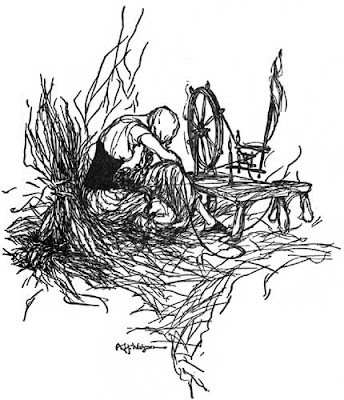
Rumpelstiltskin Illustration: A H Watson
I’ll bet what I am writing is not making much Sense and I should probably try to sleep. It’s 3 a.m. and the aftermath of this waking dream is only going to add up to fog at work tomorrow.
i am a dervish
a thaumaturge
i spin very fast
bore downwards
pour stuff out of the top of me churned rich like butter as i whirl
why do i spin so?
see
the thing about spinning
is that it is an oscillation between opposites that generates the movement
it’s how motors work
it’s how hard drives work
it’s how atoms work
the spin is ambi-valence made physical
attracted/repulsed/attracted/repulsed
so i am always moving fast yet can seem to be going nowhere
in my indecision, in the swinging tension between irreconcilable polar opposites
i can actually drill down deeper
because i am always spinning, seeing both sides almost, but not quite,
simultaneously
it’s impossible to see both sides simultaneously
but the quicker you are at seeing multiple perspectives
eddying off on fractal tangents
the faster you spin
(and the dizzier it can make you and others)
how do you solve a problem like maria?
i am not moving linearly
not climbing a ladder
it does not mean i am unproductive
it does not mean i am trapped
the hum is just my motor running at a higher frequency than the
general populace
a powerful magnet
drawing stuff in constantly
flipping it over and over
360 degrees of perspective, 365 days a year
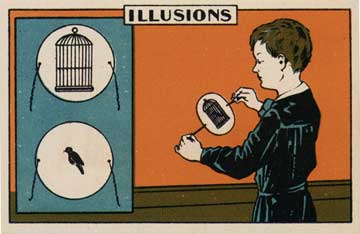
a thaumatrope
it’s a funny thing
i can actually spin, physically, round and round for ages and not get dizzy
i think this is how i manage to get through life, mentally
i am mostly able to tune out the vertigo
i have learned
others can’t
they can’t take how fast i am going all the time
the spinning keeps me upright
in perpetual motion but never able to choose only one definite course
drawing straws
in perfect tension
twirling thread
spinning gold
activates
sigils
semiotics
polarity
magnetism
solenoids
speakers
the speed of sound
affects aerodynamics
flow
determinism and chaos
it’s all connected
all ways
in the dance of particles
Chapter III. From Recollection to Dreams: Third Commentary on Bergson
3b: From the Optical and Sound Image to the Dream-Image
[regarding the dreamer’s dream:]
The virtual image which becomes actual does not do so directly, but becomes actual in a different image, which itself plays the role of virtual image being actualized in a third, and so on to infinity: The dream is not a metaphor but a series of anamorphoses which sketch out a very large circuit. [….] When the sleeper is given over to the actual luminous sensation of a green surface broken by white patches, the dreamer who lives in the sleeper may evoke the image of a meadow dotted with flowers, but this image is only actualized by already becoming the image of a billiard table furnished with balls, which in turn does not become actual without becoming something else. These are not metaphors, but a becoming which can by right continue to infinity.
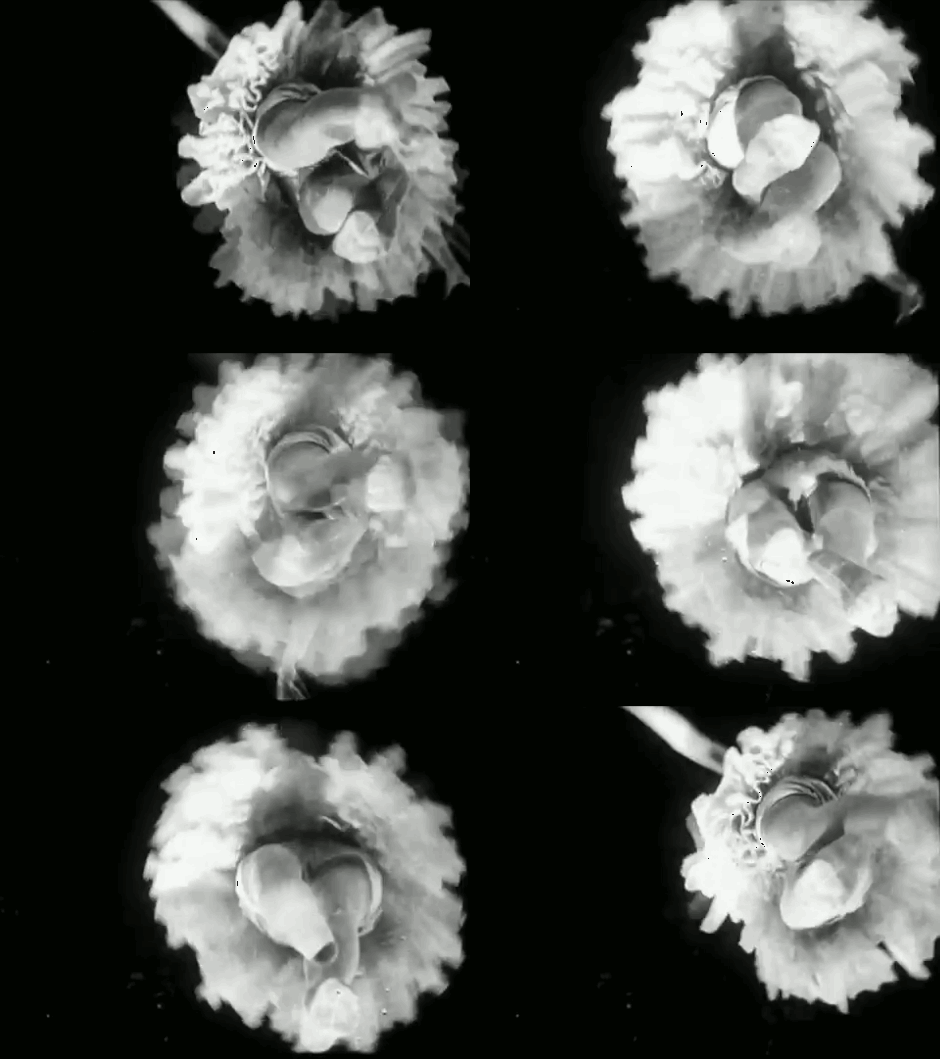
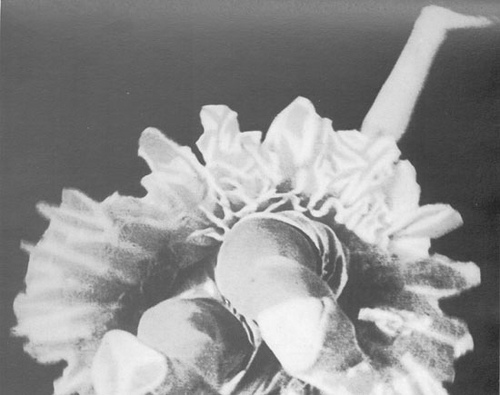
In René Clair’s Entr’acte, the dancer’s tutu seen from beneath ‘spreads out like a flower’, and the flower ‘opens and closes its corolla, enlarges its petals, and lengthens its stamens’, to turn back into the opening legs of a dancer; the city lights become a ‘pile of lighted cigarettes’ in the hair of a man playing chess, cigarettes which in turn become the columns of a Greek temple, then a silo, whilst the chessboard becomes transparent to give a view of the Place de la Concorde.’
Gilles Deleuze, in Cinema 2, 1989: 54c-55, quoting Jean Mitry.
Relâche, ballet instantanéiste en deux actes: un entr’acte cinématographique, et “la queque de chien” is a 1924 ballet by Francis Picabia with music composed by Erik Satie. The title was thought to be a Dadaist practical joke, as relâche is the French word used on posters to indicate that a show is cancelled, or the theatre is closed (and the first performance was indeed cancelled, due to the illness of Jean Börlin, the principal dancer, choreographer, and artistic director of the Ballets Suédois).
Still from “Entr’acte”
Picabia commissioned filmmaker René Clair to create a cinematic entr’acte to be shown during the ballet’s intermission. The film, simply titled Entr’acte, consists of a scene shown before the ballet and a longer piece between the acts. The score was also composed by Satie.
Entr’acte premiered as an entr’acte for the Ballets Suédois production Relâche at the Théâtre des Champs-Élysées in Paris in 1924. The Dadaists collaborating on the project invented a new mode of production: instantanéisme. Watching the 20 minute film involves seeing people running in slow motion, things happening in reverse, looking at a ballet dancer from underneath, watching an egg over a fountain of water get shot and instantly become a bird, and watching people disappear. The cast included cameo appearances by Francis Picabia, Erik Satie, Man Ray, and Marcel Duchamp. The conductor of the orchestra at the premiere was Roger Désormière. The edition of the soundtrack featured here was conducted in 1967 by Henri Sauguet.
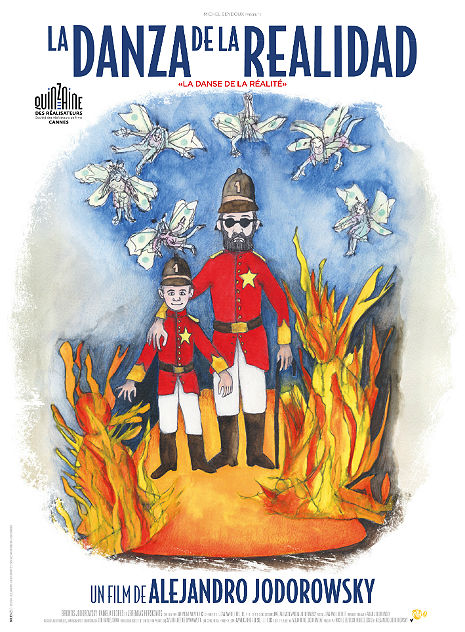
The extinct volcano of underground cinema has burst into life once again — with a bizarre, chaotic and startling film; there are some longueurs and gimmicks, but The Dance of Reality is an unexpectedly touching and personal work. At the age of 84, and over 20 years since his last movie, Alejandro Jodorowsky has returned to his hometown of Tocopilla in the Chilean desert to create a kind of magic-realist memoir of his father, Jaime Jodorowsky, a fierce Communist whose anger at the world — at his son — was redoubled by the anti-Semitism the family faced.
Of course, the entire story is swathed in surreal mythology, dream logic and instant day-glo legend, resembling Fellini, Tod Browning, Emir Kusturica, and many more. You can’t be sure how to extract conventional autobiography from this. Despite the title, there is more “dance” than “reality” — and that is the point. Or part of the point. For the first time, Jodorowsky is coming close to telling us how personal evasiveness has governed his film-making style; his flights of fancy are flights of pain, flights from childhood and flights from reality. And now he is using his transformative style to come to terms with and change the past and to confer on his father some of the heroism that he never attained in real life.
Sadly, this is a far more profound symbolic critique of Roman Catholic oppression than anything FEMEN is ever likely to pull off (notwithstanding their tops)! L’Age d’or or The Golden Age (1930), directed by Luis Buñuel, a French surrealist comedy, and one of the first films with synchronous sound ever made in France, was about the insanities of modern life, the hypocrisy of the sexual mores of bourgeois society and the value system of the Roman Catholic Church. Salvador Dalí and Buñuel wrote the screenplay together.
The BBC called it “an exhilarating, irrational masterpiece of censor-baiting chutzpah.”
Read more about the political project of surrealism HERE. Watch the film (in the original French) HERE – turn on the Youtube captions for English subtitles.
Regarding the response of the establishment to the film, from Wikipedia:
Upon receiving a cinematic exhibition permit from the Board of Censors, L’Âge d’or had its premiere presentation at Studio 28, Paris, on 29 November 1930. Later, on 3 December 1930, the great popular success of the film provoked attacks by the right-wing Ligue des Patriotes (League of Patriots), whose angry viewers took umbrage at the story told by Buñuel and Dalí. The reactionary French Patriots interrupted the screening by throwing ink at the cinema screen and assaulting viewers who opposed them; they then went to the lobby and destroyed art works by Dalí, Joan Miró, Man Ray, Yves Tanguy, and others. On 10 December 1930, the Prefect of Police of Paris, Jean Chiappe, arranged to have the film banned from further public exhibition after the Board of Censors re-reviewed the film.
A contemporary right-wing Spanish newspaper published a condemnation of the film and of Buñuel and Dalí, which described the content of the film as “…the most repulsive corruption of our age … the new poison which Judaism, Masonry, and rabid, revolutionary sectarianism want to use in order to corrupt the people”. In response, the de Noailles family withdrew L’Âge d’or from commercial distribution and public exhibition for more than forty years; nonetheless, three years later, in 1933, the film was privately exhibited at the Museum of Modern Art, in New York City. Forty-nine years later, from 1-15 November 1979, the film had its legal U.S. premiere at the Roxie Cinema in San Francisco.
The film critic Robert Short said that the scalp-decorated crucifix and the scenes of socially repressive violence, wherein the love-struck protagonist is manhandled by two men, indicate that the social and psychological repression of the libido and of romantic passion and emotion, by the sexual mores of bourgeois society and by the value system of the Roman Catholic Church, breed violence in the relations among people, and violence by men against women. The opening sequence of the film alludes to that interpretation, by Dalí and Buñuel, with an excerpt from a natural science film about the scorpion, which is a predatory arthropod whose tail is composed of five prismatic articulations that culminate in a stinger with which it injects venom to the prey. Film critic Ado Kyrou said that the five vignettes in the tale of L’Âge d’Or correspond to the five sections of the tail of the scorpion.
Judi Dench and Brendan O’Hea perform “Sixteen Going On Seventeen” from The Sound of Music at the London gala event, “Some Enchanted Evening: Richard Rogers”, held on May 12, 2002.
Thanks to Erica Lombard for putting me in stitches with this.
End fight scene from Jackie Chan’s 1978 breakthrough. Craziest foley and 70s soundtrack: As well as original music by Chou Fu-liang, the original version of the film features Jean Michel Jarre’s “Oxygène (Part 2)” and Space’s “Magic Fly”. Like many Hong Kong movies of the era, it also includes samples from western movie scores, including A Fistful Of Dollars, You Only Live Twice, The Spy Who Loved Me, and even the Death Star explosion moment from Star Wars. The English subtitles over (different) English dubbing are great, too.
The full movie is on Youtube, HERE, but if you’re in South Africa, like me, you won’t be able to watch it due to copyright nonsense.
Shintaro Kago 駕籠 真太郎) born 1969 in Tokyo, is a Japanese guro manga artist. He made his debut in in the magazine COMIC BOX, in 1988.
Shintaro Kago’s style has been called “fashionable paranoia”. He has been published in several adult manga magazines, gaining him considerable popularity. Many of his manga have strongly satirical overtones, and deal with grotesque subjects. He has also written Sci-Fi non-guro manga, most notably Super-Conductive Brains Parataxis (超伝脳パラタクシス Choutennou Paratakushisu) for Weekly Young Jump. Many of his shorts are experimental and bizarre. He frequently breaks the fourth wall, and he likes to play with page layout in extreme ways, mostly for comedic effect.
Herr Bargeld <3 <3 <3 makes a soundtrack for autobahn drive time radio, using only his voice and a looper (and some funny, funny patter) in this performance from 2006.
That is the motto of the group Passing Stones, which is also referred to as “the most offensive musician’s group of the 20th century.” or “The MOMsGOT20THC”.
[ ] are to be eaten, to be chewed with molars as if one does not have incisors. [ ] should be popped into the mouth, to bounce off the palate and land between ready mincers. [ ] ought to be chewed like cashews, until all there is, is a messy mushy pulp that’s easy to swallow. [ ] are not a fruit. there are no [ ] trees or shrubs. [ ] do not grow like creepers, scaling walls and throttling other species in a race for the sun.
one can cook [ ] although it has not been established whether or not [ ] are raw or ready. [ ] might not even be plant life for this too has not been established. [ ] might after-all be a hibernating species of some animal too timid to uncurl in our hands. wait, do [ ] fit into ones palm? are [ ] not bigger in size?
[ ] might be better for building things like cars and homes and scooters. [ ] might even be better suited to pulling boogers from hairy nostrils. [ ] are to be examined by a highly skilled childless task force made up, in equal parts, of scientists, soldiers, sunday school teachers and salmon farmers. [ ] might after all be bombs and it would make better sense to have them detonate in the hands of these lunatics. no?
but [ ] are to be eaten i am sure.
——- ———- ———-
what [ ] are you talking about?
[ ] are orange/blue, this is the first clue. in a quite suburb, north of carmarthenshire, [ ] have been reported to be quite the nuisance. residents are in disagreement as to how it is that [ ] are causing the reported nuisance. some home owners claim to hear [ ] wailing clear and true into the night, others claim [ ] run amok in the streets, up turning bins and smashing in store fronts, some seniors have even reported [ ] claims of sexual harassment from [ ], especially when they try to cross the road close to busy intersections.
the mayoral spokesperson for the district of bin has issued a statement that all allegations made against [ ] will be treated with the highest priority. The municipality remains confused however by how it is that [ ] could execute half the crimes laid against [ ].
‘it is known that [ ] have not the legs, mouths or arms to throw things, scream or grope the elderly. that littler still is understood of [ ] makes these cases harder to prosecute. are [ ] not a single body? are [ ] more like us the more we know them or less so?’
[ ] are to be left in the bogs, of this i am sure.
In Alice, a little girl follows a white rabbit into a world where nothing is quite what it seems. Where Czech surrealist Švankmajer’s Alice differs from other adaptations of Lewis Carroll’s Alice in Wonderland is that it explores the book’s darker side as well, thereby remaining faithful to the tone of uneasy confusion that pervades the original story. A live-action Alice (Kristyna Kohoutova) inhabits a Wonderland that teems with threatening stop-motion characters. Švankmajer’s visual canniness and piercing psychological insight permeate the film with a menacing dream-logic. Curiouser and curiouser.
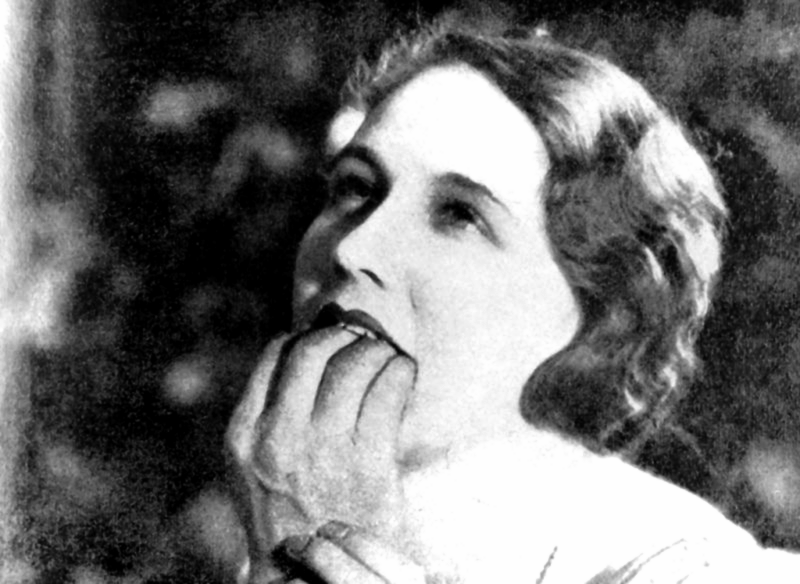
W. W. Young’s 1915 film of Lewis Carroll’s Alice in Wonderland. Starring Viola Savoy as Alice. Produced by The American Film Manufacturing Company (Flying A Studios) and released on 19 January 1915.
Directed by two of the founders of British cinema, Cecil Hepworth and Percy Stow, its original running time of twelve minutes made the first cinematic adaptation of Lewis Carroll’s literary classic the longest running British film to date.The one remaining print has been restored by the BFI, and here it is, courtesy of Youtube.
Alice in Wonderland was clearly made for cinema goers who had already read the book, hence describing this version of Alice in Wonderland as a literary adaptation in the modern understanding of the term may be misleading (without prior knowledge of the books, deciphering the events of the film would be quite difficult). Given the film’s length, it would be better to describe it as a series of vignettes from the book. It is perhaps this aspect of the film’s organisation that gives it a peculiar and slightly disjointed feel.
It is memorable for its use of special effects, clearly inspired by the likes of Georges Méliès and the Lumière Brothers.
Despite the BFI’s best efforts, the original reel of Alice in Wonderland was damaged to such an extent that the deterioration is quite clearly visible on the restored print. This however, only heightens the dreamlike atmosphere of the film. Combined with the fact that the film is not a ‘conventional narrative’, Alice in Wonderland can be seen as a forerunner for the works of surrealist filmmakers such as René Clair, Luis Buñuel and Jean Cocteau.
This poetic, surrealistic and disturbing Swedish film – sometimes called a “black comedy” – written and directed by Roy Andersson, received a number of awards, including the Swedish Film Critics Award and the Special Jury Prize at the Cannes Film Festival. It makes use of many quotations from the work of the Peruvian poet César Vallejo. It’s like a multiple pile-up where Vallejo is crashed into by Beckett, tail-ended by Bergman… and Monty Python can’t slow down or swerve enough to avoid sandwiching them all together.
Reviewed by Anton Bitel:
“Everything has its day,” says the CEO Lennart (Bengt CW Carlsson), concealed (but for his bare feet) beneath a sunbed, to his flustered sub-manager Pelle (Torbjörn Fahlström) in the opening scene of Roy Andersson’s Songs From The Second Floor. “This is a new day and age, Pelle – you have to realise that.” Faced with the imminent collapse of his business empire and the mass unemployment that will inevitably result, this invisible mogul has already decided to take the money and run, contemplating a better life (or should that be afterlife?) abroad for himself in the future once he has put the past behind him. With blithe disregard for those that he is abandoning, he asks, “What’s the point of staying where there is only misery?” – and yet Andersson’s film offers a dystopian vision of the new millennium, where misery, pain, guilt and despair are the universal condition, where escape is impossible, and where, no matter how much anyone tries to turn their back on the past, somehow it always returns.
If everything has its day, the Songs From The Second Floor was certainly a long time in coming. Andersson first discovered the avant-garde Peruvian poet César Vallejo (19892-1938) back in 1965, and first read his poem Stumble Between Two Stars while working on his second feature Gilliap (1975). In the early Eighties he began preparations for a documentary feature based around the poem, before concluding that the material would be better served by the medium of fiction. So he established an independent film studio in 1981, and devoted the next 15 years of work (in short films and commercials) to inventing and honing an aesthetic style that would make his unique vision for this third feature possible. Production proper began in 1996, and lasted four long years – but the results were well worth the wait, and would indeed win the Swedish writer/director a slew of international awards.
The film is told in a series of stylised, hyperreal tableaux, unfolding in indifferent wideshot before an unmoving camera whose very distance helps convert all the tragedy of human experience on display into a very singular brand of dark comedy. Hence the mannered grey makeup worn by the performers – for while this may reflect their status as spiritual zombies lost to their own moral damnation, it is also the familiar mask of clowns, and all these characters are both the living dead and comic chumps. So it is that when, in one sequence, a stage magician (Lucio Vucina) accidentally saws into the belly of his hapless volunteer (Per Jörnelius), eliciting immediate cries of pain, we share the fictive audience’s initial instinct to laugh, even as we are horrified.
Some of the film’s episodes are self-contained vignettes, while others feature an ensemble of recurring characters in the orbit of Kalle (Lars Nordh). Having just torched his own furniture business, this corpulent, middle-aged salesman must deal with sceptical insurance adjusters and find a new outlet (viz. crucifixes) for his flagging spirit of entrepreneurship, even as a strong sense of guilt, both personal and collective, keeps creeping up on him.
Meanwhile Kalle’s eldest son, the poet Thomas (Peter Roth), suffers in silence in a mental institution, leaving his sensitive younger brother Stefan (Stefan Larsson) to pick up the pieces and hear the depressed confessions of passengers in his taxi cab. In the background of all this grief and anxiety, Andersson reveals a grimly absurd vista of societal breakdown, where acts of racist violence go unchecked, traffic jams go on forever, suited flagellants mortify themselves in the street, the dead walk among the (almost) living, panicking financiers resort to crystal balls, and a virgin is publicly sacrificed in a last-ditch effort to fend off not just economic ruin but the end of days.
“Beloved be the ones who sit down,” reads on-screen text near the beginning of Songs From The Second Floor, cited from Vallejo’s Stumble Between Two Stars – and it will recur, along with other lines from the poem, several times within the film itself. At first there might seem little room for poetry in Andersson’s nightmarish picture of a venal, gloomy and bleakly prosaic metropolis whose only poet, Thomas, whether driven mad by his work or by the world, has been reduced to inarticulate muteness.
And yet, like the ghosts of the dead that continue to haunt Kalle’s heavy conscience, or like the buried Nazi past of the superannuated general (Nils-Åke Olsson) that resurfaces in a torrent of Tourette’s-style outbursts (à la Dr Strangelove), poetry just keeps coming back. Even in a setting as banal as a commuter train, Andersson’s drab characters are apt to burst into choral song (magisterially scored by none other than ABBA’s Benny Andersson).
Much of the film’s poetic humanism derives from the word ‘beloved’ that forms a refrain in Vallejo’s poem. For while Andersson may offer up a monstrous parade of vices and vulnerabilities, he invites us to love his gallery of rogues precisely for the flaws that make them – and all of us – so human. A key, repeating image in the film is of different characters perched on the end of their beds, making each and every one of them “the ones who sit down” – but it is a phrase that rather pointedly describes any viewer as well, ensconced in cinema or on sofa. After all, Andersson’s story of frailty and folly is our story too – and at the end of the extraordinary 10-minute single take that closes Songs From The Second Floor, the look that Kalle gives straight to camera implicates us all in the film’s haunting return of the repressed.
Put simply, the everyday apocalypse envisaged in Songs From The Second Floor is a wonder to behold, an idiosyncratic humanist allegory without parallel in cinema – unless, of course, you include Andersson’s equally astonishing follow-up You, The Living (2007), with which it forms the first two parts of a projected trilogy on the “inadequacy of man”.
Directed and written by: Roy Andersson
Director of Photography: István Borbás, Jesper Klevenås
Music: Benny Andersson








 fleurmach