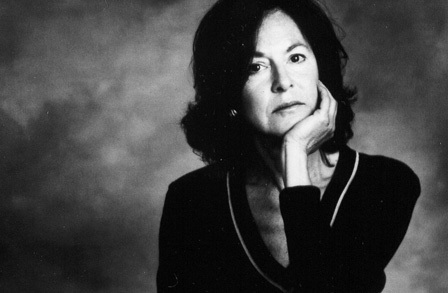
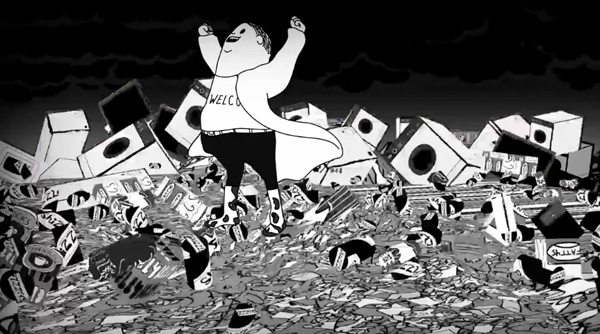
laurie anderson’s new film, “heart of a dog”

“And finally I saw it: the connection between love and death, and that the purpose of death is the release of love.”

laurie anderson heart of a dogHere is a review, and here is the trailer for Laurie Anderson’s new film, Heart of a Dog, which premiered in September. I really hope I get to see it somewhere on a big screen.

And Robert Christgau had this to say about the soundtrack:

The soundtrack to a film I missed is also Anderson’a simplest and finest album, accruing power and complexity as you relisten and relisten again: 75 minutes of sparsely but gorgeously and aptly orchestrated tales about a) her beloved rat terrier Lolabelle and b) the experience of death. There are few detours—even her old fascination with the surveillance state packs conceptual weight. Often she’s wry, but never is she satiric; occasionally she varies spoken word with singsong, but never is her voice distorted. She’s just telling us stories about life and death and what comes in the middle when you do them right, which is love.

There’s a lot of Buddhism, a lot of mom, a whole lot of Lolabelle, and no Lou Reed at all beyond a few casual “we”s. Only he’s there in all this love and death talk—you can feel him. And then suddenly the finale is all Lou, singing a rough, wise, abstruse song about the meaning of love that first appeared on his last great album, Ecstasy—a song that was dubious there yet is perfect here. One side of the CD insert is portraits of Lolabelle. But on the other side there’s a note: “dedicated to the magnificent spirit/of my husband, Lou Reed/1942-2013.” I know I should see the movie. But I bet it’d be an anticlimax. A PLUS

EDIT 6/11/15. And here’s a beautiful interview with Anderson about the film:

hélène cixous – castration or decapitation?

Hélène Cixous’ essay “Castration or Decapitation?” discusses the binary construction of sexuality and society, and how the feminine is defined by the negative: a woman is not a man because she lacks a penis. This “lack” keeps the female subject to definition by the male, as it is seen that because she is the “negative” pole to the man’s “positive”, the woman is concomitantly un-informed, and that therefore it is the position of the man to inform the woman. This imposed silence is what decapitates the feminine metaphorically, precluding her from speaking anything of meaning.

The following is an excerpt from this brilliant essay, translated by Annette Kuhn and published in Signs, Vol. 7, No. 1 (Autumn, 1981), pp. 41-55 (University of Chicago Press)  – read the full essay HERE.

 *   *   *   *   *

off with her head

… It’s hard to imagine a more perfect example of a particular relationship between two economies: a masculine economy and a feminine economy, in which the masculine is governed by a rule that keeps time with two beats, three beats, four beats, with pipe and drum, exactly as it should be. An order that works by inculcation, by education. It’s always a question of education: an education that consists of trying to make a soldier of the feminine by force, the force history keeps reserved for woman, the “capital” force that is effectively decapitation. Women have no choice other than to be decapitated. The moral is that if they don’t actually lose their heads by the sword, they only keep them on condition that they lose them – lose them, that is, to complete silence, turned into automatons.

It’s a question of submitting feminine disorder, its laughter, its inability to take the drumbeats seriously, to the threat of decapitation. If man operates under the threat of castration, if masculinity is culturally ordered by the castration complex, it might be said that the backlash, the return, on women of this castration anxiety is its displacement as decapitation, execution, of woman, as loss of her head.

We are led to pose the woman question to history in quite elementary forms like, “Where is she? Is there any such thing as woman?” At worst, many women wonder whether they even exist. They feel they don’t exist and wonder if there has ever been a place for them. I am speaking of woman’s place,from woman’s place, if she takes (a) place.

In La Jeune Née I made use of a story that seemed to me particularly expressive of woman’s place: the story of Sleeping Beauty. Woman, if you look for her, has a strong chance of always being found in one position: in bed. In bed and asleep-“laid (out).” She is always to be found on or in a bed: Sleeping Beauty is lifted from her bed by a man because, as we all know, women don’t wake up by themselves: man has to intervene, you understand. She is lifted up by the man who will lay her in her next bed so that she may be confined to bed ever after, just as the fairy tales say.

From Disney's

From Disney’s “Sleeping Beauty”

And so her trajectory is from bed to bed: one bed to another, where she can dream all the more. There are some extraordinary analyses by Kierkegaard on women’s “existence”- or that part of it set aside for her by culture-in which he says he sees her as sleeper. She sleeps, he says, and first love dreams her and then she dreams of love. From dream to dream, and always in second position. In some stories, though, she can be found standing up, but not for long.

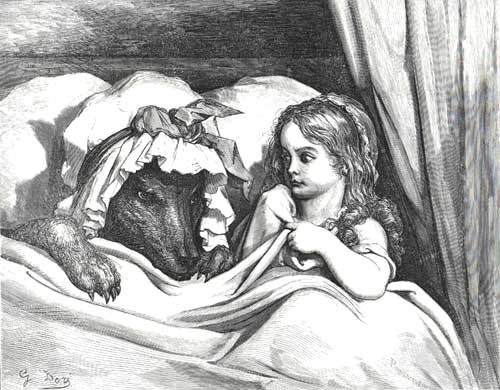
Take Little Red Riding Hood as an example: it will not, I imagine, be lost on you that the “red riding hood” in question is a little clitoris. Little Red Riding Hood basically gets up to some mischief: she’s the little female sex that tries to play a bit and sets out with her little pot of butter and her little jar of honey. What is interesting is that it’s her mother who gives them to her and sends her on an excursion that’s tempting precisely because it’s forbidden: Little Red Riding Hood leaves one house, mommy’s house, not to go out into the big wide world but to go from one house to another by the shortest route possible: to make haste, in other words, from the mother to the other.

The other in this case is grandmother, whom we might imagine as taking the place of the “Great Mother,” because there are great men but no great women: there are Grand-Mothers instead. And grandmothers are always wicked: she is the bad mother who always shuts the daughter in whenever the daughter might by chance want to live or take pleasure. So she’ll always be carrying her little pot of butter and her little jar of honey to grandmother, who is there as jealousy … the jealousy of the woman who can’t let her daughter go.

But in spite of all this Little Red Riding Hood makes her little detour, does what women should never do, travels through her own forest. She allows herself the forbidden … and pays dearly for it: she goes back to bed, in grandmother’s stomach. The Wolf is grandmother, and all women recognize the Big Bad Wolf! We know that always lying in wait for us somewhere in some big bed is a Big Bad Wolf.

Gustave Dore - The Disguised Wolf in Bed

Gustave Dore – The Disguised Wolf in Bed

The Big Bad Wolf represents, with his big teeth, his big eyes, and his grandmother’s looks, that great Superego that threatens all the little female red riding hoods who try to go out and explore their forest without the psychoanalyst’s permission. So, between two houses, between two beds, she is laid, ever caught in her chain of metaphors, metaphors that organize culture . . . ever her moon to the masculine sun, nature to culture, concavity to masculine convexity, matter to form, immobility/inertia to the march of progress, terrain trod by the masculine footstep, vessel… While man is obviously the active, the upright, the productive… and besides, that’s how it happens in History.

This opposition to woman cuts endlessly across all the oppositions that order culture. It’s the classic opposition, dualist and hierarchical. Man/Woman automatically means great/small, superior/inferior… means high or low, means Nature/History, means transformation/inertia. In fact, every theory of culture, every theory of society, the whole conglomeration of symbolic systems-everything, that is, that’s spoken, everything that’s organized as discourse, art, religion, the family, language, everything that seizes us, everything that acts on us – it is all ordered around hierarchical oppositions that come back to the man/ woman opposition, an opposition that can only be sustained by means of a difference posed by cultural discourse as “natural,” the difference between activity and passivity. It always works this way, and the opposition is founded in the couple [binary]. A couple posed in opposition, in tension, in conflict… a couple engaged in a kind of war in which death is always at work – and I keep emphasizing the importance of the opposition as couple, because all this isn’t just about one word; rather everything turns on the Word: everything is the Word and only the Word. To be aware of the couple, that it’s the couple that makes it all work, is also to point to the fact that it’s on the couple that we have to work if we are to deconstruct and transform culture. The couple as terrain, as space of cultural struggle, but also as terrain, as space demanding, insisting on, a complete transformation in the relation of one to the other. And so work still has to be done on the couple … on the question, for example, of what a completely different couple relationship would be like, what a love that was more than merely a cover for, a veil of, war would be like.

I said it turns on the Word: we must take culture at its word, as it takes us into its Word, into its tongue. You’ll understand why I think that no political reflection can dispense with reflection on language, with work on language. For as soon as we exist, we are born into language and language speaks (to) us, dictates its law, a law of death: it lays down its familial model, lays down its conjugal model, and even at the moment of uttering a sentence, admitting a notion of “being,” a question of being, an ontology, we are already seized by a certain kind of masculine desire, the desire that mobilizes philosophical discourse. As soon as the question “What is it?” is posed, from the moment a question is put, as soon as a reply is sought, we are already caught up in masculine interrogation. I say “masculine interrogation”: as we say so-and-so was interrogated by the police. And this interrogation precisely involves the work of signification: “What is it? Where is it?” A work of meaning, “This means that,” the predicative distribution that always at the same time orders the constitution of meaning. And while meaning is being constituted, it only gets constituted in a movement in which one of the terms of the couple is destroyed in favor of the other.

“Look for the lady,” as they say in the stories… “Cherchez la femme”– we always know that means: you’ll find her in bed. Another question that’s posed in History, rather a strange question, a typical male question, is: “What do women want?” The Freudian question, of course. In his work on desire, Freud asks somewhere, or rather doesn’t ask, leaves hanging in the air, the question “What do women want?” Let’s talk a bit about this desire and about why/how the question “What do women want?” gets put, how it’s both posed and left hanging in the air by philosophical discourse, by analytic discourse (analytic discourse being only one province of philosophical discourse), and how it is posed, let us say, by the Big Bad Wolf and the Grand-Mother.

“What does she want?” Little Red Riding Hood knew quite well what she wanted, but Freud’s question is not what it seems: it’s a rhetorical question. To pose the question “What do women want?” is to pose it already as answer, as from a man who isn’t expecting any answer, because the answer is “She wants nothing.” … “What does she want? … Nothing!” Nothing because she is passive. The only thing man can do is offer the question “What could she want, she who wants nothing?” Or in other words: “Without me, what could she want?”

Old Lacan takes up the slogan “What does she want?” when he says, “A woman cannot speak of her pleasure.” Most interesting! It’s all there, a woman cannot, is unable, hasn’t the power. Not to mention “speaking”: it’s exactly this that she’s forever deprived of. Unable to speak of pleasure = no pleasure, no desire: power, desire, speaking, pleasure, none of these is for woman. And as a quick reminder of how this works in theoretical discourse, one question: you are aware, of course, that for Freud/Lacan, woman is said to be “outside the Symbolic”: outside the Symbolic, that is outside language, the place of the Law, excluded from any possible relationship with culture and the cultural order. And she is outside the Symbolic because she lacks any relation to the phallus, because she does not enjoy what orders masculinity – the castration complex.

Woman does not have the advantage of the castration complex – it’s reserved solely for the little boy. The phallus, in Lacanian parlance also called the “transcendental signifier,” transcendental precisely as primary organizer of the structure of subjectivity, is what, for psychoanalysis, inscribes its effects, its effects of castration and resistance to castration and hence the very organization of language, as unconscious relations, and so it is the phallus that is said to constitute the a priori condition of all symbolic functioning. This has important implications as far as the body is concerned: the body is not sexed, does not recognize itself as, say, female or male without having gone through the castration complex.

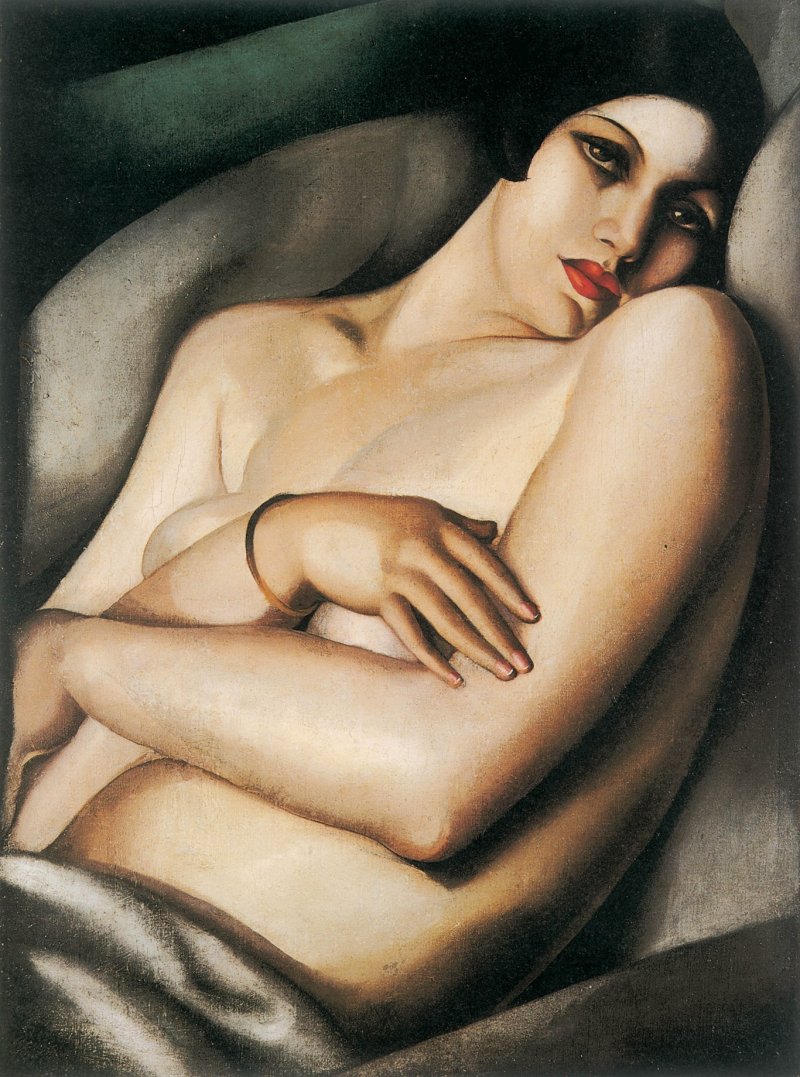
Tamara de Lapicka (1927)

Tamara de Lempicka – “Rafaela sur fond vert” (1927)

What psychoanalysis points to as defining woman is that she lacks lack. She lacks lack? Curious to put it in so contradictory, so extremely paradoxical, a manner: she lacks lack. To say she lacks lack is also, after all, to say she doesn’t miss lack … since she doesn’t miss the lack of lack. Yes, they say, but the point is “she lacks The Lack,” The Lack, lack of the Phallus. And so, supposedly, she misses the great lack, so that without man she would be indefinite, indefinable, nonsexed, unable to recognize herself: outside the Symbolic. But fortunately there is man: he who comes … Prince Charming. And it’s man who teaches woman (because man is always the Master as well), who teaches her to be aware of lack, to be aware of absence, aware of death. It’s man who will finally order woman, “set her to rights,” by teaching her that without man she could “misrecognize.” He will teach her the Law of the Father. Something of the order of: “Without me, without me-the Absolute-Father (the father is always that much more absolute the more he is improbable, dubious)-without me you wouldn’t exist, I’ll show you.” Without him she’d remain in a state of distressing and distressed undifferentiation, unbordered, unorganized, “unpoliced” by the phallus… incoherent, chaotic, and embedded in the Imaginary in her ignorance of the Law of the Signifier. Without him she would in all probability not be contained by the threat of death, might even, perhaps, believe herself eternal, immortal. Without him she would be deprived of sexuality. And it might be said that man works very actively to produce “his woman.” Take for example Marguerite Duras’  Le Ravissement de Lol V. Stein, and you will witness the moment when man can finally say “his” woman, “my” woman. It is that moment when he has taught her to be aware of Death. So man makes, he makes (up) his woman, not without being himself seized up and drawn into the dialectical movement that this sort of thing sets in play. We might say that the Absolute Woman, in culture, the woman who really represents femininity most effectively… who is closest to femininity as prey to masculinity, is actually the hysteric…. he makes her image for her!

The hysteric is a divine spirit that is always at the edge, the turning point, of making. She is one who does not make herself… she does not make herself but she does make the other. It is said that the hysteric “makes-believe” the father, plays the father, “makes-believe” the master. Plays, makes up, makes-believe: she makes-believe she is a woman, unmakes-believe too … plays at desire, plays the father… turns herself into him, unmakes him at the same time. Anyway, without the hysteric, there’s no father… without the hysteric, no master, no analyst, no analysis! She’s the unorganizable feminine construct, whose power of producing the other is a power that never returns to her. She is really a wellspring nourishing the other for eternity, yet not drawing back from the other … not recognizing herself in the images the other may or may not give her. She is given images that don’t belong to her, and she forces herself, as we’ve all done, to resemble them.

And so in the face of this person who lacks lack, who does not miss lack of lack, we have the construct that is infinitely easier to analyze, to put in place-manhood, flaunting its metaphors like banners through history. You know those metaphors: they are most effective. It’s always clearly a question of war, of battle. If there is no battle, it’s replaced by the stake of battle: strategy. Man is strategy, is reckoning . . . “how to win” with the least possible loss, at the lowest possible cost. Throughout literature masculine figures all say the same thing: “I’m reckoning” what to do to win. Take Don Juan and you have the whole masculine economy getting together to “give women just what it takes to keep them in bed” then swiftly taking back the investment, then reinvesting, etc., so that nothing ever gets given, everything gets taken back, while in the process the greatest possible dividend of pleasure is taken. Consumption without payment, of course.

chimamanda ngozi adichie – the danger of a single story

[W]hen I began to write, at about the age of seven, stories in pencil with crayon illustrations that my poor mother was obligated to read, I wrote exactly the kinds of stories I was reading: All my characters were white and blue-eyed, they played in the snow, they ate apples, and they talked a lot about the weather, how lovely it was that the sun had come out. Now, this despite the fact that I lived in Nigeria. I had never been outside Nigeria. We didn’t have snow, we ate mangoes, and we never talked about the weather, because there was no need to.

My characters also drank a lot of ginger beer, because the characters in the British books I read drank ginger beer. Never mind that I had no idea what ginger beer was. And for many years afterwards, I would have a desperate desire to taste ginger beer. But that is another story.

What this demonstrates, I think, is how impressionable and vulnerable we are in the face of a story, particularly as children. Because all I had read were books in which characters were foreign, I had become convinced that books by their very nature had to have foreigners in them and had to be about things with which I could not personally identify. Now, things changed when I discovered African books. There weren’t many of them available, and they weren’t quite as easy to find as the foreign books.

But because of writers like Chinua Achebe and Camara Laye, I went through a mental shift in my perception of literature. I realized that people like me, girls with skin the color of chocolate, whose kinky hair could not form ponytails, could also exist in literature. I started to write about things I recognized.

Now, I loved those American and British books I read. They stirred my imagination. They opened up new worlds for me. But the unintended consequence was that I did not know that people like me could exist in literature. So what the discovery of African writers did for me was this: It saved me from having a single story of what books are…

… If I had not grown up in Nigeria, and if all I knew about Africa were from popular images,I too would think that Africa was a place of beautiful landscapes, beautiful animals, and incomprehensible people, fighting senseless wars, dying of poverty and AIDS, unable to speak for themselves and waiting to be saved by a kind, white foreigner.

on colonial legacies and the violence of liberal whiteness at uct – april 2015

Here’s a thought piece I wrote for an MPhil African Studies class back in April, in the thick of the Rhodes Must Fall resistance. I want to put it here to archive it.

Problematising the Study Of Africa Assignment: 

On Colonial Legacies at the University of Cape Town


“Remember that you are an Englishman, and have consequently won first prize in the lottery of life.” — Cecil John Rhodes[1]

“[N]o matter what a white man does, the colour of his skin—his passport to privilege—will always put him miles ahead of the black man. Thus in the ultimate analysis no white person can escape being part of the oppressor camp.” —  Bantu Stephen Biko[2]

“For the black man there is only one destiny, and it is white.” — Frantz Fanon[3]

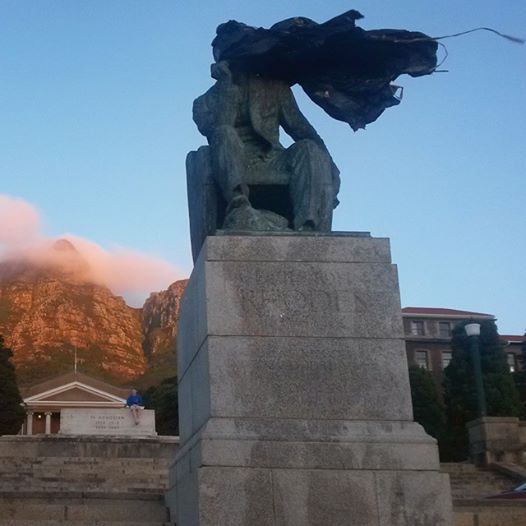
Rhodes statue, head covered in garbage bags. University of Cape Town, 17 March 2015. Photo: Rosemary Lombard

Rhodes statue, head covered in garbage bags. University of Cape Town, 17 March 2015. Photo: Rosemary Lombard

As a child, I remember reading about the railway Cecil John Rhodes envisioned from Cape Town to Cairo, and never imagining it in any light other than as a benevolent feat of engineering that would link people to others, bringing access to resources and the rest of the modern world for those cut off from Western civilisation, literally bringing light to the darkest parts of the continent.

I revised my romantic understanding of Rhodes’ expansionist desires as I became aware of the rampantly exploitative nature of these ambitions, and colonial mechanisms of dominion and exploitation more generally, but it was not until the recent events at UCT surrounding a statue of the man on campus that I realised the true psychological extent and durability of this oppressive colonial legacy, and the way its violence has been rendered almost invisible to those of us on the privileged side of what Walter Mignolo terms the “colonial difference” or divide[4].

The call for transformation is not new: it stretches back more than two decades. The present moment is notable in that students, staff and workers have organised powerfully in concert. A bucket of human excrement thrown on a statue of Rhodes that occupied a central position on UCT’s upper campus escalated tensions around institutional racism that have flared regularly since even before the formal end of the Apartheid era 21 years ago.  Black students formed a movement that became known as “Rhodes Must Fall” (RMF) after the social media hashtag they used to mobilise. The students occupied an administrative building for several weeks, in which they held intensive teach-ins and discussions around decolonisation in solidarity with the Students’ Representative Council (SRC), other students, academic staff and workers. University management eventually capitulated to the removal of the statue on 9 April 2015, after a month-long struggle in which RMF demanded to be engaged on their own terms, rather than allowing university management to dictate the terms or to dismiss the protest as had been the case on many previous occasions.

Richard Pithouse describes the mobilisation thus:

The students in Cape Town have, very rapidly, punched a gaping hole into the continuum of English liberal hegemony over the university, and a set of linked sites of a certain kind of elite power, and, thereby, a mode of white supremacy and coloniality that has not been subject to sufficient critique and opposition. It is an extraordinary political achievement that will, no doubt, inscribe itself into the history of the South African academy, and the wider society.[5]

At this historically significant moment, it is on white liberal hegemony and institutional transformation at UCT that I reflect: how has hegemonic whiteness been constructed at UCT, and how does the university continue to function as a colonial space, despite speaking about transformation?

I have made several false starts on this assignment (one of which has been losing an entire day’s work on it due to a computer glitch). Initially my idea was to write an open letter to university management, particularly the deputy Vice-Chancellor with the portfolio for transformation, Crain Soudien, whose public behaviour over the past weeks – both in his capacity as a member of university management[6] and in his written statements in the press – has seemed at odds with his historically professed radical stance against uninterrogated hegemony, and his advocacy of deep transformation as chair of the country-wide Ministerial inquiry into institutional racism just a few years ago[7]. Soudien, and other prominent black members of the corporate, academic establishment such as Jonathan Jansen, are interpellated[8] representatives of their institutions’ ideology, and any hint of activism they once displayed has evaporated.

However, I decided that I could not, in good conscience, from my position as an historical beneficiary of the untransformed system, write such a letter. So, dropping the academic apparatus as prompted by this assignment, I feel I have only enough authority to write from a personal, situated angle in attempt to contextualise the recent Rhodes Must Fall chain of events at UCT, with particular reference to the institution’s persisting coloniality. I cannot assume anything other than my own subject position, as a white, cisgender, heterosexual female, who comes from relative privilege. To do so would be disingenuous, as I have learned a trenchant lesson through listening to what students have been saying these past weeks: despite my best intentions and all the empathy I can muster, I cannot have knowledge of what it is to experience institutional racism.

As a “white” person, I have ancestrally been on the powerful side of the racial divide put in place with the advent of Western colonial activity, and I continue to be identified with that subject position. “Whiteness” is the term used to describe the position of privilege this subjectivity puts me and others like me in.

If there is one thing the Rhodes Must Fall moment has driven home to me, it’s that from my subject position I am unqualified to make authoritative pronouncements regarding the experiences or motives of anyone except myself, regardless of racial identity: it’s obvious that I can’t speak to “black” experience, but the most common “white” responses to RMF have largely made me feel alienated, too.

Two decades of rainbow nation narrative have led to the unreflexive “I don’t see colour” rhetoric becoming the status quo among liberal-thinking white South Africans, as well as black people assimilated to corporate institutional capitalist ideology. This is pernicious in that it obscures the very real, material persistence of different life experiences and oppression based on inherited structural inequalities, stemming from racial discrimination.

Coloniality, the set of dispositions, values and forms of practice set in place in the colonial world, outlives the moment of formal political decolonisation, and carries through beyond it in lasting ways. The white Western self speaks from the site of the universal, as a bearer of modernity and civilisation, situated dynamically inside of linear time and at home in a global, cosmopolitan world. All forms of knowledge produced by the Western self, in other words, are deemed to have universal, rational, historical currency.

In contrast, those selves and forms of knowledge encountered by the Western self that are deemed to be other than the Western self are deemed to be “local”, labelled “indigenous”. An indigenous self or indigenous knowledge is constituted as static, standing outside of history and linear time, and inside of tradition, which becomes the opposed category to modernity. Western, colonial knowledge is framed in binaries, in relation to Western supremacy: the privileged poles of these dyads are whiteness, maleness, heterosexuality, and so forth.

Manichean power relationships instituted on the basis of the colonial apparatus did not end with apartheid in 1994. They persist throughout social interactions, their oppressive dynamics all but invisible to those on the privileged side of such relationships, such as white people and males, due to the hegemonic nature of this framing.

A common criticism I saw levelled at black protesters by white commenters was that things changed with the coming of the democratic dispensation in 1994, and that they should stop “holding on to the past” or “playing the race card” with a “victim mentality”, that they should “move on”. But being cognisant of how the legacy of chronologically past events persists into the present is not the same as “holding on to” the past. Only those who are not experiencing the continuation of structural oppression every day can advocate ignoring or disregarding it, and “moving swiftly on”.

Western knowledge systems condition us not to admit any other perspective to the realm of validity. It thus takes concerted effort from white people to listen and not dismiss other points of view if they are to “click” and be able to acknowledge that the hegemonic “white” point of view is not the only, natural point of view. Recognition of the persisting inequality and oppression of black people generates a sense of discomfort and cognitive dissonance. I have realised through conversations with white people I know, as well as the comments I’ve read on social media, that most are unwilling (or perhaps intellectually unable?) to make this effort. Most who identify as liberal (“colour-blind”, non-racist) do not want to accept that they continue to benefit from this system at the expense of others, and display great defensiveness when confronted with the persistence of structural racism, and white complicity therewith.

The comments I have seen by white people who consider themselves liberal and “non-racial” (strenuously disavowing racism) against protesters have been telling – describing them as “uncivilised”, “uneducated”, “unreasonable”, “backward”, “barbarians”, “savages”, “childish”, “monkeys”: these epithets bear the distinctive, unreflexive tang of colonial binaries, binaries set up in implied counterpoint to the opposite values ostensibly possessed by the hallowed university. These colonial tropes have pervaded media, misrepresenting Rhodes Must Fall as an unthinking, destructive mob, when the reality is that the movement created, in a deliberate and considered way, an autonomous space which has surfaced deep pain, but also fostered constructive discussion and reimaginative work.[9]

Acts of physical protest occur when speech has failed, or is perceived to be inadequate. The act of flinging sewage at the statue of Rhodes went beyond talking, because talking was no longer believed to be a viable option for engaging. For dialogue to happen, there needs to be a willingness to listen communicated clearly. UCT, and whiteness more generally, has historically demonstrated itself to be dismissive, unprepared to engage black students’ and staff’s grievances about structural oppression. UCT even went so far as to criminalise protesters.

Steven Friedman remarks:

It is no accident that the protests are happening on the campuses of English-speaking “liberal” universities, which have long claimed to be victims of racism: it is precisely at those institutions that race is kept alive by denying it. Under apartheid, many English-speaking whites insisted that apartheid was created by Afrikaners alone. The “liberal” English-language universities joined in — they proclaimed their right to teach whatever and whomever they pleased, declaring that discrimination was imposed on them by the state. This smugness ignored the extent to which white English speakers in the professions and business profited from the denial of opportunities to others — and the degree to which they believed that blacks could win acceptance only if they adopted the values of whites. The universities ignored the reality that, when they were allowed to do as they pleased, they limited black student numbers and taught courses that assumed that every South African was white… This shows how deep-rooted the attitudes that underpinned apartheid are — and it points a finger at a form of liberalism that has washed its hands of racism while continuing to practise it…

When democracy arrived, the legal barriers tumbled; deep-rooted beliefs that whites are superior did not. The “liberal” universities now had the right to teach who and what they pleased: they used it to keep alive the racial pecking order in a “colour blind” guise… Whites remain largely in charge — but, because they are “liberal”, they always have a good “nonracial” reason for why this should be so.[10]

Hegemonic white power is not always subtle.  UCT management has an historical track record of overt institutional racism too. There are several junctures at which these issues have crystallised blatantly, and I will mention two:

In 1968, the accomplished black anthropologist, Archie Mafeje, was made an offer of employment by UCT, but this offer was rescinded under pressure from the Apartheid government, sparking protests. In 1991, the university again offered Mafeje a position. Although he had by that time, 23 years after the first offer, attained the rank of professor, it offered him only a senior lecturer post, still treating him as a junior academic. UCT apologised to Mafeje for this indignity after his death, naming a room in the Bremner building in his honour. It was no coincidence that this room was made the headquarters of Rhodes Must Fall when they occupied that building, renaming it “Azania House” in symbolic redress.

The so-called “Mamdani Affair” unfolded at UCT in 1996 when eminent Ugandan scholar Mahmood Mamdani, who at that point held the AC Jordan Chair in the Centre for African Studies, challenged the university to place African scholarship at the centre of the curriculum. He compiled a curriculum centred on African scholarship which was met with resistance from the all-white advisory committee, apparently because it did not reflect thinkers well-known enough to the committee – that is, it did not reproduce the established western canon of writing about Africa closely enough.  Via a manipulation of administrative processes, the curriculum Mamdani planned was rejected and replaced by one produced by the committee. He was suspended and left UCT soon afterwards for the United States. Nomalanga Mkhize charges that the affair “exposed the ignorance of many prominent, predominantly white South African scholars who, because of their racially privileged positions, had risen up the ranks without having to engage three decades of rigorous post-independence African scholarship.”[11]

Black students and academics are angry. Twenty years since the formal end of apartheid, they are still treated as second-class citizens on campus. Only a fraction of teaching staff are black[12], and the syllabus overwhelmingly represents the perspectives of white thinkers. Black thinkers continue to be marginalised. The disciplines are still, overwhelmingly, epistemologically “white”. Francis Nyamnjoh, writing in 2012, describes the insidious outcome of this:

In Africa, the colonial conquest of Africans – body, mind and soul – has led to real or attempted epistemicide – the decimation or near complete killing and replacement of endogenous epistemologies with the epistemological paradigm of the conqueror. The result has been education through schools and other formal institutions of learning in Africa largely as a process of making infinite concessions to the outside – mainly the western world. Such education has tended to emphasize mimicry over creativity, and the idea that little worth learning about, even by Africans, can come from Africa. It champions static dichotomies and boundedness of cultural worlds and knowledge systems. It privileges teleology and analogy over creative negotiation by Africans of the multiple encounters, influences and perspectives evident throughout their continent. It thus impoverishes the complex realities of those it attracts or represses as students.[13]

A statement by UCT’s Student Representative Council, made at a meeting the day the statue was removed, echoes the points made above:

[T]he black folk’s problem is still chiefly the potency of whiteness. In the new democratic dispensation, we have only been concerned with the ‘rainbow nation’ rhetoric and singing kumbaya while our economy still reflects the same socio-economic disparities of the apartheid era. Democracy has granted a few blacks seats at the master’s table; the rest are still fighting over breadcrumbs falling off the table. And it is these few and mostly politically connected ‘privileged’ blacks who assist their white masters in maintaining the status quo.

Whites have not even begun to see blacks as equals and as being capable of thinking for themselves. They continually want to have a say in how we break the shackles of oppression administered and maintained by them. They cry foul as soon as blacks start organising and speaking for themselves. Deep down they understand that they stand to lose their privileges. The white liberal has continued to play a rather peculiar role in the oppression of the black masses, his racist and conservative ways continue to be shielded in his subtle and ‘angelic’ approach. It is the white liberal who is at the forefront of spreading the gospel of integration and a peaceful society. White liberals point towards white conservatives as the problem, and they have convinced themselves that they have arrived at enlightenment pertaining to the sins committed by their forefathers. Yet subconsciously they share the same set of values and desire to protect their privileges.

The ideology and culture of formerly ‘whites only’ spaces has still not changed. What has taken place is that blacks can now access those spaces of learning and living in order to immerse themselves in a western culture. Thus, for the blacks to enjoy the benefits of accessing those places they have to integrate into whiteness. Our integration is nothing but black people assimilating to what is still regarded as righteous, ordained, intelligent, beautiful and angelic whiteness.[14]

Richard Pithouse comments, with hope:

Liberalism has always been fundamentally tied up with the poisonous fantasy of its barbarian other. In 1859 John Stuart Mill, the great philosopher of English liberalism, declared, in his famous essay On Liberty, that “Despotism is a legitimate mode of dealing with barbarians”. The essential logic of actually existing liberalism – freedom for some, despotism for others – was never merely, as they say, academic. In 1887 Rhodes, speaking in parliament in Cape Town echoed these sentiments when he declared that: “we must adopt a system of despotism in our relations with the barbarians of South Africa”.

Yet in 2015, in a society still fundamentally shaped by the historical weight of this idea of freedom for some and despotism for others, a text book for first year politics students, written and prescribed in South African universities, a text book in which not a single African person is presented as a thinker worthy of study, declares that “Most discussions of freedom begin with John Stuart Mill’s On Liberty”.

This sort of academic consensus, which seemed entrenched a few weeks ago, no longer seems to have much of a future. The students have made an intervention of real weight and consequence.

In addressing the necessity of curricular transformation, Harry Garuba writes about the need for a “contrapuntal pedagogy that brings the knowledge of the marginalised to bear on our teaching… The Cecil John Rhodes statue at the centre of the upper campus of UCT may have been physically removed, but what we now need to move is the hegemonic gaze of the Rhodes that is lodged in our ways of thinking… our professional practices as teachers, academics, scholars and students. We need to take a critical look at our everyday routines… In short, we need to remove the Rhodes that lives in our disciplines and the curricula that underpin them.”[15]

Stories about the past do not only tell us where we come from. They also tell us where we belong and where we should be headed: they influence how we understand our present and imagine our future. Statues and memorials intentionally inscribe in space particular stories, effectively fixing in stone a version of the past chosen by those in power.

The spatial symbolic order at UCT is hard evidence of the university’s lack of transformation.  The university, stretched across the lower slopes of Devil’s Peak, is a carefully curated memorial landscape that concretises colonial ideologies of power and knowledge: a site of prospect, and temple of rarefied knowledge on the hill. Moving through this space as individuals, we are forced to conduct a conversation with these imperial ideas: they exert their influence on us tangibly, directing our attention. Little has been changed about symbolism on the campus in the past twenty years, save for the additive naming of a few buildings and spaces after black icons: Steve Biko Student’s Union,  Cissy Gool Plaza, Madiba Circle.

Dependent on one’s subject position, the power exerted by such spatial and ideological configurations feels more or less oppressive. As white people, we may not give much thought to whether we feel at home or belong in the landscape. Black people, on the contrary, constantly confronted by representations of white triumph at the expense of black lives, feel alienated and suffocated. SRC Chair Ramabina Mohapa said at the 16 March meeting convened by UCT management on Heritage Signage and Symbolism, before walking out with most of the student body present, that black students “can no longer breathe”.[16]

As already discussed, colonial dispositions are not easily apprehended or altered, because they remain hegemonic in wider society, rendering them invisible to those who fall on the privileged side of the colonial divide between those privileged and those not privileged.

However, moments in which the symbolic order is ruptured, like the toppling of the Rhodes statue, provide rare opportunities where the usually obscured hegemony becomes plainly apparent. It is at catalytic moments such as these that spacetime is malleable: contrapuntal conversations become possible, competing epistemologies thinkable; candid self-examination and interventions, too. Perhaps substantive transformation happens more effectively in sudden shifts than gradually.

I would like to close with a trio of comments that I gleaned from my Facebook feed on 10 April 2015, the day after Rhodes’ statue was removed.

We stop mistaking Rhodes for a good white person and we stop believing in white supremacy because everywhere you look you see white people’s statues – it’s almost as though there was no one here when they arrived and they just happened to discover the gold (which, coincidentally, was discovered by a black man). When the statues are gone, we can start asking the important questions like why are there 110 white male South African professors and not a single black female South African professor at UCT – South Africa’s most prestigious university. And questions like why is the curriculum at these universities so Eurocentric in its outlook with scant reflection on Africa and her rich history and her bright future. Without these statues and the prestige and honour bestowed on the founding fathers of white supremacy, the leaders of these institutions will have no choice but to answer those questions truthfully and reflect on those answers. Further, removing these reminders of the fallacy of white supremacy leaves space for black excellence to flourish without having to use the white gaze and its tools of measurement to validate itself.

– Fumbatha May

Watched Rhodes fall last night. I’ve never experienced such an atmosphere of happiness and liberation at UCT – particularly when the students refused to let the old bastard go gracefully but crowned him with a bucket of paint as he rode off into the sunset of empire. For the past few weeks, the students have been teaching the university its most important lesson in decades, and will continue to do so for a long time to come. At last, being at UCT is beginning to feel like being at a real university.

– Carlo Germeshuys

Driving home from work passed the plinth where Rhodes stood. It has a tag sprayed on the neat wood box that is covering the base: ‘C.J. WAS HERE ~>’ There is a black girl in a blue dress leaning up on it, smiling broadly as she chats to a white guy in green shorts who is sitting on the edge of it, swinging his legs as he rummages for something in his bookbag beside him. I swear there is a lighter feeling seeing that figure gone! An invitation to a new conversation.

– Debbie Pryor

These comments convey the general mood on campus well: there is a sense of hope and determination that the symbolic fall of Rhodes’ statue will be followed by deep institutional transformation, sentiments I share.

__

REFERENCES

Africa Network Expert Panel.  2014. Why are there so few black professors in South Africa? The Guardian Africa, 6 October 2014. http://www.theguardian.com/world/2014/oct/06/south-africa-race-black-professors

Althusser, L. 1971. “Ideology and Ideological State Apparatuses (Notes towards an Investigation)”. Lenin and Philosophy and Other Essays. Verso.

Biko, S. 1988. I Write What I Like. London: Heinemann.

Friedman, S. 2015. “The racial denialism of South African liberals”. Rand Daily Mail. 1 April 2015. http://www.rdm.co.za/politics/2015/04/01/the-racial-denialism-of-south-african-liberals

Garuba, H. 2015. “What is an African curriculum?” Mail and Guardian, 17 April 2015 00:00. http://mg.co.za/article/2015-04-17-what-is-an-african-curriculum

Goodrich, A. 2015. “Statue controversies in South Africa – reimagine/recontextualise/replace” April 15, 2015. http://www.syntheticzero.net/2015/04/15/statue-controversies-in-south-africa-reimaginerecontextualisereplace/

Majavu, M. 2015. “Uct and Rhodes: Removing Statues, Dismantling Colonial Legacies”. Equal Times, 30 March 2015. http://www.equaltimes.org/uct-and-rhodes-removing-statues?lang=en#.VTUs9tyUd8E

Mangcu, X. 2015. Danger of ‘rationalist conceit’ in Cape Times, March 25 2015 at 01:52pm. http://www.iol.co.za/capetimes/danger-of-rationalist-conceit-1.1836933

Mangcu, X. 2015. “Assault on idea of academic freedom”. Cape Times,April 14 2015 at 01:44pm. http://www.iol.co.za/capetimes/assault-on-idea-of-academic-freedom-1.1844918.

Mignolo, W. 2002. “The Geopolitics of Knowledge and the Colonial Difference”. The South Atlantic Quarterly 101.1 (2002) 57-96. Duke University Press.

Mkhize, N. 2015. “Anger over Rhodes vindicates Mamdani”. Business Day, 7 April 2015. http://www.bdlive.co.za/opinion/columnists/2015/04/07/anger-over-rhodes-vindicates-mamdani

Moodie, A. 2010.”The Soudien Report: Deny racism at your peril”25 April 2010. University World News, Issue No:121. http://www.universityworldnews.com/article.php?story=20100424200305969

Mudimbe, V. 1988. The Invention of Africa: Gnosis, Philosophy and the Order of Knowledge. London: James Curry.

Muller, S. 2014. “Transformation is not UCT’s priority”. Mail and Guardian 21 November 2014. http://mg.co.za/article/2014-11-21-transformation-is-not-ucts-priority

Nyamnjoh, F. 2012. “’Potted Plants in Greenhouses’: A Critical Reflection on the Resilience of Colonial Education in Africa”. Journal of Asian and African Studies. February 15, 2012. doi: 10.1177/0021909611417240.

O’Connell, S & Himmelman, N. 2011.  “Lessons in continued oppression: UCT’s conception of post-apartheid freedom sets the bar too low”. https://concernedcasstudents.wordpress.com/2011/05/15/lessons-in-continued-oppression-ucts-conception-of-post-apartheid-freedom-sets-the-bar-too-low/

Pithouse, R. 2015. “South Africa in the Twilight of Liberalism”. Kafila, 19 April 2015. http://kafila.org/2015/04/19/south-africa-in-the-twilight-of-liberalism-richard-pithouse/

Soudien et al. 2008. Report of the Ministerial Committee on Transformation and Social Cohesion and the Elimination of Discrimination in Public Higher Education Institutions. 30 November 2008

Soudien, C. 2015 “UCT stands devoted to debate”. Cape Times, April 14 2015 at 12:43pm. http://www.iol.co.za/capetimes/uct-stands-devoted-to-debate-1.1844882

Wolpe, H. 1995. “The debate on university transformation in South Africa: The case of the University of the Western Cape.”  Comparative Education, 31(2): 275 – 292.

___

[1] Attributed in “The lottery of life”, The Independent, 5 May 2001.

[2] From I Write What I Like: Selected Writings by Steve Biko, 1969 – 1972. Heinemann, 1987.

[3] Introduction to Black Skin, White Masks. Translated by Charles Lam Markmann. New York: Grove Press, 1967.

[4] Mignolo, 2002.

[5] Pithouse, 2015.

[6] See, for example, Soudien’s handling of a walkout by the SRC and Rhodes Must Fall during a meeting at UCT on “Heritage, Signage and Symbolism”, 16 March 2015: https://www.youtube.com/watch?v=4NgpJ00M5Ho

[7] Compare Soudien et al 2008; Alison Moodie’s 2010 interview with Soudien, entitled “The Soudien Report: Deny racism at your peril” and the defensive tone of Soudien 2015.

[8] Althusser, 1971. Interpellation is the process by which the ideology of an institution constitutes individual subjects’ identities through the process of the institution and its discourses ‘hailing’ them in social interactions.

[9] I would like to state as an aside that I do not believe it is the place of beneficiaries of structural racism to offer opinions on how transformation would be best effected. I believe white people should make space to listen and take cues from those who are still being squashed by the non-transformation of the society we inhabit as to what to do. Those who encounter the problem have far more authority in this matter. This is difficult for some white people to grasp due to an ingrained sense of entitlement, and the way whiteness and white knowledge regimes still have hegemonic authority. Several have accused me of promoting self-censorship. It is very far from that. As a white person, to make space for black voices at this moment in the way I am advocating is not to disengage from the debate. It is an active decision to be quiet, to listen and reflect, an action based on a recognition that unless we with white voices behave differently, the status quo of the balance of representation being skewed in the favour of white voices will not change materially.

[10] Friedman, 2015.

[11] Mkhize, 2015.

[12] The number of white professors at UCT stands at about 87 per cent, whereas black professors make up only 4 per cent of the professorial complement (Majavu, 2015).

[13] Nyamnjoh, 2012: 129-130.

[14] UCT SRC statement delivered by Ramabina Mahapa on 9 April 2015. http://www.uct.ac.za/dailynews/?id=9096

[15] Garuba, 2015.

[16] A video of the proceedings can be found at https://www.youtube.com/watch?v=4NgpJ00M5Ho.
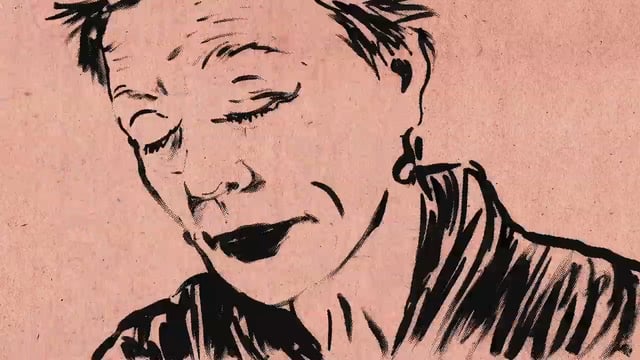
henk oosterling on science, myth, and deleuze and guattari’s dogon egg

Originally published in: “Oedipus and the Dogon: Myth of Modernity interrogated” in: H. Kimmerle (ed.). I, We and Body. Amsterdam 1989, p.27-45.

Dogon egg

Dogon egg

Let’s return to our initial question: does myth function in Western discourse and how does it function in this specific Western discourse that Capitalisme et Schizophrénie, in spite of all its radical intentions, still is? Is it an ideal that the writers want to revive and transform in order to solve specific Western problems? Is it the answer? Or is it only an illustration of another organisation of our desires that they propose? Is there any presciptive value, or do they offer it to the reader as a description that has an indirect critical function?

Well, whatever their intentions may be, to me it can’t be more than an aesthetic proposal for another body experience or an example of how actual and historical forces inhabit the individual body. In showing an articulation of the Other and opening up a space in which difference productively emerges, one is able to develop a critical instrument. As such, the Dogon myth can function as an actual figuration of that limit conception, that Artaud named the “body without organs”. As Deleuze and Guattari say themselves: the Dogon egg is a splendid theory of signs. It provides a theory of signification. But I think that, once we look at the Dogon society, we also become aware of hidden and condemned aspects of our own society, aspects we can’t see any more because of the apparent disappearance of the constitutive power of myth and religion.

This book reveals how desire is inscribed in the body in a cruel way and connected, by ignoring the mediating role of the family, immediately to the social field and history. It shows us a different meaning of time. The thinking of the Dogon is focused to the past, not the future, and completely unfamiliar with the idea of development and fulfilment in a near future. The time circle is oriented to the star Sirius which eclipses every sixty years, in which Dogon society revitalises itself. History, social planning and collective self-realisation find their essential expression in the Dogon egg. Its constituting power can open our eyes to the ritualizing functions of science in our modern educational and therapeutical practices, that can be recognized as rituals, in which science tries to fasten its grip on the body. Generally speaking it focuses our attention on the implicit mythological and ritualizing aspects of modern science.

I’m not sure whether I can draw this parallel, but perhaps we can recognize this tension in the recent discussion in Africa about the status of philosophy. On one side the oral traditions and the local systems of thought are emphasised as the original form of African philosophy, which is qualified as ‘ethnophilosophy’. On the other side, one tries to bring, by means of a theoretical instrumentation, these local stories onto a theoretical level. This discussion touches our issue because the relation between myth and science here also seems to be the main target. The critics of ethnophilosophy are aiming their attack on the irrational elements in the local systems of thought. The modernist tendency in African thinking would rather strip itself of these irrational elements.

In an article entitled Mythe et philosophie – Réponse à Elungu, Towa et autres, Irung Ishitambal’a Mulang(1) criticizes the radical division between these two points of view. In the English summary it is stated:

“The radical dichotomy between the rational and the mythopoeic is misleading, since philosophical thought, from presocratic to present times, is informed in no small measure by mythical elements. Not only have thinkers like Plato and Marx used forms of expression that properly belong to myth but, too, philosophers and philosophy as such can’t proceed without in some measure having recourse to these forms of expression.”

Here I would like to assert that in Western thought, in spite of the fact that we have tried to banish myth in a radical way from our conception of world and history, we involuntarily reintroduced it in a very peculiar way. In order to display this point to its full extent I refer to a discussion which has been initiated decennia ago by Adorno and Horkheimer in their Dialektik der Aufklärung. They state that the rational discourse of Enlightenment, which has become the dominating discourse in Western philosophy, has produced a new myth: the autonomous subject. Although modern philosophy flatters itself with the thought that it completely freed itself from the shackles of mythology and externally imposed authority in the form of religion, many 20th century philosophers have recognized the fact that, as in myth, Enlightenment gets trapped in mythology with each step it takes in order to enlarge the distance between itself and mythology.

In the beginning of the Enlightenment, myth seemed to be transformed into sheer objectivity: the project of the Encyclopedia tried to objectify religious and mythical phenomena and transform them into positive forms of knowledge. Further on, Kant grounded this knowledge in the transparency of the autonomous, self-reflexive subject. But, as Adorno and Horkheimer conclude, this subject, who thought he was the lord of creation and the driving force of history, became a myth himself. His urge to develop and to finalize, to objectify and dominate, has produced counterforces which he can no longer control.(2)

Adorno and Horkheimer come to the same conclusion as Mulang: myth and enlightenment are interrelated. Historically we can easily locate the perverted effects of the irrationality of the enlightened bourgeois society in our time: in fascism the lower middle class embraced a secularized myth. It used and destroyed democracy and autonomous subjectivity in favour of technological violence in order to physically destroy the Other: Jews, gypsies, communists and homosexuals. But in spite of its perversion it did not solely function in a negative way by providing a justification for racism, totalitarianism and genocide. Myth also offered to a completely destroyed community, as postwar Germany obviously was, a new identity and feeling of solidarity. It connected German society once more with ongoing historical events. In other words, the functions of myth were apparently still very active in this proclaimed rational society.

(1) Irung Ishitambal’a Mulang, “Mythe et philosophie: Réponse à Elungu, Towa et autres”. In:Quest, vol. 1 no. 1, 1987, p. 12.

(2) Max Horkheimer/Theodor W. Adorno, Dialektik der Aufklärung. Amsterdam 1947, p. 22.

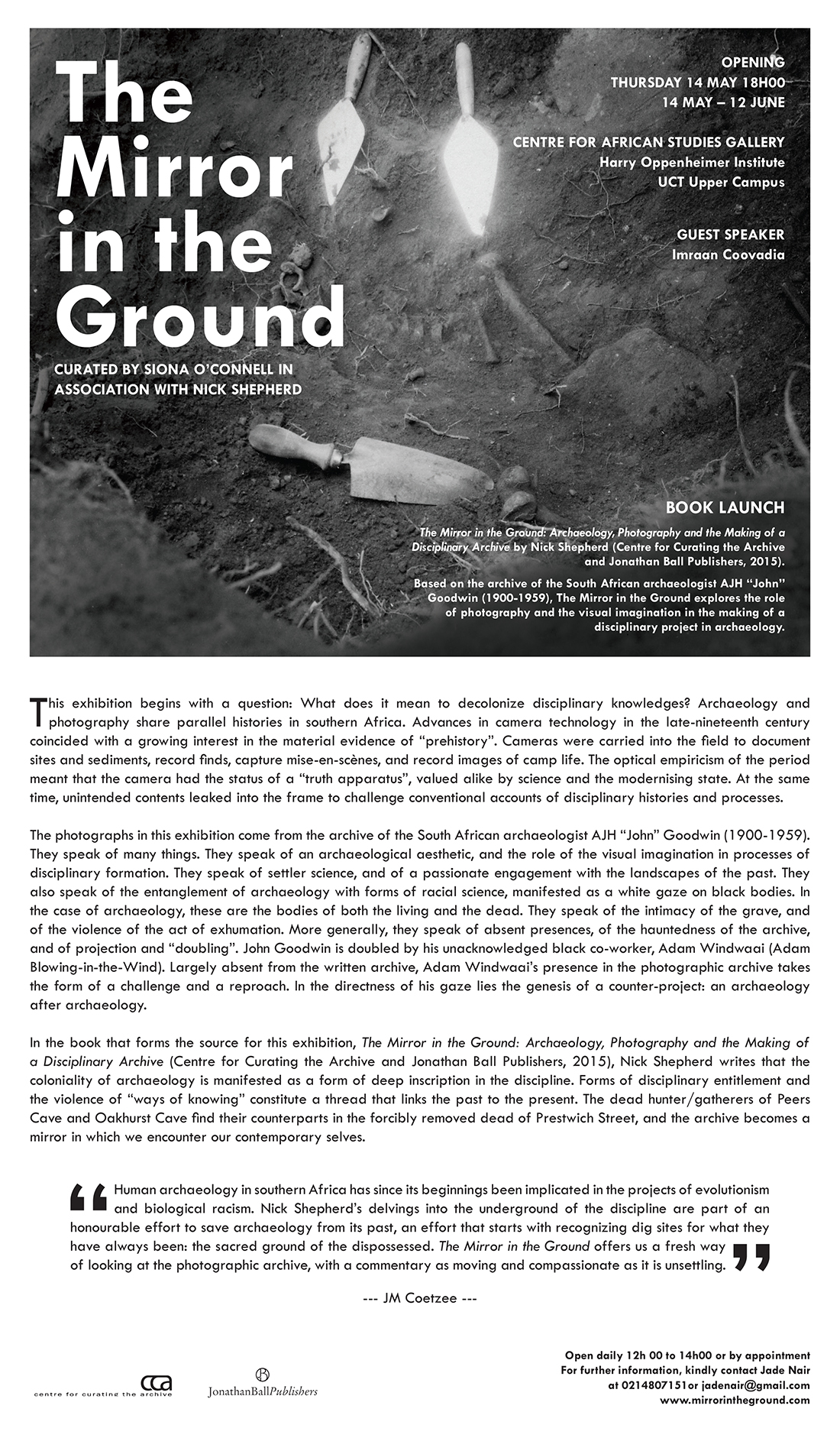
This excerpted from the essay published HERE.

deleuze and guattari and africa: southern responses

15-16 JULY, UCT, CAPE TOWN

A TWO DAY CONFERENCE ON PHILOSOPHERS GILLES DELEUZE AND FÉLIX GUATTARI
AND THEIR RELEVANCE FOR AFRICA, WITH KEYNOTE SPEAKERS
IAN BUCHANAN, ROSI BRAIDOTTI, PAUL PATTON AND CLAIRE COLEBROOK

Dogon egg

The egg, symbol of the Dogon people of Mali, used by Deleuze and Guattari as an example of the “body without organs”.

In recent years there has been a widespread surge of interest in the philosophy of Gilles Deleuze and Félix Guattari. Although Deleuze and Guattari studies is still in its infancy in South Africa, many of the themes that emerge from their individual and collaborative works – a politics of deterritorialisation, an ethics of becoming, a materialist ontology and so forth – hold great promise for thinking through and engaging with the complexities of contemporary South Africa and Africa more broadly, with pressing concerns around identity, geopolitics, culture, art, time, memory, autonomy, oppression and justice desperately calling for a bold, radical new praxis.

With the emphasis on Africa (but also keeping in mind what Deleuze says about the untimely), this conference aims to explore a wide range of topics related to the work of Deleuze and Guattari, showcasing local research and providing a supportive space for anyone interested in learning more about their compelling but difficult oeuvre, with all its lines of flight, war machines, virtual multiplicities, concrete assemblages and Bodies without Organs.

Go HERE for more info.

from simone weil’s notebooks

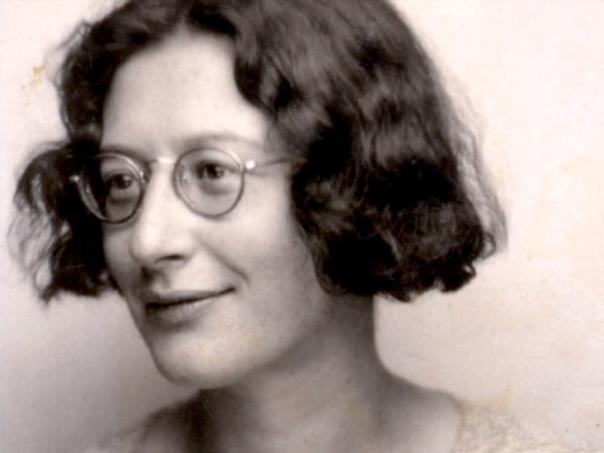
simone weilList of Temptations (to be read every morning):

Temptation of idleness (by far the strongest)
Never surrender to the flow of time. Never put off what you have decided to do.

Temptation of the inner life
Deal only with those difficulties which actually confront you. Allow yourself only those feelings which are actually called upon for effective use or else are required by thought for the sake of inspiration. Cut away ruthlessly everything that is imaginary in your feelings.

Temptation of self-immolation
Subordinate to external affairs and people everything that is subjective, but never the subject itself — i.e. your judgement. Never promise and never give to another more than you would demand from yourself if you were he.

Temptation to dominate

Temptation of perversity
Never react to an evil in such a way as to augment it.

Refuse to be an accomplice. Don’t lie — don’t keep your eyes shut…

__
Two internal obstacles to be overcome:

Cowardice before the flight of time (mania for putting things off — idleness…)

Illusion that time, of itself, will bring me courage and energy…. In fact, it is usually the contrary (sleepiness). Say to yourself: And suppose I should remain always what I am at this moment? … Never put something off indefinitely, but only to a definitely fixed time. Try to do this even when it is impossible (headaches…). Exercises: decide to do something, no matter what, and do it exactly at a certain time.

You live in a dream. You are waiting to begin to live….

__
One must develop a habit. Training.
Distinguish between the things I can put off, and those [I cannot].
Begin the training with small things, those for which inspiration is useless…

Every day, do 2 or 3 things of no interest at some definitely appointed time.

Reach the point where punctuality is automatic and effortless. — Lack of flexibility of imagination. An obstacle to be methodically overcome. The second screen between reality and yourself. Much more difficult. What is needed is something quite different from a methodical training… But precious.
__
From First and Last Notebooks.

tom stoppard on what being in love is about

It’s to do with knowing and being known. I remember how it stopped seeming odd that in biblical Greek, knowing was used for making love. Whosit knew so-and-so. Carnal knowledge. It’s what lovers trust each other with. Knowledge of each other, not of the flesh but through the flesh, knowledge of self, the real him, the real her, in extremis, the mask slipped from the face.

Every other version of oneself is on offer to the public. We share our vivacity, grief, sulks, anger, joy… we hand it out to anybody who happens to be standing around, to friends and family with a momentary sense of indecency perhaps, to strangers without hesitation. Our lovers share us with the passing trade. But in pairs we insist that we give ourselves to each other. What selves? What’s left? What else is there that hasn’t been dealt out like a deck of cards? Carnal knowledge. Personal, final, uncompromised.

Knowing, being known. I revere that. Having that is being rich, you can be generous about what’s shared — she walks, she talks, she laughs, she lends a sympathetic ear, she kicks off her shoes and dances on the tables, she’s everybody’s and it don’t mean a thing, let them eat cake; knowledge is something else, the undealt card, and while it’s held it makes you free-and-easy and nice to know, and when it’s gone everything is pain. Every single thing. Every object that meets the eye, a pencil, a tangerine, a travel poster. As if the physical world has been wired up to pass a current back to the part of your brain where imagination glows like a filament in a lobe no bigger than a torch bulb. Pain.

__
Found HERE.

louise glück on the unsaid

louise-gluckI am attracted to ellipsis, to the unsaid, to suggestion, to eloquent, deliberate silence. The unsaid, for me, exerts great power: often I wish an entire poem could be made in this vocabulary. It is analogous to the unseen for example, to the power of ruins, to works of art either damaged or incomplete. Such works inevitably allude to larger contexts; they haunt because they are not whole, though wholeness is implied: another time, a world in which they were whole, or were to have been whole, is implied. There is no moment in which their first home is felt to be the museum. …

… It seems to me that what is wanted, in art, is to harness the power of the unfinished. All earthly experience is partial. Not simply because it is subjective, but because that which we do not know, of the universe, of mortality, is so much more vast than that which we do know. What is unfinished or has been destroyed participates in these mysteries. The problem is to make a whole that does not forfeit this power.

— From Louise Glück, “Disruption, Hesitation, Silence” in Proofs & Theories: Essays on Poetry (New York: Ecco, 1994) 74-75.

mladen dolar – his master’s voice

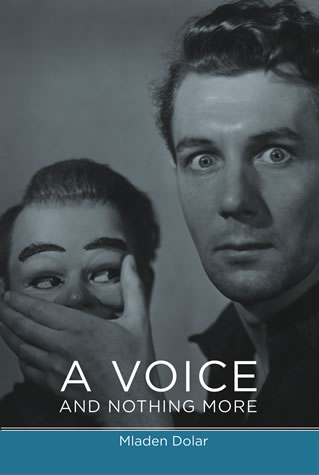
The following essay is excerpted from Mladen Dolar’s book, A Voice and Nothing More (which I’m reading for my dissertation).

The voice did not figure as a major [western] philosophical topic until the 1960s, when Derrida and Lacan separately proposed it as a central theoretical concern. Dolar goes beyond Derrida’s idea of “phonocentrism” and revives and develops Lacan’s claim that the voice is one of the paramount embodiments of the psychoanalytic object (objet a). Dolar proposes that, apart from the two commonly understood uses of the voice as a vehicle of meaning and as a source of aesthetic admiration, there is a third level of understanding: the voice as an object that can be seen as the lever of thought. He investigates the object voice on a number of different levels–the linguistics of the voice, the metaphysics of the voice, the ethics of the voice (with the voice of conscience), the paradoxical relation between the voice and the body, the politics of the voice–and he scrutinizes the uses of the voice in Freud and Kafka. (There’s a great review by Christine Boyko-Head HERE.)

a voice and nothing morePlutarch tells the story of a man who plucked a nightingale and finding but little to eat exclaimed: “You are just a voice and nothing more.”
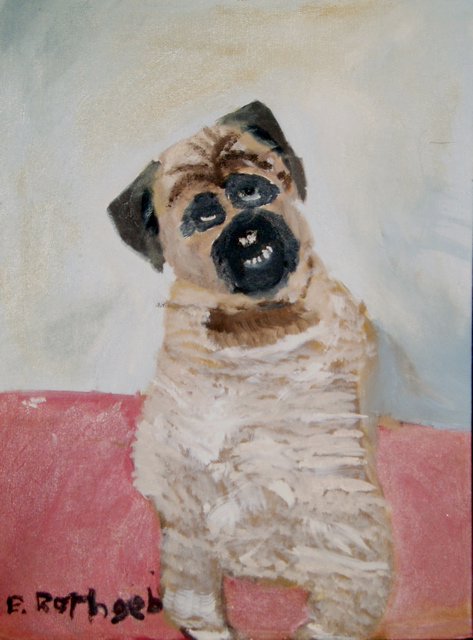
There is a story that goes like this: In the middle of a war, in the middle of a battle, there is a company of Italian soldiers in the trenches. And there is an Italian commander who issues the command “Soldiers, attack!” But nothing happens, nobody moves. So the commander gets angry and shouts even louder “Soldiers, attack!” At which point there is a response, a voice rising from the trenches saying Che bella voce!

This story can serve as a good entry into the problem of the voice. On the first level this is a story of a failed interpellation. The soldiers fail to recognize themselves in the appeal, the call of the other, the call of duty, and they don’t act accordingly. Surely the fact that they are Italian soldiers plays a great role in it, they do act according to their image of not the most courageous soldiers in the world, as legend has it, and the story is most certainly not a model of political correctness, it indulges in tacit chauvinism and national stereotypes. So the command fails, the addressees don’t recognize themselves in the meaning being conveyed, they concentrate instead on the medium, which is the voice. The attention paid to the voice hinders the interpellation and the transmission of a symbolic mandate, the transmission of a mission.

But on a second level another interpellation works in the place of the failed one: if the soldiers don’t recognize themselves in their mission as the soldiers in the middle of a battle, they do recognize themselves as addressees of another message, they constitute a community as a response to the call, the community of people who can appreciate the aesthetics of a beautiful voice. Who can appreciate it when it is hardly the moment, and especially when it is hardly the moment to do so? So if in one respect they act as stereotypical Italian soldiers, they also act as stereotypical Italians in this other respect, namely as opera lovers. They constitute themselves as the community of “the friends of the Italian opera” (to take the immortal line from Some Like It Hot), living up to their reputation of connoisseurs, people of refined taste who have amply trained their ears with bel canto, so they can tell a beautiful voice when they hear one, even among the canon fire.

The soldiers have done the right thing, from our biased present perspective, at least in an incipient way, when they have concentrated on the voice instead of on the message, although, to be sure, for the wrong reasons. They are seized by a sudden aesthetic interest precisely when they would have had to attack, they concentrate on the voice because they have grasped the meaning all too well. But quite apart from their feigned artistic inclination they have also bungled the voice the moment they isolated it, they immediately turned it into an object of aesthetic pleasure, an object of veneration and worship, the bearer of a meaning beyond the ordinary meanings. The aesthetic concentration on the voice loses the voice precisely by turning it into a fetish-object.

I will try to argue that there is a third level: an object voice which doesn’t go up in smoke in conveyance of meaning and which doesn’t solidify either in an object of fetish reverence, but an object which functions as a blind spot in the call and a disturbance of aesthetic appreciation. One shows fidelity to the first by running to the attack, one shows fidelity to the second by running to the opera. But fidelity to the third is far more difficult to achieve. I will try to pursue it on three different levels: linguistics, ethics and politics. Continue reading

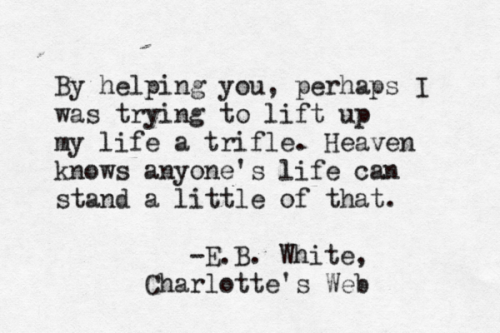
e.b. white’s response to a man who had lost his faith in humanity

helping charlotteDear Mr. Nadeau:

As long as there is one upright man, as long as there is one compassionate woman, the contagion may spread and the scene is not desolate. Hope is the thing that is left to us, in a bad time. I shall get up Sunday morning and wind the clock, as a contribution to order and steadfastness.

Sailors have an expression about the weather: they say, the weather is a great bluffer. I guess the same is true of our human society – things can look dark, then a break shows in the clouds, and all is changed, sometimes rather suddenly. It is quite obvious that the human race has made a queer mess of life on this planet. But as a people we probably harbour seeds of goodness that have lain for a long time waiting to sprout when the conditions are right. Man’s curiosity, his relentlessness, his inventiveness, his ingenuity have led him into deep trouble. We can only hope that these same traits will enable him to claw his way out.

Hang on to your hat. Hang on to your hope. And wind the clock, for tomorrow is another day.

Sincerely,

E. B. White

(I found this at Letters of Note.)

lizza littlewort on the nature of “art”

lizzaI think it’s an imperialist idea with massive blind spots.

I think creativity, and the making of artefacts, is a product of cultures in general, and the Western sense of “Art” is a product of massive surplus over and above the meeting of needs for artefacts.

The idea of it as a “high” expression of culture has spread with imperialism, as did the idea of a “national culture” being expressed through literature. It is as Western as the English language, and carries with it the same kinds of embedded privilege, in terms of it being a “text” which privileges European concerns. It is impossible to “speak” art without its European history being part of the discussion.

I think that much like European history has been selectively “rewritten” to seem to be a continuous, meaningful story from prehistory to Modern America, so has art history.

It’s great to have it around. Certainly I like it. But to engage in it without confronting its lies and limitations is like living inside the bubble of white privilege without standing back to look at its impact on the world in general, and see who gets favoured by its discourses of “natural” “genius” and “talent” (as opposed to “first-language” familiarity), compared with who gets punished and dumped outside its magic circle like so much human trash.

achille mbembe on the inadequacy of neoliberal definitions of humanity and citizenship

Antonia Mora

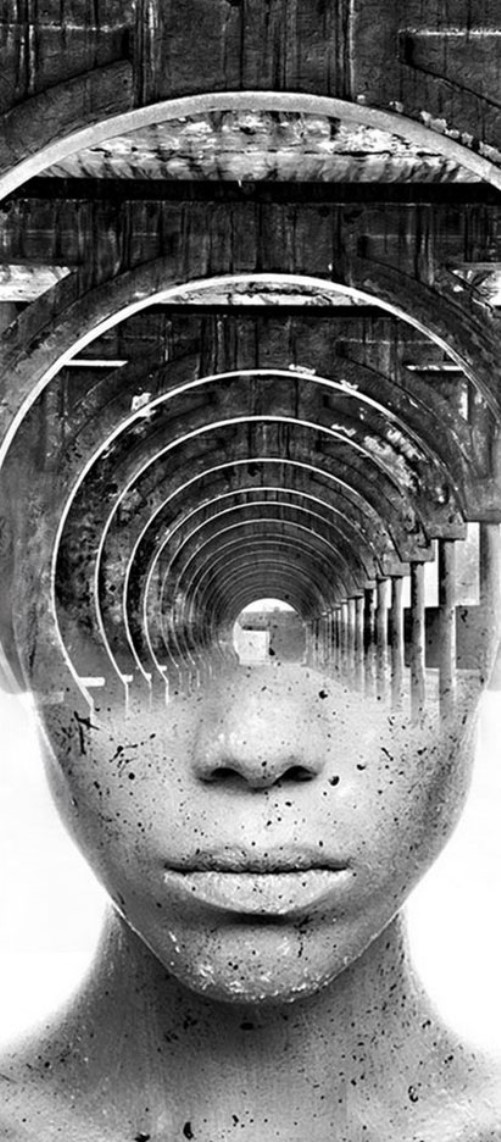
Image: Antonio Mora

The “human” in the South African context

Whether there is anything which is still to be rediscovered or to be reanimated from the term “the human” takes on a paradoxical resonance in contemporary South Africa. With the end of apartheid, South African culture and society was confronted with the urgency of engaging in affirmative politics in lieu of the politics of destruction of the years of racial segregation. Affirmative politics entailed the production of social horizons of hope. At the same time, it meant resisting both the inertia of the present and the nostalgia of the past. To reconstruct what centuries of racial brutality had destroyed, a balance had to be found between the mobilization, actualization and deployment of cognitive, affective and creative possibilities which had not so far been activated, along with a necessary dose of oppositional consciousness.

Critical humanism in this new context would have meant a persistent commitment to the possibilities and powers of life. There is substantial evidence that a return to the question of the possibilities and powers of life as a precondition for the reconstitution of “the human” in politics and culture was recognized as a matter of ethical and political urgency during the first decade of democracy. During this decade, South Africa became a model of how to dismantle a racial mode of rule, strike down race-based frameworks of citizenship and the law while striving to create racial equality through positive State action. The post-apartheid State fostered a normative project with the aim of achieving justice through reconciliation, equality through economic redress, democracy through the transformation of the law and the restoration of a variety of rights, including the right to a dignified life. This normative project was enshrined in a utopian Constitution that attempts to establish a new relationship between law and society on the one hand and law and life on the other, while equating democracy and the political itself with the ethical and the just. This Constitution’s underlying principle is ubuntu or human mutuality. It promises a transcendence of the old politics of racial difference and an affirmation of a shared humanity. Underpinning the Constitution is the hope that, after centuries of attempts by white power to contain blacks, South Africa could become the speech-act of a certain way of being-in-common rather than side by side.

This drive to “re-humanize” society and culture and to institutionalize a new political community that defines itself as an ethical community is nevertheless unfolding against various odds. Perhaps to a degree hardly achieved in the rest of the Continent, the human has consistently taken on the form of waste within the peculiar trajectory race and capitalism espoused in South Africa. Traditionally, we speak of “waste” as something produced bodily or socially by humans. In this sense, “waste” is that which is other than the human. Traditionally too, we speak of the intrinsic capacity of capitalism to waste human lives. We speak of how workers are wasted under capitalism in comparable fashion to natural resources. Marx in particular characterizes capitalist production as thoroughly wasteful with what he calls “human material” just as it is with “material resources”. It squanders “human beings, living labour”, “squandering not only flesh and blood, but nerves and brain, life and health as well”, he writes. In order to grasp the particular drama of the human in the history of South Africa, we should broaden this traditional definition of “waste” and consider the human itself as a waste product at the interface of race and capitalism. Squandering and wasting black lives has been an intrinsic part of the logic of capitalism, especially in those contexts in which race is central to the simultaneous production of wealth and of superfluous people.

Today, this logic of waste is particularly dramatized by the dilemmas of unemployment and disposability, survival and subsistence, and the expansion in every arena of everyday life of spaces of vulnerability. Despite the emergence of a solid black middle class, a rising superfluous population is becoming a permanent fixture of the South African social landscape with little possibility of ever being exploited by capital. Only a dwindling number of individuals can now claim to be workers in the traditional sense of the term. How to govern the poor has therefore become one of the biggest moral questions facing the nascent democracy. Behind policy debates on “welfare” and “service delivery” loom fundamental ethical choices that will determine the nature of the South African experiment in democracy – questions of how to right historical wrongs; what is the relationship between personal or collective injury and larger problems of equality, justice and the law; hunger and morality; owning and sharing; or even truth, hope and reconciliation. The urgency of these new moral dilemmas is such that, for the democratic project to have any future at all, it should necessarily take the form of a conscious attempt to retrieve life and “the human” from a history of waste.

Wealth and property

Meanwhile, wealth and property have acquired a new salience in public debate. They have become the key, central idioms to framing and naming ongoing social struggles – from imagining the relationship between “the good life” to redefining value itself; from claims of citizenship, rights and entitlements to the definition of the forms of property and the economy itself (whether we should nationalize or not); from matters of morality to those of lifestyle and accountability.

The centrality of wealth in the moral discourse concerning the “human’ is not new. In various parts of pre-colonial Africa, discourses on “the human”, or, on “humanity” almost always took the shape and content of discourses about “wealth”, “personhood” and “social multiplicity”. Traditional definitions of wealth usually encompassed “people”, “things” and “knowledge”.

“People”, that is, other human beings, were not only the most important unit of measurement of ultimate value. They also formed the material basis or infrastructure of human life. ‘People’ consisted of interpersonal dependents of all kinds – wives, children, clients and slaves. As Jane Guyer argues, they were sought, valued, and at times paid for at considerable expense in material terms. Kinship and marriage especially were critical components of accumulative strategies. But wealth also covered traded goods, including the imported goods brought from elsewhere. Things could be personalized objects. Goods could be functionally interchangeable with human beings who in turn could in certain respects be “objectified” or converted into clients or followers.

Wealth – embodied in rights in people – remained a persistent principle of African social and moral life even in the midst of the various shifts induced by the slave trade and colonialism. Knowledge on the other hand was understood as an ever shifting spectrum of possibility. Jane Guyer makes it clear that it was highly valued, complexly organized and plural by definition. There was no social organization of kinship and material life that did not depend, to some extent, on a regime of distribution of knowledge – the arts, music, dance, rhetoric, spiritual life, hunting, gathering, fishing, cultivation, wood-carving, metallurgy. If certain forms of knowledge were specialized, controlled and monopolized by a small cadre of experts or a secret society hierarchy, other forms of knowledge were conceptualized as an open and unbounded repertoire. This unboundedness made it possible for such forms of knowledge to be widely distributed throughout the society and among many adepts on the basis of personal capacity or potentiality.

Indeed, African pre-colonial discourses on the “human” allowed for personal differentiation or singularity. It was believed that certain qualities lived in the individual from his or her birth; which he or she had no need for “magic” to arouse although there was always the indispensable need for magical rites to conserve these. Personal abilities could be augmented, conserved and actualized within the person, making that person a “real person”, recognized as such by the community. Each individual person’s power was itself a composition.

That some of these old tropes might still be at work in current controversies on wealth and property should not be entirely excluded. But that wealth, poverty and property have become essential to the self-understanding of South African society after liberation should also be read against a long history of black dispossession. In the new phase of “frontier accumulation” made possible by the 1994 negotiated settlement, they have become the new idioms for political and normative arguments about what should be the proper relation of people to things; what should be the proper relation of people to each other with respect to things; how much property is enough for one person and how much is too much; how much enjoyment is justifiable especially for the opulent in an environment where hunger and debasement are all too real for many. It is this tension between what looks like an unstoppable logic of unproductive excess on the one hand and on the other, a logic of scarcity and depletion that is turning wealth and property into dramatic sites of contestation.

Wealth and property also operate as means of regulating access to resources that are scarce for some and plentiful for others. They are the main means by which life chances are assigned to different kinds of persons at a time when pockets of wealth and privilege are proving hard not only to account for and even less so to control, but also hard to subject to some form of accountability and redistribution. Furthermore, as Arjun Appadurai observes, the life of the poor has become a strenuous effort to produce, if not a sense of stability, then something like permanence in the face of the temporariness or volatility of almost all the arrangements of social existence. Indeed, one of the most brutal effects of neo-liberalism in South Africa has been the generalization and radicalization of a condition of temporariness for the poor. For many people, the struggle to be alive has taken the form of a struggle against the constant corrosion of the present, both by change and by uncertainty.

In order to reanimate the idea of “the human” in contemporary South African politics and culture, there is therefore no escape from the need to reflect on the thoroughly political and historical character of wealth and property and the extent to which wealth and property have come to be linked with bodily life. If what distinguishes the South African experiment from other such experiments elsewhere in the world is the attempt to establish a new relationship between law and life while equating democracy and the political itself with the ethical and the just, then we have to ask under what conditions can this project of human mutuality result in a broader and more ethical commensality.

Read the rest of this essay HERE.

“the mirror in the ground” book launch and exhibition

Happening next Thursday, 14 May 2015, this book launch and exhibition promises to be well worth attending. I’ve read parts of the manuscript for the book, and it deals with the topics of western scientific knowledge production and reading colonial archives “across the grain” in ways that are really apposite right now.

mirror

aimé césaire – from “discourse on colonialism”

cesaire… [W]e must resign ourselves to the inevitable… that the bourgeoisie is condemned to become every day more snarling, more openly ferocious, more shameless, more summarily barbarous; that it is an implacable law that every decadent class finds itself turned into a receptacle into which flow all the dirty waters of history; that it is a universal law that before it disappears, every class must first disgrace itself completely, on all fronts, and that it is with their heads buried in the dunghill that dying societies utter their swan songs.

— Aimé Césaire, from Discourse on Colonialism (1955), translated by Joan Pinkham (1972). Read more HERE (do, it’s engaging and chillingly prescient).

achille mbembe on fire

Brilliant and inspiring lecture by Prof. Achille Mbembe in conversation with Rhodes Must Fall at UCT on 29 April 2015, talking about decolonising the university.

Read his speaking notes here: Achille Mbembe – Decolonizing Knowledge and the Question of the Archive (pdf document).

uct panel discussion – decolonising the university

Charting a path forward for anti-sexist and anti-racist scholarship and activism. This discussion was hosted by the Van Zyl Slabbert Visiting Chair, the Dean of the Faculty of Humanities and the University of Cape Town’s SRC and moderated by Prof Xolela Mangcu on Thursday 23 April 2015.

“The fact that we are able to have this conversation in South Africa as though it is new, as though these issues have never been thought of before, is precisely because of our inability to engage, and to read…In a staggering display of willful ignorance, we continue to have conversations that have been had, that have been taken in remarkable directions, as though we have just discovered them.” – Pumla Gqola (at 0:26:00)

south africa in the twilight of liberalism: richard pithouse

Gautam Bhan's avatarKAFILA - COLLECTIVE EXPLORATIONS SINCE 2006

[Note: Recent events in South Africa – from raging student movements across university campuses to xenophobic violence in the streets of Durban – seem to echo so many struggles both inside and outside the university “here.” This is the first of hopefully several posts from South Africa, that seek to listen and travel across.]

Guest Post by RICHARD PITHOUSE

South Africa was supposed to be different. We attained our freedom, such as these things are, after everyone else but Palestine. It was late in the day but the afternoon sun was glorious and the best people, people who had passed through the long passage of struggle, told us that we would be able to avoid the mistakes made everywhere else.

There was a mass movement that, whatever its limits, had won tremendous popular support and carried some noble ideals through its travails. Its leaders cast long shadows. Our Constitution, we…

View original post 2,655 more words

biko on “white allies'” place in the struggle against racism

steve bikoWe are concerned with that curious bunch of nonconformists who explain their participation in negative terms: that bunch of do-gooders that goes under all sorts of names—liberals, leftists etc. These are the people who argue that they are not responsible for white racism and the country’s “inhumanity to the black man”. These are the people who claim that they too feel the oppression just as acutely as the blacks and therefore should be jointly involved in the black man’s struggle for a place under the sun. In short, these are the people who say that they have black souls wrapped up in white skins.

The role of the white liberal in the black man’s history in South Africa is a curious one. Very few black organisations were not under white direction. True to their image, the white liberals always knew what was good for the blacks and told them so. The wonder of it all is that the black people have believed in them for so long. It was only at the end of the ’50s that the blacks started demanding to be their own guardians.

Nowhere is the arrogance of the liberal ideology demonstrated so well as in their insistence that the problems of the country can only be solved by a bilateral approach involving both black and white. This has, by and large, come to be taken in all seriousness as the modus operandi in South Africa by all those who claim they would like a change in the status quo. Hence the multiracial political organisations and parties and the “nonracial” student organisations, all of which insist on integration not only as an end goal but also as a means.

The integration they talk about is first of all artificial in that it is a response to conscious manoeuvre rather than to the dictates of the inner soul. In other words the people forming the integrated complex have been extracted from various segregated societies with their inbuilt complexes of superiority and inferiority and these continue to manifest themselves even in the “nonracial” set-up of the integrated complex. As a result the integration so achieved is a one-way course, with the whites doing all the talking and the blacks the listening. Let me hasten to say that I am not claiming that segregation is necessarily the natural order; however, given the facts of the situation where a group experiences privilege at the expense of others, then it becomes obvious that a hastily arranged integration cannot be the solution to the problem. It is rather like expecting the slave to work together with the slave-master’s son to remove all the conditions leading to the former’s enslavement.

Secondly, this type of integration as a means is almost always unproductive. The participants waste lots of time in an internal sort of mudslinging designed to prove that A is more of a liberal than B. In other words the lack of common ground for solid identification is all the time manifested in internal strifes inside the group.

It will not sound anachronistic to anybody genuinely interested in real integration to learn that blacks are asserting themselves in a society where they are being treated as perpetual under-16s. One does not need to plan for or actively encourage real integration. Once the various groups within a given community have asserted themselves to the point that mutual respect has to be shown then you have the ingredients for a true and meaningful integration.

At the heart of true integration is the provision for each man, each group to rise and attain the envisioned self. Each group must be able to attain its style of existence without encroaching on or being thwarted by another. Out of this mutual respect for each other and complete freedom of self-determination there will obviously arise a genuine fusion of the life-styles of the various groups. This is true integration.

From this it becomes clear that as long as blacks are suffering from inferiority complex—a result of 300 years of deliberate oppression, denigration and derision—they will be useless as co-architects of a normal society where man is nothing else but man for his own sake. Henc what is necessary as a prelude to anything else that may come is a very strong grass-roots build-up of black consciousness such that blacks can learn to assert themselves and stake their rightful claim.

Thus in adopting the line of a nonracial approach, the liberals are playing their old game. They are claiming a “monopoly on intelligence and moral judgement” and setting the pattern and pace for the realisation of the black man’s aspirations. They want to remain in good books with both the black and white worlds. They want to shy away from all forms of “extremisms”, condemning “white supremacy” as being just as bad as “Black Power!”. They vacillate between the two worlds, verbalising all the complaints of the blacks beautifully while skilfully extracting what suits them from the exclusive pool of white privileges. But ask them for a moment to give a concrete meaningful programme that they intend adopting, then you will see on whose side they really are. Their protests are directed at and appeal to white conscience, everything they do is directed at finally convincing the white electorate that the black man is also a man and that at some future date he should be given a place at the white man’s table.

The myth of integration as propounded under the banner of liberal ideology must be cracked and killed because it makes people believe that something is being done when in actual fact the artificial integrated circles are a soporific on the blacks and provide a vague satisfaction for the guilty-stricken whites. It works on a false premise that because it is difficult to bring people from different races together in this country, therefore achievement of this is in itself a step forward towards the total liberation of the blacks. Nothing could be more irrelevant and therefore misleading. Those who believe in it are living in a fool’s paradise.

First the black-white circles are almost always a creation of white liberals. As a testimony to their claim of complete identification with the blacks, they call a few “intelligent and articulate” blacks to “come around for tea at home”, where all present ask each other the same old hackneyed question “how can we bring about change in South Africa?” The more such tea-parties one calls the more of a liberal he is and the freer he shall feel from the guilt that harnesses and binds his conscience. Hence he moves around his white circles— whites-only hotels, beaches, restaurants and cinemas—with a lighter load, feeling that he is not like the rest of the others. Yet at the back of his mind is a constant reminder that he is quite comfortable as things stand and therefore should not bother about change. Although he does not vote for the Nats (now that they are in the majority anyway), he feels quite secure under the protection offered by the Nats and subconsciously shuns the idea of a change. This is what demarcates the liberal from the black world. The liberals view the oppression of blacks as a problem that has to be solved, an eye sore spoiling an otherwise beautiful view. From time to time the liberals make themselves forget about the problem or take their eyes off the eyesore. On the other hand, in oppression the blacks are experiencing a situation from which they are unable to escape at any given moment. Theirs is a struggle to get out of the situation and not merely to solve a peripheral problem as in the case of the liberals. This is why blacks speak with a greater sense of urgency than whites.

A game at which the liberals have become masters is that of deliberate evasiveness. The question often comes up “what can I do?”. If you ask him to do something like stopping to use segregated facilities or dropping out of varsity to work at menial jobs like all blacks or defying and denouncing all provisions that make him privileged, you always get the answer—“but that’s unrealistic!”. While this may be true, it only serves to illustrate the fact that no matter what a white man does, the colour of his skin—his passport to privilege—will always put him miles ahead of the black man. Thus in the ultimate analysis no white person can escape being part of the oppressor camp.

“There exists among men, because they are men, a solidarity through which each shares responsibility for every injustice and every wrong committed in the world, and especially for crimes that are committed in his presence or of which he cannot be ignorant”.

This description of “metaphysical guilt” explains adequately that white racism “is only possible because whites are indifferent to suffering and patient with cruelty” meted out to the black man. Instead of involving themselves in an all-out attempt to stamp out racism from their white society, liberals waste lots of time trying to prove to as many blacks as they can find that they are liberal. This arises out of the false belief that we are faced with a black problem. There is nothing the matter with blacks. The problem is WHITE RACISM and it rests squarely on the laps of the white society. The sooner the liberals realise this the better for us blacks. Their presence amongst us is irksome and of nuisance value. It removes the focus of attention from essentials and shifts it to ill-defined philosophical concepts that are both irrelevant to the black man and merely a red herring across the track. White liberals must leave blacks to take care of their own business while they concern themselves with the real evil in our society—white racism…

… Does this mean that I am against integration? If by integration you understand a breakthrough into white society by blacks, an assimilation and acceptance of blacks into an already established set of norms and code of behaviour set up by and maintained by whites, then YES I am against it. I am against the superior-inferior white-black stratification that makes the white a perpetual teacher and the black a perpetual pupil (and a poor one at that). I am against the intellectual arrogance of white people that makes them believe that white leadership is a sine qua non in this country and that whites are the divinely appointed pace-setters in progress. I am against the fact that a settler minority should impose an entire system of values on an indigenous people.

If on the other hand by integration you mean there shall be free participation by all members of a society, catering for the full expression of the self in a freely changing society as determined by the will of the people, then I am with you. For one cannot escape the fact that the culture shared by the majority group in any given society must ultimately determine the broad direction taken by the joint culture of that society. This need not cramp the style of those who feel differently but on the whole, a country in Africa, in which the majority of the people are African must inevitably exhibit African values and be truly African in style.

What of the claim that the blacks are becoming racists? This is a favourite pastime of frustrated liberals who feel their trusteeship ground being washed off from under their feet. These self-appointed trustees of black interests boast of years of experience in their fight for the ‘rights of the blacks’. They have been doing things for blacks, on behalf of blacks, and because of blacks. When the blacks announce that the time has come for them to do things for themselves and all by themselves all white liberals shout blue murder!

“Hey, you can’t do that. You’re being a racist. You’re falling into their trap.”

Apparently it’s alright with the liberals as long as you remain caught by their trap. Those who know, define racism as discrimination by a group against another for the purposes of subjugation or maintaining subjugation. In other words one cannot be a racist unless he has the power to subjugate. What blacks are doing is merely to respond to a situation in which they find themselves the objects of white racism. We are in the position in which we are because of our skin. We are collectively segregated against—what can be more logical than for us to respond as a group? When workers come together under the auspices of a trade union to strive for the betterment of their conditions, nobody expresses surprise in the Western world. It is the done thing. Nobody accuses them of separatist tendencies. Teachers fight their battles, garbagemen do the same, nobody acts as a trustee for another. Somehow, however, when blacks want to do their thing the liberal establishment seems to detect an anomaly. This is in fact a counter-anomaly. The anomaly was there in the first instance when the liberals were presumptuous enough to think that it behoved them to fight the battle for the blacks.

The liberal must understand that the days of the Noble Savage are gone; that the blacks do not need a go-between in this struggle for their own emancipation. No true liberal should feel any resentment at the growth of black consciousness. Rather, all true liberals should realise that the place for their fight for justice is within their white society. The liberals must realise that they themselves are oppressed if they are true liberals and therefore they must fight for their own freedom and not that of the nebulous “they” with whom they can hardly claim identification. The liberal must apply himself with absolute dedication to the idea of educating his white brothers that the history of the country may have to be rewritten at some stage and that we may live in “a country where colour will not serve to put a man in a box”.

The blacks have heard enough of this. In other words, the liberal must serve as a lubricating material so that as we change the gears in trying to find a better direction for South Africa, there should be no grinding noises of metal against metal but a free and easy flowing movement which will be characteristic of a well-looked-after vehicle.

From I Write What I Like.

foucault on sadism’s relationship to western rationality (1961)

Sadism is not a name finally given to a practice as old as Eros; it is a massive cultural fact which appeared precisely at the end of the eighteenth century, and which constitutes one of the greatest conversions of Western imagination: unreason transformed into delirium of the heart, madness of desire, the insane dialogue of love and death in the limitless presumption of appetite.

Sadism appears at the very moment that unreason, confined for over a century and reduced to silence, reappears, no longer as an image of the world, no longer as a figura, but as language and desire. And it is no accident that sadism, as an individual phenomenon bearing the name of a man, was born of confinement and, within confinement, that Sade’s entire oeuvre is dominated by the images of the Fortress, the Cell, the Cellar, the Convent, the inaccessible Island which thus form, as it were, the natural habitat of unreason.

It is no accident, either, that all the fantastic literature of madness and horror, which is contemporary with Sade’s oeuvre, takes place, preferentially, in the strongholds of confinement.

— Michel Foucault, from Madness and Civilisation

naomi klein on the climate crisis

Carbon DioxideWe have not done the things that are necessary to lower emissions because those things fundamentally conflict with deregulated capitalism, the reigning ideology for the entire period we have been struggling to find a way out of this crisis. We are stuck because the actions that would give us the best chance of averting catastrophe – and would benefit the vast majority – are extremely threatening to an elite minority that has a stranglehold over our economy, our political process, and most of our major media outlets.

— Naomi Klein, 8 March 2015. Read the rest of this article HERE.

marx and engels on the global reach of capitalism

The bourgeoisie cannot exist without constantly revolutionising the instruments of production, and thereby the relations of production, and with them the whole relations of society. Conservation of the old modes of production in unaltered form, was, on the contrary, the first condition of existence for all earlier industrial classes. Constant revolutionising of production, uninterrupted disturbance of all social conditions, everlasting uncertainty and agitation distinguish the bourgeois epoch from all earlier ones. All fixed, fast-frozen relations, with their train of ancient and venerable prejudices and opinions, are swept away, all new-formed ones become antiquated before they can ossify. All that is solid melts into air, all that is holy is profaned, and man is at last compelled to face with sober senses his real conditions of life, and his relations with his kind.

The need of a constantly expanding market for its products chases the bourgeoisie over the entire surface of the globe. It must nestle everywhere, settle everywhere, establish connexions everywhere.

The bourgeoisie has through its exploitation of the world market given a cosmopolitan character to production and consumption in every country. To the great chagrin of Reactionists, it has drawn from under the feet of industry the national ground on which it stood. All old-established national industries have been destroyed or are daily being destroyed. They are dislodged by new industries, whose introduction becomes a life and death question for all civilised nations, by industries that no longer work up indigenous raw material, but raw material drawn from the remotest zones; industries whose products are consumed, not only at home, but in every quarter of the globe. In place of the old wants, satisfied by the production of the country, we find new wants, requiring for their satisfaction the products of distant lands and climes. In place of the old local and national seclusion and self-sufficiency, we have intercourse in every direction, universal inter-dependence of nations. And as in material, so also in intellectual production. The intellectual creations of individual nations become common property. National one-sidedness and narrow-mindedness become more and more impossible, and from the numerous national and local literatures, there arises a world literature.

man-steve-cutts-02

Still from “Man”, by Steve Cutts (watch it!)

The bourgeoisie, by the rapid improvement of all instruments of production, by the immensely facilitated means of communication, draws all, even the most barbarian, nations into civilisation. The cheap prices of commodities are the heavy artillery with which it batters down all Chinese walls, with which it forces the barbarians’ intensely obstinate hatred of foreigners to capitulate. It compels all nations, on pain of extinction, to adopt the bourgeois mode of production; it compels them to introduce what it calls civilisation into their midst, i.e., to become bourgeois themselves. In one word, it creates a world after its own image.

Marx & Engels: Library: 1848: Manifesto of the Communist Party: Chapter 1