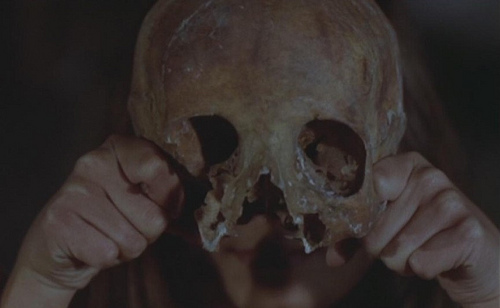
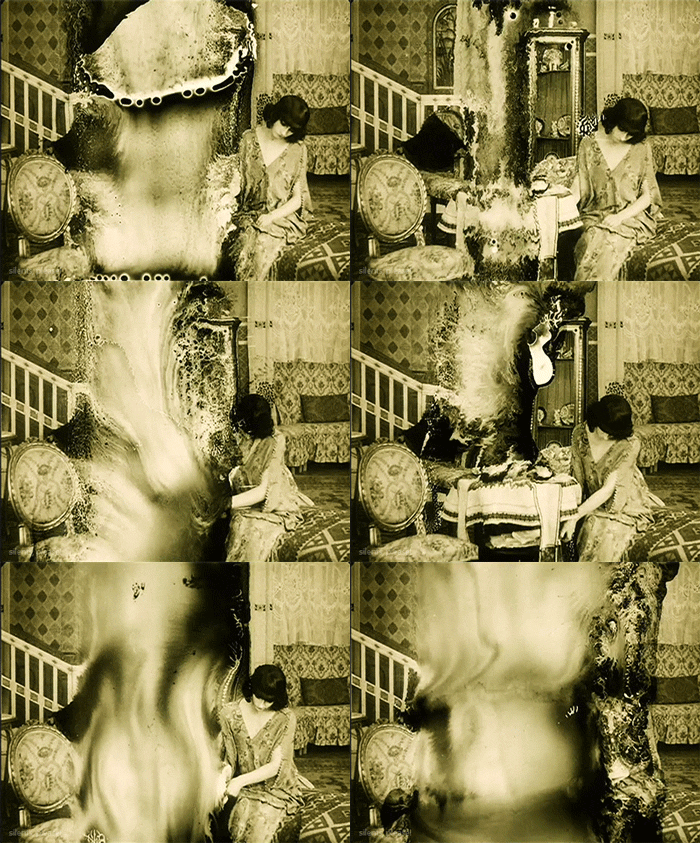
hans richter/the real tuesday weld – one more ghost before breakfast (1927/2005)

Hans Richter’s 1927 short Dadaist masterpiece: Ghosts Before Breakfast, re-scored.

“This film initially had a soundtrack which was lost when the original print was destroyed by the Nazis as ‘degenerate art’.

This music – with Jacques Van Rhijn on clarinet, Don Brosnan on bass, Jed Woodhouse on drums, Clive Painter on guitar – was recorded at Clive’s prior to the sessions for our re-score of Richter’s full length magnum opus: Dreams That Money Can Buy for the British Film Institute in 2005.
(Turn off the sound if you want to hear it as Richter didn’t really intend it.)”

scientist – scientist rids the world of the evil curse of the vampires (1981)

https://youtu.be/937GFSXbcb0

Scientist sourced his material for this album from artists Michael Prophet, Wailing Souls, Johnny Osbourne and Wayne Jarrett. Here are Scientist’s mixes and their original equivalents:

Scientist Originals
1. “Voodoo Curse” “Oh What a Feeling” – Wailing Souls (Fire House Rock, 1981)
2. “Dance of the Vampires” “You Are a No Good” – Michael Prophet (Righteous Are The Conqueror, 1980)
3. “Blood On His Lips” “Love in My Heart” – Wayne Jarrett (Chip In, 1981)
4. “Cry of the Werewolf” “Hold On To What You Got” – Michael Prophet (Gunman, 1981)
5. “The Mummy’s Shroud” “Fire House Rock” – Wailing Souls (Fire House Rock, 1981)
6. “The Corpse Rises” “Bandits Taking Over” – Wailing Souls (Fire House Rock, 1981)
7. “Night of the Living Dead” “Youthman” – Michael Prophet (Gunman, 1981)
8. “Your Teeth In My Neck” “Love and Unity” – Michael Prophet (Gunman, 1981)
9. “Plague of Zombies” “He Can Surely Turn The Tide” – Johnny Osbourne (Fally Lover, 1981)
10. “Ghost of Frankenstein” “Sweet Loving” – Michael Prophet (Gunman, 1981)

the tired sounds of stars of the lid

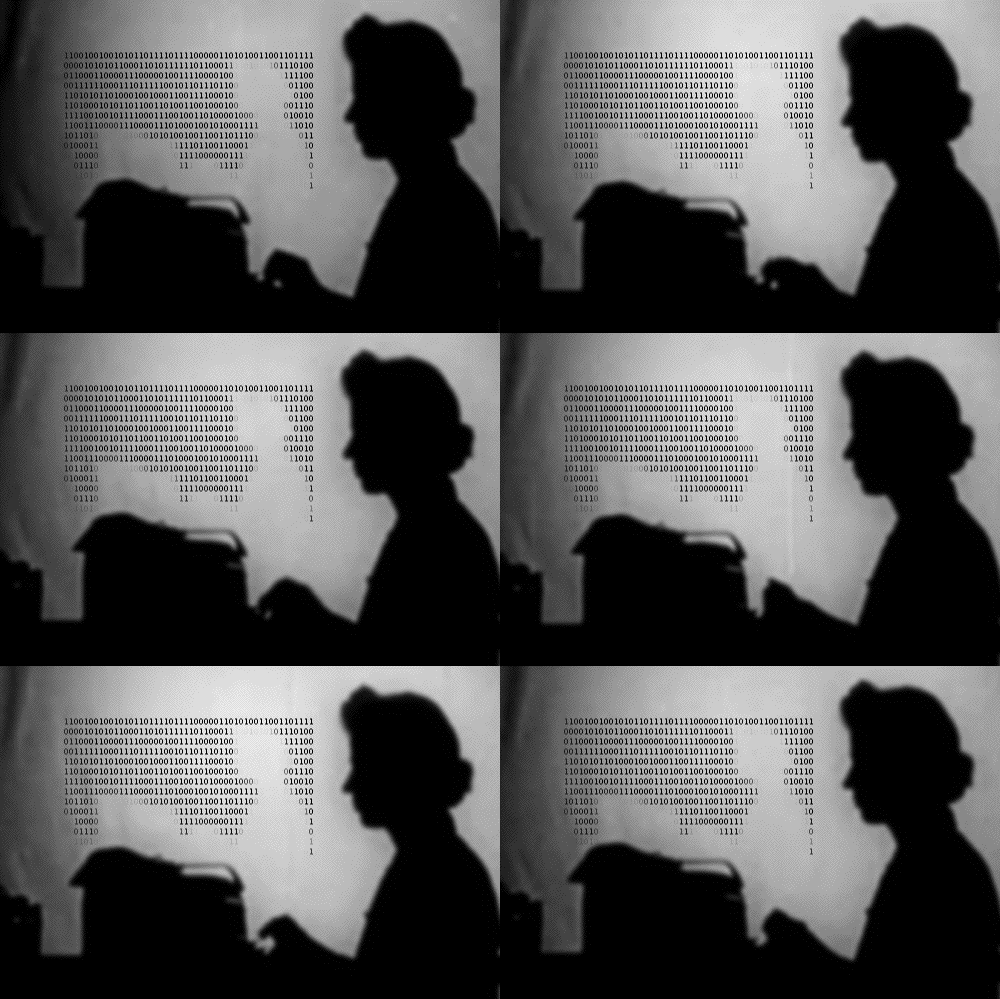
The Tired Sounds of Stars of the Lid is the sixth studio LP by ambient drone music group Stars of the Lid. It was released in late 2001 on the Kranky label, on two CDs and three LPs. The album features long minimal, droning compositions created from heavily treated guitar, horn, flute, piano, and other classical instruments. An interesting feature of the second track, “Requiem For Dying Mothers, part 2” is that it features a sample from the final scene of Andrei Tarkovsky‘s film Stalker, where the character Monkey pushes a glass across a table by way of telekinesis as a dog whines and a train whistle blows in the distance (watch the film free HERE).

a few good men – afrikaans for dummies version

This dubbed video is completely hilarious, but what it also shows up starkly is the relative authority and gravitas we give to the American voice. We shouldn’t. Global media speaks in an American accent. Even when what it peddles is not true, it sounds convincing. Question it. Always.

the amen break – a documentary

Utterly fascinating documentary on the use of the “Amen Break”, sampled from The Winston’s 1969 soul record, “Amen Brother” (although the narrator has the most boring voice ever, and the images shown are really pointless – it’s actually an audio documentary), looking at the intersection of technology, creativity and copyright.

the caretaker – an empty bliss beyond this world (2011)

‘”This Caretaker album is built from layers of sampled 78s and albums,” James Kirby told me in an email recently. “Things have been rearranged in places and other things brought in and out of focus. Surface noise”– which is abundant– “is from the original vinyls.”

‘An Empty Bliss Beyond this World was inspired by a 2010 study suggesting that Alzheimer’s patients have an easier time remembering information when it’s placed in the context of music. What makes it unique isn’t that Kirby resuscitates old but vaguely familiar source material; it’s how he edits it. Several of the tracks here take pretty, anodyne phrases and loop them mindlessly; several stop in what feels like mid-thought; several reach back and then jump forward. They never feel filled-in from start to finish, and they tend to linger on moments that feel especially comforting or conclusive: the last flourishes of a song, maybe, the pat on the shoulder, the part when we’re assured everything is drawing to a close.

Kirby isn’t just making nostalgic music, he’s making music that mimics the fragmented and inconclusive ways our memories work… [T]here’s something at least metaphorically beautiful– even slightly funny– about living inside a locked groove, dancing with nobody…

… It’s as though Kirby is trying to trick you into experiencing déjà vu… [T]he source material is music designed not only to comfort, but to sound like it existed before you: hymns, love songs, lullabies. Bliss is eerie because it takes the seduction of those forms and turns it slightly askew; there’s something unsettling about the musical equivalent of a permanent smile.’ – Pitchfork

Get the album on Bandcamp.

still life with white hyperbole

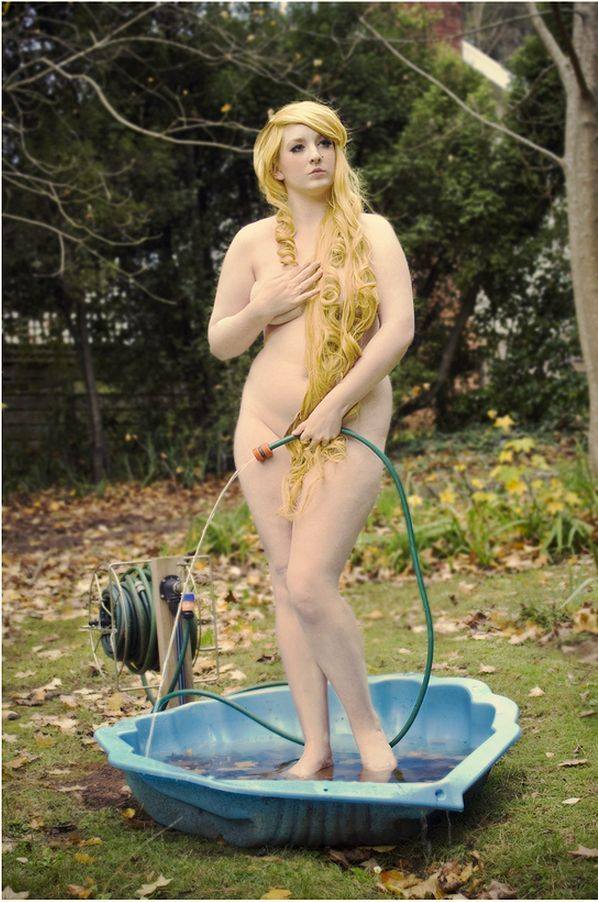
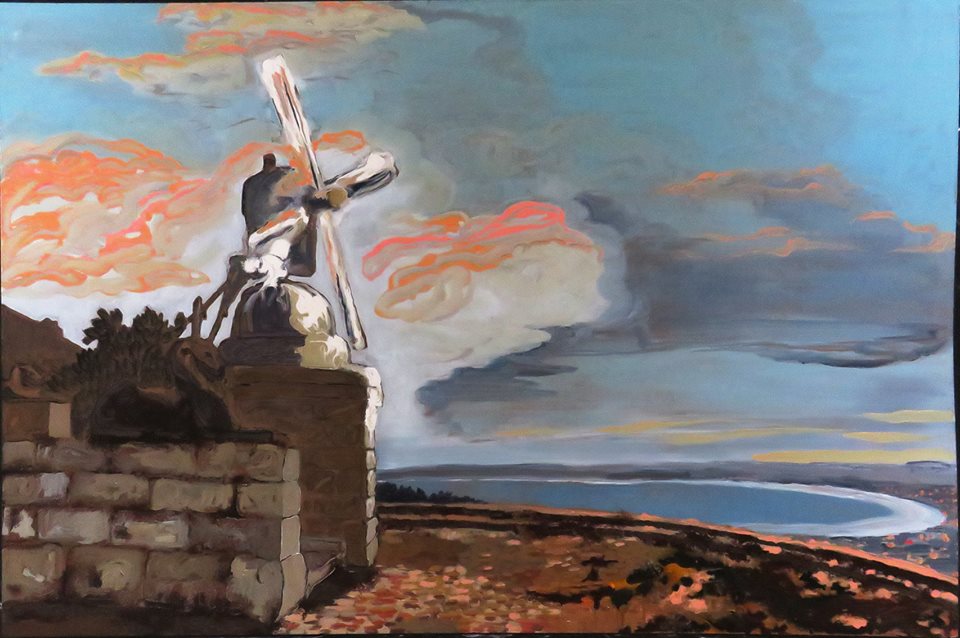
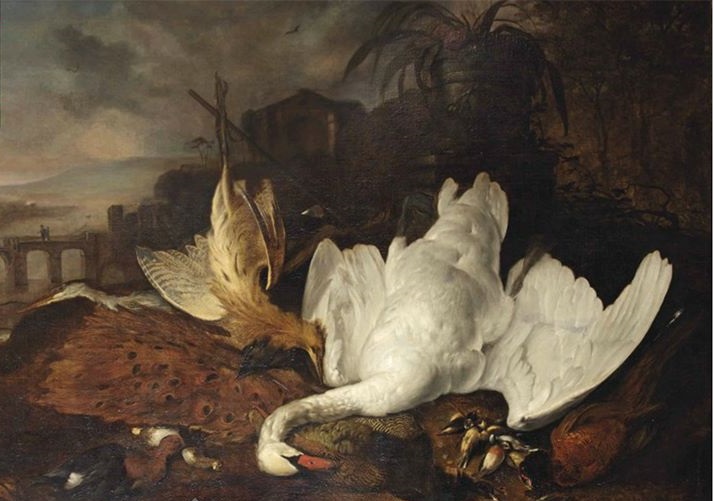
Lizza Littlewort - "Still Life with White Hyperbole". 2015.

Lizza Littlewort – “Still Life with White Hyperbole”. 2015.

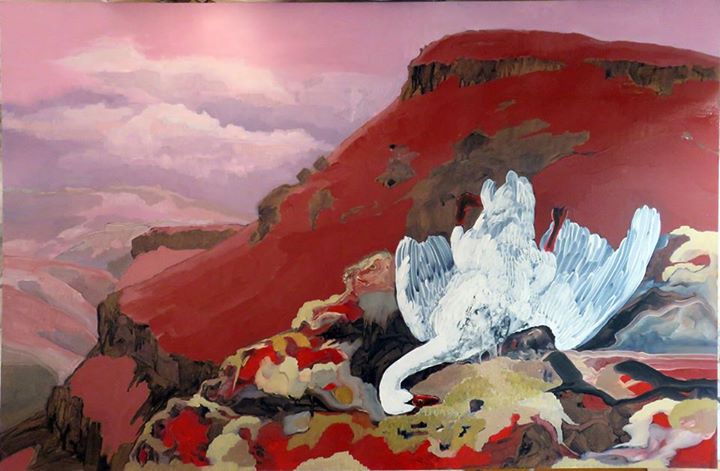
This is an adaptation from a still life by someone I’m actually descended from, whose son (or grandson, not sure) came out here as a PA to Simon van der Stel and apparently was the most corrupt, heinous motherfucker you could imagine. It’s very hard to get a straight answer from anyone in my family, but one distant uncle who I chatted to on the phone told me that because he could prove his direct descent he was allowed into the basement of the Rijks Museum where they kept all the family info. He said this guy was so corrupt that he was, individually, the reason for the first slave rebellion at the Cape. So it’s like an actual time warp of history. Except of course when I research when the slave rebellions were, none of the dates tie up. But of course there must be so many of these hideous occurrences which we no longer even know about.

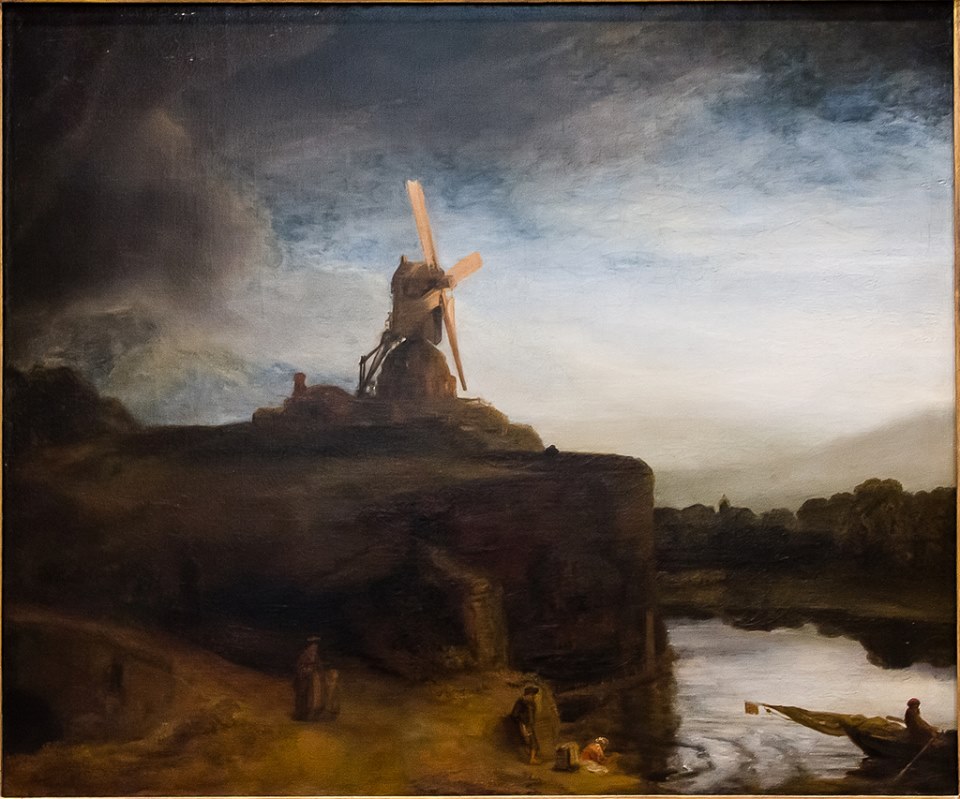
Here’s the painting, by Jacob Jacobsz. De Wet (Jacob de Wet II):

jacobz

Jacob de Wet II (Haarlem 1640/2-1697 Amsterdam).  An Italianate river landscape with a swan, a Eurasian bittern, a peacock, a pheasant and other birds before a stone vase on a pedestal. Oil on canvas, 153.6 x 217.5 cm.


goo goo g’joob

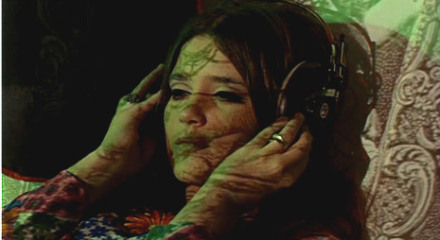
The Beatles’ song, I am the Walrus, slowed down 800% and set to the 1969 film Vertige by Jean Beaudin.

“Sympathetic but subtly critical, Vertige presents itself as a psychological portrait of the escape and/or contestation tactics of the decade’s youth: while war, violence, famine and poverty continue to devastate the planet, these youngsters seek refuge in the hedonistic haven of sexual liberation, lysergic research and communal fictions.”

Watch the film at ubu.com. And HERE is an etymological investigation into the phrase “goo goo g’joob”.

jean-beaudin-vertige-1969

on a “deaf safari” with felix laband

Watch Felix Laband’s brilliant set at the 2015 Cape Town Electronic Music Festival on 8 February (click the hyperlink – the darn embed function doesn’t seem to work properly on WordPress).

Felix opens this particular “Deaf Safari” with a dodgy old recording (that I think I actually gave him!), of Marais and Miranda entertaining a frightfully colonial white 1950s audience with their “knowledge” of “Hottentot” and “Zooloo” linguistics. With a subversive stammer, it segues into an hour-long journey of cut-up sounds and visuals.

Laband displays fluent familiarity with and yet alienation from spectacular capitalist consumer tropes. The oversaturated bricolage of radio preachers, politicians, porn, pulp cinema, big game and exoticised cultural representations is absurd and defaced: eyeless, toothless, festering with skulls. Sound and visuals work in counterpoint: horny assemblages dripping blood and infection; a snatch of Cat Power’s languid “Satisfaction”. His work foregrounds our mindless addiction to and manipulation by these fragments bouncing off the walls onto one another, their banality dismembered, dislocated, demented, discordant, decaying.

A voice in Queen’s English: “I was wondering what it is that you don’t want to remember so badly… To put it another way, what are you trying to forget?”

The response, implied in the guitar run sampled from Nico’s “These Days”: “Please don’t confront me with my failures… I had not forgotten them.”

Felix forces us to examine ourselves honestly. This I love most deeply about what he does: he will not allow us to forget, nor feign ignorance. There are naive melodies, but there is no innocence, no deafness nor blindness. We are taken through his cabinet of jabbering apparitions, racist, patriarchal horror haunting every suburban corner, lullabies, toyi-toyi chants… The valley of the shadow of death… We are not tourists. This is our own back yard. We stare the nightmares down, bopping in slo-mo. The voices persist, demand acknowledgement until they dissolve. It’s a kind of exorcism.

And beyond that, always, despite all the schizophrenic folly and sadness, hope and jubilation live on in the unfinished refrains of blues ghosts captured long ago on wax… Vera Hall, Stack O’Lee, prisoners and murderers alike now free… and there is space to breathe, place to be here now, without judgement… we are bathed in grace and exquisite melody.  This is strong muti for South Africans’ sickness.
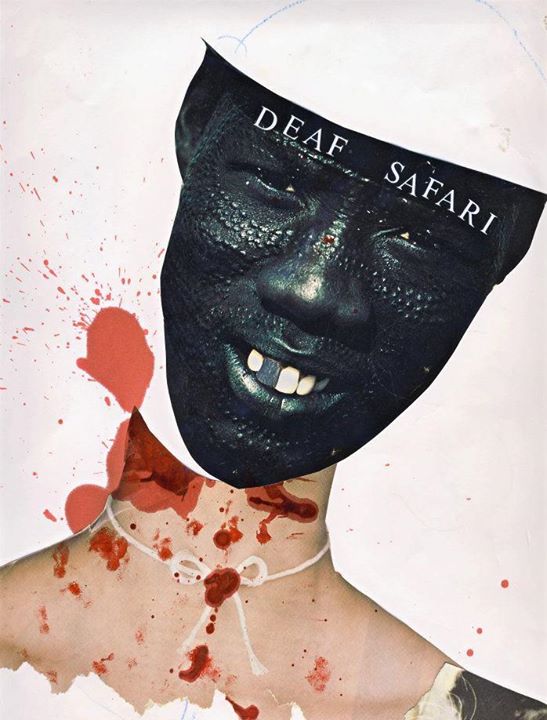
deaf safari

Collage: Felix Laband

I can’t wait for his new album, and I highly recommend that you see him live if you get the chance: he’s on form like never before and it’s a profound trip.

P.S. Read Sean O’Toole’s great interview piece for Mahala on Felix’s return (his new album, Deaf Safari, is set for release next month, after an almost decade-long gestation).