From Evangelista (Constellation, 2006).
From Evangelista (Constellation, 2006).
This is so often a problem, as I see it: that white people, particularly men, tend not to seek to understand other points of view before feeling entitled to give theirs. If listening feels hard, maybe you need to do it more.


I will never forget this.
HERE are photos by a friend, Eva Grosso, who has a far better camera than mine. Try to imagine each image continuing 360 degrees around you and above you. Utterly mind-blowing.
From The Miraculous (Pomperipossa Records, out November 13th, 2015). Saw her live last week… Almost made my chest implode!
“The laws of macro- and microcosm are alike. Travel in the interior is as a voyage in outer space: we must in each case burst past the circumference of our surface – our here-space and now-time – and, cut loose from the anchorage of an absolute, fixed center, enter worlds where the relationship of parts is the sole gravity. When the sun sets, the stars become apparent; when our eyes close out the light to sleep, there rises in the night-eye the constellation by which sleep-walkers plot their incalculable accuracies. By day we move according to desire and decision; by night Noctambulo advances without moving, led by the twins Gemini (as the eyes are twins or as the I of night is twin to that of day). It is by the dark geometry of such celestial navigation that the day‘s erratic negotiations are corrected and reconciled into the total orbits of our lives.
The film is in the negative. The blackness of night erases all horizon and, released from the leveling pressure of this plane, the movements both of the dancers and of the camera become as four-dimensional and directional as those of birds in air or fish in water.”
– Maya Deren: Chamber Films, program notes for a presentation, 1960
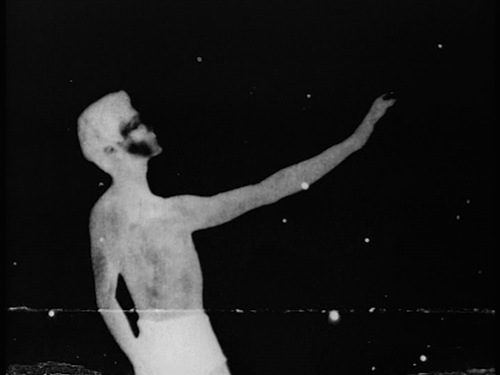
#Title: The Very Eye of Night
#Director: Maya Deren
#Year of Production: 1958
#Duration: 00:15:00
#Choregraphy: Antony Tudor, Metropolitan Opera Ballet School
#Dancers / Actors: Philp Salem, Rosemary Williams, Richard Englund, Richard Sandifer, Don Freisinger, Patricia Ferrier, Barbara Levin, Bud Bready, Genaro Gomez
#Camera: Maya Deren
#Editing: Maya Deren
#Foley Assistance: Harrison Starr
#Sound: Louis and Bebe Barron
#Music: Teiji Ito
NOTES BY ROBERT TRUNZ
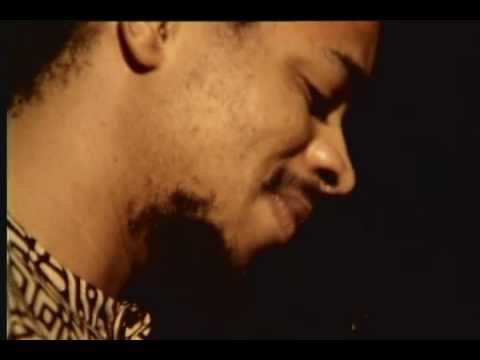
“Back in 1994 during the Outernational Meltdown recordings, in the early hours of the morning after we had finished one of the many late night recording sessions, Moses and I were the only ones left in Downtown Studios, Jo’burg. We were hanging out together, with Moses seated at one of the pianos whilst I settled down on the floor next to him. It was there that I first heard him playing solo piano.
Moses took me on a journey that lasted almost 3 hours, a journey that, for somebody who is normally not particularly enamoured by the piano, expanded my horizons and revealed a depth of Moses that few people have probably ever had the privilege to encounter.”
Read more about this recording HERE.

Kay Nielsen, 1914. Illustration from ‘East of the Sun and West of the Moon: Old Tales from the North’.
Check out the whole book at Project Gutenberg.
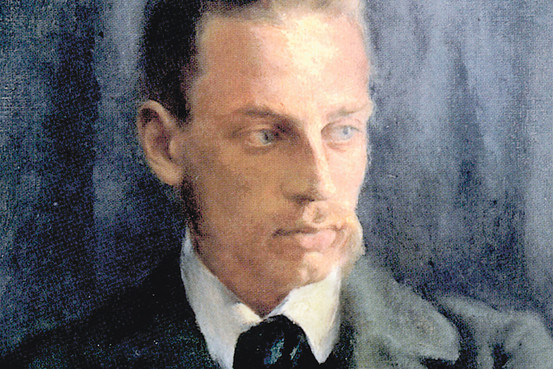 Isn’t it time that we lovingly freed ourselves from the beloved and,
quivering, endured: as the arrow endures the bowstring’s tension,
so that gathered in the snap of release it can be more than itself?
For there is no place where we can remain.
Voices. Voices. Listen, my heart, as only saints have listened:
until the gigantic call lifted them off the ground;
yet they kept on, impossibly, kneeling and didn’t notice at all: so complete was their listening.
Not that you could endure God’s voice – far from it.
But listen to the voice of the wind and the ceaseless message that forms itself out of silence…
Of course, it is strange to inhabit the earth no longer,
to give up customs one barely had time to learn,
not to see roses and other promising Things in terms of a human future;
no longer to be what one was in infinitely anxious hands;
to leave even one’s own first name behind,
forgetting it as easily as a child abandons a broken toy.
Strange to no longer desire one’s desires.
Strange to see meanings that clung together once, floating away in every direction.
And being dead is hard work and full of retrieval before one can gradually feel a trace of eternity.
Though the living are wrong to believe in the too-sharp distinctions which
they themselves have created.
Angels (they say) don’t know whether it is the living they are moving among, or the dead.
The eternal torrent whirls all ages along in it, through both realms forever,
and their voices are drowned out in its thunderous roar.
I’m sure I’ve posted this before, but I was just reminded of it, and it is so, so incredible: vulnerable yet immensely resilient.
Felix’s new album, Deaf Safari, is out at last. Get it HERE!
Here’s an atmospheric outtake, not on the album:
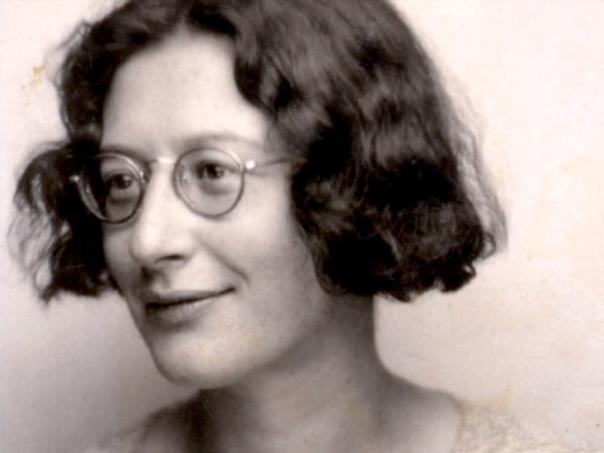 List of Temptations (to be read every morning):
Temptation of idleness (by far the strongest)
Never surrender to the flow of time. Never put off what you have decided to do.
Temptation of the inner life
Deal only with those difficulties which actually confront you. Allow yourself only those feelings which are actually called upon for effective use or else are required by thought for the sake of inspiration. Cut away ruthlessly everything that is imaginary in your feelings.
Temptation of self-immolation
Subordinate to external affairs and people everything that is subjective, but never the subject itself — i.e. your judgement. Never promise and never give to another more than you would demand from yourself if you were he.
Temptation to dominate
Temptation of perversity
Never react to an evil in such a way as to augment it.
Refuse to be an accomplice. Don’t lie — don’t keep your eyes shut…
__
Two internal obstacles to be overcome:
Cowardice before the flight of time (mania for putting things off — idleness…)
Illusion that time, of itself, will bring me courage and energy…. In fact, it is usually the contrary (sleepiness). Say to yourself: And suppose I should remain always what I am at this moment? … Never put something off indefinitely, but only to a definitely fixed time. Try to do this even when it is impossible (headaches…). Exercises: decide to do something, no matter what, and do it exactly at a certain time.
You live in a dream. You are waiting to begin to live….
__
One must develop a habit. Training.
Distinguish between the things I can put off, and those [I cannot].
Begin the training with small things, those for which inspiration is useless…
Every day, do 2 or 3 things of no interest at some definitely appointed time.
Reach the point where punctuality is automatic and effortless. — Lack of flexibility of imagination. An obstacle to be methodically overcome. The second screen between reality and yourself. Much more difficult. What is needed is something quite different from a methodical training… But precious.
__
From First and Last Notebooks.
Capacious video for the track from Tomorrow’s Harvest (Warp Records, 2013).
Giovanni Battista Pergolesi (1710-1736)
– STABAT MATER –
Duet: Stabat Mater Dolorosa
Mirella FRENI, Soprano
Teresa BERGANZA, Alto
Solisti dell’orchestra “Scarlatti” di Napoli
Ettore GRACIS, Conductor
Recording: 1972
Pause to watch, listen and reflect.
Have you ever experienced the weird magic of coming across something obliquely on Youtube, on your way somewhere else, and it speaks so powerfully, so uncannily, to all the things happening right now around you that all the hairs on your body stand on end? This is one of those times. The scene comes from a 1952 film called The Member of the Wedding, based on the book/play by Carson McCullers, starring Ethel Waters, Julie Harris and Brandon De Wilde. I came across it because my housemate Khanyi and I were singing this old hymn, hamming it up Lauryn-Hill-in-Sister-Act-2 style. I wanted to check out some of the older versions… and this clip revealed itself to me, complete with contextual preamble.
Just to tether this to a little of my own current context (I unfortunately don’t have time to write much right now), here is something written by one of my MPhil classmates about the student protests demanding the removal of the statue of Cecil John Rhodes that are currently happening at UCT, and here is the official SRC statement on the matter.

The Lamp of the Body
22“The lamp of the body is the eye. If therefore your eye is sound, your whole body will be full of light. 23But if your eye is evil, your whole body will be full of darkness. If therefore the light that is in you is darkness, how great is the darkness!
24“No one can serve two masters, for either he will hate the one and love the other; or else he will be devoted to one and despise the other. You can’t serve both God and Mammon.
Do Not Worry
25Therefore, I tell you, don’t be anxious for your life: what you will eat, or what you will drink; nor yet for your body, what you will wear. Isn’t life more than food, and the body more than clothing? 26See the birds of the sky, that they don’t sow, neither do they reap, nor gather into barns. Your heavenly Father feeds them. Aren’t you of much more value than they?27“Which of you, by being anxious, can add one moment to his lifespan? 28Why are you anxious about clothing? Consider the lilies of the field, how they grow. They don’t toil, neither do they spin, 29yet I tell you that even Solomon in all his glory was not dressed like one of these. 30But if God so clothes the grass of the field, which today exists, and tomorrow is thrown into the oven, won’t he much more clothe you, you of little faith? 31“Therefore don’t be anxious, saying, ‘What will we eat?’, ‘What will we drink?’ or, ‘With what will we be clothed?’ 32For the Gentiles seek after all these things; for your heavenly Father knows that you need all these things. 33But seek first God’s Kingdom, and his righteousness; and all these things will be given to you as well.
34Therefore don’t be anxious for tomorrow, for tomorrow will be anxious for itself. Each day’s own evil is sufficient.”
Excerpt from Wim Wender’s Wings of Desire (1987).

From Lazer Guided Melodies (1992).
Apparently this is a performance from French TV in the early ’80s. Mesmerising.
I pull out the plank and say, “Thank you for yanking me
Back to the fact that there’s always something to distract.”
Karen Dalton makes everything feel right… Summerville, Colorado, 1970. From Karen Dalton’s “Cotton Eyed Joe” double CD & DVD U.S. release on Delmore Recordings.
There’s a really interesting discussion thread about the origins of this song HERE.
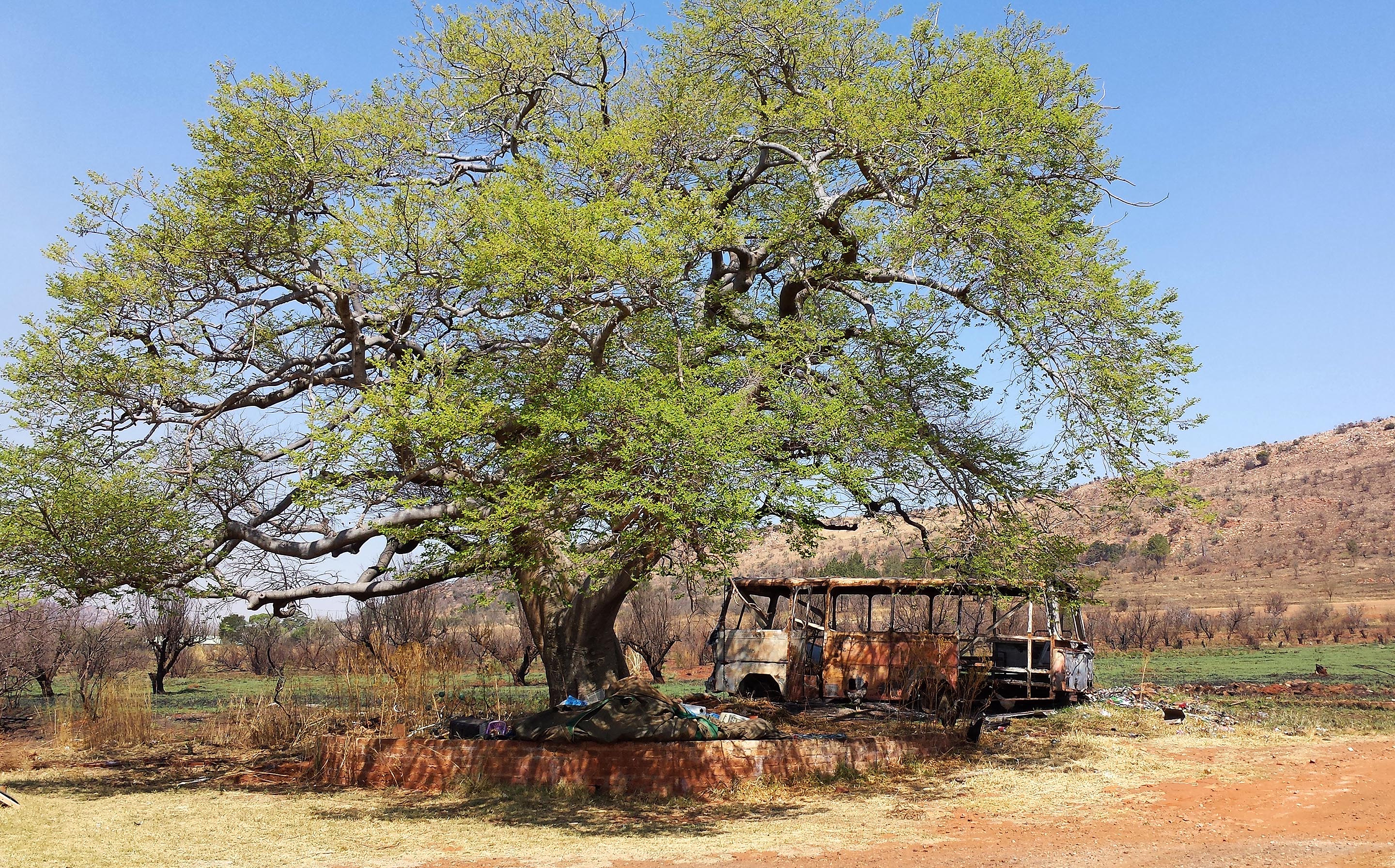
Just incredible. I wish I could have seen her perform, just once.
Tracklisting:
1976
1. Little Girl Blue
2. Backlash Blues
3. Be My Husband
4. I Wish I Knew (How It Would Feel to be Free)
5. Stars / Feelings
6. African Mailman
1987
7. Someone to Watch Over Me
8. My Baby Just Cares For Me
1990
9. I Loves You Porgy
10. Liberian Calypso
11. Four Women / Mississippi Goddam
12. Ne Me Quitte Pas (Don’t Leave Me)
Victrola record (Canadian Berliner) 88483 [275]. “Berceuse de Jocelyn” (“Angels Guard Thee”), written by Benjamin Godard. John McCormack – tenor, Fritz Kreisler – violin, Vincent O’Brien – pianoforte. First issued circa late 1914.
Beneath the quivering leaves, where shelter comes at last,
All sadness sinks to rest, or glides into the past.
Her sweet eyes prismed now in their soft silken bowers,
Oh my love, calm she sleeps beneath the trembling stars.
Awake not yet from thy repose,
A fair dream spirit hovers near thee,
Weaving a web of gold and rose,
Through dreamland’s happy isles to bear thee.
Sleep, love, it is not yet the dawn,
Angels guard thee, sweet love, till morn.
Far from the noisy throng, by song birds lulled to rest,
Where rock the branches high by breezes soft caress’d;
Softly the days go on, by sorrow all unharm’d,
Thus may life be to thee a sweet existence charm’d.
Ah! wake not yet from thy repose,
A fair dream spirit hovers near thee,
Weaving a web of gold and rose,
Through dreamland’s happy isles to bear thee!
Sleep, love, it is not yet the dawn,
Angels guard thee, sweet love, til morn!
“Compassion hurts. When you feel connected to everything, you also feel responsible for everything. And you cannot turn away. Your destiny is bound with the destinies of others. You must either learn to carry the Universe or be crushed by it. You must grow strong enough to love the world, yet empty enough to sit down at the same table with its worst horrors.”
― Andrew Boyd, in Daily Afflictions: The Agony of Being Connected to Everything in the Universe (W W Norton & Company, 2002).
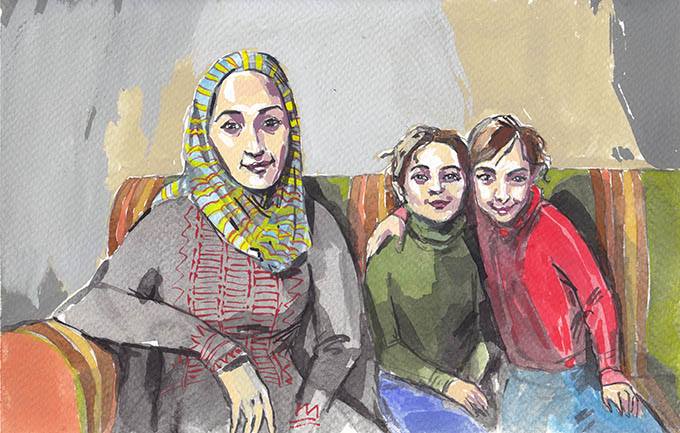
A mother and two little girls, Palestine. Lizza Littlewort, July 2014
Q: Lizza, did you paint this from a photo? I want to post these on Fleurmach and include context if there is some.
A: The likenesses are so bad there’s not much point referring to the originals… which I guess is a good thing, because I don’t feel like I’m violating anyone’s privacy. I’ve been working in a way where I strive for immediacy by going straight into paint with no pencil work underneath, so it’s pot luck how it turns out. The subjects are Palestinian though, I can say that much! I wanted to be sure to get a mood which is realistic. I want to do more of people in Palestine being human.
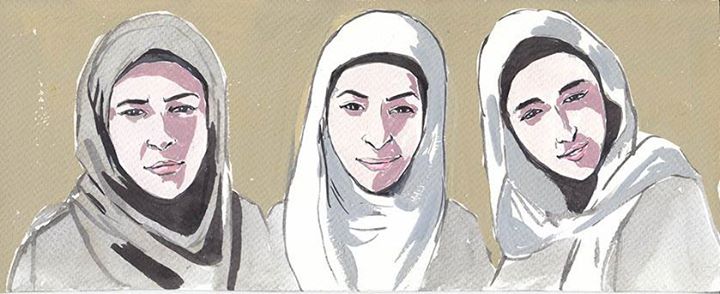
Three national coordinators of Tomorrow Youth Organisation, Palestine. Lizza Littlewort, July 2014.
I feel with some passion that what we truly are is private, and almost infinitely complex, and ambiguous, and both external and internal, and double- or triple- or multiply natured, and largely mysterious even to ourselves; and furthermore that what we are is only part of us, because identity, unlike “identity”, must include what we do.
And I think that to find oneself and every aspect of this complexity reduced in the public mind to one property that apparently subsumes all the rest (“gay”, “black”, “Muslim”, whatever) is to be the victim of a piece of extraordinary intellectual vulgarity. Literally vulgar: from vulgus. It’s crowd-thought.
— Philip Pullman
 fleurmach