it’s hallowe’en!

… And I’m in Ireland, so i asked the ghost in the machine to post these on my behalf :)


Albert Ayler – Spirits (1964)


Disney’s Silly Symphony (1929)


Screaming Lord Sutch & The Savages – ‘Til The Following Night(1961)


Blacktop – “From Beyond”. Blacktop was a short-lived swamp-rock project from the mid ’90s by unheralded genius singer/guitarist Mick Collins of the Gories and the Dirtbombs.


The Bar-Kays – Holy Ghost


Kristin Hersh feat. Michael Stipe – Your Ghost


Clara Rockmore – Nocturne in C# minor

metaphors for abandonment: exploring urban ruins

The photographs in this post are of an abandoned hot springs resort/health spa, taken by me in July 2009. The resort is situated in Aliwal North, a tiny town on the border of South Africa’s Free State and Eastern Cape provinces. During Victorian times, and continuing into the dark era of Apartheid, this settlement on the Orange River was a popular holiday destination (whose amenities would have been available to whites only). I was stuck here for several days following a car accident, so I went exploring. I was told by a local that the resort had fallen into disrepair only recently, in the past decade, due to mismanagement of the allocated maintenance funds. I wondered to what extent this might reflect a rejection of the resort’s oppressive past by its post-1994 custodians.

I share the fascination with documenting ruins and decay that is the subject of the following excerpt from the excellent blog, Archaeology and Material Culture:

An astounding number of web pages document abandoned materiality, encompassing a broad range of architectural spaces including asylumsbowling alleys,industrial sitesCold War sites, and roadside motels as well as smaller things like pianosand even scale models of abandonment. This ruination lust is not simply the province of a small handful of visual artists, hipsters colonizing Detroit, or recalcitrant trespassers; instead, it invokes something that reaches far deeper socially, has international dimensions, extends well into the past, and reflects a deep-seated fascination with—if not apprehension of—abandonment. The question is what explains our apparently sudden collective fascination with abandonment, ruination, and decay. The answers are exceptionally complex and highly individual, but there seem to be some recurrent metaphors in these discourses.

For “urban explorers” (a term that might loosely include artists, photographers, archaeologists, and curious folks alike), such journeys seek out “abandoned, unseen, and off-limits” spaces that imagine ruination in a wide range of artistic, emotional, scholarly, and political forms. Many of these urban explorers and artists see themselves as visual historians, documenting the architectural and community heritage reflected in abandoned spaces. For instance, Jonathan Haeber’s urban exploration blog Bearings explains that “I’m just an eye. I’m just a camera. … An urban explorer is just a documentarian. … We only appreciate the creations that are overlooked. … It is what remains that is the democratic equivalent of a revolution.” Continue reading

on the proliferation of magical stories


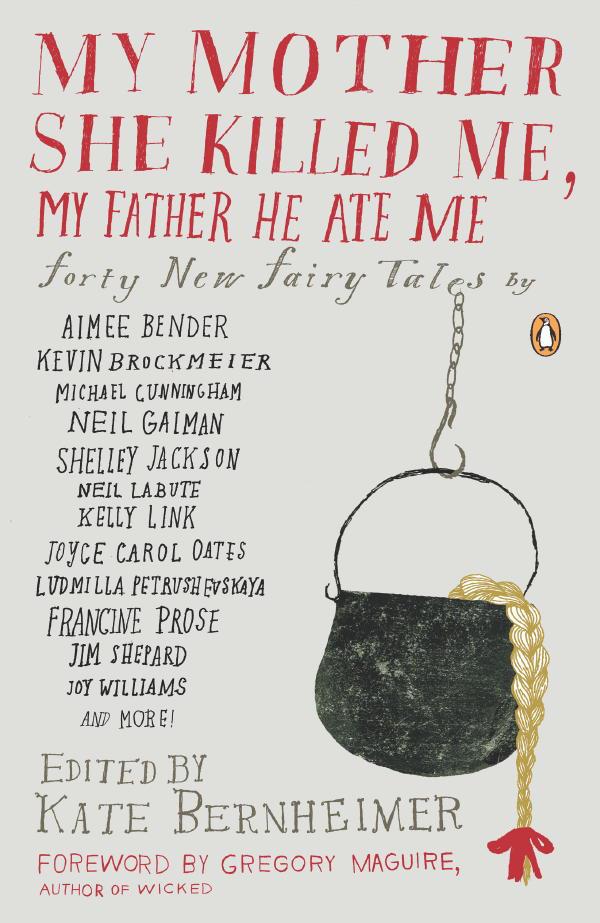
“I have a sense that a proliferation of magical stories, especially fairy tales, is correlated to a growing awareness of human separation from the wild and natural world. In fairy tales, the human and animal worlds are equal and mutually dependent. The violence, suffering and beauty are shared. Those drawn to fairy tales, perhaps, wish for a world that might live “forever after”. My work as a preservationist of fairy tales is entwined with all kinds of extinction.”

– Kate Bernheimer in the Introduction to My Mother She Killed Me, My Father He Ate Me: Forty New Fairy Tales (Penguin, 2010)

jolie holland – alley flowers

From her debut album, Catalpa (2003). It’s my favourite album of hers, I think – gorgeously hypnotic, and impossible to place in space and time. It’s like she’s channelling the voice of a ghost out of early 20th century America’s Deep South… The words from her milk-white throat weave an occult journey, harking back even further – the lolloping, liquid rhythm of this song could be straight out of West Africa.

Quote from Amazon.com:
“If you didn’t know what it was, you’d swear it was recorded in the field 70 years ago. The outright primitive audio quality, acoustic instruments, the little mistakes and coughs left in… it’s a diamond in the rough, left uncut because there’s so much beauty in the imperfections.

“Then you notice the opening track’s [“Alley Flowers”] muffled frame-drum percussion is playing a “cabalistic” 12/8 against the guitar and vocal’s 4/4, the lyrical fantistical concreteness reminiscent of Syd Barrett or Hank Williams, the fluid soprano that sounds utterly self-taught, and you know it’s not an ordinary folk album at all.

“This is very, very different music from almost anything you’re likely to hear, especially in this day of cheap semi-pro equipment and easy software editing. But it’s truly miraculous.”

emily brontë – wuthering heights

Heaven did not seem to be my home; and I broke my heart with weeping to come back to earth; and the angels were so angry that they flung me out into the middle of the heath on the top of Wuthering Heights; where I woke sobbing for joy. That will do to explain my secret, as well as the other. I’ve no more business to marry Edgar Linton than I have to be in heaven; and if the wicked man in there had not brought Heathcliff so low I shouldn’t have thought of it. It would degrade me to marry Heathcliff now; so he shall never know how I love him; and that not because he’s handsome, Nelly, but because he’s more myself than I am. Whatever our souls are made of, his and mine are the same, and Linton’s is as different as a moonbeam from lightning, or frost from fire…

… I cannot express it; but surely you and everybody have a notion that there is, or should be an existence of yours beyond you. What were the use of creation if I were entirely contained here? My great miseries in this world have been Heathcliff’s miseries, and I watched and felt each from the beginning; my great thought in living is himself. If all else perished, and he remained, I should still continue to be; and all else remained, and he were annihilated, the universe would turn to a mighty stranger; I should not seem a part of it. My love for Linton is like the foliage in the woods. Time will change it, I’m well aware, as winter changes the trees — my love for Heathcliff resembles the eternal rocks beneath — a source of little visible delight, but necessary. Nelly, I am Heathcliff — he’s always, always in my mind — not as a pleasure, any more than I am always a pleasure to myself — but as my own being — so, don’t talk of our separation again — it is impracticable.
~ Catherine Earnshaw (Ch. IX).

_____
Wuthering Heights is the only published novel by Emily Brontë, written between October 1845 and June 1846 and published in July of the following year. It was not printed until December 1847 under the pseudonym Ellis Bell, after the success of her sister Charlotte Brontë’s novel Jane Eyre. A posthumous second edition was edited by Charlotte in 1850.

kate bush – wuthering heights

Official music video (version 1) for the single “Wuthering Heights” – Kate’s debut single. Released in January 1978, it became a No.1 hit in the UK singles chart and remains Kate’s biggest-selling single. The song appears on Kate’s 1978 debut album, The Kick Inside, and was also re-recorded in 1986 for the greatest-hits album The Whole Story.

kierkegaard on transcending despair

The despairing man who is unconscious of being in despair is, in comparison with him who is conscious of it, merely a negative step further from the truth and from salvation. Despair itself is a negativity, unconsciousness of it is a new negativity. But to reach truth one must pierce through every negativity. For here applies what the fairy tale recounts about a certain enchantment: the piece of music must be played through backward; otherwise the enchantment is not broken.

~ Søren Kierkegaard (under the pseudonym Anti-Climacus) – from The Sickness Unto Death (1849)

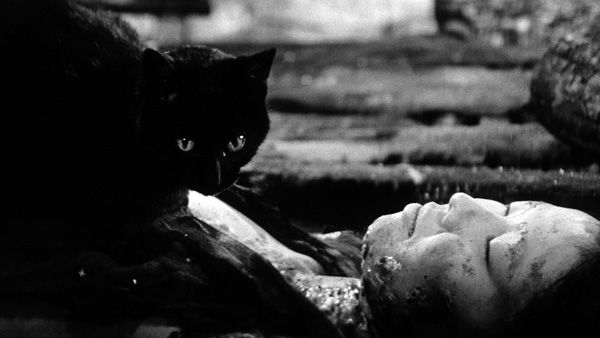
kuroneko (1968) showing tonight in cape town

Showing tonight at 20h15 at Labia on Orange, in association with the Good Film Society.

In this poetic and atmospheric horror fable, set in a village in war-torn medieval Japan, a malevolent spirit has been ripping out the throats of itinerant samurai. When a military hero is sent to dispatch the unseen force, he finds that he must struggle with his own personal demons as well. From Kaneto Shindo, director of the terror classic Onibaba, Kuroneko (Black Cat) is a spectacularly eerie twilight tale with a shocking feminist angle, evoked through ghostly special effects and mindblowingly awesome visuals.

Maitland McDonagh on Kuroneko: The Mark of the Cat
Scratch the surface of a contemporary J-horror classic like Ringu (1998) or any of the Ju-on films (2000–03) and you’ll glimpse Yabu no naka no kuroneko (Black Cat from the Grove), released in the U.S. as simply Kuroneko (1968). Shot in shimmering, widescreen black and white and suffused with an unsettling eroticism, Kaneto Shindo’s elegant nightmare of earthbound violence and otherworldly revenge wasn’t the first film to be rooted in Japanese folk stories about onryo, the vengeful spirits of those who were abused in life, usually women, whose rage is so great it can’t be contained.

The Ghost of Yotsuya (Nobuo Nakagawa, 1959) and Kwaidan (Masaki Kobayashi, 1965) both preceded it, and other classics of Japan’s golden age of filmmaking—notably Kenji Mizoguchi’s Ugetsu (1953)—featured female spirits. And supernatural cats had appeared in Black Cat Mansion (Nakagawa, 1958) and The Ghost Cat of Otama Pond (Yoshihiro Ishikawa, 1960). But Shindo drew those threads together and wove them into Kuroneko’s unprecedentedly unnerving women, whose descendents are now many, and into a terrifically spooky story whose resonance extends beyond the satisfying chill of an exotic campfire tale and whose wrenching psychological anguish transcends specific cultural traditions…

… Western folklore regularly puts cats in general, and black cats in particular, in league with witches and other dark forces, but Japanese folktales are more ambiguous, starting with the fact that, while all felines are suspected of being more than handy mousers and cute house pets, they allow for two kinds of supernatural cats, the manekineko and the bakeneko. Anyone who has eaten in a Japanese restaurant knows what a manekineko looks like: perched somewhere near the cash register, it sits with one paw raised in greeting and the other resting on a coin, benevolently beckoning good fortune to come on in and stay awhile—Hello, Hello Kitty! Thebakeneko, by contrast, is kissing cousin to the shape-shifting fox (kitsune) and the sly, mischievous tanuki (a small, scruffily kawaii canid native to East Asia): none are inherently evil, but all are capable of using their supernatural knack for mimicking other creatures—including human beings—to stir up trouble. That said, the fact that bakeneko often eat the person whose form they’ve taken suggests they’re less amusing and more alarming than their fellow shapeshifters, and the shadow of feline malevolence lurks in Kuroneko’s fog-swirled gloom.

Read more of Maitland McDonagh’s article, which discusses the historical context of this horror masterpiece, HERE.

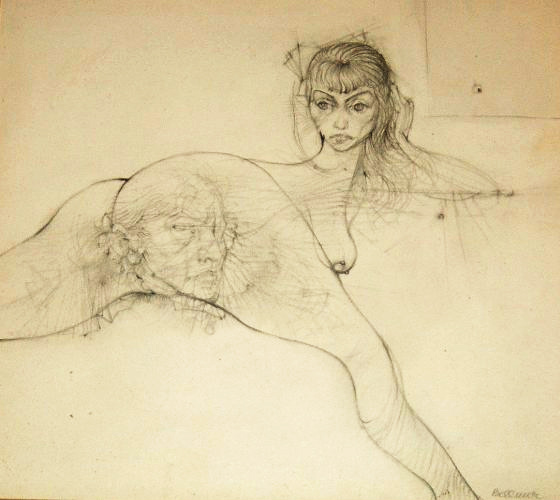
a portrait of hans bellmer, by unica zurn (1965)

HANS BELLMER: The female body…is like an endless sentence that invites us to rearrange it, so that its real meaning becomes clear through a series of endless anagrams. (1)

UNICA ZÜRN: If woman is to put into form the ‘ule’ [Greek: matter] that she is, she must not cut herself off from it nor leave it to maternity, but succeed in creating with that primary material that she is […] Otherwise, she risks using or reusing what man has already put into forms, especially about her, risks remaking what has already been made, and losing herself in that labyrinth. (2)

A Portrait of Hans Bellmer
Unica Zurn, 1965

References
(1) Webb P.& Short R., Hans Bellmer (New York: Quartet Books, 1985). Cited in: Miranda Argyle, “Hans Bellmer and The Games of the Doll” (Online Publication, 2004).
(2) Quote cited in: Subversive Intent: Gender, Politics, and the Avant-Gardex by Susan Rubin Suleiman (Cambridge, MA: Harvard University Press, 1990). 

søren kierkegaard on anxiety

In a logical system, it is convenient to say that possibility passes over into actuality. However, in actuality it is not so convenient, and an intermediate term is required. The intermediate term is anxiety… Anxiety is neither a category of necessity nor a category of freedom; it is entangled freedom, where freedom is not free in itself but entangled, not by necessity, but in itself…

… Anxiety may be compared with dizziness. He whose eye happens to look down into the yawning abyss becomes dizzy. But what is the reason for this? It is just as much in his own eye as in the abyss, for suppose he had not looked down. Hence anxiety is the dizziness of freedom, which emerges when the spirit wants to posit the synthesis and freedom looks down into its own possiblity, laying hold of finiteness to support itself. Freedom succumbs in this dizziness. Further than this, psychology cannot and will not go. In that very moment everything is changed, and freedom, when it again rises, sees that it is guilty. Between these two moments lies the leap, which no science has explained and which no science can explain.

~ Søren Kierkegaard (under the pseudonym Vigilius Haufniensis) – from The Concept of Anxiety (1844)

niklas zimmer – thinking aloud through the archives that sound

Along with Niklas, I attended a fascinating workshop at UCT last month – these are his reflections:

From August 22 to 24 this year, the Archive and Public Culture research initiative hosted a workshop, led by research fellow Dr Anette Hoffmann, under the title ‘sound/archive/voice/object.’ True to the trans-disciplinary spirit of APC, the range of academic positions present was heterogeneous, but beyond that, this workshop attracted a significant set of participants from beyond the institution: over three days in the much-loved Jon Berndt thought space, the voices of radio activism, sound art, turntablism and composition for film and theatre cross-faded with those of ethnomusicology, social anthropology, fine art and historical studies.

Dr Hoffmann’s carefully staged set of daily readings, gentle chairing and inspiring listening experiences of samples of ethnographic phonograph-recordings from Berlin’s Lautarchiv enabled us to begin thinking through the subject of sound in all its complexity. While ‘visual culture’ with its associated tropes has become commonplace, the same cannot be said for ‘sonic’ or ‘aural culture’ – the need for understanding sound (historically, psychologically, physiologically, etc.) is immanent, particularly when dealing with records of human subject research in the archive.

‘… sound is a product of the human senses and not a thing in the world apart from humans. Sound is a little piece of the vibrating world.’ (Jonathan Sterne)

As with other investigations into reproduction technologies developed in the 19th century (such as photography), a detailed understanding of the political, scientific and cultural drives that gave birth to them in the first place is key to surfacing relevant, contemporary perspectives on the audio archive. Studies into sound – and in particular the ethnographic voice recording – have so far remained in relative specialist isolation. In contrast to this, studies of visuality – and in particular ethnographic photographic portraiture – have been gaining interdisciplinary popularity. Beyond the misalignments of comparison between the two, and despite the multitude of overlaps between the orders of the eye and the ear, it becomes clear that the realms of the aural (or sonic) and the visual do require different sets of analytical tools.

‘The vocabulary may well distinguish nuances of meaning, but words fail us when we are faced with the intimate shades of the voice, which infinitely exceed meaning. (…) faced with the voice, words structurally fail.’ (Mladen Dolar)

Passive hearing and active listening involve a complex range of affective and cognitive processes which are incomparable to those associated with any other sense (other than perhaps touch) – any discussion of differences in technology for the capture and representation of aural as opposed to visual phenomena can only be secondary to this. In the shared process of active listening at the beginning of each workshop morning, the group sensed its way into some of the qualities of sound, particularly those of the speaking voice. We discovered that we are able to hear much more than we tend to trust ourselves to. The ethnographic and linguistic phonographic recordings of prisoners of war in WWI Germany from the Humboldt University’s Lautarchiv in Berlin revealed to us as listeners a small, but powerful glimpse into the potential of a different way of working with archival material. Because the transcripts and translations of the recordings were withheld until after the first listening-through, we relied on our own emotional and intellectual inferences in order to engage the questions that these ‘sound objects’ from the past carried into our present space. Listening engages us in a different way of knowing, as Dr Hoffmann pointed out, and ‘if the process of enunciation points at the locus of subjectivity in language, then voice also sustains an intimate link with the very notion of the subject.’ (Mladen Dolar)

Generally, the bigger paradigm of any research interest will at first tend towards sacrificing the individual voice to generalisation and dissection rather than a ‘regime of care’ as Prof Hamilton would remind us: sounds, in particular human voices on record are always re-presented in a web of power-relations, some of which are near-impossible to address, let alone shift. This becomes most paradoxical in thinking though the subaltern speaking position in the archive, where not only the act of recording has been an act of violence, but where the act of listening itself can be an act of othering and continued silencing. In view of this (in sound of this?), the best possible approach to reaching the necessary ‘audio condition’ from which to push at the limits of subaltern positionalities in the archive seems to be continuum of analysis, a reverence paid to the minutiae of humanity in the material. This was a recurring moment, a leitmotiv in our three days of sound studies: only a wide range of disciplines working together can actually achieve the description of the necessary aspects (aesthetic, ethical, cultural, historical, political, psychological) from which to consider a relevant engagement with the archive that sounds.

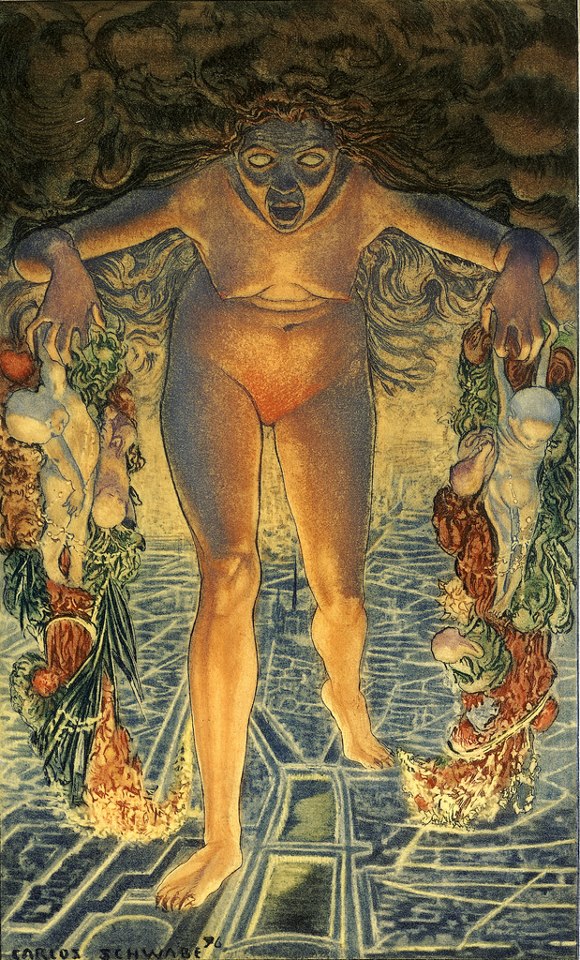
charles baudelaire – le crépuscule du soir (evening twilight)

Carlos Schwabe
“Le crépuscule du soir”
from Fleurs du Mal (1900)


This poem is from Baudelaire’s 1861 masterpiece, Les Fleurs du Mal (read the original French, as well as two more, quite divergent, translations HERE):

Evening Twilight

Delightful evening, partner of the crook,
Steals in, wolf-padded, like a complice: look:
Heaven, like a garret, closes to the day,
And Man, impatient, turns a beast of prey.

Sweet evening, loved by those whose arms can tell,
Without a lie, “Today we’ve laboured well:”
Sweet evening, it is she who brings relief
To men with souls devoured by one fierce grief,
Obstinate thinkers drowsy in the head,
And toil-bent workmen groping to their bed.

But insalubrious demons of the airs,
Like business people, wake to their affairs
And, flying, knock, like bats, on walls and shutters.
Now Prostitution lights up in the gutters
Across the glimmering jets the wind torments.
Like a huge ant-hive it unseals its vents.
On every side it weaves its hidden tracks
Like enemies preparing night-attacks.
It squirms within the City’s breast of mire,
A worm that steals the food that men desire.

One hears the kitchens hissing here and there,
Operas squealing, orchestras ablare.
Cheap tables d’hôte, where gaming lights the eyes,
Fill up with whores, and sharpers, their allies:
And thieves, whose office knows no truce nor rest,
Will shortly now start working, too, with zest,
Gently unhinging doors and forcing tills,
To live some days and buy their sweethearts frills.

Collect yourself, my soul, in this grave hour
And shut your ears against the din and stour.
It is the hour when sick men’s pains increase.
Death grips them by the throat, and soon they cease
Their destined task, to find the common pit.
The ward is filled with sighings. Out of it
Not all return the scented soup to taste,
Warm at the hearthside, by some loved-one placed.

But then how few among them can recall
Joys of the hearth, or ever lived at all!

— translated by Roy Campbell, Poems of Baudelaire (New York: Pantheon Books, 1952)

le journal de personne – not even in your dreams!

I am a woman – quite real – to myself
and all that is most virtual to others
accessible to myself
inaccessible to all the others
what is it that separates me from the others?
the veil of Maya, say some
the unbearable lightness of being, say others
illusions and allusions
there you have it, what protects us, the one and the others
what separates us, the ones from the others
to a friend who insisted on seeing me, I said, “not even in your dreams”
she took it badly and eclipsed herself from my mind
i was mistaken, badly mistaken, I should have told her
in dreams, why not, but not in real life
some hidden meaning… some secret meaning… some sacred meaning…
there you have it, what comprises Mystery
my life and I, we will always be out of reach
intimate intimity
Chimène* or Chimera
since ancient times the emphasis was always on the duplicity of all living things
am I a person or a personality?
real or virtual?
existence or excellence?
that I am Nobody makes my character more enigmatic but at the same time more consistent
it is paradoxical, but all who are tempted by infinity will know what I am saying
will push themselves to question Orpheus anew. He descended into hell to save Eurydice. Imagine the pain he put himself through. No, you can’t imagine, because it is unimaginable. And at the moment of returning to the surface, when he was in front and she behind him, the gods forbade him to turn around until they were both together at the other side of the barrier, on the human side, but Orpheus couldn’t restrain himself; he turned around, and lost Eurydice forever

* literary character signifying obsessive passion

(Thanks to Martin Jacklin for help with this translation. Original text HERE.)

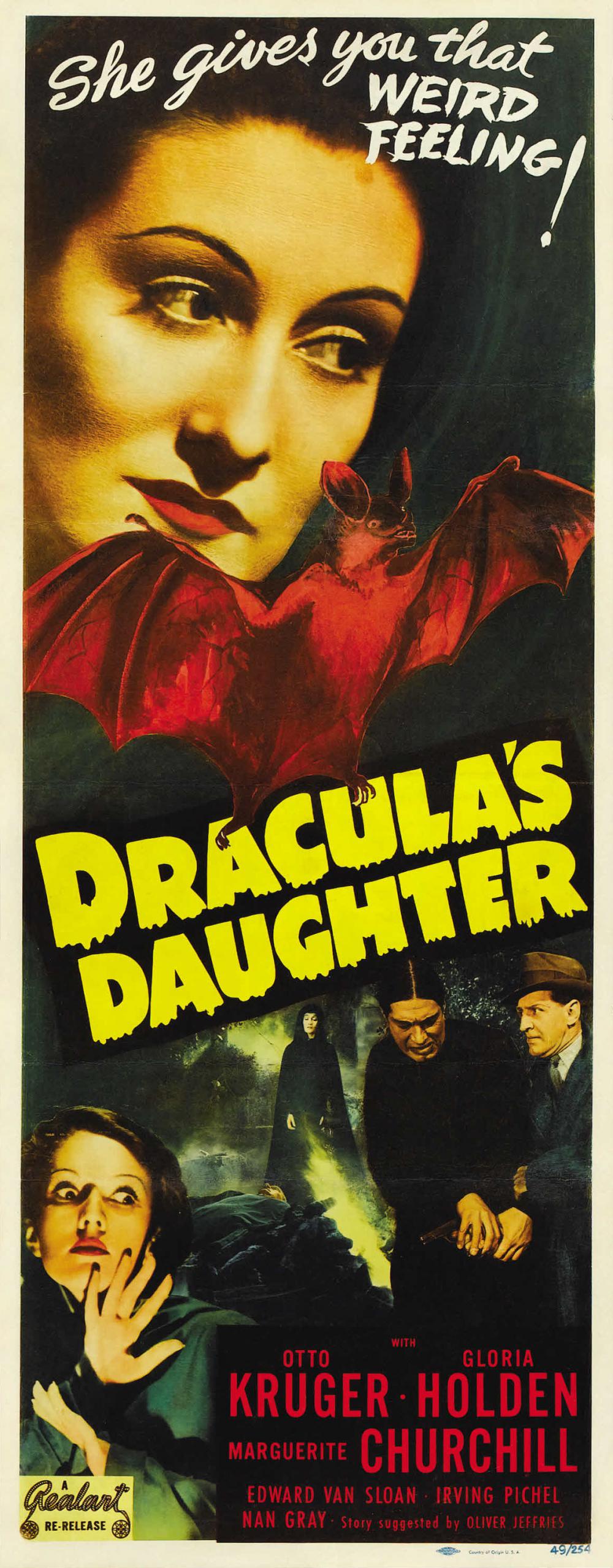
dracula’s daughter (1936)

“Why should Cecil B. DeMille have a monopoly on the great box office values of torture and cruelty?” asked John Balderton, the writer of a first draft of this long-delayed sequel to Dracula, the iconic, if somewhat tepid, 1931 version of Bram Stoker’s famous novel. Balderton envisioned a grisly horror film, full of the shrieks and cries of the damned, but his version didn’t make the cut. Instead, this version, based on one of Stoker’s stories, finally hit the screens in 1936, heavy on atmosphere and shocking (for its time) sexuality. Although it is a marked improvement on the original film, it’s still a bit of a snooze, relying too much on forced comedy and not enough on suspense or fright.

The film picks up exactly where the first film left off. Von Helsing (Edward Van Sloan), who was Van Helsing in the first film, has just offed Dracula, and Whitby constables stumble on the scene and arrest him as a murderer. The constable in charge is faced with quite a decision: try Von Helsing for murder and likely hang him, put him in the looney bin because of all his talk about vampires, or believe him. Von Helsing implores him to call on one of his former students, the renowned psychologist Dr. Garth (Otto Kruger), to help clear him.

Meanwhile, before things can get underway, a mysterious woman steals Dracula’s body and destroys it. Gloria Holden is Countess Zaleska, the titular daughter. She thinks that destroying her father’s corpse will free her from her vampiric curse, but it doesn’t work, as is obvious as soon as she returns to London and starts ogling the necks of dapper young men. It doesn’t help that her helper Sandor (Irving Pichel, who co-directed the great action film The Most Dangerous Game) keeps taunting her about how much she needs blood. The film treats vampirism as more of an addiction than an evil curse, and it’s fitting that she keeps an enabler around to sabotage her efforts to get clean.

After meeting Dr. Garth at a party, she decides that his experiments in hypnosis will help her. She attempts to seduce him, but he’s wary, especially as the body count in London starts to rise, as victims with strange puncture wounds on their necks start turning up. In the centerpiece of the film, as Zaleska attempts to do some painting to distract her from her need for blood, she enlists Sandor to bring her a model, Lili (Nan Grey).

Read more here

on chaos, creation and destruction

From Principia Discordia:

CONVENTIONAL CHAOS – GREYFACE

In the year 1166 B.C., a malcontented hunchbrain by the name of Greyface got it into his head that the universe was as humorless as he, and he began to teach that play was sinful because it contradicted the ways of Serious Order. “Look at all the order around you,” he said. And from that, he deluded honest men to believe that reality was a straightjacket affair and not the happy romance as men had known it.

It is not presently understood why men were so gullible at that particular time, for absolutely no one thought to observe all the disorder around them and conclude just the opposite. But anyway, Greyface and his followers took the game of playing at life more seriously than they took life itself and were known even to destroy other living beings whose ways of life differed from their own.

The unfortunate result of this is that mankind has since been suffering from a psychological and spiritual imbalance. Imbalance causes frustration, and frustration causes fear. And fear makes for a bad trip. Man has been on a bad trip for a long time now.

It is called THE CURSE OF GREYFACE.

Bullshit makes
the flowers grow
& that’s beautiful.

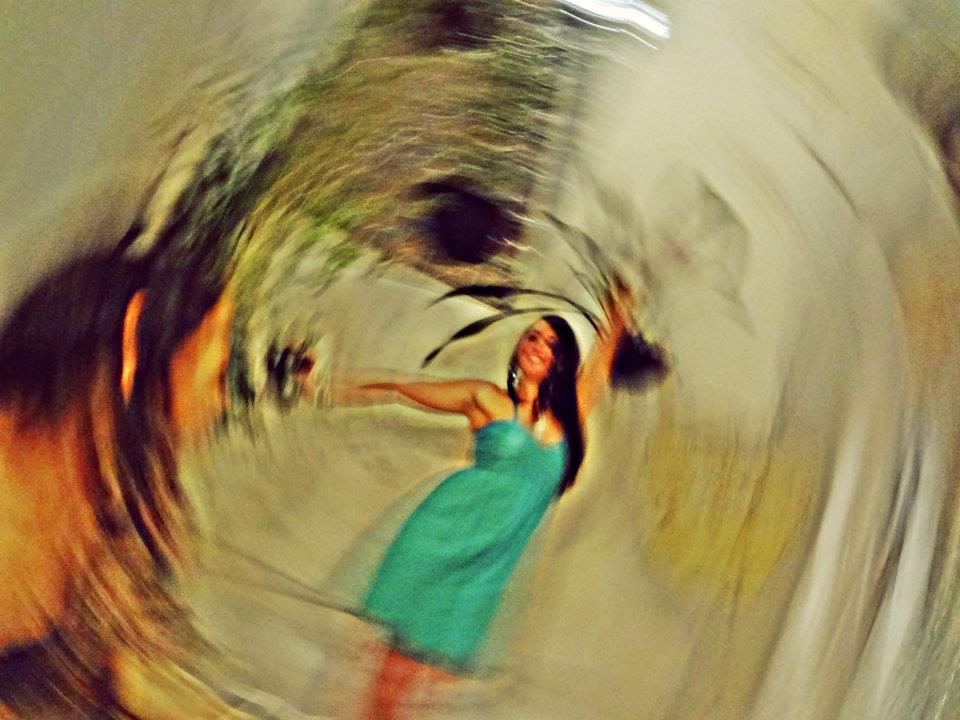
Photo: Motlatsi Khosi

THE CURSE OF GREYFACE AND THE INTRODUCTION OF NEGATIVISM

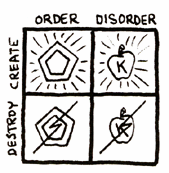
To choose order over disorder, or disorder over order, is to accept a trip composed of both the creative and the destructive. But to choose the creative over the destructive is an all-creative trip composed of both order and disorder. To accomplish this, one need only accept creative disorder along with, and equal to, creative order, and also be willing to reject destructive order as an undesirable equal to destructive disorder.

The Curse of Greyface included the division of life into order/disorder as the essential positive/negative polarity, instead of building a game foundation with creative/destructive as the essential positive/negative. He has thereby caused man to endure the destructive aspects of order and has prevented man from effectively participating in the creative uses of disorder. Civilization reflects this unfortunate division.

POEE proclaims that the other division is preferable, and we work toward the proposition that creative disorder, like creative order, is possible and desirable; and that destructive order, like destructive disorder, is unnecessary and undesirable.

Seek the Sacred Chao – therein you will find the foolishness of all ORDER/DISORDER. They are the same!

Read the whole text of POEE’s “Principia Discordia” here.