Album: Cut
Year: 1979
Album: Cut
Year: 1979
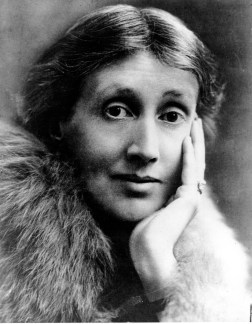
Undated photo of Virginia Woolf. (AP Photo)
I told you in the course of this paper that Shakespeare had a sister; but do not look for her in Sir Sidney Lee’s life of the poet. She died young – alas, she never wrote a word. She lies buried where the omnibuses now stop, opposite the Elephant and Castle. Now my belief is that this poet who never wrote a word and was buried at the crossroads still lives.
She lives in you and in me, and in many other women who are not here tonight, for they are washing up the dishes and putting the children to bed. But she lives; for great poets do not die; they are continuing presences; they need only the opportunity to walk among us in the flesh. This opportunity, as I think, it is now coming within your power to give her.
For my belief is that if we live another century or so – I am talking of the common life which is the real life and not of the little separate lives which we live as individuals – and have five hundred a year each of us and rooms of our own; if we have the habit of freedom and the courage to write exactly what we think; if we escape a little from the common sitting-room and see human beings not always in their relation to each other but in relation to reality; and the sky, too, and the trees or whatever it may be in themselves; if we look past Milton’s hogey, for no human being should shut out the view; if we face the fact, for it is a fact, that there is no arm to cling to, but that we go alone and that our relation is to the world of reality and not only to the world of men and women, then the opportunity will come and the dead poet who was Shakespeare’s sister will put on the body which she has so often laid down.
Drawing her life from the lives of the unknown who were her forerunners, as her brother did before her, she will be born. As for her coming without that preparation, without that effort on our part, without that determination that when she is born again she shall find it possible to live and write her poetry, that we cannot expect, for that would be impossible. But I maintain that she would come if we worked for her, and that so to work, even in poverty and obscurity, is worthwhile.
From the album Ende Neu (Mute Records,1996).
Something wonderful I came across HERE this week while trying to find Rock Rose essential oil online.
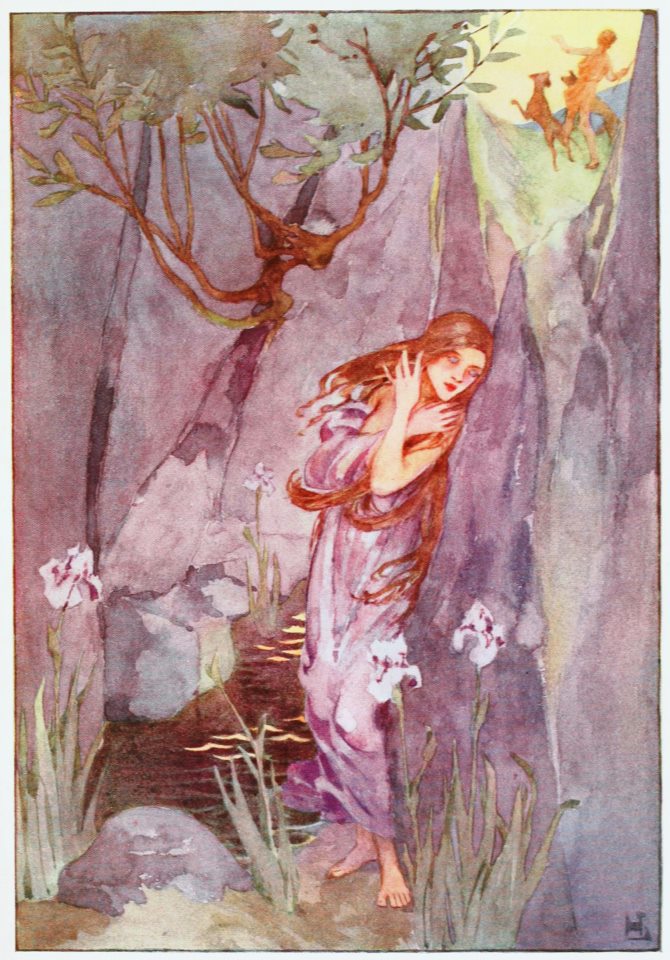
Echo and Narcissus. Helen Stratton, 1915.
The daffodil has been adopted by both the American Cancer Society, and the Madame Curie Society, for whom it symbolizes simultaneously hope and disease. The Greeks today call N. tazetta Dakrakia, “Little Tear Drops,” as this flower’s association with grief and the dead is both exceedingly ancient, and modern.
The legend of Echo’s fertility daemon Narcissus, who pined to death desiring his own reflection, is parallelled by similar flower boys such as Adonis “the scentless rose” (i.e., a windflower or anemone) who was the slain beloved of both Aphrodite and Persephone; and Hyacinthus, the slain catamite of Zeus and Apollo; and the hidden son of Aphrodite, Hermaphroditus, cavern-raised in secret by naiads of Cybele’s Mount Ida. He came to the Fountain of Queen Salmacis, to whom boxwood and clinging ivy was sacred, and he became one with Salmacis after drinking of her mystic waters, achieving a unity which Narcissus appears likewise but unsuccessfully to have sought.
Like these others, Narcissus is fundamentally impotent or sexless, though erotically appealing to goddesses or nymphs and even to the more masculine gods. We are reminded that Cybele’s boy companion Attis, born of an almond tree was, like Narcissus, sexually incapable – indeed was literally unmanned. Such sexless lads seem to originate in a very early level of myth when the Mother Goddess, being Absolute, had no actual consort, at a time when the male principle was at most a companion, son, or a priest who had unsexed himself.
Most such fertility daemons are straightforward “dying and reborn” grain-divinities, including even Jesus whose worshippers co-opted the daffodil as well as the lily as symbols of death and Easter resurrection. But Narcissus appears additionally to be partly related to a large number of female nymphs transformed directly into flowers, trees, or reeds to escape unwanted sexual encounters. Because there is something essentially female in his myth, he somewhat bridges the Attis or Galli type of mythology of self-castration, to the Daphne type of myth of nymphs escaping either lust or an unwanted marriage or the pursuit by unwanted rape by a god.
He loved his own reflection (which he mistook for female), then turned into the flower bearing his name, ignoring the erotic desires of Echo all the while. But in an alternative version, he had an incestuous affair with his twin sister, who subsequently died, and his obsession for his own reflection was due to his own resemblance to his beloved.
Echo herself had been cursed never to be able to seduce Narcissus directly, but only to repeat his words. She was, in essence, his reflection, so his sentiment that his reflection was female, or that it was his twin sister, was correct. But Echo herself is a dwindled form of a once very mighty Goddess of great antiquity, Akko, mother of all language, whose Voice was that which called forth creation at the beginning of time, and who bears a close association with the Cretan Crocus-goddess Kar.
We know that Echo’s worship was significant within the secretive rites of Demeter. One day was put aside to honor Echo during the Demeter Festival of Eleusis. The precise nature of worship at the Echo shrine was forbidden to be written down, and is today unknown. Her worship was also part of the cult of the Argive Hera; and while in Latin versions of her myth Echo angered Juno (Hera) by covering for Jove’s sundry sexual liaisons, within the Argive cult Echo was Hera’s beloved handmaiden. Echo’s central myth within this cult binds her to the erotic nature-divinity, Pan, to whom she was reluctantly betrothed, and by whom she bore a daughter, Jynx or Yunx, who cast a spell that caused Zeus to fall in love with Io, for which reason Hera turned Jynx into a wryneck bird.
Or Echo gave birth to Peitho, Goddess of Soft Speech or of Seductive Persuasion. Peitho was handmaiden to Aphrodite, and became the bride of Hermes. Peitho had her own cult in Athens, said to have been introduced to the city by none other than Theseus. She is given several genealogies and isn’t invariably a daughter of Echo, but the notion that she was Echo’s daughter was sensible in that both were associated with speaking.
Dionyssiaca calls Echo the Goddess Who Never Fails to Speak. Though in later tales this meant she was an annoying chatterbox, there is ample evidence that any negative connotation was imposed by rival cults, and that Echo was in her own right a powerful divinity. Her cult was always of a secretive kind associated with lustiness and death, and never spoken of outside the confines of secret initiations. She was depicted as an angel-like being with enormous wings hiding her mouth behind a veil, signifying secret wisdom; just such an image of Echo is shown at the top of this page, and she is clearly distinct from any sort of nymph.
As a Virgin Goddess, she rejected not only Pan, but also Poseidon who sent a flood up the mountains in pursuit of Echo. She even refused to attend the wedding of Dionysios because of her dislike of the marriage bed. It is an interesting aside that a surname for Dionysios, Antheus (“Flowery”), was an alternate name for Narcissus. Echo’s disdain for marriage would have been quite normal for huntress-goddesses or nymphs of Artemis, yet Echo may have taken her disdain for all things connubial to extremes, and insulted Dionysios when she refused to participate in the violent drunken dance of the maenadic Oreiades or Hill-nymphs at Dionysios’ wedding.
In none of her myths is Echo given a genealogy, very likely because she was part and parcel with the First Cause in that it was her Voice that called forth creation. But some have speculated she was a renegade Oreiad of Boeotia, and that she left her sister-band of the pines and oaks of the mountain forests to live alone in a deep cavern of an alpine cliff, in order to not be seen and courted by any man or god.
If she were indeed an Oreiad this would make her a sister of the Dactyls and Satyrs, perhaps even a sister of Pan. The Oreiades were sometimes likened “the female Dactyls” and were wedded to their brothers, the Dactyloi. The children of the Dactyls and Oreiades were the Curetes or Corybontes, who were priests of Cybele and defenders of infant Zeus, and were male equivalents to the raging maenads who danced madly and noisily about the hillsides.
The mother of the Oreiades and Dactyloi was the Titaness of radiant heat, Anchiale, sister of Prometheus. Their father was the Titan of hands Hekateros. The sons and daughters of Anchiale and Hekateros invented iron metallurgy and brought the Bronze Age to a close. These sons and daughters were also great artists of anything involving use of the hands, and as light-bearers were bringers of wisdom out of darkness. Though it was said that Echo was educated in the arts by the Muses, it may once have been that Echo instructed the Muses!
These Oreiades were of the same generation of divinity as the Olympians, although since these children of Anchilale secretly nurtured the infant Zeus in a mountain cavern in Crete, really they are older than the Olympians. Anchiale herself dwelt originally on Mount Ida in Crete, and later on the Phrygian Mt. Ida, which association identifies her most strongly as a byform of Cybele Idaea, greatest of the Great Goddesses, the mother of Zeus.
But it’s important to remember that Echo’s recurring association with the Oreiades never explicitly makes her one of them, and this may well be due to her having been known to be herself a Titaness of the first generation of divinity. Rather than being the Nymph of Mt. Helicon, she was an aspect of the All-Mother herself.
When Pan was spurned by Echo, he visited madness upon local goatherders and sent them raging up the mountain sides until they found Echo, ripping her to pieces and scattering her bones. The behavior of the goatherders was commonly assumed to be an activity of Dionysios’s maenads, and Echo’s fate both duplicates that of Dionysios in his infancy (when he was cut up then restored, sans penis, by Gaea) but also punishes Echo for refusing to dance the mad dance with the maeanadic Oreiades at Dionysios’s wedding.
Gaea gathered up the far-flung bones of Echo and buried her part by part in sundry cliff-faces, where not just her voice can still be heard, but where her spirit inspires poetic gift for any voice beautiful enough to sing inspired lyrics or comprehend the mystic meanings.
By all this we see that Echo had a large presence apart from the best-remembered tale of her downfall for loving Narcissus. But most revealing of her original nature is an ancient Greek assumption that she was Persephone’s personal messenger (as Hermes was the personal messenger of Zeus), and flew upon her dark wings between the living world and Thanatos bringing perfect knowledge to and from the underworld.
In this we find again the real nature of Echo, whose lips are veiled, for the secret knowledge cajoled from her is incorruptible. It was an oral tradition forbidden to be written, but she repeated it verbatim from Persephone the Maiden aspect of Hekate. This Echo is, then, the same as the Jewish Bat Kol, “Daughter Voice,” who brings news from God and repeats it verbatim in her soft womanly voice directly into the hearts and spirits of humanity. In times of need Bat Kol can be heard to speak from out of a fiery light. Echo is also encountered in Vedic religion as the Goddess Devaduti, the Divine Messenger, feminine power of communication without whom even the greatest of gods is mute.
This association of Echo with Persephone, or Black Aphrodite, feeds back to the mythology of the narcissus flower, which was sacred to Persephone. Persephone had been picking daffodils on the very day she was kidnapped into the underworld. These flowers did not formerly bow their heads, but do so now, for shame of their role in the kidnapping. A beautiful meadow of these flowers grew near the River Styx, bringing sunlight to that dark land; and during her captivity, Persephone often walked amidst these flowers.
From the lingering bits of a largely forgotten mythology, it seems probable that Echo worship regarded Her as the “spark” that dwells within each of us, that which Narcissus mistook for his twin sister, a beautiful maiden, or his soul. All the Greek words for Spirit or Soul are feminine words, and so in Greek myth the soul is often personified as a nymph or goddess, Psyche as lover of Eros being most famed of these. Not coincidentally, in Semitic and Sanskrit languages too, the words for Soul are invariably female names. The last great flourishing of Soul worship in western religion was classical gnosticism. Among Gnostics, a central idea was that Sophia (the Mother-goddess Wisdom) spun out from herself, without need of a consort, the whole of the life-force of the world, diminishing herself to become infused into the material world, the energizing power of all life. Such belief remains current in India among saktists or Kali worshippers.
So the diminished Echo is still really that earlier Creatrix trying to call out to humanity, to Narcissus, striving to correct the Error of Sophia and liberate us from the world of Matter by calling us back into the pre-created universe of light and unity. But because she is fused to us, we can never quite perceive Her as anything but a reflection of ourselves, an echo of our own voices, and we are undone by our own vanity and remain snared in the material realm.
Music video of the track from the album Tabula Rasa (1993, Mute Records), which pays clear visual homage to Luigi Russolo.

mechanical musichttps://youtu.be/8GpN5FHO60c
Russolo designed and constructed a number of noise-generating devices called Intonarumori, and assembled a noise orchestra to perform with them. A performance of his “Gran Concerto Futuristico” (1917) was met with strong disapproval and violence from the audience, as Russolo himself had predicted. None of his intoning devices have survived, though recently some have been reconstructed and used in performances. (Check this out!) Although Russolo’s works bear little resemblance to modern noise music, his pioneering creations cannot be overlooked as an essential stage in the evolution of the several genres in this category. Many artists are now familiar with Russolo’s Art of Noises manifesto.
At first the art of music sought purity, limpidity and sweetness of sound. Then different sounds were amalgamated, care being taken, however, to caress the ear with gentle harmonies. Today music, as it becomes continually more complicated, strives to amalgamate the most dissonant, strange and harsh sounds. In this way we come ever closer to noise-sound.
Antonio Russolo, another Italian Futurist composer and Luigi’s brother, produced a recording of two works featuring the original Intonarumori. The phonograph recording, made in 1921, included works entitled “Corale” and “Serenata”, which combined conventional orchestral music set against the sound of the noise machines. It is the only surviving contemporaneous sound recording of Luigi Russolo’s noise music.

Russolo, Piatti and the intonarumori
SOURCE: Good old Wikipedia.
 A case of contradictories which are true. God exists: God does not exist. Where is the problem? I am quite sure that there is a God in the sense that I am quite sure my love is not illusory. I am quite sure that there is not a God in the sense that I am quite sure nothing real can be anything like what I am able to conceive when I pronounce this word. But that which I cannot conceive is not an illusion.
There are two atheisms of which one is a purification of the notion of God.
Perhaps every evil thing has a second aspect—a purification in the course of progress towards the good—and a third which is the higher good.
We have to distinguish carefully between these three aspects because it is very dangerous for thought and for the effective conduct of life to confuse them.
Of two men who have no experience of God, he who denies him is perhaps nearer to him than the other.
The false God who is like the true one in everything, except that we cannot touch him, prevents us from ever coming to the true one.
We have to believe in a God who is like the true God in everything, except that he does not exist, since we have not reached the point where God exists.
The errors of our time come from Christianity without the supernatural. Secularization is the cause—and primarily humanism.
Religion in so far as it is a source of consolation is a hindrance to true faith: in this sense atheism is a purification. I have to be atheistic with the part of myself which is not made for God. Among those men in whom the supernatural part has not been awakened, the atheists are right and the believers wrong.
A man whose whole family had died under torture, and who had himself been tortured for a long time in a concentration camp; or a sixteenth-century Indian, the sole survivor after the total extermination of his people. Such men if they had previously believed in the mercy of God would either believe in it no longer, or else they would conceive of it quite differently from before. I have not been through such things. I know, however, that they exist; so what is the difference?
I must move towards an abiding conception of the divine mercy, a conception which does not change whatever event destiny may send upon me and which can be communicated to no matter what human being.
__
*God does not in fact exist in the same way as created things which form the only object of experience for our natural faculties. Therefore, contact with supernatural reality is at first felt as an experience of nothingness. [Editor’s note.]
__
Excerpted from Simone Weil‘s Gravity and Grace. First French edition 1947. Translated by Emma Crawford. English language edition 1963. Routledge and Kegan Paul, London.

God can only be present in creation under the form of absence.
Evil is the innocence of God. We have to place God at an infinite distance in order to conceive of him as innocent of evil; reciprocally, evil implies that we have to place God at an infinite distance.
This world, in so far as it is completely empty of God, is God himself.
Necessity, in so far as it is absolutely other than the good, is the good itself. That is why all consolation in affliction separates us from love and from truth. That is the mystery of mysteries. When we touch it we are safe.
‘In the desert of the East…’ We have to be in a desert. For he whom we must love is absent.
He who puts his life into his faith in God can lose his faith. But he who puts his life in God himself will never lose it. To put our life into that which we cannot touch in any way… It is impossible. It is a death. That is what is required.
Nothing which exists is absolutely worthy of love. We must therefore love that which does not exist.
This non-existent object of love is not a fiction, however, for our fictions cannot be any more worthy of love than we are ourselves, and we are not worthy of it.
Consent to the good—not to any good which can be grasped or represented, but unconditional consent to the absolute good.
When we consent to something which we represent to ourselves as the good, we consent to a mixture of good and evil, and this consent produces good and evil: the proportion of good and evil in us does not change. On the other hand the unconditional consent to that good which we are not able and never will be able to represent to ourselves—such consent is pure good and produces only good, moreover, it is enough that it should continue for the whole soul to be nothing but good in the end.
Faith (when it is a question of a supernatural interpretation of the natural) is a conjecture by analogy based on supernatural experience. Thus those who have the privilege of mystical contemplation, having experienced the mercy of God, suppose that, God being mercy, the created world is a work of mercy. But as for obtaining evidence of this mercy directly from nature, it would be necessary to become blind, deaf and without pity in order to believe such a thing possible. Thus the Jews and Moslems, who want to find in nature the proofs of divine mercy, are pitiless. And often the Christians are as well.
That is why mysticism is the only source of virtue for humanity. Because when men do not believe that there is infinite mercy behind the curtain of the world, or when they think that this mercy is in front of the curtain, they become cruel.
There are four evidences of divine mercy here below: the favours of God to beings capable of contemplation (these states exist and form part of their experience as creatures); the radiance of these beings and their compassion, which is the divine compassion in them; the beauty of the world. The fourth evidence is the complete absence of mercy here below.1
Incarnation. God is weak because he is impartial. He sends sunshine and rain to good and evil alike. This indifference of the Father and the weakness of Christ correspond. Absence of God. The kingdom of heaven is like a grain of mustard seed… God changes nothing whatsoever. Christ was killed out of anger because he was only God.
If I thought that God sent me suffering by an act of his will and for my good, I should think that I was something, and I should miss the chief use of suffering which is to teach me that I am nothing. It is therefore essential to avoid all such thoughts, but it is necessary to love God through the suffering.
I must love being nothing. How horrible it would be if I were something! I must love my nothingness, love being a nothingness. I must love with that part of the soul which is on the other side of the curtain, for the part of the soul which is perceptible to consciousness cannot love nothingness. It has a horror of it. Though it may think it loves nothingness, what it really loves is something other than nothingness.
God sends affliction without distinction to the wicked and to the good, just as he sends the rain and the sunlight. He did not reserve the cross for Christ. He enters into contact with a human individual as such only through purely spiritual grace which responds to the gaze turned towards him, that is to say to the exact extent to which the individual ceases to be an individual. No event is a favour on the part of God—only grace is that.
Communion is good for the good and bad for the wicked. Hence, damned souls are in paradise, but for them paradise is hell.
The cry of suffering: ‘Why?’ This rings throughout the Iliad.
To explain suffering is to console it; therefore it must not be explained.
Herein lies the pre-eminent value of the suffering of those who are innocent. It bears a resemblance to the acceptance of the evil in creation by God who is innocent.
The irreducible character of suffering which makes it impossible for us not to have a horror of it at the moment when we are undergoing it is destined to bring the will to a standstill, just as absurdity brings the intelligence to a standstill, and absence love, so that man, having come to the end of his human faculties, may stretch out his arms, stop, look up and wait.
‘He will laugh at the trials of the innocent.’ Silence of God. The noises here below imitate this silence. They mean nothing.
It is when from the innermost depths of our being we need a sound which does mean something—when we cry out for an answer and it is not given us—it is then that we touch the silence of God.
As a rule our imagination puts words into the sounds in the same way as we idly play at making out shapes in wreaths of smoke; but when we are too exhausted, when we no longer have the courage to play, then we must have real words. We cry out for them. The cry tears our very entrails. All we get is silence.
After having gone through that, some begin to talk to themselves like madmen. Whatever they may do afterwards, we must have nothing but pity for them. The others, and they are not numerous, give their whole heart to silence.
__
1 It is precisely by this antithesis, this rending of our souls between the effects of grace within us and the beauty of the world around us, on the one hand, and the implacable necessity which rules the universe on the other, that we discern God as both present to man and as absolutely beyond all human measurement.
__
Excerpted from Simone Weil‘s Gravity and Grace. First French edition 1947. Translated by Emma Crawford. English language edition 1963. Routledge and Kegan Paul, London.
Fire in My Belly (1987): David Wojnarowicz
Music: Diamanda Galas
Made by David Wojnarowicz for Rosa von Praunheim’s Silence = Death (1990).
A positive diagnosis for HIV in 1987 didn’t leave you with many options. The pharmaceuticals that have extended life spans for many of those now infected were not then available. Hostility and fear were rampant. It was reasonable to assume not only that you had received a death sentence, but that there was no hope on the horizon for those who, inevitably, would follow in your footsteps: an anguished decision to be tested, an excruciating wait for the results, a terrifying trip to the testing centre, and a life-shattering conversation with a grim-faced nurse or social worker.
Some turned to holistic medicine and yoga. Others to activism. Many just returned to their apartments, curled up in the corner, and waited to die.
But some, like David Wojnarowicz, who died in 1992 at the age of 37, used art to keep a grip on the world. He was the quintessential East Village figure, a bit of a loner, a bit crazy, ferociously brilliant and anarchic. He was a self-educated dropout who made art on garbage can lids, who painted inside the West Side piers where men met for anonymous sex, who pressed friends into lookout duty while he covered the walls of New York with graffiti. In 1987, his former lover and best friend, Peter Hujar, died of complications from AIDS, and Wojnarowicz learned that he, too, was infected with HIV.
Wojnarowicz, whose video A Fire in My Belly was removed from an exhibition of gay portraiture at the Smithsonian’s National Portrait Gallery last week after protests from a right-wing Catholic group and members of Congress, was an artist well before AIDS shattered his existence. But AIDS sharpened his anger, condensed his imagery and fueled his writing, which became at least as important as his visual work in the years before he died. In the video that has now been censored from the prominent and critically lauded exhibition Hide/Seek: Difference and Desire in American Portraiture, Wojnarowicz perfectly captured a raw Gothic, rage-filled sensibility that defined a style of outsider art that was moving into the mainstream in the late 1980s.
It may feel excessive now, but like other classic examples of excessive art – Allen Ginsberg’s 1955 poem, Howl, Krzyzstof Penderecki’s 1960 symphonic work, Threnody for the Victims of Hiroshima, or Pier Paolo Pasolini’s 1975 film, Salo – it is an invaluable emotional snapshot. Not simply a cry of anguish or protest, Wojnarowicz’s work captures the contradiction, speed and phantasmagoria of a time when it was reasonable to assume that all the political and social progress gay people had achieved in the 1960s and ’70s was being revoked – against the surreal, Reagan-era backdrop of Morning in America, and a feel-good surge of American nostalgia and triumphalism.
Read more of this 2010 article by Philip Kennicott, from the Washington Post, HERE.
“Myself I long for love and light
But must it come so cruel, and oh so bright?”
From Songs of Love and Hate (Columbia,1971).
Today’s soundtrack.
Review by Dan Snowden:
Tezeta, an Ethiopian style with a relatively strict format built on repeated circular riffs, relies on the singer to put his stamp on the form with improvised verses and the up-and-down vocal spirals characteristic of Arabic music. The word itself means something like memory or nostalgia — in musical terms, it’s similar to saudade in Portuguese music, duende in flamenco, or blues and soul in the U.S. music world.
All ten tracks here date from the early ’70s, when versions of the tezeta were an innovative force in Ethiopian pop’s golden age. There’s a surprising variety: swirling accordion handles the circular riff accompanied only by minimal percussion on Fréw Haylou’s opening “Eyètègnu Nègu,” but an almost ’50s rock ballad feel pervades Alèmayèhu Eshèté’s “Tèrèdtchéwalèhu” and Menelik Wèsnatchèw’s “Tezeta” is tranquil and dreamy.
Tezeta is also an excellent launching pad for saxophonists Tèsfa-Maryam Kidané (featured on his own “Heywèté”) and Tèwodros Meteku to provide backing fills and solos behind the singers. It’s instrumental storytelling and the breathy saxes achieve that smoky, brooding flavour that seems unique to Ethiopian music, shading the music with a deep indigo to purple colour.
The slow, mournful versions really bring out that smoky trance sensation here. Sèyfu Yohannès is the first singer to really stand out on his nagging “Tezeta,” supported by Meketu’s fills and Mèssèlè Gèssèssè’s prominent piano. Moges Habté and Feqadu Amdè-Mèsquèl duel tenor saxes over a mysterious Fender Rhodes lick and Andrew Wilson’s sharp wah-wah guitar on Mulatu Astatqé’s instrumental “Gubèlyé.” And Mahmoud Ahmed’s “Tezeta” runs for 12 and a half gripping minutes with swirling organ, muted sax, and bubbling bass runs supplementing the voice of the most expressive singer in Ethiopian pop music.
With nearly 75 minutes of music and extensive liner notes, Tezeta is another impeccable release in the outstanding Ethiopiques series. But even more than earlier soul-influenced compilations geared toward dancing, these brooding love blues laments cut to the emotional core essence of the country’s music. This music sounds distinctly Ethiopian, like it could be from no other place on the planet.
How sound recording’s uncanny confluence of human and machine would transform our expectations of mourning and melancholia, transfiguring our intimate relation to death.
Currently sitting with this book in my reading queue… i.e. trying to wait until I have read the stuff I need to prioritise before diving into it, but having peeped the PDF I’m struggling to!
Breathless explores early sound recording and the literature that both foreshadowed its invention and was contemporaneous with its early years, revealing the broad influence of this new technology at the very origins of Modernism. Through close readings of works by Edgar Allan Poe, Stéphane Mallarmé, Charles Cros, Paul Valéry, Villiers de L’Isle-Adam, Jules Verne, and Antonin Artaud, Allen S. Weiss shows how sound recording’s uncanny confluence of human and machine would transform our expectations of mourning and melancholia, transfiguring our intimate relation to death. Interdisciplinary, the book bridges poetry and literature, theology and metaphysics. As Breathless shows, the symbolic and practical roles of poetry and technology were transformed as new forms of nostalgia and eroticism arose.
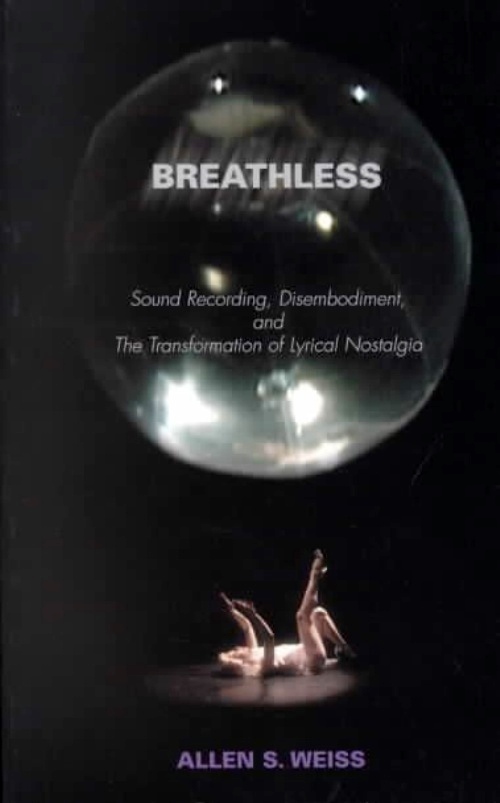
“By suggesting that sound recording changes the very notion of textuality at a key inflection point in Modernism, Weiss literally turns the field of cultural studies on its ear.” (Gregory Whitehead, co-editor of Wireless Imagination: Sound, Radio and the Avant-Garde)
Imperial 2688, played on HMV 101 gramophone.

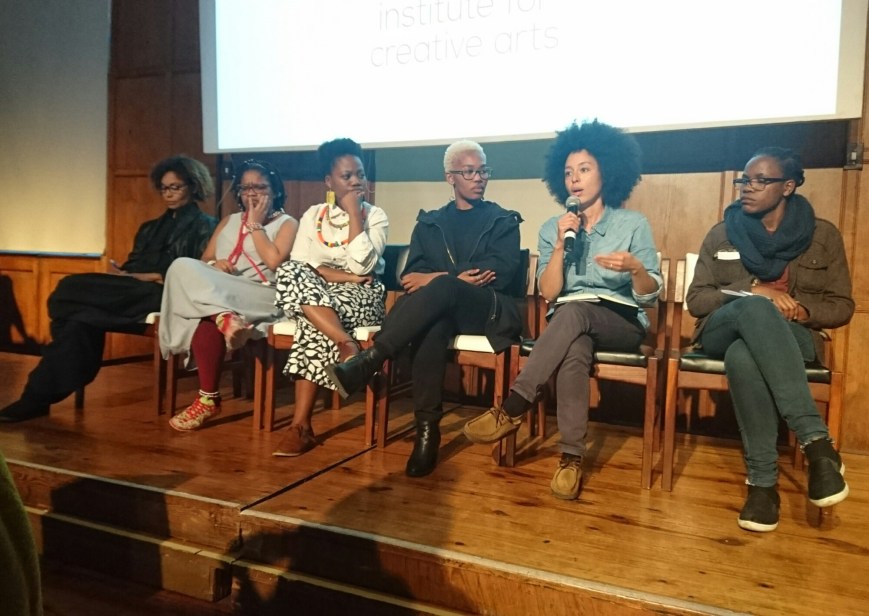
L-R: jackï job, Dee Moholo, Koleka Putuma, Khanyi Mbongwa (Vasiki), Ilze Wolff, Lois Anguria
The most decolonised academic space I have yet had the joy of experiencing. The conference continues today. If you’re in Cape Town, come. It’s free!
HERE is the programme. 🌸
Published on 4 May 2016
Having followed the #RUReferenceList and #RUInterdict, Activate has put together a feature-length documentary about the silencing of students and staff within the space that is currently known as Rhodes University.
DISRUPT stands to continue the conversation surrounding this mistreatment of survivors and the ways in which the university management and police have failed us. It is a direct response to the use of legalese – in the form of an interdict against involved parties – to try and force the university back into “business as usual”.
Featuring interviews with members of the student and staff body, footage from the two weeks of protest and the resulting use of police force on students and workers, DISRUPT serves as both a chronological documenting of the events of the last three weeks; but also uses the window of the #RUReferenceList protests to shine a light on the institutional issue that is rape culture.

My dad, Ray, on his 68th birthday, with my brother’s daughter, River, born 30 April 2016.

Djurgården, November 2015
Stand still. The trees ahead and the bushes beside you
Are not lost. Wherever you are is called Here,
And you must treat it as a powerful stranger,
Must ask it permission to know it and be known.
The forest breathes. Listen. It answers,
I have made this place around you.
If you leave it, you may come back again, saying Here.
No two trees are the same to Raven.
No two branches are the same to Wren.
If what a tree or a bush does is lost on you,
You are surely lost. Stand still. The forest knows
Where you are. You must let it find you.
*This post originally appeared on Cyborgology.
Objects have lives. They are witness to things.
–This American Life, “The House on Loon Lake”
Atlantic Cities’ feature on the psychology of “ruin porn” is worth a look–in part because it’s interesting in itself, in part because it features some wonderful images, and in part because it has a great deal to do with both a piece I posted previously on Michael Chrisman’s photograph of a year and with the essay that piece referenced, Nathan Jurgenson’s take on the phenomenon of faux-vintage photography.
All of these pieces are, to a greater or lesser extent, oriented around a singular idea: atemporality – that the intermeshing and interweaving of the physical and digital causes us not only to experience both of those categories differently, but to perceive time itself differently; that for most of us, time is no longer a…
View original post 3,142 more words
Analysis by Duane Jethro, one of my colleagues at the Archive and Public Culture Research Initiative.
By Duane Jethro
Svetlana Boym argues that ruins “make us think of the past that could have been and the future that never took place”. She turns the idea about the link between the past and the future around, and suggests we can use ruined or wasted things for clues about society in the present. In this piece I want to think about what certain ways of talking about waste and ruins in South Africa can tell us about pasts that never came to be and futures that never took place.
To do so means briefly thinking about heritage and reconciliation. Heritage, or the singling out of certain histories and people for commemoration, is connected to the idea of reconciliation, because in South Africa, it was meant to do the work of bringing South Africans together as a nation. Through new museums, statues and memorials, heritage would help overcome the long…
View original post 837 more words



I just found out that the April full moon (just past) is called the Pink Moon. And there I was thinking Nick Drake was being poetic.
The beings I love are creatures. They were born by chance. My meeting with them was also by chance. They will die. What they think, do and say is limited and is a mixture of good and evil.
I have to know this with all my soul and not love them the less.
I have to imitate God who infinitely loves finite things in that they are finite things.
We want everything which has a value to be eternal. Now everything which has a value is the product of a meeting, lasts throughout this meeting and ceases when those things which met are separated. That is the central idea of Buddhism (the thought of Heraclitus). It leads straight to God.
Meditation on chance which led to the meeting of my father and mother is even more salutary than meditation on death.
Is there a single thing in me of which the origin is not to be found in that meeting? Only God. And yet again, my thought of God had its origin in that meeting.
Stars and blossoming fruit-trees: utter permanence and extreme fragility give an equal sense of eternity.
The theories about progress and the ‘genius which always pierces through’, arise from the fact that it is intolerable to suppose that what is most precious in the world should be given over to chance. It is because it is intolerable that it ought to be contemplated.
Creation is this very thing.
The only good which is not subject to chance is that which is outside the world.
The vulnerability of precious things is beautiful because vulnerability is a mark of existence.
The destruction of Troy. The fall of the petals from fruit trees in blossom. To know that what is most precious is not rooted in existence—that is beautiful. Why? It projects the soul beyond time.
The woman who wishes for a child white as snow and red as blood gets it, but she dies and the child is given over to a stepmother.
__
Excerpted from Simone Weil‘s Gravity and Grace. First French edition 1947. Translated by Emma Crawford. English language edition 1963. Routledge and Kegan Paul, London.



 fleurmach