
jelly roll morton – the crave
The Crave (Jelly Roll Morton)
Recorded : 14th December 1939
Reeves Sound Studios
1600 Broadway, New York City, New York
Recording Engineer : Hazard E. Reeves
R-2562 General 4003-B
marchel duchamp took the credit for his friend elsa’s work
Just another sorry tale of appropriation:
Evidence that Marcel Duchamp may have stolen his most famous work, Fountain, from a woman poet has been in the public domain for many years. But the art world as a whole—museums, academia and the market—has persistently refused to acknowledge this fact.
The Museum of Modern Art (MoMA) in New York is the latest eminent body to bury its head in the sand. It has just published a new edition of Calvin Tomkins’s 1996 life of Duchamp, updated by its author. Ann Temkin, MoMA’s chief curator of painting and sculpture, praises Tomkins in her introduction for his “thorough research”. But Tomkins avoids addressing the implications of the question marks over the origins of the work that Duchamp himself raised in 1917.
Irene Gammel and Glyn Thompson have revealed the truth of his much earlier private account that he did not submit the urinal to the Society of Independent Artists exhibition in New York in 1917. Nevertheless, Duchamp’s late, fictional story is still taught in every class and recited in every book…

Should museums re-label the work Fountain as “a replica, appropriated by Marcel Duchamp (1887-1968), of an original by Baroness Elsa von Freytag-Loringhoven (1874-1927)”? Photo: Felix Clay
… Duchamp wrote to his sister, a nurse in war-torn Paris, telling her that “one of my female friends under a masculine pseudonym, Richard Mutt, sent in a porcelain urinal as a sculpture”. The explosive contents of this letter did not enter the public domain until 1983 when the missive was published in the Archives of American Art Journal.
The mere fact that Duchamp referred to the urinal as a sculpture suggests that it could not have been his, since by 1913, prompted by the work of the wealthy, chess-playing writer Raymond Roussel, he had stopped creating art. His Roussel-inspired “Readymades” were elaborate, personal rebuses to be read, not viewed.
The literary historian Irene Gammel was the first to discover who Duchamp’s “female friend” was. She was born Else Plötz in Germany in 1874, the daughter of a builder and local politician who philandered freely and beat her mother. Afflicted with syphilis, her mother attempted suicide and died later in an institution. As Elsa put it, she “left me her heritage… to fight”.
Elsa first married the leading Jugendstil architect August Endell, then Felix Paul Greve, the translator of Oscar Wilde, who faked his own suicide to escape his creditors and fled with Elsa to America. Her third marriage was to Leopold Karl Friedrich Baron von Freytag-Loringhoven, the impoverished son of a German aristocrat who had also escaped to America to avoid debts. He soon vanished with Elsa’s paltry savings but left her with a title and entrée into artistic circles in New York.
Elsa simultaneously inspired and repelled all who came into contact with her, from Ezra Pound to Ernest Hemingway. Nevertheless The Little Review treated her as a star and published her poems alongside excerpts from James Joyce’s Ulysses. Elsa’s genius was to find new ways to break out of the social straightjacket that bound women so that she could fight her mother’s battle in public, whenever and wherever she wanted, not when men told her she could.
In October 1917, the painter George Biddle described her room in New York filled with “odd bits of ironware, automobile tiles… ash cans, every conceivable horror, which to her tortured yet highly sensitive perception, became objects of formal beauty… it had to me quite as much authenticity as, for instance, Brancusi’s studio in Paris.”
Elsa was a poet of found objects, but she didn’t leave them as they were—she transformed them into works of art.
Elsa exploded in fury when the US declared war on her motherland, on Good Friday, 6 April 1917. Her target was the Society of Independent Artists, whose representatives had consistently cold-shouldered her. We believe she submitted an upside-down urinal, signed R. Mutt in a script similar to the one she sometimes used for her poems.
Armut—the homophone of R. Mutt—has many resonances in German. It is used in common phrases to mean “poverty”, and in some contexts “intellectual poverty”. Elsa’s submission was a double-pronged attack. The society was hoist by its own petard, for in accepting the entry it would demonstrate its inability to distinguish a work of art from an everyday object, but in rejecting it, it would break its own rule that the definition of what was art should be left to the submitting artist. Hence the “intellectual poverty” of its stance.
The urinal was Elsa’s declaration of war against a man’s war—an extraordinary visual assault on all that men stood for. As a sculpture of a transformed everyday object, it deserves to rank alongside Picasso’s Bull’s Head, 1942, made of bicycle handlebars and a saddle, and Dali’s Lobster Telephone, 1936.
If Duchamp did not submit the urinal, why would he pretend later that he did? After Elsa died in 1927, forgotten and in abject poverty, Duchamp began to let his name be associated with the urinal, and by 1950, four years after the death of Alfred Stieglitz, who photographed the original Fountain, he began to assume its authorship…
… When the mood took him, Duchamp could be honest about his dishonesty. In an interview in 1962, he told William Seitz: “I insist every word I am telling you now is stupid and wrong.” Why, then, has the art world persisted in believing an account grounded in the myths he promulgated?
—
Sélavy, baby… Read the full article HERE.
the goatman
What is male sexuality, and will it always fuck you in the eye? Confronted by an eager male who intrudes into your space, the turn-on is the confidence, the turn-off is the arrogance. It’s great that the male is being forthright, but is he like this with just you, or every sexual object in his vicinity? If he fucks you, is he fucking you or his fantasy? My wife replied when I said I connect with her during sex, no, you connect with yourself ..
arundhati roy on accountability

The trouble is that once you see it, you can’t unsee it. And once you’ve seen it, keeping quiet, saying nothing, becomes as political an act as speaking out. There’s no innocence. Either way, you’re accountable.
— Arundhati Roy in Power Politics. South End Press, 2001.
felix laband – burg killer 108 cut 01-09-2012
A live outtake from 2012 – arpeggiated loveliness.
tough cookie

felix laband – dusty house
An outtake from his long-awaited forthcoming album, Deaf Safari.
lucy in the sky with diamonds – the flaming lips, miley cyrus and moby
Aaah– aaah… That head-shattering chorus! (NSFW.)
“Blonde SuperFreak Steals the Magic Brain” meets “Lucy In The Sky With Diamonds” — read the story behind the video HERE.
come with us to the edge of wrong tomorrow
I’m part of the South African curatorial/organising team for this series of collaborative multi-medium performances. If you’re in Cape Town, check EOW 9.1 out tomorrow night.
It will involve an insane mash-up of guitarists, violinists, opera singers, noise musicians, circuitbenders, chiptunists, avant-percussionists, pianists, body modification, visuals generated from cellular automata, experimental improv dance, provocative video art and the livecoded sound of the Ebola genome…
More information HERE.

heaven mixtapes
A sweetly told story of a Jo’burg boy falling in love with the night and music… Check out the mixtapes!

 Classic Heaven comp
Heaven was a nightclub from the mid-1980s in Johannesburg at 165 Marshall Street. Many will know this address as being that of the original Doors nightclub that opened in 1990 and operated there for many years before moving to Edenvale. Between Heaven and The Doors two other short-lived clubs called BLUES and BANGS operated on the premises.
For me, Heaven was my first proper nightclub experience. I somehow managed to get in on old years eve in 1986 (thanks to a friends brother who worked at the bar who passed me off as his little brother plus I was pretty tall for my age). I spent the night upstairs next to the DJ box absorbing the music, watching the people and more importantly – watching the DJ.
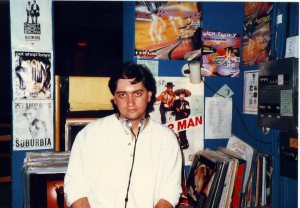 Andrew Wood in the Heaven DJ box
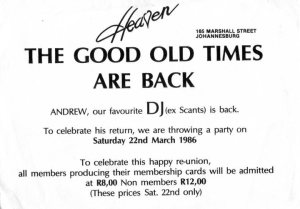 Andrew is back!
The music was a mixture of high energy, eurobeat and…
View original post 1,511 more words
elizabeth fraser – at last i am free
Originally released by Chic in 1978, Elizabeth Fraser (ex-Cocteau Twins) covered this song for Rough Trade’s 2003 compilation release, Stop Me If You Think You’ve Heard This One Before.
giant step
jimmie noone’s apex club orchestra – blues my naughty sweetie gives to me
i love this
anna-maria hefele – polyphonic overtone singing
take me somewhere love is brutal
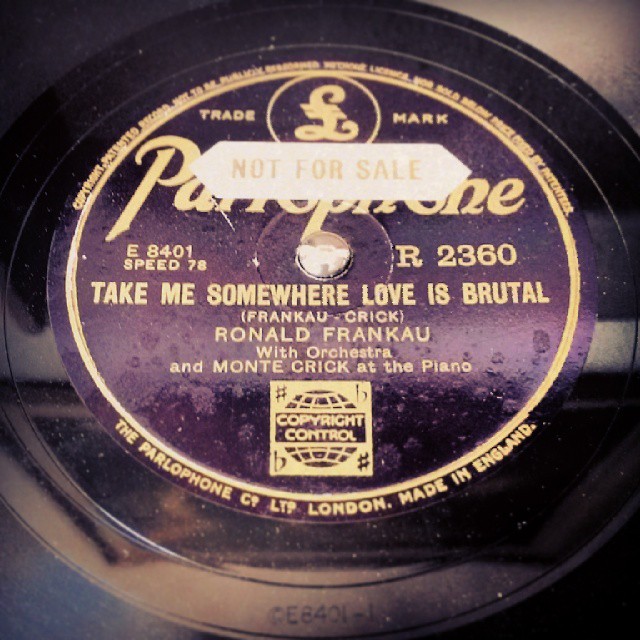
I’ve just been listening to this crackpot 78 by Ronald Frankau and Monte Crick. Check out a performance of the song in the British Pathé archive, interspersed with ridiculously exoticised film clips – released in 1937.
frank zappa on politics

ravel – shéhérazade, part II – la flûte enchantée
(Bożena Bujnicka – soprano, Paweł Sommer – piano)
A song cycle by Ravel, first performed in 1904. More information about the composition can be found HERE.
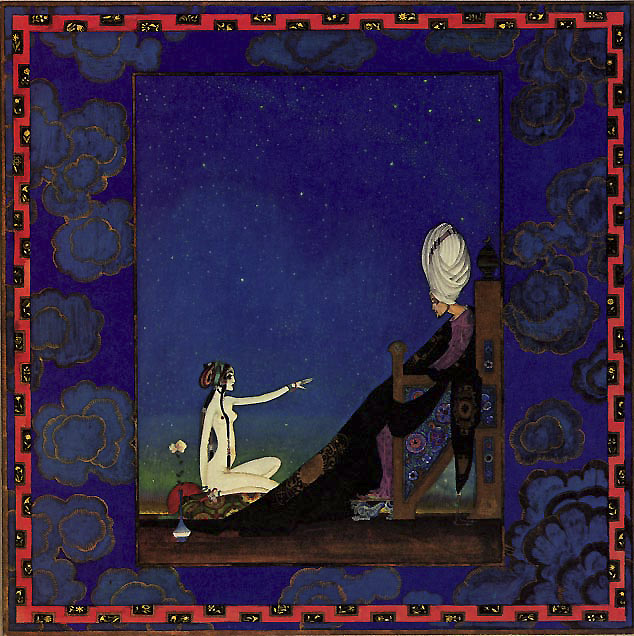
The shade is soft and my master sleeps
Wearing a conical hat of silk,
His long yellow nose in his white beard.
But me, I’m yet awake,
Listening to the melody of a flute outside
which pours forth, in turns, sadness and joy,
An air in turns languid or frivolous,
Which my darling love plays.
And when I approach the window,
It seems to me that each note flies
From the flute to my cheek
Like a mysterious kiss.
L’ombre est douce et mon maître dort
Coiffé d’un bonnet conique de soie
Et son long nez jaune en sa barbe blanche.
Mais moi, je suis éveillée encor
Et j’écoute au dehors
Une chanson de flûte où s’épanche
Tour à tour la tristesse ou la joie.
Un air tour à tour langoureux ou frivole
Que mon amoureux chéri joue,
Et quand je m’approche de la croisée
Il me semble que chaque note s’envole
De la flûte vers ma joue
Comme un mystérieux baiser.
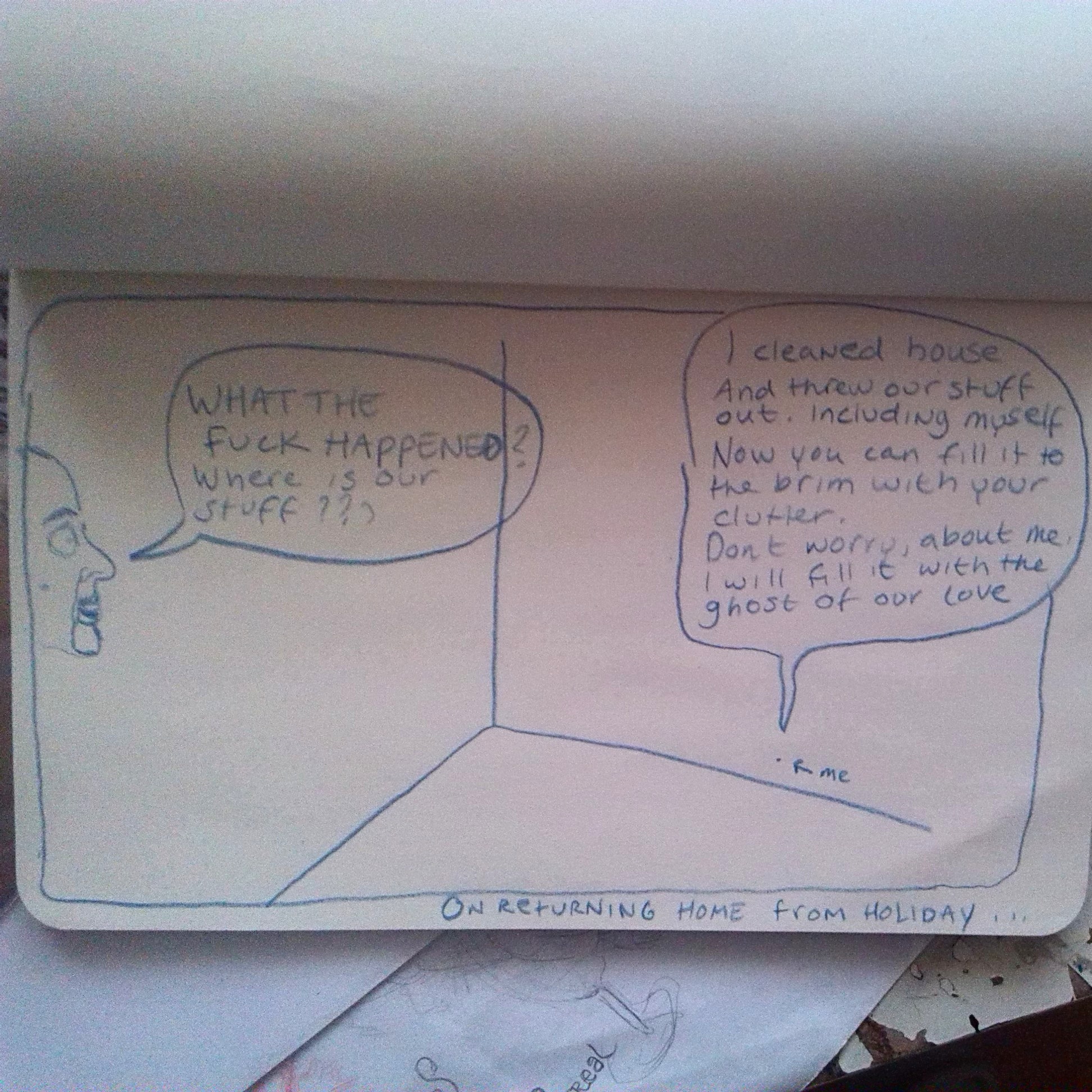
getting rid of junk..
Doodle..
tricky & pj harvey – broken bones (live)
“And if you’re famous you might get acquitted…”
thoroughly sick
“And how comfortless is the thought that the sickness of the normal does not necessarily imply as its opposite the health of the sick, but that the latter usually only present, in a different way, the same disastrous pattern.”
— Theodor Adorno

cat power – the moon
From The Greatest (Matador, 2006).
karen dalton – blues jumped the rabbit
Karen Dalton makes everything feel right… Summerville, Colorado, 1970. From Karen Dalton’s “Cotton Eyed Joe” double CD & DVD U.S. release on Delmore Recordings.
There’s a really interesting discussion thread about the origins of this song HERE.
neo-utopian mashup 2: the project
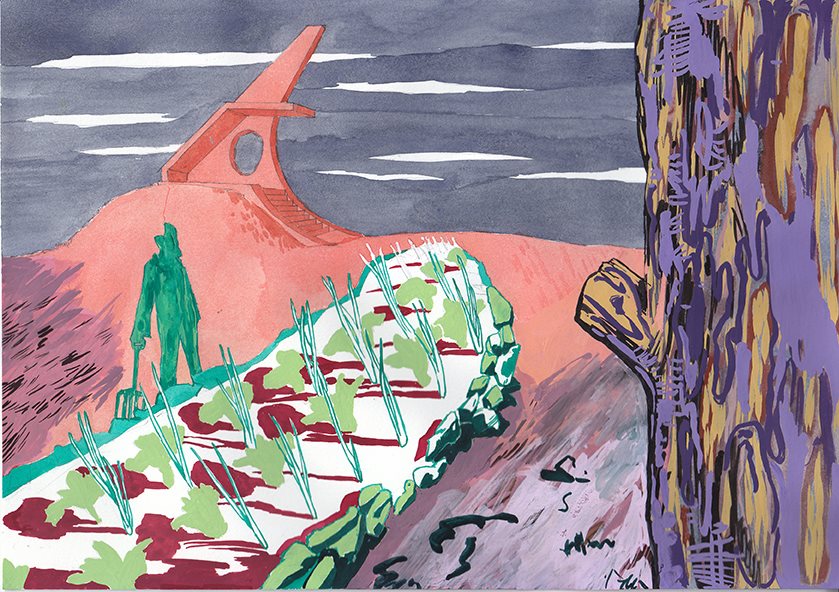
“Neo-Utopian Mashup 2: The Project”. Lizza Littlewort, 2014.
neo-utopian sublime
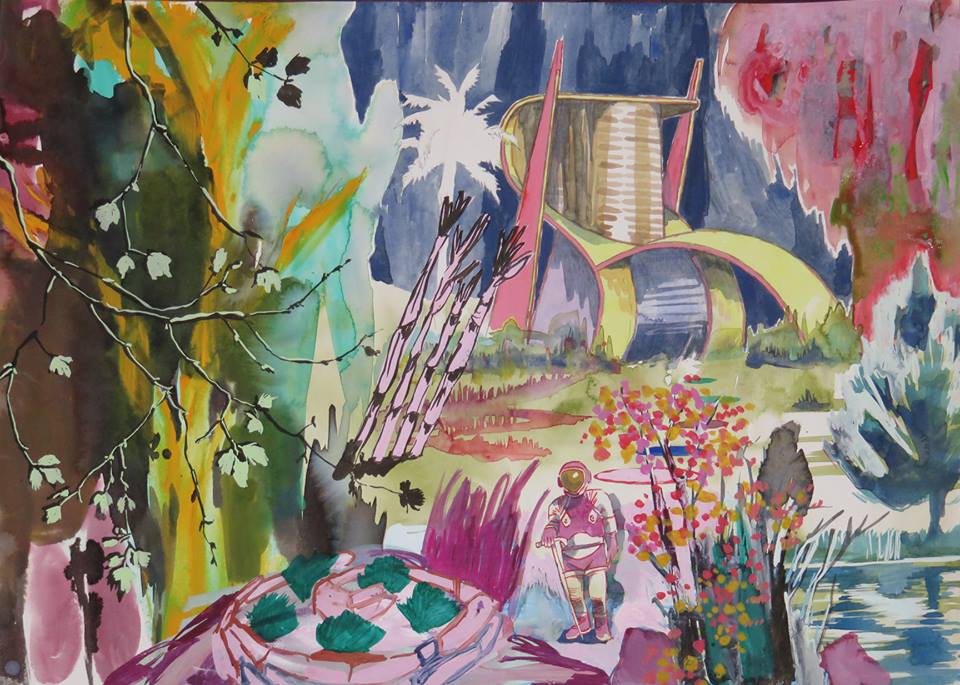
“Neo-Utopian Sublime”. Lizza Littlewort, 2014.
the electric koolaid epic fail

cross section

on cutting the crap
(Amen!)
UPDATE, 3 SEPTEMBER: I have just checked and the following quote is actually from the author José Micard Teixeira, but has been widely misattributed to Meryl Streep (apologies — I picked it up on Facebook). However, these words do resonate with Ms Streep’s uncompromising attitude to life, which is why the erroneous attribution has stuck, I guess. I love the sentiment, and am happy to pass this on, whoever said it!
 “I no longer have patience for certain things, not because I’ve become arrogant, but simply because I’ve reached a point in my life where I do not want to waste more time with what displeases me or hurts me. I have no patience for cynicism, excessive criticism and demands of any nature. I lost the will to please those who do not like me, to love those who do not love me and to smile at those who do not want to smile at me.
“I no longer spend a single minute on those who lie or want to manipulate. I decided not to coexist anymore with pretense, hypocrisy, dishonesty and cheap praise. I do not tolerate selective erudition nor academic arrogance. I do not adjust either to popular gossiping. I hate conflict and comparisons. I believe in a world of opposites and that’s why I avoid people with rigid and inflexible personalities. In friendship I dislike the lack of loyalty and betrayal. I do not get along with those who do not know how to give a compliment or a word of encouragement. Exaggerations bore me and I have difficulty accepting those who do not like animals. And on top of everything I have no patience for anyone who does not deserve my patience.”
nina simone – live at montreux – 1976, 1987 and 1990
Just incredible. I wish I could have seen her perform, just once.
Tracklisting:
1976
1. Little Girl Blue
2. Backlash Blues
3. Be My Husband
4. I Wish I Knew (How It Would Feel to be Free)
5. Stars / Feelings
6. African Mailman
1987
7. Someone to Watch Over Me
8. My Baby Just Cares For Me
1990
9. I Loves You Porgy
10. Liberian Calypso
11. Four Women / Mississippi Goddam
12. Ne Me Quitte Pas (Don’t Leave Me)
rainy day – rainy day (full album, 1984)
The Paisley Underground scene of L.A. bands of the 1980s — of which David Roback’s bands Rain Parade, Clay Allison, Opal, and Mazzy Star were a part — was in part inspired by 1960s rock/psychedelia. This Rainy Day album was David’s project. It contains covers of nine of his favourite songs from the 1960s, and one from the 1970s (“Holocaust”). He enlisted musicians and singers from a variety of Paisley Underground bands to collaborate on the album.
Tracklisting
A1 – “I’ll Keep It With Mine” (Bob Dylan)
Guitar, Tambourine, Vocals – David Roback; Violin – Will Glenn; Bass – Michael Quercio; Lead Vocals – Susanna Hoffs
A2 – “John Riley” (B. Gibson, R. Neff. A folk song covered by The Byrds in 1966)
Drums – Dennis Duck; Guitar [Acoustic 12-string] – Matthew Piucci; Guitar [Electric 12-string], Vocals – David Roback; Violin, Vocals – Will Glenn; Lead Vocals, Bass – Michael Quercio
A3 – “Flying On The Ground Is Wrong” (Neil Young/Buffalo Springfield)
Guitar – David Roback; Lead and Background Vocals – Kendra Smith; Background Vocals – Susanna Hoffs
A4 – “Sloop John B.” (Traditional. The Beach Boys had a 1966 hit with their arrangement)
Drums – Dennis Duck; Guitar, Congas – David Roback; Keyboards – Ethan James; Lead Vocals, Bass, Percussion – Michael Quercio
A5 – Soon Be Home (Pete Townshend/The Who)
Bass, Drums – Michael Quercio; Tambourine – “Spock”; Background Vocals – Susanna Hoffs, Vicki Peterson; Lead Vocals, Guitar – David Roback
B1 – “Holocaust” (Alex Chilton/Big Star)
Cello, Violin – Will Glenn; Guitar – David Roback; Piano – Steven Roback; Piano [Backwards] – Ethan James; Vocals – Kendra Smith
B2 – “On The Way Home” (Neil Young/Buffalo Springfield)
Vocals, Guitar – David Roback
B3 – “I’ll Be Your Mirror” (Lou Reed/Velvet Underground)
Guitar, Bass, Tambourine – David Roback; Lead and Background Vocals – Kendra Smith; Lead Vocals, Guitar – Susanna Hoffs
B4 – “Rainy Day, Dream Away” (Jimi Hendrix)
Bass, Keyboards – Ethan James; Drums – Dennis Duck; Guitar – Karl Precoda; Congas – David Roback; Lead Vocals – Michael Quercio Continue reading
 fleurmach