william butler yeats – a crazed girl

That crazed girl improvising her music.
Her poetry, dancing upon the shore,

Her soul in division from itself
Climbing, falling, she knew not where,
Hiding amid the cargo of a steamship,
Her knee-cap broken, that girl I declare
A beautiful lofty thing, or a thing
Heroically lost, heroically found.

No matter what disaster occurred
She stood in desperate music wound,
Wound, wound, and she made in her triumph
Where the bales and the baskets lay
No common intelligible sound
But sang, ‘O sea-starved, hungry sea.’

elizabeth barrett browning – a musical instrument

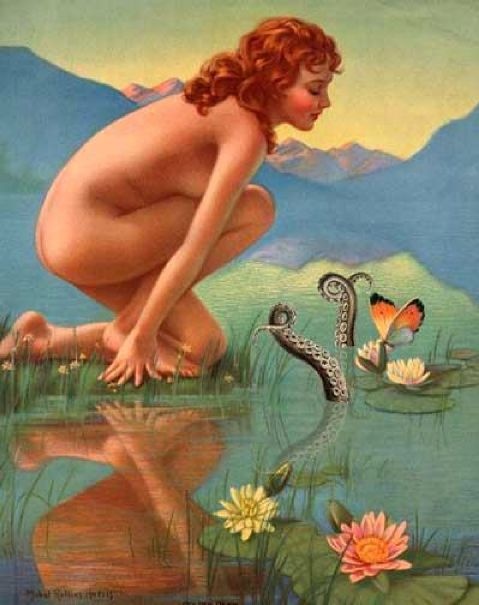
What was he doing, the great god Pan,
Down in the reeds by the river?
Spreading ruin and scattering ban,
Splashing and paddling with hoofs of a goat,
And breaking the golden lilies afloat
With the dragon-fly on the river.

He tore out a reed, the great god Pan,
From the deep cool bed of the river:
The limpid water turbidly ran,
And the broken lilies a-dying lay,
And the dragon-fly had fled away,
Ere he brought it out of the river.

High on the shore sat the great god Pan
While turbidly flowed the river;
And hacked and hewed as a great god can,
With his hard bleak steel at the patient reed,
Till there was not a sign of the leaf indeed
To prove it fresh from the river.

He cut it short, did the great god Pan,
(How tall it stood in the river!)
Then drew the pith, like the heart of a man,
Steadily from the outside ring,
And notched the poor dry empty thing
In holes, as he sat by the river.

‘This is the way,’ laughed the great god Pan
(Laughed while he sat by the river),
‘The only way, since gods began
To make sweet music, they could succeed.’
Then, dropping his mouth to a hole in the reed,
He blew in power by the river.

Sweet, sweet, sweet, O Pan!
Piercing sweet by the river!
Blinding sweet, O great god Pan!
The sun on the hill forgot to die,
And the lilies revived, and the dragon-fly
Came back to dream on the river.

Yet half a beast is the great god Pan,
To laugh as he sits by the river,
Making a poet out of a man:
The true gods sigh for the cost and pain, —
For the reed which grows nevermore again
As a reed with the reeds in the river.

a.a. milne – halfway down

Halfway down the stairs
is a stair
where i sit.
there isn’t any
other stair
quite like
it.
i’m not at the bottom,
i’m not at the top;
so this is the stair
where
I always
stop.

Halfway up the stairs
Isn’t up
And it isn’t down.
It isn’t in the nursery,
It isn’t in town.
And all sorts of funny thoughts
Run round my head.
It isn’t really
Anywhere!
It’s somewhere else
Instead!

chadwick tyler – “something she didn’t know was there”

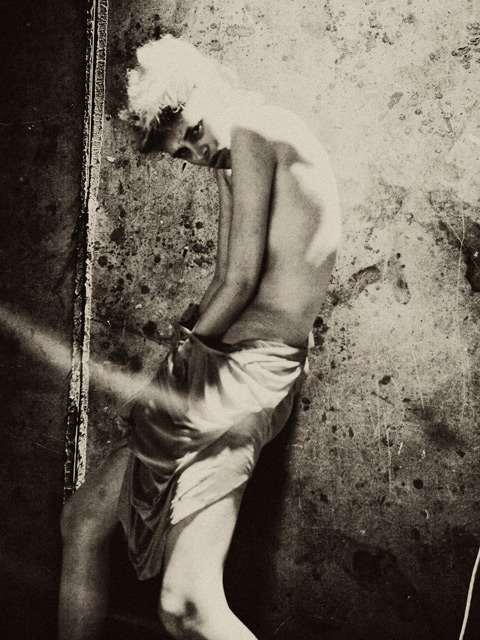
I just love the ´dirty´work of Chadwick Tyler. These photos were part of his exhibition ´Tiberius´, 2009.

“Every project I do revolves around the model, “the girl.” For me, to work with a model is to find a connection, to develop a mode of communication & to create a relationship, in order to draw what is within her out to the surface. My job is to enable a model to feel comfortable being vulnerable in a way that shows up on camera. Documenting the range of a girl’s personality that emerges is everything to me; especially when it’s something she didn’t know was there.” – Chadwick Tyler

adorno on the decay of human relationships

“The fear of the secret decay of relationships is almost always caused by those involved allegedly or really finding things ‘too hard’. They are too weak in the face of reality, overtaxed by it on all sides, to muster the loving determination to maintain the relationship purely for its own sake. In the realm of utility, every relationship worthy of human beings takes on an aspect of luxury. No one can really afford it, and resentment at this breaks through in critical situations…“…If the subject is deeply involved while the relationship’s outward aspect prevents him, with good reason, from indulging his impulse, the relation is turned to permanent suffering and thus endangered. The absurd significance of trivia like a missed phone call, a stinted handshake, a hackneyed turn of phrase, springs from their manifesting an inner dynamic otherwise held in check, and threatening the relationship’s objective concreteness. Psychologists may well condemn the fear and shock of such moments as neurotic, pointing out their disproportion to the relationship’s objective weight. Anyone who takes fright so easily is indeed ‘unrealistic’, and in his dependence on the reflexes of his own subjectivity betrays a faulty adjustment.

“Only when one responds to the inflection of another’s voice with despair is the relation as spontaneous as it should be between free people, while yet for that very reason becoming a torment which, moreover, takes on an air of narcissism in its fidelity to the idea of immediacy, its impotent protest against coldheartedness. The neurotic reaction is that which hits on the true state of affairs, while the one adjusted to reality already discounts the relationship as dead. The cleansing of human beings of the murk and impotence of affects is in direct proportion to the advance of dehumanization.”

~ Theodor W. Adorno, Messages in a Bottle

michelle mcgrane – things that a bond girl should never leave home without

A double entendre,
a steady gun-arm, a failproof
recipe for Béarnaise sauce,
a kick-ass lipstick,
‘Five of a Kind’.

Contortionist training,
a reservation at Maxim’s,
a magnum of Taittinger Blanc
de Brut 1943 and twenty
Morland Specials.

A stolen copy
of Hogan’s Power Golf,
a smouldering silhouette,
a commando dagger,
a cyanide tablet.

Sagittarius rising,
a Côte d’Azur suntan,
opera glasses, life insurance,
fifty rounds of ammo,
a contact in Japan.

A bluff and a bikini,
a Triumph convertible,
a parachute, a silk peignoir,
a concealed blueprint,
an escape route.

Previously published in Magma 50.

arlyn culwick – on death

Image: Inflected Landscape by Arlyn Culwick

So, young Death, what could you be?
Even my father’s cancered body
brought me no sightless terror at eternity.
I suspect you have no sting.
Perhaps you, old splinter in the heart of love,
never were more than mirage,
though love would need you –
necessary certain death –
as a nail for a cross,
and cross and nail and Christ and
resurrection
are all love –
the ever-dying eternal life of all.

If so, where would you go,
you much-maligned seed of beginnings?
Youngest purveyor of life,
always exactly zero years old –
ever painted Grim Reaper,
thief of loved ones,
skeletal with age and demon-haunted.
You, unknowable ultimate horizon,
ear-whisperer of the infinite terror of endings,
do not impart any evil
except perhaps deluded dread.

You would go to a greater whole
of which you are inseparably part,
for shapes without space,
age without time,
or nails without crosses,
have no significance.
Thus you, youngest innocent death
are as much your own as the terror of
a darkened room:
mere mirage,
as seemingly all-powerful
as its infinite inscrutable blackness
and the child-fantasy it feeds.

You are love’s very vehicle.
Flesh for sacrifice, in dying,
is meaning-embodied matter –
is substance made significant –
surrendered, emptied, dissolute,
but never for itself, nor for nothing;
always for all,
for everything made sign;
spirit, soul, and soil pervaded
by kindest, complete kenosis,
all-originating, all-resurrecting.
Only silliest oldest humanity,
children trembling sightless in their beds,
give shadows a scythe and empty eye sockets
and forget the bedroom’s sturdy walls.

Check out Arlyn’s blog HERE.

divine madness: can creativity kill you?

Superstar at home NYC, 1968 by Diane Arbus

During Diane Arbus’s funeral, the photographer Richard Avedon turned to a friend and whispered, ”Oh, I wish I could be an artist like Diane.” The friend, Frederick Eberstadt, answered, ”Oh, no, you don’t.” Their brief exchange – as recounted in Patricia Bosworth’s biography of Arbus – raises the charged questions surrounding the tormented, even self-destructive, creative artist. Chief among them is where reality ends and mythology begins.

Arbus personified the artist whose inner turmoil – depression, dislocation and a taste for risk bordering on a death wish – fueled her creations, those moving and disturbing photographs of drag queens and hermaphrodites, celebrities and Siamese twins. But Arbus was also a woman defeated by depressions so debilitating she often could not work and, ultimately, chose not to live. Finally, Arbus represented an artist who gained more fame, who was indeed romanticized, more for living on the edge than for the artistry she brought back from that emotional frontier.

It is no wonder, then, that Arbus – that the entire issue of the ”mad artist,” as the awful cliche has it -should both attract and repel, as it has for literally thousands of years. Aristotle spoke of ”divine madness,” Renaissance scholar Marsilio Ficino of the ”Saturnine temperament.” The playwright August Strindberg declared that few people were ”lucky enough to be capable of madness,” and the poet John Berryman opined, ”The artist is extremely lucky who is presented with the worst possible ordeal which will not nearly kill him.”

Read more of Samuel G Freedman´s text here

federico garcia lorca – the passing stage of the siguiriya

Among black butterflies
goes a dark-haired girl
next to a white serpent
of mist.

Earth of light,
sky of earth.

She is chained to the tremor
of a never arriving rhythm;
she has a heart of silver
and a dagger in her right hand.

Where are you going, siguiriya,
with such a headless rhythm?
What moon’ll gather up your pain
of whitewash and oleander?

Earth of light,
sky of earth.

(translated by Ralph Angel)

La Seguiriya – A flamenco form with a mixed compás – combining 3/4 and 6/8 time (a feature that drives music experts to despair). The seguiriya takes its name from the Castilian ‘seguidilla’, a musical style to which it is related, literarily at least. It is considered the quintessential style of ‘cante jondo’, for its solemnity, the minimalism of the lyric, and the wailing ‘quejío’ associated with vocal performances.

“The Gypsy siguiriya had always evoked for me (an incurable lyricist) the endless road, one without crossroads, which ends at the pulsating fountain of the girl-child, poetry, the road where the first bird died and the first arrow rusted.

The Gypsy siguiriya begins with a dreadful cry, a cry that divides the landscape into two perfect hemispheres. It is the cry of dead generations, a poignant elegy for vanished centuries, the evocation of love filled with pathos beneath other winds and other moons.”

Read the text of a fascinating lecture by Lorca on the historical and artistic significance of Canto Jondo (“deep song”) HERE.

laure: the true whore as muse

“Avoid contact with all people in whom there is no possible resonance with what touches you most deeply and toward whom you have obligations of “kindness,” of “politeness.”- Laure, Collected writings

Although she wrote little and published almost nothing, Colette Peignot, a.k.a. Laure, is one of the more fascinating and intense women writers of the past century. Georges Bataille and Michel Leiris described her as “one of the most vehement existences [that] ever lived, one of the most conflicted.” They summarized her volatile personality as “[e]ager for affection and for disaster, oscillating between extreme audacity and the most dreadful anguish, as inconceivable on a scale of real beings as a mythical being, she tore herself on the thorns with which she surrounded herself until becoming nothing but a wound, never allowing herself to be confined by anything or anyone.” In other words, Laure was the epitome of what Bataille would dub the “sovereign” individual.

Read more HERE.

dracula’s daughter (1936)

“Why should Cecil B. DeMille have a monopoly on the great box office values of torture and cruelty?” asked John Balderton, the writer of a first draft of this long-delayed sequel to Dracula, the iconic, if somewhat tepid, 1931 version of Bram Stoker’s famous novel. Balderton envisioned a grisly horror film, full of the shrieks and cries of the damned, but his version didn’t make the cut. Instead, this version, based on one of Stoker’s stories, finally hit the screens in 1936, heavy on atmosphere and shocking (for its time) sexuality. Although it is a marked improvement on the original film, it’s still a bit of a snooze, relying too much on forced comedy and not enough on suspense or fright.

The film picks up exactly where the first film left off. Von Helsing (Edward Van Sloan), who was Van Helsing in the first film, has just offed Dracula, and Whitby constables stumble on the scene and arrest him as a murderer. The constable in charge is faced with quite a decision: try Von Helsing for murder and likely hang him, put him in the looney bin because of all his talk about vampires, or believe him. Von Helsing implores him to call on one of his former students, the renowned psychologist Dr. Garth (Otto Kruger), to help clear him.

Meanwhile, before things can get underway, a mysterious woman steals Dracula’s body and destroys it. Gloria Holden is Countess Zaleska, the titular daughter. She thinks that destroying her father’s corpse will free her from her vampiric curse, but it doesn’t work, as is obvious as soon as she returns to London and starts ogling the necks of dapper young men. It doesn’t help that her helper Sandor (Irving Pichel, who co-directed the great action film The Most Dangerous Game) keeps taunting her about how much she needs blood. The film treats vampirism as more of an addiction than an evil curse, and it’s fitting that she keeps an enabler around to sabotage her efforts to get clean.

After meeting Dr. Garth at a party, she decides that his experiments in hypnosis will help her. She attempts to seduce him, but he’s wary, especially as the body count in London starts to rise, as victims with strange puncture wounds on their necks start turning up. In the centerpiece of the film, as Zaleska attempts to do some painting to distract her from her need for blood, she enlists Sandor to bring her a model, Lili (Nan Grey).

Read more here

first creature to survive in outer space

Image found at http://ambergold.ruTardigrades or “Water Bears” are the only living animals known to be able to survive the extreme conditions in the vacuum of outer space. This means, conceivably, that they could have come from there (INDUCTIVE REASONING IS FUN)… Find out more about these tiny yet formidable critters at the Tardigrade Appreciation Headquarters, or watch this entertaining video.

Ella Joyce Buckley – Sister

From the new album, Blood Finds No Sea. Find out more and buy the album here.

whisper your sister
faceless
turning blisters
this parade itself
has a white wind of listlessness

I am missing a grave

a messy curve of skin
missing the link from within
a messy curve of skin
missing the link from within
in

now go
go beyond the veil
go beyond the veil
go beyond the grail

listen
this morning my name meant nothing to me
my heart pulled this thing from me
my god from its hinge
saw me
and could it be

we are apart in a part of a persisting sea
we have a curve in the earth within an endless weave
i must tell her we are
she is
within with me
i will
at once
let the bird fly away

sister i must tell you
that it will end in ease
we will build our hearts against the sea
we will carefully repeat the links
and let it be

become each other
somehow
we are slaves
we were missing for days

a messy curve of skin
missing the link from within
a messy curve of skin
missing the link from within
in

whisper your sisters
faceless
turning blisters
this melancholy has a white wind of listlessness

whisper your sisters
faceless
turning blisters
this melancholy is just a white wind of listlessness

Ella – vocals / casio va 10 / electric guitar / acoustic guitar / loops / alpine zither / synthetics / percussion / foleys / effects

Ross Campbell – percussion

Righard Kapp – electric guitar

Gene Kierman – french horn

on chaos, creation and destruction

From Principia Discordia:

CONVENTIONAL CHAOS – GREYFACE
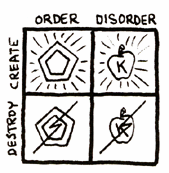
In the year 1166 B.C., a malcontented hunchbrain by the name of Greyface got it into his head that the universe was as humorless as he, and he began to teach that play was sinful because it contradicted the ways of Serious Order. “Look at all the order around you,” he said. And from that, he deluded honest men to believe that reality was a straightjacket affair and not the happy romance as men had known it.

It is not presently understood why men were so gullible at that particular time, for absolutely no one thought to observe all the disorder around them and conclude just the opposite. But anyway, Greyface and his followers took the game of playing at life more seriously than they took life itself and were known even to destroy other living beings whose ways of life differed from their own.

The unfortunate result of this is that mankind has since been suffering from a psychological and spiritual imbalance. Imbalance causes frustration, and frustration causes fear. And fear makes for a bad trip. Man has been on a bad trip for a long time now.

It is called THE CURSE OF GREYFACE.

Bullshit makes
the flowers grow
& that’s beautiful.

Photo: Motlatsi Khosi

THE CURSE OF GREYFACE AND THE INTRODUCTION OF NEGATIVISM

To choose order over disorder, or disorder over order, is to accept a trip composed of both the creative and the destructive. But to choose the creative over the destructive is an all-creative trip composed of both order and disorder. To accomplish this, one need only accept creative disorder along with, and equal to, creative order, and also be willing to reject destructive order as an undesirable equal to destructive disorder.

The Curse of Greyface included the division of life into order/disorder as the essential positive/negative polarity, instead of building a game foundation with creative/destructive as the essential positive/negative. He has thereby caused man to endure the destructive aspects of order and has prevented man from effectively participating in the creative uses of disorder. Civilization reflects this unfortunate division.

POEE proclaims that the other division is preferable, and we work toward the proposition that creative disorder, like creative order, is possible and desirable; and that destructive order, like destructive disorder, is unnecessary and undesirable.

Seek the Sacred Chao – therein you will find the foolishness of all ORDER/DISORDER. They are the same!

Read the whole text of POEE’s “Principia Discordia” here.