Dinosaur Jr. perform three of my favourite songs from their 1988 album, Bug, live in the KEXP studio, Seattle, interviewed by Henry Rollins (casting himself as a major fanboy!) in between songs. Recorded on December 17, 2011. They may all look like slacker deadbeat dads, but crikey, they sound like a TORNADO.
Songs:
Little Fury Things
Freak Scene
Just Like Heaven (The Cure cover)
Hosts: DJ El Toro & Henry Rollins
Audio Engineer: James Nixon
Cameras: Jim Beckmann, Scott Holpainen & Patrick Richardson Wright
Editing: Scott Holpainen
What was that you just said?
That didn’t make any sense to me
It’s not the way I see it, man
I’m almost tired of listening to you
Why do you tie me up with words?
The way your eye shifts makes me wanna go
Black-jawed living room couch professor
When will you be through with me? I’d like to know
Everywhere I go I feel it
But I won’t talk; I won’t get stuck with you
Everyone’s so lonely I dig it
But I’m afraid I can’t share this with you
So don’t make me your captive
I don’t feel like talking your shit
I nod my broken head
I’m not too amused with humans
“This is a city of heartless beings; what can I do?”
This provocative song featured in the 1993 film, Khalnayak (Hindi = “Villain”), starring an incandescent Madhuri Dixit and Sanjay Dutt. It was a huge yet controversial hit, largely due to the erotic lyrics.
“La Sucette” – Cherry Bomb, 2007 Digital photograph manipulated with Microsoft Photo Editor
On cold days
it is easy to be reasonable,
to button the mouth against kisses,
dust the breasts
with talcum powder
& forget
the red pulp meat
of the heart.
On those days
it beats
like a digital clock–
not a beat at all
but a steady whirring
chilly as green neon,
luminous as numerals in the dark,
cool as electricity.
& I think:
I can live without it all–
love with its blood pump,
sex with its messy hungers,
men with their peacock strutting,
their silly sexual baggage,
their wet tongues in my ear
& their words like little sugar suckers
with sour centers.
On such days
I am zipped in my body suit,
I am wearing seven league red suede boots,
I am marching over the cobblestones
as if they were the heads of men,
& I am happy
as a seven-year-old virgin
holding Daddy’s hand.
Don’t touch.
Don’t try to tempt me with your ripe persimmons.
Don’t threaten me with your volcano.
The sky is clearer when I’m not in heat,
& the poems
are colder.
“Our stories give shape to our inchoate, disparate, fleeting impressions of everyday life.”
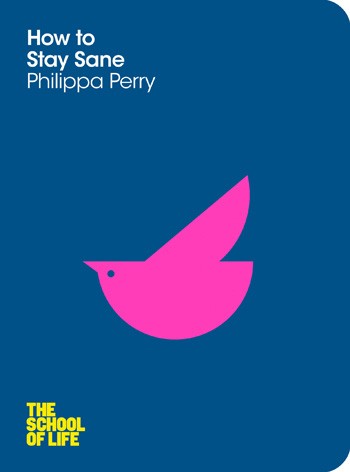
“[I] pray to Jesus to preserve my sanity,” Jack Kerouac professed in discussing his writing routine. But those of us who fall on the more secular end of the spectrum might need a slightly more potent sanity-preservation tool than prayer. That’s precisely what writer and psychotherapist Philippa Perry offers in How To Stay Sane (public library; UK), part of The School of Life’s wonderful series reclaiming the traditional self-help genre as intelligent, non-self-helpy, yet immensely helpful guides to modern living.
At the heart of Perry’s argument — in line with neurologist Oliver Sacks’s recent meditation on memory and how “narrative truth,” rather than “historical truth,” shapes our impression of the world — is the recognition that stories make us human and learning to reframe our interpretations of reality is key to our experience of life:
Our stories give shape to our inchoate, disparate, fleeting impressions of everyday life. They bring together the past and the future into the present to provide us with structures for working towards our goals. They give us a sense of identity and, most importantly, serve to integrate the feelings of our right brain with the language of our left.
[…]
We are primed to use stories. Part of our survival as a species depended upon listening to the stories of our tribal elders as they shared parables and passed down their experience and the wisdom of those who went before. As we get older it is our short-term memory that fades rather than our long-term memory. Perhaps we have evolved like this so that we are able to tell the younger generation about the stories and experiences that have formed us which may be important to subsequent generations if they are to thrive.
I worry, though, about what might happen to our minds if most of the stories we hear are about greed, war and atrocity.
Perry goes on to cite research indicating that people who watch television for more than four hours a day see themselves as far more likely to fall victim in a violent incident in the forthcoming week than their peers who watch less than two hours a day. Just like E. B. White advocated for the responsibility of the writer to “to lift people up, not lower them down,” so too is our responsibility as the writers of our own life-stories to avoid the well-documented negativity bias of modern media — because, as artist Austin Kleon wisely put it, “you are a mashup of what you let into your life.” Perry writes:
Be careful which stories you expose yourself to.
[…]
The meanings you find, and the stories you hear, will have an impact on how optimistic you are: it’s how we evolved. … If you do not know how to draw positive meaning from what happens in life, the neural pathways you need to appreciate good news will never fire up.
[…]
The trouble is, if we do not have a mind that is used to hearing good news, we do not have the neural pathways to process such news.
Yet despite the adaptive optimism bias of the human brain, Perry argues a positive outlook is a practice — and one that requires mastering the art of vulnerability and increasing our essential tolerance for uncertainty:
You may find that you have been telling yourself that practicing optimism is a risk, as though, somehow, a positive attitude will invite disaster and so if you practice optimism it may increase your feelings of vulnerability. The trick is to increase your tolerance for vulnerable feelings, rather than avoid them altogether.
[…]
Optimism does not mean continual happiness, glazed eyes and a fixed grin. When I talk about the desirability of optimism I do not mean that we should delude ourselves about reality. But practicing optimism does mean focusing more on the positive fall-out of an event than on the negative. … I am not advocating the kind of optimism that means you blow all your savings on a horse running at a hundred to one; I am talking about being optimistic enough to sow some seeds in the hope that some of them will germinate and grow into flowers.
Another key obstruction to our sanity is our chronic aversion to being wrong, entwined with our damaging fear of the unfamiliar. Perry cautions:
We all like to think we keep an open mind and can change our opinions in the light of new evidence, but most of us seem to be geared to making up our minds very quickly. Then we process further evidence not with an open mind but with a filter, only acknowledging the evidence that backs up our original impression. It is too easy for us to fall into the trap of believing that being right is more important than being open to what might be.
If we practice detachment from our thoughts we learn to observe them as though we are taking a bird’s eye view of our own thinking. When we do this, we might find that our thinking belongs to an older, and different, story to the one we are now living.
Perry concludes:
We need to look at the repetitions in the stories we tell ourselves [and] at the process of the stories rather than merely their surface content. Then we can begin to experiment with changing the filter through which we look at the world, start to edit the story and thus regain flexibility where we have been getting stuck.
Complement How To Stay Sane with radical psychoanalyst Wilhelm Reich’s 1948 list of the six rules for creative sanity.
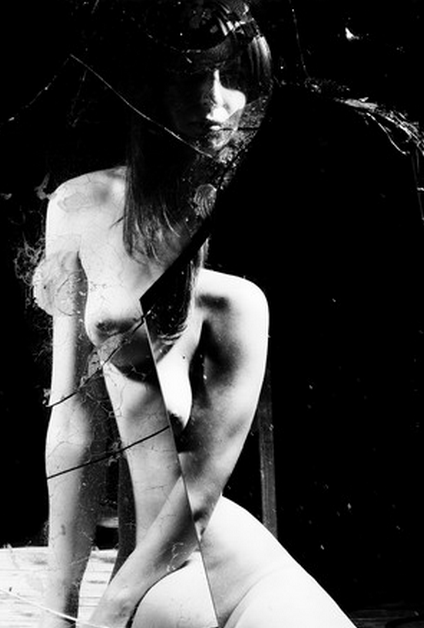
Broken is a project by photographer Dave Coba which features black and white studies of nude models. Coba says the images “were created by photographing the models in front of broken, partly “blind” mirrors. Thematically they’re about dreamlike rapture — self awareness in a reality that’s altered, twisted, broken and reflected in an enigmatic way. It means a lot to me that the models wanted to see themselves as they were portrayed: They played their decisive part by ‘putting themselves into the mirror’ and letting the photographer document them.”
Shintaro Kago 駕籠 真太郎) born 1969 in Tokyo, is a Japanese guro manga artist. He made his debut in in the magazine COMIC BOX, in 1988.
Shintaro Kago’s style has been called “fashionable paranoia”. He has been published in several adult manga magazines, gaining him considerable popularity. Many of his manga have strongly satirical overtones, and deal with grotesque subjects. He has also written Sci-Fi non-guro manga, most notably Super-Conductive Brains Parataxis (超伝脳パラタクシス Choutennou Paratakushisu) for Weekly Young Jump. Many of his shorts are experimental and bizarre. He frequently breaks the fourth wall, and he likes to play with page layout in extreme ways, mostly for comedic effect.
From What Up, Dog? (Chrysalis/Phonogram, 1988). This video by artist/animator Christoph Simon appeared on MTV’s Liquid Television and in various film festivals, including the Spike and Mike Festival.
“Life moves on, whether we act as cowards or heroes. Life has no other discipline to impose, if we would but realise it, than to accept life unquestioningly. Everything we shut our eyes to, everything we run away from, everything we deny, denigrate or despise, serves to defeat us in the end. What seems nasty, painful, evil, can become a source of beauty, joy, and strength, if faced with an open mind. Every moment is a golden one for him who has the vision to recognise it as such.”
Bill Henson – Untitled #20 (2003-3) C-type print, Roslyn Oxley Gallery, Sydney
Bill Henson (born 1955) is an Australian contemporary art photographer.
Henson’s photographs reflect an interest in ambiguity and transition. The use of chiaroscuro is common throughout his works. His photographs are painterly and often presented as diptychs, triptychs and other groupings.
Henson’s works often meditate on the categories of and relationships between male and female; youth and adulthood; day and night; light and dark; nature and civilisation. His images often use flattened perspective and tend towards abstraction. The faces of the subjects are often blurred or partly shadowed and do not directly face the viewer.
According to Crawford, Henson presents “adolescents in their states of despair, intoxication and immature ribaldry”. He has said that these “moments of transition and metamorphosis are important in everyone’s lives”.
As soon as I desire I am asking to be considered. I am not merely here-and-now, sealed into thingness. I am for somewhere else and for something else. I demand that notice be taken of my negating activity insofar as I pursue something other than life; insofar as I do battle for the creation of a human world – that is, of a world of reciprocal recognitions. He who is reluctant to recognize me opposes me. In a savage struggle I am willing to accept convulsions of death, invincible dissolution, but also the possibility of the impossible.
~ Frantz Fanon: Black Skin White Masks. New York: Grove Press (1967)
My favourite version of this Weill/Brecht classic, ever.
“Pirate Jenny” (German: “Seeräuberjenny”) is a well-known song from The Threepenny Opera by Kurt Weill, with lyrics by Bertolt Brecht. The English lyrics are by Marc Blitzstein. This cover by Shilpa Ray, Nick Cave and Warren Ellis was published in February 2013 on Sons of Rogues Gallery: Pirate Ballads, Sea Songs and Chanteys, a Hal Willner-produced compilation album of songs performed by a roster of artists which also includes Tom Waits, Shane MacGowan, Iggy Pop, Patti Smith, Macy Grey, Johnny Depp, Frank Zappa and Richard Thompson.
Marina Abramovic and Ulay shared an intense love in the 1970s, performing art out of the van they lived in. When they felt the relationship had run its course (after almost 12 years), they decided to walk the Great Wall of China, each from one end, meeting for one last big hug in the middle and never seeing each other again.
At her 2010 MoMa retrospective, Marina performed ‘The Artist Is Present’ as part of the show, where she shared a minute of silence with each stranger who sat in front of her. Ulay arrived without her knowing and this is what happened:
Not to be confused with the group of the same name from the UK. From Melbourne, these guys unfortunately disbanded in 2001 after having self-released an EP, and then two albums produced by Steve Shelley (Sonic Youth). This track is taken from the album Alone Alone (2000).
Shot in 1996 and edited in 2000, this is a short documentary about a group of 13-year-old riot grrrls who were socially ostracized at school by their peers and upperclassmen. Everyone in the schoolyard held strong opinions about these so-called “dirty girls,” and meanwhile the “dirty girls” themselves aimed to get their message across by distributing their zine across campus. Directed by Michael Lucid. Music: “Batmobile” by Liz Phair.
“The best moments in reading are when you come across something — a thought, a feeling, a way of looking at things — which you had thought special and particular to you. And now, here it is, set down by someone else, a person you have never met, someone, even, who is long dead. And it is as if a hand has come out, and taken yours.”
Archival interview with David Cronenberg from Bombsite (1986)
Bette Gordon (BG) Are your nightmares like your movies? Do you actually see your movie images in your dreams?
David Cronenberg (DC) Rarely. My images come out of the process of making film. I do really think that movies work on the level of dream logic. However realistic or narrative they might like to think they are, they are dreamlike.
BG You, as a director, have an incredible ability to tap into the unconscious.
DC I was once on a talk show with a psychiatrist who worked at the Clark Institute with criminals. He had seen my film, Videodrome and said to me, “I’m almost afraid to be sitting here next to you.” He was totally mystified as to how I could empathize with those states of mind and he obviously, could not. It is mostly intuitive with me. One of the reasons I make a movie is that I’m then in a position where I have to analyze and I enjoy that process.
BG In They Came from Within there was a line of dialogue—”Man thinks too much, he’s lost touch with the body, with instincts. Too much brain and not enough guts.” Do you think the mind is stronger than the body?
DC No. I think the quote is particular to that film. What interests me is the mind/body schism.
BG What do you mean by mind/body schism?
DC I think the mind grows out of the body. I don’t believe in an afterlife. I don’t see the mind or the spirit or the soul continuing after our body dies. The mind and body are completely dependent and interrelated. The mind is somehow organic and physical. It’s only our perception and our culture that keeps them separate.
BG What about the mind creating its own monsters in a sense, that the monster comes from within the mind. Like in Dead Ringers for example, or in Videodrome where it’s the mind that is completely in charge of the body.
DC In as much as the mind is ever in charge of anything. I don’t think it is always in control.
BG Or in Scanners where through mind control, you can . . .
DC Affect the body. But you see, I think everybody does that. I don’t think it’s just Western culture, other cultures even accentuate it more by saying the body’s nothing; it’s only temporary and the mind and the spirit are eternal. I think that’s very destructive. It’s not true. All philosophical, metaphysical and religious forces should be concentrating on trying to form a perception and reality for ourselves that integrates the two. And that would include coming to terms with death as a physical event rather than trying to evade it.
BG So how would you come to terms with death?
DC There’s a Japanese religion that thinks of all of life as a preparation for death, which to the Western mind seems like a very morbid approach to life. But if you think of death as a true end of something, of a process, it makes perfect sense. There we get into the old idea of Western culture being death denying, but I actually think Eastern culture is too. Because they try to trivialize death as being not important.
BG So it falls somewhere between the two as being very important and not important at all.
DC One of the main subjects of all of my films is exactly that. In Dead Ringers you get a body split into two (the twins) with basically, one mind. Just doing that is like an experiment in a lab—which all my movies really are. I set out to see how they work, to illuminate something for myself by doing these experiments.
Videodrome – with James Woods and Debbie Harry
BG There is something about the medical profession in all of your films.
DC Scientists and doctors to me, are at the leading edge of what all human beings do all of the time; which is to change, everything. We’ve never been satisfied with what we’re given. We don’t accept the earth as a given. We change our body chemistry, our physiology, our biology, our biochemistry. We clear the forest, we build our own environment, we climate control it . . . And, the interface between that impulse and the human body often is doctors, biologists, and biochemists.
BG Were you a biochemist?
DC I did go into biochemistry at the University of Toronto. But when I came face to face with what science required, I realized that my temperament was much more suited to some form of art; writing or whatever. I didn’t think of film at the time. I found I would prefer to invent my own science rather than spend two years with rats in a lab getting results.
BG There’s an ambivalence for the medical/science profession in all of your films. You don’t really have villains in the film, nobody’s quite evil . . .
DC That’s right. It is ambivalence. Because I think that they’re heroic even when they’re crazed. I think that being crazed and obsessed is part of being heroic. You don’t get one without the other. Ambition is something else. It’s not ambition in the material sense. My characters are obsessed with discovery and that does excite me and I do identify with that. A good creative scientist is as good as a good creative artist. No question in my mind.
BG What is your notion of the hero? You said your characters are heroic even when they are crazed.
DC Yes, maybe even especially because they’re crazed. I’m obviously drawn to people as main characters who are not embedded so completely in their culture that they can’t see any . . . a visionary’s process . . . people who are jarred into being outside. Continue reading →





![The Garden of Earthly Delights [detail].Date 1480-1510](https://fleurmach.com/wp-content/uploads/2013/03/hieronymus_bosch_garden_of_earthly_delights_tryptich_centre_panel_-_detail_9.jpg)

 fleurmach
