“Free your ass and your mind will follow” (with a nod to George Clinton).
What HAS changed since this song came out in 2001 is that you don’t have to go offline to take to the streets anymore. ;)
“Free your ass and your mind will follow” (with a nod to George Clinton).
What HAS changed since this song came out in 2001 is that you don’t have to go offline to take to the streets anymore. ;)
From the ex-X-Ray-Spex icon’s last album, Generation Indigo, released in March 2011, a month before her death at 53 of breast cancer.

I was just reminded of this photo I took a while back.
A demo recorded circa 1968, but only released in 1995 on the album Rolled Gold (label: Dig The Fuzz Records).
A cover of Simon and Garfunkel’s “The Sound of Silence” on Laforêt’s Album 3 (Disques Festival, 1967). The video contains footage from the film, The Graduate (1967), in which this and other Simon and Garfunkel songs feature prominently during pivotal montage scenes.
Beautiful woman, beautiful album.
From Album 3 (Disques Festival, 1967). Beautiful woman, beautiful album.
From Album 3 (Disques Festival, 1967).
From Album 3 (Disques Festival, 1967).

(Image: http://ad-busting.tumblr.com/)
“skin and bones
blood and stones
feathered.”
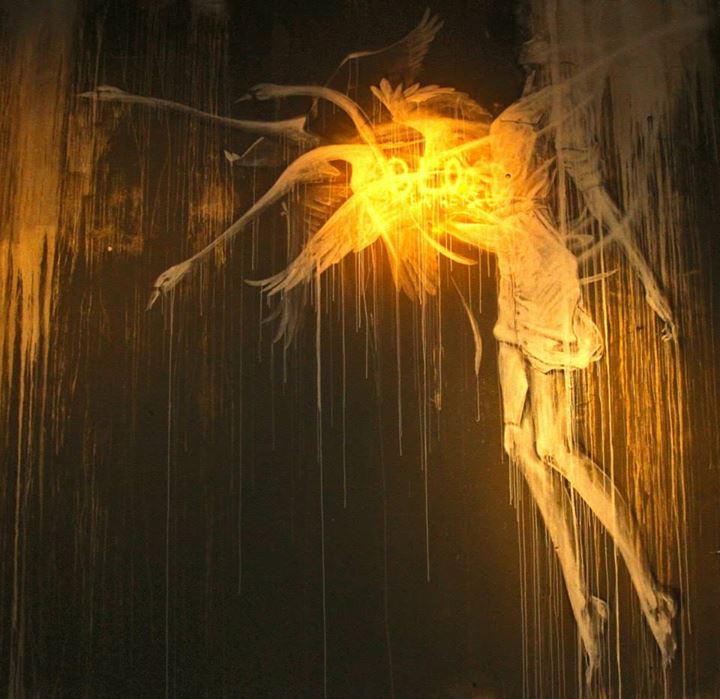
By South African artist Faith47 – NUART, Norway, 2013
Photo: Hendrik Haven
Check out more of Faith47’s beautiful, profound street art and paintings HERE.
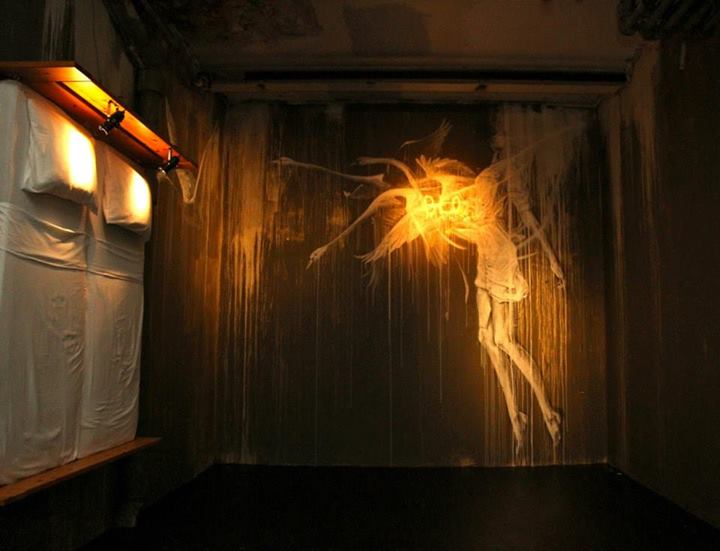
By South African artist Faith47 – NUART, Norway, 2013
Photo: Hendrik Haven
From the album of the same name, released on Island Records/Chrysalis in 1985.
“The moon’s shining so brightly tonight…”
Kyle Shepherd (piano, voice), Shane Cooper (double bass) and Jonno Sweetman (drums) perform a version of this subversive traditional Cape Goema song arranged by Kyle Shepherd. Recorded live at Welgemeend, Welgemeend Street, Gardens, Cape Town, South Africa on Friday 21 May 2009.
“Liars rule the world…”
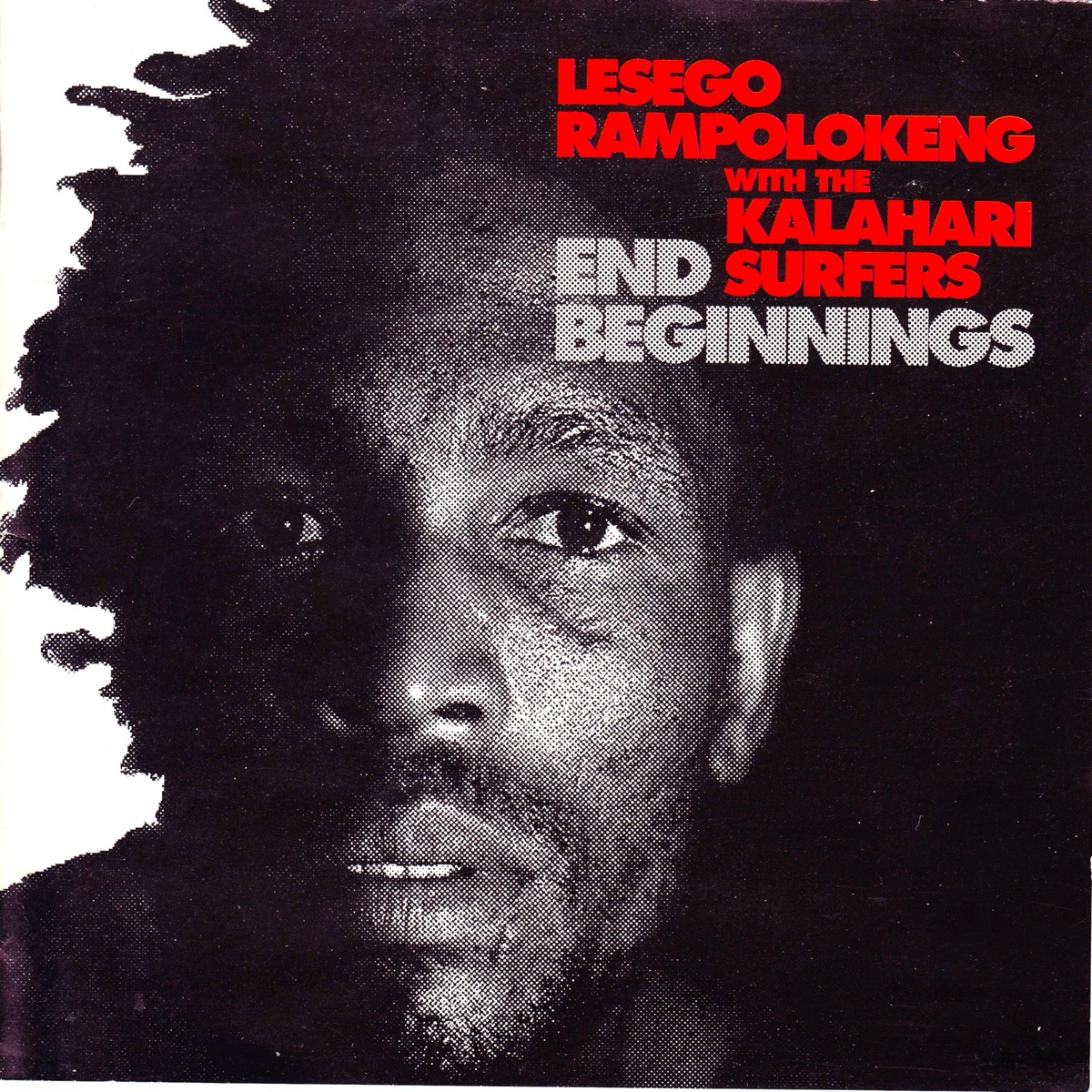
“Treason” and “End Beginnings” — tracks from the album End Beginnings (Shifty, 1991). This is the sound of South Africa in the late 1980s/early 1990s. Of course, I never got to hear this until years later.
Music: Warrick Sony
Words and voice: Lesego Rampolokeng
Download this album HERE.
From one of the most arresting albums of the twentieth century, Maxinquaye (Island Records, 1995). I bought this CD in my final year of high school, and spent hours and hours in its company over the next few years, lying prone, alone, on the floor, curtains drawn, drowning. The album’s fractured claustrophobia felt so exactly right for the time, particularly in South Africa… its heart of darkness festering quietly while the rainbow nationalist rhetoric raged outside.
“It was the most bizarre record I’ve ever worked on,” says Mark Saunders about Maxinquaye, the 1995 Tricky album that, with the exception of the previously released singles ‘Aftermath’ and ‘Ponderosa’, he co-produced with the artist, in addition to taking care of the engineering, programming and mixing. “It was a complete un-learning experience and it was also a total re-learning experience. Think of how to make a record, then forget everything you’ve learned and start completely backwards and upside down. I could write a book about Tricky. He’s such a great character.”
Read more about the highly unorthodox way in which Maxinquaye was made, HERE.
Hello, reader :)
It’s Fleurmach’s first birthday! To celebrate, here is a ground-shifting text, a manifesto of sorts, from Hélène Cixous back in 1976 (the year punk broke). If you haven’t ever read Cixous (and even if you have, once upon a time), do yourself a favour and plough through this, SERIOUSLY. I tried to excerpt chunks from it (and may still), but decided that it’s really important and enriching to read the piece in its entirety.
Thank you all for your ongoing support and contributions to the Fleurmach community.
Much love,
Cherry Bomb
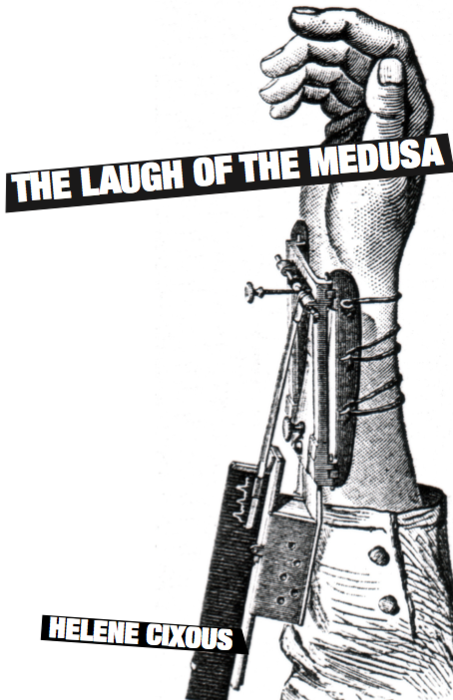
I shall speak about women’s writing: about what it will do. Woman must write her self: must write about women and bring women to writing, from which they have been driven away as violently as from their bodies – for the same reasons, by the same law, with the same fatal goal.
Woman must put herself into the text – as into the world and into history – by her own movement.
The future must no longer be determined by the past. I do not deny that the effects of the past are still with us. But I refuse to strengthen them by repeating them, to confer upon them an irremovability the equivalent of destiny, to confuse the biological and the cultural. Anticipation is imperative.
Since these reflections are taking shape in an area just on the point of being discovered, they necessarily bear the mark of our time-a time during which the new breaks away from the old, and, more precisely, the (feminine) new from the old (la nouvelle de l’ancien). Thus, as there are no grounds for establishing a discourse, but rather an arid millennial ground to break, what I say has at least two sides and two aims: to break up, to destroy; and to foresee the unforeseeable, to project.
I write this as a woman, toward women. When I say “woman”, I’m speaking of woman in her inevitable struggle against conventional man; and of a universal woman subject who must bring women to their senses and to their meaning in history. But first it must be said that in spite of the enormity of the repression that has kept them in the “dark” – that dark which people have been trying to make them accept as their attribute – there is, at this time, no general woman, no one typical woman. What they have in common I will say. But what strikes me is the infinite richness of their individual constitutions: you can’t talk about a female sexuality, uniform, homogeneous, classifiable into codes – any more than you can talk about one unconscious resembling another.
Women’s imaginary is inexhaustible, like music, painting, writing: their stream of phantasms is incredible.
I have been amazed more than once by a description a woman gave me of a world all her own which she had been secretly haunting since early childhood. A world of searching, the elaboration of a knowledge, on the basis of a systematic experimentation with the bodily functions, a passionate and precise interrogation of her erotogeneity. This practice, extraordinarily rich and inventive, in particular as concerns masturbation, is prolonged or accompanied by a production of forms, a veritable aesthetic activity, each stage of rapture inscribing a resonant vision, a composition, something beautiful. Beauty will no longer be forbidden.
I wished that that woman would write and proclaim this unique empire so that other women, other unacknowledged sovereigns, might exclaim: I, too, overflow; my desires have invented new desires, my body knows unheard-of songs. Time and again I, too, have felt so full of luminous torrents that I could burst – burst with forms much more beautiful than those which are put up in frames and sold for a stinking fortune. And I, too, said nothing, showed nothing; I didn’t open my mouth, I didn’t repaint my half of the world. I was ashamed. I was afraid, and I swallowed my shame and my fear. I said to myself: You are mad! What’s the meaning of these waves, these floods, these outbursts?
Where is the ebullient, infinite woman who, immersed as she was in her naïveté, kept in the dark about herself, led into self-disdain by the great arm of parental-conjugal phallocentrism, hasn’t been ashamed of her strength? Who, surprised and horrified by the fantastic tumult of her drives (for she was made to believe that a well-adjusted normal woman has a … divine composure), hasn’t accused herself of being a monster?
Who, feeling a funny desire stirring inside her (to sing, to write, to dare to speak, in short, to bring out something new), hasn’t thought she was sick? Well, her shameful sickness is that she resists death, that she makes trouble.
And why don’t you write? Write! Writing is for you, you are for you; your body is yours, take it. I know why you haven’t written. (And why I didn’t write before the age of twenty-seven.) Because writing is at once too high, too great for you, it’s reserved for the great – that is, for “great men”; and it’s “silly.” Besides, you’ve written a little, but in secret. And it wasn’t good, because it was in secret, and because you punished yourself for writing, because you didn’t go all the way; or because you wrote, irresistibly, as when we would masturbate in secret, not to go further, but to attenuate the tension a bit, just enough to take the edge off. And then as soon as we come, we go and make ourselves feel guilty – so as to be forgiven; or to forget, to bury it until the next time.
Write, let no one hold you back, let nothing stop you: not man; not the imbecilic capitalist machinery, in which publishing houses are the crafty, obsequious relayers of imperatives handed down by an economy that works against us and off our backs; and not yourself.
Live performance, 28 July 2012, Madrid.
Anyone wanna update this with current news images?

Image: Sarah Sandin
David Foster Wallace was arguably one of the most brilliant American writers of his generation. In this excerpt from a speech he gave, first published on the Guardian website a week after his death in 2008, he reflects on the difficulties of daily life and ‘making it to 30, or maybe 50, without wanting to shoot yourself in the head’. Read it below the jump or listen to the audio recording here:
There are these two young fish swimming along, and they happen to meet an older fish swimming the other way, who nods at them and says, “Morning, boys, how’s the water?” And the two young fish swim on for a bit, and then eventually one of them looks over at the other and goes, “What the hell is water?”
If you’re worried that I plan to present myself here as the wise old fish explaining what water is, please don’t be. I am not the wise old fish. The immediate point of the fish story is that the most obvious, ubiquitous, important realities are often the ones that are the hardest to see and talk about. Stated as an English sentence, of course, this is just a banal platitude – but the fact is that, in the day-to-day trenches of adult existence, banal platitudes can have life-or-death importance. That may sound like hyperbole, or abstract nonsense. So let’s get concrete …
A huge percentage of the stuff that I tend to be automatically certain of is, it turns out, totally wrong and deluded. Here’s one example of the utter wrongness of something I tend to be automatically sure of: everything in my own immediate experience supports my deep belief that I am the absolute centre of the universe, the realest, most vivid and important person in existence. We rarely talk about this sort of natural, basic self-centredness, because it’s so socially repulsive, but it’s pretty much the same for all of us, deep down. It is our default setting, hard-wired into our boards at birth. Think about it: there is no experience you’ve had that you were not at the absolute centre of. The world as you experience it is right there in front of you, or behind you, to the left or right of you, on your TV, or your monitor, or whatever. Other people’s thoughts and feelings have to be communicated to you somehow, but your own are so immediate, urgent, real – you get the idea. But please don’t worry that I’m getting ready to preach to you about compassion or other-directedness or the so-called “virtues”. This is not a matter of virtue – it’s a matter of my choosing to do the work of somehow altering or getting free of my natural, hard-wired default setting, which is to be deeply and literally self-centred, and to see and interpret everything through this lens of self.
By way of example, let’s say it’s an average day, and you get up in the morning, go to your challenging job, and you work hard for nine or ten hours, and at the end of the day you’re tired, and you’re stressed out, and all you want is to go home and have a good supper and maybe unwind for a couple of hours and then hit the rack early because you have to get up the next day and do it all again. But then you remember there’s no food at home – you haven’t had time to shop this week, because of your challenging job – and so now, after work, you have to get in your car and drive to the supermarket. It’s the end of the workday, and the traffic’s very bad, so getting to the store takes way longer than it should, and when you finally get there the supermarket is very crowded, because of course it’s the time of day when all the other people with jobs also try to squeeze in some grocery shopping, and the store’s hideously, fluorescently lit, and infused with soul-killing Muzak or corporate pop, and it’s pretty much the last place you want to be, but you can’t just get in and quickly out: you have to wander all over the huge, overlit store’s crowded aisles to find the stuff you want, and you have to manoeuvre your junky cart through all these other tired, hurried people with carts, and of course there are also the glacially slow old people and the spacey people and the kids who all block the aisle and you have to grit your teeth and try to be polite as you ask them to let you by, and eventually, finally, you get all your supper supplies, except now it turns out there aren’t enough checkout lanes open even though it’s the end-of-the-day rush, so the checkout line is incredibly long, which is stupid and infuriating, but you can’t take your fury out on the frantic lady working the register.
Anyway, you finally get to the checkout line’s front, and pay for your food, and wait to get your cheque or card authenticated by a machine, and then get told to “Have a nice day” in a voice that is the absolute voice of death, and then you have to take your creepy flimsy plastic bags of groceries in your cart through the crowded, bumpy, littery parking lot, and try to load the bags in your car in such a way that everything doesn’t fall out of the bags and roll around in the trunk on the way home, and then you have to drive all the way home through slow, heavy, SUV-intensive rush-hour traffic, etc, etc.
The point is that petty, frustrating crap like this is exactly where the work of choosing comes in. Because the traffic jams and crowded aisles and long checkout lines give me time to think, and if I don’t make a conscious decision about how to think and what to pay attention to, I’m going to be pissed and miserable every time I have to food-shop, because my natural default setting is the certainty that situations like this are really all about me, about my hungriness and my fatigue and my desire to just get home, and it’s going to seem, for all the world, like everybody else is just in my way, and who are all these people in my way? And look at how repulsive most of them are and how stupid and cow-like and dead-eyed and nonhuman they seem here in the checkout line, or at how annoying and rude it is that people are talking loudly on cell phones in the middle of the line, and look at how deeply unfair this is: I’ve worked really hard all day and I’m starved and tired and I can’t even get home to eat and unwind because of all these stupid goddamn people.
Or if I’m in a more socially conscious form of my default setting, I can spend time in the end-of-the-day traffic jam being angry and disgusted at all the huge, stupid, lane-blocking SUVs and Hummers and V12 pickup trucks burning their wasteful, selfish, 40-gallon tanks of gas, and I can dwell on the fact that the patriotic or religious bumper stickers always seem to be on the biggest, most disgustingly selfish vehicles driven by the ugliest, most inconsiderate and aggressive drivers, who are usually talking on cell phones as they cut people off in order to get just 20 stupid feet ahead in a traffic jam, and I can think about how our children’s children will despise us for wasting all the future’s fuel and probably screwing up the climate, and how spoiled and stupid and disgusting we all are, and how it all just sucks …
If I choose to think this way, fine, lots of us do – except that thinking this way tends to be so easy and automatic it doesn’t have to be a choice. Thinking this way is my natural default setting. It’s the automatic, unconscious way that I experience the boring, frustrating, crowded parts of adult life when I’m operating on the automatic, unconscious belief that I am the centre of the world and that my immediate needs and feelings are what should determine the world’s priorities. The thing is that there are obviously different ways to think about these kinds of situations. In this traffic, all these vehicles stuck and idling in my way: it’s not impossible that some of these people in SUVs have been in horrible car accidents in the past and now find driving so traumatic that their therapist has all but ordered them to get a huge, heavy SUV so they can feel safe enough to drive; or that the Hummer that just cut me off is maybe being driven by a father whose little child is hurt or sick in the seat next to him, and he’s trying to rush to the hospital, and he’s in a much bigger, more legitimate hurry than I am – it is actually I who am in his way.
Again, please don’t think that I’m giving you moral advice, or that I’m saying you’re “supposed to” think this way, or that anyone expects you to just automatically do it, because it’s hard, it takes will and mental effort, and if you’re like me, some days you won’t be able to do it, or you just flat-out won’t want to. But most days, if you’re aware enough to give yourself a choice, you can choose to look differently at this fat, dead-eyed, over-made-up lady who just screamed at her little child in the checkout line – maybe she’s not usually like this; maybe she’s been up three straight nights holding the hand of her husband who’s dying of bone cancer, or maybe this very lady is the low-wage clerk at the Motor Vehicles Dept who just yesterday helped your spouse resolve a nightmarish red-tape problem through some small act of bureaucratic kindness. Of course, none of this is likely, but it’s also not impossible – it just depends on what you want to consider. If you’re automatically sure that you know what reality is and who and what is really important – if you want to operate on your default setting – then you, like me, will not consider possibilities that aren’t pointless and annoying. But if you’ve really learned how to think, how to pay attention, then you will know you have other options. It will be within your power to experience a crowded, loud, slow, consumer-hell-type situation as not only meaningful but sacred, on fire with the same force that lit the stars – compassion, love, the sub-surface unity of all things. Not that that mystical stuff’s necessarily true: the only thing that’s capital-T True is that you get to decide how you’re going to try to see it. You get to consciously decide what has meaning and what doesn’t. You get to decide what to worship.
Because here’s something else that’s true. In the day-to-day trenches of adult life, there is no such thing as atheism. There is no such thing as not worshipping. Everybody worships. The only choice we get is what to worship. And an outstanding reason for choosing some sort of god or spiritual-type thing to worship – be it JC or Allah, be it Yahweh or the Wiccan mother-goddess or the Four Noble Truths or some infrangible set of ethical principles – is that pretty much anything else you worship will eat you alive. If you worship money and things – if they are where you tap real meaning in life – then you will never have enough. Never feel you have enough. It’s the truth. Worship your own body and beauty and sexual allure and you will always feel ugly, and when time and age start showing, you will die a million deaths before they finally plant you. On one level, we all know this stuff already – it’s been codified as myths, proverbs, clichés, bromides, epigrams, parables: the skeleton of every great story. The trick is keeping the truth up front in daily consciousness. Worship power – you will feel weak and afraid, and you will need ever more power over others to keep the fear at bay. Worship your intellect, being seen as smart – you will end up feeling stupid, a fraud, always on the verge of being found out.
The insidious thing about these forms of worship is not that they’re evil or sinful; it is that they are unconscious. They are default settings. They’re the kind of worship you just gradually slip into, day after day, getting more and more selective about what you see and how you measure value without ever being fully aware that that’s what you’re doing. And the world will not discourage you from operating on your default settings, because the world of men and money and power hums along quite nicely on the fuel of fear and contempt and frustration and craving and the worship of self. Our own present culture has harnessed these forces in ways that have yielded extraordinary wealth and comfort and personal freedom. The freedom to be lords of our own tiny skull-sized kingdoms, alone at the centre of all creation. This kind of freedom has much to recommend it. But there are all different kinds of freedom, and the kind that is most precious you will not hear much talked about in the great outside world of winning and achieving and displaying. The really important kind of freedom involves attention, and awareness, and discipline, and effort, and being able truly to care about other people and to sacrifice for them, over and over, in myriad petty little unsexy ways, every day. That is real freedom. The alternative is unconsciousness, the default setting, the “rat race” – the constant gnawing sense of having had and lost some infinite thing.
I know that this stuff probably doesn’t sound fun and breezy or grandly inspirational. What it is, so far as I can see, is the truth with a whole lot of rhetorical bullshit pared away. Obviously, you can think of it whatever you wish. But please don’t dismiss it as some finger-wagging Dr Laura sermon. None of this is about morality, or religion, or dogma, or big fancy questions of life after death. The capital-T Truth is about life before death. It is about making it to 30, or maybe 50, without wanting to shoot yourself in the head. It is about simple awareness – awareness of what is so real and essential, so hidden in plain sight all around us, that we have to keep reminding ourselves, over and over: “This is water, this is water.”
· Adapted from the commencement speech the author gave to a graduating class at Kenyon College, Ohio. First published on the Guardian website.
In this fascinating interview for Spinner, PJ Harvey describes the intensive process of anchoring down the words and forms of the songs in advance of recording her album, Let England Shake.
 I
I
Midwinter spring is its own season
Sempiternal though sodden towards sundown,
Suspended in time, between pole and tropic.
When the short day is brightest, with frost and fire,
The brief sun flames the ice, on pond and ditches,
In windless cold that is the heart’s heat,
Reflecting in a watery mirror
A glare that is blindness in the early afternoon.
And glow more intense than blaze of branch, or brazier,
Stirs the dumb spirit: no wind, but pentecostal fire
In the dark time of the year. Between melting and freezing
The soul’s sap quivers. There is no earth smell
Or smell of living thing. This is the spring time
But not in time’s covenant. Now the hedgerow
Is blanched for an hour with transitory blossom
Of snow, a bloom more sudden
Than that of summer, neither budding nor fading,
Not in the scheme of generation.
Where is the summer, the unimaginable
Zero summer?
If you came this way,
Taking the route you would be likely to take
From the place you would be likely to come from,
If you came this way in may time, you would find the hedges
White again, in May, with voluptuary sweetness.
It would be the same at the end of the journey,
If you came at night like a broken king,
If you came by day not knowing what you came for,
It would be the same, when you leave the rough road
And turn behind the pig-sty to the dull facade
And the tombstone. And what you thought you came for
Is only a shell, a husk of meaning
From which the purpose breaks only when it is fulfilled
If at all. Either you had no purpose
Or the purpose is beyond the end you figured
And is altered in fulfilment. There are other places
Which also are the world’s end, some at the sea jaws,
Or over a dark lake, in a desert or a city—
But this is the nearest, in place and time,
Now and in England.
If you came this way,
Taking any route, starting from anywhere,
At any time or at any season,
It would always be the same: you would have to put off
Sense and notion. You are not here to verify,
Instruct yourself, or inform curiosity
Or carry report. You are here to kneel
Where prayer has been valid. And prayer is more
Than an order of words, the conscious occupation
Of the praying mind, or the sound of the voice praying.
And what the dead had no speech for, when living,
They can tell you, being dead: the communication
Of the dead is tongued with fire beyond the language of the living.
Here, the intersection of the timeless moment
Is England and nowhere. Never and always.
II
Ash on an old man’s sleeve
Is all the ash the burnt roses leave.
Dust in the air suspended
Marks the place where a story ended.
Dust inbreathed was a house-
The walls, the wainscot and the mouse,
The death of hope and despair,
This is the death of air.
There are flood and drouth
Over the eyes and in the mouth,
Dead water and dead sand
Contending for the upper hand.
The parched eviscerate soil
Gapes at the vanity of toil,
Laughs without mirth.
This is the death of earth.
Water and fire succeed
The town, the pasture and the weed.
Water and fire deride
The sacrifice that we denied.
Water and fire shall rot
The marred foundations we forgot,
Of sanctuary and choir.
This is the death of water and fire.
In the uncertain hour before the morning
Near the ending of interminable night
At the recurrent end of the unending
After the dark dove with the flickering tongue
Had passed below the horizon of his homing
While the dead leaves still rattled on like tin
Over the asphalt where no other sound was
Between three districts whence the smoke arose
I met one walking, loitering and hurried
As if blown towards me like the metal leaves
Before the urban dawn wind unresisting.
And as I fixed upon the down-turned face
That pointed scrutiny with which we challenge
The first-met stranger in the waning dusk
I caught the sudden look of some dead master
Whom I had known, forgotten, half recalled
Both one and many; in the brown baked features
The eyes of a familiar compound ghost
Both intimate and unidentifiable.
So I assumed a double part, and cried
And heard another’s voice cry: “What! are you here?”
Although we were not. I was still the same,
Knowing myself yet being someone other—
And he a face still forming; yet the words sufficed
To compel the recognition they preceded.
And so, compliant to the common wind,
Too strange to each other for misunderstanding,
In concord at this intersection time
Of meeting nowhere, no before and after,
We trod the pavement in a dead patrol.
I said: “The wonder that I feel is easy,
Yet ease is cause of wonder. Therefore speak:
I may not comprehend, may not remember.”
And he: “I am not eager to rehearse
My thoughts and theory which you have forgotten.
These things have served their purpose: let them be.
So with your own, and pray they be forgiven
By others, as I pray you to forgive
Both bad and good. Last season’s fruit is eaten
And the fullfed beast shall kick the empty pail.
For last year’s words belong to last year’s language
And next year’s words await another voice.
But, as the passage now presents no hindrance
To the spirit unappeased and peregrine
Between two worlds become much like each other,
So I find words I never thought to speak
In streets I never thought I should revisit
When I left my body on a distant shore.
Since our concern was speech, and speech impelled us
To purify the dialect of the tribe
And urge the mind to aftersight and foresight,
Let me disclose the gifts reserved for age
To set a crown upon your lifetime’s effort.
First, the cold fricton of expiring sense
Without enchantment, offering no promise
But bitter tastelessness of shadow fruit
As body and soul begin to fall asunder.
Second, the conscious impotence of rage
At human folly, and the laceration
Of laughter at what ceases to amuse.
And last, the rending pain of re-enactment
Of all that you have done, and been; the shame
Of things ill done and done to others’ harm
Which once you took for exercise of virtue.
Then fools’ approval stings, and honour stains.
From wrong to wrong the exasperated spirit
Proceeds, unless restored by that refining fire
Where you must move in measure, like a dancer.”
The day was breaking. In the disfigured street
He left me, with a kind of valediction,
And faded on the blowing of the horn.
III
There are three conditions which often look alike
Yet differ completely, flourish in the same hedgerow:
Attachment to self and to things and to persons, detachment
From self and from things and from persons; and, growing between them, indifference
Which resembles the others as death resembles life,
Being between two lives – unflowering, between
The live and the dead nettle. This is the use of memory:
For liberation – not less of love but expanding
Of love beyond desire, and so liberation
From the future as well as the past. Thus, love of a country
Begins as an attachment to our own field of action
And comes to find that action of little importance
Though never indifferent. History may be servitude,
History may be freedom. See, now they vanish,
The faces and places, with the self which, as it could, loved them,
To become renewed, transfigured, in another pattern.
Sin is Behovely, but
All shall be well, and
All manner of thing shall be well.
If I think, again, of this place,
And of people, not wholly commendable,
Of not immediate kin or kindness,
But of some peculiar genius,
All touched by a common genius,
United in the strife which divided them;
If I think of a king at nightfall,
Of three men, and more, on the scaffold
And a few who died forgotten
In other places, here and abroad,
And of one who died blind and quiet,
Why should we celebrate
These dead men more than the dying?
It is not to ring the bell backward
Nor is it an incantation
To summon the spectre of a Rose.
We cannot revive old factions
We cannot restore old policies
Or follow an antique drum.
These men, and those who opposed them
And those whom they opposed
Accept the constitution of silence
And are folded in a single party.
Whatever we inherit from the fortunate
We have taken from the defeated
What they had to leave us – a symbol:
A symbol perfected in death.
And all shall be well and
All manner of thing shall be well
By the purification of the motive
In the ground of our beseeching.
IV
The dove descending breaks the air
With flame of incandescent terror
Of which the tongues declare
The one dischage from sin and error.
The only hope, or else despair
Lies in the choice of pyre of pyre-
To be redeemed from fire by fire.
Who then devised the torment? Love.
Love is the unfamiliar Name
Behind the hands that wove
The intolerable shirt of flame
Which human power cannot remove.
We only live, only suspire
Consumed by either fire or fire.
V
What we call the beginning is often the end
And to make and end is to make a beginning.
The end is where we start from. And every phrase
And sentence that is right (where every word is at home,
Taking its place to support the others,
The word neither diffident nor ostentatious,
An easy commerce of the old and the new,
The common word exact without vulgarity,
The formal word precise but not pedantic,
The complete consort dancing together)
Every phrase and every sentence is an end and a beginning,
Every poem an epitaph. And any action
Is a step to the block, to the fire, down the sea’s throat
Or to an illegible stone: and that is where we start.
We die with the dying:
See, they depart, and we go with them.
We are born with the dead:
See, they return, and bring us with them.
The moment of the rose and the moment of the yew-tree
Are of equal duration. A people without history
Is not redeemed from time, for history is a pattern
Of timeless moments. So, while the light fails
On a winter’s afternoon, in a secluded chapel
History is now and England.
With the drawing of this Love and the voice of this Calling
We shall not cease from exploration
And the end of all our exploring
Will be to arrive where we started
And know the place for the first time.
Through the unknown, unremembered gate
When the last of earth left to discover
Is that which was the beginning;
At the source of the longest river
The voice of the hidden waterfall
And the children in the apple-tree
Not known, because not looked for
But heard, half-heard, in the stillness
Between two waves of the sea.
Quick now, here, now, always—
A condition of complete simplicity
(Costing not less than everything)
And all shall be well and
All manner of thing shall be well
When the tongues of flames are in-folded
Into the crowned knot of fire
And the fire and the rose are one.
“Little Gidding” is the fourth and final poem of T. S. Eliot‘s Four Quartets, a series of poems that discuss time, perspective, humanity, and salvation. It was first published in September 1942 after being delayed for over a year because of the air-raids on Great Britain during World War II and Eliot’s declining health. The title refers to a small Anglican community in Huntingdonshire, established by Nicholas Ferrar in the 17th century and scattered during the English Civil War.
The poem uses the combined image of fire and Pentecostal fire to emphasize the need for purification and purgation. According to the poet, humanity’s flawed understanding of life and turning away from God leads to a cycle of warfare, but this can be overcome by recognizing the lessons of the past. Within the poem, the narrator meets a ghost that is a combination of various poets and literary figures. Little Gidding focuses on the unity of past, present, and future, and claims that understanding this unity is necessary for salvation.
I have been working for the last while as researcher and production manager on a weekly SABC-commissioned TV documentary series, I Am Woman – Leap of Faith. Here’s one of the episodes, directed by Jane Kennedy:
In January 1996 Shelley Barry was 23 and on her way to a job interview in Cape Town when she was caught in the crossfire of taxi violence caused by rival taxi groups battling for ownership of the same routes.
She was sitting next to the taxi driver in the front of his minibus when an assassin pulled up alongside the moving vehicle and opened fire. The driver was shot seven times and was killed instantly. The taxi crashed, injuring many of its passengers.
Shelley was hit by one of the assassin’s bullets and was instantly paralysed. Her life hung in the balance and it was assumed she would not survive. The friend she was travelling with was seriously injured but has recovered, despite the bullet still lodged in her chest. Shelley has been in a wheelchair ever since. Today she is 42.
How does one create a life for oneself after something like this? How does one find work and meaning once again? Importantly, what happened to Shelley Barry’s dream, held close since childhood, of becoming a filmmaker?
Join this remarkable woman, teacher, activist and filmmaker as she describes her life before and after the shooting: The life of a young girl who told her childhood friends that one day her films would be on the big screen and has achieved that, despite a bullet getting in her way and forcing her into a wheelchair for over twenty years… The life of an activist who worked in the Presidency and has made a significant difference to the lives of the disabled in South Africa… The deeply spiritual journey of a sensitive, funny and bolshy woman who, despite her circumstances, is determined to continue making her mark on the world.
Shelley Barry graciously lets us into her world, describing the many Leaps of Faith she has taken so far and continues to take each and every day.
Catch the broadcast of this programme on SABC 3, Sundays at 09h30, or watch archived episodes on the I AM WOMAN – LEAP OF FAITH WEBSITE.
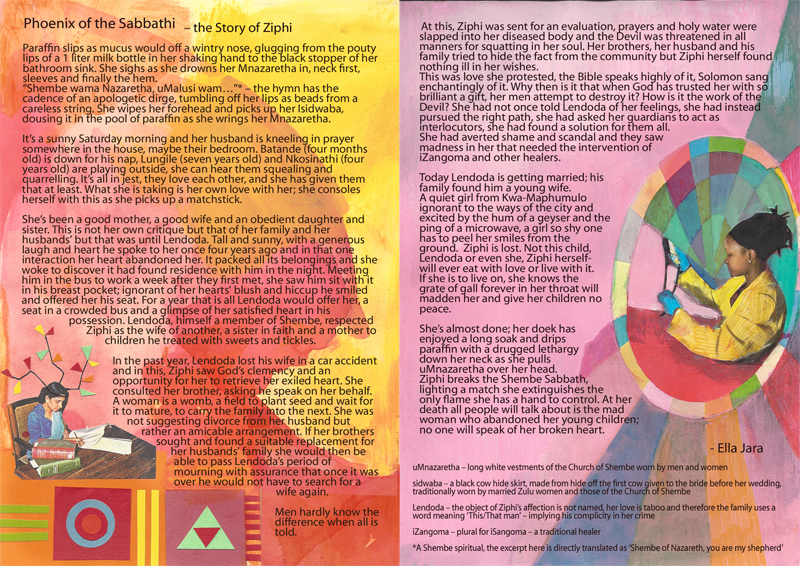
This is a page taken from FLEURZINE, a zine curated and illustrated by Julia Mary Grey. You can go and download this beautiful work of art for free on her site, HERE.
The name was inspired by Fleurmach, and six pieces of writing from this blog appear in the publication. This piece is by Fleurmach contributor NoHolyCows.
 “Being born a woman is an awful tragedy… Yes, my consuming desire to mingle with road crews, sailors and soldiers, bar room regulars – to be a part of a scene, anonymous, listening, recording – all is spoiled by the fact that I am a girl, a female always in danger of assault and battery. My consuming interest in men and their lives is often misconstrued as a desire to seduce them, or as an invitation to intimacy. Yet, God, I want to talk to everybody I can as deeply as I can. I want to be able to sleep in an open field, to travel west, to walk freely at night…”
— Sylvia Plath
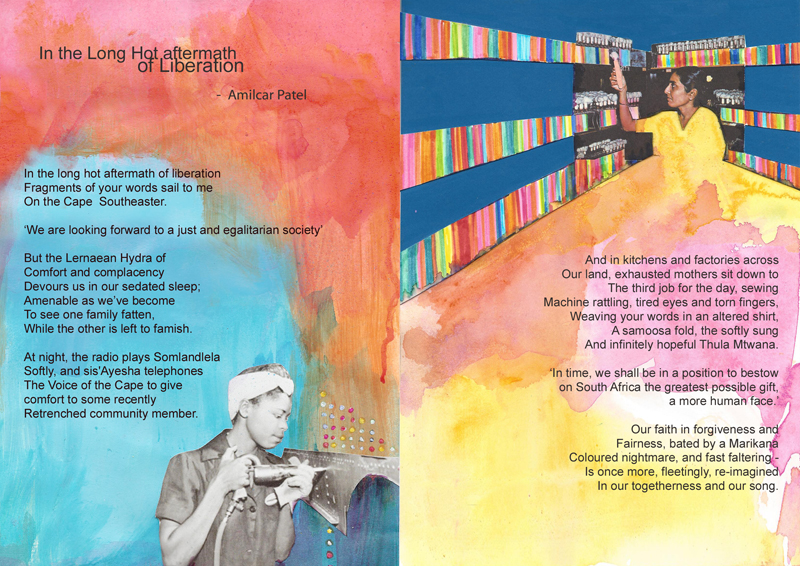 This is a page taken from FLEURZINE, a zine curated and illustrated by Julia Mary Grey. You can go and download this beautiful work of art for free on her site, HERE.
The name was inspired by Fleurmach, and six pieces of writing from this blog appear in the publication!
Directors: Djuna Wahlrab and Matthew Houck
Producers: Casey McGrath and Joshua Levine
Production Company: Phear Creative
“See, honey, I am not some broken thing
I do not lay here in the dark waiting for thee.
My heart is wild, and my bones are steel
and I could kill you with my bare hands if I was free.”

“FUCK WOMEN’S DAY. FUCK IT.
Don’t ask me to celebrate Women’s Day. Don’t offer me ten percent off beauty products or a free glass of cheap bubbly. Don’t even ask me to commemorate the historic women’s march on the Union buildings – a milestone event whose noble essence has been sold down the river by leaders who are eager to claim some sort of retrospective credit for it, but don’t even pretend to honour its values.
Last year, I was in an epic rage. This year, I’m in despair.”
Read why Helen Moffett is so upset about this travesty of a public holiday HERE.
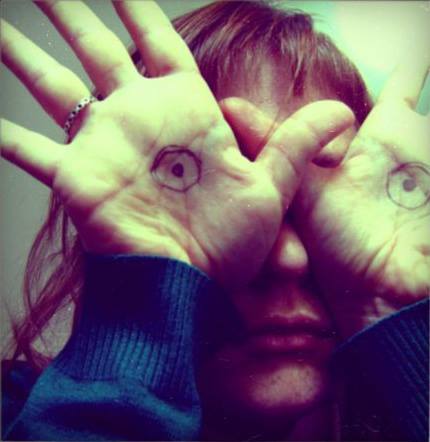
After “Pan’s Labyrinth”, 2009
Tonight at 20h00, Bolo’bolo in Observatory presents a free screening of a documentary about the life and ideas of Emma Goldman: anarchist, feminist and lifelong rabble rouser.
 For nearly half a century, Russian emigrant Emma Goldman was the most controversial woman in America, taunting the mainstream with her fervent attacks on government, big business, and war. To the tabloids, she was “Red Emma, queen of the anarchists,” but many admired Goldman for her defense of labour rights, women’s emancipation, birth control, and free speech.
Goldman’s life was indelibly marked by two violent acts: the attempted assassination of anti-union industrialist Henry Clay Frick by her comrade and lover Alexander Berkman (he spent 14 years in prison for the crime) and the 1901 slaying of President William McKinley by Leon Czolgosz, a young anarchist who claimed he had been “set on fire” by Goldman’s exhortations to political assassination and martyrdom. McKinley’s assassination led to widespread condemnation of Goldman and other anarchists. Fearing for her life, Goldman went underground.
In 1906, she reemerged as founder and editor of Mother Earth, an anarchist magazine devoted to politics and literature. Once again a public figure, she returned to the lecture circuit. Her talks on the struggling revolution in Russia, on the rights of workers, on civil liberties — even on anarchism — drew large, sympathetic crowds. For almost a decade, Goldman maintained a grueling schedule, spending nearly half of every year on the road. In one six-month period, she delivered 120 lectures in 37 cities.
An outspoken opponent of America’s entry into World War I, she was arrested and imprisoned for demonstrating against the draft. In 1919 she, Berkman, and 247 others were deported to Russia, just two years after the October revolution replaced the Czarist regime with Bolshevik tyranny. After two dispiriting years, Goldman and Berkman left the Soviet Union and dedicated themselves to revealing the truth about a revolution gone wrong.
“The State is the altar of political freedom and, like the religious altar, it is maintained for the purpose of human sacrifice.” – Emma Goldman
PS: Non-alcoholic drinks and vegan snacks will be on sale. You may bring your own beer or wine if you’d like. The screenings are free, but donations are welcome.
This is an excerpt from a speech given by American writer George Saunders at Syracuse University recently, and well worth reading:
“Now, one useful thing you can do with an old person, in addition to borrowing money from them, or asking them to do one of their old-time “dances,” so you can watch, while laughing, is ask: “Looking back, what do you regret?” And they’ll tell you. Sometimes, as you know, they’ll tell you even if you haven’t asked. Sometimes, even when you’ve specifically requested they not tell you, they’ll tell you.
So: What do I regret? Being poor from time to time? Not really. Working terrible jobs, like “knuckle-puller in a slaughterhouse?” (And don’t even ASK what that entails.) No. I don’t regret that. Skinny-dipping in a river in Sumatra, a little buzzed, and looking up and seeing like 300 monkeys sitting on a pipeline, pooping down into the river, the river in which I was swimming, with my mouth open, naked? And getting deathly ill afterwards, and staying sick for the next seven months? Not so much. Do I regret the occasional humiliation? Like once, playing hockey in front of a big crowd, including this girl I really liked, I somehow managed, while falling and emitting this weird whooping noise, to score on my own goalie, while also sending my stick flying into the crowd, nearly hitting that girl? No. I don’t even regret that.
But here’s something I do regret:
In seventh grade, this new kid joined our class. In the interest of confidentiality, her Convocation Speech name will be “ELLEN.” ELLEN was small, shy. She wore these blue cat’s-eye glasses that, at the time, only old ladies wore. When nervous, which was pretty much always, she had a habit of taking a strand of hair into her mouth and chewing on it.
So she came to our school and our neighborhood, and was mostly ignored, occasionally teased (“Your hair taste good?” – that sort of thing). I could see this hurt her. I still remember the way she’d look after such an insult: eyes cast down, a little gut-kicked, as if, having just been reminded of her place in things, she was trying, as much as possible, to disappear. After awhile she’d drift away, hair-strand still in her mouth. At home, I imagined, after school, her mother would say, you know: “How was your day, sweetie?” and she’d say, “Oh, fine.” And her mother would say, “Making any friends?” and she’d go, “Sure, lots.”
Sometimes I’d see her hanging around alone in her front yard, as if afraid to leave it.
And then – they moved. That was it. No tragedy, no big final hazing.
One day she was there, next day she wasn’t.
End of story.
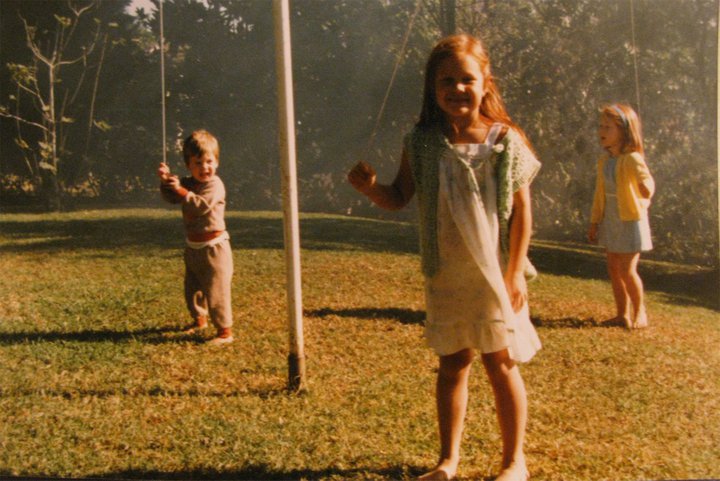
In the garden, circa autumn 1985 (Photo by Ray or June Lombard)
Now, why do I regret that? Why, forty-two years later, am I still thinking about it? Relative to most of the other kids, I was actually pretty nice to her. I never said an unkind word to her. In fact, I sometimes even (mildly) defended her.
But still. It bothers me.
So here’s something I know to be true, although it’s a little corny, and I don’t quite know what to do with it:
What I regret most in my life are failures of kindness.
Those moments when another human being was there, in front of me, suffering, and I responded…sensibly. Reservedly. Mildly.
Or, to look at it from the other end of the telescope: Who, in your life, do you remember most fondly, with the most undeniable feelings of warmth?
Those who were kindest to you, I bet.
It’s a little facile, maybe, and certainly hard to implement, but I’d say, as a goal in life, you could do worse than: Try to be kinder.
Now, the million-dollar question: What’s our problem? Why aren’t we kinder?
Here’s what I think:
Each of us is born with a series of built-in confusions that are probably somehow Darwinian. These are: (1) we’re central to the universe (that is, our personal story is the main and most interesting story, the only story, really); (2) we’re separate from the universe (there’s US and then, out there, all that other junk – dogs and swing-sets, and the State of Nebraska and low-hanging clouds and, you know, other people), and (3) we’re permanent (death is real, o.k., sure – for you, but not for me).
Now, we don’t really believe these things – intellectually we know better – but we believe them viscerally, and live by them, and they cause us to prioritize our own needs over the needs of others, even though what we really want, in our hearts, is to be less selfish, more aware of what’s actually happening in the present moment, more open, and more loving.
So, the second million-dollar question: How might we DO this? How might we become more loving, more open, less selfish, more present, less delusional, etc., etc?
Well, yes, good question.
Unfortunately, I only have three minutes left.
So let me just say this. There are ways. You already know that because, in your life, there have been High Kindness periods and Low Kindness periods, and you know what inclined you toward the former and away from the latter. Education is good; immersing ourselves in a work of art: good; prayer is good; meditation’s good; a frank talk with a dear friend; establishing ourselves in some kind of spiritual tradition – recognizing that there have been countless really smart people before us who have asked these same questions and left behind answers for us.
Because kindness, it turns out, is hard – it starts out all rainbows and puppy dogs, and expands to include…well,everything.
One thing in our favor: some of this “becoming kinder” happens naturally, with age. It might be a simple matter of attrition: as we get older, we come to see how useless it is to be selfish – how illogical, really. We come to love other people and are thereby counter-instructed in our own centrality. We get our butts kicked by real life, and people come to our defense, and help us, and we learn that we’re not separate, and don’t want to be. We see people near and dear to us dropping away, and are gradually convinced that maybe we too will drop away (someday, a long time from now). Most people, as they age, become less selfish and more loving. I think this is true. The great Syracuse poet, Hayden Carruth, said, in a poem written near the end of his life, that he was “mostly Love, now.”
And so, a prediction, and my heartfelt wish for you: as you get older, your self will diminish and you will grow in love. YOU will gradually be replaced by LOVE. If you have kids, that will be a huge moment in your process of self-diminishment. You really won’t care what happens to YOU, as long as they benefit. That’s one reason your parents are so proud and happy today. One of their fondest dreams has come true: you have accomplished something difficult and tangible that has enlarged you as a person and will make your life better, from here on in, forever.
When young, we’re anxious – understandably – to find out if we’ve got what it takes. Can we succeed? Can we build a viable life for ourselves? But you – in particular you, of this generation – may have noticed a certain cyclical quality to ambition. You do well in high-school, in hopes of getting into a good college, so you can do well in the good college, in the hopes of getting a good job, so you can do well in the good job so you can….
And this is actually O.K. If we’re going to become kinder, that process has to include taking ourselves seriously – as doers, as accomplishers, as dreamers. We have to do that, to be our best selves.
Still, accomplishment is unreliable. “Succeeding,” whatever that might mean to you, is hard, and the need to do so constantly renews itself (success is like a mountain that keeps growing ahead of you as you hike it), and there’s the very real danger that “succeeding” will take up your whole life, while the big questions go untended.
So, quick, end-of-speech advice: Since, according to me, your life is going to be a gradual process of becoming kinder and more loving: Hurry up. Speed it along. Start right now. There’s a confusion in each of us, a sickness, really: selfishness. But there’s also a cure. So be a good and proactive and even somewhat desperate patient on your own behalf – seek out the most efficacious anti-selfishness medicines, energetically, for the rest of your life.
Do all the other things, the ambitious things – travel, get rich, get famous, innovate, lead, fall in love, make and lose fortunes, swim naked in wild jungle rivers (after first having it tested for monkey poop) – but as you do, to the extent that you can, err in the direction of kindness. Do those things that incline you toward the big questions, and avoid the things that would reduce you and make you trivial. That luminous part of you that exists beyond personality – your soul, if you will – is as bright and shining as any that has ever been. Bright as Shakespeare’s, bright as Gandhi’s, bright as Mother Theresa’s. Clear away everything that keeps you separate from this secret luminous place. Believe it exists, come to know it better, nurture it, share its fruits tirelessly.”
Read the rest of George Saunders’ sage advice to graduates HERE.
From The Fantastic Expedition of Dillard and Clark (1968).

 fleurmach