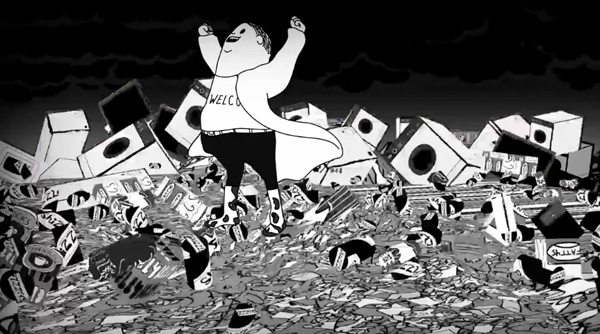
totte leker med kisse

I can’t think of a better way to start understanding a country’s culture and mores than by watching its kids’ programmes (also, the simple language is good when you’re just starting to learn). The cat in this is so beautifully rendered. It teaches gentleness and consideration for others. What is weird, though, is that only the invisible narrator has a voice, although there is other diegetic sound. It’s very clearly meant to be didactic, like the voice of the superego.

huma seminar at uct this thursday

humaHUMA Seminar Series

“’Then you are a man, my son’: Kipling and the Zuma Rape Trial” presented by Lucy Graham (UWC)

When: Thursday, 30 July 2015

Time: 13h00 – 14h30

Venue: HUMA Seminar Room, 4th Floor, The Neville Alexander Building (formerly known as the Humanities Building), University Avenue, Upper Campus, UCT

One of the strangest incidents during the Jacob Zuma rape trial was surely the moment when Judge Willem van der Merwe, handing down his verdict that exonerated Zuma, addressed Zuma with the following words: “Had Rudyard Kipling known of this case at the time he wrote his poem, ‘If’, he might have added the following: ‘And, if you can control your body and your sexual urges, then you are a man, my son’”.

It is now nine years since the Zuma rape trial, and yet this allusion to Kipling’s famous poem has been passed over by other commentators on the trial. Of what exactly is Kipling a spectre as he appeared in the judge’s verdict, and how do we read the judge’s strange politics of (dis)affinity that arises out of his rescripting of Kipling: his insistence on the developmental and racialised difference of boyhood and manhood, while at the same time his possible consolidation of a more absolute difference based on gender? How was discourse and performativity during and around the Zuma rape trial related to the history of “Zuluness”, and to the reception of narratives of intraracial sexual violence by the ANC? What significance does an analysis of the Zuma rape trial that takes into account colonial history have for contemporary South Africa, and specifically for the UCT: Rhodes Must Fall movement at the University of Cape Town? In this paper I am interested in the ways in which spectres of colonial patriarchy continue to haunt the South African present.

a nightmare

Just dreamed I was working at a mattress abattoir/factory in some long ago time and place. The mattresses were somehow living organisms. I had to use a guillotine and also sometimes a huge cleaver, if the guillotine didn’t slice all the way through, and chop them cleanly and very systematically, blood pooling on the rushes underfoot. Every blow I dealt nauseated me to tears. There was a foreman forcing me to speed up all the time. There was nothing else to the dream but this enforced, repetitive violence, and all I could do to try to make it better was to do the awful hacking with more precision.

But what does it mean?

Myself, I think it has to do with being inescapably forced to inhabit the violent, corporate machine of colonialism… I’m working on knowledge production about Africa by missionaries and scientists, through looking at archival objects, which are objects but also subjects, violently wrenched from their contexts. The mattress here symbolises something… maybe related to peace of mind, restfulness, not being awake or aware… I don’t know. Whatever it is, it is being violently ruptured. I think this could be about being forced to make one’s bed to lie in, as a researcher and writer inserted into the chain of murderous history, unable to escape perpetuating it even as I try to undo it, still half asleep.

chimamanda ngozi adichie – the danger of a single story

[W]hen I began to write, at about the age of seven, stories in pencil with crayon illustrations that my poor mother was obligated to read, I wrote exactly the kinds of stories I was reading: All my characters were white and blue-eyed, they played in the snow, they ate apples, and they talked a lot about the weather, how lovely it was that the sun had come out. Now, this despite the fact that I lived in Nigeria. I had never been outside Nigeria. We didn’t have snow, we ate mangoes, and we never talked about the weather, because there was no need to.

My characters also drank a lot of ginger beer, because the characters in the British books I read drank ginger beer. Never mind that I had no idea what ginger beer was. And for many years afterwards, I would have a desperate desire to taste ginger beer. But that is another story.

What this demonstrates, I think, is how impressionable and vulnerable we are in the face of a story, particularly as children. Because all I had read were books in which characters were foreign, I had become convinced that books by their very nature had to have foreigners in them and had to be about things with which I could not personally identify. Now, things changed when I discovered African books. There weren’t many of them available, and they weren’t quite as easy to find as the foreign books.

But because of writers like Chinua Achebe and Camara Laye, I went through a mental shift in my perception of literature. I realized that people like me, girls with skin the color of chocolate, whose kinky hair could not form ponytails, could also exist in literature. I started to write about things I recognized.

Now, I loved those American and British books I read. They stirred my imagination. They opened up new worlds for me. But the unintended consequence was that I did not know that people like me could exist in literature. So what the discovery of African writers did for me was this: It saved me from having a single story of what books are…

… If I had not grown up in Nigeria, and if all I knew about Africa were from popular images,I too would think that Africa was a place of beautiful landscapes, beautiful animals, and incomprehensible people, fighting senseless wars, dying of poverty and AIDS, unable to speak for themselves and waiting to be saved by a kind, white foreigner.

on colonial legacies and the violence of liberal whiteness at uct – april 2015

Here’s a thought piece I wrote for an MPhil African Studies class back in April, in the thick of the Rhodes Must Fall resistance. I want to put it here to archive it.

Problematising the Study Of Africa Assignment: 

On Colonial Legacies at the University of Cape Town


“Remember that you are an Englishman, and have consequently won first prize in the lottery of life.” — Cecil John Rhodes[1]

“[N]o matter what a white man does, the colour of his skin—his passport to privilege—will always put him miles ahead of the black man. Thus in the ultimate analysis no white person can escape being part of the oppressor camp.” —  Bantu Stephen Biko[2]

“For the black man there is only one destiny, and it is white.” — Frantz Fanon[3]

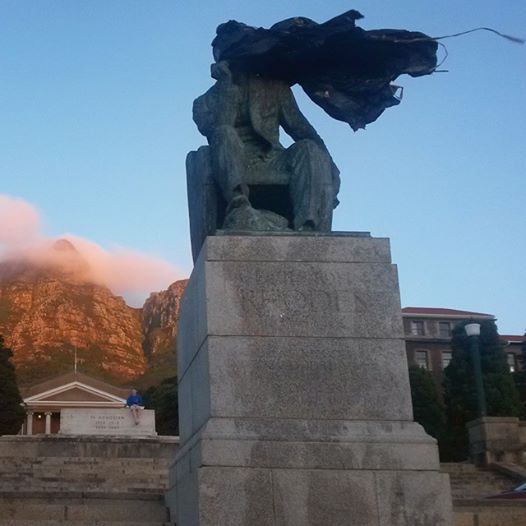
Rhodes statue, head covered in garbage bags. University of Cape Town, 17 March 2015. Photo: Rosemary Lombard

Rhodes statue, head covered in garbage bags. University of Cape Town, 17 March 2015. Photo: Rosemary Lombard

As a child, I remember reading about the railway Cecil John Rhodes envisioned from Cape Town to Cairo, and never imagining it in any light other than as a benevolent feat of engineering that would link people to others, bringing access to resources and the rest of the modern world for those cut off from Western civilisation, literally bringing light to the darkest parts of the continent.

I revised my romantic understanding of Rhodes’ expansionist desires as I became aware of the rampantly exploitative nature of these ambitions, and colonial mechanisms of dominion and exploitation more generally, but it was not until the recent events at UCT surrounding a statue of the man on campus that I realised the true psychological extent and durability of this oppressive colonial legacy, and the way its violence has been rendered almost invisible to those of us on the privileged side of what Walter Mignolo terms the “colonial difference” or divide[4].

The call for transformation is not new: it stretches back more than two decades. The present moment is notable in that students, staff and workers have organised powerfully in concert. A bucket of human excrement thrown on a statue of Rhodes that occupied a central position on UCT’s upper campus escalated tensions around institutional racism that have flared regularly since even before the formal end of the Apartheid era 21 years ago.  Black students formed a movement that became known as “Rhodes Must Fall” (RMF) after the social media hashtag they used to mobilise. The students occupied an administrative building for several weeks, in which they held intensive teach-ins and discussions around decolonisation in solidarity with the Students’ Representative Council (SRC), other students, academic staff and workers. University management eventually capitulated to the removal of the statue on 9 April 2015, after a month-long struggle in which RMF demanded to be engaged on their own terms, rather than allowing university management to dictate the terms or to dismiss the protest as had been the case on many previous occasions.

Richard Pithouse describes the mobilisation thus:

The students in Cape Town have, very rapidly, punched a gaping hole into the continuum of English liberal hegemony over the university, and a set of linked sites of a certain kind of elite power, and, thereby, a mode of white supremacy and coloniality that has not been subject to sufficient critique and opposition. It is an extraordinary political achievement that will, no doubt, inscribe itself into the history of the South African academy, and the wider society.[5]

At this historically significant moment, it is on white liberal hegemony and institutional transformation at UCT that I reflect: how has hegemonic whiteness been constructed at UCT, and how does the university continue to function as a colonial space, despite speaking about transformation?

I have made several false starts on this assignment (one of which has been losing an entire day’s work on it due to a computer glitch). Initially my idea was to write an open letter to university management, particularly the deputy Vice-Chancellor with the portfolio for transformation, Crain Soudien, whose public behaviour over the past weeks – both in his capacity as a member of university management[6] and in his written statements in the press – has seemed at odds with his historically professed radical stance against uninterrogated hegemony, and his advocacy of deep transformation as chair of the country-wide Ministerial inquiry into institutional racism just a few years ago[7]. Soudien, and other prominent black members of the corporate, academic establishment such as Jonathan Jansen, are interpellated[8] representatives of their institutions’ ideology, and any hint of activism they once displayed has evaporated.

However, I decided that I could not, in good conscience, from my position as an historical beneficiary of the untransformed system, write such a letter. So, dropping the academic apparatus as prompted by this assignment, I feel I have only enough authority to write from a personal, situated angle in attempt to contextualise the recent Rhodes Must Fall chain of events at UCT, with particular reference to the institution’s persisting coloniality. I cannot assume anything other than my own subject position, as a white, cisgender, heterosexual female, who comes from relative privilege. To do so would be disingenuous, as I have learned a trenchant lesson through listening to what students have been saying these past weeks: despite my best intentions and all the empathy I can muster, I cannot have knowledge of what it is to experience institutional racism.

As a “white” person, I have ancestrally been on the powerful side of the racial divide put in place with the advent of Western colonial activity, and I continue to be identified with that subject position. “Whiteness” is the term used to describe the position of privilege this subjectivity puts me and others like me in.

If there is one thing the Rhodes Must Fall moment has driven home to me, it’s that from my subject position I am unqualified to make authoritative pronouncements regarding the experiences or motives of anyone except myself, regardless of racial identity: it’s obvious that I can’t speak to “black” experience, but the most common “white” responses to RMF have largely made me feel alienated, too.

Two decades of rainbow nation narrative have led to the unreflexive “I don’t see colour” rhetoric becoming the status quo among liberal-thinking white South Africans, as well as black people assimilated to corporate institutional capitalist ideology. This is pernicious in that it obscures the very real, material persistence of different life experiences and oppression based on inherited structural inequalities, stemming from racial discrimination.

Coloniality, the set of dispositions, values and forms of practice set in place in the colonial world, outlives the moment of formal political decolonisation, and carries through beyond it in lasting ways. The white Western self speaks from the site of the universal, as a bearer of modernity and civilisation, situated dynamically inside of linear time and at home in a global, cosmopolitan world. All forms of knowledge produced by the Western self, in other words, are deemed to have universal, rational, historical currency.

In contrast, those selves and forms of knowledge encountered by the Western self that are deemed to be other than the Western self are deemed to be “local”, labelled “indigenous”. An indigenous self or indigenous knowledge is constituted as static, standing outside of history and linear time, and inside of tradition, which becomes the opposed category to modernity. Western, colonial knowledge is framed in binaries, in relation to Western supremacy: the privileged poles of these dyads are whiteness, maleness, heterosexuality, and so forth.

Manichean power relationships instituted on the basis of the colonial apparatus did not end with apartheid in 1994. They persist throughout social interactions, their oppressive dynamics all but invisible to those on the privileged side of such relationships, such as white people and males, due to the hegemonic nature of this framing.

A common criticism I saw levelled at black protesters by white commenters was that things changed with the coming of the democratic dispensation in 1994, and that they should stop “holding on to the past” or “playing the race card” with a “victim mentality”, that they should “move on”. But being cognisant of how the legacy of chronologically past events persists into the present is not the same as “holding on to” the past. Only those who are not experiencing the continuation of structural oppression every day can advocate ignoring or disregarding it, and “moving swiftly on”.

Western knowledge systems condition us not to admit any other perspective to the realm of validity. It thus takes concerted effort from white people to listen and not dismiss other points of view if they are to “click” and be able to acknowledge that the hegemonic “white” point of view is not the only, natural point of view. Recognition of the persisting inequality and oppression of black people generates a sense of discomfort and cognitive dissonance. I have realised through conversations with white people I know, as well as the comments I’ve read on social media, that most are unwilling (or perhaps intellectually unable?) to make this effort. Most who identify as liberal (“colour-blind”, non-racist) do not want to accept that they continue to benefit from this system at the expense of others, and display great defensiveness when confronted with the persistence of structural racism, and white complicity therewith.

The comments I have seen by white people who consider themselves liberal and “non-racial” (strenuously disavowing racism) against protesters have been telling – describing them as “uncivilised”, “uneducated”, “unreasonable”, “backward”, “barbarians”, “savages”, “childish”, “monkeys”: these epithets bear the distinctive, unreflexive tang of colonial binaries, binaries set up in implied counterpoint to the opposite values ostensibly possessed by the hallowed university. These colonial tropes have pervaded media, misrepresenting Rhodes Must Fall as an unthinking, destructive mob, when the reality is that the movement created, in a deliberate and considered way, an autonomous space which has surfaced deep pain, but also fostered constructive discussion and reimaginative work.[9]

Acts of physical protest occur when speech has failed, or is perceived to be inadequate. The act of flinging sewage at the statue of Rhodes went beyond talking, because talking was no longer believed to be a viable option for engaging. For dialogue to happen, there needs to be a willingness to listen communicated clearly. UCT, and whiteness more generally, has historically demonstrated itself to be dismissive, unprepared to engage black students’ and staff’s grievances about structural oppression. UCT even went so far as to criminalise protesters.

Steven Friedman remarks:

It is no accident that the protests are happening on the campuses of English-speaking “liberal” universities, which have long claimed to be victims of racism: it is precisely at those institutions that race is kept alive by denying it. Under apartheid, many English-speaking whites insisted that apartheid was created by Afrikaners alone. The “liberal” English-language universities joined in — they proclaimed their right to teach whatever and whomever they pleased, declaring that discrimination was imposed on them by the state. This smugness ignored the extent to which white English speakers in the professions and business profited from the denial of opportunities to others — and the degree to which they believed that blacks could win acceptance only if they adopted the values of whites. The universities ignored the reality that, when they were allowed to do as they pleased, they limited black student numbers and taught courses that assumed that every South African was white… This shows how deep-rooted the attitudes that underpinned apartheid are — and it points a finger at a form of liberalism that has washed its hands of racism while continuing to practise it…

When democracy arrived, the legal barriers tumbled; deep-rooted beliefs that whites are superior did not. The “liberal” universities now had the right to teach who and what they pleased: they used it to keep alive the racial pecking order in a “colour blind” guise… Whites remain largely in charge — but, because they are “liberal”, they always have a good “nonracial” reason for why this should be so.[10]

Hegemonic white power is not always subtle.  UCT management has an historical track record of overt institutional racism too. There are several junctures at which these issues have crystallised blatantly, and I will mention two:

In 1968, the accomplished black anthropologist, Archie Mafeje, was made an offer of employment by UCT, but this offer was rescinded under pressure from the Apartheid government, sparking protests. In 1991, the university again offered Mafeje a position. Although he had by that time, 23 years after the first offer, attained the rank of professor, it offered him only a senior lecturer post, still treating him as a junior academic. UCT apologised to Mafeje for this indignity after his death, naming a room in the Bremner building in his honour. It was no coincidence that this room was made the headquarters of Rhodes Must Fall when they occupied that building, renaming it “Azania House” in symbolic redress.

The so-called “Mamdani Affair” unfolded at UCT in 1996 when eminent Ugandan scholar Mahmood Mamdani, who at that point held the AC Jordan Chair in the Centre for African Studies, challenged the university to place African scholarship at the centre of the curriculum. He compiled a curriculum centred on African scholarship which was met with resistance from the all-white advisory committee, apparently because it did not reflect thinkers well-known enough to the committee – that is, it did not reproduce the established western canon of writing about Africa closely enough.  Via a manipulation of administrative processes, the curriculum Mamdani planned was rejected and replaced by one produced by the committee. He was suspended and left UCT soon afterwards for the United States. Nomalanga Mkhize charges that the affair “exposed the ignorance of many prominent, predominantly white South African scholars who, because of their racially privileged positions, had risen up the ranks without having to engage three decades of rigorous post-independence African scholarship.”[11]

Black students and academics are angry. Twenty years since the formal end of apartheid, they are still treated as second-class citizens on campus. Only a fraction of teaching staff are black[12], and the syllabus overwhelmingly represents the perspectives of white thinkers. Black thinkers continue to be marginalised. The disciplines are still, overwhelmingly, epistemologically “white”. Francis Nyamnjoh, writing in 2012, describes the insidious outcome of this:

In Africa, the colonial conquest of Africans – body, mind and soul – has led to real or attempted epistemicide – the decimation or near complete killing and replacement of endogenous epistemologies with the epistemological paradigm of the conqueror. The result has been education through schools and other formal institutions of learning in Africa largely as a process of making infinite concessions to the outside – mainly the western world. Such education has tended to emphasize mimicry over creativity, and the idea that little worth learning about, even by Africans, can come from Africa. It champions static dichotomies and boundedness of cultural worlds and knowledge systems. It privileges teleology and analogy over creative negotiation by Africans of the multiple encounters, influences and perspectives evident throughout their continent. It thus impoverishes the complex realities of those it attracts or represses as students.[13]

A statement by UCT’s Student Representative Council, made at a meeting the day the statue was removed, echoes the points made above:

[T]he black folk’s problem is still chiefly the potency of whiteness. In the new democratic dispensation, we have only been concerned with the ‘rainbow nation’ rhetoric and singing kumbaya while our economy still reflects the same socio-economic disparities of the apartheid era. Democracy has granted a few blacks seats at the master’s table; the rest are still fighting over breadcrumbs falling off the table. And it is these few and mostly politically connected ‘privileged’ blacks who assist their white masters in maintaining the status quo.

Whites have not even begun to see blacks as equals and as being capable of thinking for themselves. They continually want to have a say in how we break the shackles of oppression administered and maintained by them. They cry foul as soon as blacks start organising and speaking for themselves. Deep down they understand that they stand to lose their privileges. The white liberal has continued to play a rather peculiar role in the oppression of the black masses, his racist and conservative ways continue to be shielded in his subtle and ‘angelic’ approach. It is the white liberal who is at the forefront of spreading the gospel of integration and a peaceful society. White liberals point towards white conservatives as the problem, and they have convinced themselves that they have arrived at enlightenment pertaining to the sins committed by their forefathers. Yet subconsciously they share the same set of values and desire to protect their privileges.

The ideology and culture of formerly ‘whites only’ spaces has still not changed. What has taken place is that blacks can now access those spaces of learning and living in order to immerse themselves in a western culture. Thus, for the blacks to enjoy the benefits of accessing those places they have to integrate into whiteness. Our integration is nothing but black people assimilating to what is still regarded as righteous, ordained, intelligent, beautiful and angelic whiteness.[14]

Richard Pithouse comments, with hope:

Liberalism has always been fundamentally tied up with the poisonous fantasy of its barbarian other. In 1859 John Stuart Mill, the great philosopher of English liberalism, declared, in his famous essay On Liberty, that “Despotism is a legitimate mode of dealing with barbarians”. The essential logic of actually existing liberalism – freedom for some, despotism for others – was never merely, as they say, academic. In 1887 Rhodes, speaking in parliament in Cape Town echoed these sentiments when he declared that: “we must adopt a system of despotism in our relations with the barbarians of South Africa”.

Yet in 2015, in a society still fundamentally shaped by the historical weight of this idea of freedom for some and despotism for others, a text book for first year politics students, written and prescribed in South African universities, a text book in which not a single African person is presented as a thinker worthy of study, declares that “Most discussions of freedom begin with John Stuart Mill’s On Liberty”.

This sort of academic consensus, which seemed entrenched a few weeks ago, no longer seems to have much of a future. The students have made an intervention of real weight and consequence.

In addressing the necessity of curricular transformation, Harry Garuba writes about the need for a “contrapuntal pedagogy that brings the knowledge of the marginalised to bear on our teaching… The Cecil John Rhodes statue at the centre of the upper campus of UCT may have been physically removed, but what we now need to move is the hegemonic gaze of the Rhodes that is lodged in our ways of thinking… our professional practices as teachers, academics, scholars and students. We need to take a critical look at our everyday routines… In short, we need to remove the Rhodes that lives in our disciplines and the curricula that underpin them.”[15]

Stories about the past do not only tell us where we come from. They also tell us where we belong and where we should be headed: they influence how we understand our present and imagine our future. Statues and memorials intentionally inscribe in space particular stories, effectively fixing in stone a version of the past chosen by those in power.

The spatial symbolic order at UCT is hard evidence of the university’s lack of transformation.  The university, stretched across the lower slopes of Devil’s Peak, is a carefully curated memorial landscape that concretises colonial ideologies of power and knowledge: a site of prospect, and temple of rarefied knowledge on the hill. Moving through this space as individuals, we are forced to conduct a conversation with these imperial ideas: they exert their influence on us tangibly, directing our attention. Little has been changed about symbolism on the campus in the past twenty years, save for the additive naming of a few buildings and spaces after black icons: Steve Biko Student’s Union,  Cissy Gool Plaza, Madiba Circle.

Dependent on one’s subject position, the power exerted by such spatial and ideological configurations feels more or less oppressive. As white people, we may not give much thought to whether we feel at home or belong in the landscape. Black people, on the contrary, constantly confronted by representations of white triumph at the expense of black lives, feel alienated and suffocated. SRC Chair Ramabina Mohapa said at the 16 March meeting convened by UCT management on Heritage Signage and Symbolism, before walking out with most of the student body present, that black students “can no longer breathe”.[16]

As already discussed, colonial dispositions are not easily apprehended or altered, because they remain hegemonic in wider society, rendering them invisible to those who fall on the privileged side of the colonial divide between those privileged and those not privileged.

However, moments in which the symbolic order is ruptured, like the toppling of the Rhodes statue, provide rare opportunities where the usually obscured hegemony becomes plainly apparent. It is at catalytic moments such as these that spacetime is malleable: contrapuntal conversations become possible, competing epistemologies thinkable; candid self-examination and interventions, too. Perhaps substantive transformation happens more effectively in sudden shifts than gradually.

I would like to close with a trio of comments that I gleaned from my Facebook feed on 10 April 2015, the day after Rhodes’ statue was removed.

We stop mistaking Rhodes for a good white person and we stop believing in white supremacy because everywhere you look you see white people’s statues – it’s almost as though there was no one here when they arrived and they just happened to discover the gold (which, coincidentally, was discovered by a black man). When the statues are gone, we can start asking the important questions like why are there 110 white male South African professors and not a single black female South African professor at UCT – South Africa’s most prestigious university. And questions like why is the curriculum at these universities so Eurocentric in its outlook with scant reflection on Africa and her rich history and her bright future. Without these statues and the prestige and honour bestowed on the founding fathers of white supremacy, the leaders of these institutions will have no choice but to answer those questions truthfully and reflect on those answers. Further, removing these reminders of the fallacy of white supremacy leaves space for black excellence to flourish without having to use the white gaze and its tools of measurement to validate itself.

– Fumbatha May

Watched Rhodes fall last night. I’ve never experienced such an atmosphere of happiness and liberation at UCT – particularly when the students refused to let the old bastard go gracefully but crowned him with a bucket of paint as he rode off into the sunset of empire. For the past few weeks, the students have been teaching the university its most important lesson in decades, and will continue to do so for a long time to come. At last, being at UCT is beginning to feel like being at a real university.

– Carlo Germeshuys

Driving home from work passed the plinth where Rhodes stood. It has a tag sprayed on the neat wood box that is covering the base: ‘C.J. WAS HERE ~>’ There is a black girl in a blue dress leaning up on it, smiling broadly as she chats to a white guy in green shorts who is sitting on the edge of it, swinging his legs as he rummages for something in his bookbag beside him. I swear there is a lighter feeling seeing that figure gone! An invitation to a new conversation.

– Debbie Pryor

These comments convey the general mood on campus well: there is a sense of hope and determination that the symbolic fall of Rhodes’ statue will be followed by deep institutional transformation, sentiments I share.

__

REFERENCES

Africa Network Expert Panel.  2014. Why are there so few black professors in South Africa? The Guardian Africa, 6 October 2014. http://www.theguardian.com/world/2014/oct/06/south-africa-race-black-professors

Althusser, L. 1971. “Ideology and Ideological State Apparatuses (Notes towards an Investigation)”. Lenin and Philosophy and Other Essays. Verso.

Biko, S. 1988. I Write What I Like. London: Heinemann.

Friedman, S. 2015. “The racial denialism of South African liberals”. Rand Daily Mail. 1 April 2015. http://www.rdm.co.za/politics/2015/04/01/the-racial-denialism-of-south-african-liberals

Garuba, H. 2015. “What is an African curriculum?” Mail and Guardian, 17 April 2015 00:00. http://mg.co.za/article/2015-04-17-what-is-an-african-curriculum

Goodrich, A. 2015. “Statue controversies in South Africa – reimagine/recontextualise/replace” April 15, 2015. http://www.syntheticzero.net/2015/04/15/statue-controversies-in-south-africa-reimaginerecontextualisereplace/

Majavu, M. 2015. “Uct and Rhodes: Removing Statues, Dismantling Colonial Legacies”. Equal Times, 30 March 2015. http://www.equaltimes.org/uct-and-rhodes-removing-statues?lang=en#.VTUs9tyUd8E

Mangcu, X. 2015. Danger of ‘rationalist conceit’ in Cape Times, March 25 2015 at 01:52pm. http://www.iol.co.za/capetimes/danger-of-rationalist-conceit-1.1836933

Mangcu, X. 2015. “Assault on idea of academic freedom”. Cape Times,April 14 2015 at 01:44pm. http://www.iol.co.za/capetimes/assault-on-idea-of-academic-freedom-1.1844918.

Mignolo, W. 2002. “The Geopolitics of Knowledge and the Colonial Difference”. The South Atlantic Quarterly 101.1 (2002) 57-96. Duke University Press.

Mkhize, N. 2015. “Anger over Rhodes vindicates Mamdani”. Business Day, 7 April 2015. http://www.bdlive.co.za/opinion/columnists/2015/04/07/anger-over-rhodes-vindicates-mamdani

Moodie, A. 2010.”The Soudien Report: Deny racism at your peril”25 April 2010. University World News, Issue No:121. http://www.universityworldnews.com/article.php?story=20100424200305969

Mudimbe, V. 1988. The Invention of Africa: Gnosis, Philosophy and the Order of Knowledge. London: James Curry.

Muller, S. 2014. “Transformation is not UCT’s priority”. Mail and Guardian 21 November 2014. http://mg.co.za/article/2014-11-21-transformation-is-not-ucts-priority

Nyamnjoh, F. 2012. “’Potted Plants in Greenhouses’: A Critical Reflection on the Resilience of Colonial Education in Africa”. Journal of Asian and African Studies. February 15, 2012. doi: 10.1177/0021909611417240.

O’Connell, S & Himmelman, N. 2011.  “Lessons in continued oppression: UCT’s conception of post-apartheid freedom sets the bar too low”. https://concernedcasstudents.wordpress.com/2011/05/15/lessons-in-continued-oppression-ucts-conception-of-post-apartheid-freedom-sets-the-bar-too-low/

Pithouse, R. 2015. “South Africa in the Twilight of Liberalism”. Kafila, 19 April 2015. http://kafila.org/2015/04/19/south-africa-in-the-twilight-of-liberalism-richard-pithouse/

Soudien et al. 2008. Report of the Ministerial Committee on Transformation and Social Cohesion and the Elimination of Discrimination in Public Higher Education Institutions. 30 November 2008

Soudien, C. 2015 “UCT stands devoted to debate”. Cape Times, April 14 2015 at 12:43pm. http://www.iol.co.za/capetimes/uct-stands-devoted-to-debate-1.1844882

Wolpe, H. 1995. “The debate on university transformation in South Africa: The case of the University of the Western Cape.”  Comparative Education, 31(2): 275 – 292.

___

[1] Attributed in “The lottery of life”, The Independent, 5 May 2001.

[2] From I Write What I Like: Selected Writings by Steve Biko, 1969 – 1972. Heinemann, 1987.

[3] Introduction to Black Skin, White Masks. Translated by Charles Lam Markmann. New York: Grove Press, 1967.

[4] Mignolo, 2002.

[5] Pithouse, 2015.

[6] See, for example, Soudien’s handling of a walkout by the SRC and Rhodes Must Fall during a meeting at UCT on “Heritage, Signage and Symbolism”, 16 March 2015: https://www.youtube.com/watch?v=4NgpJ00M5Ho

[7] Compare Soudien et al 2008; Alison Moodie’s 2010 interview with Soudien, entitled “The Soudien Report: Deny racism at your peril” and the defensive tone of Soudien 2015.

[8] Althusser, 1971. Interpellation is the process by which the ideology of an institution constitutes individual subjects’ identities through the process of the institution and its discourses ‘hailing’ them in social interactions.

[9] I would like to state as an aside that I do not believe it is the place of beneficiaries of structural racism to offer opinions on how transformation would be best effected. I believe white people should make space to listen and take cues from those who are still being squashed by the non-transformation of the society we inhabit as to what to do. Those who encounter the problem have far more authority in this matter. This is difficult for some white people to grasp due to an ingrained sense of entitlement, and the way whiteness and white knowledge regimes still have hegemonic authority. Several have accused me of promoting self-censorship. It is very far from that. As a white person, to make space for black voices at this moment in the way I am advocating is not to disengage from the debate. It is an active decision to be quiet, to listen and reflect, an action based on a recognition that unless we with white voices behave differently, the status quo of the balance of representation being skewed in the favour of white voices will not change materially.

[10] Friedman, 2015.

[11] Mkhize, 2015.

[12] The number of white professors at UCT stands at about 87 per cent, whereas black professors make up only 4 per cent of the professorial complement (Majavu, 2015).

[13] Nyamnjoh, 2012: 129-130.

[14] UCT SRC statement delivered by Ramabina Mahapa on 9 April 2015. http://www.uct.ac.za/dailynews/?id=9096

[15] Garuba, 2015.

[16] A video of the proceedings can be found at https://www.youtube.com/watch?v=4NgpJ00M5Ho.
izithunguthu

The Archive and Public Culture Research Initiative, where I work, is hosting an interesting conference next month:

IZITHUNGUTHU: 

Southern African Pasts Before the Colonial Era, their Archives and their Ongoing Present/Presence

16, 17, 18, July, 2015
Archive and Public Culture Research Initiative
University of Cape Town

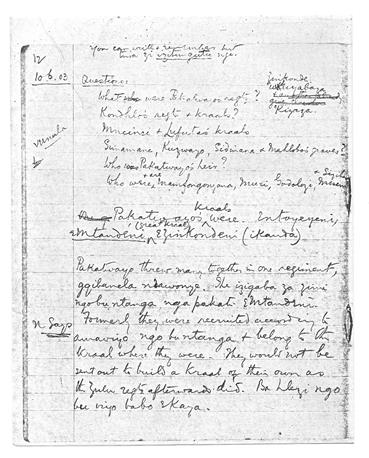
“You can write and remember but for our part we are simply izithunguthu” (Thununu ka Nonjiya, 1903, in James Stuart Archive, vol.6. p.289)

Thunguthu (Isi), n. One flustered or put out, made to forget by being scolded or cross-questioned, though well-informed. Colenso’s Dictionary (4th ed., 1905, p. 627)

Transcript of Thununu ka Nonjiya, 1903, in James Stuart Archive, vol.6. p.289

Transcript of Thununu ka Nonjiya, 1903, in the James Stuart Archive

In late 2014 the sixth volume of the James Stuart Archive of Recorded Oral Evidence Relating to the History of the Zulu and Neighbouring Peoples (edited by the late C.de B.Webb and J.B. Wright) was published by the University of KwaZulu-Natal Press, bringing the number of pages of edited, translated and annotated archival text to a total of 1697 (excluding indexes), organised alphabetically from Antel to Zwayi, under the names of 185 primary interviewees.

The conference celebrates this remarkable editorial achievement and its contribution to the enquiry into the southern African past in the many eras before the advent of European colonialism. It also foregrounds and seeks to take forward new developments and thinking about these eras. It does this through a double focus on the different forms of archive relevant to the various eras and on the innovations – conceptual, theoretical, methodological, technological, practical or creative – involved both in mobilizing such archives, and indeed other materials considered to be not-archive, and in pursuing enquiries into those eras.

The conference will be organised around four central themes:

  • the making and remaking of the James Stuart Archive;
  • the nature and forms of archive, and indeed other forms of historical material, pertinent to these eras;
  • the meanings of pasts designated “pre-colonial” in the present, and in past presents;
  • innovations- conceptual, theoretical, methodological, technological, practical and creative – in enquiry into these eras.

The Making and Remaking of the James Stuart Archive
The James Stuart Archive is a rare southern African treasure for a number of reasons, of which two are particularly significant. The first is that while the collection is undoubtedly the work of the collector, and has been fundamentally shaped by him in ways that are the subject of ongoing critical scholarly investigation, the recorded texts also offer insight into the thinking of the various people whose accounts Stuart recorded. The bulk of the material was documented between 1897 and 1922, when Stuart interviewed some 200 people whom he considered to be well informed on contemporary and historical matters relevant to the region. He took detailed notes in the course of the conversations, often seemingly recording people in their own words. His working methods, the contributions of his interlocutors and all the other factors that shaped the archival texts, are the subject of ongoing scholarly attention. The combination of the extensiveness of the corpus and the nature of the material covered by interviewer and interviewees, often dealing with topics little discussed elsewhere in written documentation of the time, makes it one of South Africa’s most valuable historical resources pertinent to the late independent era in south-east Africa, as well as the colonial period that followed.

Archive and its “Others”
The past decade has seen the paying of close attention to the making and shaping of archive in many forms, while archive/s have also been the subject of sustained theoretical and methodological discussion. Long understood to be a time without an archive, the eras of the past before European colonialism and enquiries into them both draw from and contribute to, in distinctive ways, the larger critical discussion about archive, itself otherwise decisively shaped by European intellectual history.  The conference theme on the nature and forms of archive focuses attention on these distinctive ways, seeking to understand what they mean for the wider understanding of archive and what they mean for enquiries into the long southern African past.

We welcome papers not only on similarly iconic text-based archives (like the much celebrated Bleek and Lloyd Archive of material collected from /xam and !kung speakers between 1870 and 1884) but also on lesser known text-based sources, including ones which might heretofore have never been explicitly treated as archives. The conference hopes to interrogate taken-for-granted distinctions between primary and secondary sources.  When, for example, is a published account be considered an archive, and of what precisely is it an archive? We are interested in discursive materials that may not take a written form, including poetic forms, songs and invocations, and in interrogating critically the notion of “oral tradition”, seeking not only its disaggregation, but also careful reassessment of the conceptual apparatus associated with it.

We are especially interested in the nature of materials that are relevant to the remote past which have been or are yet thought of explicitly as “not archival”. Items of material and visual culture are widely used as sources for various aspects of enquiry into the past, but often in a manner that assumes that they have a timeless cultural relevance. We invite papers that build on recent work which historicises such items, paying close attention to particularities of provenance, circumstances and effects of collection, classification and curation. Current work is beginning to recognize incorporated, as opposed to inscribed, archival forms, notably embodied forms of materials that refer to the past. We invite contributions that grapple with the complex challenges involved in exploring, for example, contemporary instances of spirit possession and rituals concerning ancestors, for what they might add to an understanding of the distant past.

The Entangled “Pre-colonial”
How do we think of what has been termed the pre-colonial beyond the strictures of prepositional time? The academic orthodoxy teaches us to approach it as the distant past, as an evacuated experience, as a domain of specialists. And yet, our everyday scenes are stamped by its uncanny fecundity, its untheorised proximity, its entangled lives in the contemporary.  In a variety of different ways – imaginatively, expansively, subjectively, critically, affectively – contemporary artists, writers, family and clan historians, politicians and intellectuals engage the body of inherited materials that academics and lawyers use as “sources”, often with very different purposes, from the celebratory through the denunciatory to the parodic.  All of these engagements with the eras of the past before European colonialism, and with the ways in which the colonial and apartheid eras dealt with the earlier periods, undertaken by historians and many others, contribute to contemporary understandings and meanings of the distant past and fall within the purview of the conference.

In the nineteenth century, many colonial intellectuals took the history of the region before colonialism seriously enough to record and collect materials pertinent to it and to write its histories. In the post-conquest context of the twentieth century, the many eras of the long past, and indeed the history of indigenous people in the colonial and apartheid eras, were systematically ghetto-ised as the subject of the disciplines of archaeology, anthropology, linguistics and prehistory, and as requiring a specialist conceptual apparatus pertinent to the study of ‘tribal’ or ‘pre-modern’ societies. Unpacking the legacies of this conceptual apparatus requires comparative perspectives from across and beyond the continent attentive to the cross-genealogies of the tribal and the modern. These concepts have lingering effects that are yet discernible. In trying to think about the past beyond the warranty of these concepts, we also invite reflections on the ways of being in the world in which that past may not necessarily be an object of capture.

Conceptual Innovations
Our conference, therefore, is inevitably an engagement with the new. As it seeks to break out of the academic ghetto-isation, its exploratory restlessness challenges the established boundaries of disciplines, regions and identities. What happens when we consider enquiries into the past before European colonialism in the light of the contemporary insights on religion and affect, fashion and beauty, embodied knowledges, decoloniality, performance theory, border epistemologies, theory from the south, and so on?

The conference rationale is founded in a long view of history, seeking to subvert persistent habits of treating the past before colonialism as another country, and the advent of colonialism as the history of the region’s starting point with only a passing nod to, or introductory paragraph on, what went before. What happens when histories of ideas, modes of thought, institutions and practices, and the changes which they have undergone, are traced across the early state, late independent, early colonial, apartheid, and even post-apartheid, eras? In the conference even the latter, provisional, periodization would itself be open to debate and question.

For more information, please email APC-admin@uct.ac.za.

zhou xuan – don’t sing (1947)

Gramophone recording 周璇-不要唱吧 (1947).

Bad translation:

Word you said too elegant
Turn, do not sing, do not sing!
Self-love and love
Sound they say is too nauseating
Easily and not great
Majestic and frightening
Solemn nobody loves it
Not to sing, do not sing!
Do not open so people curse
Do not open to avoid being criticized
Do not sing do not sing!

lata mangeshkar – mujh ko iss raat ki tanhai mei

I’ve been listening to old Lata Mangeshkar records on my new, very old His Master’s Voice (model HMV 88a) gramophone. Indescribably magical, to listen to something powered only by the twist of your own wrist.

This song is from the film Dil Bhi Tera Hum Bhi Tere (1960).

https://youtu.be/BXVEmg0ToqQ

Don’t call out to me in the stillness of the night
Don’t play that music which brings tears to my eyes
Don’t play it
Don’t call out to me

lizza littlewort on the nature of “art”

lizzaI think it’s an imperialist idea with massive blind spots.

I think creativity, and the making of artefacts, is a product of cultures in general, and the Western sense of “Art” is a product of massive surplus over and above the meeting of needs for artefacts.

The idea of it as a “high” expression of culture has spread with imperialism, as did the idea of a “national culture” being expressed through literature. It is as Western as the English language, and carries with it the same kinds of embedded privilege, in terms of it being a “text” which privileges European concerns. It is impossible to “speak” art without its European history being part of the discussion.

I think that much like European history has been selectively “rewritten” to seem to be a continuous, meaningful story from prehistory to Modern America, so has art history.

It’s great to have it around. Certainly I like it. But to engage in it without confronting its lies and limitations is like living inside the bubble of white privilege without standing back to look at its impact on the world in general, and see who gets favoured by its discourses of “natural” “genius” and “talent” (as opposed to “first-language” familiarity), compared with who gets punished and dumped outside its magic circle like so much human trash.

achille mbembe on the inadequacy of neoliberal definitions of humanity and citizenship

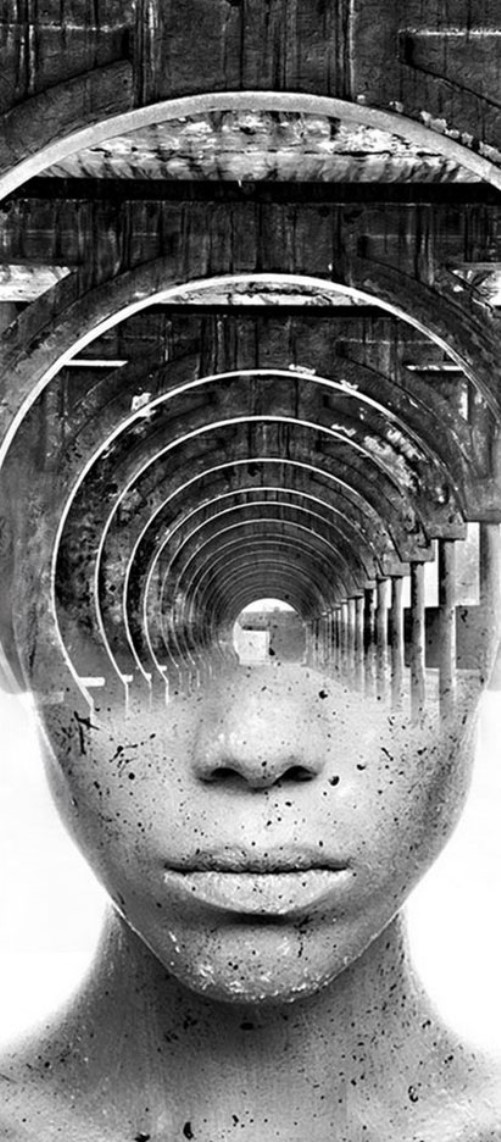
Antonia Mora

Image: Antonio Mora

The “human” in the South African context

Whether there is anything which is still to be rediscovered or to be reanimated from the term “the human” takes on a paradoxical resonance in contemporary South Africa. With the end of apartheid, South African culture and society was confronted with the urgency of engaging in affirmative politics in lieu of the politics of destruction of the years of racial segregation. Affirmative politics entailed the production of social horizons of hope. At the same time, it meant resisting both the inertia of the present and the nostalgia of the past. To reconstruct what centuries of racial brutality had destroyed, a balance had to be found between the mobilization, actualization and deployment of cognitive, affective and creative possibilities which had not so far been activated, along with a necessary dose of oppositional consciousness.

Critical humanism in this new context would have meant a persistent commitment to the possibilities and powers of life. There is substantial evidence that a return to the question of the possibilities and powers of life as a precondition for the reconstitution of “the human” in politics and culture was recognized as a matter of ethical and political urgency during the first decade of democracy. During this decade, South Africa became a model of how to dismantle a racial mode of rule, strike down race-based frameworks of citizenship and the law while striving to create racial equality through positive State action. The post-apartheid State fostered a normative project with the aim of achieving justice through reconciliation, equality through economic redress, democracy through the transformation of the law and the restoration of a variety of rights, including the right to a dignified life. This normative project was enshrined in a utopian Constitution that attempts to establish a new relationship between law and society on the one hand and law and life on the other, while equating democracy and the political itself with the ethical and the just. This Constitution’s underlying principle is ubuntu or human mutuality. It promises a transcendence of the old politics of racial difference and an affirmation of a shared humanity. Underpinning the Constitution is the hope that, after centuries of attempts by white power to contain blacks, South Africa could become the speech-act of a certain way of being-in-common rather than side by side.

This drive to “re-humanize” society and culture and to institutionalize a new political community that defines itself as an ethical community is nevertheless unfolding against various odds. Perhaps to a degree hardly achieved in the rest of the Continent, the human has consistently taken on the form of waste within the peculiar trajectory race and capitalism espoused in South Africa. Traditionally, we speak of “waste” as something produced bodily or socially by humans. In this sense, “waste” is that which is other than the human. Traditionally too, we speak of the intrinsic capacity of capitalism to waste human lives. We speak of how workers are wasted under capitalism in comparable fashion to natural resources. Marx in particular characterizes capitalist production as thoroughly wasteful with what he calls “human material” just as it is with “material resources”. It squanders “human beings, living labour”, “squandering not only flesh and blood, but nerves and brain, life and health as well”, he writes. In order to grasp the particular drama of the human in the history of South Africa, we should broaden this traditional definition of “waste” and consider the human itself as a waste product at the interface of race and capitalism. Squandering and wasting black lives has been an intrinsic part of the logic of capitalism, especially in those contexts in which race is central to the simultaneous production of wealth and of superfluous people.

Today, this logic of waste is particularly dramatized by the dilemmas of unemployment and disposability, survival and subsistence, and the expansion in every arena of everyday life of spaces of vulnerability. Despite the emergence of a solid black middle class, a rising superfluous population is becoming a permanent fixture of the South African social landscape with little possibility of ever being exploited by capital. Only a dwindling number of individuals can now claim to be workers in the traditional sense of the term. How to govern the poor has therefore become one of the biggest moral questions facing the nascent democracy. Behind policy debates on “welfare” and “service delivery” loom fundamental ethical choices that will determine the nature of the South African experiment in democracy – questions of how to right historical wrongs; what is the relationship between personal or collective injury and larger problems of equality, justice and the law; hunger and morality; owning and sharing; or even truth, hope and reconciliation. The urgency of these new moral dilemmas is such that, for the democratic project to have any future at all, it should necessarily take the form of a conscious attempt to retrieve life and “the human” from a history of waste.

Wealth and property

Meanwhile, wealth and property have acquired a new salience in public debate. They have become the key, central idioms to framing and naming ongoing social struggles – from imagining the relationship between “the good life” to redefining value itself; from claims of citizenship, rights and entitlements to the definition of the forms of property and the economy itself (whether we should nationalize or not); from matters of morality to those of lifestyle and accountability.

The centrality of wealth in the moral discourse concerning the “human’ is not new. In various parts of pre-colonial Africa, discourses on “the human”, or, on “humanity” almost always took the shape and content of discourses about “wealth”, “personhood” and “social multiplicity”. Traditional definitions of wealth usually encompassed “people”, “things” and “knowledge”.

“People”, that is, other human beings, were not only the most important unit of measurement of ultimate value. They also formed the material basis or infrastructure of human life. ‘People’ consisted of interpersonal dependents of all kinds – wives, children, clients and slaves. As Jane Guyer argues, they were sought, valued, and at times paid for at considerable expense in material terms. Kinship and marriage especially were critical components of accumulative strategies. But wealth also covered traded goods, including the imported goods brought from elsewhere. Things could be personalized objects. Goods could be functionally interchangeable with human beings who in turn could in certain respects be “objectified” or converted into clients or followers.

Wealth – embodied in rights in people – remained a persistent principle of African social and moral life even in the midst of the various shifts induced by the slave trade and colonialism. Knowledge on the other hand was understood as an ever shifting spectrum of possibility. Jane Guyer makes it clear that it was highly valued, complexly organized and plural by definition. There was no social organization of kinship and material life that did not depend, to some extent, on a regime of distribution of knowledge – the arts, music, dance, rhetoric, spiritual life, hunting, gathering, fishing, cultivation, wood-carving, metallurgy. If certain forms of knowledge were specialized, controlled and monopolized by a small cadre of experts or a secret society hierarchy, other forms of knowledge were conceptualized as an open and unbounded repertoire. This unboundedness made it possible for such forms of knowledge to be widely distributed throughout the society and among many adepts on the basis of personal capacity or potentiality.

Indeed, African pre-colonial discourses on the “human” allowed for personal differentiation or singularity. It was believed that certain qualities lived in the individual from his or her birth; which he or she had no need for “magic” to arouse although there was always the indispensable need for magical rites to conserve these. Personal abilities could be augmented, conserved and actualized within the person, making that person a “real person”, recognized as such by the community. Each individual person’s power was itself a composition.

That some of these old tropes might still be at work in current controversies on wealth and property should not be entirely excluded. But that wealth, poverty and property have become essential to the self-understanding of South African society after liberation should also be read against a long history of black dispossession. In the new phase of “frontier accumulation” made possible by the 1994 negotiated settlement, they have become the new idioms for political and normative arguments about what should be the proper relation of people to things; what should be the proper relation of people to each other with respect to things; how much property is enough for one person and how much is too much; how much enjoyment is justifiable especially for the opulent in an environment where hunger and debasement are all too real for many. It is this tension between what looks like an unstoppable logic of unproductive excess on the one hand and on the other, a logic of scarcity and depletion that is turning wealth and property into dramatic sites of contestation.

Wealth and property also operate as means of regulating access to resources that are scarce for some and plentiful for others. They are the main means by which life chances are assigned to different kinds of persons at a time when pockets of wealth and privilege are proving hard not only to account for and even less so to control, but also hard to subject to some form of accountability and redistribution. Furthermore, as Arjun Appadurai observes, the life of the poor has become a strenuous effort to produce, if not a sense of stability, then something like permanence in the face of the temporariness or volatility of almost all the arrangements of social existence. Indeed, one of the most brutal effects of neo-liberalism in South Africa has been the generalization and radicalization of a condition of temporariness for the poor. For many people, the struggle to be alive has taken the form of a struggle against the constant corrosion of the present, both by change and by uncertainty.

In order to reanimate the idea of “the human” in contemporary South African politics and culture, there is therefore no escape from the need to reflect on the thoroughly political and historical character of wealth and property and the extent to which wealth and property have come to be linked with bodily life. If what distinguishes the South African experiment from other such experiments elsewhere in the world is the attempt to establish a new relationship between law and life while equating democracy and the political itself with the ethical and the just, then we have to ask under what conditions can this project of human mutuality result in a broader and more ethical commensality.

Read the rest of this essay HERE.

achille mbembe on fire

Brilliant and inspiring lecture by Prof. Achille Mbembe in conversation with Rhodes Must Fall at UCT on 29 April 2015, talking about decolonising the university.

Read his speaking notes here: Achille Mbembe – Decolonizing Knowledge and the Question of the Archive (pdf document).

uct panel discussion – decolonising the university

Charting a path forward for anti-sexist and anti-racist scholarship and activism. This discussion was hosted by the Van Zyl Slabbert Visiting Chair, the Dean of the Faculty of Humanities and the University of Cape Town’s SRC and moderated by Prof Xolela Mangcu on Thursday 23 April 2015.

“The fact that we are able to have this conversation in South Africa as though it is new, as though these issues have never been thought of before, is precisely because of our inability to engage, and to read…In a staggering display of willful ignorance, we continue to have conversations that have been had, that have been taken in remarkable directions, as though we have just discovered them.” – Pumla Gqola (at 0:26:00)

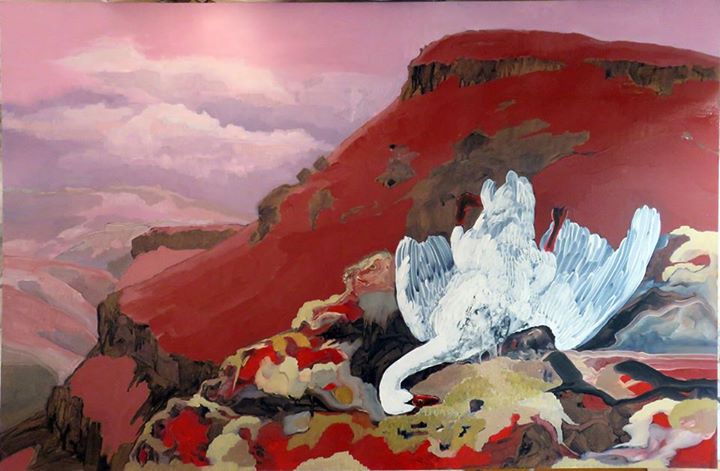
still life with white hyperbole

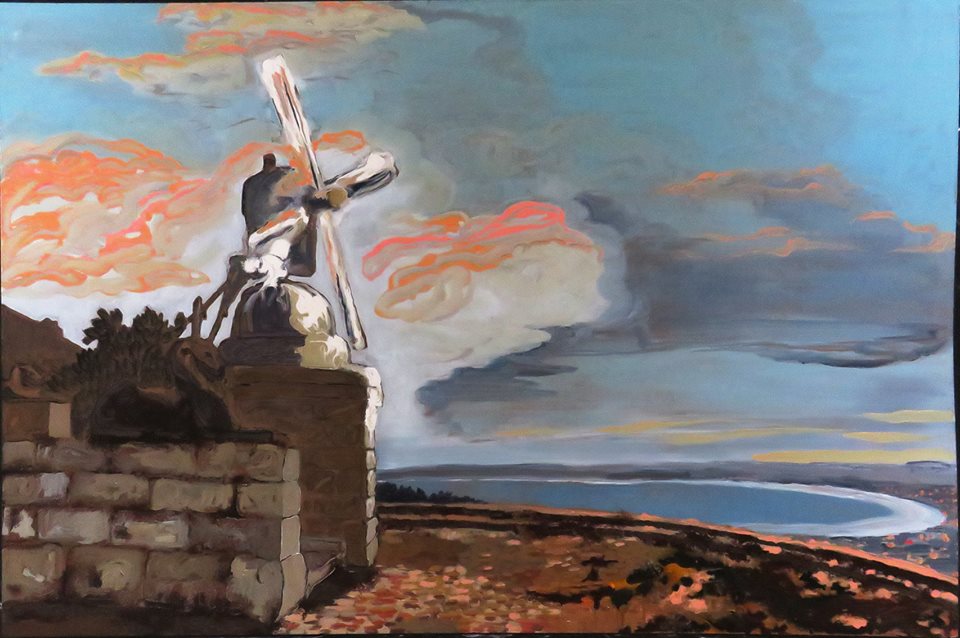
Lizza Littlewort - "Still Life with White Hyperbole". 2015.

Lizza Littlewort – “Still Life with White Hyperbole”. 2015.

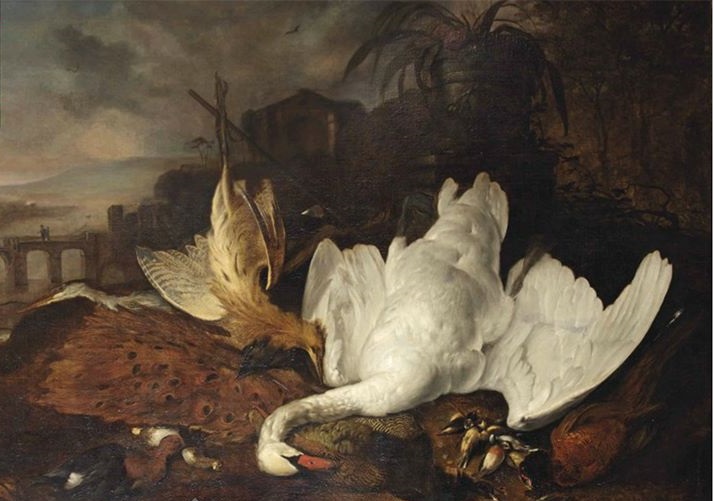
This is an adaptation from a still life by someone I’m actually descended from, whose son (or grandson, not sure) came out here as a PA to Simon van der Stel and apparently was the most corrupt, heinous motherfucker you could imagine. It’s very hard to get a straight answer from anyone in my family, but one distant uncle who I chatted to on the phone told me that because he could prove his direct descent he was allowed into the basement of the Rijks Museum where they kept all the family info. He said this guy was so corrupt that he was, individually, the reason for the first slave rebellion at the Cape. So it’s like an actual time warp of history. Except of course when I research when the slave rebellions were, none of the dates tie up. But of course there must be so many of these hideous occurrences which we no longer even know about.

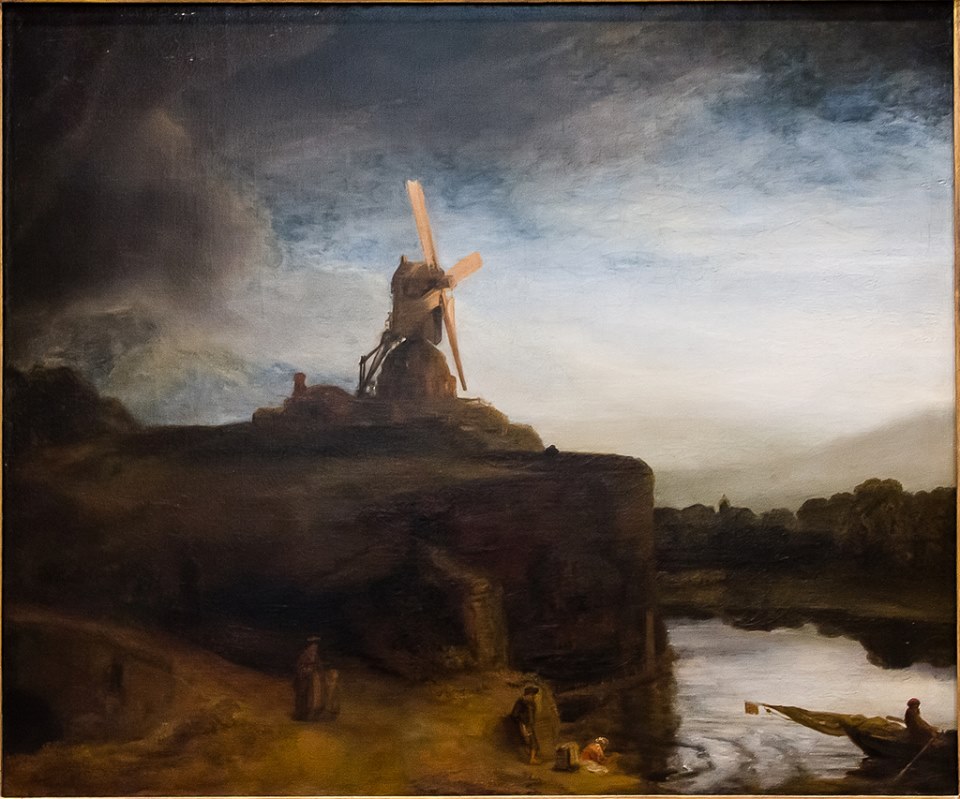
Here’s the painting, by Jacob Jacobsz. De Wet (Jacob de Wet II):

jacobz

Jacob de Wet II (Haarlem 1640/2-1697 Amsterdam).  An Italianate river landscape with a swan, a Eurasian bittern, a peacock, a pheasant and other birds before a stone vase on a pedestal. Oil on canvas, 153.6 x 217.5 cm.


ameera conrad – on exhaustion over a lack of understanding

ameeraI am tired
God Almighty, I am tired
of being told that we need to move on,
that we need to forget,
that we need to put the past behind us,
that Apartheid is over.

They don’t understand.
We never will.
Our bodies are monuments of centuries of torture,
trauma
terror
these exist in us
we live it every day.
We built this country
slaves
whips at our backs –
The Man holding the whip did not build –
we built.

Apartheid is not over.
No magic TRC wand can bippity-boppity-boo! it away.
Our glass carriage is still a pumpkin,
rotting,
pulled by rats.
A polite revolution over tea and crumpets, good Sir,
‘twas the order of the day.

When could we mourn?
When could we cry?
When could we scream
for our loved ones lost
our chances trampled on?

Please Mastah Baas Meneer,
Asseblief,
Gee my ‘n kans om te huil
vir my ma
en my pa
en my susters
en broers
gee my ‘n kans om te huil.

Let me stand up for myself
and for those who stood before me.
Let me march for myself
and for those who marched before me.
Let me call out AMANDLA
and raise my fist
and let me cry
after hundreds of years
let me cry.

— Ameera Conrad
4th Year
B.A. Theatre and Performance at UCT

Please visit Ameera’s blog, HERE.

UCT black academics: when they arrived!

A substantive account of what students are doing right now at UCT. Fiercely awesome.

briankamanzi's avatarbriankamanzi

Foreword

Forgive me at this moment, it is difficult to not be romantic in my description of what I feel is History in the making. This story is dedicated to my friends and comrades who are making waves at the University of Cape Town on behalf of many students, on behalf of me, on behalf of our children to change the institutional climate from the restrictions it has been gripped with through it’s inception. This latest wave of energy takes its rightful place as one, among many, of the acts of resistance against the systemic forces that resist change and substantive “transformation” as voices take on a new interpretation of the never ending struggle for liberation.

Forgive me in my limitedness, as I am physically unable to recount to you all that happened but I hope you appreciate my account of what I remember.. along with the moments that, most…

View original post 1,412 more words

statement from students occupying uct’s bremner building aka azania house

BREMNER OCCUPATION STATEMENT

We, the Rhodes Must Fall movement, are occupying the Bremner building with the intention to 1) disrupt the normal processes of management and 2) force management to accept our demands. We have chosen to occupy the Bremner building, and the Archie Mafeje room specifically, because of its strategic and historical significance – it is the place where management carries out its activities, and these are precisely the activities we seek to subvert. In addition, the building is a historical site of protest – in 1968 UCT students opposed the university’s decision to rescind the professorship of one of the continent’s leading anthropologists, Archie Mafeje. We have chosen the Archie Mafeje boardroom to recognise his struggle against the very institutional racism we are fighting against.

We have claimed and transformed this space to begin the decolonisation of the university. We are implementing a programme of rigorous political education under the guidance of a group of black lecturers from UCT and other South African universities that interrogates and problematizes the neo-colonial narratives pertaining to Africa. This education forces us to reject these narratives and their normative nature because they re-inforce our displacement both geographically and existentially.

We have begun to question the entire neo-colonial situation, whether South Africa belongs to all those who live in it and whether it is us the people that are occupying this building or whether we are realising the fact that this building and its land always belonged to the people. This education has extended far beyond the falling of the statue and has reached the language of struggle. How do we organise, how do we mobilise and most importantly how do we get what we want. How do we resolve the tensions between Pan-Africanism and intersectionality, moreover how does that implicate our own movement. Management has told us that they are allowing us to stay in Bremner. This building that sits on the land of black people, this building that was constructed on the sweat and blood of black people. If UCT is not afraid at this point all we have to say is NANG’UMFAZI OMNYAMA MAX PRICE!

We are here because we are calling into question the legitimacy of the supposedly democratic process Dr Max Price has put in place to address the removal of the Rhodes statue.

It is infuriating that management is attempting to open up a process of debate through their plan of action. Alumni have been emailed and asked for input, and notice boards have been put up near the statue to allow for comment from the broader student body. This is unacceptable to the black (by this we mean all oppressed people of colour) students, workers and staff belonging to this movement. It is absurd that anyone besides those who experience the statue as a violent presence should have any say in whether the statue should stay or not. White students in particular cannot be consulted in such a process because they can never truly empathise with the profound violence exerted on the psyche of black students. Management is making clear through this process that they are not interested in alleviating black pain unless the move to do so is validated by white voices. Opening up the discussion to an alumni that is overwhelmingly white and male will only prejudice black people, and black women particularly, in the decision-making process. To refuse to explicitly acknowledge these skewed demographics is unacceptable. Our pain and anger is at the centre of why the statue is being questioned, so this pain and anger must be responded to in a way that only we can define.

Further, the ‘Have Your Say’ notice boards have only made UCT’s black community more vulnerable – UCT has crafted a space that allows students to be blatantly racist with impunity, at the expense of a safe space for black people. This shows that UCT either does not know the violence black people face here, or they truly have no interest in our protection. Finally, it is revealing that while black protestors are threatened with and are facing investigations, the racist backlash from white students has been met with silence by the university.

That the presence of Rhodes is seen as debatable shows that management does not understand the extent of the terrible violence inflicted against black people historically and presently. The push for dialogue around the statue reflects the disturbing normalisation of colonisation and white supremacy at UCT.

In his letter “From the VC’s Desk: Rhodes statue protests and transformation”, Dr Price states that there has never been such university-wide discussion on this issue. He does so without interrogating why this is the case. It is the fault of UCT management that discussion has been suppressed for so long. Black students have clearly not had any channels through which to express their pain within the university, and no genuine steps have been taken by UCT to provide such. It is telling that a student had to go to the lengths that Chumani did in order to garner the university’s attention on issues of black pain. The fact that management has clearly disregarded the experiences of black students, staff and workers for the last 21 years on this campus calls into question their legitimacy in dealing with the issue of removing the statue.

The illegitimate nature of this process is also illustrated by our walk-out last Monday in protest of the disingenuous Heritage, Signage and Symbolism seminar. After the walk-out, the remaining members of the seminar stopped the discussion to respect student protestors and our decision that any conversation on the statue can only happen on our terms. The fact that the Vice-Chancellor mentioned this seminar in his letter without contextualising it reveals that he is committed to upholding a process that is clearly to the detriment of black students.

We take issue with Dr Price’s reasoning that “it is a council decision”. Again, the only view relevant to the decision is that of black students, workers and staff, and we refuse to accept the trivialisation of this fact in the form of management prioritising white stakeholders. We are also fully aware that UCT senior management has taken unilateral decisions before with no delay – we refer here to the decisions taken on the admissions policy which was pushed through by senior management.

We stress that this movement is not simply about the removal of a statue, and removing the statue is only the first step towards the radical decolonisation of this university. The removal of the statue is the first condition of our campaign – from which point we will allow management to engage with us. We demand that Management accepts that there is no decision to make: this movement has decided that the statue must fall. We demand that Dr Price organises an emergency meeting of council this week Friday the 27th of March to discuss the processes involved in removing the statue from this campus. We will remain in Bremner building until we receive confirmation of this.

olive schreiner on cecil john rhodes

“We fight Rhodes because he means so much of oppression, injustice, and moral degradation to South Africa; – but if he passed away tomorrow there still remains the terrible fact that something in our society has formed the matrix which has fed, nourished, and built up such a man!”

— In a letter to John X. Merriman on 3 April 1897, published at Olive Schreiner Letters online.

Rhodes statue, head covered in garbage bags. University of Cape Town, 17 March 2015. Photo: Rosemary Lombard

Statue of Cecil John Rhodes, head covered in garbage bags. University of Cape Town, 17 March 2015. Photo: Rosemary Lombard

Some more provocative white writing about the legacy of Rhodes can be found HERE.

foucault on sadism’s relationship to western rationality (1961)

Sadism is not a name finally given to a practice as old as Eros; it is a massive cultural fact which appeared precisely at the end of the eighteenth century, and which constitutes one of the greatest conversions of Western imagination: unreason transformed into delirium of the heart, madness of desire, the insane dialogue of love and death in the limitless presumption of appetite.

Sadism appears at the very moment that unreason, confined for over a century and reduced to silence, reappears, no longer as an image of the world, no longer as a figura, but as language and desire. And it is no accident that sadism, as an individual phenomenon bearing the name of a man, was born of confinement and, within confinement, that Sade’s entire oeuvre is dominated by the images of the Fortress, the Cell, the Cellar, the Convent, the inaccessible Island which thus form, as it were, the natural habitat of unreason.

It is no accident, either, that all the fantastic literature of madness and horror, which is contemporary with Sade’s oeuvre, takes place, preferentially, in the strongholds of confinement.

— Michel Foucault, from Madness and Civilisation

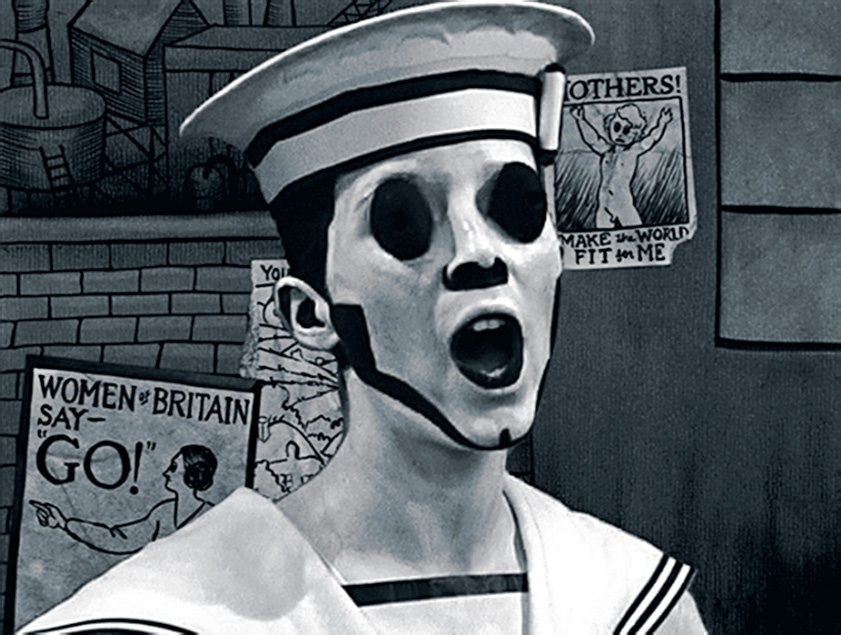
mary reid kelley – you make me iliad

Filmed in 2011 at Mary Reid Kelley’s home and studio in Saratoga Springs, New York, the video artist and painter discusses her video work “You Make Me Iliad” (2010). In researching the lives and experiences of women who lived during the first World War, Reid Kelley was struck by how few first-hand accounts she was able to uncover. Mary Reid Kelley explains her attempts to reconstitute an experience that would have otherwise been lost to history by creating an imagined narrative involving a prostitute, a soldier, and a medical officer.

In black-and-white videos and drawings filled with punning wordplay and political strife, Mary Reid Kelley presents her take on the clash between utopian ideologies and the realities of women’s lives in the struggle for liberation. Performing scripted narratives in rhyming verse— featuring characters such as nurses, soldiers, prostitutes, and saltimbanques—Reid Kelley playfully jumbles historical periods to trace the ways in which present concerns are rooted in the past.

Watch an excerpt from another of Reid Kelley’s works, Sadie the Saddest Sadist on Reid Kelley’s website.

mary-reid-kelley_101146821464.jpg_x_1600x1200Sadie, the Saddest Sadist (7 minutes, 23 seconds), 2009, is set in Great Britain in 1915, according to a free booklet that includes the video’s lyrics. The title character, a munitions worker, wants to learn a trade “so [she] could be a traitor.” She meets Jack, a sailor (played by Reid Kelley in drag), and with “passions inflamed,” she requests rousing war stories. His sung reply: “Calm down sweetheart / Britannia rules the waves.” In pledging herself to him, she offers her “surplus devotion,” and after their off-camera tryst, she sings, “The stains on my sheets / will come out with some lemon / I know that you care / by these Marx on my Lenin.” Live action alternates with stop-motion animation in which dancing refrigerator magnet-style letters spell out the dialogue or toy with it, as when “surplus devotion” is anagrammatized into “spurs devolution.”…

… Reid Kelley’s interest seems to be primarily in historical material, expressed in details such as the patriotic flyers that hang on the walls behind Sadie and Jack when they meet, which urge citizens to conserve food and to fight for king and country. Her fine ear for popular verse makes Reid Kelley’s work rich fun for those who are, as Jack describes himself, “verbally inclined.”

Source: http://www.artinamericamagazine.com/reviews/mary-reid-kelley/

ethel waters – his eye is on the sparrow

Pause to watch, listen and reflect.

Have you ever experienced the weird magic of coming across something obliquely on Youtube, on your way somewhere else, and it speaks so powerfully, so uncannily, to all the things happening right now around you that all the hairs on your body stand on end? This is one of those times. The scene comes from a 1952 film called The Member of the Weddingbased on the book/play by Carson McCullers, starring Ethel Waters, Julie Harris and Brandon De Wilde. I came across it because my housemate Khanyi and I were singing this old hymn, hamming it up Lauryn-Hill-in-Sister-Act-2 style. I wanted to check out some of the older versions… and this clip revealed itself to me, complete with contextual preamble.

Just to tether this to a little of my own current context (I unfortunately don’t have time to write much right now), here is something written by one of my MPhil classmates about the student protests demanding the removal of the statue of Cecil John Rhodes that are currently happening at UCT, and here is the official SRC statement on the matter.

member-of-the-wedding-julie-harris-ethel-waters-brandon-de-wilde-1952

marx and engels on the global reach of capitalism

The bourgeoisie cannot exist without constantly revolutionising the instruments of production, and thereby the relations of production, and with them the whole relations of society. Conservation of the old modes of production in unaltered form, was, on the contrary, the first condition of existence for all earlier industrial classes. Constant revolutionising of production, uninterrupted disturbance of all social conditions, everlasting uncertainty and agitation distinguish the bourgeois epoch from all earlier ones. All fixed, fast-frozen relations, with their train of ancient and venerable prejudices and opinions, are swept away, all new-formed ones become antiquated before they can ossify. All that is solid melts into air, all that is holy is profaned, and man is at last compelled to face with sober senses his real conditions of life, and his relations with his kind.

The need of a constantly expanding market for its products chases the bourgeoisie over the entire surface of the globe. It must nestle everywhere, settle everywhere, establish connexions everywhere.

The bourgeoisie has through its exploitation of the world market given a cosmopolitan character to production and consumption in every country. To the great chagrin of Reactionists, it has drawn from under the feet of industry the national ground on which it stood. All old-established national industries have been destroyed or are daily being destroyed. They are dislodged by new industries, whose introduction becomes a life and death question for all civilised nations, by industries that no longer work up indigenous raw material, but raw material drawn from the remotest zones; industries whose products are consumed, not only at home, but in every quarter of the globe. In place of the old wants, satisfied by the production of the country, we find new wants, requiring for their satisfaction the products of distant lands and climes. In place of the old local and national seclusion and self-sufficiency, we have intercourse in every direction, universal inter-dependence of nations. And as in material, so also in intellectual production. The intellectual creations of individual nations become common property. National one-sidedness and narrow-mindedness become more and more impossible, and from the numerous national and local literatures, there arises a world literature.

man-steve-cutts-02

Still from “Man”, by Steve Cutts (watch it!)

The bourgeoisie, by the rapid improvement of all instruments of production, by the immensely facilitated means of communication, draws all, even the most barbarian, nations into civilisation. The cheap prices of commodities are the heavy artillery with which it batters down all Chinese walls, with which it forces the barbarians’ intensely obstinate hatred of foreigners to capitulate. It compels all nations, on pain of extinction, to adopt the bourgeois mode of production; it compels them to introduce what it calls civilisation into their midst, i.e., to become bourgeois themselves. In one word, it creates a world after its own image.

Marx & Engels: Library: 1848: Manifesto of the Communist Party: Chapter 1

marchel duchamp took the credit for his friend elsa’s work

Just another sorry tale of appropriation:

Evidence that Marcel Duchamp may have stolen his most famous work, Fountain, from a woman poet has been in the public domain for many years. But the art world as a whole—museums, academia and the market—has persistently refused to acknowledge this fact.

The Museum of Modern Art (MoMA) in New York is the latest eminent body to bury its head in the sand. It has just published a new edition of Calvin Tomkins’s 1996 life of Duchamp, updated by its author. Ann Temkin, MoMA’s chief curator of painting and sculpture, praises Tomkins in her introduction for his “thorough research”. But Tomkins avoids addressing the implications of the question marks over the origins of the work that Duchamp himself raised in 1917.

Irene Gammel and Glyn Thompson have revealed the truth of his much earlier private account that he did not submit the urinal to the Society of Independent Artists exhibition in New York in 1917. Nevertheless, Duchamp’s late, fictional story is still taught in every class and recited in every book…

Should museums re-label the work Fountain as “a replica, appropriated by Marcel Duchamp (1887-1968), of an original by Baroness Elsa von Freytag-Loringhoven (1874-1927)”? Photo: Felix Clay

Should museums re-label the work Fountain as “a replica, appropriated by Marcel Duchamp (1887-1968), of an original by Baroness Elsa von Freytag-Loringhoven (1874-1927)”? Photo: Felix Clay

… Duchamp wrote to his sister, a nurse in war-torn Paris, telling her that “one of my female friends under a masculine pseudonym, Richard Mutt, sent in a porcelain urinal as a sculpture”. The explosive contents of this letter did not enter the public domain until 1983 when the missive was published in the Archives of American Art Journal.

The mere fact that Duchamp referred to the urinal as a sculpture suggests that it could not have been his, since by 1913, prompted by the work of the wealthy, chess-playing writer Raymond Roussel, he had stopped creating art. His Roussel-inspired “Readymades” were elaborate, personal rebuses to be read, not viewed.

The literary historian Irene Gammel was the first to discover who Duchamp’s “female friend” was. She was born Else Plötz in Germany in 1874, the daughter of a builder and local politician who philandered freely and beat her mother. Afflicted with syphilis, her mother attempted suicide and died later in an institution. As Elsa put it, she “left me her ­heritage… to fight”.

Elsa first married the leading Jugendstil architect August Endell, then Felix Paul Greve, the translator of Oscar Wilde, who faked his own suicide to escape his creditors and fled with Elsa to America. Her third marriage was to Leopold Karl Friedrich Baron von Freytag-Loringhoven, the impoverished son of a German aristocrat who had also escaped to America to avoid debts. He soon ­vanished with Elsa’s paltry savings but left her with a title and entrée into artistic circles in New York.

Elsa simultaneously inspired and repelled all who came into contact with her, from Ezra Pound to Ernest Hemingway. Nevertheless The Little Review treated her as a star and ­published her poems alongside excerpts from James Joyce’s Ulysses. Elsa’s genius was to find new ways to break out of the social straightjacket that bound women so that she could fight her mother’s battle in public, whenever and wherever she wanted, not when men told her she could.

In October 1917, the painter George Biddle described her room in New York filled with “odd bits of ­ironware, automobile tiles… ash cans, every conceivable horror, which to her tortured yet highly sensitive ­perception, became objects of formal beauty… it had to me quite as much authenticity as, for instance, Brancusi’s studio in Paris.”

Elsa was a poet of found objects, but she didn’t leave them as they were—she transformed them into works of art.

Elsa exploded in fury when the US declared war on her motherland, on Good Friday, 6 April 1917. Her ­target was the Society of Indepen­dent Artists, whose representatives had consistently cold-shouldered her. We believe she submitted an upside-down urinal, signed R. Mutt in a script similar to the one she sometimes used for her poems.

Armut—the homophone of R. Mutt—has many resonances in German. It is used in common phrases to mean “poverty”, and in some contexts “intellectual poverty”. Elsa’s submission was a double-pronged attack. The society was hoist by its own petard, for in accepting the entry it would demonstrate its inability to distinguish a work of art from an everyday object, but in rejecting it, it would break its own rule that the definition of what was art should be left to the submitting artist. Hence the “intellectual poverty” of its stance.

The urinal was Elsa’s declaration of war against a man’s war—an extraordinary visual assault on all that men stood for. As a sculpture of a transformed everyday object, it deserves to rank alongside Picasso’s Bull’s Head, 1942, made of bicycle ­handlebars and a saddle, and Dali’s Lobster Telephone, 1936.

If Duchamp did not submit the urinal, why would he pretend later that he did? After Elsa died in 1927, forgotten and in abject poverty, Duchamp began to let his name be associated with the urinal, and by 1950, four years after the death of Alfred Stieglitz, who photographed the original Fountain, he began to assume its authorship…

… When the mood took him, Duchamp could be honest about his dishonesty. In an interview in 1962, he told William Seitz: “I insist every word I am telling you now is stupid and wrong.” Why, then, has the art world persisted in believing an account grounded in the myths he promulgated?

Sélavy, baby… Read the full article HERE.