how could you go ahead of me? (1586)

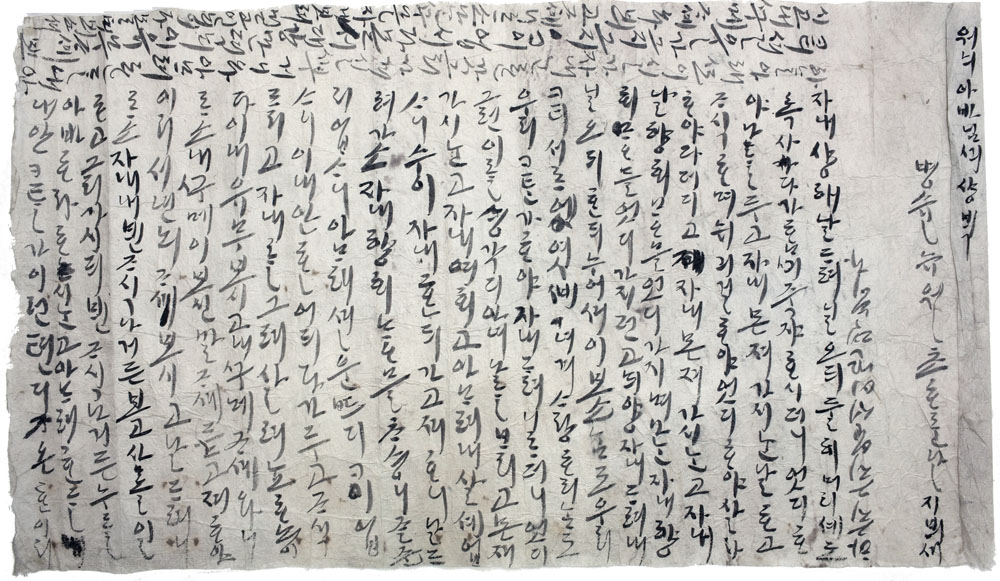
Excavating an ancient tomb in South Korea, archaeologists found the 4-centuries-old mummy of Eung-Tae Lee, who had died at the age of 30. Lying on his chest was this letter, written by his pregnant widow and addressed to the father of their unborn child:

mummy letter

Source: Letters of Note

Transcript

To Won’s Father
June 1, 1586

You always said, “Dear, let’s live together until our hair turns grey and die on the same day.” How could you pass away without me? Who should I and our little boy listen to and how should we live? How could you go ahead of me?

How did you bring your heart to me and how did I bring my heart to you? Whenever we lay down together you always told me, “Dear, do other people cherish and love each other like we do? Are they really like us?” How could you leave all that behind and go ahead of me?

I just cannot live without you. I just want to go to you. Please take me to where you are. My feelings toward you I cannot forget in this world and my sorrow knows no limit. Where would I put my heart in now and how can I live with the child missing you?

Please look at this letter and tell me in detail in my dreams. Because I want to listen to your saying in detail in my dreams I write this letter and put it in. Look closely and talk to me.

When I give birth to the child in me, who should it call father? Can anyone fathom how I feel? There is no tragedy like this under the sky.

You are just in another place, and not in such a deep grief as I am. There is no limit and end to my sorrows that I write roughly. Please look closely at this letter and come to me in my dreams and show yourself in detail and tell me. I believe I can see you in my dreams. Come to me secretly and show yourself. There is no limit to what I want to say and I stop here.

Source: Letters of Note

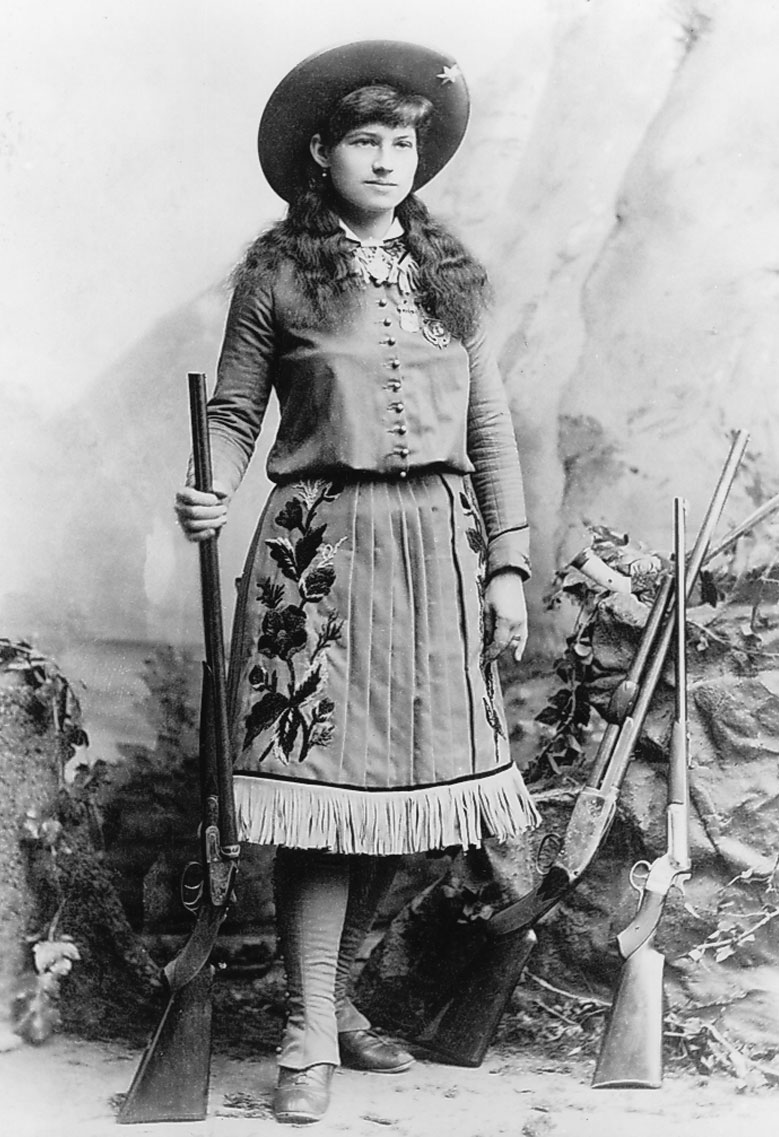
annie oakley in a thomas edison film (1894)

Created and published by the Edison Manufacturing Co., 1894
Performer: Annie Oakley.
Camera: William Heise.
Filmed November 1, 1894, in Thomas Edison’s Black Maria studio.

From Archive.org:

Annie Oakley was probably the most famous marksman/woman in the world when this short clip was produced in Edison’s Black Maria studio in West Orange, New Jersey. Barely five feet tall, Annie was always associated with the wild west, although she was born in 1860 as Phoebe Ann Oakley Mozee (or Moses) in Darke County, Ohio. Nevertheless, she was a staple in the Buffalo Bill Wild West Show and similar wild west companies. Because of her diminutive stature, she was billed as “Little Sure Shot.”

annie oakley

The man assisting her is this appearance is probably her husband, Frank E. Butler. Annie had outshot Butler (a famous dead-eye marksman himself) in a shooting contest in the 1880s. Instead of nursing his bruised ego because he had been throughly outgunned by a woman, Butler fell in love, married Little Sure Shot, and became her manager.

Theirs was a solid and happy marriage that lasted 44 years, and when Annie died on November 3, 1926, at age 66, a heartbroken Butler followed her to the grave 18 days later.

lydia lunch – cesspool called history

Montage from film footage: Fingered and The Right Side of my Brain, attributed to Richard Kern, starring Lydia Lunch.
Music: “Cesspool Called History” (Lydia’s reciting over a version of the jazz standard, “Harlem Nocturne”), from the Lydia Lunch album, Hangover Hotel (self-released in 2001).

95 years since the end of world war 1 today

This version of the traditional song originally penned by J H McNaughton during the American Civil War was recorded by Jolie Holland for her Escondida album in 2004:

Here is the first known recorded version, by Buell Kazee, in 1928:

Today marks 95 years since the end of World War 1.

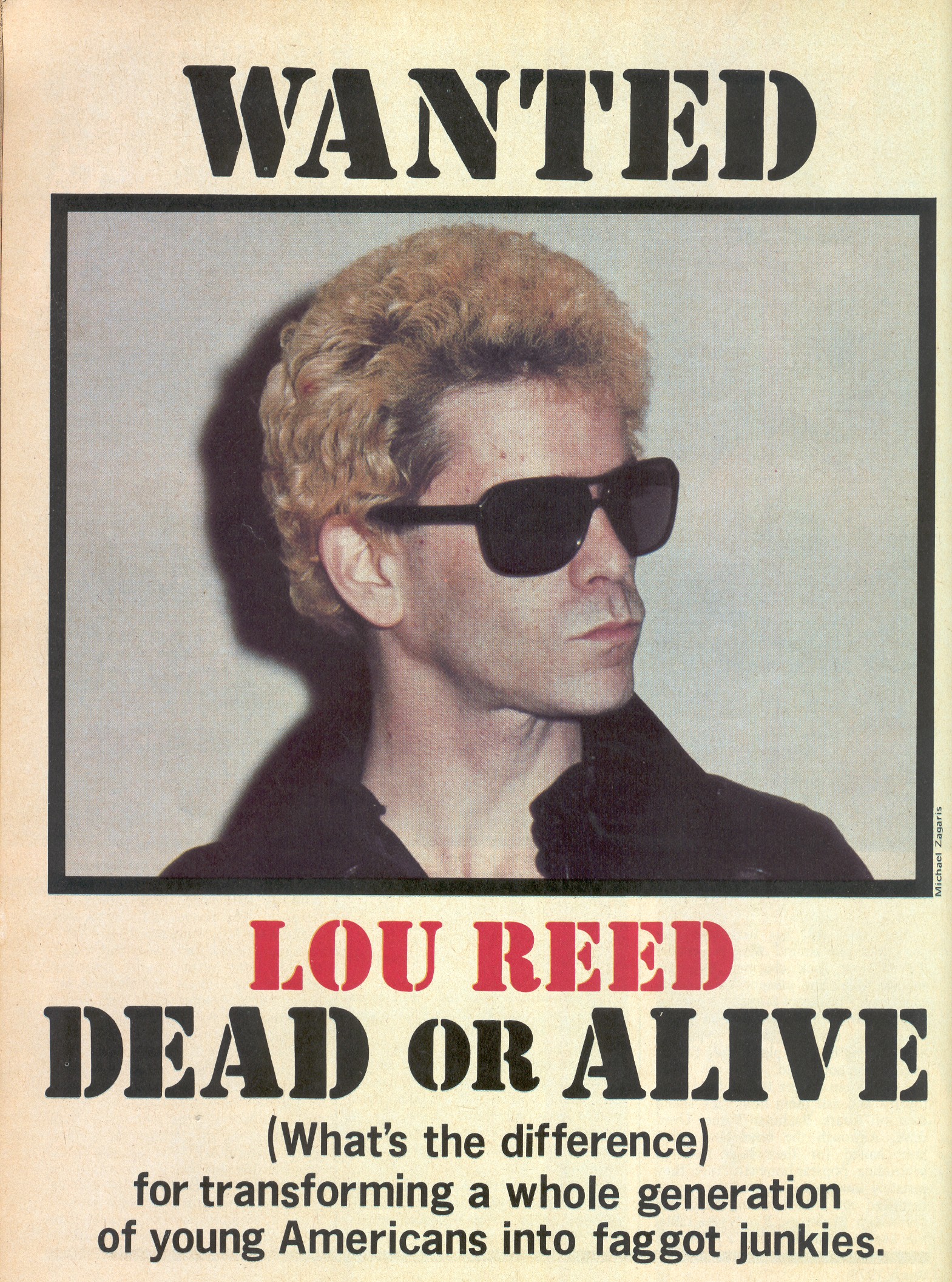
rock and roll heart – lou reed documentary

Rock and Roll Heart traces Lou Reed’s career from the formation of the Velvet Underground to rock icon to his more recent artistic endeavours. Includes lots of rare and vintage footage along with interviews with David Bowie, John Cale, Patti Smith, Thurston Moore, David Byrne, Jim Carroll, Maureen Tucker, Suzanne Vega, Dave Stewart and Philip Glass. Directed by Timothy Greenfield-Sanders for American Masters and screened at the Sundance Film Festival in 1998.

Lou Reed Creem

on the romance of records

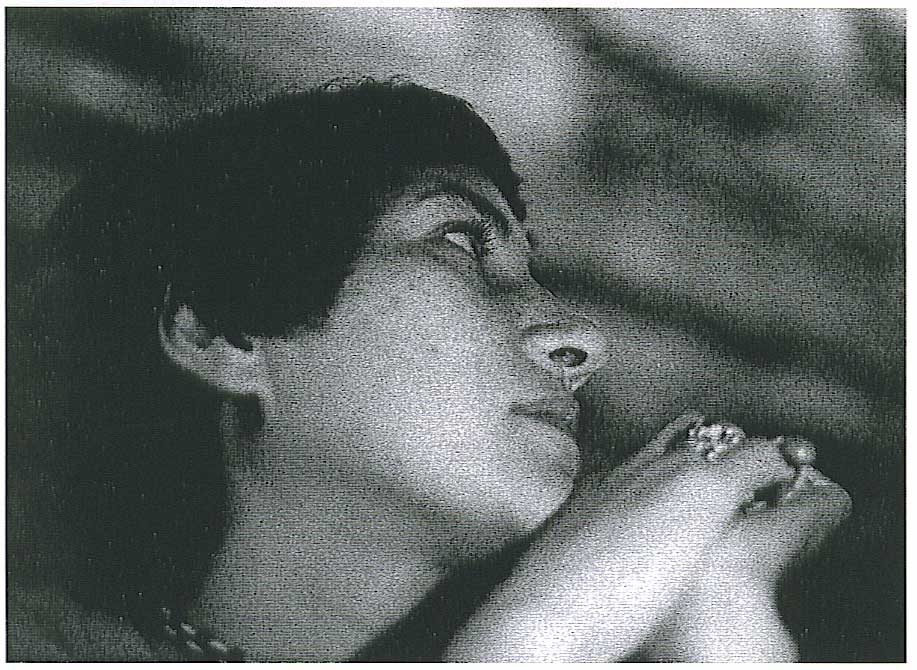
[Juliette Gréco]

Juliette Gréco

“Is it wrong, wanting to be at home with your record collection? It’s not like collecting records is like collecting stamps, or beermats, or antique thimbles. There’s a whole world in here, a nicer, dirtier, more violent, more peaceful, more colourful, sleazier, more dangerous, more loving world than the world I live in; there is history, and geography, and poetry, and countless other things I should have studied at school, including music.”

― Nick Hornby, High Fidelity

ntozake shange – dark phrases

dark phrases of womanhood
of never havin been a girl
half-notes scattered
without rhythm/no tune
distraught laughter fallin
over a black girl’s shoulder
it’s funny/it’s hysterical
the melody-less-ness of her dance
don’t tell nobody don’t tell a soul
she’s dancin on beer cans & shingles

this must be the spook house
another song with no singers
lyrics/no voices
& interrupted solos
unseen performances

are we ghouls?
children of horror?
the joke?

don’t tell nobody don’t tell a soul
are we animals? have we gone crazy?

i can’t hear anythin
but maddening screams
& the soft strains of death
& you promised me
you promised me…
somebody/anybody
sing a black girl’s song
bring her out
to know herself
to know you
but sing her rhythms
carin/struggle/hard times
sing her song of life
she’s been dead so long
closed in silence so long
she doesn’t know the sound
of her own voice
her infinite beauty
she’s half-notes scattered
without rhythm/no tune
sing her sighs
sing the song of her possibilities
sing a righteous gospel
let her be born
let her be born
& handled warmly.

— from For Colored Girls Who Have Considered Suicide When the Rainbow is Enuf.  Macmillan Publishing, 1977. Shange was born Paulette L. Williams in Trenton, New Jersey. She later changed her name to isiXhosa/isiZulu – read more HERE.

anne carson – the gender of sound

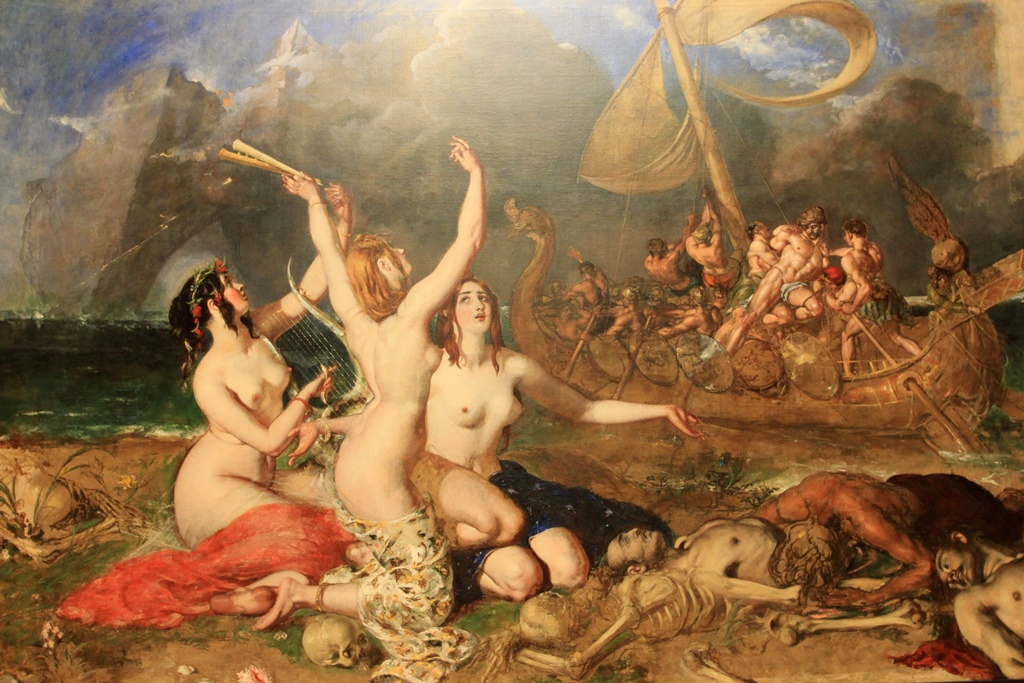
William Etty - "The Siren and Ulysses", 1837.

William Etty – “The Siren and Ulysses”, 1837.

Madness and witchery as well as bestiality are conditions commonly associated with the use of the female voice in public, in ancient as well as modern contexts. Consider how many female celebrities of classical mythology, literature and cult make themselves objectionable by the way they use their voice.

For example, there is the heart-chilling groan of the Gorgon, whose name is derived from a Sanskrit word, *garg meaning “a guttural animal howl that issues as a great wind from the back of the throat through a hugely distended mouth”. There are the Furies whose high-pitched and horrendous voices are compared by Aiskhylos to howling dogs or sounds of people being tortured in hell (Eumenides). There is the deadly voice of the Sirens and the dangerous ventriloquism of Helen (Odyssey) and the incredible babbling of Kassandra (Aiskhylos, Agamemnon) and the fearsome hullabaloo of Artemis as she charges through the woods (Homeric Hymn to Aphrodite). There is the seductive discourse of Aphrodite which is so concrete an aspect of her power that she can wear it on her belt as a physical object or lend it to other women (Iliad). There is the old woman of Eleusinian legend Iambe who shrieks obscenities and throws her skirt up over her head to expose her genitalia. There is the haunting garrulity of the nymph Echo (daughter of Iambe in Athenian legend) who is described by Sophokles as “the girl with no door on her mouth” (Philoktetes).

Putting a door on the female mouth has been an important project of patriarchal culture from antiquity to the present day. Its chief tactic is an ideological association of female sound with monstrosity, disorder and death.

— From “The Gender of Sound”, in Glass, Irony and God. New Directions, 1995: pp 120-121

The brilliant Anne Carson presents a history of the gendered voice, from Sophocles to Gertrude Stein. She outlines what is at stake in our assumptions around sound, questioning whether the concept of ‘self-control’ is a barrier to acknowledging other forms of human order, feeding into wider debates on social order, both past and present.

Read the whole essay HERE.

the verve – already there

Off the John Leckie-produced masterpiece of ’90s psychedelia, A Storm in Heaven (Hut/Vernon Yard, 1993). Visual material from Andrei Tarkovsky’s incredible film, Solaris (1972). 

I was so in love with this album for so many years, yet I have hardly listened to it in the past decade…  It’s hard to figure out why.  I don’t think it’s because I tired of it. Listening again now to the full album, I get the very same goosebumps as always. Most likely the reason I haven’t listened to it is because I have it on CD, and I haven’t really listened to CDs in a long time (though I am pretty sure I have it ripped to mp3 somewhere?). Heck, I don’t even own a CD player anymore, except for my old Walkman and the DVD drive in my Windows laptop. More broadly, it’s interesting to think about how different the mix of listening formats is now compared to when this came out, and how the format of a recording affects its consumption… But I think that may be an essay for another day when I’m feeling less spacey!

Hello it’s me, it’s me
I want to touch you
It’s me throwing stones from the stars
On your mixed up world

Been circling round for twenty years
And in that time I’ve seen all the fires and all the liars
I’ve been calling home for twenty years
And in that time I heard the screams rebound to me
While you were making history

LISTEN TO A STORM IN HEAVEN, and dream galaxies…

how to dance the “black bottom”

The “Black Bottom” (aka “Swanee Bottom”) was originally from New Orleans, later worked its way to Georgia and finally New York. Some say the “Black Bottom” was introduced by blues singer Alberta Hunter (which is probably true as many songs & dances were “stolen” and reproduced by someone else). However, it has been reported that the Black Bottom was derived from an earlier and similar dance called the “Echo.” The dance was done all over the South before Perry Bradford wrote his “Original Black Bottom Dance” in 1919.

Simple moves were created by natural movements, like the stomp was to imitate a cow’s feet stuck in mud.
__
The above info is posted below the Youtube video. Read more (a different story) about the supposed origins of this ’20s dance craze HERE, and watch another video from 1927 from the British Pathe archive:

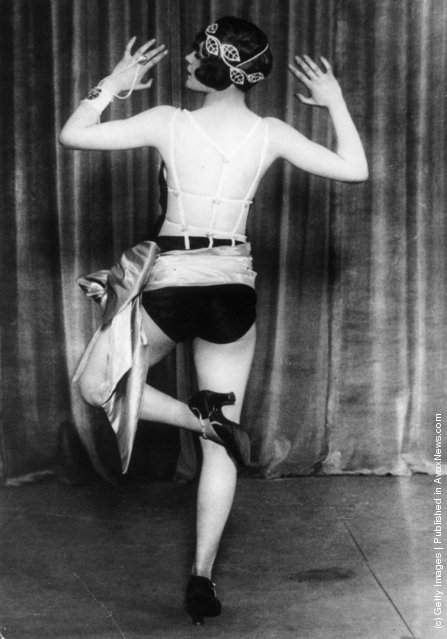
flapper

kyle shepherd trio – die maan skyn so helder

“The moon’s shining so brightly tonight…”

Kyle Shepherd (piano, voice), Shane Cooper (double bass) and Jonno Sweetman (drums) perform a version of this subversive traditional Cape Goema song arranged by Kyle Shepherd. Recorded live at Welgemeend, Welgemeend Street, Gardens, Cape Town, South Africa on Friday 21 May 2009.

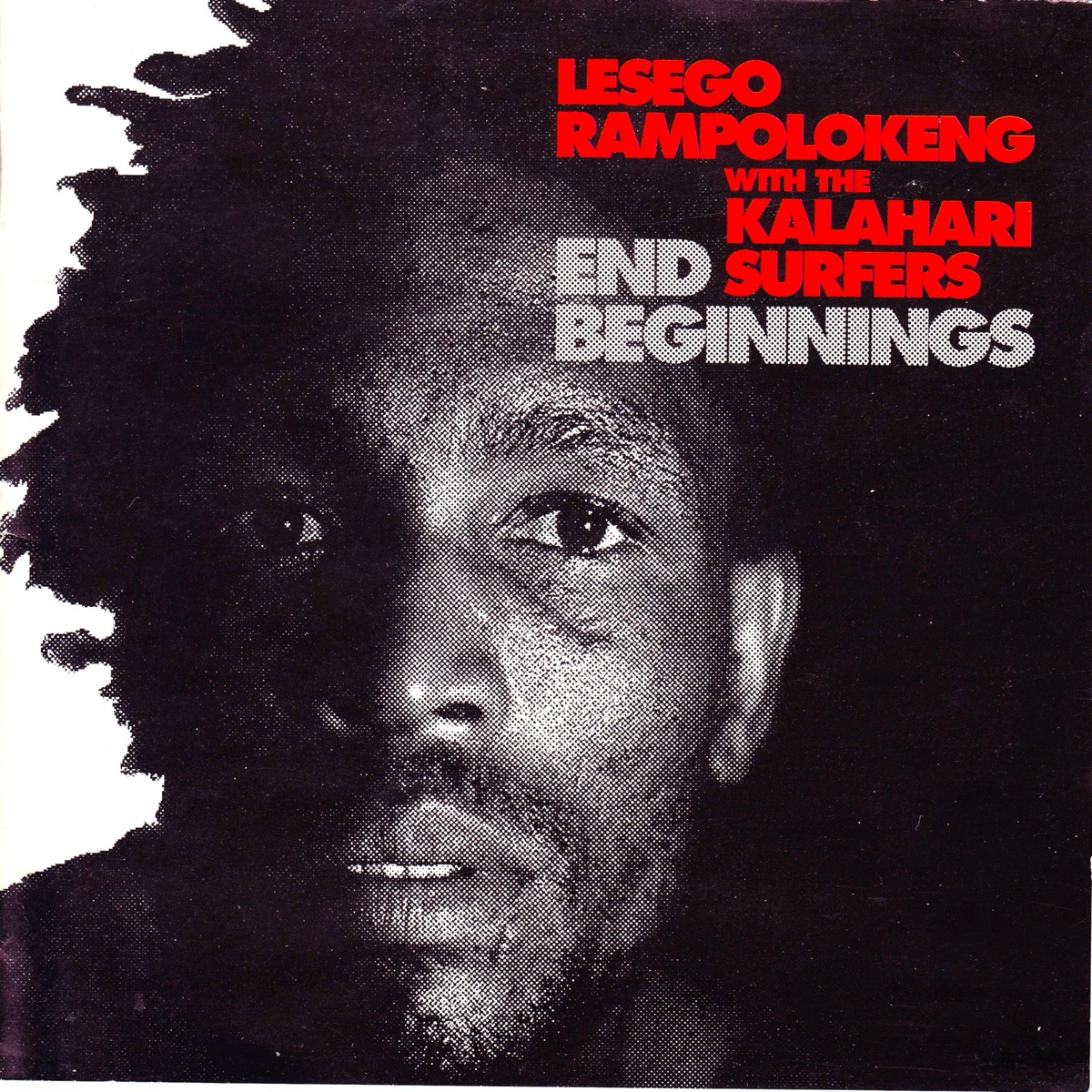
lesego rampolokeng with the kalahari surfers – end beginnings

“Liars rule the world…”

“Treason” and “End Beginnings” — tracks from the album End Beginnings (Shifty, 1991). This is the sound of South Africa in the late 1980s/early 1990s. Of course, I never got to hear this until years later.
Music: Warrick Sony
Words and voice: Lesego Rampolokeng

Download this album HERE.

end beginnings

rosalia chalia – i dreamt that i dwelt in marble halls (1901)

This is Rosalia Chalia (1863-1948) singing “I Dreamt That I Dwelt in Marble Halls” from the opera The Bohemian Girl, composed by MW Balfe in 1843, recorded on wax cylinder in 1901…

… And here’s the incomparable re-recording engineer and archivist Ward Marston talking about this forgotten Cuban soprano, and the physical realities of trying to rescue recordings of her from obscurity — fascinating:


t.s. eliot – little gidding (1942)

little-giddingI

Midwinter spring is its own season
Sempiternal though sodden towards sundown,
Suspended in time, between pole and tropic.
When the short day is brightest, with frost and fire,
The brief sun flames the ice, on pond and ditches,
In windless cold that is the heart’s heat,
Reflecting in a watery mirror
A glare that is blindness in the early afternoon.
And glow more intense than blaze of branch, or brazier,
Stirs the dumb spirit: no wind, but pentecostal fire
In the dark time of the year. Between melting and freezing
The soul’s sap quivers. There is no earth smell
Or smell of living thing. This is the spring time
But not in time’s covenant. Now the hedgerow
Is blanched for an hour with transitory blossom
Of snow, a bloom more sudden
Than that of summer, neither budding nor fading,
Not in the scheme of generation.
Where is the summer, the unimaginable
Zero summer?

If you came this way,
Taking the route you would be likely to take
From the place you would be likely to come from,
If you came this way in may time, you would find the hedges
White again, in May, with voluptuary sweetness.
It would be the same at the end of the journey,
If you came at night like a broken king,
If you came by day not knowing what you came for,
It would be the same, when you leave the rough road
And turn behind the pig-sty to the dull facade
And the tombstone. And what you thought you came for
Is only a shell, a husk of meaning
From which the purpose breaks only when it is fulfilled
If at all. Either you had no purpose
Or the purpose is beyond the end you figured
And is altered in fulfilment. There are other places
Which also are the world’s end, some at the sea jaws,
Or over a dark lake, in a desert or a city—
But this is the nearest, in place and time,
Now and in England.

If you came this way,
Taking any route, starting from anywhere,
At any time or at any season,
It would always be the same: you would have to put off
Sense and notion. You are not here to verify,
Instruct yourself, or inform curiosity
Or carry report. You are here to kneel
Where prayer has been valid. And prayer is more
Than an order of words, the conscious occupation
Of the praying mind, or the sound of the voice praying.
And what the dead had no speech for, when living,
They can tell you, being dead: the communication
Of the dead is tongued with fire beyond the language of the living.
Here, the intersection of the timeless moment
Is England and nowhere. Never and always.

II

Ash on an old man’s sleeve
Is all the ash the burnt roses leave.
Dust in the air suspended
Marks the place where a story ended.
Dust inbreathed was a house-
The walls, the wainscot and the mouse,
The death of hope and despair,
This is the death of air.

There are flood and drouth
Over the eyes and in the mouth,
Dead water and dead sand
Contending for the upper hand.
The parched eviscerate soil
Gapes at the vanity of toil,
Laughs without mirth.
This is the death of earth.

Water and fire succeed
The town, the pasture and the weed.
Water and fire deride
The sacrifice that we denied.
Water and fire shall rot
The marred foundations we forgot,
Of sanctuary and choir.
This is the death of water and fire.

In the uncertain hour before the morning
Near the ending of interminable night
At the recurrent end of the unending
After the dark dove with the flickering tongue
Had passed below the horizon of his homing
While the dead leaves still rattled on like tin
Over the asphalt where no other sound was
Between three districts whence the smoke arose
I met one walking, loitering and hurried
As if blown towards me like the metal leaves
Before the urban dawn wind unresisting.
And as I fixed upon the down-turned face
That pointed scrutiny with which we challenge
The first-met stranger in the waning dusk
I caught the sudden look of some dead master
Whom I had known, forgotten, half recalled
Both one and many; in the brown baked features
The eyes of a familiar compound ghost
Both intimate and unidentifiable.
So I assumed a double part, and cried
And heard another’s voice cry: “What! are you here?”
Although we were not. I was still the same,
Knowing myself yet being someone other—
And he a face still forming; yet the words sufficed
To compel the recognition they preceded.
And so, compliant to the common wind,
Too strange to each other for misunderstanding,
In concord at this intersection time
Of meeting nowhere, no before and after,
We trod the pavement in a dead patrol.
I said: “The wonder that I feel is easy,
Yet ease is cause of wonder. Therefore speak:
I may not comprehend, may not remember.”
And he: “I am not eager to rehearse
My thoughts and theory which you have forgotten.
These things have served their purpose: let them be.
So with your own, and pray they be forgiven
By others, as I pray you to forgive
Both bad and good. Last season’s fruit is eaten
And the fullfed beast shall kick the empty pail.
For last year’s words belong to last year’s language
And next year’s words await another voice.
But, as the passage now presents no hindrance
To the spirit unappeased and peregrine
Between two worlds become much like each other,
So I find words I never thought to speak
In streets I never thought I should revisit
When I left my body on a distant shore.
Since our concern was speech, and speech impelled us
To purify the dialect of the tribe
And urge the mind to aftersight and foresight,
Let me disclose the gifts reserved for age
To set a crown upon your lifetime’s effort.
First, the cold fricton of expiring sense
Without enchantment, offering no promise
But bitter tastelessness of shadow fruit
As body and soul begin to fall asunder.
Second, the conscious impotence of rage
At human folly, and the laceration
Of laughter at what ceases to amuse.
And last, the rending pain of re-enactment
Of all that you have done, and been; the shame
Of things ill done and done to others’ harm
Which once you took for exercise of virtue.
Then fools’ approval stings, and honour stains.
From wrong to wrong the exasperated spirit
Proceeds, unless restored by that refining fire
Where you must move in measure, like a dancer.”
The day was breaking. In the disfigured street
He left me, with a kind of valediction,
And faded on the blowing of the horn.

III

There are three conditions which often look alike
Yet differ completely, flourish in the same hedgerow:
Attachment to self and to things and to persons, detachment
From self and from things and from persons; and, growing between them, indifference
Which resembles the others as death resembles life,
Being between two lives – unflowering, between
The live and the dead nettle. This is the use of memory:
For liberation – not less of love but expanding
Of love beyond desire, and so liberation
From the future as well as the past. Thus, love of a country
Begins as an attachment to our own field of action
And comes to find that action of little importance
Though never indifferent. History may be servitude,
History may be freedom. See, now they vanish,
The faces and places, with the self which, as it could, loved them,
To become renewed, transfigured, in another pattern.
Sin is Behovely, but
All shall be well, and
All manner of thing shall be well.
If I think, again, of this place,
And of people, not wholly commendable,
Of not immediate kin or kindness,
But of some peculiar genius,
All touched by a common genius,
United in the strife which divided them;
If I think of a king at nightfall,
Of three men, and more, on the scaffold
And a few who died forgotten
In other places, here and abroad,
And of one who died blind and quiet,
Why should we celebrate
These dead men more than the dying?
It is not to ring the bell backward
Nor is it an incantation
To summon the spectre of a Rose.
We cannot revive old factions
We cannot restore old policies
Or follow an antique drum.
These men, and those who opposed them
And those whom they opposed
Accept the constitution of silence
And are folded in a single party.
Whatever we inherit from the fortunate
We have taken from the defeated
What they had to leave us – a symbol:
A symbol perfected in death.
And all shall be well and
All manner of thing shall be well
By the purification of the motive
In the ground of our beseeching.

IV

The dove descending breaks the air
With flame of incandescent terror
Of which the tongues declare
The one dischage from sin and error.
The only hope, or else despair
Lies in the choice of pyre of pyre-
To be redeemed from fire by fire.

Who then devised the torment? Love.
Love is the unfamiliar Name
Behind the hands that wove
The intolerable shirt of flame
Which human power cannot remove.
We only live, only suspire
Consumed by either fire or fire.

V

What we call the beginning is often the end
And to make and end is to make a beginning.
The end is where we start from. And every phrase
And sentence that is right (where every word is at home,
Taking its place to support the others,
The word neither diffident nor ostentatious,
An easy commerce of the old and the new,
The common word exact without vulgarity,
The formal word precise but not pedantic,
The complete consort dancing together)
Every phrase and every sentence is an end and a beginning,
Every poem an epitaph. And any action
Is a step to the block, to the fire, down the sea’s throat
Or to an illegible stone: and that is where we start.
We die with the dying:
See, they depart, and we go with them.
We are born with the dead:
See, they return, and bring us with them.
The moment of the rose and the moment of the yew-tree
Are of equal duration. A people without history
Is not redeemed from time, for history is a pattern
Of timeless moments. So, while the light fails
On a winter’s afternoon, in a secluded chapel
History is now and England.

With the drawing of this Love and the voice of this Calling

We shall not cease from exploration
And the end of all our exploring
Will be to arrive where we started
And know the place for the first time.
Through the unknown, unremembered gate
When the last of earth left to discover
Is that which was the beginning;
At the source of the longest river
The voice of the hidden waterfall
And the children in the apple-tree
Not known, because not looked for
But heard, half-heard, in the stillness
Between two waves of the sea.
Quick now, here, now, always—
A condition of complete simplicity
(Costing not less than everything)
And all shall be well and
All manner of thing shall be well
When the tongues of flames are in-folded
Into the crowned knot of fire
And the fire and the rose are one.

Context from Wikipedia:

“Little Gidding” is the fourth and final poem of T. S. Eliot‘s Four Quartets, a series of poems that discuss time, perspective, humanity, and salvation. It was first published in September 1942 after being delayed for over a year because of the air-raids on Great Britain during World War II and Eliot’s declining health. The title refers to a small Anglican community in Huntingdonshire, established by Nicholas Ferrar in the 17th century and scattered during the English Civil War.

The poem uses the combined image of fire and Pentecostal fire to emphasize the need for purification and purgation. According to the poet, humanity’s flawed understanding of life and turning away from God leads to a cycle of warfare, but this can be overcome by recognizing the lessons of the past. Within the poem, the narrator meets a ghost that is a combination of various poets and literary figures. Little Gidding focuses on the unity of past, present, and future, and claims that understanding this unity is necessary for salvation.

sathima bea benjamin – i’m glad there is you

Thank you for being here, Sathima. I am so grateful that I had the chance to meet you before you left… May you go in peace.

Sathima Bea Benjamin by Seton_pic_6

The track above comes from the album, A Morning in Paris, recorded in 1963 but only released in 1996.

Sathima Benjamin met Duke Ellington while he was in Zurich for a short engagement in February of 1963. Standing in the wings during most of the Ellington band’s performance, once the concert ended she insisted that Duke hear her husband Abdullah Ibrahim (then known as Dollar Brand)’s trio at the Club Africana, one of the few local jazz spots where the couple could work fairly regularly. Duke obliged and liked what he heard, but he also insisted that Benjamin sing for him. He adored her voice and promptly arranged for the couple to fly to Paris and record separate albums on the Reprise label (at the time, Ellington was the A&R man for Reprise Records). Ibrahim’s record, Duke Ellington Presents The Dollar Brand Trio, was released the following year and subsequently helped him build a following in Europe and the USA. Benjamin’s recording, unfortunately, languished in the vault because Reprise executives did not think she was “commercial” enough. It was eventually released under the title A Morning in Paris, but not until 1996.

Read about what made her so special yet kept her in obscurity HERE.

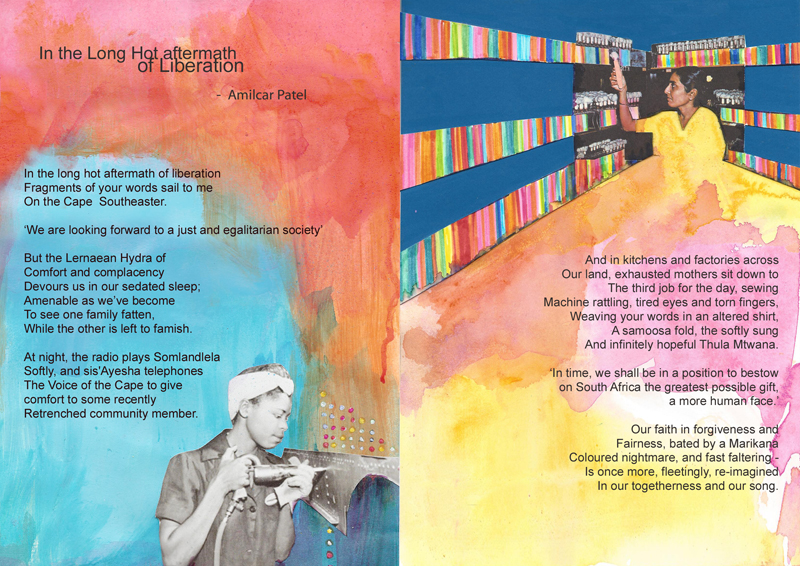
amilcar patel – in the long hot aftermath of liberation

long hot aftermathThis is a page taken from FLEURZINE, a zine curated and illustrated by Julia Mary Grey. You can go and download this beautiful work of art for free on her site, HERE.

The name was inspired by Fleurmach, and six pieces of writing from this blog appear in the publication!

helen moffett on “women’s day” in 2013

FUCK WOMEN’S DAY. FUCK IT.

Don’t ask me to celebrate Women’s Day. Don’t offer me ten percent off beauty products or a free glass of cheap bubbly. Don’t even ask me to commemorate the historic women’s march on the Union buildings – a milestone event whose noble essence has been sold down the river by leaders who are eager to claim some sort of retrospective credit for it, but don’t even pretend to honour its values.

Last year, I was in an epic rage. This year, I’m in despair.”

Read why Helen Moffett is so upset about this travesty of a public holiday HERE.

nightmare

After “Pan’s Labyrinth”,  2009

screening tonight: emma goldman – an exceedingly dangerous woman

Tonight at 20h00, Bolo’bolo in Observatory presents a free screening of a documentary about the life and ideas of Emma Goldman: anarchist, feminist and lifelong rabble rouser.

emma goldmanFor nearly half a century, Russian emigrant Emma Goldman was the most controversial woman in America, taunting the mainstream with her fervent attacks on government, big business, and war. To the tabloids, she was “Red Emma, queen of the anarchists,” but many admired Goldman for her defense of labour rights, women’s emancipation, birth control, and free speech.

Goldman’s life was indelibly marked by two violent acts: the attempted assassination of anti-union industrialist Henry Clay Frick by her comrade and lover Alexander Berkman (he spent 14 years in prison for the crime) and the 1901 slaying of President William McKinley by Leon Czolgosz, a young anarchist who claimed he had been “set on fire” by Goldman’s exhortations to political assassination and martyrdom. McKinley’s assassination led to widespread condemnation of Goldman and other anarchists. Fearing for her life, Goldman went underground.

In 1906, she reemerged as founder and editor of Mother Earth, an anarchist magazine devoted to politics and literature. Once again a public figure, she returned to the lecture circuit. Her talks on the struggling revolution in Russia, on the rights of workers, on civil liberties — even on anarchism — drew large, sympathetic crowds. For almost a decade, Goldman maintained a grueling schedule, spending nearly half of every year on the road. In one six-month period, she delivered 120 lectures in 37 cities.

An outspoken opponent of America’s entry into World War I, she was arrested and imprisoned for demonstrating against the draft. In 1919 she, Berkman, and 247 others were deported to Russia, just two years after the October revolution replaced the Czarist regime with Bolshevik tyranny. After two dispiriting years, Goldman and Berkman left the Soviet Union and dedicated themselves to revealing the truth about a revolution gone wrong.

“The State is the altar of political freedom and, like the religious altar, it is maintained for the purpose of human sacrifice.” – Emma Goldman

PS: Non-alcoholic drinks and vegan snacks will be on sale. You may bring your own beer or wine if you’d like. The screenings are free, but donations are welcome.

essentially

hate and love

If only a change of heart could magically repair the concrete effects of centuries of evil and dispossession overnight… It can’t, but thank you, Nelson Rolihlahla Mandela, for holding on to hope; for leading by example. If we all started living from an unselfish basis of love and respect, things WOULD shift.

oh sister where art thou? – la vie en rose

From The Lost Phone Recordings. This was recorded on a Nokia 95 phone by my sister Erica and me, playing around in my lounge a couple of years ago, inspired by a music box I picked up in Montmartre in 2007…  Our little music project, Oh Sister Where Art Thou?, was about trying to position ourselves playfully in relation to the performance of nostalgic pop classics. While the music may sound simple and cutesy, it was pretty complicated to negotiate. Issues of identity, history, place, privilege, voice, language, racial politics, respect, pastiche, authenticity, memory, erasure, iteration all intertwined… More to be written about this another day when I have time!

erik bünger’s schizophonia

I watched two incredible films tonightSchizophonia and The Third Man, courtesy of Anette Hoffmann and the Archive & Public Culture Platform at UCT, with the kind permission of musician, composer and performance artist, Erik Bünger, who made the films.

In each film, Bünger both analyses and plays with the uncanny, magical potency of sound as recorded medium. Everything he does is underpinned by formidable quantities of research, a fondness for outrageously rhizomatic linkages and a wicked sense of humour. Definitely my new art crush of the month! ;)

Here’s a video of Bünger giving a lecture/performance which utilises much of the material presented in the standalone film, Schizophonia. This was recorded at MEDEA, Malmo University, in March 2011, as part of the K3 courses “Music in the Digital Media Landscape” and “Illustrating with Music”.

I really WISH I could find more of The Third Man to share here –  it was tremendously entertaining, and, even off on its most questionable, occult-paranoid tangents, bizarrely pertinent to so much of the stuff about performance, recording and playback of music that I’ve been posting and thinking about in the past few years; even down to an hilarious discussion of the “entraining” (his word) power of The Sound Of Music (my post this afternoon prefigured this too, eerily!).

Anyway, you can watch the lecture:

And here’s a bio:

The Swedish artist, composer, musician and writer Erik Bünger (1976) works with re-contextualising existing media in performances, installations and web projects. In ‘Gospels’, sections of Hollywood interviews are removed from their original contexts, interacting to form a new, seemingly coherent whole. Yet these pre-existing works frequently conflict; Bünger explores the disjunction between replaying and experiencing in his ‘Lecture on Schizophonia’. This simultaneously analytical and performative work highlights the relationship between sound and perceived reality, using popular references and familiar footage including Barak Obama and Woody Allen. Similar tensions are exposed in ‘God Moves on the Water’, in which two songs about the sinking of the Titanic are combined to form a third narrative. In ‘The Third Man’, the negative power of music is explored. Displacing and recombining familiar material, Bünger challenges the separation between authentic and simulated experiences.

Bünger may have followed a traditional education in composition at the Stockholm Royal College of Music, but he is hardly a run-of-the-mill composer. His works have increasingly come to approach contemporary conceptual art, but his combination of sound and visual is also linked to literary storytelling. In his performances, installations and web projects, different timelines are superposed, past worlds and present understandings. The most important thing about Bünger’s work is not the art or literature context but the transformation that takes place in the specific works. What may seem trivial and inconsequential suddenly becomes the stuff of dreams. He is attracted to moments when recorded sound and image bridge a space between absolutes, between death and life and between gods and humankind. –

This info comes from http://expo.argosarts.org/

hmv

Francis Barraud – “Dog Looking At and Listening to a Phonograph”(1898)

marimba memories

achiclose

In the year 2000 I stopped my beat-up old car to help two guys who were carrying marimbas and gave them a lift up to Melville. On the way we got to chatting, discovered we were all musos, and I decided to come and jam with them while they busked, which I did, a few nights later.

This pair used to come all the way in from Orange Farm township in the Vaal, almost 40km out of Joburg, to busk until midnight outside Melville’s clubs and restaurants, then take a taxi or train home again. So whatever they earned, which was often a pittance, had to cover considerable transport costs – one of apartheid’s architectural legacies, which will take generations to change.

I kept playing with these two guys on the streets, for a couple of years, through winter and summer, on my djembe, cos it was quite something to experience. We were all from Zim, so we had something in common. It wasn’t the first time I had played with so-called black musicians, having played djembe with a maskande outfit called Abafana Bakwa Zulu a couple of years previous to this, but busking was new to me.

Busking is quite a cool way to get really fit on your instrument, and tight as a band. It’s kind of halfway between practicing and performing … sometimes you have an audience, and you have to step it up, and sometimes you don’t, and you can experiment with new songs and licks. If a crowd gathers you can hit on a song for like, 10 or 15 minutes, as long as they are getting into it, which can create some pretty deep calluses if you happen to be a drummer.

In winter, it got so cold that I used to play with a T-shirt, long-sleeve shirt, jersey and leather biker jacket on, plus a hat, even though I was drumming full-tilt. The crap thing about playing a djembe drum outside in the cold is that your hands are moving, creating wind, so even though they are hitting the goatskin hard, on the way up and down they are cooling off, and never really warm up.

Time passed and our little group, which we called Chapungu – meaning ‘whirlwind’ in Shona – apparently it has other, mystical connotations – became fairly good. The dudes found a place to store their instruments, or they would store them at my place, making getting to and from our favourite busking place on the corner of 7th and 4th in Melville much easier. We started getting better tips – we even got a R200 note from a tourist once – and we made a free one-day recording dubbed Sons of the Sun with a guy called Adrian Ziller, bless his heart. My friends helped to design the album cover and print it.

I started visiting the dudes in Orange Farm, which was a full-on jol. Many so-called whites think townships are miserable places, full of suffering and hardship. I’m sure they can be, especially at night in winter, or when the wind howls through Orange Farm, whipping up the dust.

But on my visits, I found a tangible sense of community; neighbours would wander in while we played and get into the vibe. Gangs of kids and dogs would pass by; fences were few and far between. I was uplifted by the music, which was, I guess, our common language, and started playing at events with the dudes, at schools, cultural gatherings, sports meetings, weddings.

There were quite a few kids who used to come and play with the adults; generally the girls would dance and the boys would drum or play on the marimbas, which were all handmade. We started making uniforms for them, with cloth supplied by my friends, or gathered from here and there in the township. The singer’s partner was carving out dance routines for the girls. Things were gathering momentum.

There was a couple in Joburg who were also keen to help our band; they had access to a trust fund, and donated some money which was used to buy tools, which were to be used for making marimbas. We also tried making drums, but it’s not an easy thing to make a good drum.

This couple took us on a trip to visit the Khomani San, who had been granted land by the SA government – but not the means to make a living from it. This couple, they were trying to set things up for some of the Bushmen, a camp which tourists could sleep at, a place to grow indigenous plants, that kind of thing. We met Dawid Kruiper, who was quite famous for his role in getting the land, and a couple of San sangomas. We slept in the camp, which was full of large, black scorpions, and read Tarot cards on the roof of the Landrover, while high on Sceletium, which gives you loads of energy, a natural speed. We dropped our pants and gave brown-eye to the bottle store. It was quite a trip.

Then the couple organised a group of musicians and performers to go on a country-wide tour to advertise a new MTN product. It was called the Multi-Talented Nomad tour, but I didn’t go on it, cos I was working full-time and couldn’t get two weeks’ leave. The guys went on the tour, made a couple of thousand bucks, and decided to go and visit the same Bushmen again, but this return trip didn’t go too well. They apparently shagged some of the Bushmen prostitutes and at least one of them caught AIDS. The singer, a short, fiery character with only one eye – died a few years later. He didn’t make it to the era of ARVs, when having AIDS is no longer a death sentence.

Things had started falling apart even before he died. As soon as we got funding, he and the bassist started arguing about who owned what, and the tools bought with the funding were kept at the singer’s place, and the whole positive vibe started crumbling.

Sometimes they would bitch at me about each other and I just hated being the middle. Fuck that. I really didn’t want to take sides. I was trying to help, not because I thought I should, but because I had just ended up getting involved in the music with these guys and I often had the means to help – the access to transport, to money, to the media. It was unavoidable, but sometimes it had unforeseen consequences.

Eventually, Chapungu broke up, and shortly afterward I was invited to take part in a musical play at the Aardklop festival in Potchefstroom, with the bassist and a group of performers from Orange Farm. We had a teacher who had toured Germany and he knocked our performance into shape, around the idea of a Magic Marimba Tree, from which music came, and provided nourishment to a parched land. I was the white priest, and wore a dog-collar for the role.

When we drove down to Potch I was the only so-called white in the cast of about 14 people. We played on the fringe of the festival and did workshops in the townships. I ate and slept in a room full of blacks, who seldom spoke English … my fault for not knowing Zulu, I guess. The best part was between gigs, as we jammed all day at the backpackers we were staying in, often with outsiders from the festival, who heard us and joined in.

Our mentor came to watch our final performance, hated it, and crapped all over us. We were totally dispirited. Then he wanted to ride back to Joburg in my car, not the overloaded minibus the rest of the crew were to travel in. I split before he could get in, pissed off with his attitude. We had tried our hardest to do a good show. Then we couldn’t get our money out of him. We only got paid after I threatened to put a debt collector on his ass.

The most vivid memory from the whole show, which went on for about a week, was when a beautiful young woman in the cast, who I had been eyeing from the start, stood behind me on the stage and softly put her hands on my shoulders, during the encore. Nothing more happened, but it was an intimate acknowledgment. I see you.

After Aardklop, some of the performers started congregating round the bassist’s place, practicing on the marimbas, and continuing with coaching kids, who would come in after school to play. They were also playing at a nearby school, the kids were winning prizes for their performances, it was all very organic and grassroots. I set up a website for the group. We started playing gigs at cultural events like the Green Africa Party, and then got onto the books of booking agencies, and began playing at corporate events like year-end parties. We made business cards, bought bright uniforms, and started playing quite regularly. This was before the recession, which killed the golden goose of regular corporate gigs, for us and loads of other musicians, including my drum teacher.

I was still doing a day-job, and was asked to write a piece on jazz experimental maestro Zim Ngqawana by the Daily Sun. I met his agent at the Zimology Institute, which he had set up for his jazz students, ironically right next to Orange Farm township. I got to know his agent better, and she helped us to set up an NGO for the musical training of the township kids. After some applications – again, with the help of a friend – we obtained funding, enough to provide the adults with salaries for a couple of years, and to buy some better musical instruments.

This era was our peak. Both the kids and the adults were getting lots of gigs. The kids took part in the FNB Dance Festival a couple of times and won prizes at the National Marimba Competition. They appeared on TV shows and in newspapers; soon we had an entire album of photos and clippings.

The adult group was traveling all over Gauteng and beyond, playing at weddings and parties and openings. A really good (so-called white) guitarist joined the crew, adding an extra car and skilled licks. I evolved a new style of playing the drums, with the djembe where the snare usually stands, and the snare off to the left. I could switch fast between snare and djembe, and play hi-hat and bass foot with both.

We had a huge repertoire of songs, way over 50 songs; some were covers, but many were originals, which had evolved over years of playing. We were playing gospel songs, African jazz, traditional African songs, including some Chimurenga stuff (Zim protest music) and some more bluesy and reggae stuff.

We got a trailer to put the marimbas in; slept over in posh places and demanded, and got, proper meals and treatment from clients, via the contracts with our agencies. Achimota also brought out a CD, recorded free of charge by Brendan Jury, called Ukuxolelana (Forgiveness).

But, after a time, cracks began to show. A key member of the group left to pursue his own musical career. His replacement had less energy and the group, already low on vibrancy, started losing impetus. The recession provided less jobs … the funding for the NGO dried up. The problem of getting to practices, when the guys were 40km out of town, was a thorn in our flesh from the start, but it didn’t matter when we were all into the whole thing – we basically practiced when we played at gigs. Now it was just this massive divide. We weren’t learning new songs, and things were getting stale.

I started standing back, trying to get the other members of the band involved in setting up gigs, obtaining funding, running things themselves. But no-one seemed willing, or able, to keep the ball rolling. I became tired of putting in time and effort, to make things happen: organising gigs, drawing money, sorting paperwork, dealing with clients, auditors and agents.

There were two final straws which made me pull out after twelve years of playing with my marimba mates. On both occasions, we were booked to play for corporate clients, and the guys didn’t pitch on time. I was left carrying the can, got crapped out by the agent and client both times, and, on the last gig, we lost our one remaining agent in the process. That was it.

I had so many experiences with these guys. We travelled thousands of kilometres together, listening to reggae and world music, dreaming of the day when Mugabe would finally die and we could visit Zim to dance on his grave. We often slept in the same room en route to gigs, and I even shared the same bed with them a couple of times.

We played to ecstatic, wildly dancing audiences, and totally bored executives, who would have likely preferred wallflowers to our presence… the catering staff at events was usually our best audience! We fixed broken trailers, cars, instruments, egos and homes together. We busked in Newtown for the whole of the Fifa World Cup. I even did sweat lodges and took psychedelics with some of the dudes.

But there was always that line, that divide, between black and white, between middle-class and poor, between living in town and living in township. It was crossed at times, but it always returned. I count myself lucky that I caught a glimpse of a totally different type of lifestyle and culture to that of white urban Johannesburg.

The door to Orange Farm is still slightly open. I still see the bassist now and then; he is teaching marimbas at a school in Joburg, and is now playing with his uncle, from Zim, who taught him how to play. That sounds innarestin. Me and the guitarist are going to go check it out one of these days. Because there is something utterly organic and magical about playing marimba music. No getting round that.

There were times when I grew frustrated, because things didn’t pan out the way I hoped they would, but overall I don’t regret the experience. Things are born and then they die. I read, in an article on South African NGOs, that you never know what effect you are going to have when you set up structures in poor communities. You have an idea of things going one way; they end up going in another. There might be one or two kids who become brilliant performers after having played with Achimota or Chapungu, or perhaps it changed their lives in some other way, a way which I couldn’t possibly have predicted. That would be enough. For me,  my life and music were sure as hell enriched.

Having reread what I just wrote, I realise how much my friends and partners helped me, every step along the way with this crazy adventure, and if they ever read this, thanks a ton guys. We couldn’t have done it without you. At base, at heart, people want to help each other; often, they just don’t know how, but there channels, if you look, or if they find you. This whole dog-eat-dog system that’s been forced down our throats, it’s a load of balls. A lot of us are learning to see past that now. I hope it keeps spreading.