genna gardini – performance scale (2017)

CN: Chronic illness; Multiple Sclerosis; graphic depictions of bodies and illness.

‘Performance Scale’ is a poem about Genna Gardini’s personal experience of being diagnosed with Multiple Sclerosis (MS). It was adapted into a film by three people close to Gardini and personally affected by MS. The film was created as part of Gardini’s 2016 ICA National Fellowship project MS Independent: Diagnosis.

Written by Genna Gardini
Directed by Gary Hartley
Performed by Amy Louise Wilson
Filmed and edited by Francois Knoetze
A Horses’ Heads Production, created with the assistance of the Institute for Creative Arts.

‘Performance Scale’ was nominated by PEN SA for the 2015 New Voices Award. Read an interview with Genna about the poem here.

Performance Scale
The startling fact was this: my body was offering a precise physiological equivalent to what had been going on in my mind.
Joan Didion, The White Album.

1:

I spent so many years attacking my body,
finding fault in faint abundance, obsessing over every lack
that it didn’t surprise me when I woke up one morning
to discover that it was finally fighting me back.

2:

This was the year you kept killing all the machines you owned
and that is what we refer to as a “running motif”
(and that is what we refer to as “dramatic irony”).

3:

You’ll come to,
conked out on some strange cistern in a Southern Suburbs mall,
your legs hinging against the plastic billboard of the bathroom door,
angled in the jamb like damp cardboard
folded and forced into a full stop.

4:

This is paper as metaphor and limbs as punctuation.
This is the reverse of writing.

5:

You’ll find your phone lying, lesioned, next to you,
a fissure fresh down its crustacean container
like a phantom crack. Like a mime at a wall,
bucking but flat.

6:

You’re tipped against a nurse
whose prophylactic palm pats nerved and certain on your neck.
You have heard her tell the others that they are good girls.
You are not a good girl
because when she sets you straight on the mat, then the scale,
she only says, “Try not to hurl”, then
“You must make a note of your weight”.

7:

The zinging technology of your mouth
steams against the frosted door of the consultation room.

8:

She is warm and alive as an urn at the Church fete
and you are the Styrofoam cup
leaning at her tap.

9:

“Look at it this way, at least you’ll be skinny!”
is quite a funny thing to say to someone
when you think they could be dying.

10:

You began to let your bob grow unbidden,
split and wrought
because if a part of your physicality still chooses to thrive
who are you cut it short?

10:

You make these kinds of jokes.

11:

You are convinced that the nails and hair of a corpse
inch out past conclusion, intrepid as weeds, eternal as worms,
eyeless and edging in all directions, past even the last right
to scratch into life. This is poetry, I thought,
before I was told that I was wrong.

12:

You retract back into yourself, creating the illusion of growth,
moving like a skirt hitched above the knee, balking as if in shock
pressed against the back of the closest ablution block.

13:

At 27, I became blind in one eye
but didn’t realise, because I only notice my mouth.
I thought perhaps a crack had formed between my head
and the cheese-cloth membrane of my disbelief.

14:

Speaking is uncertain and pinpricked.
It is shrouded. It is grief.

15:

Every bad thing that’d happened to me before
was because a man had decided to teach me a lesson
and this is why, after I found out,
I had to reconsider atheism.

14:

You are turning a manuscript into a
fan with the bridging press of pleats.
You are not Keats.

15:

The good doctor made eye-contact with me for the whole beat
which I know is supposed to convey the meaningfulness of the moment
because of my expensive acting degree.

16:

Raisins injected with water.

17:

Thinned the way paint under the slow drip of turpentine is.

18:

I pick this bed because of its proximity to the TV. I am surrounded by women who are in various states of collapse. One spends each day lamenting the canteen’s slopped and unbroiled chicken ala king, sending voicenotes to her daughters to remember to let the cat in. The others cannot walk. I do not want to know them. I do not want to admit that I am one of them. At first, I shuffle, hesitantly, like it’s a character choice, until I realise I am not performing and the gimmick has stuck, gammy. My legs lurch and twitch beyond me.

19:

I look up and there is nothing.

I look down at my own arm, which the nurse has stuck so repeatedly, finding me false and veinless, that the blood clotted before it gathered, like I was a boring meeting they wanted to leave and this might be the exit.

I look up and she is staring straight at me.

Her face is wide and aimed. I pull out my earphones but she is whispering. I say her name. She is mouthing something and I do not know the words but I know that what she is saying is help me and I cannot even help myself

which is why I am plugged into a wall like a faulty Blackberry on charge
which is why I am connected to wet metal that looks like a clothes horse,
which is why I am making so many Joan Crawford wire hanger jokes.
This means help me.

I thumb the call button. The station, which perpindiculates next to us is unlike, myself, without staff. I use the IV as a cane and I call out but the movement of my voice is as interrupted as my legs, cramped, boned by pain. There is a sound here, it rings out, clean and to the side as a scalpel. Panic is a disinfected metal knife, it slices me from myself, each thought going into the brain instead of the mouth, bounced like an email sent to the incorrect address. The prospect of the seizure is thick and electric in her bones, I can see it. The day before, her family had come to visit. Two of them explained how this latest bout was caused of the evil thoughts she allowed to enter her head. She must lose them. My own – which buzzed, a constant cortex, old and reliable as a Cortina that has been veering for years, cutting breaks and ties with whoever passed me by – stay stuck. I wish I had a demon but I don’t, I have my legs and I run past corn rows of beds to find some assistance

20:

towards the end.

the hauntology of liz mitchell (a long way from home)

This video is one of the things I treasure most on Youtube – it gives me chills every time. It’s a recording of Liz Mitchell of Boney M performing “Motherless Child” live with the Les Humphries singers in the early 1970s. It’s incredible how Mitchell seems to be singing about her removal from herself via recording, its simulacral persistence beyond her existence in that moment… And the wavering picture also speaks of analog decay, arrested and mummified by its digitisation from analog video and (again lossy) upload to Youtube. And then, of course, the song’s origins in slavery and dispossession. So many degrees of loss, so many layers of noise.

naomi shihab nye – kindness (1995)

Before you know what kindness really is
you must lose things,
feel the future dissolve in a moment
like salt in a weakened broth. What you held in your hand,
what you counted and carefully saved,
all this must go so you know how desolate the landscape can be between the regions of kindness. How you ride and ride
thinking the bus will never stop,
the passengers eating maize and chicken
will stare out the window forever.

Before you learn the tender gravity of kindness
you must travel where the Indian in a white poncho
lies dead by the side of the road. You must see how this could be you,
how he too was someone
who journeyed through the night with plans
and the simple breath that kept him alive.

Before you know kindness as the deepest thing inside,
you must know sorrow as the other deepest thing.
You must wake up with sorrow.
You must speak to it till your voice
catches the thread of all sorrows
and you see the size of the cloth.
Then it is only kindness that makes sense anymore,
only kindness that ties your shoes
and sends you out into the day to gaze at bread,
only kindness that raises its head
from the crowd of the world to say
It is I you have been looking for,
and then goes with you everywhere
like a shadow or a friend.

__

Naomi Shihab Nye was born in St. Louis, Missouri in 1952. Her father was a Palestinian refugee and her mother an American of German and Swiss descent, and Nye spent her adolescence in both Jerusalem and San Antonio, Texas. Read more here.

george michael – praying for time (1990)

These are the days of the open hand
They will not be the last
Look around now
These are the days of the beggars and the choosers

This is the year of the hungry man
Whose place is in the past
Hand in hand with ignorance
And legitimate excuses

The rich declare themselves poor
And most of us are not sure
If we have too much
But we’ll take our chances
Because god’s stopped keeping score
I guess somewhere along the way
He must have let us alt out to play
Turned his back and all God’s children
Crept out the back door

And it’s hard to love, there’s so much to hate
Hanging on to hope
When there is no hope to speak of
And the wounded skies above say it’s much too late
Well maybe we should all be praying for time

These are the days of the empty hand
Oh you hold on to what you can
And charity is a coat you wear twice a year

This is the year of the guilty man
Your television takes a stand
And you find that what was over there is over here

So you scream from behind your door
Say “what’s mine is mine and not yours”
I may have too much but i’ll take my chances
Because God’s stopped keeping score
And you cling to the things they sold you
Did you cover your eyes when they told you

That he can’t come back
Because he has no children to come back for

It’s hard to love there’s so much to hate
Hanging on to hope when there is no hope to speak of
And the wounded skies above say it’s much too late
So maybe we should all be praying for time

tibetan book of the dead (1994)

https://youtu.be/nOs8s5zTGnA

Narrated by Leonard Cohen, this two-part documentary series explores ancient teachings on death and dying and boldly visualizes the afterlife according to Tibetan philosophy. Tibetan Buddhists believe that after a person dies, they enter a state of “bardo” for 49 days until a rebirth.

Program 1, The Tibetan Book of the Dead: A Way of Life documents the history of The Tibetan Book of the Dead, tracing the book’s acceptance and use in Europe and North America. Included is remarkable footage of the rites and liturgies surrounding and following the death of a Ladakhi elder as well as the views of the Dalai Lama on life and death. 

Program 2, The Tibetan Book of the Dead: The Great Liberation observes an old Buddhist lama and a 13-year-old novice monk as they guide a deceased person into the afterlife. The passage of the soul is visualized with animation blended into actual location shooting. 

This information comes from the website of the National Film Board of Canada. NFB produced the documentary in co-operation with NHK Japan and Mistral Film of France.

michelle mcgrane – cento for leonard cohen (2006)

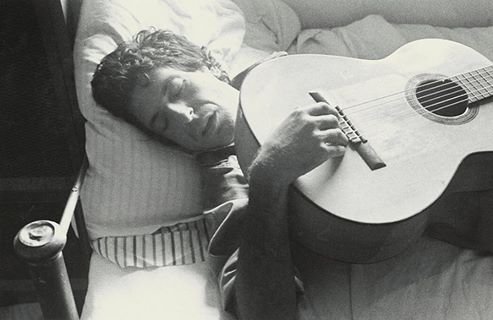
leonard-cohen-montreal-1973-photo-ralph-gibson

Leonard Cohen, Montreal, 1973. Photo: Ralph Gibson

once there was a path and a girl with chestnut hair – – – we met when we were almost young – – deep in the green lilac park – – you held on to me like i was a crucifix – – as we went kneeling through the dark – – – i loved you in the morning – our kisses deep and warm – – your hair upon the pillow like a sleepy golden storm – – yes – many loved before us – i know that we are not new – – in city and in forest they smiled like me and you – – – let me see you moving like they do in babylon – – show me slowly what i only know the limits of – – dance me very tenderly and dance me very long – – dance me to the wedding now – dance me on and on – – – there’s a concert hall in vienna – – where your mouth had a thousand reviews – – i remember you well in the chelsea hotel – – you were famous – your heart was a legend – – i thought you were the crown prince – – of all the wheels in ivory town – and everywhere that you wandered – – love seemed to go along with you – – – lost among the subway crowds – – i tried to catch your eye – – i saw you there with the rose in your teeth – – i’d been waiting – i was sure – – – but you’d been to the station to meet every train – – – i knew i was in danger of losing what i used to think was mine – – just dance me to the dark side of the gym – – chances are i’ll let you do most anything – – so we’re dancing close – the band is playing stardust – – balloons and paper streamers floating down on us – – – i know you’re hungry – i can hear it in your voice – – and there are many parts of me to touch – you have your choice – – – the women in your scrapbook – – – (i was in that army – yes i stayed a little while – – though i wore a uniform i was not born to fight) – – – now your love is a secret all over the block – – – i’m just a station on your way – – – where are you golden boy – – where is your famous golden touch? – – the sun pours down like honey – – and yes it’s come to this – it’s come to this – – hey prince you need a shave – – – i forget to pray for the angels – – and then the angels forget to pray for us – – – your letters they all say that you’re beside me now – – then why do i feel alone? – – i’m standing on a ledge and your fine spider web – – is fastening my ankle to a stone – – – everybody knows that you love me baby – – everybody knows that you really do – – everybody knows that you’ve been faithful – – ah – give or take a night or two – – everybody knows you’ve been discreet – – but there were so many people you just had to meet – – without your clothes – and everybody knows – – – and i can’t wait to tell you to your face – – and i can’t wait for you to take my place – – – i cannot follow you – my love – – you cannot follow me – – i am the distance you put between – – all of the moments that we will be – – – i choose the rooms that i live in with care – – the windows are small and the walls almost bare – – there’s only one bed and there’s only one prayer – – i listen all night for your step on the stair – – – i don’t like your fashion business mister – – and i don’t like those drugs that keep you thin – – – some women wait for jesus – and some women wait for cain – – i was waiting for a miracle – i waited half my life away – – – lately you’ve started to stutter – as though you had nothing to say – – – you don’t love me quite so fiercely now – – you’re weak and you’re harmless – – you’re sleeping in your harness – – – you thought that it could never happen – – to all the people you became – – the rain falls down on last year’s man – – that’s a crayon in his hand – – – like any dealer he was watching for the card – – that is so high and wild – – he’ll never need to deal another – – – (o you’ve seen that man before) – – his golden arm dispatching cards – – (but now it’s rusted from the elbow to the finger – – and he wants to trade the game he plays for shelter) – – – everybody knows that the dice are loaded – – everybody rolls with their fingers crossed – – everybody knows that the war is over – – everybody knows the good guys lost – – everybody knows the fight was fixed – – the poor stay poor – the rich get rich – – that’s how it goes – everybody knows – – – well – i found a silver needle – i put it into my arm – – it did some good – did some harm – – but the nights were cold – and it almost kept me warm – – – in a dream of hungarian lanterns – – in the mist of some sweet afternoon – – some girls wander by mistake – – into the mess that scalpels make – – – morning came and then came noon – – dinner time a scalpel blade – – lay beside my silver spoon – – those who earnestly are lost – – are lost and lost again – – – i journey down the hundred steps – – the street is still the very same – – was i – was i only limping – was i really lame? – – – i can’t run no more with this lawless crowd – – – you say you’ve been humbled in love – – cut down in your love – – – you say you’ve gone away from me – – (i see you’ve gone and changed your name again) – – but i can feel you when you breathe – – – you stumble into this movie-house – then climb in to the frame – – – your pain is no credential here – – of course you’ll say you can’t complain – – you who wish to conquer pain – – love calls you by your name – – – why do you stand by the window – – abandoned to beauty and pride – – the thorn of the night in your chest – – the spear of the age in your side – – lost in the rages of fragrance – – lost in the rags of remorse – – lost in the waves of a sickness – – that loosens the high silver nerves – – – yes you who must leave everything that you cannot control – – it begins with your family – but soon it comes around to your soul – – – well i’ve been where you’re hanging – i think i can see how you’re pinned – – when you’re not feeling holy – your loneliness says that you’ve sinned – – – it’s four in the morning – the end of december – – it’s dark now and it’s snowing – – the cadillacs go creeping now through the night and the poison gas – – the cities they are broke in half and the middle men are gone – – – all the rocket-ships are climbing through the sky – – the holy books are open wide – – – the blizzard – the blizzard of the world – – has crossed the threshold – – – do you remember all of those pledges – – that we pledged in the passionate night – – ah they’re soiled now – they’re torn at the edges – – like moths on a still yellow light – – no penance serves to renew them – – no massive transfusions of trust – – why not even revenge can undo them – – so twisted these vows and so crushed – – – i’m cold as a new razor blade – – your shirt is all undone – – – will you kneel beside this bed – – that we polished so long ago – – your eyes are wild and your knuckles are red – – and you’re speaking far too low – – – you don’t know me from the wind – – you never will – you never did – – – the crumbs of love that you offer me – – they’re the crumbs i’ve left behind – – – and is this what you wanted – – to live in a house that is haunted – – by the ghost of you and me? – – – i’ve lain by this window long enough – – to get used to an empty room – – and your love is some dust in an old man’s cough – – who is tapping his foot to a tune – – – and why are you so quiet now – – standing there in the doorway? – – you chose your journey long before – – you came upon this highway – – remember when the scenery started fading – – i held you till you learned to walk on air – – so don’t look down the ground is gone – – there’s no one waiting anyway – – the smokey life is practised – -everywhere – – – looks like freedom but it feels like death – – – i balance on a wishing well that all men call the world – – we are so small between the stars – so large against the sky – – – and where do all these highways go – now that we are free? – – the age of lust is giving birth – and both the parents ask – – the nurse to tell them fairytales on both sides of the glass – – – there is a war between the rich and poor – – a war between the man and the woman – – there is a war between the ones who say there is a war – – and the ones who say there isn’t – – – there is a war between the left and right – – a war between the black and white – – a war between the odd and even – – – i can’t pretend i still feel very much like singing – – as they carry the bodies away – – – there’s blood on every bracelet – – you can see it – you can taste it – – – (every heart – every heart – – to love will come but like a refugee) – – – too early for the rainbow – too early for the dove – – these are the final days – this is the darkness – this is the flood – – and there is no man or woman who can’t be touched – – but you who come between them will be judged – – – so the great affair is over but whoever would have guessed – – it would leave us all so vacant and so deeply unimpressed – – – it’s like our visit to the moon or to that other star – – i guess you go for nothing if you really want to go that far – – – it’s over – it ain’t going any further – – i’m sick of pretending – i’m broken from bending – – i’ve lived too long on my knees – – – the river is swollen up with rusty cans – – and the trees are burning in your promised land – – – along with several thousand dreams – – – there’s nothing left to do – – when you know that you’ve been taken – – – it’s closing time.


(cento: a composition made up of quotations from other authors; latin: patchwork garment)

lyrics taken from:
songs of leonard cohen: suzanne; master song; winter lady; stranger song; sisters of mercy; so long marianne; hey, that’s no way to say goodbye; stories of the street; teachers
i’m your man: first we take manhattan; ain’t no cure for love; everybody knows; take this waltz
songs of love and hate: avalanche; last year’s man; dress rehearsal rag; diamonds in the mine; love calls you by your name; famous blue raincoat
the future: the future; waiting for the miracle; closing time; anthem; light as the breeze; death of a ladies’ man: iodine; paper thin hotel; memories; death of a ladies’ man
songs from a room: the old revolution; the butcher; you know who i am; tonight will be fine
new skin for the old ceremony: is this what you wanted; chelsea hotel #2; there is a war
various positions: dance me to the end of love
recent songs: the guests; humbled in love; the window; the gypsy’s wife; the smokey life

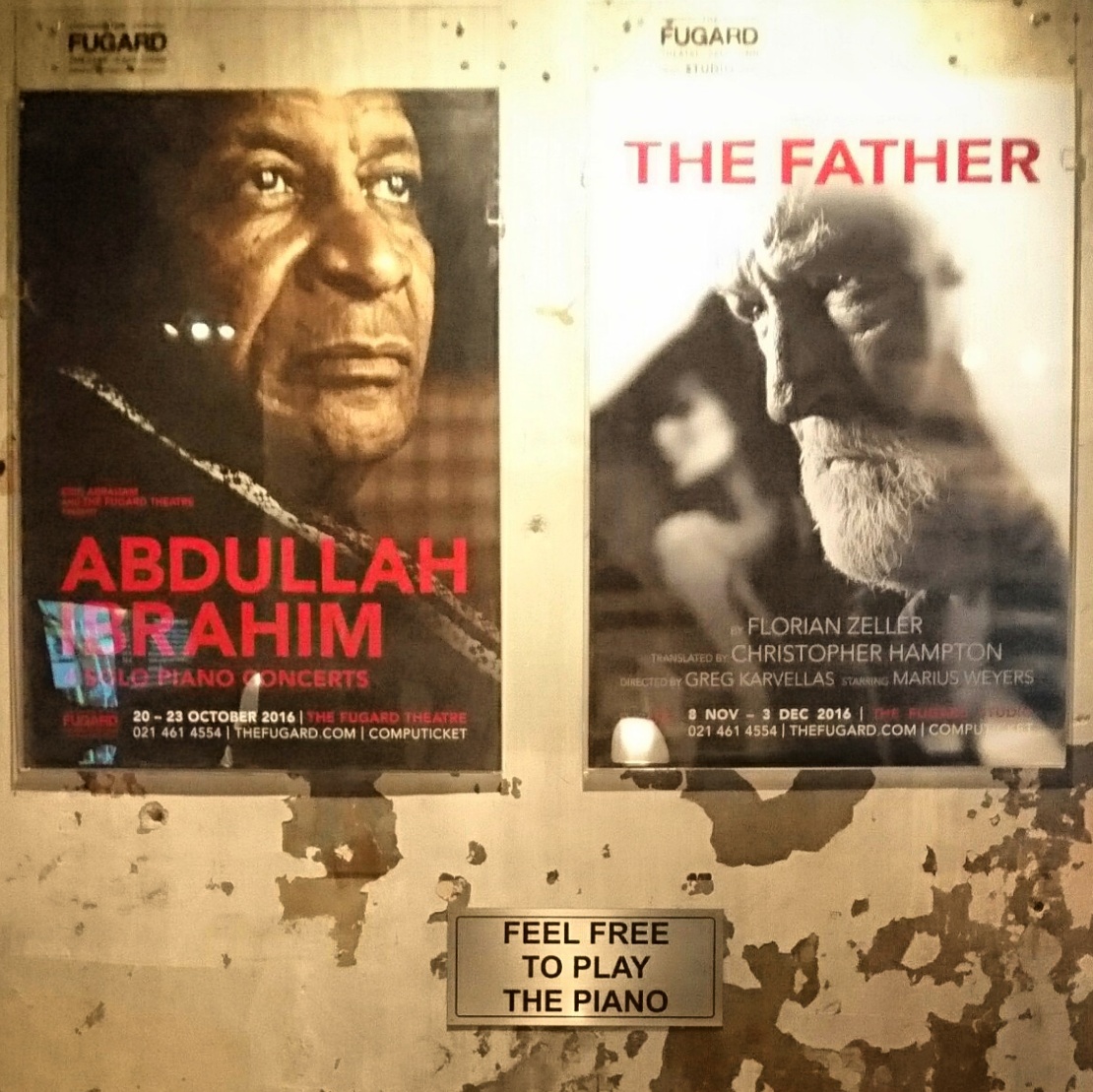
feel free to play the piano (21 october 2016) 

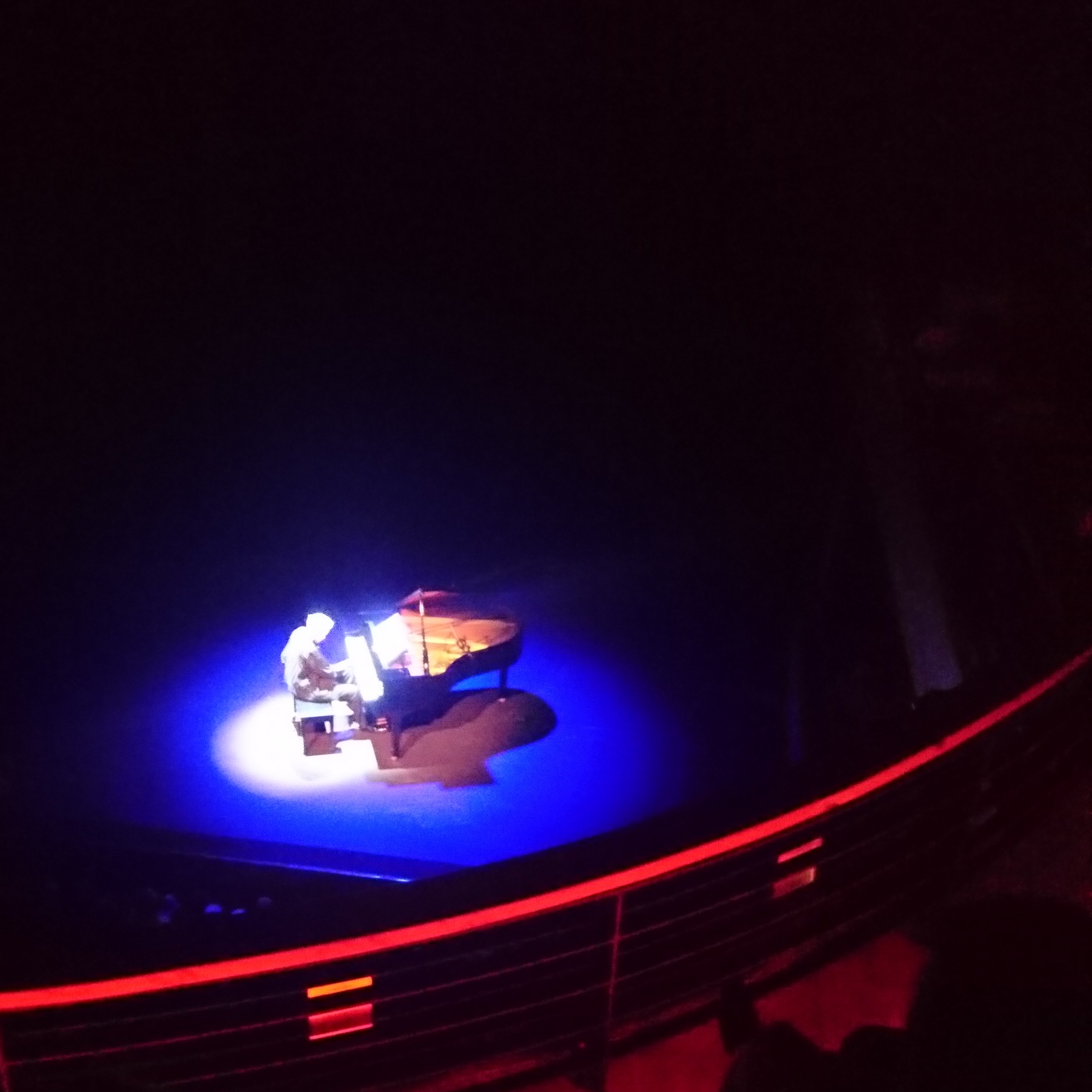
My kind friend Anwar gave me a ticket to Abdullah Ibrahim’s solo concert last night at the Fugard Theatre. It was the quietly incandescent performance of an old man who has been so far and seen so much, whose heart remains rooted in this troubled land even as it hurts to be here, even as his fingers know he doesn’t have forever. His playing held such sorrow, yet such peace, and playfulness, too. Refusing easy resolution, defiantly free as ever.  We imagined afterwards how incredible it would have been if the whole performance could have been broadcast live on loudspeakers, into every roiling corner of this country, for everyone to hear it simultaneously. A lament. A hymn. A balm. A lesson. Beyond the span of words’ expression.

louis moholo’s 4blokes, live at straight no chaser, cape town (15 january 2016)

It’s weird how the recording industry warps experience. We can sometimes forget that every recording is only one iteration that was captured and set in stone as “The” Definitive Performance, when really it just happened to be captured that particular time among many, many other possible times. Records, like photos, pluck moments out of time and concretise them… And they are the only thing we’re left with later to glimpse a whole era. That’s why densely detailed archives such as Ian Bruce Huntley‘s, where there were many recordings of the same bands made during the same era, are so interesting. I’ve posted here, and in the preceding post, recordings of the same band on two consecutive nights.

One of the lovely things about everyone having a camera in their pocket on their phone is that this is not something that is rare anymore, and the democratisation of shared experience is a very powerful and positive thing. One of the horrible things is that there is just such a volume of recorded stuff (much of questionable quality) being generated that the brightest nuggets of wonder can be drowned in the dross… Too much recording and we have a shaky, pixelated backup of every moment kept on hard drives, that no one ever has time to live through twice, to the extent that everything melts into undifferentiated, indigestible “big data” and can only be apprehended as statistics. I feel very ambivalent about it.

I think it’s really important that, whenever possible, we still have experienced photographers, videographers and sound recorders assigned to do this stuff, so that in years to come what we are left with are some beautiful and considered recordings, and not just a haunted avalanche of muddy glimpses.

khaçadur avedisyan – oratoryo

From the soundtrack of the film Gelecek Uzun Sürer (Future Lasts Forever) (Turkey, 2011).

Synopsis from IMDB: Sumru is doing music research at a university in Istanbul. To work on her thesis on gathering and recording an exhaustive collection of Anatolian elegies she sets off for the south-east of the country for a few months. The brief trip turns out to be the longest journey of her life. During the trip, Sumru crosses paths with Ahmet, a young guy who sells bootleg DVDs on the streets of Diyarbakir, with Antranik, the ageing and solitary warden of a crumbling church in the city and with various characters who witness the ongoing ‘unnamed war’. During her three-month stay in Diyarbakir, while looking for the stories of the elegies, she finds herself confronting an agony from her own past.

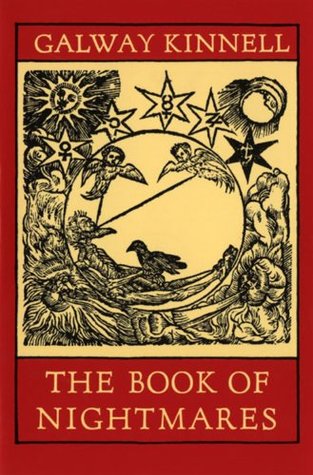
galway kinnell – little sleep-head’s sprouting hair in the moonlight (1971)

galway-kinnell-book-of-nightmares1
You scream, waking from a nightmare.
When I sleepwalk
into your room, and pick you up,
and hold you up in the moonlight, you cling to me
hard,
as if clinging could save us. I think
you think
I will never die, I think I exude
to you the permanence of smoke or stars,
even as
my broken arms heal themselves around you.

2
I have heard you tell
the sun, don’t go down, I have stood by
as you told the flower, don’t grow old,
don’t die. Little Maud,
I would blow the flame out of your silver cup,
I would suck the rot from your fingernail,
I would brush your sprouting hair of the dying light,
I would scrape the rust off your ivory bones,
I would help death escape through the little ribs of your body,
I would alchemize the ashes of your cradle back into wood,
I would let nothing of you go, ever,
until washerwomen
feel the clothes fall asleep in their hands,
and hens scratch their spell across hatchet blades,
and rats walk away from the cultures of the plague,
and iron twists weapons toward the true north,
and grease refuses to slide in the machinery of progress,
and men feel as free on earth as fleas on the bodies of men,
and lovers no longer whisper to the presence beside them in the
dark, O corpse-to-be …
And yet perhaps this is the reason you cry,
this the nightmare you wake screaming from:
being forever
in the pre-trembling of a house that falls.

3
In a restaurant once, everyone
quietly eating, you clambered up
on my lap: to all
the mouthfuls rising toward
all the mouths, at the top of your voice
you cried
your one word, caca! caca! caca!
and each spoonful
stopped, a moment, in midair, in its withering
steam.
Yes,
you cling because
I, like you, only sooner
than you, will go down
the path of vanished alphabets,
the roadlessness
to the other side of the darkness,
your arms
like the shoes left behind,
like the adjectives in the halting speech
of old men,
which once could call up the lost nouns.

4
And you yourself,
some impossible Tuesday
in the year Two Thousand and Nine, will walk out
among the black stones
of the field, in the rain,
and the stones saying
over their one word, ci-gît, ci-gît, ci-gît,
and the raindrops
hitting you on the fontanel
over and over, and you standing there
unable to let them in.

5
If one day it happens
you find yourself with someone you love
in a café at one end
of the Pont Mirabeau, at the zinc bar
where white wine stands in upward opening glasses,
and if you commit then, as we did, the error
of thinking,
one day all this will only be memory,
learn,
as you stand
at this end of the bridge which arcs,
from love, you think, into enduring love,
learn to reach deeper
into the sorrows
to come – to touch
the almost imaginary bones
under the face, to hear under the laughter
the wind crying across the black stones. Kiss
the mouth
which tells you, here,
here is the world. This mouth. This laughter. These temple bones.
The still undanced cadence of vanishing.

6
In the light the moon
sends back, I can see in your eyes
the hand that waved once
in my father’s eyes, a tiny kite
wobbling far up in the twilight of his last look:
and the angel
of all mortal things lets go the string.

7
Back you go, into your crib.
The last blackbird lights up his gold wings: farewell.
Your eyes close inside your head,
in sleep. Already
in your dreams the hours begin to sing.
Little sleep’s-head sprouting hair in the moonlight,
when I come back
we will go out together,
we will walk out together among
the ten thousand things,
each scratched too late with such knowledge, the wages
of dying is love.

__
from The Book of Nightmares by Galway Kinnell (Mariner Books, 1971). Thank you Kelly Rosenthal for sharing this on Facebook this morning.

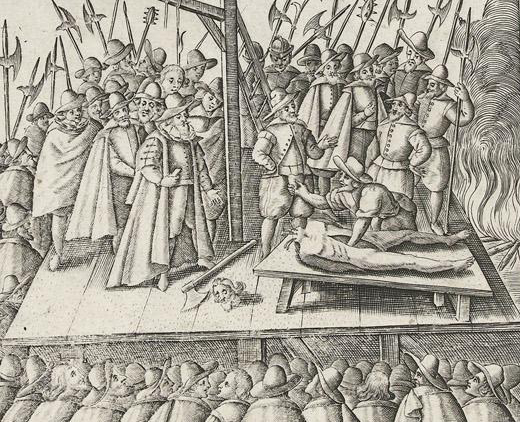
tichborne’s elegie (1586)

Tychbornes Elegie, written with his owne hand in the Tower before his execution*

hollaendischer-druck_gunpowder-plot_1605_blogMy prime of youth is but a frost of cares,
My feast of joy is but a dish of paine,
My Crop of corne is but a field of tares,
And al my good is but vaine hope of gaine.
The day is past, and yet I saw no sunne,
And now I live, and now my life is done.

My tale was heard, and yet it was not told,
My fruite is falne, & yet my leaves are greene:
My youth is spent, and yet I am not old,
I saw the world, and yet I was not seene.
My thred is cut, and yet it is not spunne,
And now I live, and now my life is done.

I sought my death, and found it in my wombe,
I lookt for life, and saw it was a shade:
I trod the earth, and knew it was my Tombe,
And now I die, and now I was but made.
My glasse is full, and now my glasse is runne,
And now I live, and now my life is done.

__
*Chidiock Tichborne was one of fourteen convicted in 1586 in the plot to kill Queen Elizabeth 1 of England.

chet baker – for all we know (1987)

“Recorded just before he passed and released posthumously, this is some of Chet’s best work. Arguably it’s his best work. As his life deteriorated from drugs through the years, his work had suffered and he had faded from the music world. It all came together in this concert in Tokyo. Absolutely fantastic musicians backing him up, and Chet had somehow come back into top form for this show. In fact he was better than he used to be… the years, the pain, the experiences, the feeling all came through in a more mature fashion in his voice and trumpet.”

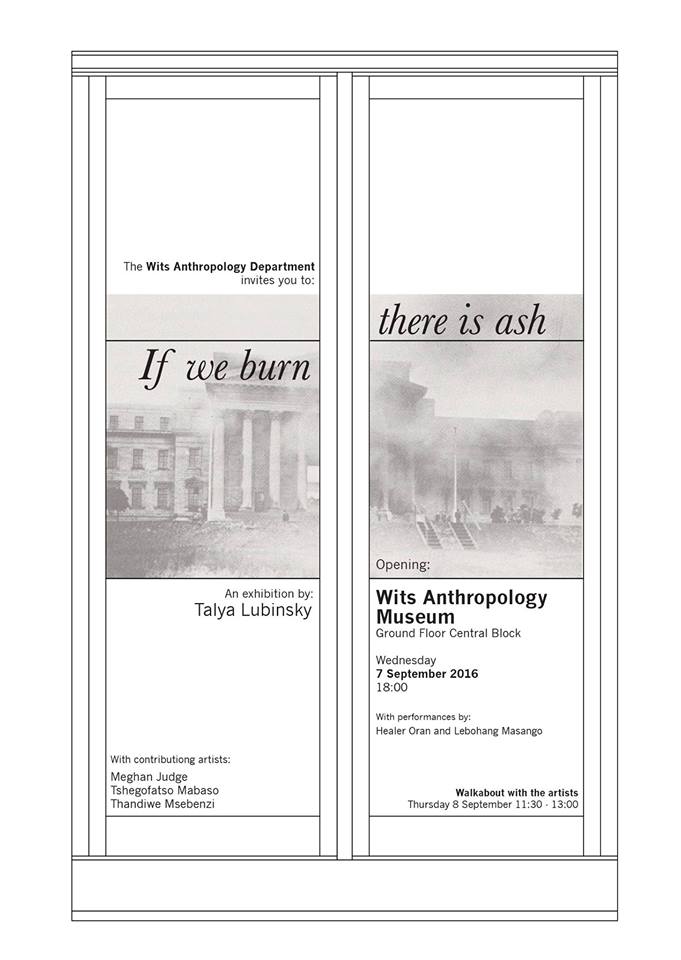
if we burn there is ash (7 september 2016)

if we burn there is ash

The Wits Anthropology Department is pleased to reopen its Museum collection with

If we burn there is ash

An exhibition by Talya Lubinsky
with contributing artists Meghan Judge, Tshegofatso Mabaso and Thandiwe Msebenzi
and performances by Lebohang Masango and Healer Oran

Wits Anthropology Museum
Wednesday 7 September 2016
18:00

Walkabout with the artists Thursday 8 September 11:30-13:00

All welcome

__
On Christmas Eve of 1931 a fire broke out at Wits University’s Great Hall. At the time, the façade of the Great Hall had been built, its stone pillars and steps creating a striking image of the university in the young colonial city. But the University had run out of funds, and the building that would become Central Block, had not yet been built. Erected behind the grand façade of the Great Hall were wooden shack-like structures, which burned in the fire. These wooden structures housed the collections of what is now called the Cullen Library, as well as the Ethnographic Museum’s collection. Initiated by Winifred Hoernle, head of the Ethnography Museum at the time, the collection was largely comprised of pieces of material culture sent to her from the British missionary, William Burton, while stationed in the ‘Congo’ region.

The fire burned hundreds of books, paintings and artefacts. Some of the only objects that survived the fire are clay burial bowls from the Burton collection. Able to withstand the heat precisely because of their prior exposure to fire, these bowls remain, but are blackened and broken by the 1931 fire.

The exhibition, If we burn, there is ash centres around this story as a place from which to think about the value of colonial collections of material culture. While the origins of the 1931 fire remain unknown, it nonetheless provides a space in which to think about the potentially generative qualities of fire.

Ash, the material remains of fire, however elusive, does not disappear. Even when things burn, they are never fully physically or ephemerally eliminated. Ash is not just the physical remains of that which has been burnt. It is also used as an ingredient in cement mixtures. It is literally transformed into a building material.

Using ash and cement as a poetic relation, this exhibition asks about the potentiality of burning in the project of building and growth. Ash and cement serve as a provocation on the question of what is to be done with the material remains of a violent colonial past.

__
For further information, please contact Talya Lubinsky (talya.lubinsky@gmail.com) or Kelly Gillespie (Kelly.Gillespie@wits.ac.za)

кумушки

“Among all the remarkable Usvyaty singers it is necessary, first and foremost, to single out the name of Olga Fedoseevna Sergeeva [I can’t find any English website for her]. We communicated with Olga Sergeeva for ten years and recorded over 300 songs in the most various genres performed by her. I brought the singer to Leningrad three times and she performed in ethnographic concerts in the House of Composers, on Leningrad radio and made some records with “Melodia” company.

“Sergeeva is an outstanding folk singer. Ritual songs and old lyric prevail in her richest repertoire which indicates the high artistic taste of Olga Sergeeva, as most of her contemporaries prefer singing new lyrical songs of the romance type. In the lyrical songs especially loved by the singer, her voice sounds plummy, deep–however, reserved at the same time and even subdued a bit, and from the very first sounds it spellbinds the listener with its beauty and cordiality.

“There is nothing outward, emotionally open in her performance, this is singing for herself with no relation to the listener. At the same time plainness, naturalness, strictness, is combined here with improvised freedom and excellence of micro variation. “Each song has one hundred changes”, the singer remarked once. It is not by chance that Andrei Tarkovsky chose the recording of Olga Sergeevas’s 1971/2 recording of the old song ‘Kumushki’ for his film Nostalghia.” (From HERE.)

The second version that follows here is also very beautiful, but a more contemporary interpretation, by singer Pelageya off her album Girls’ Songs in 2007.

Here is a translation of the words that I found:

Oh, my girlfriends, be sweet;
be sweet and love one another,
be sweet and love one another,
Love me too.

You will go to the green garden,
take me with you.
You will pick flowers,
Pick some for me too.

You will weave garlands,
take me with you.

You will go to the Donau,
take me with you.
You will offer your wreaths to the river,
offer mine too.

Your wreaths will float on the water,
but mine will sink to the bottom.
Your boyfriends came back from the war!
Mine didn’t return.

joanna newsom – time, as a symptom (2015)

Time passed hard,
and the task was the hardest thing she’d ever do.
But she forgot,
the moment she saw you.

So it would seem to be true:
when cruel birth debases, we forget.
When cruel death debases,
we believe it erases all the rest
that precedes.

But stand brave, life-liver,
bleeding out your days
in the river of time.
Stand brave:
time moves both ways,

in the nullifying, defeating, negating, repeating
joy of life;
the nullifying, defeating, negating, repeating
joy of life.

The moment of your greatest joy sustains:
not axe nor hammer,
tumor, tremor,
can take it away, and it remains.
It remains.

And it pains me to say, I was wrong.
Love is not a symptom of time.
Time is just a symptom of love

(and the nullifying, defeating, negating, repeating
joy of life;
the nullifying, defeating, negating, repeating
joy of life).

Hardly seen, hardly felt–
deep down where your fight is waiting,
down ’till the light in your eyes is fading:
joy of life.
Where i know that you can yield, when it comes down to it;
bow like the field when the wind combs through it:
joy of life.
And every little gust that chances through
will dance in the dust of me and you,
with joy-of-life.
And in our perfect secret-keeping:
One ear of corn,
in silent, reaping
joy of life.

Joy! Again, around–a pause, a sound–a song:
a way a lone a last a loved a long.
A cave, a grave, a day: arise, ascend.
(Areion, Rharian, go free and graze. Amen.)

A shore, a tide, unmoored–a sight, abroad:
A dawn, unmarked, undone, undarked (a god).
No time. No flock. No chime, no clock. No end.
White star, white ship–Nightjar, transmit: transcend!

White star, white ship–Nightjar, transmit: transcend!
White star, white ship–Nightjar, transmit: trans

https://youtu.be/KHAHgjL0YzQ

Much has been made, in almost all recent profiles and in earlier reviews, of the optimistically transcendent cyclicality of the “final” gesture on Newsom’s exquisite new album, Divers — her first in five years. But gauging the (potentially inconclusive) philosophical conclusion — one that could also be wholly cynical — of Divers really comes down to how the listener decides to experience its last song, “Time, as a Symptom.”

The album’s ending is not unlike the “Isn’t this where we came in?” conclusion/introduction to Pink Floyd’s The Wall, except even more abrupt, given that Newsom cuts herself off in the middle of a single word. The word in question — “transcending” — wraps around at the start of the album’s first song.

Set your iTunes to loop and it’ll join the album’s hanging final prefix, “trans—” and opening word, “sending.” It’ll likewise connect the similar sylvan soundbites underscoring these two moments (varied birdcalls and the technicolor fog of the album’s cover rendered in sound), joining the first and last tracks in a form of rebirth in a way that, as NPR put it, “lift[s] the spirit aloft.” Listen to it on vinyl and you may hear how “trans” and “sending” attempt, now perhaps futilely, to reach back and forth through your own memory of the opening of the album, to connect. Listen to the song on its own on, say, YouTube, and the end is an almost violent death of a close, cutting off the singer’s last command, “transcend,” as though she’s vocalizing her own — and everyone else’s own — fatal failure to do so. Like most of Newsom’s music, she leaves the meaning of the album’s culmination — and the light or despairing shadow it casts on the rest of it — ambiguous.

Throughout the album, Newsom appears rigorously aware, on both minute and cosmic scales, of the shifting ontological implications of our times, as well as their potential fallacy, and the possibility that some factors of human life — like altering time’s tyranny over it — may never truly change. The current human experience is underscored by new polarities of doom and transcendent life: possibilities of immortality via “the Singularity” versus imminent death via global warming, particle colliders showing us how space-time can be bent versus particle colliders destroying us, the Internet as the birth of a more universalist world versus the Internet as the death of the physical world. Even more than artists who’ve been lauded for eliciting the emotional spectra of humans who’ve melded with machines, Newsom has, with her bounty of antiquated instruments, made an album that unquestionably sounds like today…

Divers is a monumental album in which monuments are brought up for their proneness to crumble, their inability to remain beyond their — as a line in “Waltz of the 101st Lightborne” goes — “great simulacreage.” But it wonders, with the ultimate inconclusiveness of that last line, if the physical/temporal restraints on the human condition could shift. In “Sapokanikan,” Newsom sings that “the causes we die for are lost in the idling bird call.” And so perhaps it’s best to say that there’s both victory and despair, existing as parallel possibilities, when the album ends with either a death or a transcendence, underscored by birdcalls — the indifferent, (and especially as Jonathan Franzen likes to point out, also fleeting) presences that are left. The question it leaves open — as it simultaneously creates a tragic death and a transcendent bridge — is one that makes Divers one of the affecting reflections of our philosophical, scientific and emotional moment recently made into an album.

Read the rest of this review at Flavorwire.