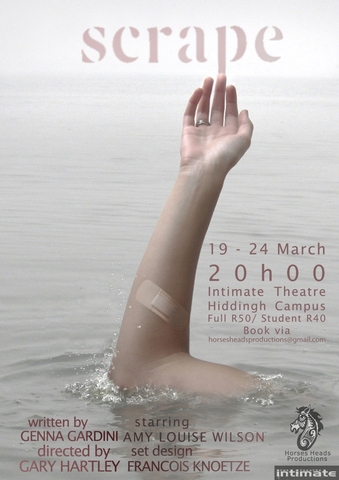
This play is on for two more nights at the Intimate Theatre on UCT’s Hiddingh Campus. I went last night. It is an absolute tour de force – insightful, brutal, awkward, compassionate, hilarious. If you are in Cape Town, GO, GO, GO!
Scrape is the story of an everyday woman suffering from an unusual condition.
After falling and scraping herself, Beth discovers that not only does skin heal, it can sometimes do so with a vengeance.
This one-person show, performed by Amy Louise Wilson, is presented by writer Genna Gardini and director Gary Hartley. It features sound design by musician and performance artist SIYA IS YOUR ANARCHIST and set design by 2011 ABSA L’Atelier and Sasol New Signatures finalist Francois Knoetze.
Scrape is presented by the new theatre company Horses’ Heads Productions. The production will preview at the Intimate Theatre from 19 – 24 March 2013 and go on to feature as part of The Cape Town Edge programme at this year’s National Arts Festival. Scrape will then return to the Mother City for a run at The Alexander Bar in August 2013.
Scrape, 19 – 24 March 2013, 20:00
The Intimate Theatre on UCT’s Hiddingh Campus
R50 general/ R40 students
To book tickets, contact 0827765490 or horsesheadsproductions@gmail.com
Director:
Gary Hartley is a theatre-maker, performer and television producer based in Cape Town. In 2007 he graduated from Rhodes University with a distinction in Drama. His production, WinterSweet, made in collaboration with The Runaway Buni Collective and writer Genna Gardini, won a Standard Bank Ovation Encore prize at the 2012 National Arts Festival. He currently works as a writer and producer at Greenwall Productions and has produced for shows such as The Showbiz Report, The Close Up and Screentime with Nicky Greenwall.
Playwright:
Genna Gardini is a writer based in Cape Town. Her play WinterSweet was produced in collaboration with Gary Hartley and The Runaway Buni Collective for the 2012 National Arts Festival and won a Standard Bank Encore Ovation Award. She has curated The Readings Upstairs, a monthly series of play readings held upstairs at the Alexander Bar, since 2012. Her work as a poet has been published widely both locally and internationally. Gardini has presented papers at the 2012 AFTA Annual International Conference and GIPCA Directors and Directing: Playwrights Symposium. She also works as a freelance arts writer for various publications, including the Cape Times and Art South Africa magazine. She is currently completing her MA Theatre-making (Playwriting) at UCT.
Performer:
Amy Louise Wilson is an actress living in Cape Town. She has studied Acting and Contemporary Performance at Rhodes University; Processes of Performance and Shakespeare Studies at the University of Leeds and Theatre and Performance at the University of Cape Town. Recent performances include The Petticoat Chronicle (dir. Lynne Maree), Voiced (under Clare Stopford) and 2012’s Standard Bank Encore Ovation Award winning Wintersweet (dir. Robert Haxton). She will be presenting her paper ‘Performance, Persona and Identity in the work of Die Antwoord’ at the New Directions in South African Theatre Today: Circulation, Evolutions, Adaptations symposium in France later this year.
Set Designer:
Francois Knoetze is an artist based in Cape Town. Having recently completed his Honours in Fine Art at Rhodes University, he is currently pursuing his MFA at Michaelis. His work is multidisciplinary, incorporating performance, assemblage sculpture and film. In 2011 he was a finalist in both the Absa L’Atelier and Sasol New Signatures competitions. Last year he was named one of Art South Africa magazine’s Bright Young Things. He has been involved in numerous theatre productions as set designer and puppet-maker, including works by the UBOM! Eastern Cape Theatre Company.
Sound designer:
Writer, journalist, musician and filmmaker SIYA IS YOUR ANARCHIST has written for publications like the Sunday World, The Event and The Callsheet. He has performed at the National Arts Festival and written several plays. He has also worked for TV shows such as Rhythm City (E-TV), Font (SABC 3), Breaking New Ground (SABC 2). He directed an SABC2 documentary on Aids activist Zackie Achmat called His Husband in 2011 and has exhibited multi-media installations for Goodman Gallery Cape Town and GIPCA Live Art Festival. He now works for Entertainment Africa as a features writer and is combining writing, music, art and media for the release of his upcoming musical EP.
Dinosaur Jr. perform three of my favourite songs from their 1988 album, Bug, live in the KEXP studio, Seattle, interviewed by Henry Rollins (casting himself as a major fanboy!) in between songs. Recorded on December 17, 2011. They may all look like slacker deadbeat dads, but crikey, they sound like a TORNADO.
Songs:
Little Fury Things
Freak Scene
Just Like Heaven (The Cure cover)
Hosts: DJ El Toro & Henry Rollins
Audio Engineer: James Nixon
Cameras: Jim Beckmann, Scott Holpainen & Patrick Richardson Wright
Editing: Scott Holpainen
“Our stories give shape to our inchoate, disparate, fleeting impressions of everyday life.”
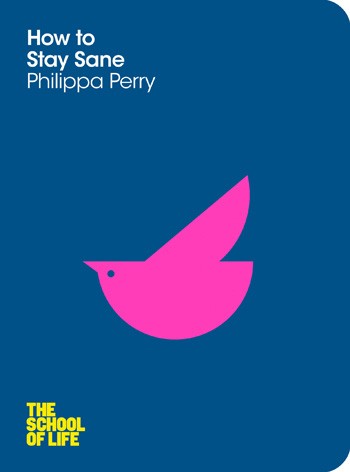
“[I] pray to Jesus to preserve my sanity,” Jack Kerouac professed in discussing his writing routine. But those of us who fall on the more secular end of the spectrum might need a slightly more potent sanity-preservation tool than prayer. That’s precisely what writer and psychotherapist Philippa Perry offers in How To Stay Sane (public library; UK), part of The School of Life’s wonderful series reclaiming the traditional self-help genre as intelligent, non-self-helpy, yet immensely helpful guides to modern living.
At the heart of Perry’s argument — in line with neurologist Oliver Sacks’s recent meditation on memory and how “narrative truth,” rather than “historical truth,” shapes our impression of the world — is the recognition that stories make us human and learning to reframe our interpretations of reality is key to our experience of life:
Our stories give shape to our inchoate, disparate, fleeting impressions of everyday life. They bring together the past and the future into the present to provide us with structures for working towards our goals. They give us a sense of identity and, most importantly, serve to integrate the feelings of our right brain with the language of our left.
[…]
We are primed to use stories. Part of our survival as a species depended upon listening to the stories of our tribal elders as they shared parables and passed down their experience and the wisdom of those who went before. As we get older it is our short-term memory that fades rather than our long-term memory. Perhaps we have evolved like this so that we are able to tell the younger generation about the stories and experiences that have formed us which may be important to subsequent generations if they are to thrive.
I worry, though, about what might happen to our minds if most of the stories we hear are about greed, war and atrocity.
Perry goes on to cite research indicating that people who watch television for more than four hours a day see themselves as far more likely to fall victim in a violent incident in the forthcoming week than their peers who watch less than two hours a day. Just like E. B. White advocated for the responsibility of the writer to “to lift people up, not lower them down,” so too is our responsibility as the writers of our own life-stories to avoid the well-documented negativity bias of modern media — because, as artist Austin Kleon wisely put it, “you are a mashup of what you let into your life.” Perry writes:
Be careful which stories you expose yourself to.
[…]
The meanings you find, and the stories you hear, will have an impact on how optimistic you are: it’s how we evolved. … If you do not know how to draw positive meaning from what happens in life, the neural pathways you need to appreciate good news will never fire up.
[…]
The trouble is, if we do not have a mind that is used to hearing good news, we do not have the neural pathways to process such news.
Yet despite the adaptive optimism bias of the human brain, Perry argues a positive outlook is a practice — and one that requires mastering the art of vulnerability and increasing our essential tolerance for uncertainty:
You may find that you have been telling yourself that practicing optimism is a risk, as though, somehow, a positive attitude will invite disaster and so if you practice optimism it may increase your feelings of vulnerability. The trick is to increase your tolerance for vulnerable feelings, rather than avoid them altogether.
[…]
Optimism does not mean continual happiness, glazed eyes and a fixed grin. When I talk about the desirability of optimism I do not mean that we should delude ourselves about reality. But practicing optimism does mean focusing more on the positive fall-out of an event than on the negative. … I am not advocating the kind of optimism that means you blow all your savings on a horse running at a hundred to one; I am talking about being optimistic enough to sow some seeds in the hope that some of them will germinate and grow into flowers.
Another key obstruction to our sanity is our chronic aversion to being wrong, entwined with our damaging fear of the unfamiliar. Perry cautions:
We all like to think we keep an open mind and can change our opinions in the light of new evidence, but most of us seem to be geared to making up our minds very quickly. Then we process further evidence not with an open mind but with a filter, only acknowledging the evidence that backs up our original impression. It is too easy for us to fall into the trap of believing that being right is more important than being open to what might be.
If we practice detachment from our thoughts we learn to observe them as though we are taking a bird’s eye view of our own thinking. When we do this, we might find that our thinking belongs to an older, and different, story to the one we are now living.
Perry concludes:
We need to look at the repetitions in the stories we tell ourselves [and] at the process of the stories rather than merely their surface content. Then we can begin to experiment with changing the filter through which we look at the world, start to edit the story and thus regain flexibility where we have been getting stuck.
Complement How To Stay Sane with radical psychoanalyst Wilhelm Reich’s 1948 list of the six rules for creative sanity.
Marina Abramovic and Ulay shared an intense love in the 1970s, performing art out of the van they lived in. When they felt the relationship had run its course (after almost 12 years), they decided to walk the Great Wall of China, each from one end, meeting for one last big hug in the middle and never seeing each other again.
At her 2010 MoMa retrospective, Marina performed ‘The Artist Is Present’ as part of the show, where she shared a minute of silence with each stranger who sat in front of her. Ulay arrived without her knowing and this is what happened:
Not to be confused with the group of the same name from the UK. From Melbourne, these guys unfortunately disbanded in 2001 after having self-released an EP, and then two albums produced by Steve Shelley (Sonic Youth). This track is taken from the album Alone Alone (2000).
This is again radio Yerevan with… our news (claps)
Oh, I’m sorry, you should turn on the machine
This is radio Yerevan, (laughs)
my name is Hans Ivanovich (laughs) Hagen and this is…
The news (laughs) Continue reading →
I made this poster in reference to this one, but the events it describes are entirely true. My cat’s head was never found. That night, I think I lost a part of me too, though I didn’t realise it at the time: the part that trusted and expected people who said they loved me not to hurt me intentionally.
What made me realise how this all fitted together was a chain status update game that went around on Facebook a few weeks ago. My answers to the questions went like this:
Age I was given: 17 (I balked because it was a very heavy year for me, but here goes…) Where I lived: Waterfall, a village in KZN a little north of the Comrades Marathon route, through the sugarcane fields (which are now Tuscan townships). What I did: Wrote matric with the help of regular immunoglobulin injections and reflexology to stave off the Chronic Fatigue Syndrome/M.E.that I’d been severely ill with since 14 when I’d contracted Glandular Fever. Spent a lot of my study time taping songs off the radio. Went to Turkey on short term Rotary Exchange after finishing school. Who had my heart: My cat, Jorgy, who had been my constant companion throughout my illness. He was killed while I was in Turkey. I’d broken up with my first boyfriend during matric trials – I couldn’t handle his obsessive, controlling demands for attention. He turned stalker on me, hanging around outside my house, phoning all the time, sending letters threatening suicide, warning me that I would be sorry if “I left him” and went to Turkey. A day or two before I got back, my family found the headless body of our beloved Jorgensen Fassbinder Kittyman Von Streichen Hashimoto Lighoré at the bottom of the garden, tossed over the fence. I wish I was making this up.
Age I am now: 34 Where I live: Oranjezicht, Cape Town What I do: I excel at giving too much of a shit. Who has my heart: My heart is a hot potato.
__
The shadow of this manifested down the years in relationships with a string of men who were deliberately unkind and dismissive to me too often; with me always holding on too long because I mistakenly identified their cruelty or disloyalty as evidence of their love for me in spite of what they judged to be my shortcomings. At the darkest junctures over those years, I actually believed that I might deserve the humiliation, the punishment; that I should be grateful anyone humoured me. If they weren’t critical or manipulative enough, if I didn’t have cause to be outraged by their mistreatment, to defend myself against their accusations, to demand consideration, recognition… then it didn’t feel like they could really care (how twisted is that?).
The men I fell most deeply for were never truly available or fully present, would leave me because they cared more about someone else, or were running for their own damaged reasons. I guess I only felt safe from being smothered when they had one foot outside the door, though I yearned with all my heart to be held unconditionally, the way I held them.
This delusion is broken and I am free of its bonds.
“I don’t think you ever do stop loving a person. I think you can hate them a little… But I still love the people I’ve loved, even if I cross the street to avoid them.”
“When I was fourteen, I discovered the sound of iniquity on a long-playing record for the blind from the Library of Congress. I listened to Paradise Lost, and sometimes after hours of playing the story of Satan I’d walk to the driveway’s edge and feel the elaborate work of sunlight and wind and imagine, the way only a teenager can, the falling of Satan in a blackness so pure you could feel it in the bones of your face… I’d discovered the gift of Milton: the soul’s path is in the ear – not the mirror.”
~ Stephen Kuusisto, from Eavesdropping: A Memoir of Blindness and Listening (W. W. Norton & Company, 2006)
I remember being happy and carefree until about the year I turned 10. That was the year everyone around me became aware of something called “coolness”. It seemed you had to do certain things a certain way to be deemed “cool”. It didn’t make much sense to me. I collected stamps and pressed indigenous flowers. The other girls were really into pastel writing paper (blank). I was in the school choir. I had takkies instead of hockey boots (I hated hockey; why waste my parents’ money?). I read voraciously — National Geographics, Rumer Godden, Lucy Maud Montgomery. There was always a queue to read the next Sweet Valley High that I never joined.
While others were playing handstands and kissing catchers, I liked to walk further out, past the squeals, put my sandwich out on the grass, lie down and wait for a yellow-billed kite to spy it. I loved to feel the wind from its wings as it swooped down right over me from way up high… in the next second, bird and morsel would be gone; a tiny shadow, a cry far, far out of reach.
Almost all my time inside and outside school was spent dreaming up elaborate, exotic worlds and cobbling approximations of them together from whatever was at hand: cardboard, tablecloths, our little red wagon, press-ganged siblings, pets. Some games took weeks. Gypsy caravans morphed into Voortrekker laagers morphed into hunter-gatherers in the Drakensberg morphed into refugee camps morphed into townships morphed into castles under siege. Ways of being that were other than mine held endless fascination for me; every scenario a mystery I longed to inhabit. Engrossed with historical detail, with exact measurements, with flavours and textures and smells, I would be nowhere but there in my head – not exactly germane to making flesh-and-blood friends. Maybe worst of all, though, when the teacher asked questions in class and I was actually paying attention, I would put up my hand and answer, or even disagree with her.
I found out that my differences did not endear me to others, did not interest them. In fact, the things that made me different made me actively UNcool. At first I didn’t really care, but then it started to hurt. I was frozen out, systematically. The nastiest kids used to make me cry. They would pass notes warning their cronies not to borrow my scissors because I had “AIDS”. This was 1987. We didn’t really know what it was, only that it was worse than leprosy… and the lepers we’d heard about at Sunday School were pretty abhorrent.
One day I punched a boy called Stuart Urquhart when he had kicked my school bag, put Prestik in my hair and called me “ginger”, “fatty” and “freckles” one too many times. So what, I had freckles (show me a redhead who doesn’t… I quite liked mine, and I always liked my hair), but “fatty” I couldn’t accept. (It stuck regardless though. Around 16 I was weighing all my food to make sure I knew how many kilojoules I was swallowing.) Stuart came off with a respectably-sized purple and yellow bruise. The teacher made me stay in at big break and beat chalkboard dusters while Stuart got on with “getting off” with girls behind the change rooms on the far side of the field, where the myopic staff member on duty couldn’t make out that there were boys on the girls’ side. It was a Belle & Sebastian song just waiting to happen.
(This is a Youtube playlist I made to go with this piece.)
Fast forward to a year or two later, when I discovered The Smiths, the Pixies, U2 and the House of Love through a mix tape copied for me by the Std 7 boy I (and everyone else, it seemed) had a devastating crush on. He saved my life. Inadvertently, of course. He was the minister’s son, a gymnast with beautiful arms. Sitting outside, vestigial and bored at the Std 5 leavers’ disco, I imagined those taut biceps encircling my pubescent torso, crushing my stonies to him, exquisite pain as we slow-danced to Richard Marx, eternal reverie in the fuggy November night…
“Whatever it takes, or how my heart breaks, I will be right here waiting for you.”
When, oh when, would a boy sing that to me? (Note to younger self: “Don’t hold your breath, girlie.”) Only one boy had ever been sweet (or brave?) enough to ask me to dance at the handful of parties to which I was invited. The time he did, it wasn’t a slow song. He wasn’t that sweet (or brave?). His name was Francis and he flapped his elbows like a chicken. I was staying outside. I hadn’t developed a sense of irony yet.
“Close your eyes, gimme your hand, darlin'” … “Lay a whisper on my pillow” … “Huh-ush, hush, keep it down now, voices carry…”
Back then, those numbers induced in me a wild yearning for a reason to empathise with the girls from my Pop Shop tapes, and an overwhelming sense of hopelessness that things were not moving in that direction. That was before I discovered The Smiths, Depeche Mode, The Cure, Tears for Fears. What? Bands who were singing about how I really felt, instead of what I would never be?! Singing, in fact, about the precise feeling of inadequacy that perfect pop had provoked in me! They left me standing alone with a smirk, instead of the sigh of an outcast. The relief I felt was immediate.
“Sheila take a, Sheila take a bow/ Boot the grime of this world in the crotch, dear/ Throw your homework onto the fire/ Go out and find the one you love”
I wished I’d brought my rollerskates that night. I wanted to glide away down the smooth, concrete walkways, eerie dark tunnels ringing silently with the monitors’ “No running on the corridors!” refrain, the illicit rumble of my wheels propelling me far from all the clammy paired-off hands and Bon Jovi… I slipped out across the moonlit playing fields, the dew muddying both pairs of roll-down lumo-pink and white nylon socks I was wearing, my black takkies squeaking with every step. Grasping the perimeter fence, I pressed my face against the diamond mesh until it patterned my cheeks, and the dog barking at me from across the road forced the preternatural image that had projected itself into the sky — the minister’s son, away at boarding school in ‘Maritzburg, straw boater cocked rakishly — to dissipate.
The crush passed, though not until after I had wasted more than a year of stupefying Fridays at youth group watching the blonde chicks compete for his attention. I never tried. I had learned that tragedy was also cool. And anyway, Morrissey said I was the one for him (fatty). Who needed 15-year-old zitfarms when you had Morrissey’s alabaster chest and bruised daffodils, and Robert Smith’s bleeding mouth? So hot. So beyond sex. So beyond my stupid suburban world.
I ditched the stamps and started collecting Melody Makers & NMEs with religious fervour. Plastered my room with Joy Division, Bowie, Bauhaus, Jim Morrison, Sinead o’ Connor, Jesus & Mary Chain posters. Cultivated a floppy fringe and faraway eyes. Whined for Docs. A couple of years on my mom would be despairing at the puddles of black kohl staining my pillow. Every day, regardless of Natal’s weather, I wore the darkest parts of my school uniform: the navy jersey and dark stockings. Every day, I packed the same cabbage salad in my lunchbox, skimping on the mayo, trying to suppress my burgeoning curves, to look tortured, sick, blank, cold, mechanical, monosyllabic. Like I was inside.
The new wave music in my head deflected everything irrelevant. And everything felt irrelevant. I could identify with nothing around me. With no one — certainly not white South Africa in 1993! The violence. The confusion. The fear. The news explained nothing. I could taste the lies.
“Ich möchte ein Eisbär sein/ Im kalten Polar/ Dann müßte ich nicht mehr schrei’n/ Alles wär’ so klar.”
“All we ever wanted was everything/ All we ever got was cold/ Get up, eat jelly, Sandwich bars and barbed wire/ Squash every week into a day.”
“I could turn and walk away, or I could fire the gun/ Staring at the sky, staring at the sun/ Whatever I do, it amounts to the same: Absolutely nothing/ I’m alive/ I’m dead/ I am the stranger/ Killing an Arab.”
“Me… I disconnect from you…”
“I belong to the blank generation, and I can take or leave it each time.”
“I see liberals; I am just a fashion accessory… La tristessa durera, scream to a si-i-igh, to a si-i-igh…”
“Rock ‘n’ roll is our epiphany: culture, alienation, boredom and despair,” the Manic Street Preachers howled. I was in love with fragile, callow Richey Manic, with the leather, leopard print and makeup. We scrawled copycat slogans on our Std 9 history teacher’s blackboard before class. Mr Mundell was a Springbok walker (yes, a competitive WALKER) with a tight arse and vindictive streak a mile wide towards any “non-athlete”, his term for anyone who preferred house plays to hayfever. We spent our time in his classes on Bismarck and the Cold War and Botha VS Smuts writing rainbow pages in advance for “forgetting” our P.E. kits. Notice I say “we”, for by then the other angry girls in dark stockings had deigned to notice me. They were rebels. They’d nicked the template from their elder sisters who’d been in London.
Penny and Olwen were in love with their horses, and also with Dave Gahan and Brett Anderson. They had tails: long, snarled strands of hair that they had to keep rolled up and clipped under the other short hair to avoid being bust. When they got bored with those, they got undercuts. Anything to cause shit, to push the limits, to be different. I didn’t really get the point of that at high school. I had my mom do me a tight plait down my back most days. I made her do it over if it wasn’t perfect.
I tagged along with them, mostly for the music I could sponge off their connections. Penny had given me the Stone Roses record her sister bought her in London, for example. She’d scorned it cos it was “too pop”. She couldn’t see that part of its brilliance lay in the way the shambling prettiness cloaked the meticulous cruelty beneath:
“You’ve been bought and paid/ You’re a whore and a slave/ Your dark star holy shrine/ Come taste the end, you’re mine/ Here he comes/ Got no questions, got no love/ I’m throwing stones at you man/ I want you black and blue and/ I’m gonna make you bleed/ Gonna bring you down to your knees/ Bye bye badman/ Ooh, bye bye/ I’ve got a bad intention/ I intend to/ Knock you down/ These stones I throw/ Oh these French kisses/ Are the only way I’ve found…”
Swigging vodka and crème soda out of a juice bottle under the stands on Sports Day, keeping cave while they smoked, I couldn’t quite buy in to group rebellion. Drinking was fun. Cigarettes were siff. Dagga was a chance I was nervous of taking. I heard rumours that it could make you schizo. I already doubted my sanity too often. Also, I was pretty sure dagga definitely killed brain cells, and, well, I was coming top in the standard, and my parents expected me to continue doing so… My parents were the only people in the world I knew really did love me. Didn’t mean we liked each other much but I felt like I shouldn’t fuck that up…
Rewind a couple of years again: “You can all just kiss off into the air/ behind my back I can see them stare/ They’ll hurt me bad, but I won’t mind/ They’ll hurt me bad, they do it all the time, yeah, yeah, they do it all the time…”
The Violent Femmes! Never had I heard anything like them! Pasty, whiny smalltown nerds. They wrote lonely, ugly songs, about masturbation and Jesus and killing your daughters and wanting to fuck black girls. They broke the rules in a way I could dig. They broke them because they had to. But what really got me was the rock ‘n’ roll. Deadpan-venomous-breakneck-shake-a-chicken-rock’n’roll, baybeh. The fattest, twangiest bass… and a marimba! I wanted to be defiled! I hadn’t felt like dancing this much since I was about 9 or 10 and Dad used to stick on the Beatles’ Red Album for us when it was raining and we couldn’t play outside.
It was in a marquee on the beach at Kenton-on-Sea in the Eastern Cape that I noticed the first boy I would ever kiss watching me, kinda slo-mo headbanging to “American Music”. I remember he seemed passably cute. He lurched over, wordlessly, and pulled me close. Dizzy from my Cure-style flailings and a couple of Hunter’s Golds, I collapsed on top of him on a hay bale and his tongue found mouth. It busied itself deep in my nonplussed oral cavity for a while. It was all a bit too gross to feel like the miracle I had anticipated for years, but boy was I stoked. My necklace popped undone. Tiny, cold beads rolled down between my breasts, between my shoulder blades, adding to the strange, electric shivers as the foreign hand inched up, up under my Rattle & Hum t-shirt, fumbling round to the front. I think he pulled away because he had to burp.
His plaque was flavoured with curdled Black Label and zol, and the rest of him with that purple Ego deodorant – what was it called? Bahama Mist? Afterwards, back from my holiday, I would go into Spar with my mom, loiter around the mens’ toiletries while she was in another aisle, spray Bahama Mist nonchalantly into the lid, take a hit of sweaty rapture on my isle of romance, over and over again.
I don’t recall a word he said. I forgot his name years ago. But his friend’s, who had set about ravishing my younger sister in similar fashion, is indelibly etched in my mind. It was Geoff. You see, for weeks afterwards she and I chanted the Pixies’ refrain, “Jefrey-with-one-ef-Jefrey”, when alluding to the escapade in front of Mom and Dad. We were convinced if they found out what naughty things we’d got up to right under their noses, we’d NEVER be allowed to go to parties unchaperoned again.
Jef was a surfer, a boarder at a boys’ high school in King William’s Town. Suave. Told us he had a mattress in the back of his bakkie. (HIS bakkie? How old were they??) We shat ourselves. When they staggered off to find more dop, we skedaddled home to my grandparents’ house via the most brightly lit street. Out of breath with giggles, we picked the straw from our tresses, only a little more relieved than regretful that we had been sensible. Ooh, but hadn’t they given us their phone numbers?! When we dialled them from a tickiebox next day we got the out-of-order tone. And making a getaway the night before, I had forgotten to retrieve my beloved velvet hat from whence it had tumbled as I fell into first base. The first brutal abandonment, and there’d be too many down the years to keep count.
“A sad fact widely known/ The most impassioned song to a lonely soul/ Is so easily outgrown/ But don’t forget the songs that made you smile/ And the songs that made you cry/ As you lay in awe on your bedroom floor/ And said ‘Oh! Oh! Smother me, Mother…’/ Yes, you’re older now and you’re a clever swine/ But they were the only ones who ever stood by you…/ I’m here with the cause; I’m holding the torch/ In the corner of your room, can you hear me? And when you’re dancing, and laughing, and finally living/ Hear my voice in your head and think of me kindly.”
I do, Steven Patrick, you whiny old git, every now and then I really do. And you can consider this one such paean of my gratitude to your ilk. (2004)
each and every one one of us has a book of narratives, that we read write and become part of. each chapter verse and paragraph tells our stories and as time passes, we become familiar with our own characters and our own cast of characters become familiar with us.
there is the longing, the dreaming, the ambition, the beauty and the ugliness and above all, there is the love.. the love of others, the love of others like self and the love of self..
the hardest part though, is to be and become part of the narrative..beauty.. to not negate from its positivity its validity as a document to the light rays streaming through our windows of hope and courage to go forward.
the sun rises and sets in a distant sky, as trees bend, bow, blow leaves, jingling. we are hushed into our own simplicities, the grace of intelligence..
man woman or child is the subtotal of a life lived and hoped for.. the narrative of distant and close dreams are but moments, in our own being, where we are awake and know and overstand that it is in the power of our being that we learn that our own empowerment is the storehouse.. that we are capable of more than the small parts that make up the whole.
love, romance, career, children are all part of the course of our own destined future, but the inner self, the inner voice is the calling to follow your own path, all love, and in doing so .. this becomes a mantra, a calling even..
*.* Love’s Secret Domain, 2004. Self-portrait manipulated with MS Photo Editor.
“I think,” Tehanu said in her soft, strange voice, “that when I die, I can breathe back the breath that made me live. I can give back to the world all that I didn’t do. All that I might have been and couldn’t be. All the choices I didn’t make. All the things I lost and spent and wasted. I can give them back to the world. To the lives that haven’t been lived yet. That will be my gift back to the world that gave me the life I did live, the love I loved, the breath I breathed.”
Meshes of the Afternoon (1943) is a short experimental film directed by wife and husband team, Maya Deren and Alexander Hammid. The film’s narrative is circular, and repeats a number of psychologically symbolic images, including a flower on a long driveway, a key falling, a door unlocked, a knife in a loaf of bread, a mysterious Grim Reaper-like cloaked figure with a mirror for a face, a phone off the hook and an ocean. Through creative editing, distinct camera angles, and slow motion, this surrealist film depicts a world in which it is more and more difficult to catch reality.
“This film is concerned with the interior experiences of an individual. It does not record an event which could be witnessed by other persons. Rather, it reproduces the way in which the subconscious of an individual will develop, interpret and elaborate an apparently simple and casual incident into a critical emotional experience.”
— Maya Deren on Meshes of the Afternoon, from DVD release Maya Deren: Experimental Films 1943–58.
The film was originally silent – the soundtrack, by Deren’s third husband, Teiji Ito, was only added in 1959.
Tale of Tales, like Tarkovsky’sMirror, attempts to structure itself like a human memory. Memories are not recalled in neat chronological order; instead, they are recalled by the association of one thing with another, which means that any attempt to put memory on film cannot be told like a conventional narrative. The film is thus made up of a series of related sequences whose scenes are interspersed between each other. One of the primary themes involves war, with particular emphasis on the enormous losses the Soviet Union suffered on the Eastern Front during World War II. Several recurring characters and their interactions make up a large part of the film, such as the poet, the little girl and the bull, the little boy and the crows, the dancers and the soldiers, and especially the little grey wolf (Russian: се́ренький волчо́к, syeryenkiy volchok). Another symbol connecting nearly all of these different themes are green apples (which may symbolise life, hope, or potential).
Yuriy Norshteyn wrote in Iskusstvo Kino magazine that the film is “about simple concepts that give you the strength to live.”
Aah, Sea Point. Maybe it’s just the pheromones, or the exhaust fumes, or the soupy mist of oil from cheap takeaways, or the blinking lights, relentless through the fishy smog… Maybe it’s the conglomeration of them all… The whole place reeks of overtiredness.
Main Road, Sea Point. Photo: Rosemary Lombard
Know how the Durban beach front feels at night? All sodium glare and humid candyfloss and hooting and “Rayban” pushers, stumbling over sprawling elephantiasis limbs; cabbagey piss and rotting elephantiasis limbs underfoot at every turn, elephantiasis limbs EVERYWHERE?
Or the water slides in Muizenberg? Ice-cream sticks and rusty fish guts and cocoa butter thick in your nostrils? Shrivelled, orange bikini grans and stubbed toes and burnt children scrambling back up, over and over, getting their money’s worth, with fresh snot to add to the circulated stream? Kinda like that.
Like a casino, or a circus, or the school parking lot half an hour before the last night of the end-of-year play. Just like that. The cement, the tar etched with residues of action, the erratic paths of people hopscotching between the pavement’s wet patches of unknown origin, beat-up cabs snaking through the gutters, cruising for someone going somewhere, doing something… you never can be certain what.
There’s an interminable vacancy in all the hyperactivity, a loneliness. A sense that most of what’s done is probably being done to keep up appearances, because it’s in the script. In bar toilets, in sighing lifts and entrance lobbies of peeling flats, people wait, unexpectantly, for something undisclosed… The sour gaggles of Jewish crones… The sweet fags in the coin-op laundrette… The salty dog walkers on the promenade… The makwerekwere… The goosefleshed trannie under the stop sign… LCD Jesus loves you, 01:31, 8°C.
It’s a frustrating place, a titillating place for anyone with even a pinch of the voyeur in them. You never know if today will be your chance to be privy to that something, to overhear the deal… Well, it’s hardly likely to be above board, is it? You daren’t blink in case you miss it, yet you virtually never get to see the loops close, experience the denouement. And your imagination goes crazy.
Oy vey, it’s a schande. Happeningness rubs your nose in it, but, from a distance, it’s too pungent, too slippery to pry open cleanly… You know your conjecture’s amusing but empty.
Romanticism breeds covetousness, even of the sordid. So, you’ve read Burroughs, Bukowski, Genet, Sade. Ballard, Palahniuk, Sartre… Your own illicit missions never feel as archetypal.
It’s like being hopelessly in love, but not being in ’40s Casablanca, you know? Like rainbow soap bubbles popping on your tongue… The bath gets cold before you stop being too distracted by the froth to immerse yourself fully.
Tran Nguyen – Treading Through An Untrimmed Memory
Tran Nguyen is a Georgia-based artist. Born in Vietnam and raised in the States, she received a BFA from Savannah College of Art and Design in 2009. She is fascinated with creating visuals that can be used as a psycho-therapeutic support vehicle, treading the mind’s surreal dreamscape. Her paintings are created with a delicate quality using color pencil and thin glazes of acrylic on paper. Tran’s oeuvre has been exhibited with galleries in New York, Los Angeles, Miami, London, and Barcelona. “ I find interest in illustrating the universal emotions we come across in everyday living — emotions that are tucked away, deep inside our psyches.”
“Our first film. This Way Up had money to make a video, we wanted to make something more like a film. We were told about Jarvis and Steve from Pulp, who were making films with Martin Wallace. We made it during the summer of ’93. Dickon’s not in it because he was in Mexico as part of his studies. It was good fun and hard work, driving around in our Ford Cortina, Jarvis squashed on the passenger seat floor. Sidonie, Stuart’s daughter, is the baby. It was the start of a long and joyful relationship with Martin Wallace, who’s become a wonderful friend.”
So much of the city
is our bodies. Places in us
old light still slants through to.
Places that no longer exist but are full of feeling,
like phantom limbs.
Even the city carries ruins in its heart.
Longs to be touched in places
only it remembers…
(from The Weight of Oranges / Miner’s Pond. McClelland & Stewart, 1997. p.86)
i really don’t get it,
never have.
hard rock/metal in general, i mean.
too much sweaty hair thrashing around,
too many notes overcrowding each bar,
too many gratuitous tempo changes,
the voice (always male) too yowly or growly,
the lyrics, ridiculous.
i can dig the more spacey prog stuff from the ’70s, king crimson for example, or the o.t.t. weirdness of frank zappa, but the testosserterrain of deep purple/motorhead/budgie etc etc… i just don’t get it.
it reminds me of all the wankers i tried to sing or play guitar with at school.
i could never find anyone who wanted to do anything interesting.
all they did was spank away over and over for hours and hours at the same led zeppelin or sabbath or metallica riffs,
show off their paradiddle-diddle-diddle drumming,
their kakky renditions of les claypool slap bass,
drink black label quarts, smoke dagga, crow about forcing themselves on girls.
here’s a memory from when i was about 15 or 16… i’m at a house party in kloof, drunk and very bored, after one such disappointing “jam”. the drummer, julian (still remember his stinking name), with long fluffy hair and a straggly beard and juicy zits who’s maybe a bit older than the rest of us, starts kissing me and i’m kinda flattered but not feeling anything at all. so i crawl off a bit later when he’s getting another beer to go sleep in someone’s bedroom plastered with creepy iron maiden posters.
he comes to find me and i wake to his entire weight bearing down on me, smothered in salty, smoky hair and he’s forcing his hands into my panties and shoving his filthy callused stompie fingers in my virginity and his penis is grinding into my thigh and i can’t move or breathe. i’m choking. i bite at his furry beer tongue and he swears at me and slaps me, calls me a cocktease, and then he’s gone. mercifully. i need to vomit and wash myself but i daren’t go to the bathroom. i’m scared that he’ll come back. i’m lying there groggy and rigid with the reek of him on me, his plaque in my mouth, with that eddie creature leering down at me from the moonlit posters, with the drone of mosquitoes and the signature riffs of the morning birds over and over for hours and hours – bulbul, white-eye, hadeda, bulbul, white-eye, hadeda, bulbul, hadeda… somewhere a cock is crowing and finally i can get out of there.
coda: my younger sister got seduced by the whole scene and ended up pregnant at 16 by one of these fret-tapping frauds that she’d called her boyfriend for about 2 years. a few months after the baby came, he slunk off with the chick he’d been cheating on her with.
so yeah. i don’t enjoy hard rock/metal’s machismo-drenched doodling.
i find it the aural equivalent of being fucked badly.
there’s not a smidgen of feminine awareness in its puffed-up rooster strut.





 fleurmach