writing wrongs

my wrists ache
wrest them
look out
a deck of shards
sick notes
cutting in
cutting up
cutting down
cutting out
cutting off
the pulse
wound up wound
wind up wind
wound up wind
wound down wind
wind down wound
wind up wounded
binds unbound

an unstruck sound
this name means nothing to me
rolling off my glossed tongue
the missing ink
the beads of spittle in the pink
the drown flying in my drink
sink for yourself
sink or blink

outside carries on
the whorl of a banshee
howling at the pane

open your eyes
close your mouth
close your eyes
open your mouth
open your close
eye your mouth
mouth your silence
silence your eyes
make the whirl go away

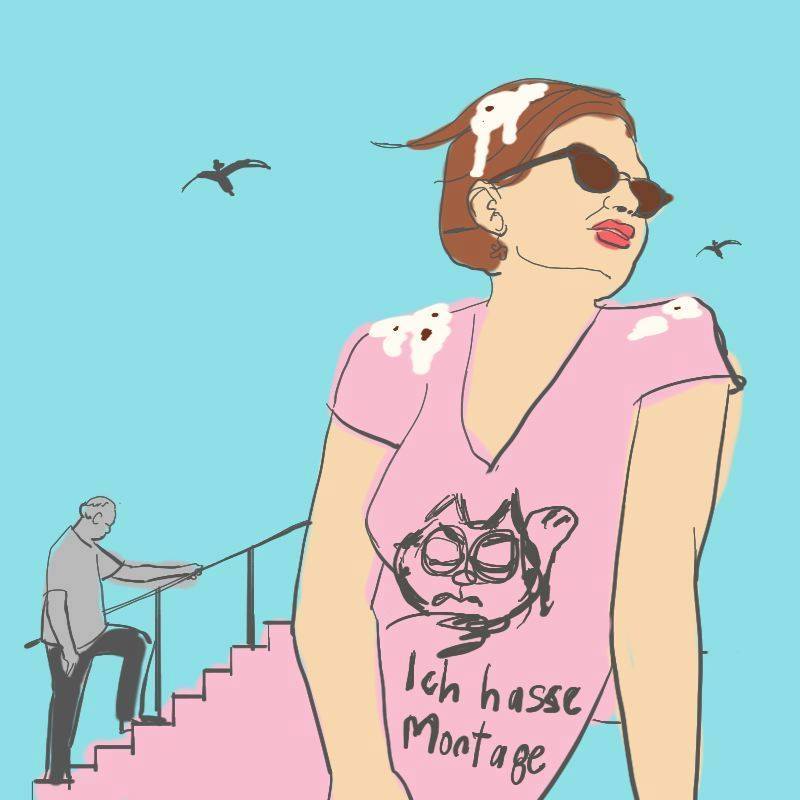
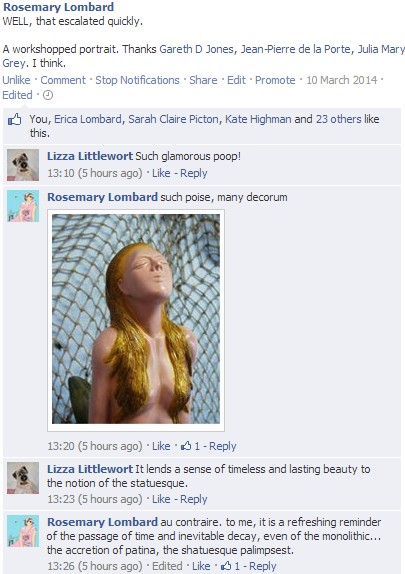
well, that escalated quickly.

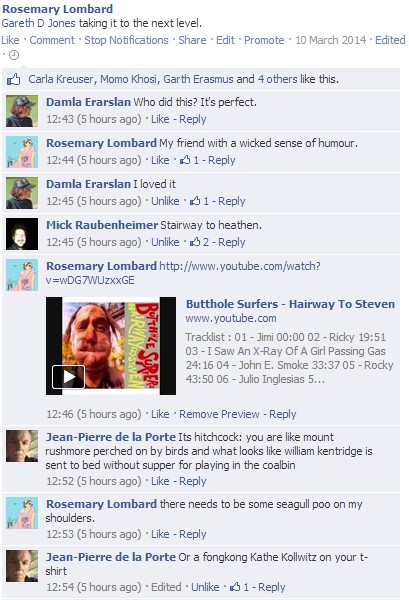
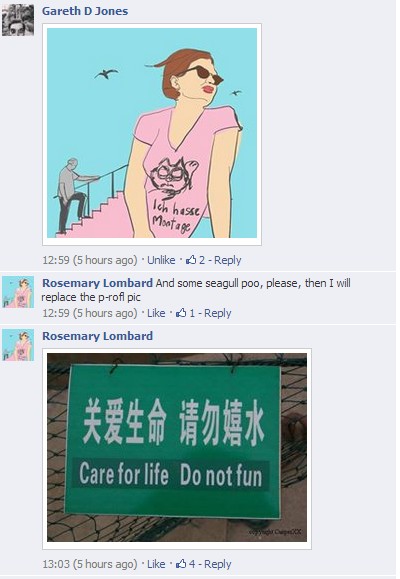
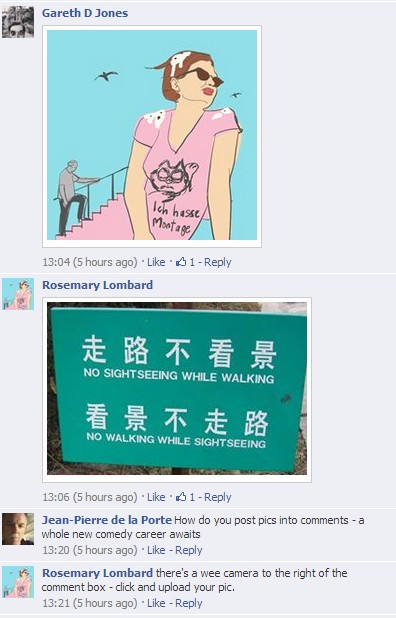
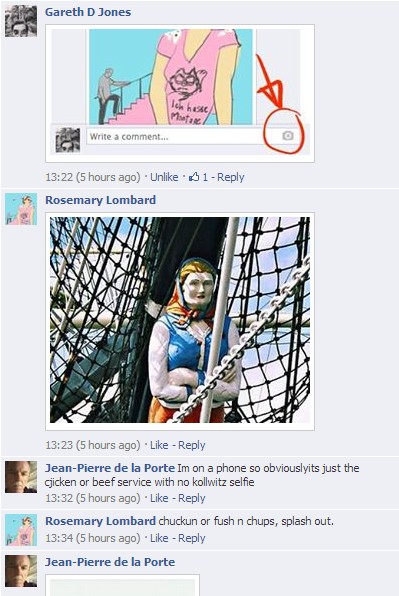
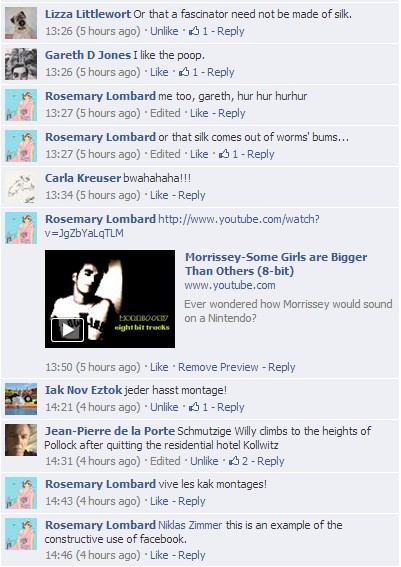
This is what Facebook is really for. Here is a funny conversation that evolved into a collaborative portrait in layers on my wall over a few hours today, a particularly suffocating Monday. I’m keeping this as a snapshot of what creative people used to do when bored silly with social media in 2014.

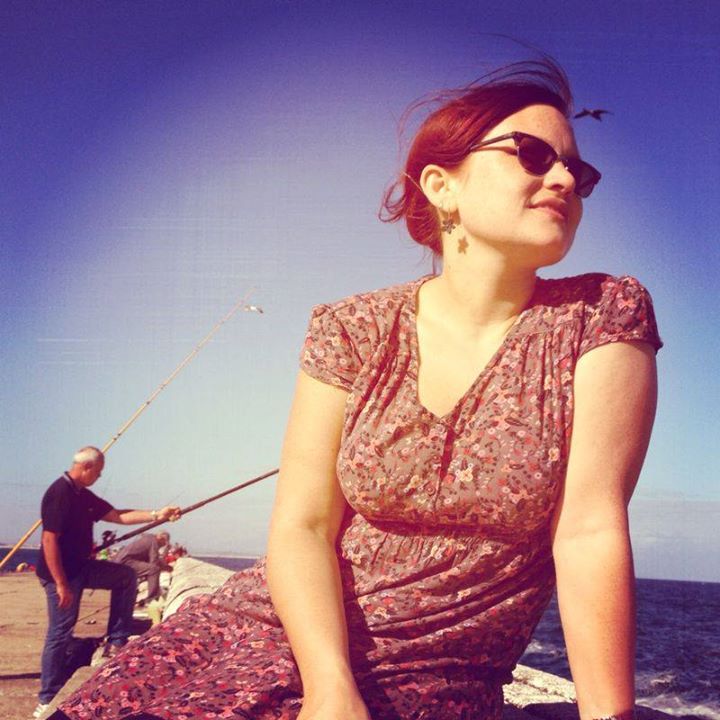
Photo by Julia Mary Grey, Kalk Bay harbour, Saturday 8 March, 2014

Photo by Julia Mary Grey, Kalk Bay harbour, Saturday 8 March, 2014

sea 1 comments

sea 2

By Gareth Jones,  in response to comments under the original image

sea 2a
sea 2b

sea 2c

sea 2d

By Jean-Pierre Delaporte

By Jean-Pierre de la Porte

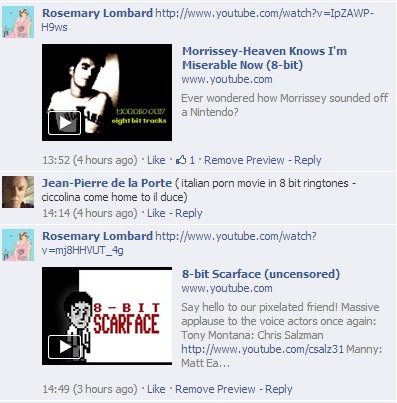
http://youtu.be/IpZAWP-H9ws

sea 2e

Meanwhile, on another thread…

sea 3

By Gareth Jones, third iteration, after further comments under his first drawing

sea 3a

sea 3b

http://youtu.be/JgZbYaLqTLM

sea 3c

sea 3d

inflamed

ExitDeer015

Exit-deer: “He left himself with frightening pace”

“Almost every day I can feel myself suffering mainly in the head, I can explain the pain to myself but knowing it comes from an inflammation of my imagination doesn’t prevent it being reality itself. What’s more I’d be crazy not to go crazy. We don’t know what an illness is. On awful hurts we plaster little old words, as if we could think hell with a paper bandage.”

― Hélène Cixous, Hyperdream

sorry, you’re breaking up

brokenI learned the hard way, several times over, that attempting to help someone who can’t or won’t take responsibility for working on their own issues will never amount to anything positive. By doing this you enable the self-destructive behaviour to continue, and may very likely get hurt badly yourself.

out of order

“A minute of silence in images for all the absent images, censored images, prostituted images, machinated images, delinquent images, buggered images, images beaten up by all the governments, televisions and westernized cinemas that rhyme information and repression with trash and culture.”

— Jean-Luc Godard – Le Gai Savoir (The Joy of Learning), 1969

http://youtu.be/65cLX0npa0U

“We can’t really understand. Of course. They’re speaking out of order.”

Continue reading

on dreams and the reality of sadness

Log-lady-quote-3

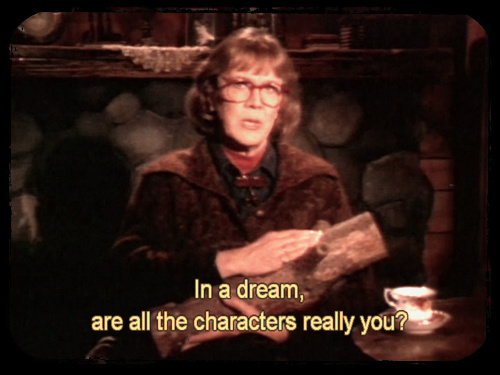
Sometime ideas, like men, jump up and say ‘hello’. They introduce themselves, these ideas, with words. Are they words? These ideas speak so strangely. All that we see in this world is based on someone’s ideas. Some ideas are destructive, some are constructive. Some ideas can arrive in the form of a dream. I can say it again: some ideas arrive in the form of a dream…

… There is a sadness in this world, for we are ignorant of many things. Yes, we are ignorant of many beautiful things — things like the truth. So sadness, in our ignorance, is very real. The tears are real. What is this thing called a tear? There are even tiny ducts — tear ducts — to produce these tears should the sadness occur. Then the day when the sadness comes — then we ask: “Will this sadness which makes me cry — will this sadness that makes me cry my heart out — will it ever end?” The answer, of course, is yes. One day the sadness will end.

— David Lynch’s Log Lady, in Twin Peaks

maria callas – mad scene from lucia di lammermoor (donizetti)

“The character of Lucia has become an icon in opera and beyond, an archetype of the constrained woman asserting herself in society. She reappears as a touchstone for such diverse later characters as Flaubert’s adulterous Madame Bovary and the repressed Englishwomen in the novels of E.M. Forster. The insanity that overtakes and destroys Lucia, depicted in opera’s most celebrated mad scene, has especially captured the public imagination. Donizetti’s handling of this fragile woman’s state of mind remains seductively beautiful, thoroughly compelling, and deeply disturbing. Madness as explored in this opera is not merely something that happens as a plot function: it is at once a personal tragedy, a political statement, and a healing ritual.” (Commentary from HERE)

http://youtu.be/Ex3p20BKEjI

Maria Callas performs “Il dolce suono mi colpì di sua voce”, the “Mad Scene” from the opera Lucia di Lammermoor by Gaetano Donizetti, recorded live in Florence in February 1953. Tullio Serafin conducted Callas, Giuseppe di Stefano, Tito Gobbi, Raffaele Arie, Valliano Natali, Maria Canali, Maggio Musical Fiorentino Orchestra & Maggio Musicale Fiorentino Chorus.

The discussion in the comments underneath the video is quite entertaining, especially if read in light of the Anne Carson essay I posted earlier. Continue reading

it’s your fault!

Published on 19 Sep 2013.

Are women responsible for protecting themselves from rape? Indian comedy group All India Bakchod’s sarcastic It’s Your Fault video shows Bollywood actresses Kalki Koechlin and VJ Juhi Pandey blaming themselves for what they wear, working late into the night, and not fighting back. HERE is an explanation of the rationale for the video.

the cure – a strange day

http://youtu.be/TyG3AtzN1OM

One of my favourites off Pornography (Fiction Records, 1982).

My head falls back
And the walls crash down
And the sky
And the impossible
Explode
Held for one moment, I remember a song
An impression of sound
Then everything is gone
Forever

lydia lunch – stares to nowhere

From her second solo album, 13.13, released on Ruby Records (a subsidiary of Slash Records) in 1982.

The plastic crumbles and the walls fall in
The sidewalk’s melting, I begin to spin
You know where I’m going and
You know where I’ve been
My mind’s exploding like it’s never been
The sidewalk’s melting, I begin to spin
I can’t look down, I might fall in

cnn caught staging news segments on syria with actors

From this report/video, and several others like it from different sources, it appears that journalist Anderson Cooper and CNN have been caught staging fake news about Syria to justify military intervention.

The following was published on Intellihub.com on August 30, 2013:

“The primary “witness” that the mainstream media has been using as a source in Syria has been caught staging fake news segments.  Recent video evidence proves that “Syria Danny”, the supposed activist who has been begging for military intervention on CNN, is really just a paid actor and a liar.

“While Assad is definitely a tyrant like any head of state, a US invasion of the country is a worst case scenario for the people living there. By pointing out that the mainstream media is orchestrating their entire coverage of this incident, we are not denying that there is a tremendous amount of death and violence in Syria right now.  However, we are showing that the mainstream media version of events is scripted and staged propaganda.”

The following video shows so-called activist/citizen journalist Danny Abdul-Dayem apparently contradicting himself while off air, and even asking crew members to “get the gunfire sounds ready” for his video conference with Anderson Cooper on CNN.

http://youtu.be/p-DCZxsrt9I

“Syria Danny” has also appeared on many other news programmes [Here’s an example of him on Al Jazeera last year – note the highly emotive and graphic nature of his commentary/the footage].

This is also not the first time that mainstream media reports have been exposed as propaganda, especially during times of war. Some of the most hyped news images of our time have actually been elaborate public relations stunts, designed as psychological warfare operations.

The article continues with further examples:

“No one in America can forget the image of Saddam Hussein’s statue being toppled and covered with an American flag, yet few people realize that this was a hoax, a staged psychological operation coordinated between the military and the media.  In July of 2004 journalist Jon Elmer exposed an internal army study of the war showing that the statue scenario was indeed a set up.”

Elmer wrote: “the infamous toppling of the statue of Saddam Hussein in Firdos Square in central Baghdad on April 9, 2003 was stage-managed by American troops and not a spontaneous reaction by Iraqis. According to the study, a Marine colonel first decided to topple the statue, and an Army psychological operations unit turned the event into a propaganda moment… The Marines brought in cheering Iraqi children in order to make the scene appear authentic, the study said.  Allegations that the event was staged were made in April of last year, mostly by opponents of the war, but were ignored or ridiculed by the US government and most visible media outlets.”

That Psy-ops were involved in making these momentous images was independently corroborated by the LA Times and then NPR in 2008.

Read more about other allegedly staged newscasts HERE  – I only say “allegedly” as I haven’t done enough research on this myself yet not to (the main problem being that I don’t speak Arabic and need proof that the translations are accurate); what I have seen so far is chillingly convincing, however.

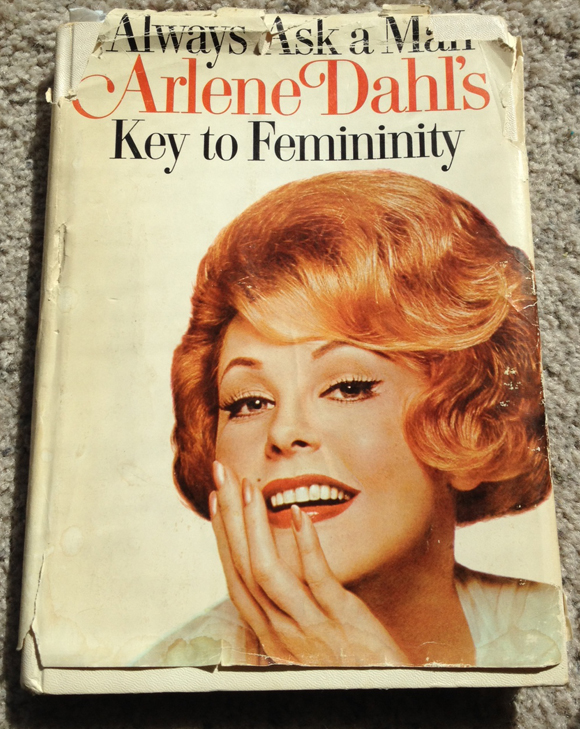
always ask a man (1965)

arlenedahl-always-ask-a-man-key-to-femininity

“Millions of dollars, the statisticians tell us, are spent yearly at beauty salons, cosmetics counters, gymnasiums, and dress shops in woman’s quest for beauty. But beauty for whom? The girls in the office? The women at the club? How can the world progress if women don’t consider men… the man… first?”

— Arlene Dahl, from Always Ask A Man: Arlene Dahl’s Key to Femininity (1965). Read more sage advice transcribed from this minor 1950s screen star’s tome HERE.

mount eerie – i hold nothing

Your love
swells and pounds me

I know nothing (now that I know you)
My face goes blank
My eyes go open gates
and the world can go (in them)
it can make us wealthy
and take away
so
I hold nothing (now that I hold you)

There’s no place to use our money where we live
The generous world suggests we live generously
so we lay
under low wide branches
of the oldest tree on the dune
or in the hay
where we will stay for so long without moving
that the careful birds finally relax
and make black nests in your black hair
and find ants walking around my unmoving feet
and we will only notice this play of the world
(that long moss is growing on us)
(that that wind has rewritten us)
(the give and take not stopping ever)
for only a moment
and then, having briefly noticed,
let the world roll on
through open gates

In a generous way
I give long walks to the dogs
I put commas and periods in song
I give closed eye to the day
I give peace to the long decay
(we do not need to fear dying)

— Written by Phil Elvrum, from the 2005 Mount Eerie album, “No Flashlight”: Songs of the Fulfilled Night

expose yourself to reality exposed

Diff-Opening-2Written by Sarah Dawson

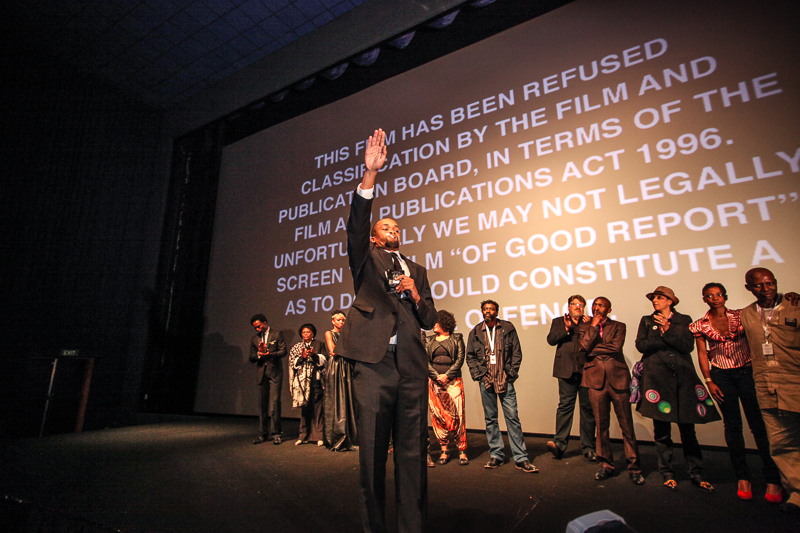
On July 18, the Film and Publication Board’s refusal to classify the would-be opening film of the Durban International Film Festival, Jahmil XT Qubeka’s Of Good Report, became the flint that sparked the latest South African aesthetic controversy.

Unclassified films are illegal to screen, which means that this is a functional ban on the production. The ruling was imposed on the basis of having interpreted the representation of a sexual encounter of a Grade 9 pupil, Nolitha, (played by the 23-year old actress Petronella Tshuma) as being child pornography.

Tongues have been wagging in creative circles and the media, and given that the film is divorced from any overt perspective on political matters (as in the case ofThe Spear), it is clear that this matter relates to some quite primal conflict over the interpretation of a particular image.

In this case, the battle over meaning is taking place in the awkward, sexually liminal space of the moment of the young female character’s transition from archetypal “virgin” to archetypal “whore”, and what she, the figure of the girl, means.

It probably wouldn’t be completely unfair to assume that the film is objectionable to the classification board because of this very liminality, and the way in which the morality embedded in the process clearly regards anything that isn’t exclusively either “virgin” or “whore” as a kind of abomination.

This act of censorship is fundamentally based on a conflict of representation – meaning it’s as much an aesthetic one as it is an ideological one. This means that we need to be asking not the obvious and common question of whether we should or shouldn’t be allowed to depict female children in an erotic light, but rather what actually is a female child, and what is an erotic light?

South African film and South African audiences remain equally conservative. The idea that representations of people, places, things and events can have a lot of different meanings and aren’t consistently, singularly defined is, surprisingly, not taken for granted by the typical South African viewer, practitioner or institution of film.

We aren’t yet comfortable with the multifarious nature of representation, and expend a lot of hot air trying to settle on the one, all-encompassing, so-called “South African voice”, which it turns out, we’re really struggling to locate.

It’s a self-evidently flawed project, because its ridiculous to think that such a thing could ever actually exist in a finite sense.

Read the rest of this article HERE.
poesboekies

This celebration of 80s South African pulp photo comic culture was made by Lloyd Ross and Robbie Thorpe in the late 1990s.

And here’s a piece on the subject written by DR Walker:

In 1980, like so many other white males, I was dragged kicking and screaming into that institution we would come to know as the SADF. The culture shock was enormous, legions of brown clad eenvormigge troepies all marching to the tune of the National party. After almost a year of rondfok and “training” I eventually ended up in the “Operational Area” or “The Border” as it was so commonly known.

Diversions were few and far between; drinking, talking kak, getting messed around, an occasional incursion by Swapo, and reading whatever came to hand. Newspapers were great but they reminded us of home too much so we avoided them. Paperbacks we never saw or they were invariably bad cowboy novels. Our all time favourite though were those beloved and much maligned “Photo Picture Libraries” or, as we so fondly knew them: “P*** Boekies”. These trashy produced pieces of literature fascinated us because you did not need an imagination, and if you did not understand the text you could always look at the pictures. They were better than a comic and were made in South Africa too.

Of course we all had our favourites, there was “Tessa”, a platinum blonde who strutted around in a bikini all day, running through the jungles of urban South Africa while clad in her cossie and high heels. Clashing with sinister suit and shade wearing individuals who were clearly “the bad guys” Naturally she always came out on top, the hair on that blonde head not even disturbed. As far as we were concerned she was akin to a Goddess and she would have been mobbed had she ever come to the border. With hindsight, those same bad guys looked very much like the guys who appeared before the Truth Commission and spilt so much dirty laundry. Maybe Tessa knew something we did not?

Remember “Swart Luiperd, Wit Tier, Kaptein Duiwel, Grensvegter” and all that ilk? They were out in the bushes clutching their wooden machine guns, (this is a rifle, this is a gun, this is for shooting, this is for fun), killing off naughty cigar smoking Cuban clones who held the proverbial dishevelled damsel in distress captive after her convoy/aircraft/helicopter/hospital was invaded/crashed/broke down (delete whichever is not applicable). By our reckoning we were not needed on the border, those three guys would solve all the problems and we could go home to start our long delayed civvy existence. Now that I think of it, just maybe they were really out there doing dirty deeds while we were being fed propaganda about how good the SADF and SAP were. Go on reading HERE.

For a critical history of South African pulp comics, read Sean O’Toole’s 2012 Mail & Guardian piece.

jane elliot’s brown eyes/blue eyes racism experiment

http://youtu.be/VeK759FF84s

It all seemed like a game at first… Watch this brilliant teacher recreate segregation in her 3rd grade classroom at the end of the 1960s, to demonstrate the arbitrary violence and effects of discrimination. A profound object lesson, and one the world still hasn’t been able to grasp; this is essential viewing. More about Jane Elliot’s work can be found HERE.

fairbanks-fairy-soap

erik bünger’s schizophonia

I watched two incredible films tonightSchizophonia and The Third Man, courtesy of Anette Hoffmann and the Archive & Public Culture Platform at UCT, with the kind permission of musician, composer and performance artist, Erik Bünger, who made the films.

In each film, Bünger both analyses and plays with the uncanny, magical potency of sound as recorded medium. Everything he does is underpinned by formidable quantities of research, a fondness for outrageously rhizomatic linkages and a wicked sense of humour. Definitely my new art crush of the month! ;)

Here’s a video of Bünger giving a lecture/performance which utilises much of the material presented in the standalone film, Schizophonia. This was recorded at MEDEA, Malmo University, in March 2011, as part of the K3 courses “Music in the Digital Media Landscape” and “Illustrating with Music”.

I really WISH I could find more of The Third Man to share here –  it was tremendously entertaining, and, even off on its most questionable, occult-paranoid tangents, bizarrely pertinent to so much of the stuff about performance, recording and playback of music that I’ve been posting and thinking about in the past few years; even down to an hilarious discussion of the “entraining” (his word) power of The Sound Of Music (my post this afternoon prefigured this too, eerily!).

Anyway, you can watch the lecture:

And here’s a bio:

The Swedish artist, composer, musician and writer Erik Bünger (1976) works with re-contextualising existing media in performances, installations and web projects. In ‘Gospels’, sections of Hollywood interviews are removed from their original contexts, interacting to form a new, seemingly coherent whole. Yet these pre-existing works frequently conflict; Bünger explores the disjunction between replaying and experiencing in his ‘Lecture on Schizophonia’. This simultaneously analytical and performative work highlights the relationship between sound and perceived reality, using popular references and familiar footage including Barak Obama and Woody Allen. Similar tensions are exposed in ‘God Moves on the Water’, in which two songs about the sinking of the Titanic are combined to form a third narrative. In ‘The Third Man’, the negative power of music is explored. Displacing and recombining familiar material, Bünger challenges the separation between authentic and simulated experiences.

Bünger may have followed a traditional education in composition at the Stockholm Royal College of Music, but he is hardly a run-of-the-mill composer. His works have increasingly come to approach contemporary conceptual art, but his combination of sound and visual is also linked to literary storytelling. In his performances, installations and web projects, different timelines are superposed, past worlds and present understandings. The most important thing about Bünger’s work is not the art or literature context but the transformation that takes place in the specific works. What may seem trivial and inconsequential suddenly becomes the stuff of dreams. He is attracted to moments when recorded sound and image bridge a space between absolutes, between death and life and between gods and humankind. –

This info comes from http://expo.argosarts.org/

hmv

Francis Barraud – “Dog Looking At and Listening to a Phonograph”(1898)