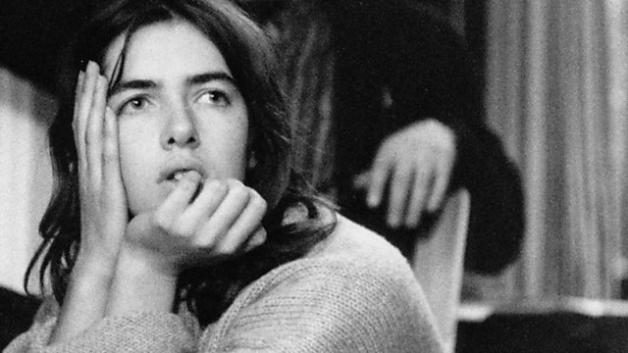
anne briggs (1971)

All songs are traditional:
“Blackwater Side” 0:00
“The Snow It Melts The Soonest” 3:50
“Willie O’Winsbury” 6:15
“Go Your Way” 11:47
“Thorneymoor Woods” 16:02
“The Cuckoo” 19:39
“Reynardine” 22:52
“Young Tambling” 25:52
“Living By The Water” 36:35
“Ma Bonny Lad” 40:28

The following is adapted from John Dougan of All Music Guide:

Anne Briggs was a singer of traditional English folk music, possessing as beautiful a voice as one could hope to have. She was the single most important influence on a group of female British folk singers including Sandy Denny, Maddy Prior, June Tabor, and Linda Thompson. Even Norma Waterson, herself a hugely important figure in the British folk revival of the mid-’60s, admits to being influenced by Briggs’ singing and notes that Anne Briggs singlehandedly changed the way that English women folk singers sang.

What makes this story so odd is that Anne Briggs’ entire recorded output consists of about 30 songs. She stopped singing at the age of 27, supposedly because she hated the sound of her recorded voice. As folk music became electrified and increasingly popular and bands such as Fairport Convention and Pentangle were reinventing the British folk tradition, and more and more women (Sandy Denny et al) were singing in a style started by Anne Briggs, her legend flourished, yet she still refused to sing. Read an interview with her HERE.

anne briggs

ppirf & one – no pussyfooting backwards (1973)

Funny story:

This is John Peel playing Fripp and Eno’s album backwards on BBC Radio One on 18th December 1973, without anyone in the studio knowing any difference. The story goes that Brian Eno was driving in his car, listening to Peel’s show, and he had the shock of his life when he heard Peel was playing his album backwards. He tried to phone the BBC to let Peel know that, but the BBC engineers thought it was an imposter playing a prank, therefore putting the phone down on him. Peel told his listeners at the end that it was an album worth buying, without realising he was playing it backwards!

P.S. Try playing this and the adjacent Japanese court music post simultaneously!

nippon gagaku kai

Ancient Japanese court music, recorded in 1972. Sublime.

A1 Hyōjō Netori
A2 Etenraku In Hyojo
A3 Etenraku In Banshkicho
A4 Etenraku In Oshikichō
A5 Bairo
B1 Sahō Taiheiraku (Kyū)
B2 Sahō Ranryō – Oh
B3 Uhō Genjōraku (Yatara Byōshi)
B4 Uhō Nasori (Ha)
B5 Uhō Nasori (Kyū)

Get this out-of-print recording HERE (look in the comments for the link).

louise glück on the unsaid

louise-gluckI am attracted to ellipsis, to the unsaid, to suggestion, to eloquent, deliberate silence. The unsaid, for me, exerts great power: often I wish an entire poem could be made in this vocabulary. It is analogous to the unseen for example, to the power of ruins, to works of art either damaged or incomplete. Such works inevitably allude to larger contexts; they haunt because they are not whole, though wholeness is implied: another time, a world in which they were whole, or were to have been whole, is implied. There is no moment in which their first home is felt to be the museum. …

… It seems to me that what is wanted, in art, is to harness the power of the unfinished. All earthly experience is partial. Not simply because it is subjective, but because that which we do not know, of the universe, of mortality, is so much more vast than that which we do know. What is unfinished or has been destroyed participates in these mysteries. The problem is to make a whole that does not forfeit this power.

— From Louise Glück, “Disruption, Hesitation, Silence” in Proofs & Theories: Essays on Poetry (New York: Ecco, 1994) 74-75.

sophie hunger – broken english

There were mountains to begin with
Silence shaped in giant
My voice would reach the highest
But you cannot tell this in English

An old man’s precise and attentive
My mother’s tongue my heart only sounds
As a girl I got lost in a cloud
But you cannot tell this in English

I balance an egg in a spoon
I’m never on time, it’s too late or too soon
In the night there is always the moon
That doesn’t speak in English

mladen dolar – his master’s voice

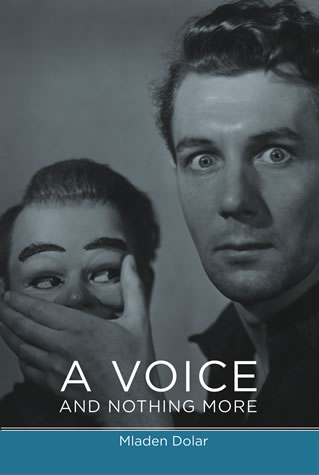
The following essay is excerpted from Mladen Dolar’s book, A Voice and Nothing More (which I’m reading for my dissertation).

The voice did not figure as a major [western] philosophical topic until the 1960s, when Derrida and Lacan separately proposed it as a central theoretical concern. Dolar goes beyond Derrida’s idea of “phonocentrism” and revives and develops Lacan’s claim that the voice is one of the paramount embodiments of the psychoanalytic object (objet a). Dolar proposes that, apart from the two commonly understood uses of the voice as a vehicle of meaning and as a source of aesthetic admiration, there is a third level of understanding: the voice as an object that can be seen as the lever of thought. He investigates the object voice on a number of different levels–the linguistics of the voice, the metaphysics of the voice, the ethics of the voice (with the voice of conscience), the paradoxical relation between the voice and the body, the politics of the voice–and he scrutinizes the uses of the voice in Freud and Kafka. (There’s a great review by Christine Boyko-Head HERE.)

a voice and nothing morePlutarch tells the story of a man who plucked a nightingale and finding but little to eat exclaimed: “You are just a voice and nothing more.”

There is a story that goes like this: In the middle of a war, in the middle of a battle, there is a company of Italian soldiers in the trenches. And there is an Italian commander who issues the command “Soldiers, attack!” But nothing happens, nobody moves. So the commander gets angry and shouts even louder “Soldiers, attack!” At which point there is a response, a voice rising from the trenches saying Che bella voce!

This story can serve as a good entry into the problem of the voice. On the first level this is a story of a failed interpellation. The soldiers fail to recognize themselves in the appeal, the call of the other, the call of duty, and they don’t act accordingly. Surely the fact that they are Italian soldiers plays a great role in it, they do act according to their image of not the most courageous soldiers in the world, as legend has it, and the story is most certainly not a model of political correctness, it indulges in tacit chauvinism and national stereotypes. So the command fails, the addressees don’t recognize themselves in the meaning being conveyed, they concentrate instead on the medium, which is the voice. The attention paid to the voice hinders the interpellation and the transmission of a symbolic mandate, the transmission of a mission.

But on a second level another interpellation works in the place of the failed one: if the soldiers don’t recognize themselves in their mission as the soldiers in the middle of a battle, they do recognize themselves as addressees of another message, they constitute a community as a response to the call, the community of people who can appreciate the aesthetics of a beautiful voice. Who can appreciate it when it is hardly the moment, and especially when it is hardly the moment to do so? So if in one respect they act as stereotypical Italian soldiers, they also act as stereotypical Italians in this other respect, namely as opera lovers. They constitute themselves as the community of “the friends of the Italian opera” (to take the immortal line from Some Like It Hot), living up to their reputation of connoisseurs, people of refined taste who have amply trained their ears with bel canto, so they can tell a beautiful voice when they hear one, even among the canon fire.

The soldiers have done the right thing, from our biased present perspective, at least in an incipient way, when they have concentrated on the voice instead of on the message, although, to be sure, for the wrong reasons. They are seized by a sudden aesthetic interest precisely when they would have had to attack, they concentrate on the voice because they have grasped the meaning all too well. But quite apart from their feigned artistic inclination they have also bungled the voice the moment they isolated it, they immediately turned it into an object of aesthetic pleasure, an object of veneration and worship, the bearer of a meaning beyond the ordinary meanings. The aesthetic concentration on the voice loses the voice precisely by turning it into a fetish-object.

I will try to argue that there is a third level: an object voice which doesn’t go up in smoke in conveyance of meaning and which doesn’t solidify either in an object of fetish reverence, but an object which functions as a blind spot in the call and a disturbance of aesthetic appreciation. One shows fidelity to the first by running to the attack, one shows fidelity to the second by running to the opera. But fidelity to the third is far more difficult to achieve. I will try to pursue it on three different levels: linguistics, ethics and politics. Continue reading

zhou xuan – don’t sing (1947)

Gramophone recording 周璇-不要唱吧 (1947).

Bad translation:

Word you said too elegant
Turn, do not sing, do not sing!
Self-love and love
Sound they say is too nauseating
Easily and not great
Majestic and frightening
Solemn nobody loves it
Not to sing, do not sing!
Do not open so people curse
Do not open to avoid being criticized
Do not sing do not sing!

lata mangeshkar – mujh ko iss raat ki tanhai mei

I’ve been listening to old Lata Mangeshkar records on my new, very old His Master’s Voice (model HMV 88a) gramophone. Indescribably magical, to listen to something powered only by the twist of your own wrist.

This song is from the film Dil Bhi Tera Hum Bhi Tere (1960).

Don’t call out to me in the stillness of the night
Don’t play that music which brings tears to my eyes
Don’t play it
Don’t call out to me

gaudeamus igitur

My irreverent nieces’ voicenotes are just the best when end of term varsity work is driving me a bit insane.

Gaudeamus igitur
Iuvenes dum sumus.
Post iucundam iuventutem
Post molestam senectutem
Nos habebit humus.
Let us rejoice, therefore,
While we are young.
After a pleasant youth
After a troubling old age
The earth will have us.

e.b. white’s response to a man who had lost his faith in humanity

helping charlotteDear Mr. Nadeau:

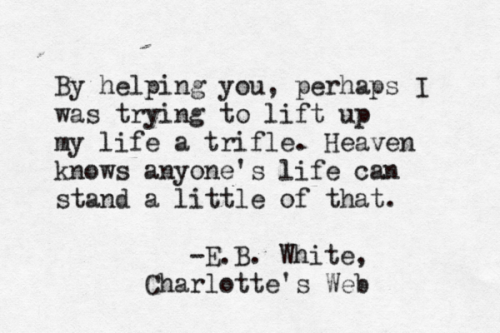
As long as there is one upright man, as long as there is one compassionate woman, the contagion may spread and the scene is not desolate. Hope is the thing that is left to us, in a bad time. I shall get up Sunday morning and wind the clock, as a contribution to order and steadfastness.

Sailors have an expression about the weather: they say, the weather is a great bluffer. I guess the same is true of our human society – things can look dark, then a break shows in the clouds, and all is changed, sometimes rather suddenly. It is quite obvious that the human race has made a queer mess of life on this planet. But as a people we probably harbour seeds of goodness that have lain for a long time waiting to sprout when the conditions are right. Man’s curiosity, his relentlessness, his inventiveness, his ingenuity have led him into deep trouble. We can only hope that these same traits will enable him to claw his way out.

Hang on to your hat. Hang on to your hope. And wind the clock, for tomorrow is another day.

Sincerely,

E. B. White

(I found this at Letters of Note.)

lizza littlewort on the nature of “art”

lizzaI think it’s an imperialist idea with massive blind spots.

I think creativity, and the making of artefacts, is a product of cultures in general, and the Western sense of “Art” is a product of massive surplus over and above the meeting of needs for artefacts.

The idea of it as a “high” expression of culture has spread with imperialism, as did the idea of a “national culture” being expressed through literature. It is as Western as the English language, and carries with it the same kinds of embedded privilege, in terms of it being a “text” which privileges European concerns. It is impossible to “speak” art without its European history being part of the discussion.

I think that much like European history has been selectively “rewritten” to seem to be a continuous, meaningful story from prehistory to Modern America, so has art history.

It’s great to have it around. Certainly I like it. But to engage in it without confronting its lies and limitations is like living inside the bubble of white privilege without standing back to look at its impact on the world in general, and see who gets favoured by its discourses of “natural” “genius” and “talent” (as opposed to “first-language” familiarity), compared with who gets punished and dumped outside its magic circle like so much human trash.

octavio paz – no more clichés

Beautiful face
That like a daisy opens its petals to the sun
So do you
Open your face to me as I turn the page.

Enchanting smile
Any man would be under your spell,
Oh, beauty of a magazine.
How many poems have been written to you?
How many Dantes have written to you, Beatrice?
To your obsessive illusion,
To your manufactured fantasy?

But today I won’t make one more cliché
And write this poem to you.
No, no more clichés.

This poem is dedicated to those women
Whose beauty is in their charm,
In their intelligence,
In their character,
Not in their fabricated looks.

This poem is to you women,
That like a Scheherazade wake up
Every day with a new story to tell,
A story that sings for change
That hopes for battles:
Battles for the love of the united flesh
Battles for passion aroused by a new day
Battles for neglected rights
Or just battles to survive one more night.

Yes, to you women in a world of pain
To you, bright star in this ever-spending universe
To you, fighter of a thousand-and-one fights
To you, friend of my heart.

From now on, my head won’t look down to a magazine
Rather, it will contemplate the night
And its bright stars,
And so, no more clichés.

naomi uman – removed

Using as her source material a segment of 1970s European softcore pornography, Naomi Uman created this derived piece by painstakingly removing the female from each frame using bleach and nail polish remover, thus presenting the viewer with a bizarre, ghostly effect of a figure; a blank void of a woman.

achille mbembe on the inadequacy of neoliberal definitions of humanity and citizenship

Antonia Mora

Image: Antonio Mora

The “human” in the South African context

Whether there is anything which is still to be rediscovered or to be reanimated from the term “the human” takes on a paradoxical resonance in contemporary South Africa. With the end of apartheid, South African culture and society was confronted with the urgency of engaging in affirmative politics in lieu of the politics of destruction of the years of racial segregation. Affirmative politics entailed the production of social horizons of hope. At the same time, it meant resisting both the inertia of the present and the nostalgia of the past. To reconstruct what centuries of racial brutality had destroyed, a balance had to be found between the mobilization, actualization and deployment of cognitive, affective and creative possibilities which had not so far been activated, along with a necessary dose of oppositional consciousness.

Critical humanism in this new context would have meant a persistent commitment to the possibilities and powers of life. There is substantial evidence that a return to the question of the possibilities and powers of life as a precondition for the reconstitution of “the human” in politics and culture was recognized as a matter of ethical and political urgency during the first decade of democracy. During this decade, South Africa became a model of how to dismantle a racial mode of rule, strike down race-based frameworks of citizenship and the law while striving to create racial equality through positive State action. The post-apartheid State fostered a normative project with the aim of achieving justice through reconciliation, equality through economic redress, democracy through the transformation of the law and the restoration of a variety of rights, including the right to a dignified life. This normative project was enshrined in a utopian Constitution that attempts to establish a new relationship between law and society on the one hand and law and life on the other, while equating democracy and the political itself with the ethical and the just. This Constitution’s underlying principle is ubuntu or human mutuality. It promises a transcendence of the old politics of racial difference and an affirmation of a shared humanity. Underpinning the Constitution is the hope that, after centuries of attempts by white power to contain blacks, South Africa could become the speech-act of a certain way of being-in-common rather than side by side.

This drive to “re-humanize” society and culture and to institutionalize a new political community that defines itself as an ethical community is nevertheless unfolding against various odds. Perhaps to a degree hardly achieved in the rest of the Continent, the human has consistently taken on the form of waste within the peculiar trajectory race and capitalism espoused in South Africa. Traditionally, we speak of “waste” as something produced bodily or socially by humans. In this sense, “waste” is that which is other than the human. Traditionally too, we speak of the intrinsic capacity of capitalism to waste human lives. We speak of how workers are wasted under capitalism in comparable fashion to natural resources. Marx in particular characterizes capitalist production as thoroughly wasteful with what he calls “human material” just as it is with “material resources”. It squanders “human beings, living labour”, “squandering not only flesh and blood, but nerves and brain, life and health as well”, he writes. In order to grasp the particular drama of the human in the history of South Africa, we should broaden this traditional definition of “waste” and consider the human itself as a waste product at the interface of race and capitalism. Squandering and wasting black lives has been an intrinsic part of the logic of capitalism, especially in those contexts in which race is central to the simultaneous production of wealth and of superfluous people.

Today, this logic of waste is particularly dramatized by the dilemmas of unemployment and disposability, survival and subsistence, and the expansion in every arena of everyday life of spaces of vulnerability. Despite the emergence of a solid black middle class, a rising superfluous population is becoming a permanent fixture of the South African social landscape with little possibility of ever being exploited by capital. Only a dwindling number of individuals can now claim to be workers in the traditional sense of the term. How to govern the poor has therefore become one of the biggest moral questions facing the nascent democracy. Behind policy debates on “welfare” and “service delivery” loom fundamental ethical choices that will determine the nature of the South African experiment in democracy – questions of how to right historical wrongs; what is the relationship between personal or collective injury and larger problems of equality, justice and the law; hunger and morality; owning and sharing; or even truth, hope and reconciliation. The urgency of these new moral dilemmas is such that, for the democratic project to have any future at all, it should necessarily take the form of a conscious attempt to retrieve life and “the human” from a history of waste.

Wealth and property

Meanwhile, wealth and property have acquired a new salience in public debate. They have become the key, central idioms to framing and naming ongoing social struggles – from imagining the relationship between “the good life” to redefining value itself; from claims of citizenship, rights and entitlements to the definition of the forms of property and the economy itself (whether we should nationalize or not); from matters of morality to those of lifestyle and accountability.

The centrality of wealth in the moral discourse concerning the “human’ is not new. In various parts of pre-colonial Africa, discourses on “the human”, or, on “humanity” almost always took the shape and content of discourses about “wealth”, “personhood” and “social multiplicity”. Traditional definitions of wealth usually encompassed “people”, “things” and “knowledge”.

“People”, that is, other human beings, were not only the most important unit of measurement of ultimate value. They also formed the material basis or infrastructure of human life. ‘People’ consisted of interpersonal dependents of all kinds – wives, children, clients and slaves. As Jane Guyer argues, they were sought, valued, and at times paid for at considerable expense in material terms. Kinship and marriage especially were critical components of accumulative strategies. But wealth also covered traded goods, including the imported goods brought from elsewhere. Things could be personalized objects. Goods could be functionally interchangeable with human beings who in turn could in certain respects be “objectified” or converted into clients or followers.

Wealth – embodied in rights in people – remained a persistent principle of African social and moral life even in the midst of the various shifts induced by the slave trade and colonialism. Knowledge on the other hand was understood as an ever shifting spectrum of possibility. Jane Guyer makes it clear that it was highly valued, complexly organized and plural by definition. There was no social organization of kinship and material life that did not depend, to some extent, on a regime of distribution of knowledge – the arts, music, dance, rhetoric, spiritual life, hunting, gathering, fishing, cultivation, wood-carving, metallurgy. If certain forms of knowledge were specialized, controlled and monopolized by a small cadre of experts or a secret society hierarchy, other forms of knowledge were conceptualized as an open and unbounded repertoire. This unboundedness made it possible for such forms of knowledge to be widely distributed throughout the society and among many adepts on the basis of personal capacity or potentiality.

Indeed, African pre-colonial discourses on the “human” allowed for personal differentiation or singularity. It was believed that certain qualities lived in the individual from his or her birth; which he or she had no need for “magic” to arouse although there was always the indispensable need for magical rites to conserve these. Personal abilities could be augmented, conserved and actualized within the person, making that person a “real person”, recognized as such by the community. Each individual person’s power was itself a composition.

That some of these old tropes might still be at work in current controversies on wealth and property should not be entirely excluded. But that wealth, poverty and property have become essential to the self-understanding of South African society after liberation should also be read against a long history of black dispossession. In the new phase of “frontier accumulation” made possible by the 1994 negotiated settlement, they have become the new idioms for political and normative arguments about what should be the proper relation of people to things; what should be the proper relation of people to each other with respect to things; how much property is enough for one person and how much is too much; how much enjoyment is justifiable especially for the opulent in an environment where hunger and debasement are all too real for many. It is this tension between what looks like an unstoppable logic of unproductive excess on the one hand and on the other, a logic of scarcity and depletion that is turning wealth and property into dramatic sites of contestation.

Wealth and property also operate as means of regulating access to resources that are scarce for some and plentiful for others. They are the main means by which life chances are assigned to different kinds of persons at a time when pockets of wealth and privilege are proving hard not only to account for and even less so to control, but also hard to subject to some form of accountability and redistribution. Furthermore, as Arjun Appadurai observes, the life of the poor has become a strenuous effort to produce, if not a sense of stability, then something like permanence in the face of the temporariness or volatility of almost all the arrangements of social existence. Indeed, one of the most brutal effects of neo-liberalism in South Africa has been the generalization and radicalization of a condition of temporariness for the poor. For many people, the struggle to be alive has taken the form of a struggle against the constant corrosion of the present, both by change and by uncertainty.

In order to reanimate the idea of “the human” in contemporary South African politics and culture, there is therefore no escape from the need to reflect on the thoroughly political and historical character of wealth and property and the extent to which wealth and property have come to be linked with bodily life. If what distinguishes the South African experiment from other such experiments elsewhere in the world is the attempt to establish a new relationship between law and life while equating democracy and the political itself with the ethical and the just, then we have to ask under what conditions can this project of human mutuality result in a broader and more ethical commensality.

Read the rest of this essay HERE.
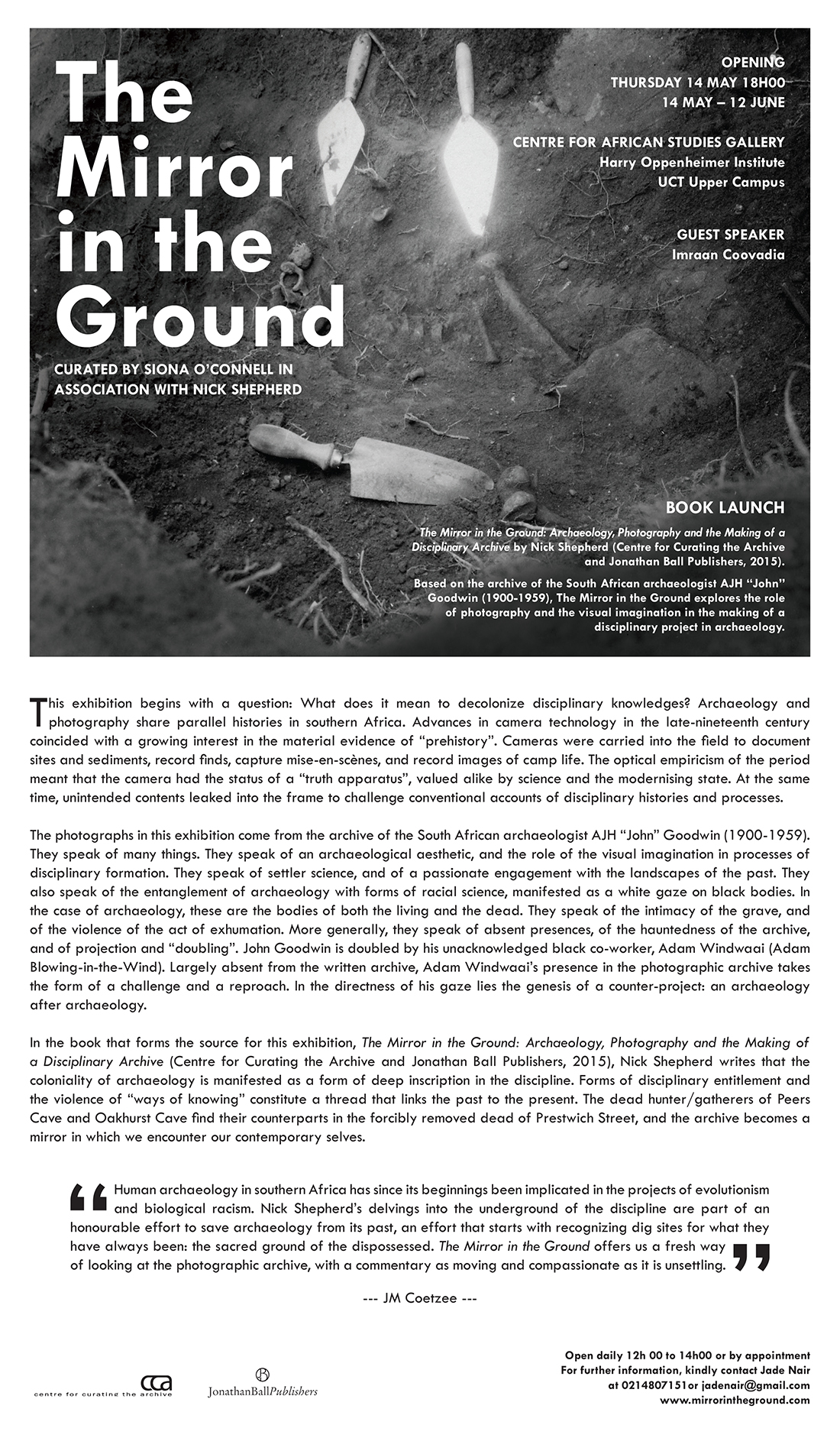
“the mirror in the ground” book launch and exhibition

Happening next Thursday, 14 May 2015, this book launch and exhibition promises to be well worth attending. I’ve read parts of the manuscript for the book, and it deals with the topics of western scientific knowledge production and reading colonial archives “across the grain” in ways that are really apposite right now.

mirror