Originally telecast on 31 July,1977.
Originally telecast on 31 July,1977.
Image: Eric Rondpierre
Self knowledge is not fully possible for human beings. We do not reside in a body, a mind or a world where it is achievable or, from the point of being interesting, even desirable. Half of what lies in the heart and mind is potentiality, resides in the darkness of the unspoken and unarticulated and has not yet come into being: this hidden unspoken half of a person will supplant and subvert any present understandings we have about ourselves. Human beings are always, and always will be, a frontier between what is known and what is not known. The act of turning any part of the unknown into the known is simply an invitation for an equal measure of the unknown to flow in and reestablish that frontier: to reassert the far horizon of an individual life; to make us what we are – that is – a moving edge between what we know about ourselves and what we are about to become. What we are actually about to become or are afraid of becoming always trumps and rules over what we think we are already…
— David Whyte, 2014. Excerpted from “Self Knowledge”, from the upcoming book of essays CONSOLATIONS: The Solace, Nourishment and Underlying Meaning in Everyday Words.
 The Archive & Public Culture Research Initiative (where I work) has invited Esther Peeren, author of The Spectral Metaphor: Living Ghosts and the Agency of Invisibility (Palgrave, 2014), for a week of intense discussion, academic exchange and engagement around the theme of the ghost/spectre both as archival metaphor and as conceptual figure in post-colonial and cultural studies.
Peeren is Associate Professor of Media Studies at the University of Amsterdam, Vice-Director of the Amsterdam Centre for Globalisation Studies (ACGS) and senior researcher at the Amsterdam School for Cultural Analysis (ASCA). Her current research projects explore global spectralities and rural globalization.
On Tuesday, 26 August, she will deliver a lunchtime lecture, Lumumba’s Ghosts: Immaterial Matters and Matters Immaterial in Sven Augustijnen’s Spectres, in the Jon Berndt Thought Space (A17, Arts Block, Upper Campus, University of Cape Town). In her analysis of Belgian artist Sven Augustijnen’s 2011 multi-media exhibition, Spectres (which focuses on the mystery of the 1961 assassination of Patrice Lumumba, the first democratically elected Prime Minister of the independent Republic of the Congo), Peeren argues that a focus on immaterialities-as-spectralities prompts the viewer to take seriously that which is not immediately apprehensible, or deemed inconsequential. At the same time, it transforms our understanding of matter itself, since immateriality is inevitably implied in materiality, both metaphorically (materialities may be considered immaterial, insignificant) and literally (over time, materialities may transform, decay or even disappear).
Appealing to Jacques Derrida’s concept of spectrality, her analysis shows how Augustijnen’s work, especially the feature-length film included in the exhibition, moves the materiality of the immaterial and the immateriality of the material centre stage, and lays out the consequences of this double imbrication for individual and collective understandings of history, memory and the archive.
If you’d like to attend pn 26 August, RSVP to APC-admin@uct.ac.za.
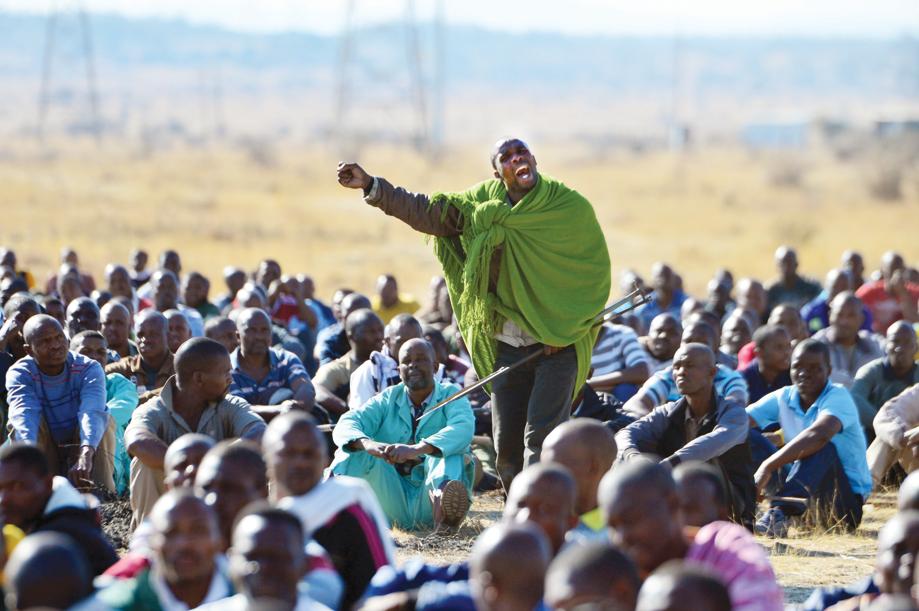
This chillingly insightful documentary on the Marikana massacre should be required viewing for every South African. It’s two years tomorrow since that terrible, indelible day. The film is available to watch in full on Youtube for a few days only. Don’t miss this opportunity. EDIT: 18/8: The film is no longer available on Youtube. Please visit its website to find out about future screenings.
In August 2012, mineworkers at one of South Africa’s biggest platinum mines began a wildcat strike for better wages.
Six days later, on 16 August 2012, the police used live ammunition to suppress the strike, killing 34 and injuring many more.
Using the point of view of the Marikana miners, “Miners Shot Down” follows the strike from day one, showing the courageous but isolated fight waged by a group of low-paid workers against the combined forces of the mining company Lonmin, the ANC government and their allies in the National Union of Mineworkers.
What emerges is collusion at the top, spiralling violence, police brutality and the country’s first post-apartheid massacre. If you still have any doubts that this was a premeditated massacre by Lonmin, the government and the police, this documentary will change your mind with a lot of previously unseen footage. Nobody will have an excuse after watching this to continue to blame the miners.
South Africa will never be the same again.
Victrola record (Canadian Berliner) 88483 [275]. “Berceuse de Jocelyn” (“Angels Guard Thee”), written by Benjamin Godard. John McCormack – tenor, Fritz Kreisler – violin, Vincent O’Brien – pianoforte. First issued circa late 1914.
Beneath the quivering leaves, where shelter comes at last,
All sadness sinks to rest, or glides into the past.
Her sweet eyes prismed now in their soft silken bowers,
Oh my love, calm she sleeps beneath the trembling stars.
Awake not yet from thy repose,
A fair dream spirit hovers near thee,
Weaving a web of gold and rose,
Through dreamland’s happy isles to bear thee.
Sleep, love, it is not yet the dawn,
Angels guard thee, sweet love, till morn.
Far from the noisy throng, by song birds lulled to rest,
Where rock the branches high by breezes soft caress’d;
Softly the days go on, by sorrow all unharm’d,
Thus may life be to thee a sweet existence charm’d.
Ah! wake not yet from thy repose,
A fair dream spirit hovers near thee,
Weaving a web of gold and rose,
Through dreamland’s happy isles to bear thee!
Sleep, love, it is not yet the dawn,
Angels guard thee, sweet love, til morn!
Rest in peace, Robin Williams.

… gained from storyboarding an endless stream of jock lager ads:
Where men are a caricature of manliness, their sexuality depends on them always being The Ones Who Know, who are worldly and can sum up reality in short, pithy bro-repartee (bropartee). To achieve this, they need to simplify reality into easy-to-read contrasts, with rules in big type, so they don’t have to suffer the shrivelling-dick humiliation of being faced with complexity.


“My name is Amy Leibrand. I reside deep in the suburbs of Columbus, Ohio. I am a science writer. This is just a fancy way of saying I take data and summarize it.”
Read more of this interview and see more of her work and some of her compositing techniques HERE.
Amy’s own website is also well worth checking out, HERE. This is excerpted from her artist’s statement:
“My work shifts between visceral, uncomfortable, intimate self-portraits and surreal travel narratives; by nature, I am a wanderer, both in body and in mind. Colossal legs that dwarf a desert, forest, mountain landscape reveal the discomfort I feel in my surroundings, and the endless search for satisfaction, perhaps even a nod to escape. Turning the camera on myself, self-portraits illustrate the endless conflict between internal and external dialogue: pretty versus ugly, fearless versus cowardly, and so on. Using subtle odd, dreamlike, humoristic and disturbing elements, my intent is to objectify not only my own emotions, but those of the viewer. I want the viewer to become part of my work, as their reaction has as much to do with the art as the artwork itself.”

The wonderful Jun Togawa, Japan’s Bjork-before-there-was-Bjork (although comparisons can be reductive, she’s cut from similar revolutionary woman cloth), with her band Yapoos, off their 1987 album, ヤプーズ計画 (Yapoos Plan). And this video is incredible.
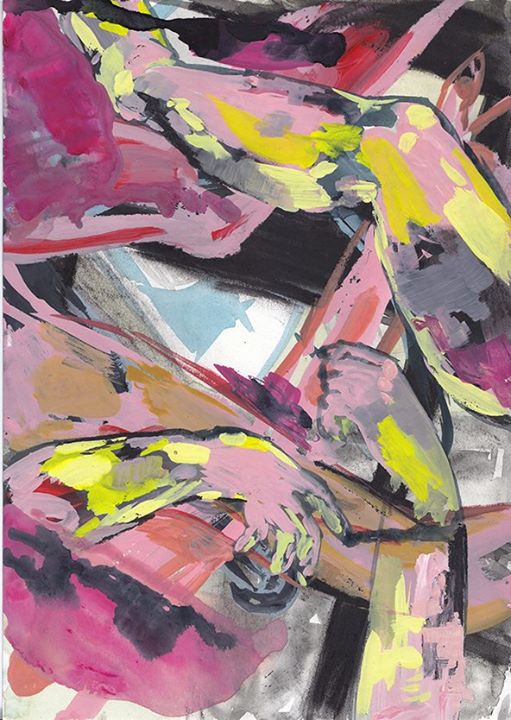
“Such a long way to Cecily Brown.” Lizza Littlewort, 2014.
I saw this guy live at the Baxter Theatre last night. He is wonderful.
Willy Mason live at The Band Room in Farndale, North Yorkshire, UK, 3 February 2007.

Some of the New Zealand beaches are black volcanic ash, with bright shiny dots, purples and golds …
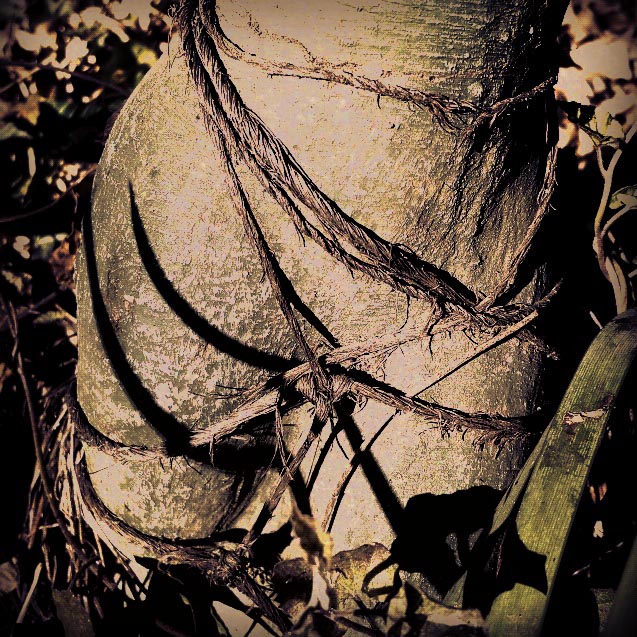
#BedtimeStory:
“every mouth you’ve ever kissed
was just practice
all the bodies you’ve ever undressed
and ploughed in to
were preparing you for me.
i don’t mind tasting them in the
memory of your mouth
they were a long hall way
a door half open
a single suit case still on the conveyor belt
was it a long journey?
did it take you long to find me?
you’re here now,
welcome home.”
―Warsan Shire
“Compassion hurts. When you feel connected to everything, you also feel responsible for everything. And you cannot turn away. Your destiny is bound with the destinies of others. You must either learn to carry the Universe or be crushed by it. You must grow strong enough to love the world, yet empty enough to sit down at the same table with its worst horrors.”
― Andrew Boyd, in Daily Afflictions: The Agony of Being Connected to Everything in the Universe (W W Norton & Company, 2002).
“(1) A major corporation is like a construction set. It can be used to put together the whole world. (2) Because of the growing division of labour, many people no longer recognize the role they play in producing mass destruction. (3) That which is manufactured in the end is the product of the workers, students, and engineers.”
“When we show you pictures of napalm victims, you’ll shut your eyes. You’ll close your eyes to the pictures. Then you’ll close them to the memory. And then you’ll close your eyes to the facts.” These words are spoken at the beginning of an agitprop film that can be viewed as a unique and remarkable development. Farocki refrains from making any sort of emotional appeal. His point of departure is the following: “When napalm is burning, it is too late to extinguish it. You have to fight napalm where it is produced: in the factories.”
Harun Farocki, rest in peace.
Another track written by the brilliant Curtis Mayfield (who was just 20 at the time) and released as a single on Okeh in December 1963.
Penned by Curtis Mayfield, from the group’s near-flawless album, Not Me (Cameo, 1963).


Photo: Andrew Turner. “Me 1998. My room I shared with Ghangis. Trying to look cool.”
Animator Nina Paley, she of the wonderful public domain film Sita Sings the Blues (WATCH IT, please, if you haven’t yet!), also made another short cartoon a while back*, this one caricaturing the ongoing conflict in the Middle East.
So, who’s killing who? Nina has provided a handy guide to the various historical groups HERE.
*Please do note that this was made in 2012, before the most recent turn of events.
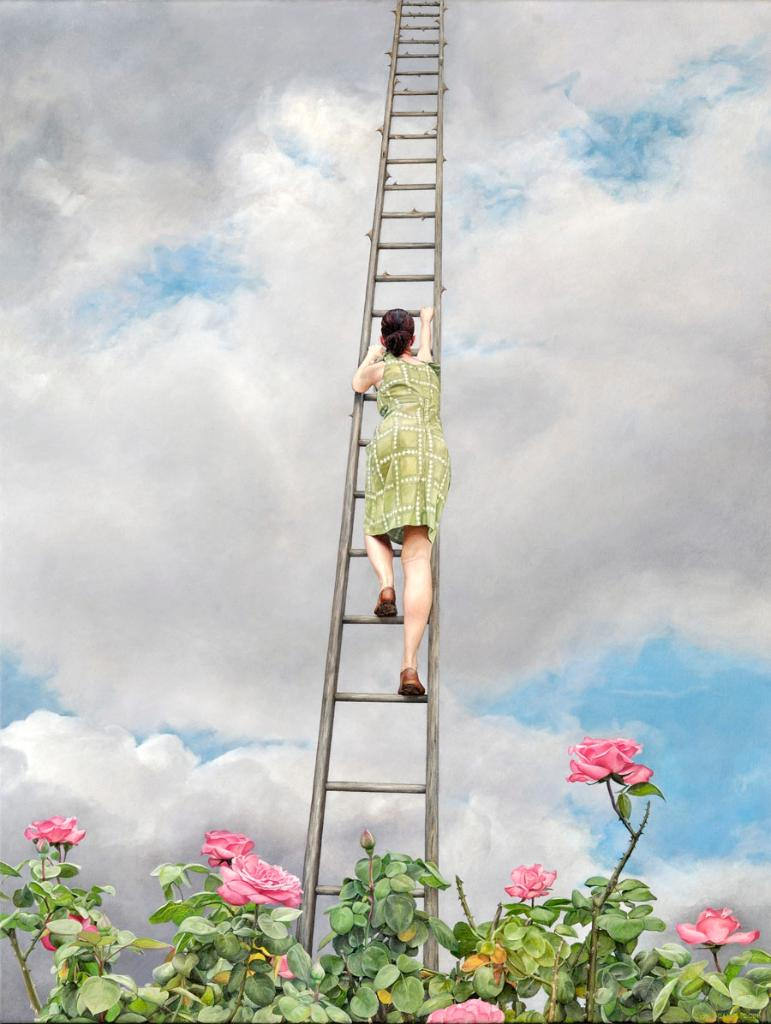
Lisa Adams – “Rose Garden”, 2008.
Check out more of this self-taught Australian artist’s darkly surreal work HERE.
(My gratitude to Joey Hamilton for the introduction!)

This deserves to be heard. The cynical manipulation and deception happening will blow your mind. This talk by ex-Israeli Defence Force soldier Eran Efrati was filmed in Denver, Colorado on March 3, 2014 as part of The Soldier and the Refusenik U.S. tour with Maya Wind. Eran talk about his experiences in the Israeli Defence Force (IDF) and then more broadly discusses Israel, its relationship to the U.S. and the global expansion of militarism.
Eran Efrati, 28, was born and raised in Jerusalem. After graduating high school he enlisted in the IDF, where he served as a combat soldier and company sergeant in Battalion 50 of the Nachal Division. He spent most of his service in Hebron and throughout the West Bank. In 2009, he was discharged and joined Breaking the Silence, an organization of veteran Israeli soldiers working to raise awareness about the daily reality in the Occupied Territories.
He worked as the chief investigator of the organization, collecting testimonies from IDF soldiers about their activities. He also guided political tours and to the West Bank and worked to educate Israeli youth about the reality of being a soldier in an occupying army. His collected testimonies appear in the booklet “Operation Cast Lead” and their most recent release “Our Harsh Logic”.
Since leaving Breaking the Silence, his investigative reports appeared in The New York Times, The Washington Post and The Guardian. Today he is active with the Israeli groups Anarchists Against the Wall and Boycott from Within.
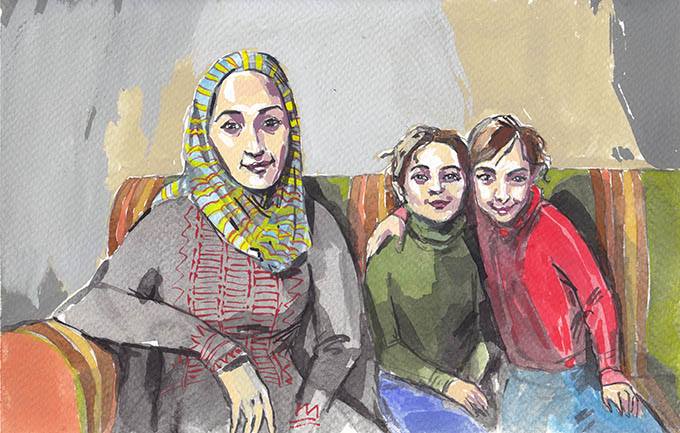
A mother and two little girls, Palestine. Lizza Littlewort, July 2014
Q: Lizza, did you paint this from a photo? I want to post these on Fleurmach and include context if there is some.
A: The likenesses are so bad there’s not much point referring to the originals… which I guess is a good thing, because I don’t feel like I’m violating anyone’s privacy. I’ve been working in a way where I strive for immediacy by going straight into paint with no pencil work underneath, so it’s pot luck how it turns out. The subjects are Palestinian though, I can say that much! I wanted to be sure to get a mood which is realistic. I want to do more of people in Palestine being human.
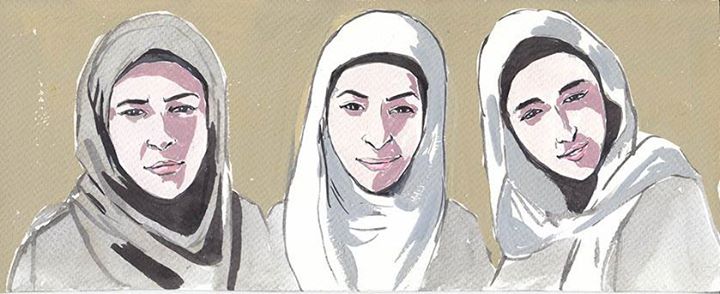
Three national coordinators of Tomorrow Youth Organisation, Palestine. Lizza Littlewort, July 2014.
 fleurmach