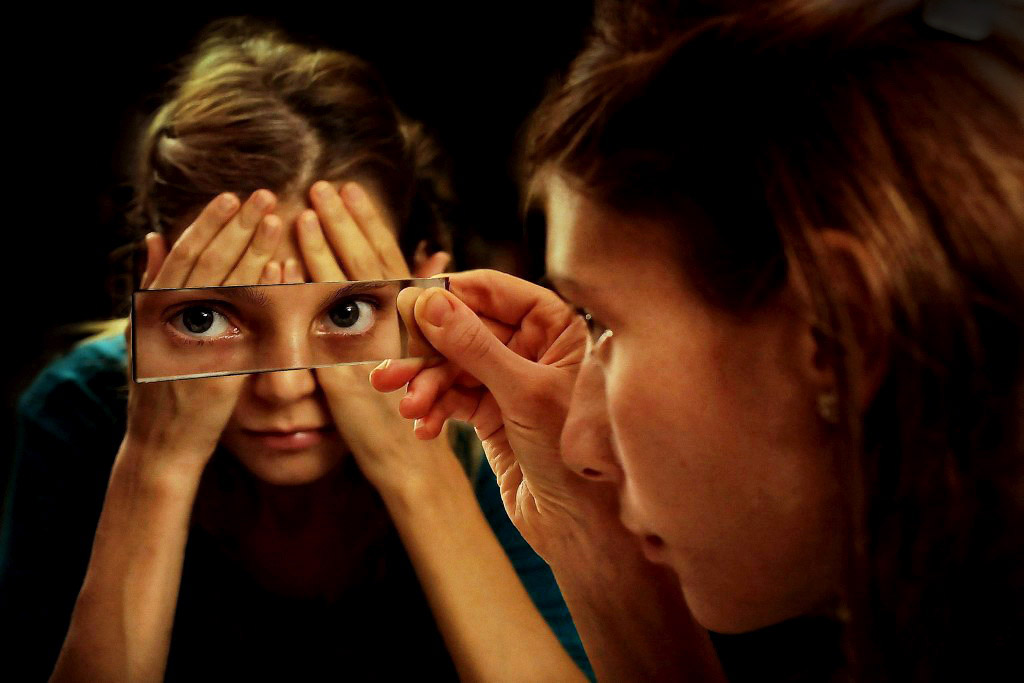
essentially

hate and love

If only a change of heart could magically repair the concrete effects of centuries of evil and dispossession overnight… It can’t, but thank you, Nelson Rolihlahla Mandela, for holding on to hope; for leading by example. If we all started living from an unselfish basis of love and respect, things WOULD shift.

luce irigaray – women on the market

Chapter Eight from This Sex Which Is Not One, 1985. This text was originally published as “Le marche des femmes,” in Sessualita e politica, (Milan: Feltrinelli, 1978).

hands on experience

The society we know, our own culture, is based upon the exchange of women. Without the exchange of women, we are told, we would fall back into the anarchy (?) of the natural world, the randomness (?) of the animal kingdom. The passage into the social order, into the symbolic order, into order as such, is assured by the fact that men, or groups of men, circulate women among themselves, according to a rule known as the incest taboo.

Whatever familial form this prohibition may take in a given state of society, its signification has a much broader impact. It assures the foundation of the economic, social, and cultural order that has been ours for centuries.

Why exchange women? Because they are “scarce [commodities] . . . essential to the life of the group,” the anthropologist tells us.1 Why this characteristic of scarcity, given the biological equilibrium between male and female births? Because the “deep polygamous tendency, which exists among all men, always makes the number of available women seem insufficient. Let us add that even if there were as many women as men, these women would not be equally desirable … and that, by definition. . ., the most desirable women must form a minority. “2

Are men all equally desirable? Do women have no tendency toward polygamy? The good anthropologist does not raise such questions. A fortiori: why are men not objects of exchange among women? It is because women’s bodies – through their use, consumption, and circulation – provide for the condition making social life and culture possible, although they remain an unknown “infrastructure” of the elaboration of that social life and culture. The exploitation of the matter that has been sexualized female is so integral a part of our sociocultural horizon that there is no way to interpret it except within this horizon.

In still other words: all the systems of exchange that organize patriarchal societies and all the modalities of productive work that are recognized, valued, and rewarded in these societies are men’s business. The production of women, signs, and commodities is always referred back to men (when a man buys a girl, he “pays” the father or the brother, not the mother … ), and they always pass from one man to another, from one group of men to another. The work force is thus always assumed to be masculine, and “products” are objects to be used, objects of transaction among men alone.

Which means that the possibility of our social life, of our culture, depends upon a ho(m)mo-sexual monopoly? The law that orders our society is the exclusive valorization of men’s needs/desires, of exchanges among men. What the anthropologist calls the passage from nature to culture thus amounts to the institution of the reign of hom(m)o-sexuality. Not in an “immediate” practice, but in its “social” mediation. From this point on, patriarchal societies might be interpreted as societies functioning in the mode of “semblance.” The value of symbolic and imaginary productions is superimposed upon, and even substituted for, the value of relations of material, natural, and corporal (re)production.

sensualist gif

From “The Sensualist”, Kōshoku Ichidai Otoko’s animated interpretation of the 17th century novel by Ihara Seikaku

In this new matrix of History, in which man begets man as his own likeness, wives, daughters, and sisters have value only in that they serve as the possibility of, and potential benefit in, relations among men. The use of and traffic in women subtend and uphold the reign of masculine hom(m)o-sexuality, even while they maintain that hom(m)o-sexuality in speculations, mirror games, identifications, and more or less rivalrous appropriations, which defer its real practice. Reigning everywhere, although prohibited in practice, hom(m)o-sexuality is played out through the bodies of women, matter, or sign, and heterosexuality has been up to now just an alibi for the smooth workings of man’s relations with himself, of relations among men.

Whose “sociocultural endogamy” excludes the participation of that other, so foreign to the social order: woman. Exogamy doubtless requires that one leave one’s family, tribe, or clan, in order to make alliances. All the same, it does not tolerate marriage with populations that are too far away, too far removed from the prevailing cultural rules. A sociocultural endogamy would thus forbid commerce with women. Men make commerce of them, but they do not enter into any exchanges with them. Is this perhaps all the more true because exogamy is an economic issue, perhaps even subtends economy as such? The exchange of women as goods accompanies and stimulates exchanges of other “wealth” among groups of men. The economy in both the narrow and the broad sense-that is in place in our societies thus requires that women lend themselves to alienation in consumption, and to exchanges in which they do not participate, and that men be exempt from being used and circulated like commodities.

*

Marx’s analysis of commodities as the elementary form of capitalist wealth can thus be understood as an interpretation of the status of woman in so-called partriarchal societies. The organization of such societies, and the operation of the symbolic system on which this organization is based-a symbolic system whose instrument and representative is the proper name: the name of the father, the name of God-contain in a nuclear form the developments that Marx defines as characteristic of a capitalist regime: the submission of “nature” to a “labor” on the part of men who thus constitute “nature” as use value and exchange value; the division of labor among private producer-owners who exchange their women-commodities among themselves, but also among producers and exploiters or exploitees of the social order; the standardization of women according to proper names that determine their equivalences; a tendency to accumulate wealth, that is, a tendency for the representatives of the most “proper” names-the leaders-to capitalize more women than the others; a progression of the social work of the symbolic toward greater and greater abstraction; and so forth.

To be sure, the means of production have evolved, new techniques have been developed, but it does seem that as soon as the father-man was assured of his reproductive power and had marked his products with his name, that is, from the very origin of private property and the patriarchal family, social exploitation occurred. In other words, all the social regimes of “History” are based upon the exploitation of one “class” of producers, namely, women. Whose reproductive use value (reproductive of children and of the labor force) and whose constitution as exchange value underwrite the symbolic order as such, without any compensation in kind going to them for that “work.” For such compensation would imply a double system of exchange, that is, a shattering of the monopolization of the proper name (and of what it signifies as appropriative power) by father-men.

Thus the social body would be redistributed into producer-subjects no longer functioning as commodities because they provided the standard of value for commodities, and into commodity objects that ensured the circulation of exchange without participating in it as subjects.

*

Let us now reconsider a few points (3) in Marx’s analysis of value that seem to describe the social status of women.

Wealth amounts to a subordination of the use of things to their accumulation. Then would the way women are used matter less than their number? The possession of a woman is certainly indispensable to man for the reproductive use value that she represents; but what he desires is to have them all. To “accumulate” them, to be able to count off his conquests, seductions, possessions, both sequentially and cumulatively, as measure or standard(s).

All but one? For if the series could be closed, value might well lie, as Marx says, in the relation among them rather than in the relation to a standard that remains external to them – whether gold or phallus.

The use made of women is thus of less value than their appropriation one by one. And their “usefulness” is not what counts the most. Woman’s price is not determined by the “properties” of her body-although her body constitutes the material support of that price.

But when women are exchanged, woman’s body must be treated as an abstraction. The exchange operation cannot take place in terms of some intrinsic, immanent value of the commodity.

It can only come about when two objects-two women are in a relation of equality with a third term that is neither the one nor the other. It is thus not as “women” that they are exchanged, but as women reduced to some common feature-their current price in gold, or phalluses-and of which they would represent a plus or minus quantity. Not a plus or a minus of feminine qualities, obviously. Since these qualities are abandoned in the long run to the needs of the consumer, woman has value on the market by virtue of one single quality: that of being a product of man’s “labor.”

On this basis, each one looks exactly like every other. They all have the same phantom-like reality. Metamorphosed in identical sublimations, samples of the same indistinguishable work, all these objects now manifest just one thing, namely, that in their production a force of human labor has been expended, that labor has accumulated in them. In their role as crystals of that common social substance, they are deemed to have value.

Liu Jianhua - ceramic

Liu Jianhua – ceramic

As commodities, women are thus two things at once: utilitarian objects and bearers of value. “They manifest themselves therefore as commodities, or have the form of commodities, only in so far as they have two forms, a physical or natural form, and a value form” (p. 55).

But “the reality of the value of commodities differs in respect from Dame Quickly, that we don’t know ‘where to have it”’ (ibid.). Woman, object of exchange, differs from woman, use value, in that one doesn’t know how to take (hold of) her, for since “the value of commodities is the very opposite of the coarse materiality of their substance, not an atom of matter enters into its composition. Turn and examine a single commodity, by itself, as we will. Yet in so far as it remains an object of value, it seems impossible to grasp it” (ibid.). The value of a woman always escapes: black continent, hole in the symbolic, breach in discourse . . . It is only in the operation of exchange among women that something of this-something enigmatic, to be sure-can be felt. Woman thus has value only in that she can be exchanged. In the passage from one to the other, something else finally exists beside the possible utility of the “coarseness” of her body. But this value is not found, is not recaptured, in her. It is only her measurement against a third term that remains external to her, and that makes it possible to compare her with another woman, that permits her to have a relation to another commodity in terms of an equivalence that remains foreign to both.

Women-as-commodities are thus subject to a schism that divides them into the categories of usefulness and exchange value; into matter-body and an envelope that is precious but impenetrable, ungraspable, and not susceptible to appropriation by women themselves; into private use and social use.

In order to have a relative value, a commodity has to be confronted with another commodity that serves as its equivalent.

Its value is never found to lie within itself And the fact that it is worth more or less is not its own doing but comes from that to which it may be equivalent. Its value is transcendent to itself, super-natural, ek-static.

In other words, for the commodity, there is no mirror that copies it so that it may be at once itself and its “own” reflection. One commodity cannot be mirrored in another, as man is mirrored in his fellow man. For when we are dealing with commodities the self-same, mirrored, is not “its” own likeness, contains nothing of its properties, its qualities, its “skin and hair.” The likeness here is only a measure expressing the fabricated character of the commodity, its trans-formation by man’s (social, symbolic) “labor.” The mirror that envelops and paralyzes the commodity specularizes, speculates (on) man’s “labor.” Commodities, women, are a mirror of value of and for man. In order to serve as such, they give up their bodies to men as the supporting material of specularization, of speculation. They yield to him their natural and social value as a locus of imprints, marks, and mirage of his activity.

Commodities among themselves are thus not equal, nor alike, nor different. They only become so when they are compared by and for man. And the prosopopoeia of the relation of commodities among themselves is a projection through which producers exchangers make them reenact before their eyes their operations of specula(riza)tion. Forgetting that in order to reflect (oneself), to speculate (oneself), it is necessary to be a “subject,” and that matter can serve as a support for speculation but cannot itself speculate in any way.

Thus, starting with the simplest relation of equivalence between commodities, starting with the possible exchange of women, the entire enigma of the money form-of the phallic function-is implied. That is, the appropriation-disappropriation by man, for man, of nature and its productive forces, insofar as a certain mirror now divides and travesties both nature and labor. Man endows the commodities he produces with a narcissism that blurs the seriousness of utility, of use.

Desire, as soon as there is exchange, “perverts” need. But that perversion will be attributed to commodities and to their alleged relations. Whereas they can have no relationships except from the perspective of speculating third parties.

The economy of exchange-of desire-is man’s business. For two reasons: the exchange takes place between masculine subjects, and it requires a plus-value added to the body of the commodity, a supplement which gives it a valuable form. That supplement will be found, Marx writes, in another commodity, whose use value becomes, from that point on, a standard of value.

But that surplus-value enjoyed by one of the commodities might vary: ‘Just as many a man strutting about in a gorgeous uniform counts for more than when in mufti” (p. 60). Or just as “A, for instance, cannot be ‘your majesty’ to B, unless at the same time majesty in B’s eyes assume the bodily form of A, and, what is more, with every new father of the people, changes its features, hair, and many other things besides” (ibid.).

Commodities – “things” produced – would thus have the respect due the uniform, majesty, paternal authority. And even God. “The fact that it is value, is made manifest by its equality with the coat, just as the sheep’s nature of a Christian is shown in his resemblance to the Lamb of God” (ibid.).

Commodities thus share in the cult of the father, and never stop striving to resemble, to copy, the one who is his representative. It is from that resemblance, from that imitation of what represents paternal authority, that commodities draw their value – for men. But it is upon commodities that the producers-exchangers bring to bear this power play. “We see, then, all that our analysis of the value of commodities has already told us, is told us by the linen itself, so soon as it comes into communication with another commodity, the coat. Only it betrays its thoughts in that language with which alone it is familiar, the language of commodities. In order to tell us that its own value is created by labour in its abstract character of human labour, it says that the coat, in so far as it is worth as much as the linen, and therefore is value, consists of the same labour as the linen. In order to inform us that its sublime reality as value is not the same as its buckram body, it says that value has the appearance of a coat, and consequently that so far as the linen is value, it and the coat are as like as two peas. We may here remark, that the language of commodities has, besides Hebrew, many other more or less correct dialects. The German ‘werthsein,’ to be worth, for instance, expresses in a less striking manner than the Romance verbs ‘valere,’ ‘valer,’ ‘valoir,’ that the equating of commodity B to commodity A, is commodity A’s own mode of expressing its value. Paris vaut bien une messe” (pp. 60-61).

So commodities speak. To be sure, mostly dialects and patois, languages hard for “subjects” to understand. The important thing is that they be preoccupied with their respective values, that their remarks confirm the exchangers’ plans for them. Continue reading

oh sister where art thou? – la vie en rose

From The Lost Phone Recordings. This was recorded on a Nokia 95 phone by my sister Erica and me, playing around in my lounge a couple of years ago, inspired by a music box I picked up in Montmartre in 2007…  Our little music project, Oh Sister Where Art Thou?, was about trying to position ourselves playfully in relation to the performance of nostalgic pop classics. While the music may sound simple and cutesy, it was pretty complicated to negotiate. Issues of identity, history, place, privilege, voice, language, racial politics, respect, pastiche, authenticity, memory, erasure, iteration all intertwined… More to be written about this another day when I have time!

“kuulumia”

“Kuulumia is an archaic Finnish word that refers to the aural quality of a landscape. Kuuluma denotes how a space, a clearing, or a site sounds. We have reintroduced this old expression because we feel that the term ‘soundscape’ is slightly problematic. The notion of “soundscape” has a tendency to objectify sonic landscapes and often seems to overlook the listener.”

— Tuike and Simo Alitalo

Read more about the pair’s acoustemological explorations HERE.

erik bünger’s schizophonia

I watched two incredible films tonightSchizophonia and The Third Man, courtesy of Anette Hoffmann and the Archive & Public Culture Platform at UCT, with the kind permission of musician, composer and performance artist, Erik Bünger, who made the films.

In each film, Bünger both analyses and plays with the uncanny, magical potency of sound as recorded medium. Everything he does is underpinned by formidable quantities of research, a fondness for outrageously rhizomatic linkages and a wicked sense of humour. Definitely my new art crush of the month! ;)

Here’s a video of Bünger giving a lecture/performance which utilises much of the material presented in the standalone film, Schizophonia. This was recorded at MEDEA, Malmo University, in March 2011, as part of the K3 courses “Music in the Digital Media Landscape” and “Illustrating with Music”.

I really WISH I could find more of The Third Man to share here –  it was tremendously entertaining, and, even off on its most questionable, occult-paranoid tangents, bizarrely pertinent to so much of the stuff about performance, recording and playback of music that I’ve been posting and thinking about in the past few years; even down to an hilarious discussion of the “entraining” (his word) power of The Sound Of Music (my post this afternoon prefigured this too, eerily!).

Anyway, you can watch the lecture:

And here’s a bio:

The Swedish artist, composer, musician and writer Erik Bünger (1976) works with re-contextualising existing media in performances, installations and web projects. In ‘Gospels’, sections of Hollywood interviews are removed from their original contexts, interacting to form a new, seemingly coherent whole. Yet these pre-existing works frequently conflict; Bünger explores the disjunction between replaying and experiencing in his ‘Lecture on Schizophonia’. This simultaneously analytical and performative work highlights the relationship between sound and perceived reality, using popular references and familiar footage including Barak Obama and Woody Allen. Similar tensions are exposed in ‘God Moves on the Water’, in which two songs about the sinking of the Titanic are combined to form a third narrative. In ‘The Third Man’, the negative power of music is explored. Displacing and recombining familiar material, Bünger challenges the separation between authentic and simulated experiences.

Bünger may have followed a traditional education in composition at the Stockholm Royal College of Music, but he is hardly a run-of-the-mill composer. His works have increasingly come to approach contemporary conceptual art, but his combination of sound and visual is also linked to literary storytelling. In his performances, installations and web projects, different timelines are superposed, past worlds and present understandings. The most important thing about Bünger’s work is not the art or literature context but the transformation that takes place in the specific works. What may seem trivial and inconsequential suddenly becomes the stuff of dreams. He is attracted to moments when recorded sound and image bridge a space between absolutes, between death and life and between gods and humankind. –

This info comes from http://expo.argosarts.org/

hmv

Francis Barraud – “Dog Looking At and Listening to a Phonograph”(1898)

climb every mountain

Self portrait in the Cederberg, 2012

Self portrait in the Cederberg, 2012

“My heart wants to beat like the wings of the birds that rise from the lake to the trees
My heart wants to sigh like a chime that flies from a church on a breeze
To laugh like a brook when it trips and falls over stones on its way
To sing through the night like a lark who is learning to pray
I go to the hills when my heart is lonely
I know I will hear what I’ve heard before
My heart will be blessed with the sound of music
And I’ll sing once more…”

howard zinn: “you can’t be neutral on a moving train”

“Civil disobedience is not our problem. Our problem is civil obedience. Our problem is that people all over the world have obeyed the dictates of leaders…and millions have been killed because of this obedience… Our problem is that people are obedient all over the world in the face of poverty and starvation and stupidity, and war, and cruelty. Our problem is that people are obedient while the jails are full of petty thieves, and all the while the grand thieves are running the country. That’s our problem.”

Watch this documentary:

turkish protest music

The rhythm of outrage…

“What do a park in Istanbul, a baby in Sarajevo, a security chief in Sofia, a TV station in Athens and bus tickets in Sao Paulo have in common? However random the sequence may seem at first, a common theme runs through and connects all of them. Each reveals, in its own particular way, the deepening crisis of representative democracy at the heart of the modern nation state. And each has, as a result, given rise to popular protests that have in turn sparked nationwide demonstrations, occupations and confrontations between the people and the state.” Read more HERE.

Brazilian solidarity poster

Brazilian solidarity poster

“like me, you must suffer in rhythm”

The truth is that I can’t put down my pen: I think I’m going to have the Nausea and I feel as though I’m delaying it while writing. So I write whatever comes into my mind. Madeleine, who wants to please me, calls to me from the distance, holding up a record:

“Your record, Monsieur Antoine, the one you like, do you want to hear it for the last time?”

“Please.”

I said that out of politeness, but I don’t feel too well disposed to listen to jazz. Still, I’m going to pay attention because, as Madeleine says, I’m hearing it for the last time: it is very old, even too old for the provinces; I will look for it in vain in Paris. Madeleine goes and sets it on the gramophone, it is going to spin; in the grooves, the steel needle is going to start jumping and grinding and when the grooves will have spiralled it into the centre of the disc it will be finished and the hoarse voice singing “Some of these days” will be silent forever.

It begins. To think that there are idiots who get consolation from the fine arts. Like my Aunt Bigeois:
“Chopin’s Preludes were such a help to me when your poor uncle died.” And the concert halls overflow with humiliated, outraged people who close their eyes and try to turn their pale faces into receiving antennas. They imagine that the sounds flow into them, sweet, nourishing, and that their sufferings become music, like Werther; they think that beauty is compassionate to them. Mugs. I’d like them to tell me whether they find this music compassionate. A while ago I was certainly far from swimming in beatitudes. On the surface I was counting my money, mechanically. Underneath stagnated all those unpleasant thoughts which took the form of unformulated questions, mute astonishments and which leave me neither day nor night. Thoughts of Anny, of my wasted life. And then, still further down, Nausea, timid as dawn. But there was no music then, I was morose and calm.

All the things around me were made of the same material as I, a sort of messy suffering. The world was so ugly, outside of me, these dirty glasses on the table were so ugly, and the brown stains on the mirror and Madeleine’s apron and the friendly look of the gross lover of the patronne, the very existence of the world so ugly that I felt comfortable, at home.

Now there is this song on the saxophone. And I am ashamed. A glorious little suffering has just been born, an exemplary suffering. Four notes on the saxophone. They come and go, they seem to say: You must be like us, suffer in rhythm. All right! Naturally, I’d like to suffer that way, in rhythm, without complacence, without self-pity, with an arid purity. But is it my fault if the beer at the bottom of my glass is warm, if there are brown stains on the mirror, if I am not wanted, if the sincerest of my sufferings drags and weighs, with too much flesh and the skin too wide at the same time, like a sea elephant, with bulging eyes, damp and touching and yet so ugly? No, they certainly can’t tell me it’s compassionate—this little jewelled pain which spins around above the record and dazzles me. Not even ironic: it spins gaily, completely self-absorbed; like a scythe it has cut through the drab intimacy of the world and now it spins and all of us, Madeleine, the thick-set man, the patronne, myself, the tables, benches, the stained mirror, the glasses, all of us abandon ourselves to existence, because we were among ourselves, only among ourselves, it has taken us unawares, in the disorder, the day to day drift: I am ashamed for myself and for what exists in front of it.

It does not exist. It is even an annoyance; if I were to get up and rip this record from the table which holds it, if I were to break it in two, I wouldn’t reach it. It is beyond—always beyond something, a voice, a violin note. Through layers and layers of existence, it veils itself, thin and firm, and when you want to seize it, you find only existants, you butt against existants devoid of sense. It is behind them: I don’t even hear it, I hear sounds, vibrations in the air which unveil it. It does not exist because it has nothing superfluous: it is all the rest which in relation to it is superfluous. It is.

And I, too, wanted to be. That is all I wanted; this is the last word. At the bottom of all these attempts which seemed without bonds, I find the same desire again: to drive existence out of me, to rid the passing moments of their fat, to twist them, dry them, purify myself, harden myself, to give back at last the sharp, precise sound of a saxophone note. That could even make an apologue: there was a poor man who got in the wrong world. He existed, like other people, in a world of public parks, bistros, commercial cities and he wanted to persuade himself that he was living somewhere else, behind the canvas of paintings, with the doges of Tintoretto, with Gozzoli’s Florentines, behind the pages of books, with Fabrizio del Dongo and Julien Sorel, behind the phonograph records, with the long dry laments of jazz. And then, after making a complete fool of himself, he understood, he opened his eyes, he saw that it was a misdeal: he was in a bistro, just in front of a glass of warm beer. He stayed overwhelmed on the bench; he thought: I am a fool. And at that very moment, on the other side of existence, in this other world which you can see in the distance, but without ever approaching it, a little melody began to sing and dance: “You must be like me; you must suffer in rhythm.”

The voice sings:

Some of these days
You’ll miss me, honey

Someone must have scratched the record at that spot because it makes an odd noise. And there is something that clutches the heart: the melody is absolutely untouched by this tiny coughing of the needle on the record. It is so far—so far behind. I understand that too: the disc is scratched and is wearing out, perhaps the singer is dead; I’m going to leave, I’m going to take my train. But behind the existence which falls from one present to the other, without a past, without a future, behind these sounds which decompose from day to day, peel off and slip towards death, the melody stays the same, young and firm, like a pitiless witness.

The voice is silent. The disc scrapes a little, then stops. Delivered from a troublesome dream, the cafe ruminates, chews the cud over the pleasure of existing. The patronne’s face is flushed, she slaps the fat white cheeks of her new friend, but without succeeding in colouring them. Cheeks of a corpse. I stagnate, fall half-asleep. In fifteen minutes I will be on the train, but I don’t think about it. I think about a clean-shaven American with thick black eyebrows, suffocating with the heat, on the twenty-first floor of a New York skyscraper. The sky burns above New York, the blue of the sky is inflamed, enormous yellow flames come and lick the roofs; the Brooklyn children are going to put on bathing drawers and play under the water of a fire-hose. The dark room on the twenty-first floor cooks under a high pressure. The American with the black eyebrows sighs, gasps and the sweat rolls down his cheeks. He is sitting, in shirtsleeves, in front of his piano; he has a taste of smoke in his mouth and, vaguely, a ghost of a tune in his head. “Some of these days.” Continue reading

la nausée

Hyperobjects are objects that are massively distributed in time and space: Plutonium (half-life of 24 100 years), global warming (7% of effects still occurring 100 000 years later), the BP oil slick. This massive distribution does various things to our perception of them, and to our ideas about what constitutes an “environment” and the significance of being human—among others.

Oil made me develop the metaphor that hyperobjects are viscous. Viscosity here means that the more you know about a hyperobject, the more entangled with it you realize you already are.

Hyperobjects thus push the reset button on what phenomenology (Levinas, Graham Harman) calls sincerity. Sincerity means that in the words of Buckaroo Banzai, “Wherever you go, there you are.” When I’m typing this, I’m totally absorbed in the typing. When I’m experiencing irony, there I am, feeling ironic. Sincerity eats irony! In Lacanian, “there is no metalanguage.”

This is a very curious phenomenon, one that confirms my suspicion that we have entered an ecological era. A few moments ago we were delighting in our ironic free play. Now it seems we’re stuck to the mirror, like Neo in that scene in The Matrix.

We are caught in object-ive existence whether we like it or not.

– Timothy Morton, from his fascinating blog, ECOLOGY WITHOUT NATURE

________________________

A baby vomits curdled milk. She learns to distinguish between the vomit and the not-vomit, and comes to know the not-vomit as self. Every subject is formed at the expense of some viscous, slightly poisoned substance, possibly teeming with bacteria, rank with stomach acid. The parent scoops up the mucky milk in a tissue and flushes the wadded package down the toilet.

Now we know where it goes.

For some time we may have thought that the U-bend in the toilet was a convenient curvature of ontological space that took whatever we flush down it into a totally different dimension called Away, leaving things clean over here. Now we know better: instead of the mythical land Away, we know the waste goes to the Pacific Ocean or the wastewater treatment facility.

Knowledge of the hyperobject Earth, and of the hyperobject biosphere, presents us with viscous surfaces from which nothing can be forcibly peeled. There is no Away on this surface, no here and no there. In effect, the entire Earth is a wadded tissue of vomited milk.

— Timothy Morton, from “Hyperobjects” (University of Minnesota Press, 2013)

daddy (1973)

NB: not for the strait-laced! An experimental Freudian drama by Niki de Saint Phalle and Peter Whitehead. Grotesque, garish, ghastly… with an incredible piano-driven soundtrack that riffs on Cole Porter’s “My Heart Belongs To Daddy”. If you’re needing an antidote to all the commercial, anodyne Father’s Day bull, this should do the trick. niki daddy

jerry lewis on the secret of staying young


Jerry-Lewis-and-his-friends_-Hollywood

“If you think childlike, you’ll stay young. If you keep your energy going, and do everything with a little flair, you’re gonna stay young. But most people do things without energy, and they atrophy their mind as well as their body. You have to think young, you have to laugh a lot, and you have to have good feelings for everyone in the world, because if you don’t, it’s going to come inside, your own poison, and it’s over.”

— Jerry Lewis

down by the schoolyard

Paul Simon and a wonderfully spunky child in improvisational counterpoint on the Muppet Show in 1977. Thank you to Genna Gardini for reminding me about this awkward, amazing moment. Read more on the Muppet Wiki.

Simon later would stress the concept of rhythm itself communicating a deeper message, and his earlier writing also demonstrates his dedication to making a deceptively simple rock and roll song embody a unified, total package in which each part must complement the others. “If you take a song that has some rhythm to it…and I don’t get the rhythm right… then the song doesn’t seem real.” With the right rhythm, though, “the listener gives up his defense. You’re willing to entertain a number of ideas, you’re having that good a time.” Rhythm, he said, “is good for lyrics that express emotion. And in allowing emotion to speak, rhythm connects us in anger or in love, to others.” Again, Simon stresses that the artist must communicate, and the songwriter´s communication must appeal to a sense well beyond that of the five recognized senses, a sense of rhythm innately found in songwriter and audience alike.

belly – star (feed the tree version)

Sweet, sweet, sweet wind
Burn off this skin
Get it to reach
Sachuest beach
I can never win
With this body I live in

Belly’s Star  has been one of my favourite albums since the early 1990s. This is a version of the title track that appeared as a B-side on the “Feed the Tree” single. The version on the album is slower and sparser, and not online, unless you listen to the entire album HERE, which I highly recommend you do!