Anyone wanna update this with current news images?

Image: Sarah Sandin
Anyone wanna update this with current news images?
Image: Sarah Sandin
I have been working for the last while as researcher and production manager on a weekly SABC-commissioned TV documentary series, I Am Woman – Leap of Faith. Here’s one of the episodes, directed by Jane Kennedy:
In January 1996 Shelley Barry was 23 and on her way to a job interview in Cape Town when she was caught in the crossfire of taxi violence caused by rival taxi groups battling for ownership of the same routes.
She was sitting next to the taxi driver in the front of his minibus when an assassin pulled up alongside the moving vehicle and opened fire. The driver was shot seven times and was killed instantly. The taxi crashed, injuring many of its passengers.
Shelley was hit by one of the assassin’s bullets and was instantly paralysed. Her life hung in the balance and it was assumed she would not survive. The friend she was travelling with was seriously injured but has recovered, despite the bullet still lodged in her chest. Shelley has been in a wheelchair ever since. Today she is 42.
How does one create a life for oneself after something like this? How does one find work and meaning once again? Importantly, what happened to Shelley Barry’s dream, held close since childhood, of becoming a filmmaker?
Join this remarkable woman, teacher, activist and filmmaker as she describes her life before and after the shooting: The life of a young girl who told her childhood friends that one day her films would be on the big screen and has achieved that, despite a bullet getting in her way and forcing her into a wheelchair for over twenty years… The life of an activist who worked in the Presidency and has made a significant difference to the lives of the disabled in South Africa… The deeply spiritual journey of a sensitive, funny and bolshy woman who, despite her circumstances, is determined to continue making her mark on the world.
Shelley Barry graciously lets us into her world, describing the many Leaps of Faith she has taken so far and continues to take each and every day.
Catch the broadcast of this programme on SABC 3, Sundays at 09h30, or watch archived episodes on the I AM WOMAN – LEAP OF FAITH WEBSITE.
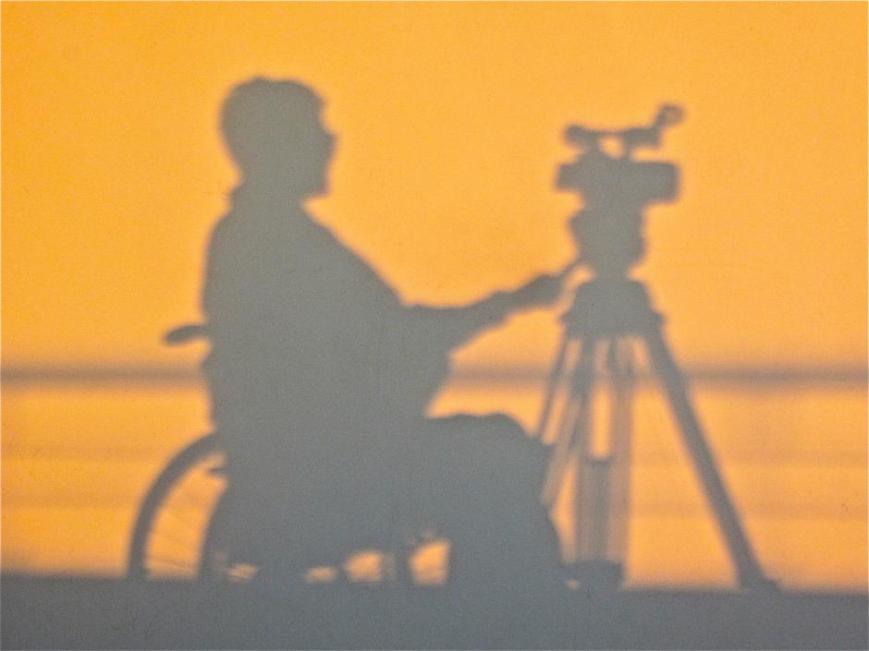
… you could dance with me?

This is an excerpt from a speech given by American writer George Saunders at Syracuse University recently, and well worth reading:
“Now, one useful thing you can do with an old person, in addition to borrowing money from them, or asking them to do one of their old-time “dances,” so you can watch, while laughing, is ask: “Looking back, what do you regret?” And they’ll tell you. Sometimes, as you know, they’ll tell you even if you haven’t asked. Sometimes, even when you’ve specifically requested they not tell you, they’ll tell you.
So: What do I regret? Being poor from time to time? Not really. Working terrible jobs, like “knuckle-puller in a slaughterhouse?” (And don’t even ASK what that entails.) No. I don’t regret that. Skinny-dipping in a river in Sumatra, a little buzzed, and looking up and seeing like 300 monkeys sitting on a pipeline, pooping down into the river, the river in which I was swimming, with my mouth open, naked? And getting deathly ill afterwards, and staying sick for the next seven months? Not so much. Do I regret the occasional humiliation? Like once, playing hockey in front of a big crowd, including this girl I really liked, I somehow managed, while falling and emitting this weird whooping noise, to score on my own goalie, while also sending my stick flying into the crowd, nearly hitting that girl? No. I don’t even regret that.
But here’s something I do regret:
In seventh grade, this new kid joined our class. In the interest of confidentiality, her Convocation Speech name will be “ELLEN.” ELLEN was small, shy. She wore these blue cat’s-eye glasses that, at the time, only old ladies wore. When nervous, which was pretty much always, she had a habit of taking a strand of hair into her mouth and chewing on it.
So she came to our school and our neighborhood, and was mostly ignored, occasionally teased (“Your hair taste good?” – that sort of thing). I could see this hurt her. I still remember the way she’d look after such an insult: eyes cast down, a little gut-kicked, as if, having just been reminded of her place in things, she was trying, as much as possible, to disappear. After awhile she’d drift away, hair-strand still in her mouth. At home, I imagined, after school, her mother would say, you know: “How was your day, sweetie?” and she’d say, “Oh, fine.” And her mother would say, “Making any friends?” and she’d go, “Sure, lots.”
Sometimes I’d see her hanging around alone in her front yard, as if afraid to leave it.
And then – they moved. That was it. No tragedy, no big final hazing.
One day she was there, next day she wasn’t.
End of story.
In the garden, circa autumn 1985 (Photo by Ray or June Lombard)
Now, why do I regret that? Why, forty-two years later, am I still thinking about it? Relative to most of the other kids, I was actually pretty nice to her. I never said an unkind word to her. In fact, I sometimes even (mildly) defended her.
But still. It bothers me.
So here’s something I know to be true, although it’s a little corny, and I don’t quite know what to do with it:
What I regret most in my life are failures of kindness.
Those moments when another human being was there, in front of me, suffering, and I responded…sensibly. Reservedly. Mildly.
Or, to look at it from the other end of the telescope: Who, in your life, do you remember most fondly, with the most undeniable feelings of warmth?
Those who were kindest to you, I bet.
It’s a little facile, maybe, and certainly hard to implement, but I’d say, as a goal in life, you could do worse than: Try to be kinder.
Now, the million-dollar question: What’s our problem? Why aren’t we kinder?
Here’s what I think:
Each of us is born with a series of built-in confusions that are probably somehow Darwinian. These are: (1) we’re central to the universe (that is, our personal story is the main and most interesting story, the only story, really); (2) we’re separate from the universe (there’s US and then, out there, all that other junk – dogs and swing-sets, and the State of Nebraska and low-hanging clouds and, you know, other people), and (3) we’re permanent (death is real, o.k., sure – for you, but not for me).
Now, we don’t really believe these things – intellectually we know better – but we believe them viscerally, and live by them, and they cause us to prioritize our own needs over the needs of others, even though what we really want, in our hearts, is to be less selfish, more aware of what’s actually happening in the present moment, more open, and more loving.
So, the second million-dollar question: How might we DO this? How might we become more loving, more open, less selfish, more present, less delusional, etc., etc?
Well, yes, good question.
Unfortunately, I only have three minutes left.
So let me just say this. There are ways. You already know that because, in your life, there have been High Kindness periods and Low Kindness periods, and you know what inclined you toward the former and away from the latter. Education is good; immersing ourselves in a work of art: good; prayer is good; meditation’s good; a frank talk with a dear friend; establishing ourselves in some kind of spiritual tradition – recognizing that there have been countless really smart people before us who have asked these same questions and left behind answers for us.
Because kindness, it turns out, is hard – it starts out all rainbows and puppy dogs, and expands to include…well,everything.
One thing in our favor: some of this “becoming kinder” happens naturally, with age. It might be a simple matter of attrition: as we get older, we come to see how useless it is to be selfish – how illogical, really. We come to love other people and are thereby counter-instructed in our own centrality. We get our butts kicked by real life, and people come to our defense, and help us, and we learn that we’re not separate, and don’t want to be. We see people near and dear to us dropping away, and are gradually convinced that maybe we too will drop away (someday, a long time from now). Most people, as they age, become less selfish and more loving. I think this is true. The great Syracuse poet, Hayden Carruth, said, in a poem written near the end of his life, that he was “mostly Love, now.”
And so, a prediction, and my heartfelt wish for you: as you get older, your self will diminish and you will grow in love. YOU will gradually be replaced by LOVE. If you have kids, that will be a huge moment in your process of self-diminishment. You really won’t care what happens to YOU, as long as they benefit. That’s one reason your parents are so proud and happy today. One of their fondest dreams has come true: you have accomplished something difficult and tangible that has enlarged you as a person and will make your life better, from here on in, forever.
When young, we’re anxious – understandably – to find out if we’ve got what it takes. Can we succeed? Can we build a viable life for ourselves? But you – in particular you, of this generation – may have noticed a certain cyclical quality to ambition. You do well in high-school, in hopes of getting into a good college, so you can do well in the good college, in the hopes of getting a good job, so you can do well in the good job so you can….
And this is actually O.K. If we’re going to become kinder, that process has to include taking ourselves seriously – as doers, as accomplishers, as dreamers. We have to do that, to be our best selves.
Still, accomplishment is unreliable. “Succeeding,” whatever that might mean to you, is hard, and the need to do so constantly renews itself (success is like a mountain that keeps growing ahead of you as you hike it), and there’s the very real danger that “succeeding” will take up your whole life, while the big questions go untended.
So, quick, end-of-speech advice: Since, according to me, your life is going to be a gradual process of becoming kinder and more loving: Hurry up. Speed it along. Start right now. There’s a confusion in each of us, a sickness, really: selfishness. But there’s also a cure. So be a good and proactive and even somewhat desperate patient on your own behalf – seek out the most efficacious anti-selfishness medicines, energetically, for the rest of your life.
Do all the other things, the ambitious things – travel, get rich, get famous, innovate, lead, fall in love, make and lose fortunes, swim naked in wild jungle rivers (after first having it tested for monkey poop) – but as you do, to the extent that you can, err in the direction of kindness. Do those things that incline you toward the big questions, and avoid the things that would reduce you and make you trivial. That luminous part of you that exists beyond personality – your soul, if you will – is as bright and shining as any that has ever been. Bright as Shakespeare’s, bright as Gandhi’s, bright as Mother Theresa’s. Clear away everything that keeps you separate from this secret luminous place. Believe it exists, come to know it better, nurture it, share its fruits tirelessly.”
Read the rest of George Saunders’ sage advice to graduates HERE.
Newly released official video directed by Paul Thomas Anderson, featuring Fiona and her sister, Maude Maggart.
Paul Simon and a wonderfully spunky child in improvisational counterpoint on the Muppet Show in 1977. Thank you to Genna Gardini for reminding me about this awkward, amazing moment. Read more on the Muppet Wiki.
Simon later would stress the concept of rhythm itself communicating a deeper message, and his earlier writing also demonstrates his dedication to making a deceptively simple rock and roll song embody a unified, total package in which each part must complement the others. “If you take a song that has some rhythm to it…and I don’t get the rhythm right… then the song doesn’t seem real.” With the right rhythm, though, “the listener gives up his defense. You’re willing to entertain a number of ideas, you’re having that good a time.” Rhythm, he said, “is good for lyrics that express emotion. And in allowing emotion to speak, rhythm connects us in anger or in love, to others.” Again, Simon stresses that the artist must communicate, and the songwriter´s communication must appeal to a sense well beyond that of the five recognized senses, a sense of rhythm innately found in songwriter and audience alike.


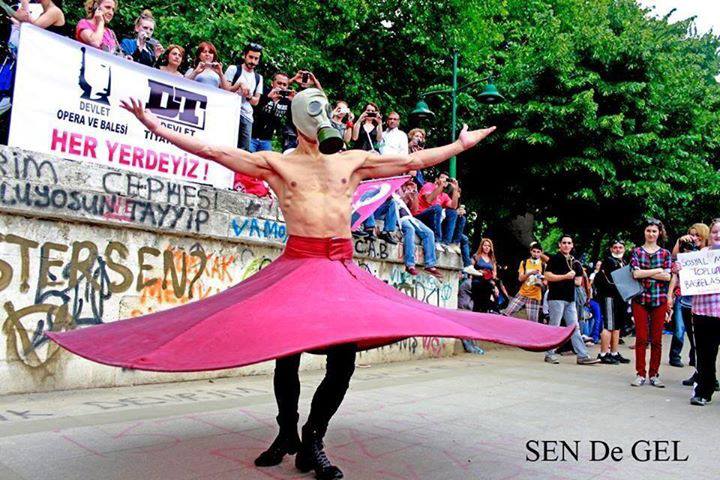
A whirling Sufi protester wearing a gas mask in a Gezi Protest in Ankara, 2 June 2013
Photograph: Azirlazarus (on Wikipedia)
“You come too!”
“Just keep still; keep together!”
6 December, 1969: A free live performance by the Rolling Stones at Altamont of “Sympathy for the Devil” with Hells Angels doing security descends into chaos.
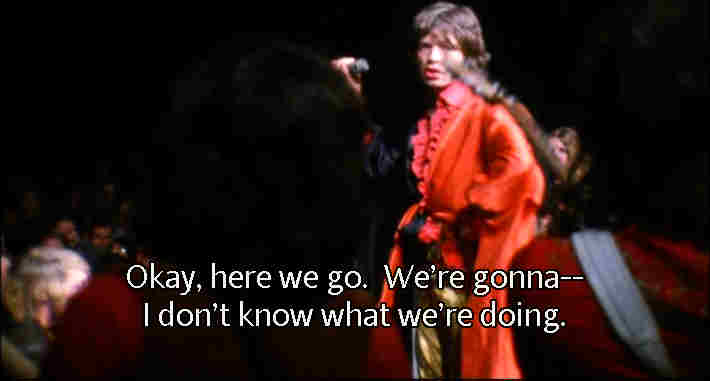
Screenshot of the infamous Altamont concert from the film “Gimme Shelter”
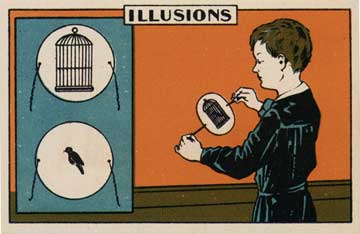
birdcage thaumatrope
[7 may 2012]
i am a dervish
a thaumaturge
i spin very fast
bore downwards
pour stuff out of the top of me churned rich like butter as i whirl
why do i spin so?
see
the thing about spinning
is that it is an oscillation between opposites that generates the movement
it’s how motors work
it’s how hard drives work
it’s how atoms work
the spin is ambi-valence made physical
attracted/repulsed/attracted/repulsed
so i am always moving fast yet can seem to be going nowhere
in my indecision, in the swinging tension between irreconcilable polar opposites
i can actually drill down deeper
because i am always spinning, seeing both sides almost, but not quite,
simultaneously
it’s impossible to see both sides simultaneously
but the quicker you are at seeing multiple perspectives
eddying off on fractal tangents
the faster you spin
(and the dizzier it can make you and others)
how do you solve a problem like maria?
i am not moving linearly
not climbing a ladder
it does not mean i am unproductive
it does not mean i am trapped
the hum is just my motor running at a higher frequency than the
general populace
a powerful magnet
drawing stuff in constantly
flipping it over and over
360 degrees of perspective, 365 days a year
a thaumatrope
it’s a funny thing
i can actually spin, physically, round and round for ages and not get dizzy
i think this is how i manage to get through life, mentally
i am mostly able to tune out the vertigo
i have learned
others can’t
they can’t take how fast i am going all the time
the spinning keeps me upright
in perpetual motion but never able to choose only one definite course
drawing straws
in perfect tension
twirling thread
spinning gold
activates
sigils
semiotics
polarity
magnetism
solenoids
speakers
the speed of sound
affects aerodynamics
flow
determinism and chaos
it’s all connected
all ways
in the dance of particles
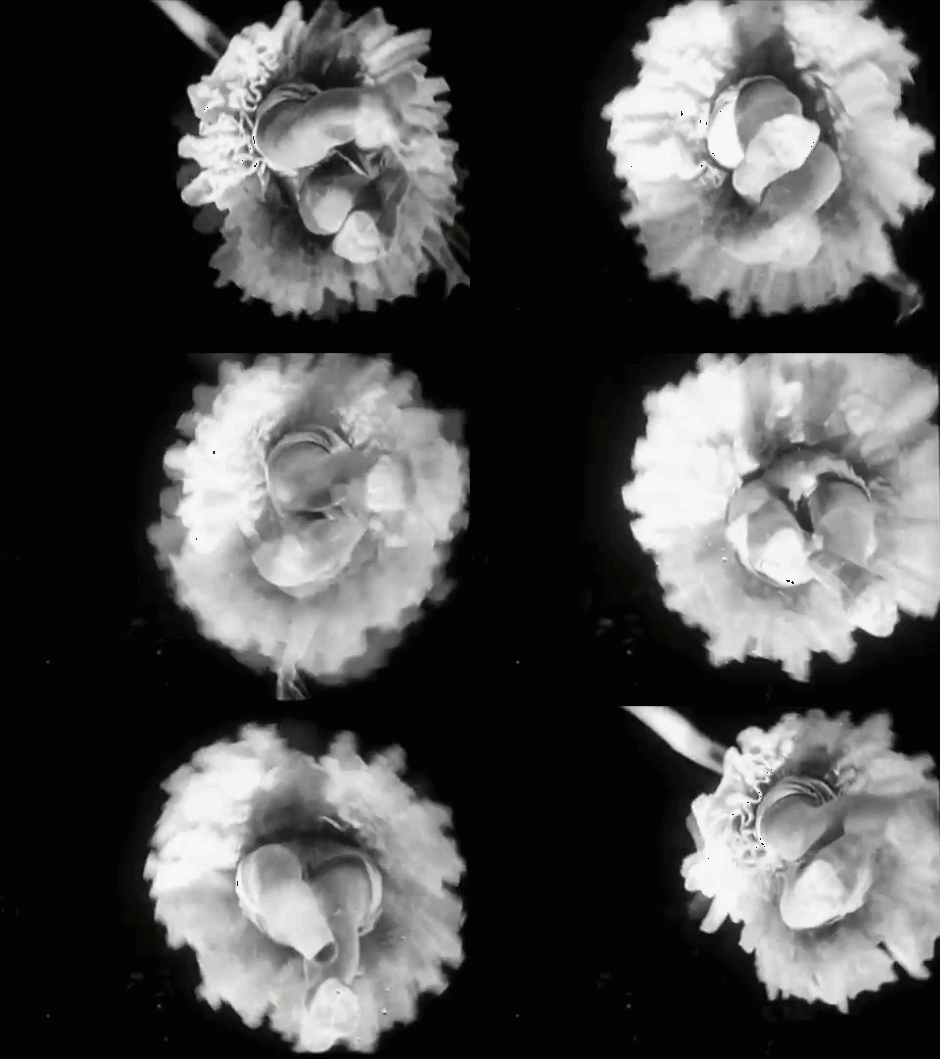
Relâche, ballet instantanéiste en deux actes: un entr’acte cinématographique, et “la queque de chien” is a 1924 ballet by Francis Picabia with music composed by Erik Satie. The title was thought to be a Dadaist practical joke, as relâche is the French word used on posters to indicate that a show is cancelled, or the theatre is closed (and the first performance was indeed cancelled, due to the illness of Jean Börlin, the principal dancer, choreographer, and artistic director of the Ballets Suédois).
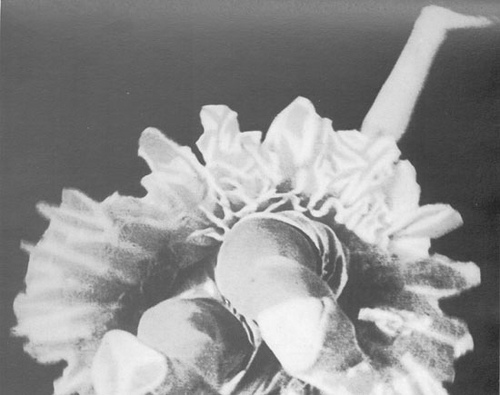
Still from “Entr’acte”
Picabia commissioned filmmaker René Clair to create a cinematic entr’acte to be shown during the ballet’s intermission. The film, simply titled Entr’acte, consists of a scene shown before the ballet and a longer piece between the acts. The score was also composed by Satie.
Entr’acte premiered as an entr’acte for the Ballets Suédois production Relâche at the Théâtre des Champs-Élysées in Paris in 1924. The Dadaists collaborating on the project invented a new mode of production: instantanéisme. Watching the 20 minute film involves seeing people running in slow motion, things happening in reverse, looking at a ballet dancer from underneath, watching an egg over a fountain of water get shot and instantly become a bird, and watching people disappear. The cast included cameo appearances by Francis Picabia, Erik Satie, Man Ray, and Marcel Duchamp. The conductor of the orchestra at the premiere was Roger Désormière. The edition of the soundtrack featured here was conducted in 1967 by Henri Sauguet.
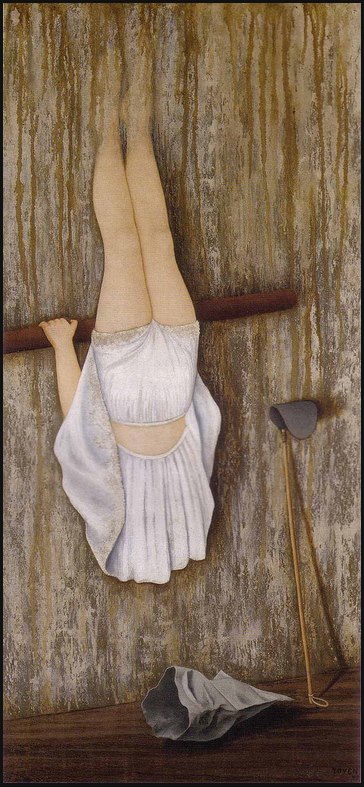
Toyen (Marie Čermínová) – “Relâche”, 1943
Dear God,
When we fall, let us fall inwards.
Let us fall freely and completely:
that we may find our depth and humility:
the solid earth from which we may rise up and love again.
Amen.
— Michael Leunig
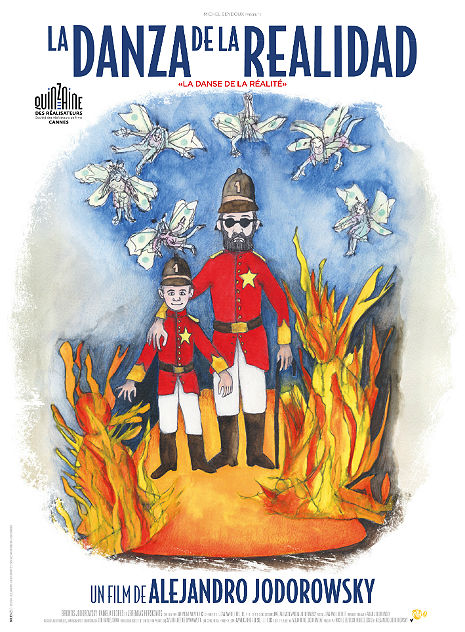 Watch the trailer:
The Guardian review from Cannes 2013 has this to say:
The extinct volcano of underground cinema has burst into life once again — with a bizarre, chaotic and startling film; there are some longueurs and gimmicks, but The Dance of Reality is an unexpectedly touching and personal work. At the age of 84, and over 20 years since his last movie, Alejandro Jodorowsky has returned to his hometown of Tocopilla in the Chilean desert to create a kind of magic-realist memoir of his father, Jaime Jodorowsky, a fierce Communist whose anger at the world — at his son — was redoubled by the anti-Semitism the family faced.
Of course, the entire story is swathed in surreal mythology, dream logic and instant day-glo legend, resembling Fellini, Tod Browning, Emir Kusturica, and many more. You can’t be sure how to extract conventional autobiography from this. Despite the title, there is more “dance” than “reality” — and that is the point. Or part of the point. For the first time, Jodorowsky is coming close to telling us how personal evasiveness has governed his film-making style; his flights of fancy are flights of pain, flights from childhood and flights from reality. And now he is using his transformative style to come to terms with and change the past and to confer on his father some of the heroism that he never attained in real life.
Read more of this review HERE.
The Doors, live in Copenhagen,1968. Ray, I was always even more in love with you than I was with Jim… That organ of yours is what really hypnotised me (that’s what she said).
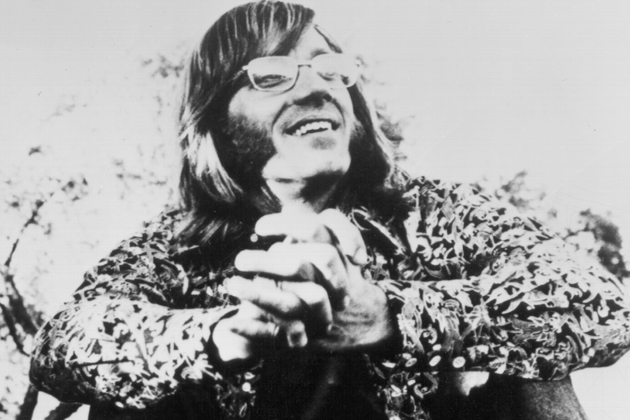
From Michael Ochs’ archive
As my friend Carlo Germeshuys just put it, “Goodbye, Ray Manzarek – without your swirly lounge keyboard old Jimbo wouldn’t have gotten far with his whole bozo Dionysus act.” Oh wait, Carlo says he was referencing a diss by Lester Bangs. Well, whatever. “Bozo Dionysus” = best description of Jim Morrison ever.
HERE‘s an obituary from Rolling Stone.
Flamenco flash mob staged by anti-capitalist group flo6x8 inside a bank in Sevilla, Spain, to express anger and frustration at the economic crisis. Flamenco began as an art form centred around protest and social awareness. In the late 18th and early 19th centuries, flamenco songs were largely about poverty, suffering and the hardships of everyday life.
Read more HERE about how flash mobs are reconnecting flamenco to its roots, or watch a 25 minute BBC documentary on the phenomenon.
(Thanks to Lizza Littlewort for posting the featured link on Facebook this morning.)
Judi Dench and Brendan O’Hea perform “Sixteen Going On Seventeen” from The Sound of Music at the London gala event, “Some Enchanted Evening: Richard Rogers”, held on May 12, 2002.
Thanks to Erica Lombard for putting me in stitches with this.
… And, while we’re on the lugubrious, seamy baritone tip, it would be remiss not to make a turn past l’original, Monsieur Serge Gainsbourg:
Watch Melody Nelson, a short film directed Jean-Christophe Avery, starring Serge Gainsbourg and Jane Birkin, based on Gainsbourg’s seminal (ahem, heheh) 1971 album. More information HERE.
This is so, so beautiful.
 I don’t want to be a designer, a marketer, an illustrator, a brander, a social media consultant, a multi-platform guru, an interface wizard, a writer of copy, a technological assistant, an applicator, an aesthetic king, a notable user, a profit-maximizer, a bottom-line analyzer, a meme generator, a hit tracker, a re-poster, a sponsored blogger, a starred commentator, an online retailer, a viral relayer, a handle, a font or a page. I don’t want to be linked in, tuned in, ‘liked’, incorporated, listed or programmed. I don’t want to be a brand, a representative, an ambassador, a bestseller or a chart-topper. I don’t want to be a human resource or part of your human capital.
I don’t want to be an entrepreneur of myself.
Don’t listen to the founders, the employers, the newspapers, the pundits, the editors, the forecasters, the researchers, the branders, the career counsellors, the prime minister, the job market, Michel Foucault or your haughty brother in finance – there’s something else!
I want to be a lover, a teacher, a wanderer, an assembler of words, a sculptor of immaterial, a maker of instruments, a Socratic philosopher and an erratic muse. I want to be a community centre a piece of art, a wonky cursive script and an old-growth tree! I want to be a disrupter, a creator, an apocalyptic visionary, a master of reconfiguration, a hypocritical parent, an illegal download and a choose-your-own-adventure! I want to be a renegade agitator! A licker of ice cream! An organiser of mischief! A released charge! A double jump on the trampoline! A wayward youth! A volunteer! A partner.
I want to be a curator of myself, an anti-preneur, a person.
Unlimited availabilities. No followers required. Only friends.
~ Danielle Leduc
First published HERE (thanks to Emma Arogundade for sharing it on Facebook).
Note from the author:
I actually didn’t write this as an ‘anti-preneurial manifesto’ – it was more of a poetic rant written in frustration from combing through the online job market. I meant it as less of a takedown of capitalism and more of a critique of how we are told to sell ourselves as brands, to self-promote, in order to make it in this world, and as such we allow our job titles to define us to a certain extent. I think all of us are many of the things I listed towards the end, but these things don’t appear as marketable skills in a neoliberal economy with a tight and precarious job market. We are not our resumes, is all.
“This is a city of heartless beings; what can I do?”
This provocative song featured in the 1993 film, Khalnayak (Hindi = “Villain”), starring an incandescent Madhuri Dixit and Sanjay Dutt. It was a huge yet controversial hit, largely due to the erotic lyrics.
From the album At the Down-Turned Jagged Rim of the Sky (Kranky, 2012). Video featuring Claudia Cardinale.
A sizzling mash-up!
Song from Fiona Apple’s 2012 album The Idler Wheel Is Wiser Than the Driver of the Screw and Whipping Cords Will Serve You More Than Ropes Will Ever Do.
Video excerpted from Fritz’s Lang’s 1926 sci-fi masterpiece, Metropolis.
The marionette scene from Krzysztof Kieslowski’s The Double Life of Veronique (1991). Watch the full film HERE.
“The director’s international breakthrough remains one of his most beloved films, a ravishing, mysterious rumination on identity, love, and human intuition. Irène Jacob is incandescent as both Weronika, a Polish choir soprano, and her double, Véronique, a French music teacher. Though unknown to each other, the two women share a mysterious and emotional bond that transcends language and geography, which Kieslowski details in gorgeous reflections, colours, and movements. Aided by Slawomir Idziak’s shimmering cinematography and Zbigniew Preisner’s haunting, operatic score, Kieslowski creates one of cinema’s most purely metaphysical works. The Double Life of Veronique is an unforgettable symphony of feeling.
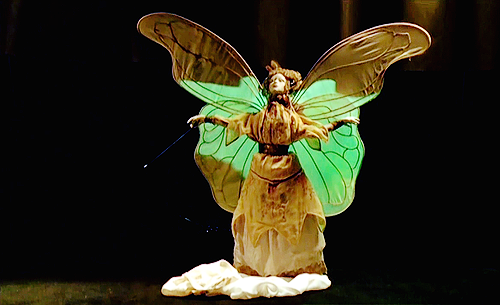
“Krzysztof Kieslowski focuses on identity using actress Irene Jacobs in the dual role of French music teacher Veronique and Polish soprano Weronika – both born on the same day. Metaphysically they are aware of each other’s counterpart – this harkens back to the director’s penchant for fate, chance and circumstance,and we envision a possible meeting of the intertwined souls… Our unspoken desire for a mirrored being – who can non-verbally share our most intimate loves and joys – is the ultimate expression of personal support… Overall, an ambiguous and enigmatic offering, this is a film that clings to you for years after viewing. A true masterpiece of cinema.”
~ Gary W. Tooze
“I’ll Read You a Story” appears on The Golden Morning Breaks; also on Colleen Et Les Boîtes À Musique.
Appears on the album Colleen… Et Les Boîtes à Musique.
Astoundingly beautiful animation masterpiece by Yuri Norstein (USSR,1979, 28 min).
From Wikipedia:
Tale of Tales, like Tarkovsky’s Mirror, attempts to structure itself like a human memory. Memories are not recalled in neat chronological order; instead, they are recalled by the association of one thing with another, which means that any attempt to put memory on film cannot be told like a conventional narrative. The film is thus made up of a series of related sequences whose scenes are interspersed between each other. One of the primary themes involves war, with particular emphasis on the enormous losses the Soviet Union suffered on the Eastern Front during World War II. Several recurring characters and their interactions make up a large part of the film, such as the poet, the little girl and the bull, the little boy and the crows, the dancers and the soldiers, and especially the little grey wolf (Russian: се́ренький волчо́к, syeryenkiy volchok). Another symbol connecting nearly all of these different themes are green apples (which may symbolise life, hope, or potential).
Yuriy Norshteyn wrote in Iskusstvo Kino magazine that the film is “about simple concepts that give you the strength to live.”
Rising to fame in the twenties and early thirties, Ruth Etting was renowned for her great beauty, her gorgeous voice and her tragic life. She starred on Broadway, made movies in Hollywood, married a mobster, had numerous hit-records, and was known as America’s Sweetheart of Song.
Born in David City, Nebraska on November 23, 1897, Ruth left home at seventeen for Chicago and art school. She got a job designing costumes at a night club called the Marigold Gardens and when the tenor got sick, she was pulled into the show since she was the only one who could sing low enough. That led to dancing in the chorus line and eventually featured solos.
By 1918 she was the featured vocalist at the club and the Gimp entered her life. A Chicago gangster, Moe Snyder married Ruth in 1922 and managed her career for the next two decades. Her numerous radio appearances during these years led to her becoming known as Chicago’s Sweetheart.
In 1926 she was discovered by a record company executive and immediately signed to an exclusive recording deal with Columbia Records, which led to nationwide exposure. Her early recordings were very straightforward in delivery. She later commented that “I sounded like a little girl on those records!” and insisted that her voice was actually much deeper than these recordings would lead one to believe.
In 1927 Ruth hit New York and she was an instant success. Irving Berlin suggested her for the Ziegfeld Follies and she was hired after Ziegfeld checked her ankles, not her voice. She appeared in the Follies of 1927. In 1929 she starred with Eddie Cantor in Whoopee! and in 1930 she made 135 appearances in Simple Simon with Ed Wynn. In 1931 she appeared in the very last Follies, shortly before Ziegfeld’s death.
Her blond hair and blue eyes and stunning voice all led to her being dubbed the Sweetheart of Columbia Records, America’s Radio Sweetheart, and finally America’s Sweetheart of Song. She began to experiment with tempo and phrasing during this period in her career. Her trademark was to change the tempo – alternating between normal tempo, half-time and double-time to create and maintain interest.
Ruth had over sixty hit recordings. Among her best in the Jazz Age are “Button Up Your Overcoat” and “Mean to Me” and, in the depression, “Ten Cents A Dance”. Her versions of “Shine on Harvest Moon”, “Let Me Call You Sweetheart”, “You Made Me Love You” and “Love Me or Leave Me” became her signature songs.
Next she headed to Hollywood and made a string of movie shorts and three full-length features. Her big break came in Roman Scandals with Eddie Cantor and Lucille Ball in a bit part. Then came Gift of Gab and Hips Hips Hooray.
It was in Hollywood that her loveless marriage finally fell apart. In 1937 Ruth fell for her accompanist and, in a rage, the Gimp shot him. The musician survived, Snyder went to jail and Ruth ended up divorcing him and marrying her true love, Meryl Alderman. But the scandal was too much for her career to survive. She made a few attempts at a comeback, but her days as America’s Sweetheart were over.
(Information from ruthetting.com, a site maintained by the granddaughter of one of Ruth Etting’s cousins.)
 fleurmach