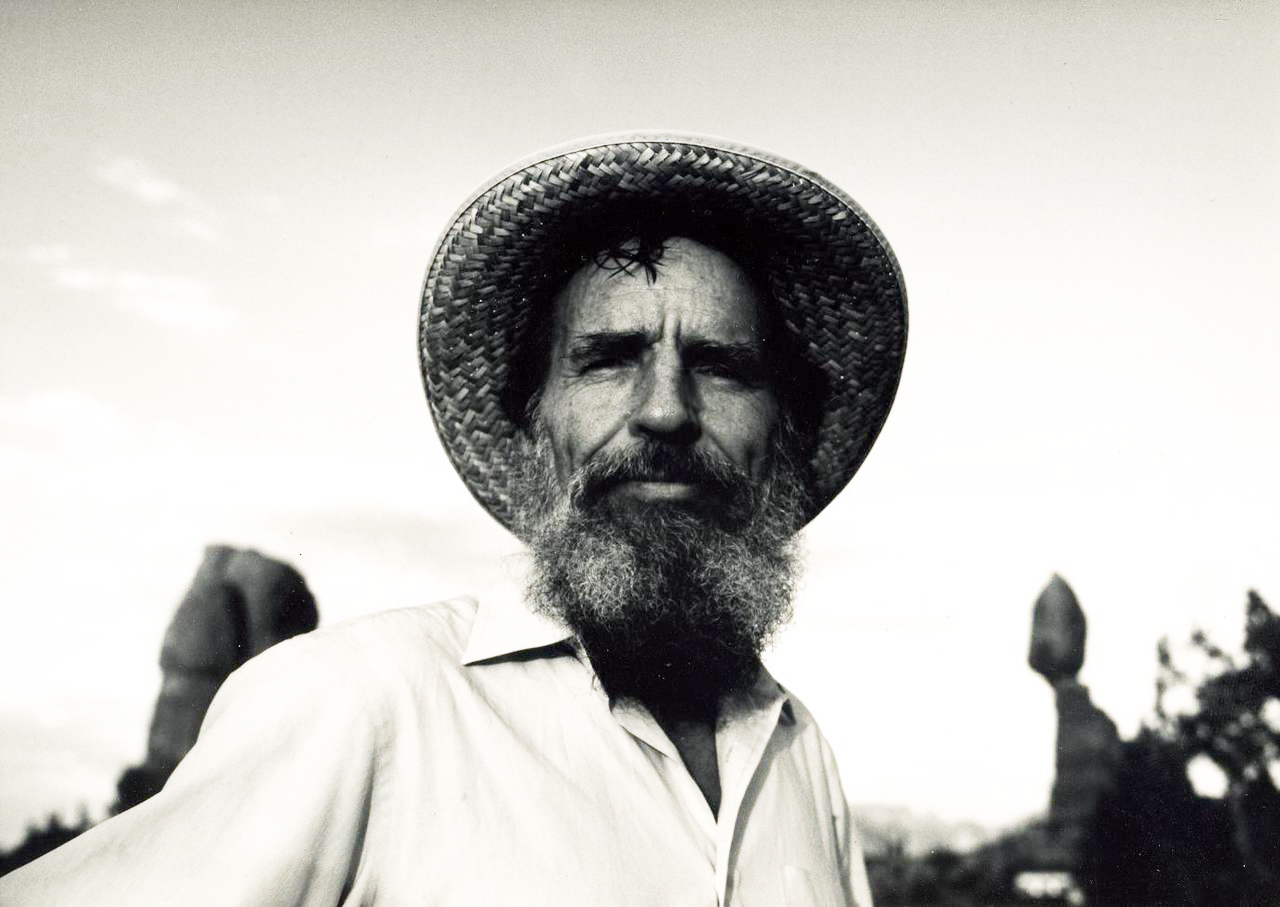
“Society is like a stew. If you don’t stir it up every once in a while then a layer of scum floats to the top.”
“My loyalties will not be bound by national borders, or confined in time by one nation’s history, or limited in the spiritual dimension by one language and culture. I pledge my allegiance to the damned human race, and my everlasting love to the green hills of Earth, and my intimations of glory to the singing stars, to the very end of space and time.”
— From Confessions of a Barbarian: Selections from the Journals of Edward Abbey, 1951-1989 (Boston: Little, Brown 1994).
Uncanny scene from the film Beetlejuice (1989), in which a frightfully posh dinner is ruptured when the table is re-possessed by the voices of exploited plantation labourers, specifically via Harry Belafonte’s “Day-O”. One of Tim Burton’s most politically subversive moments.
My sister Heather started crocheting this beautiful blanket at the age of 16 while pregnant with Juliette, spending hours of time in difficult reflection as her friends carried on being carefree teenagers. Heather has finally finished the blanket and handed it to Juliette, now 16 herself, who has also been going through an incredibly hard and painful time lately. Today Heather posted a couple of photographs on Facebook with the following caption:
“Labour of love for my big girl-child. Every stitch was done with you in mind. Tears and love and prayers are woven into the threads, my precious gift from God.”
“They are really always saying the same thing. They don’t change; everybody else changes. They are accused of the most incompatible crimes, of egoism and a mania for power, indifference to the fate of their cause, fanaticism, triviality, lack of humour, buffoonery and irreverence. But they sound a certain note. Hence the great practical power of persistent radicals. To all appearance, nobody follows them, yet everyone believes them. They hold a tuning-fork and sound A, and everybody knows it really is A, though the time-honoured pitch is G flat.”
Isn’t this a good description of the effect of Pussy Riot performances? In spite of all accusations, you sound a certain note. It may appear that people do not follow you, but secretly, they believe you, they know you are telling the truth, or, even more, you are standing for truth.
— Slavoj Žižek, quoting political essayist John Jay Chapman (who was writing in 1900) in a recent letter to imprisoned Pussy Riot member, Nadezhda Tolokonnikova. Read more from their correspondence HERE.
Eve Warren – “A Punk Prayer”. Find out more about this work HERE.
“Is it wrong, wanting to be at home with your record collection? It’s not like collecting records is like collecting stamps, or beermats, or antique thimbles. There’s a whole world in here, a nicer, dirtier, more violent, more peaceful, more colourful, sleazier, more dangerous, more loving world than the world I live in; there is history, and geography, and poetry, and countless other things I should have studied at school, including music.”
dark phrases of womanhood
of never havin been a girl
half-notes scattered
without rhythm/no tune
distraught laughter fallin
over a black girl’s shoulder
it’s funny/it’s hysterical
the melody-less-ness of her dance
don’t tell nobody don’t tell a soul
she’s dancin on beer cans & shingles
this must be the spook house
another song with no singers
lyrics/no voices
& interrupted solos
unseen performances
are we ghouls?
children of horror?
the joke?
don’t tell nobody don’t tell a soul
are we animals? have we gone crazy?
i can’t hear anythin
but maddening screams
& the soft strains of death
& you promised me
you promised me…
somebody/anybody
sing a black girl’s song
bring her out
to know herself
to know you
but sing her rhythms
carin/struggle/hard times
sing her song of life
she’s been dead so long
closed in silence so long
she doesn’t know the sound
of her own voice
her infinite beauty
she’s half-notes scattered
without rhythm/no tune
sing her sighs
sing the song of her possibilities
sing a righteous gospel
let her be born
let her be born
& handled warmly.
— from For Colored Girls Who Have Considered Suicide When the Rainbow is Enuf. Macmillan Publishing, 1977. Shange was born Paulette L. Williams in Trenton, New Jersey. She later changed her name to isiXhosa/isiZulu – read more HERE.
What Simone did for African American women was more liberating than the sweet elegance of her take on “I Love You, Porgy” (delivered without the fake dialect of all its predecessors), the thought-provoking militancy she added to spirituals like “Sinnerman,” or the wicked humor of “Old Jim Crow” and “Go Limp,” or the wonderfully ironic cover of Screamin’ Jay Hawkins’s kitsch hit, “I Put a Spell on You.”
First of all, her songs, whether covers or original compositions, always privileged the black woman’s point of view; they spoke for the dispossessed Sister Sadie who cleaned floors or raised children who would never in their lives again treat black women with respect.
Yes, you lied to me all these years/told me to wash and clean my ears/and talk real fine, just like a lady/and you’d stop calling me Sister Sadie.
“See Line Woman” viewed its exotic black female as an object of desire and admiration in a way unknown outside of the black poetry that was its source, or those raunchy blues songs that polite Negroes did not play, which nonetheless lauded the virtues of a full body and brown skin.
My skin is black/My arms are long/My hair is wooly/My back is strong/Strong enough to take the pain/Inflicted again and again/What do they call me?/My name is Aunt Sara. — “Four Women”
It was “Four Women,” an instantly accessible analysis of the damning legacy of slavery, that made iconographic the real women we knew and would become. For African American women it became an anthem affirming our existence, our sanity, and our struggle to survive a culture which regards us as anti-feminine. It acknowledged the loss of childhoods among African American women, our invisibility, exploitation, defiance, and even subtly reminded that in slavery and patriarchy, your name is what they call you. Simone’s final defiant scream of the name Peaches was our invitation to get over color and class difference and step with the sister who said:
My skin is brown/My manner is tough/I’ll kill the first mother I see/ My life has been rough/I’m awfully bitter these days/Because my parents were slaves.
For African American women artists of my generation, “Four Women” became the core of works to come, notably Julie Dash’s film of the same name, and it should be regarded a direct ancestor of Ntozake Shange’s For Colored Girls Who Have Considered Suicide When the Rainbow Is Enuf. This Simone song was a call heard by Alice Walker, Toni Cade Bambara, Gayl Jones, and countless artists who come to mind as women who gave us a whole generation of the stories of Aunt Sara, Safronia, Sweet Thing, and Peaches.
May the High Priestess’s cult widen to take in the unwise who made her as outrageous as she was.
“The character of Lucia has become an icon in opera and beyond, an archetype of the constrained woman asserting herself in society. She reappears as a touchstone for such diverse later characters as Flaubert’s adulterous Madame Bovary and the repressed Englishwomen in the novels of E.M. Forster. The insanity that overtakes and destroys Lucia, depicted in opera’s most celebrated mad scene, has especially captured the public imagination. Donizetti’s handling of this fragile woman’s state of mind remains seductively beautiful, thoroughly compelling, and deeply disturbing. Madness as explored in this opera is not merely something that happens as a plot function: it is at once a personal tragedy, a political statement, and a healing ritual.” (Commentary from HERE)
Maria Callas performs “Il dolce suono mi colpì di sua voce”, the “Mad Scene” from the opera Lucia di Lammermoor by Gaetano Donizetti, recorded live in Florence in February 1953. Tullio Serafin conducted Callas, Giuseppe di Stefano, Tito Gobbi, Raffaele Arie, Valliano Natali, Maria Canali, Maggio Musical Fiorentino Orchestra & Maggio Musicale Fiorentino Chorus.
The discussion in the comments underneath the video is quite entertaining, especially if read in light of the Anne Carson essay I posted earlier. Continue reading →
Madness and witchery as well as bestiality are conditions commonly associated with the use of the female voice in public, in ancient as well as modern contexts. Consider how many female celebrities of classical mythology, literature and cult make themselves objectionable by the way they use their voice.
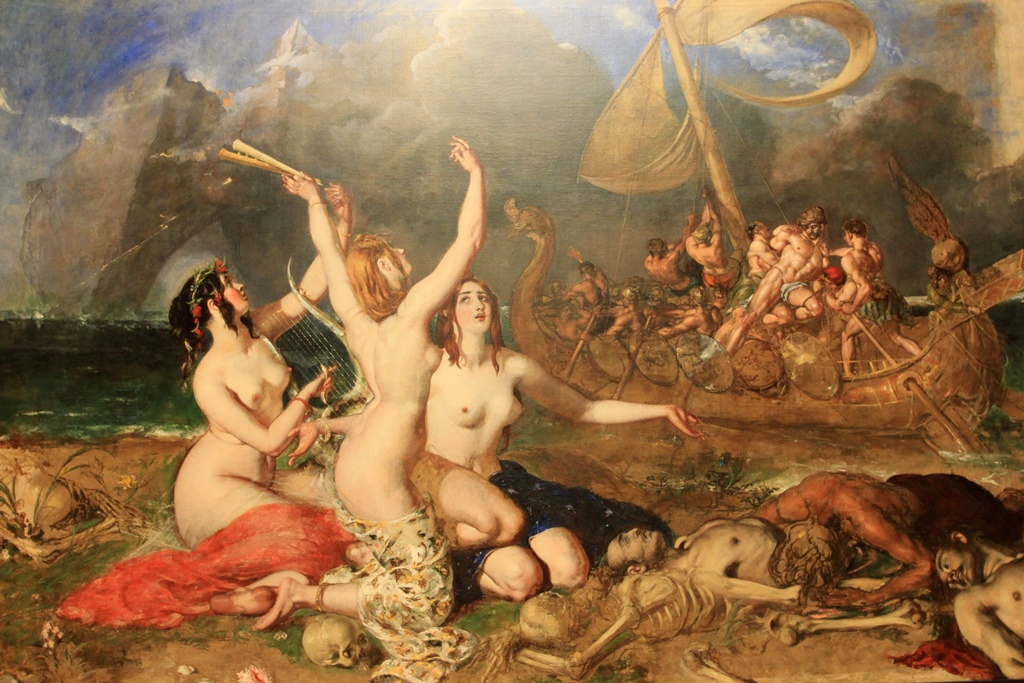
For example, there is the heart-chilling groan of the Gorgon, whose name is derived from a Sanskrit word, *garg meaning “a guttural animal howl that issues as a great wind from the back of the throat through a hugely distended mouth”. There are the Furies whose high-pitched and horrendous voices are compared by Aiskhylos to howling dogs or sounds of people being tortured in hell (Eumenides). There is the deadly voice of the Sirens and the dangerous ventriloquism of Helen (Odyssey) and the incredible babbling of Kassandra (Aiskhylos, Agamemnon) and the fearsome hullabaloo of Artemis as she charges through the woods (Homeric Hymn to Aphrodite). There is the seductive discourse of Aphrodite which is so concrete an aspect of her power that she can wear it on her belt as a physical object or lend it to other women (Iliad). There is the old woman of Eleusinian legend Iambe who shrieks obscenities and throws her skirt up over her head to expose her genitalia. There is the haunting garrulity of the nymph Echo (daughter of Iambe in Athenian legend) who is described by Sophokles as “the girl with no door on her mouth” (Philoktetes).
Putting a door on the female mouth has been an important project of patriarchal culture from antiquity to the present day. Its chief tactic is an ideological association of female sound with monstrosity, disorder and death.
— From “The Gender of Sound”, in Glass, Irony and God. New Directions, 1995: pp 120-121
The brilliant Anne Carson presents a history of the gendered voice, from Sophocles to Gertrude Stein. She outlines what is at stake in our assumptions around sound, questioning whether the concept of ‘self-control’ is a barrier to acknowledging other forms of human order, feeding into wider debates on social order, both past and present.
Humanity also needs dreamers, for whom the disinterested development of an enterprise is so captivating that it becomes impossible for them to devote their care to their own material profit. Without doubt, these dreamers do not deserve wealth, because they do not desire it. Even so, a well-organized society should assure to such workers the efficient means of accomplishing their task, in a life freed from material care and freely consecrated to research.
— Marie Curie, scientist, Nobel laureate (1867-1934)
Are women responsible for protecting themselves from rape? Indian comedy group All India Bakchod’s sarcastic It’s Your Fault video shows Bollywood actresses Kalki Koechlin and VJ Juhi Pandey blaming themselves for what they wear, working late into the night, and not fighting back. HERE is an explanation of the rationale for the video.
One of my favourites off Pornography (Fiction Records, 1982).
My head falls back
And the walls crash down
And the sky
And the impossible
Explode
Held for one moment, I remember a song
An impression of sound
Then everything is gone
Forever
An excerpt from a 2007 interview with Ani DiFranco where she speaks about life as a teenager, anger, rape and exploitation, and on finding the tools to stand up for yourself in a world where you don’t feel respected. If you want to watch the whole interview, there are 5 parts on Youtube.
Performed here by the 5.6.7.8s, a Japanese all-female trio who also played it live in a scene from Quentin Tarantino’s Kill Bill 1 (2003), this song was originally released by The Rock-A-Teens in 1959.




![[Juliette Gréco]](https://fleurmach.com/wp-content/uploads/2013/10/juliette-grc3a9co.jpg)






 fleurmach