I have made a promise to this world that I will carry with me to my last days. It is my vow to lessen the suffering of the world while I am here – it is to ensure that every toxic legacy that I inherited from our culture ends with me – and, ideally, ends with all of us, in our lifetime. The task may be impossible, but I have to help. I have to do it because my true nature wants me to. When I do this work, my heart sings. My inner self rejoices. That is because your happiness is my happiness. Doing the work connects me with what is really true. We are all connected. We are all in relationship.
Still from Hayao Miyazaki’s “Nausicaä of the Valley of the Wind” (1984)
Focusing on media activism, it is quite easy to get swept up in a thousand different messages, leaving me sometimes feeling like I’ve gotten off track with my core message and purpose. What am I doing here? Why am I here?
The answer is in an old Sufi song I learned as a child, “What are we here for? To love, serve and remember.”
To love, serve and remember.
Remember what?
That we are all family.
That you are because I am.
That what is sacred in me is sacred in you. And that sacredness pervades the cosmos, if we choose.*
Reverence and awe for the world is our choice to make. We can see that beauty, and live that life, or we can choose not to see it, and live without that beauty.
Look at your lover this way today. See the sacred in her. See the sacred in him. When you see it in them, see it in your family and your friends. Then, start looking for it in people you see at the grocery store and on the street. Then see it in all of the animal creatures in your life. See it in the trees and plants that grow outside your house. See life in everything, truly be present to its nature and vibrational energy.
Each person in the world is family – caught with us amid the “splendour and travail of the earth.”
When we see the sacred in every person, we can see that those who cause others to suffer are also suffering and have been deeply wounded by this culture since they were born. Every child is born with love in their hearts. The child does not know that we are not all family until they are taught so. This is how we forget.
Our culture teaches us to forget. Our culture teaches us who to love and who not to love. It is a very small circle of people. But that circle is growing bigger for more and more people each day.
More and more people are remembering that our family is life itself.
That is the core message I am trying to spread with my activism.
From this revolution of the heart flowers every other revolution. Sexism, racism, environmental destruction, poverty and war are not possible when true love is there. True love dissolves illusion. True love shatters prejudice and malice. True love liberates both the child and the adult from centuries of our inherited suffering. It is the revolution we need most desperately to save every 5 year old child from the suffering they will inherit if we do not vow to ensure that every toxic cultural legacy of our culture ends with us.
*I define sacred as something having intrinsic worth and value, so for me the word connects with me on both a secular and spiritual level. In a scientific sense that value may be entirely subjective, but I’m okay with that. For me, it’s a choice to see the sacred in life. I can choose to see that beauty, or not see it.
___
Tim Hjersted is the director and co-founder of Films For Action. 16 August 2016.
This work is licensed under an Attribution-NonCommercial-ShareAlike 4.0 International License.
This is a research paper I wrote in 2014 for “The Public Life of the Image”, an MPhil course offered through the Centre for African Studies at the University of Cape Town.
“[T]he striking mine workers at Marikana have become spectacularised. It is a stark reminder that the mine worker, a modern subject of capitalism, in these parts of the world is also the product of a colonial encounter.”
— Suren Pillay (2014)
“We need to understand how photography works within everyday life in advanced industrial societies: the problem is one of materialist cultural history rather than art history.”
— Allan Sekula (2003)
__
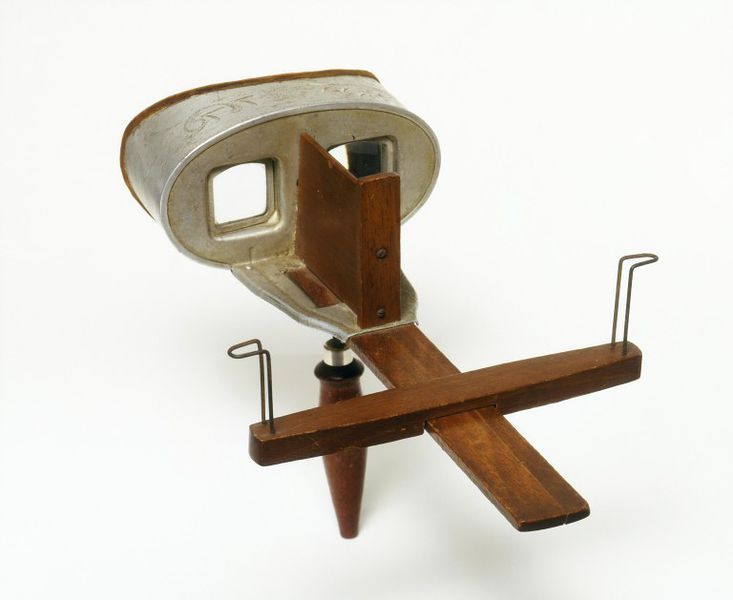
I pick up the odd wood and metal contraption. This is a stereoscope, I am told. It feels old, in the sense that there is a certain worn patina about it, and a non-utilitarian elegance to the turned wood and decoration, though not as if it were an expensive piece – just as if it came from an era where there was time for embellishment. It feels cheaply put together, mass-produced and flimsy as opposed to delicate, the engraving detail of the tinny sheet metal rather rough, the fit of the one piece as it glides through the other somewhat rickety in my hands.
From two elevations, a stereoscope almost identical to the one I used. Various kinds were devised in the 19th century. The particular hand-held variety, of oak, tin, glass and velvet depicted here dates back to 1901, Based on a design by the inventor Oliver Wendell Holmes, it is perhaps the most readily available and simplest model.
I reach for the pile of faded stereographs; flipping through them slowly. There are 24, picked up in an antique shop in an arcade off Cape Town’s Long Street together with the viewing device. A stereograph is composed of two photographs of the same subject taken from slightly different angles. When placed in the stereoscope’s wire holder, and viewed through the eyeholes, an illusion of perspective and depth is achieved as the two images appear to combine through a trick of parallax.
Susan Sontag remarks that “[p]hotographs, which cannot themselves explain anything, are inexhaustible invitations to deduction, speculation, and fantasy”2. And Allan Sekula calls the photograph an “incomplete utterance, a message that depends on some external matrix of conditions and presuppositions for its readability. That is, the meaning of any photographic message is necessarily context determined”3. In what follows, while unable to offer definitive conclusions, I will look more closely at 2 out of these 24 pictures and, through a contextual discussion, attempt to unpack a few aspects of the complex relationships of photography with its subjects and also with public circulation.
Each thick, oblong card with its rounded, scuffed edges discoloured by age has two seemingly identical images on it, side by side, and is embossed with the name of what I guess must have been the photographer or printing studio’s name in gold down the margin: “RAYMOND NEILSON, BOX 145, JOHANNESBURG”. The images depict miners underground. Some are very faded, to the extent that the figures in them appear featureless and ghostly. There is virtually no annotation on most of the photos. On just a few of them, spidery white handwriting on the photo itself, as if scratched into the negative before it was printed, announces the name of the machinery or activity in the picture and the name of the mine: “Crown Mines”.
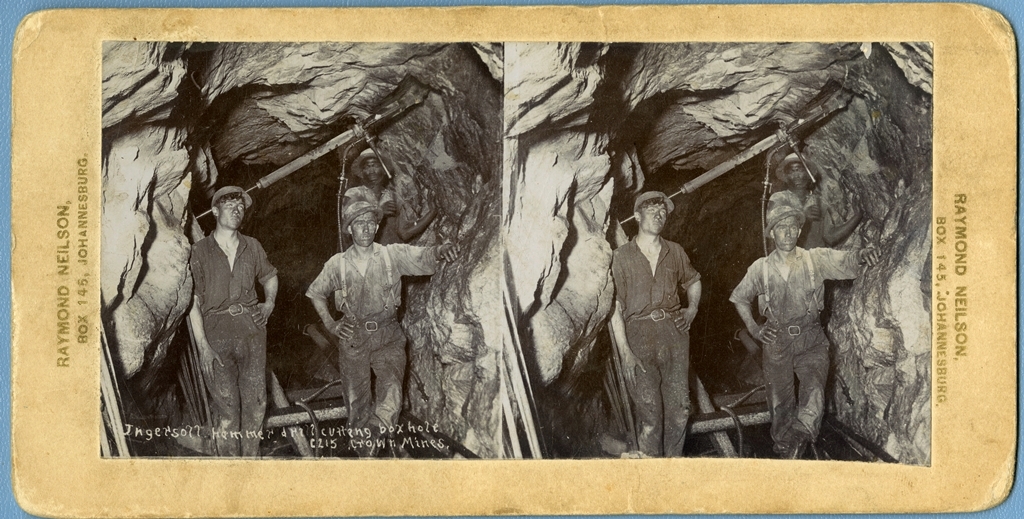
I pick up the first card, slot it into the stereoscope, and peer through the device. On the left of the two images, the writing announces: “Ingersoll hammer drill cutting box hole. C215. Crown Mines.”
Photo 1: Stereographic image of miners in Crown Mines around the turn of the twentieth century.
I slide the holder backwards and forwards along the wooden shaft to focus. I’m seeing two images, nothing remarkable, until suddenly, at a precise point on the axis, the images coalesce into one, three-dimensional. The experience is that of a gestalt switch, the optical illusion uncanny. I blink hard. It’s still there. It feels magical, as if the figures in the photos are stepping right out of the card towards me. Their eyes stare into mine through over a century of time, gleaming white out of dirty, sweaty faces.
Startlingly tangible, here stand two young white men in a mine shaft, scarcely out of their teens, leaning against rock, each with a hand on a hip and a jauntily cocked hat. They are very young… yet very old too, I immediately think: definitely dead now; and perhaps dead soon after the picture was taken, living at risk, killed in a rock fall or in World War One. A pang of indefinable emotion hits. I am amazed at how powerfully this image has flooded my imagination. Even with the difficult viewing process, the effect is astonishing.
I am reminded of Susan Sontag’s contention that all photographs are memento mori: “To take a photograph is to participate in another person’s (or thing’s) mortality, vulnerability, mutability. Precisely by slicing out this moment and freezing it, all photographs testify to time’s relentless melt”5.
I also notice that the trick of parallax (and concurrently, the evocativeness) works most pronouncedly on the figures in the foreground, probably due to the camera angle and vanishing points of the perspective. Behind the two white youngsters, almost fading into the darkness, is a black man, holding up a drill over all of their heads that seems to penetrate the tunnel of rock in which they are suspended.
He appears to have moved during the shot as his face is blurred. This could also be due to the low light in the shaft. Though he is looking straight at me, I can’t connect with him like I do with the figures in front. He is very much in the background, a presence without substance. The way the photo was set up and taken has placed him in that position, and this viewpoint is indelible, no matter how hard I try to look past it.
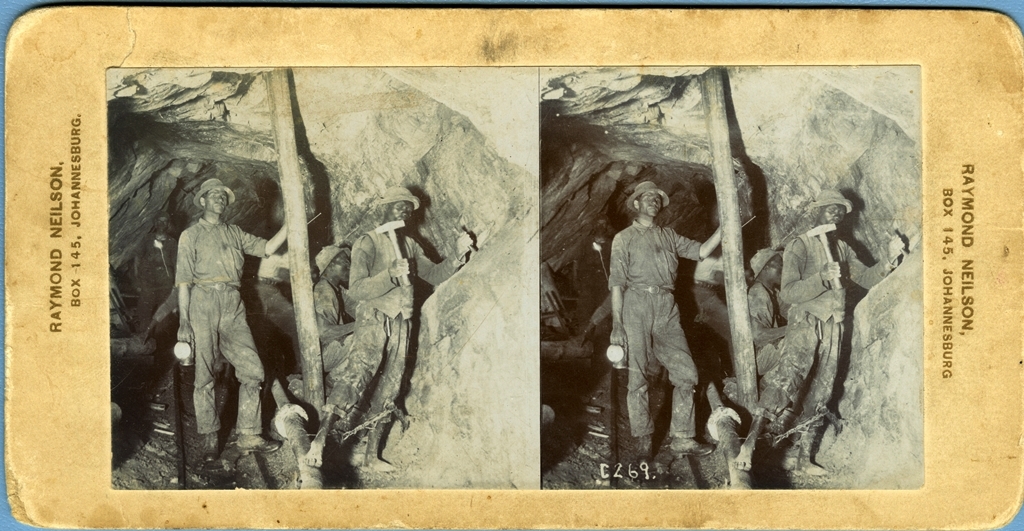
Photo 2: Stereographic image of Johannesburg miners around the turn of the twentieth century.
There is no writing on this one except for what seems to be a reference number: “C269”. The figure in the foreground is a black man, miming work with a mallet and chisel against the rock face, though clearly standing very still for the shot, as he is perfectly in focus, his sceptical gaze on us, a sharp shadow thrown on the rock behind him. This is no ordinary lamp light: it seems clear that these pictures have been professionally illumined by the photographer, perhaps using magnesium flares, because these shots definitely predate flash photography.
To the man with the chisel’s left stands a white man, face dark with dirt. He is holding a lamp in one hand, and his other grasps a support pile which bisects the shaft and also the photo. Tight-jawed, he stares beyond us, his eyes preoccupied, glazed over. Behind the two men in the foreground, there are more men – parts of two, perhaps three workers can be seen, one a black man crouched down at the rock face behind the man with the chisel.
What strikes me most trenchantly about this picture — the punctum, after Barthes7 — is the man with the chisel’s bare feet. He is at work in an extremely hazardous environment without shoes. Looking at all the photographs, every white worker is wearing boots, but there are several pictures where it is visible that many of the black workers are barefoot.
This is shocking visual evidence of an exploitative industry which does not take its workers’ safety seriously: these men are placed at incredible risk without the provision of adequate protective attire: none have hard protection for their heads, and black workers are without shoes. Men not deemed worthy of protection are, by inference, expendable. From these photos, one surmises that black lives are more dispensable than white.
I am really curious to find out more about these pictures. Perhaps the visual evidence here is echoed in literature? Perhaps they can tell us things the literature does not?
Who were these people posing? There is nothing on the back of the photos. No captions, no dates. Who was the photographer? For what purpose were these pictures being taken? The lack of answers to these most mundane of questions lends the photos an uncanny, almost spectral quality.
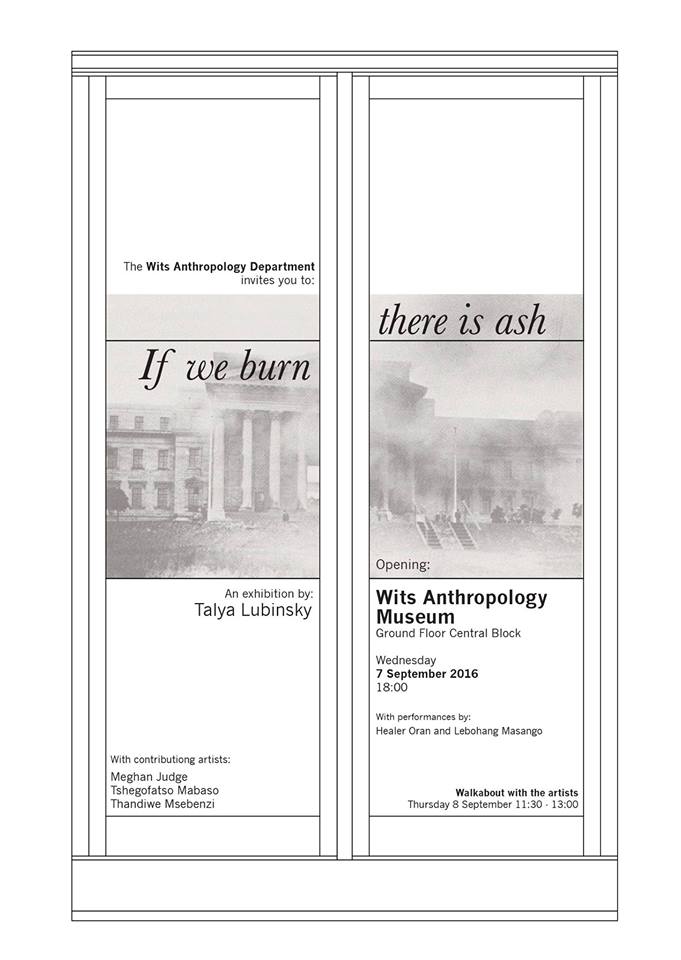
The Wits Anthropology Department is pleased to reopen its Museum collection with
If we burn there is ash
An exhibition by Talya Lubinsky
with contributing artists Meghan Judge, Tshegofatso Mabaso and Thandiwe Msebenzi
and performances by Lebohang Masango and Healer Oran
Wits Anthropology Museum
Wednesday 7 September 2016
18:00
Walkabout with the artists Thursday 8 September 11:30-13:00
All welcome
__
On Christmas Eve of 1931 a fire broke out at Wits University’s Great Hall. At the time, the façade of the Great Hall had been built, its stone pillars and steps creating a striking image of the university in the young colonial city. But the University had run out of funds, and the building that would become Central Block, had not yet been built. Erected behind the grand façade of the Great Hall were wooden shack-like structures, which burned in the fire. These wooden structures housed the collections of what is now called the Cullen Library, as well as the Ethnographic Museum’s collection. Initiated by Winifred Hoernle, head of the Ethnography Museum at the time, the collection was largely comprised of pieces of material culture sent to her from the British missionary, William Burton, while stationed in the ‘Congo’ region.
The fire burned hundreds of books, paintings and artefacts. Some of the only objects that survived the fire are clay burial bowls from the Burton collection. Able to withstand the heat precisely because of their prior exposure to fire, these bowls remain, but are blackened and broken by the 1931 fire.
The exhibition, If we burn, there is ash centres around this story as a place from which to think about the value of colonial collections of material culture. While the origins of the 1931 fire remain unknown, it nonetheless provides a space in which to think about the potentially generative qualities of fire.
Ash, the material remains of fire, however elusive, does not disappear. Even when things burn, they are never fully physically or ephemerally eliminated. Ash is not just the physical remains of that which has been burnt. It is also used as an ingredient in cement mixtures. It is literally transformed into a building material.
Using ash and cement as a poetic relation, this exhibition asks about the potentiality of burning in the project of building and growth. Ash and cement serve as a provocation on the question of what is to be done with the material remains of a violent colonial past.
__
For further information, please contact Talya Lubinsky (talya.lubinsky@gmail.com) or Kelly Gillespie (Kelly.Gillespie@wits.ac.za)
Russian director Andrei Tarkovsky’s film from 1983. I’m not going to link to any analysis here because to do so would narrow the interpretive possibilities of this opaque, allegorical masterpiece. Very superficially, though, the storyline is about a writer who, trapped by his fame and an unhappy marriage, seeks out his cultural past in Italy. Here he meets a local pariah who declares that the world is coming to an end. The writer finds this prophecy curiously more alluring than the possibility of a dead-end future. Nostalghia won the Grand Prix de Creation and the International Critics Prize at the 1984 Cannes Film Festival.
You can pick (slightly crappy) subtitles in several languages.
Edouard-Leon Scott de Martinville was the first person to record his voice and send it into the future. David Giovannoni recounts how First Sounds discovered and played back these recordings 150 years later. This is a fascinating documentary! Goosebump-inducing.
“Quite simply – and this is what I wish to discuss tonight in relation to the question of rage and violence – we are living in different times. Or at least, our time is disjointed, out of sync, plagued by a generational fault line that scrambles historicity.
“The spectre of revolution, of radical change, is in young peoples’ minds and politics, and it is almost nowhere in the politics of the anti-apartheid generation. In fact, even as they criticised young people just five years earlier for being apathetic and depoliticized, they have now thought student activists misguided, uninformed, and mad.
“You would think that it might be possible to resolve this difference in time by means of a careful reading of what is called the ‘objective conditions for revolution’: are we in fact in a time in which revolution is immanent? No matter the subjective experience of time – there must be a way of determining who has the better bearing on history, who can tell the time. What time is it? Yet to tell the time is a complex matter in this society.
“We are, to some degree, post-apartheid, but in many ways not at all. We are living in a democracy that is at the same time violently, pathologically unequal. Protest action against the government – huge amounts of it, what in most other places would signal the beginning of radical change – often flips into a clamour for favour from that very government. Our vacillations, contradictions and anachronisms are indication that what time it is, is open to interpretation.
“I want to argue that the comrades I have worked with in the student movement are not so much mad as they are time-travellers. Or rather, that their particular, beautiful madness is to have recognised and exploited the ambivalence of our historical moment to push into the future. They have been working on the project of historical dissonance, of clarifying the untenable status quo of the present by forcing an awareness of a time when things are not this way. They have seen things many have yet to see. They have been experimenting with hallucinating a new time…”
__ Read the rest of this paper, delivered at the 13th annual Ruth First Memorial Lecture at Wits University in Johannesburg last night.
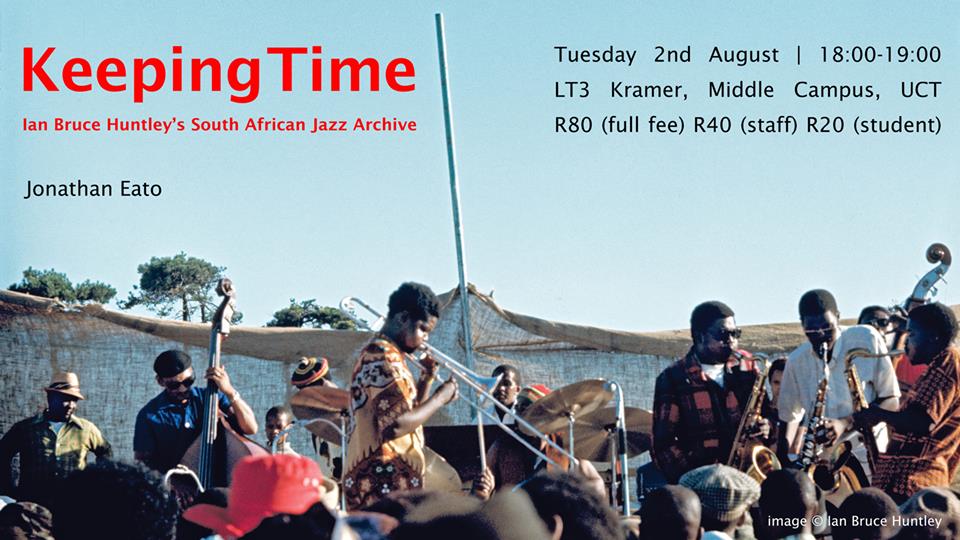
This coming Tuesday, find out more about the extraordinary archive of photographs and live recordings made by Ian Bruce Huntley in the 1960s and early 1970s. In 2013 I was involved in putting this archive of recordings online, which you can explore HERE.
Keeping Time: Ian Bruce Huntley’s South African jazz archive
by Jonathan Eato
Ian Bruce Huntley is not a name that you’ll find readily in the burgeoning annals of South African jazz. Unless, that is, you talk to the dwindling generation of jazz musicians who were working in South Africa in the mid-1960s. Tete Mbambisa remembers Huntley as the man who ‘recorded our gold’, and this Huntley did through a series of remarkable photographic images and live audio recordings. Having privately preserved these records for over forty years, throughout the state repression of grand-apartheid and into the democratic era, they have recently been made available for the first time.
This talk will consider how, in the face of increasing political oppression, Huntley’s archive documented a community of vernacular intellectuals exploring and developing ideas in counterpoint to much commercially available South African jazz post-‘Pondo Blues’.
First having read the book of myths,
and loaded the camera,
and checked the edge of the knife-blade,
I put on
the body-armor of black rubber
the absurd flippers
the grave and awkward mask.
I am having to do this
not like Cousteau with his
assiduous team
aboard the sun-flooded schooner
but here alone.
There is a ladder.
The ladder is always there
hanging innocently
close to the side of the schooner.
We know what it is for,
we who have used it.
Otherwise
it is a piece of maritime floss
some sundry equipment.
I go down.
Rung after rung and still
the oxygen immerses me
the blue light
the clear atoms
of our human air.
I go down.
My flippers cripple me,
I crawl like an insect down the ladder
and there is no one
to tell me when the ocean
will begin.
First the air is blue and then
it is bluer and then green and then
black I am blacking out and yet
my mask is powerful
it pumps my blood with power
the sea is another story
the sea is not a question of power
I have to learn alone
to turn my body without force
in the deep element.
And now: it is easy to forget
what I came for
among so many who have always
lived here
swaying their crenellated fans
between the reefs
and besides
you breathe differently down here.
I came to explore the wreck.
The words are purposes.
The words are maps.
I came to see the damage that was done
and the treasures that prevail.
I stroke the beam of my lamp
slowly along the flank
of something more permanent
than fish or weed
the thing I came for:
the wreck and not the story of the wreck
the thing itself and not the myth
the drowned face always staring
toward the sun
the evidence of damage
worn by salt and sway into this threadbare beauty
the ribs of the disaster
curving their assertion
among the tentative haunters.
This is the place.
And I am here, the mermaid whose dark hair
streams black, the merman in his armored body.
We circle silently
about the wreck
we dive into the hold.
I am she: I am he
whose drowned face sleeps with open eyes
whose breasts still bear the stress
whose silver, copper, vermeil cargo lies
obscurely inside barrels
half-wedged and left to rot
we are the half-destroyed instruments
that once held to a course
the water-eaten log
the fouled compass
We are, I am, you are
by cowardice or courage
the one who find our way
back to this scene
carrying a knife, a camera
a book of myths
in which
our names do not appear.
__
From Diving into the Wreck: Poems 1971-1972. W. W. Norton & Company, 2013
The body is the canvas on which the female experience is painted and through which female identity is often understood. The female body is a slate on which a patriarchal story has been written, scarred onto the flesh.
For Simone Weil metaxu was simultaneously that which separated and connected, so for instance the wall between two prison cells cuts off the prisoners but was also the means by which they communicated by knocking on that wall. Could the body be that metaxu all at once separating us and connecting us to the Divine? The nature of metaxu is that it offers a route not just for the individual soul but for the souls of others to travel…
—
It’s all well and good to dust off a dead French Jewish Catholic not-quite-feminist-philosopher called Simone Weil and say ‘thanks, your theory of metaxu is great’, but what I want to know within the bones of my so-called soul is how this notion of metaxu can draw me into God, how can it liberate my sisters and how can it usher in the kingdom of the mother of all creation?
Human beings are created in the image of God and formed from the dust of the earth, and thus the body has an echoing significance throughout Christian history. The body is the perceived seat of what some describe as the fall, the locus of the incarnation, the home of crucifixion, the vessel of redemption, salvation and resurrection. The body is not an external meaningless diversion from the spiritual path; rather it is an incredibly important recurring theme both biblically and in Christian tradition and history. Bray and Colebrook state that,
The body is a negotiation with images, but it is also a negotiation with pleasures, pains, other bodies, space, visibility, and medical practice; no single event in this field can act as a general ground for determining the status of the body (Bray and Colebrook, 1998).
Yet more than all of this, the body is the place in which we dwell, it is all we have. As Elizabeth Moltmann Wendell says ‘I am my body’ (Moltmann-Wendell, 1994). For each of our sisters the body is the canvas on which the female experience is painted and through which female identity is often understood. It is on the stage of our female bodies that some of the most fixed church doctrines have been written and enacted. The female body is a slate on which a patriarchal story has been written, scarred onto the flesh. These bodies of ours are patriarchal constructs which must be liberated and re-adopted into the Christian story without the limitations of perceived notions or definitions of ‘gender’.
Isherwood and Stuart assert that ‘From the moment we are asked to believe that Eve was a rib removed from the side of Adam we understand that theology is based in the body and we are at a disadvantage!’ (Isherwood and Stuart, 1998: 15). The historical dichotomy between the Eve and the Mary constructions has led to a definitive inequality for women, both in terms of physical wellbeing and in terms of spiritual and psychological wellbeing. The choices for a woman to be the sin-formed, temptress Eve or the virginal pure vessel Mary are seen historically in the precarious place of women in the church and in society.
Elizabeth Stuart writes that ‘Women were regarded as being ensnared in their bodiliness to a far greater degree than men and they too had to be tamed and subdued for their own good and the good of the men they might tempt into sin’ (Stuart, 1996: 23). It is hardly surprising therefore that twentieth and twenty-first century feminist, womanist, mujerista and black theologians have worked hard to undo and re-express a theology of the body which offers a more authentic narrative of the relationship between the Divine and the physical which both liberates the female body and liberates God from the patriarchal box the Church has created around her.
…The female body can only be liberated from that patriarchal overwriting by writing its own narrative, much of which will be based upon experiences of being troubled. The true nature of the female body can only be revealed by a concerted effort to ‘re-own’ this body as our own not as we have been taught to understand it. This in turn means that the systems, doctrines and ‘ways of being’ which exist within the Church and society must be challenged and re-imagined from the perspective of the un-vocalized and troubled female narrative. In the sense that the female body has not really been ours, has not been an authentically female body and yet has the potential to be unlocked as such, it therefore makes for the perfect condition for metaxu, it is that thing which separates in its forms of oppression and connects in its potential liberation. It is at once a place where great evil has been wrought and a place of divine goodness. Weil writes of love that,
Creation is an act of love and it is perpetual. At each moment our existence is God’s love for us. But God can only love himself. His love for us is love for himself through us. Thus, he who gives us our being loves in us the acceptance of not being. Our existence is made up only of his waiting for our acceptance not to exist. He is perpetually begging from us that existence which he gives. He gives it to us in order to beg it from us (Weil, 2002: 28).
According to Weil, our very existence is from God and returns to God. I would argue that to be able to return this ‘not being’ to God, the body has to take some form of action, or have some form of action performed upon it to open a space in which our not being or not existing can be offered to God. It is this removal of our self which I argue can be interpreted as a removal of the socially created self to leave only the God part of ourselves, the authentic self that is God. The body is metaxu in that it is imperfect and yet perfect. The body is human and therefore unreal and socially recreated, yet the body is also created by God and God dwells within it. The female body is both imprisoned and is liberated. Its imprisonment is the very thing that enables it to unravel the layers of patriarchal construction to locate the God part and its imprisonment is the thing which allows for an authentic narrative to be written. The female body has to separate us from the Divine in order to connect us to the Divine.
Give up to life your every action, your every ounce of faith. Throw all your best energies, sincerely and disinterestedly, into life. Immerse yourselves, living creatures that you are, in the live, pulsing tide of human existence, until you feel at one with it, until it floods through you, and you feel your individual personality as an atom within a body, a vibrating particle within a whole, a violin string which receives and echoes all the symphonies of history; of that history which, in this way, you are helping to create.
In spite of this utter abandonment of the self to the reality which surrounds it, in spite of this attempt to key your individuality into the complex play of universal causes and effects, you may still, suddenly, feel a sense that something is missing; you may become conscious of vague and indefinable needs, those needs which Schopenhauer termed metaphysical.
You are in the world, but you do not know why you are here. You act, but you do not know why. You are conscious of voids in your life; you desire some justification of your being, of your actions; and it seems to you that human reasons alone do not suffice. Tracing the causal links further and further back, you arrive at a point where, to co-ordinate, to regulate the movement, some supreme reason is necessary, some reason which lies beyond what is known and what is knowable. You are just like a man looking at the sky, who, as he moves further and further back through the space while science has mapped out for us, finds ever greater difficulties in his fantastic uncontrolled impulses.
But what can conquer them is the force of life itself; historical activity can annul them. They are simply the products of tradition, the instinctual vestiges of millennia of terror and of ignorance of the reality that surrounds us. Their origin can be traced. To explain them is to overcome them. To make them the object of history is to recognize their emptiness. And then one can return to the active life, and experience more authentically the reality of history. By bringing feeling, as well as fact, within the sphere of history, one can finally recognize that it is in history alone that the explanation of our existence lies. What can be historicized cannot be supernatural in origin, the vestige of some divine revelation. If something still remains inexplicable, that is due only to our cognitive deficiencies, to the still imperfect grasp of our intellect. Recognizing this may make us more humble, more modest, but it will not throw us into the arms of religion.
Our religion becomes, once again, history. Our faith becomes, once again, man, and man’s will and his capacity for action. We feel an enormous, an irresistible, force from our human past.
We recognize the good things it brings us, like the energetic certainty that what has been possible will be possible again; all the more so, in that we have become wise through the experience of others. But we also recognize the bad, like these inorganic vestiges of transcended states of mind. And this is why we inevitably feel ourselves to be in conflict with Catholicism; and this is why we call ourselves modern. Because, though we feel the past fuelling our struggle, it is a past that we have tamed; our servant, not our master; a past which illuminates and does not overshadow us.
Avanti, 29 August 1916
__
From Pre-Prison Writings, edited by Richard Bellamy. Cambridge Texts in the History of Political Thought, 1994, pp 13-14.
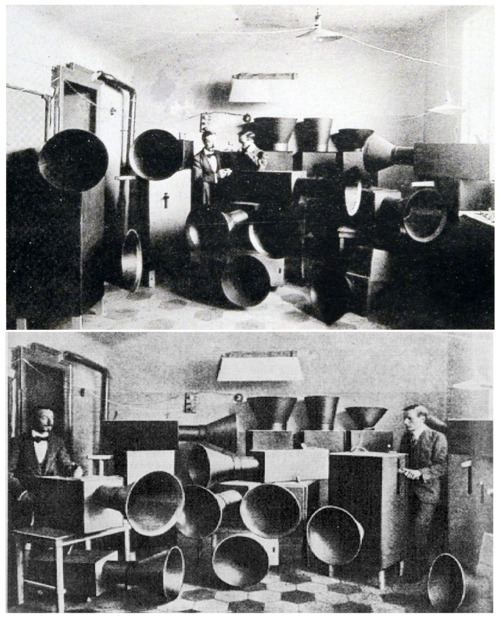
Russolo designed and constructed a number of noise-generating devices called Intonarumori, and assembled a noise orchestra to perform with them. A performance of his “Gran Concerto Futuristico” (1917) was met with strong disapproval and violence from the audience, as Russolo himself had predicted. None of his intoning devices have survived, though recently some have been reconstructed and used in performances. (Check this out!) Although Russolo’s works bear little resemblance to modern noise music, his pioneering creations cannot be overlooked as an essential stage in the evolution of the several genres in this category. Many artists are now familiar with Russolo’s Art of Noises manifesto.
At first the art of music sought purity, limpidity and sweetness of sound. Then different sounds were amalgamated, care being taken, however, to caress the ear with gentle harmonies. Today music, as it becomes continually more complicated, strives to amalgamate the most dissonant, strange and harsh sounds. In this way we come ever closer to noise-sound.
Antonio Russolo, another Italian Futurist composer and Luigi’s brother, produced a recording of two works featuring the original Intonarumori. The phonograph recording, made in 1921, included works entitled “Corale” and “Serenata”, which combined conventional orchestral music set against the sound of the noise machines. It is the only surviving contemporaneous sound recording of Luigi Russolo’s noise music.
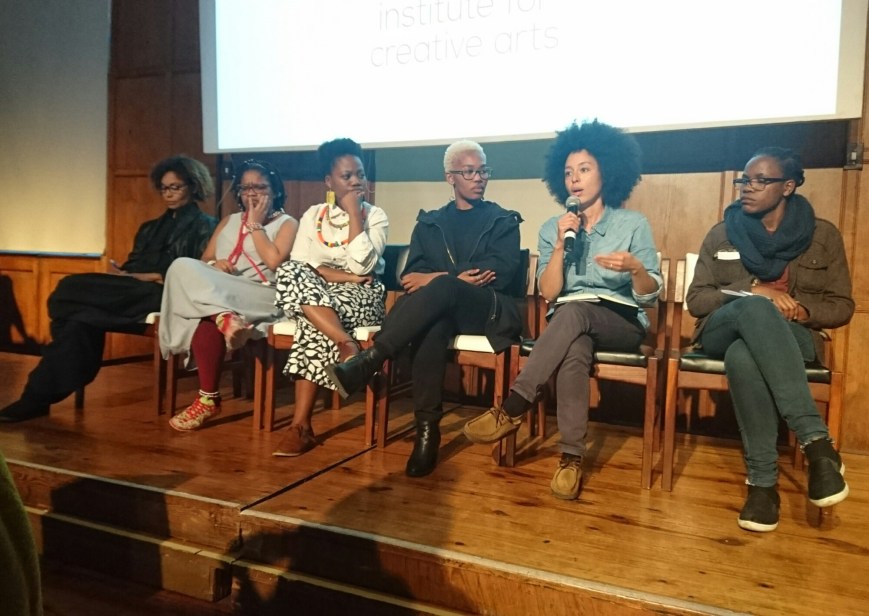
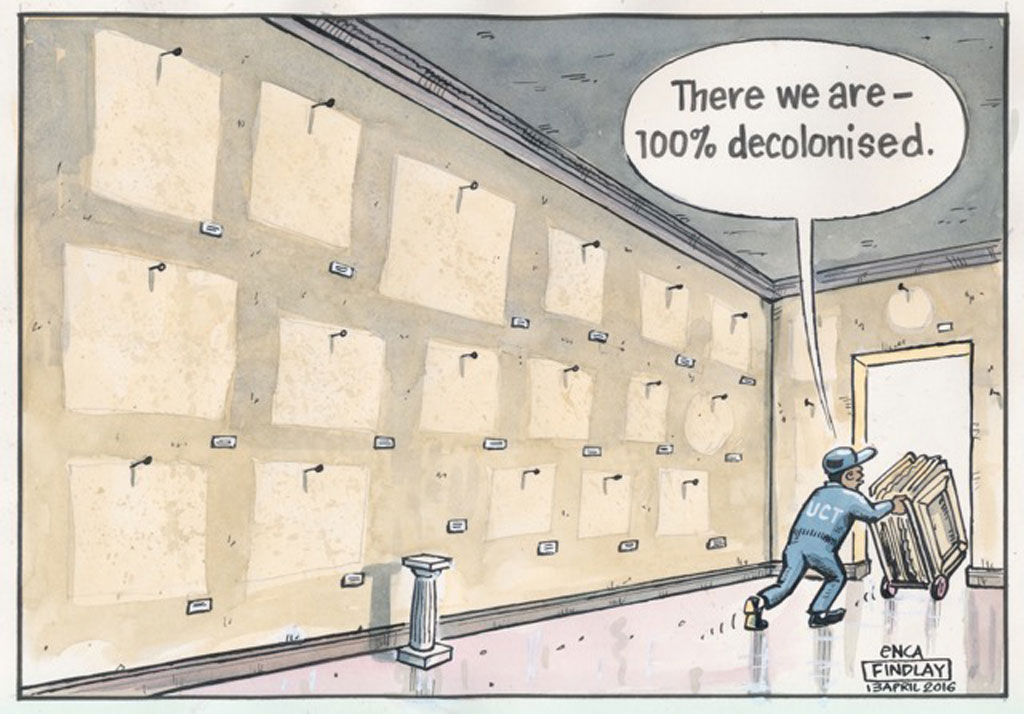
The most decolonised academic space I have yet had the joy of experiencing. The conference continues today. If you’re in Cape Town, come. It’s free! HERE is the programme. 🌸
This is a post from a few years ago. Julia Clark reminded me of it today.
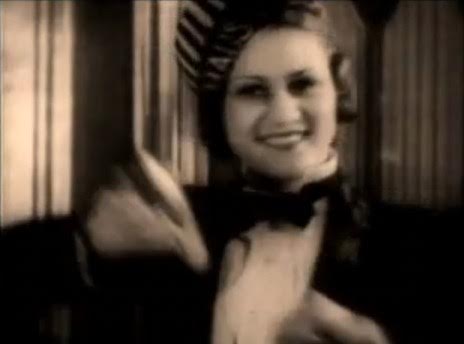
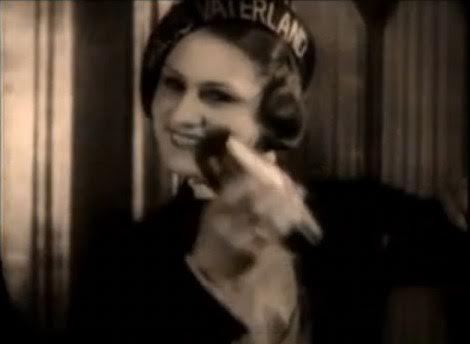
A still from here, at 0:27:
it is so startling to see yourself somewhere you are not
so slippy
in my sleep
i am this dancing girl
in the weimar nightclub
and i buzz with black holes
between the nets of swinging cliches
dietrich’s smile
kurt weill refrains
bauhaus lines
they’re all unravelled, sucked away
and i’m left with only questions
to clothe her dancing bones
so who was she?
and what was her name?
what was her favourite food?
colour?
how did she move?
was she a good dancer?
where did she work?
was she in love?
was she lonely?
did she have a brother in the army? a lover?
as she donned that “vaterland” hat, did her chest swell with pride
or was it just the dress code?
where was she in 5 years’ time?
did she have any children? grandchildren? where are they now?
do they also look like me?
more and more questions
and all from just a 1-and-a-half second cutaway to anonymous archive in
a lousy louise brooks documentary
i feel dizzy
eisenstein was right
montage is dangerous.
Jean Cocteau began his career as a poet, publishing his first collection, Aladdin’s Lamp, at the age of 19. By 1963, at the age of 73, he had lived one of the richest artistic lives imaginable, transforming every genre he touched. Deciding to leave one last artefact to posterity, Cocteau sat down and recorded the film above, a message to the year 2000, intending it as a time capsule only to be opened in that year (though it was discovered, and viewed a few years earlier). Biographer James S. Williams describes the documentary testament as “Cocteau’s final gift to his fellow human beings.”
Portraying himself as “a living anachronism” in a “phantom-like state,” Cocteau, seated before his own artwork, quotes St. Augustine, makes parables of events in his life, and addresses, primarily, the youth of the future. The uses and misuses of technology comprise a central theme of his discourse: “I certainly hope that you have not become robots,” Cocteau says, “but on the contrary that you have become very humanized: that’s my hope.” The people of his time, he claims, “remain apprentice robots.”
Among Cocteau’s concerns is the dominance of an “architectural Esperanto, which remains our time’s great mistake.” By this phrase he means that “the same house is being built everywhere and no attention is paid to climate, atmospherical conditions or landscape.” Whether we take this as a literal statement or a metaphor for social engineering, or both, Cocteau sees the condition as one in which these monotonous repeating houses are “prisons which lock you up or barracks which fence you in.” The modern condition, as he frames it, is one “straddling contradictions” between humanity and machinery. Nonetheless, he is impressed with scientific advancement, a realm of “men who do extraordinary things.”
And yet, “the real man of genius,” for Cocteau, is the poet, and he hopes for us that the genius of poetry “hasn’t become something like a shameful and contagious sickness against which you wish to be immunized.” He has very much more of interest to communicate, about his own time, and his hopes for ours. Cocteau recorded this transmission from the past in August of 1963. On October 11 of that same year, he died of a heart attack, supposedly shocked to death by news of his friend Edith Piaf’s death that same day in the same manner.
His final film, and final communication to a public yet to be born, accords with one of the great themes of his life’s work—“the tug of war between the old and the new and the paradoxical disparities that surface because of that tension.” Should we attend to his messages to our time, we may find that he anticipated many of our 21st century dilemmas between technology and humanity, and between history and myth. It’s interesting to imagine how we might describe our own age to a later generation, and, like Cocteau, what we might hope for them.
Max Ernst – collage from The Hundred Headless Woman (1929).
… There is always, in such movements, a moment when the original tension of the secret society must either explode in a matter-of-fact, profane struggle for power and domination, or decay as a public demonstration and be transformed. Surrealism is in this phase of transformation at present. But at the time when it broke over its founders as an inspiring dream wave, it seemed the most integral, conclusive, absolute of movements. Everything with which it came into contact was integrated. Life only seemed worth living where the threshold between waking and sleeping was worn away in everyone as by the steps of multitudinous images flooding back and forth, language only seemed itself where, sound and image, image and sound interpenetrated with automatic precision and such felicity that no chink was left for the penny-in-the-slot called ‘meaning’.
Image and language take precedence. Saint-Pol Roux, retiring to bed about daybreak, fixes a noticeon his door: ‘Poet at work.’ Breton notes: ‘Quietly. I want to pass where no one yet has passed, quietly! After you, dearest language.’ Language takes precedence. Not only before meaning. Also before the self. In the world’s structure dream loosens individuality like a bad tooth. This loosening of the self by intoxication is, at the same time, precisely the fruitful, living experience that allowed these people to step outside the domain of intoxication.
This is not the place to give an exact definition of Surrealist experience. But anyone who has perceived that the writings of this circle are not literature but something else – demonstrations, watchwords, documents, bluffs, forgeries if you will, but at any rate not literature – will also know, for the same reason, that the writings are concerned literally with experiences, not with theories and still less with phantasms. And these experiences are by no means limited to dreams, hours of hashish eating, or opium smoking. It is a cardinal error to believe that, of ‘Surrealist experiences’, we know only the religious ecstasies or the ecstasies of drugs. The opium of the people, Lenin called religion, and brought the two things closer together than the Surrealists could have liked.
I shall refer later to the bitter, passionate revolt against Catholicism in which Rimbaud, Lautreamont, and Apollinaire brought Surrealism into the world. But the true creative overcoming of religious illumination certainly does not lie in narcotics. It resides in a profane illumination, ‘a materialistic, anthropological inspiration, to which hashish, opium, or whatever else can give an introductory lesson. (But a dangerous one; and the religious lesson is stricter.)
This profane illumination did not always find the Surrealists equal to it, or to themselves, and the very writings that proclaim it most powerfully, Aragon’s incomparable Paysan de Paris and Breton’s Nadja, show very disturbing symptoms of deficiency. For example, there is in Nadja an excellent passage on the ‘delightful days spent looting Paris under the sign of Sacco and Vanzetti’; Breton adds the assurance that in those days Boulevard Bonne-Nouvelle fulfilled the strategic promise of revolt ‘that had always been implicit in its name. But Madame Sacco also appears, not the wife of Fuller’s victim but avoyante, a fortune-teller who lives at 3 rue des Usines and tells Paul Eluard that he can expect no good from Nadja.
Now I concede that the breakneck career of Surrealism over rooftops, lightning conductors, gutters, verandas, weathercocks, stucco work – all ornaments are grist to the cat burglar’s mill- may have taken it also into the humid backroom of spiritualism. But I am not pleased to hear it cautiously tapping on the window-panes to inquire about its future. Who would not wish to see these adoptive children of revolution most rigorously severed from all the goings-on in the conventicles of down-at-heel dowagers, retired majors, and emigre profiteers?
In other respects Breton’s book illustrates well a number of the basic characteristics of this ‘profane illumination’. He calls Nadja ‘a book with a banging door’. (In Moscow I lived in a hotel in which almost all the rooms were occupied by Tibetan lamas who had come to Moscow for a congress of Buddhist churches. I was struck by the number of doors in the corridors that were always left ajar. What had at first seemed accidental began to be disturbing. I found out that in these rooms lived members of a sect who had sworn never to occupy closed rooms. The shock I had then must be felt by the reader of Nadja.)
To live in a glass house is a revolutionary virtue par excellence. It is also an intoxication, a moral exhibitionism, that we badly need. Discretion concerning one’s own existence, once an aristocratic virtue, has become more and more an affair of petty-bourgeois parvenus. Nadja has achieved the true, creative synthesis between the art novel and the roman-a-clef.
Moreover, one need only take love seriously to recognize in it, too – as Nadja also indicates – a ‘profane illumination’. ‘At just that time’ (i.e., when he knew Nadja), the author tells us, ‘I took a great interest in the epoch of Louis VII, because it was the time of the ‘courts of love’, and I tried to picture with great intensity how people saw life then.’ We have from a recent author quite exact information on Provencal love poetry, which comes surprisingly close to the Surrealist conception of love. ‘All the poets of the ‘new style’,’ Erich Auerback points out in his excellent Dante: Poet of the Secular World, ‘possess a mystical beloved, they all have approximately the same very curious experience of love; to them all Amor bestows or withholds gifts that resemble an illumination more than sensual pleasure; all arc subject to a kind of secret bond that determines their inner and perhaps also their outer-lives’. The dialectics of intoxication are indeed curious. Is not perhaps all ecstasy in one world humiliating sobriety in that complementary to it? What is it that courtly Minne seeks, and it, not love, binds Breton to the telepathic girl, if not to make chastity, too, a transport? Into a world that borders not only on tombs of the Sacred Heart or altars to the Virgin, but also on the morning before a battle or after a victory.
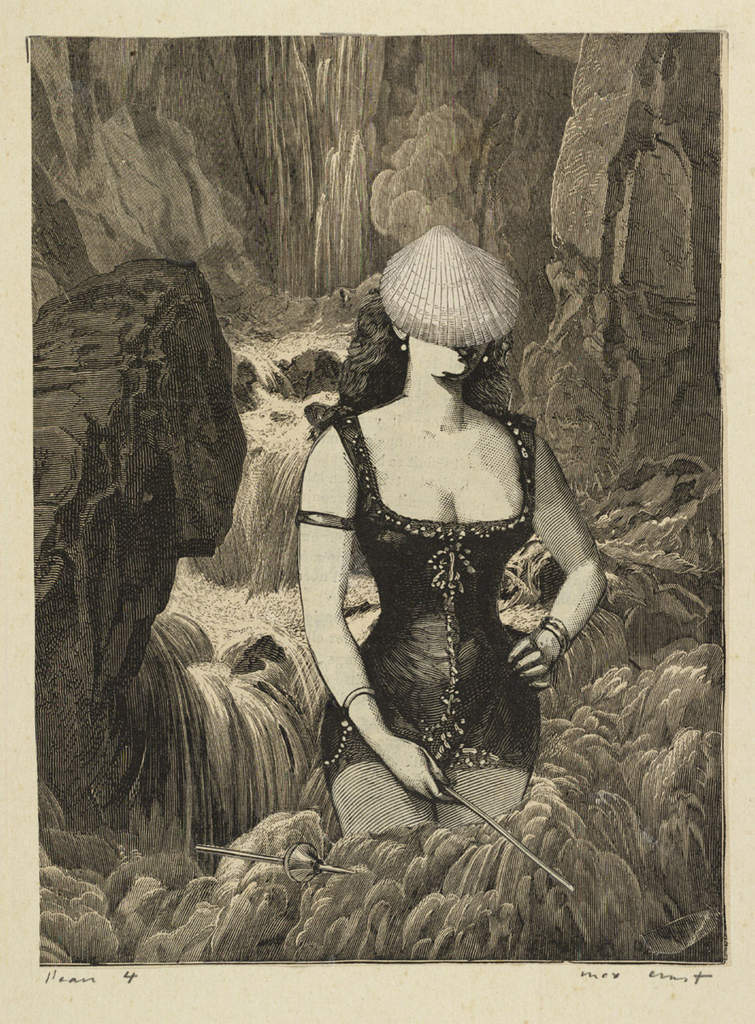
Max Ernst – Une semaine de bonté [A Week of Kindness]. La clé des chants 1 [The Key of Songs 1] 1933
The lady, in esoteric love, matters least. So, too, for Breton. He is closer to the things that Nadja is close to than to her. What are these things? Nothing could reveal more about Surrealism than their canon.Where shall I begin? He can boast an extraordinary discovery. He was the first to perceive the revolutionary energies that appear in the ‘outmoded’, in the first iron constructions, the first factory buildings, the earliest photos, the objects that have begun to be extinct, grand pianos, the dresses of five years ago, fashionable restaurants when the vogue has begun to ebb from them. The relation of these things to revolution, no one can have a more exact concept of it than these authors. No one before these visionaries and augurs perceived how destitution – not only socialbut architectonic, the poverty of interiors/enslaved and enslaving objects – can be suddenly transformed into revolutionary nihilism. Leaving aside Aragon’s Passage de I’Opera, Breton and Nadja are the lovers who convert everything that we have experienced on mournful railway journeys (railways are beginning to age), on Godforsaken Sunday afternoons in the proletarian quarters of the great cities, in the first glance through the rain-blurred window of a new apartment, into revolutionary experience, if not action. They bring the immense forces of ‘atmosphere’ concealed in these things to the point of explosion. What form do you suppose a life would take that was determined at a decisive moment precisely by the street song last on everyone’s lips?
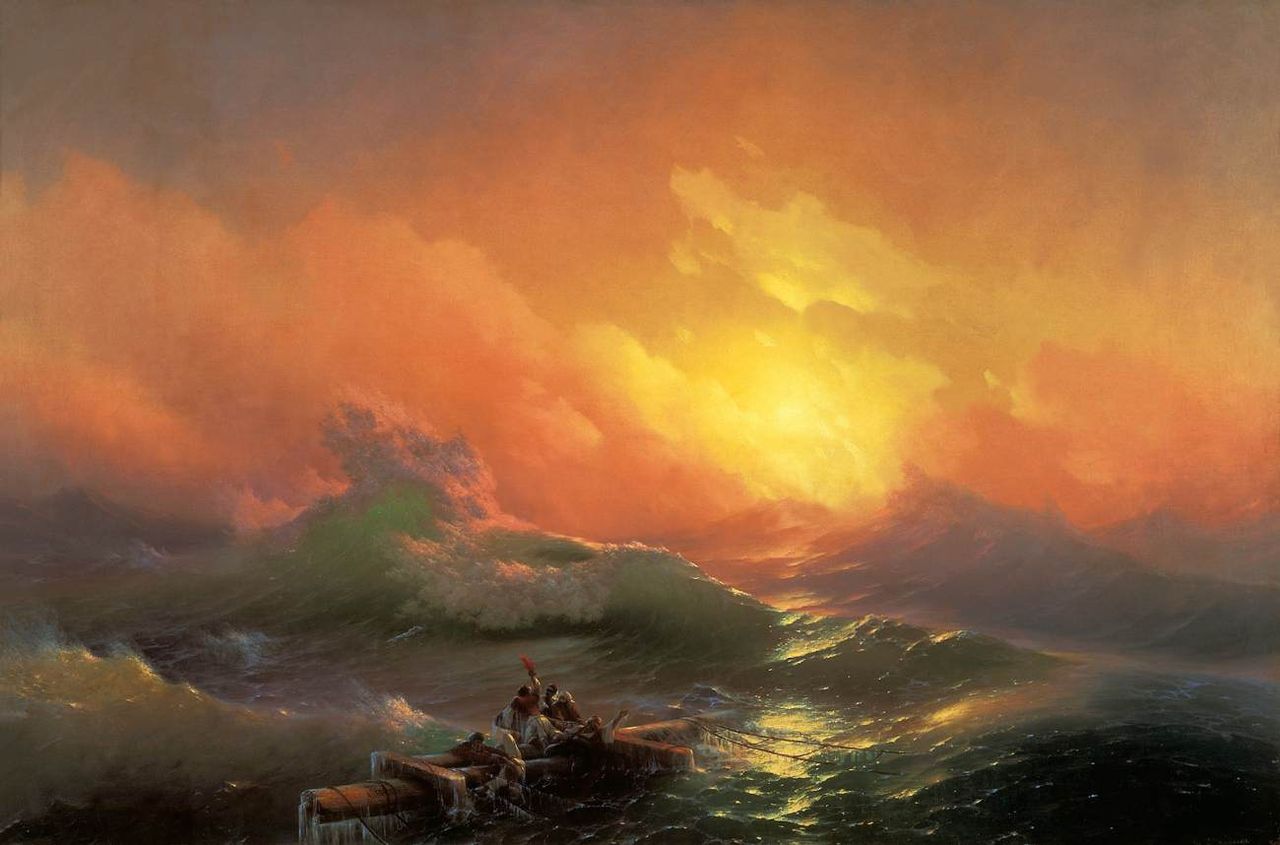
“Wave after wave, each mightier than the last,
Till last, a ninth one, gathering half the deep
And full of voices, slowly rose and plunged
Roaring, and all the wave was in a flame.”
From Alfred, Lord Tennyson’s Idylls of the King (1859).
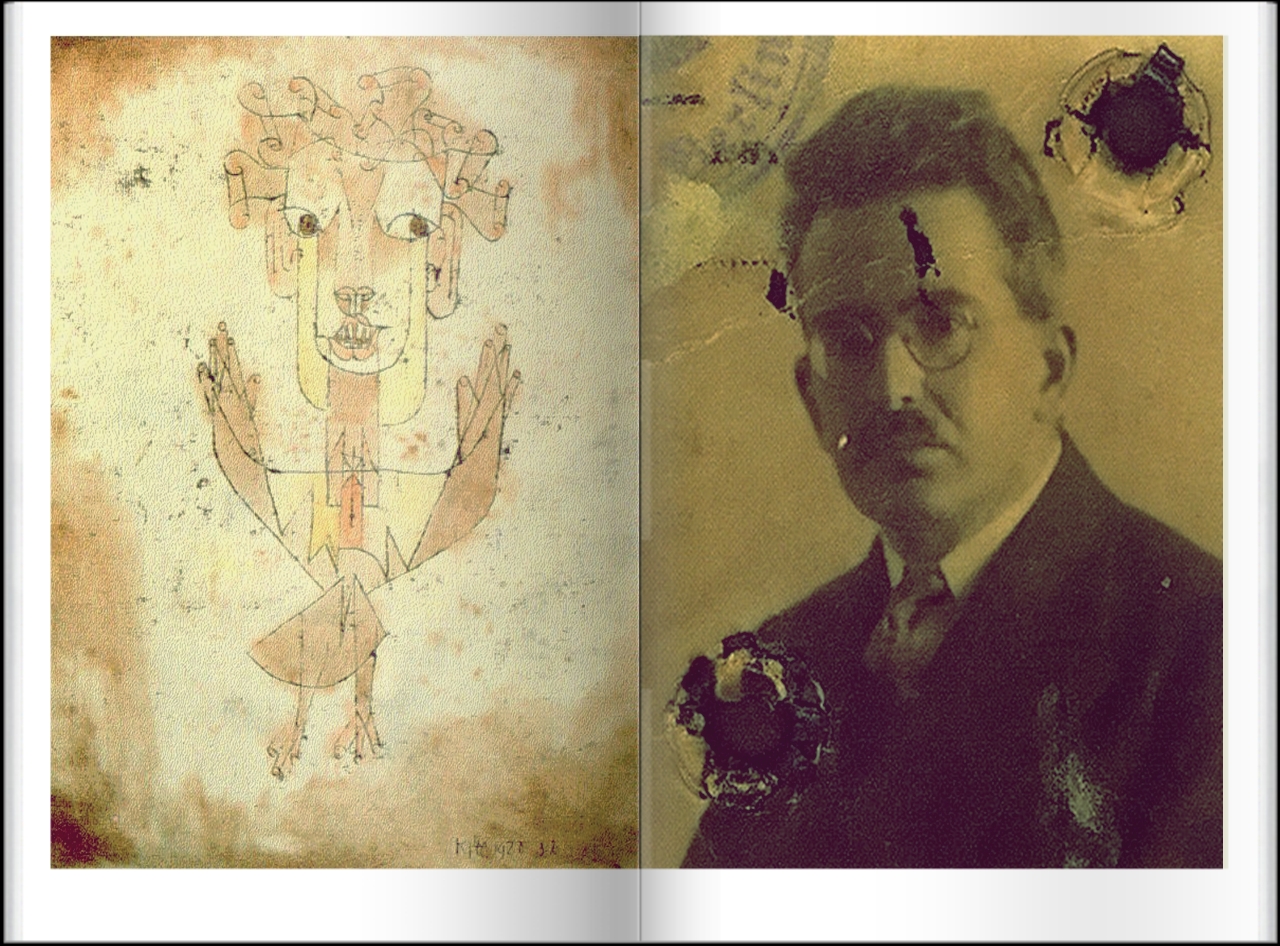
Susan Buck-Morss, writing in 2001 on Walter Benjamin’s philosophy of history, marked by the critique of progress in the name of a revolutionary time which interrupts history’s chronological continuum:
The only power available to us as we, riding in the train of history, reach for the emergency brake, is the power that comes from the past… One fact of the past that we particularly are in danger of forgetting is the apparent harmlessness with which the process of cultural capitulation takes place. lt is a matter, simply, of wanting to keep up with the intellectual trends, to compete in the marketplace, to stay relevant, to stay in fashion…
So, what in God’s name are we doing here? The litmus test for intellectual production is how it affects the outside world, not what happens inside an academic enclave such as this one. [Walter] Benjamin himself held up as the criterion for his work that it be “totally useless for the purpose of Fascism.”* Could any of us say of our work that it is totally useless for the purposes of the new global order, in which class exploitation is blatant, but the language to describe it is in ruins? Of course, we would be horrified if decisions on academic hiring and promotion were made on the basis of what our work contributed to the class struggle. The disturbing truth, however, is that these decisions are already being made on the basis of ensuring that our work contributes nothing to the class struggle. And that, my friends, is problematic.
__
*Benjamin, preface to ‘Work in the Age of Mechanical Reproduction”. In: Benjamin 1969: 2 18.
The problem is that white people see racism as conscious hate, when racism is bigger than that. Racism is a complex system of social and political levers and pulleys set up generations ago to continue working on the behalf of whites at other people’s expense, whether whites know/like it or not. Racism is an insidious cultural disease. It is so insidious that it doesn’t care if you are a white person who likes Black people; it’s still going to find a way to infect how you deal with people who don’t look like you.
Yes, racism looks like hate, but hate is just one manifestation. Privilege is another. Access is another. Ignorance is another. Apathy is another, and so on. So while I agree with people who say no one is born racist, it remains a powerful system that we’re immediately born into. It’s like being born into air: you take it in as soon as you breathe.
It’s not a cold that you can get over. There is no anti-racist certification class. It’s a set of socioeconomic traps and cultural values that are fired up every time we interact with the world. It is a thing you have to keep scooping out of the boat of your life to keep from drowning in it. I know it’s hard work, but it’s the price you pay for owning everything.
Hélène Cixous’ essay “Castration or Decapitation?” discusses the binary construction of sexuality and society, and how the feminine is defined by the negative: a woman is not a man because she lacks a penis. This “lack” keeps the female subject to definition by the male, as it is seen that because she is the “negative” pole to the man’s “positive”, the woman is concomitantly un-informed, and that therefore it is the position of the man to inform the woman. This imposed silence is what decapitates the feminine metaphorically, precluding her from speaking anything of meaning.
The following is an excerpt from this brilliant essay, translated by Annette Kuhn and published in Signs, Vol. 7, No. 1 (Autumn, 1981), pp. 41-55 (University of Chicago Press) – read the full essay HERE.
* * * * *
… It’s hard to imagine a more perfect example of a particular relationship between two economies: a masculine economy and a feminine economy, in which the masculine is governed by a rule that keeps time with two beats, three beats, four beats, with pipe and drum, exactly as it should be. An order that works by inculcation, by education. It’s always a question of education: an education that consists of trying to make a soldier of the feminine by force, the force history keeps reserved for woman, the “capital” force that is effectively decapitation. Women have no choice other than to be decapitated. The moral is that if they don’t actually lose their heads by the sword, they only keep them on condition that they lose them – lose them, that is, to complete silence, turned into automatons.
It’s a question of submitting feminine disorder, its laughter, its inability to take the drumbeats seriously, to the threat of decapitation. If man operates under the threat of castration, if masculinity is culturally ordered by the castration complex, it might be said that the backlash, the return, on women of this castration anxiety is its displacement as decapitation, execution, of woman, as loss of her head.
We are led to pose the woman question to history in quite elementary forms like, “Where is she? Is there any such thing as woman?” At worst, many women wonder whether they even exist. They feel they don’t exist and wonder if there has ever been a place for them. I am speaking of woman’s place,from woman’s place, if she takes (a) place.
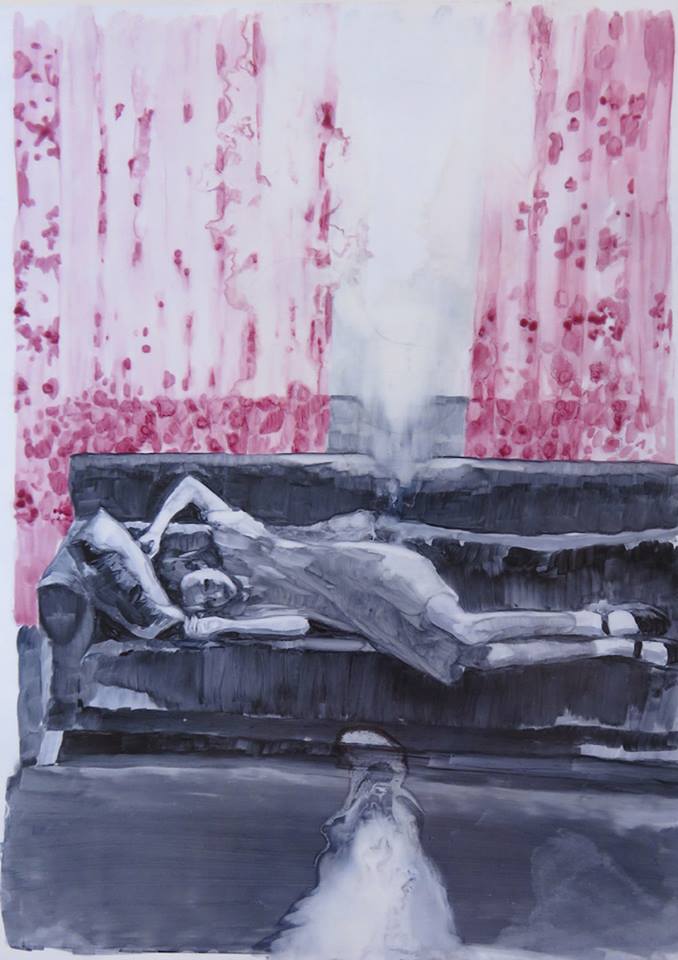
In La Jeune Née I made use of a story that seemed to me particularly expressive of woman’s place: the story of Sleeping Beauty. Woman, if you look for her, has a strong chance of always being found in one position: in bed. In bed and asleep-“laid (out).” She is always to be found on or in a bed: Sleeping Beauty is lifted from her bed by a man because, as we all know, women don’t wake up by themselves: man has to intervene, you understand. She is lifted up by the man who will lay her in her next bed so that she may be confined to bed ever after, just as the fairy tales say.
From Disney’s “Sleeping Beauty”
And so her trajectory is from bed to bed: one bed to another, where she can dream all the more. There are some extraordinary analyses by Kierkegaard on women’s “existence”- or that part of it set aside for her by culture-in which he says he sees her as sleeper. She sleeps, he says, and first love dreams her and then she dreams of love. From dream to dream, and always in second position. In some stories, though, she can be found standing up, but not for long.
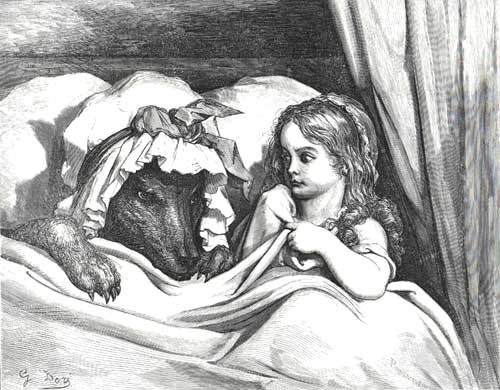
Take Little Red Riding Hood as an example: it will not, I imagine, be lost on you that the “red riding hood” in question is a little clitoris. Little Red Riding Hood basically gets up to some mischief: she’s the little female sex that tries to play a bit and sets out with her little pot of butter and her little jar of honey. What is interesting is that it’s her mother who gives them to her and sends her on an excursion that’s tempting precisely because it’s forbidden: Little Red Riding Hood leaves one house, mommy’s house, not to go out into the big wide world but to go from one house to another by the shortest route possible: to make haste, in other words, from the mother to the other.
The other in this case is grandmother, whom we might imagine as taking the place of the “Great Mother,” because there are great men but no great women: there are Grand-Mothers instead. And grandmothers are always wicked: she is the bad mother who always shuts the daughter in whenever the daughter might by chance want to live or take pleasure. So she’ll always be carrying her little pot of butter and her little jar of honey to grandmother, who is there as jealousy … the jealousy of the woman who can’t let her daughter go.
But in spite of all this Little Red Riding Hood makes her little detour, does what women should never do, travels through her own forest. She allows herself the forbidden … and pays dearly for it: she goes back to bed, in grandmother’s stomach. The Wolf is grandmother, and all women recognize the Big Bad Wolf! We know that always lying in wait for us somewhere in some big bed is a Big Bad Wolf.
Gustave Dore – The Disguised Wolf in Bed
The Big Bad Wolf represents, with his big teeth, his big eyes, and his grandmother’s looks, that great Superego that threatens all the little female red riding hoods who try to go out and explore their forest without the psychoanalyst’s permission. So, between two houses, between two beds, she is laid, ever caught in her chain of metaphors, metaphors that organize culture . . . ever her moon to the masculine sun, nature to culture, concavity to masculine convexity, matter to form, immobility/inertia to the march of progress, terrain trod by the masculine footstep, vessel… While man is obviously the active, the upright, the productive… and besides, that’s how it happens in History.
This opposition to woman cuts endlessly across all the oppositions that order culture. It’s the classic opposition, dualist and hierarchical. Man/Woman automatically means great/small, superior/inferior… means high or low, means Nature/History, means transformation/inertia. In fact, every theory of culture, every theory of society, the whole conglomeration of symbolic systems-everything, that is, that’s spoken, everything that’s organized as discourse, art, religion, the family, language, everything that seizes us, everything that acts on us – it is all ordered around hierarchical oppositions that come back to the man/ woman opposition, an opposition that can only be sustained by means of a difference posed by cultural discourse as “natural,” the difference between activity and passivity. It always works this way, and the opposition is founded in the couple [binary]. A couple posed in opposition, in tension, in conflict… a couple engaged in a kind of war in which death is always at work – and I keep emphasizing the importance of the opposition as couple, because all this isn’t just about one word; rather everything turns on the Word: everything is the Word and only the Word. To be aware of the couple, that it’s the couple that makes it all work, is also to point to the fact that it’s on the couple that we have to work if we are to deconstruct and transform culture. The couple as terrain, as space of cultural struggle, but also as terrain, as space demanding, insisting on, a complete transformation in the relation of one to the other. And so work still has to be done on the couple … on the question, for example, of what a completely different couple relationship would be like, what a love that was more than merely a cover for, a veil of, war would be like.
I said it turns on the Word: we must take culture at its word, as it takes us into its Word, into its tongue. You’ll understand why I think that no political reflection can dispense with reflection on language, with work on language. For as soon as we exist, we are born into language and language speaks (to) us, dictates its law, a law of death: it lays down its familial model, lays down its conjugal model, and even at the moment of uttering a sentence, admitting a notion of “being,” a question of being, an ontology, we are already seized by a certain kind of masculine desire, the desire that mobilizes philosophical discourse. As soon as the question “What is it?” is posed, from the moment a question is put, as soon as a reply is sought, we are already caught up in masculine interrogation. I say “masculine interrogation”: as we say so-and-so was interrogated by the police. And this interrogation precisely involves the work of signification: “What is it? Where is it?” A work of meaning, “This means that,” the predicative distribution that always at the same time orders the constitution of meaning. And while meaning is being constituted, it only gets constituted in a movement in which one of the terms of the couple is destroyed in favor of the other.
“Look for the lady,” as they say in the stories… “Cherchez la femme”– we always know that means: you’ll find her in bed. Another question that’s posed in History, rather a strange question, a typical male question, is: “What do women want?” The Freudian question, of course. In his work on desire, Freud asks somewhere, or rather doesn’t ask, leaves hanging in the air, the question “What do women want?” Let’s talk a bit about this desire and about why/how the question “What do women want?” gets put, how it’s both posed and left hanging in the air by philosophical discourse, by analytic discourse (analytic discourse being only one province of philosophical discourse), and how it is posed, let us say, by the Big Bad Wolf and the Grand-Mother.
“What does she want?” Little Red Riding Hood knew quite well what she wanted, but Freud’s question is not what it seems: it’s a rhetorical question. To pose the question “What do women want?” is to pose it already as answer, as from a man who isn’t expecting any answer, because the answer is “She wants nothing.” … “What does she want? … Nothing!” Nothing because she is passive. The only thing man can do is offer the question “What could she want, she who wants nothing?” Or in other words: “Without me, what could she want?”
Old Lacan takes up the slogan “What does she want?” when he says, “A woman cannot speak of her pleasure.” Most interesting! It’s all there, a woman cannot, is unable, hasn’t the power. Not to mention “speaking”: it’s exactly this that she’s forever deprived of. Unable to speak of pleasure = no pleasure, no desire: power, desire, speaking, pleasure, none of these is for woman. And as a quick reminder of how this works in theoretical discourse, one question: you are aware, of course, that for Freud/Lacan, woman is said to be “outside the Symbolic”: outside the Symbolic, that is outside language, the place of the Law, excluded from any possible relationship with culture and the cultural order. And she is outside the Symbolic because she lacks any relation to the phallus, because she does not enjoy what orders masculinity – the castration complex.
Woman does not have the advantage of the castration complex – it’s reserved solely for the little boy. The phallus, in Lacanian parlance also called the “transcendental signifier,” transcendental precisely as primary organizer of the structure of subjectivity, is what, for psychoanalysis, inscribes its effects, its effects of castration and resistance to castration and hence the very organization of language, as unconscious relations, and so it is the phallus that is said to constitute the a priori condition of all symbolic functioning. This has important implications as far as the body is concerned: the body is not sexed, does not recognize itself as, say, female or male without having gone through the castration complex.
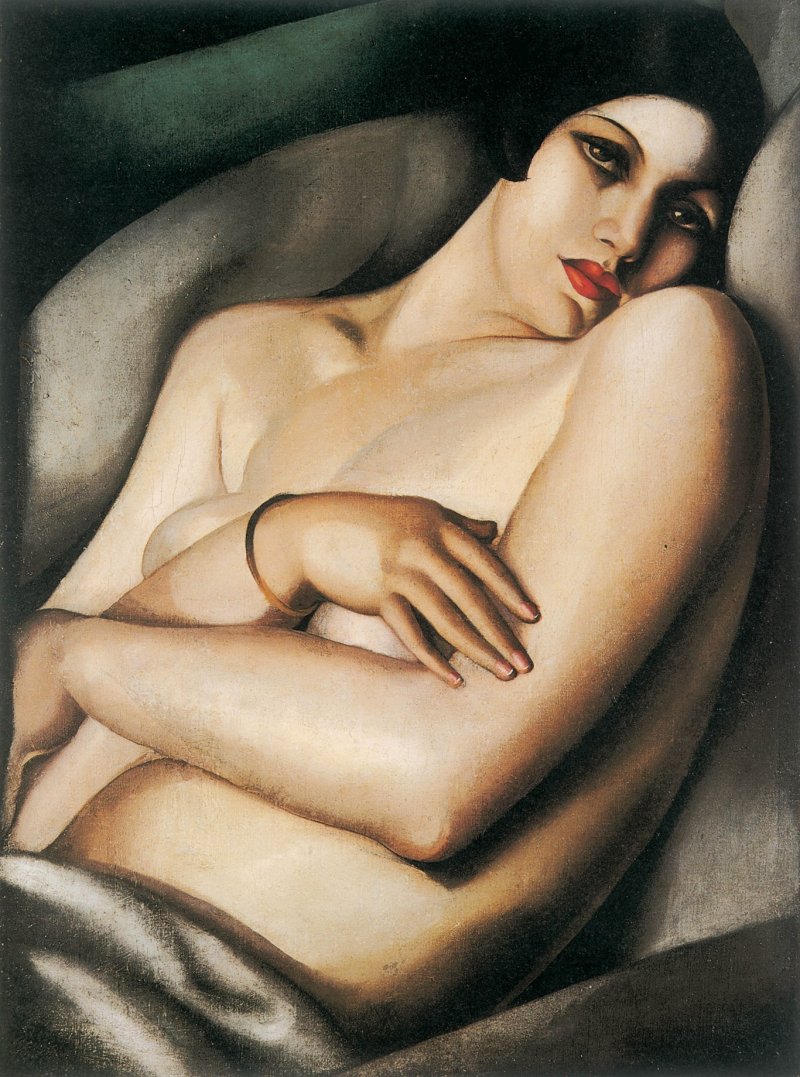
Tamara de Lempicka – “Rafaela sur fond vert” (1927)
What psychoanalysis points to as defining woman is that she lacks lack. She lacks lack? Curious to put it in so contradictory, so extremely paradoxical, a manner: she lacks lack. To say she lacks lack is also, after all, to say she doesn’t miss lack … since she doesn’t miss the lack of lack. Yes, they say, but the point is “she lacks The Lack,” The Lack, lack of the Phallus. And so, supposedly, she misses the great lack, so that without man she would be indefinite, indefinable, nonsexed, unable to recognize herself: outside the Symbolic. But fortunately there is man: he who comes … Prince Charming. And it’s man who teaches woman (because man is always the Master as well), who teaches her to be aware of lack, to be aware of absence, aware of death. It’s man who will finally order woman, “set her to rights,” by teaching her that without man she could “misrecognize.” He will teach her the Law of the Father. Something of the order of: “Without me, without me-the Absolute-Father (the father is always that much more absolute the more he is improbable, dubious)-without me you wouldn’t exist, I’ll show you.” Without him she’d remain in a state of distressing and distressed undifferentiation, unbordered, unorganized, “unpoliced” by the phallus… incoherent, chaotic, and embedded in the Imaginary in her ignorance of the Law of the Signifier. Without him she would in all probability not be contained by the threat of death, might even, perhaps, believe herself eternal, immortal. Without him she would be deprived of sexuality. And it might be said that man works very actively to produce “his woman.” Take for example Marguerite Duras’ Le Ravissement de Lol V. Stein, and you will witness the moment when man can finally say “his” woman, “my” woman. It is that moment when he has taught her to be aware of Death. So man makes, he makes (up) his woman, not without being himself seized up and drawn into the dialectical movement that this sort of thing sets in play. We might say that the Absolute Woman, in culture, the woman who really represents femininity most effectively… who is closest to femininity as prey to masculinity, is actually the hysteric…. he makes her image for her!
The hysteric is a divine spirit that is always at the edge, the turning point, of making. She is one who does not make herself… she does not make herself but she does make the other. It is said that the hysteric “makes-believe” the father, plays the father, “makes-believe” the master. Plays, makes up, makes-believe: she makes-believe she is a woman, unmakes-believe too … plays at desire, plays the father… turns herself into him, unmakes him at the same time. Anyway, without the hysteric, there’s no father… without the hysteric, no master, no analyst, no analysis! She’s the unorganizable feminine construct, whose power of producing the other is a power that never returns to her. She is really a wellspring nourishing the other for eternity, yet not drawing back from the other … not recognizing herself in the images the other may or may not give her. She is given images that don’t belong to her, and she forces herself, as we’ve all done, to resemble them.
And so in the face of this person who lacks lack, who does not miss lack of lack, we have the construct that is infinitely easier to analyze, to put in place-manhood, flaunting its metaphors like banners through history. You know those metaphors: they are most effective. It’s always clearly a question of war, of battle. If there is no battle, it’s replaced by the stake of battle: strategy. Man is strategy, is reckoning . . . “how to win” with the least possible loss, at the lowest possible cost. Throughout literature masculine figures all say the same thing: “I’m reckoning” what to do to win. Take Don Juan and you have the whole masculine economy getting together to “give women just what it takes to keep them in bed” then swiftly taking back the investment, then reinvesting, etc., so that nothing ever gets given, everything gets taken back, while in the process the greatest possible dividend of pleasure is taken. Consumption without payment, of course.









![Max Ernst - Une semaine de bonté [A Week of Kindness]. La clé des chants 1 [The Key of Songs 1] 1933](https://fleurmach.com/wp-content/uploads/2016/03/003_max_ernst_theredlist.jpg)


 fleurmach