Nin talks fondly about some of her favourite rebellious women, including psychoanalyst Lou Andreas-Salomé (who could hold her own with Rilke, Freud and Nietzsche) and Caresse Crosby, the infamous libertine, anti-war crusader and publisher, about being an artist and exploring psychological worlds, beyond judgement.
Category Archives: spirit
nick cave on love songs
Though the love song comes in many guises – songs of exultation and praise, songs of rage and of despair, erotic songs, songs of abandonment and loss – they all address God, for it is the haunted premises of longing that the true love song inhabits. It is a howl in the void, for Love and for comfort and it lives on the lips of the child crying for his mother. It is the song of the lover in need of her loved one, the raving of the lunatic supplicant petitioning his God. It is the cry of one chained to the earth, to the ordinary and to the mundane, craving flight; a flight into inspiration and imagination and divinity. The love song is the sound of our endeavours to become God-like, to rise up and above the earthbound and the mediocre.
~ Nick Cave
shane koyczan – to this day project
Help this message have a far reaching and long lasting effect in confronting bullying. Please share generously.
the rape of persephone (homeric hymn)
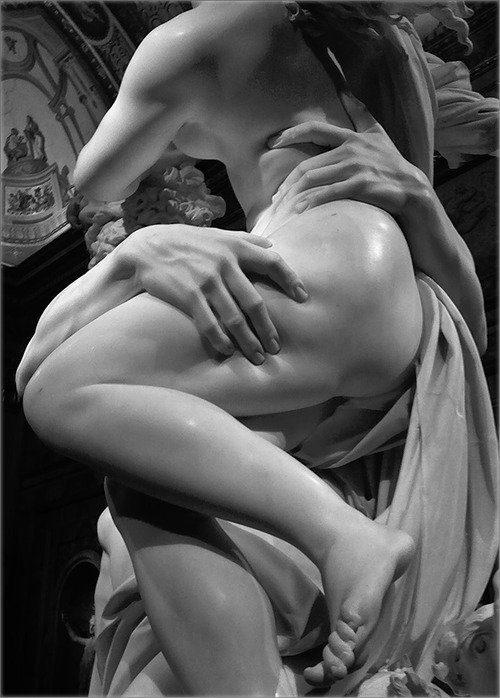
The Rape of Proserpina – Gian Lorenzo Bernini (1622)
I) HAIDES ABDUCTS PERSEPHONE
Homeric Hymn ii to Demeter (abridged) (trans. Evelyn White) (Greek epic circa 7th or 6th B.C.)
“[Demeter’s] trim-ankled daughter whom Aidoneus [Haides] rapt away, given to him by all-seeing Zeus the loud-thunderer. Apart from Demeter, lady of the golden sword and glorious fruits, she was playing with the deep-bosomed daughters of Okeanos and gathering flowers over a soft meadow, roses and crocuses and beautiful violets, irises also and hyacinths and the narcissus, which Gaia made to grow at the will of Zeus and to please Polydektor (the Host of Many), to be a snare for the bloom-like girl – a marvellous, radiant flower. It was a thing of awe whether for deathless gods or mortal men to see: from its root grew a hundred blooms and it smelled most sweetly, so that all wide heaven (Ouranos) above and the whole earth (Gaia) and the sea’s (Thalassa’s) salt swell laughed for joy.
And the girl was amazed and reached out with both hands to take the lovely toy: but the wide-pathed earth yawned there in the plain of Nysa, and the lord, Polydegmon (Host of Many), with his immortal horses sprang out upon her — the Son of Kronos, Polynomos (He who has many names). He caught her up reluctant on his golden car and bare her away lamenting.
Then she cried out shrilly with her voice, calling upon her father, [Zeus] the Son of Kronos, who is most high and excellent. But no one, either of the deathless gods or mortal men, heard her voice, nor yet the olive-trees bearing rich fruit: only tender-hearted Hekate, bright-coiffed, the daughter of Persaios, heard the girl from her cave, and the lord Helios (the Sun), Hyperion’s bright son, as she cried to her father, the Son of Kronos. But he was sitting aloof, apart from the gods, in his temple where many pray, and receiving sweet offerings from mortal men. So he [Haides], that Son of Kronos, Polynomos (of Many Names), Polysemantor (Ruler of Many) and Polydegmon (Host of Many), was bearing her away by leave of Zeus on his immortal chariot – his brother’s child and all unwilling.
And so long as she, the goddess, yet beheld earth and starry heaven and the strong-flowing sea where fishes shoal, and the rays of the sun, and still hoped to see her dear mother and the tribes of the eternal gods, so long hope claimed her great heart for all her trouble… and the heights of the mountains and the depths of the sea ran with her immortal voice: and her queenly mother heard her.
the boswell sisters – shout sister, shout (1931)
Recorded in New York, April 23, 1931
House Orchestra: Mannie Klein or Jack Purvis (tpt) Tommy Dorsey (tbn) Jimmy Dorsey (cl, as) Joe Venuti (vln) Arthur Schutt (p) Eddie Lang (g) Joe Tarto (sb) Chauncey Morehouse (d, vib) Victor Young (cond)

E-36655-A Shout, Sister, Shout (Williams-Hill-Brynan) 3:13 Brunswick 6109, Brunswick 6847, Brunswick 6783, [BSC1], [NWST], [IY], [ELMB], [ITG], [TOOMA]
Composed by J. Tim Brymn, Alexander Hill and Clarence Williams
The Boswell Sisters were a close harmony singing group, consisting of sisters Martha Boswell (June 9, 1905 – July 2, 1958), Connee Boswell (original name Connie) (December 3, 1907 – October 11, 1976), and Helvetia “Vet” Boswell (May 20, 1911 – November 12, 1988), noted for intricate harmonies and rhythmic experimentation.
silent vigil this wednesday in cape town
Via Malika Ndlovu:
Stand Up! Be still. Join the Tower of Silence in reflection and protest against the silencing, a pillar of honouring and mourning. Wear white (a symbol of spirit, light, cleansing, unity beyond gender, language, political or religious agenda) and join this 1 hour vigil against the violence epitomized by the death and brutalisation of Anene Booysen… and too many of our daughters and sisters like her. This Wednesday, 13th February 2013, on the steps of St George’s Cathedral, from 12 pm to 1 pm.
Bring a photograph on a placard of anyone you think we need to remember in this way too. We will not be sloganeering or shouting retaliations against our lost sons, brothers who have perpetuated this crime against their own and her humanity. Our collective presence and solidarity speaks volumes and calls for multiple responses to this complex situation, affecting an entire nation. We make this physical visual statement on the eve of onebillionrising.org global campaign and the president’s “State of the Nation” address. For us, these faces, these stories, these discarded bodies and all the reasons why this continues to happen in the world and all over South Africa – THIS is OUR ‘State of our Nation’ call to address!
crows in highgate cemetery
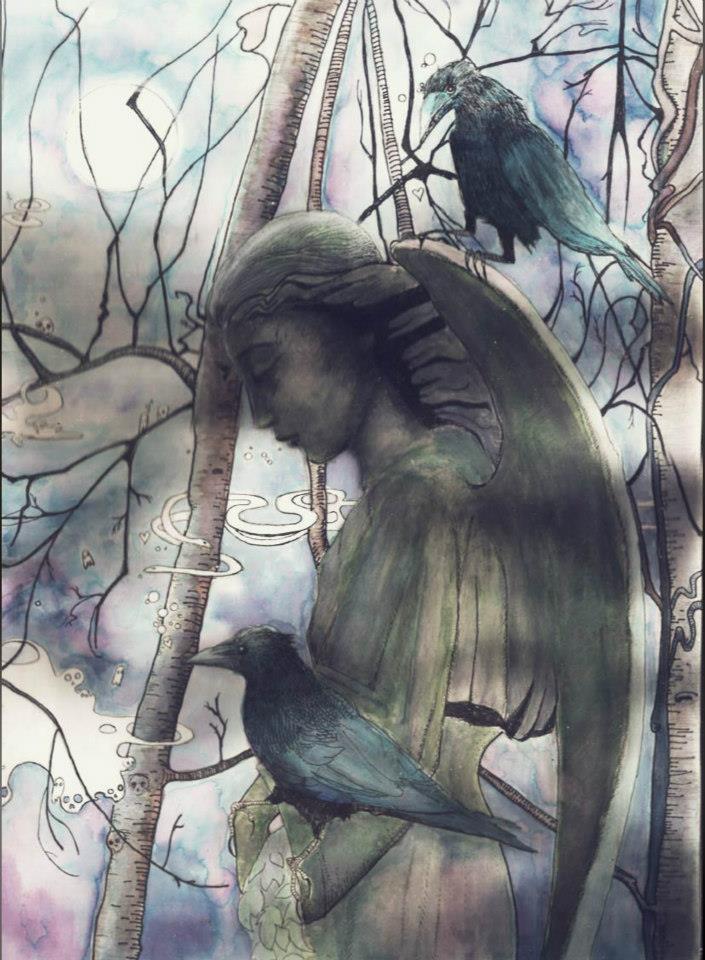
Illustration by Marga Duggan. All Rights Reserved.
owl flying under ‘suicide bridge’, highgate
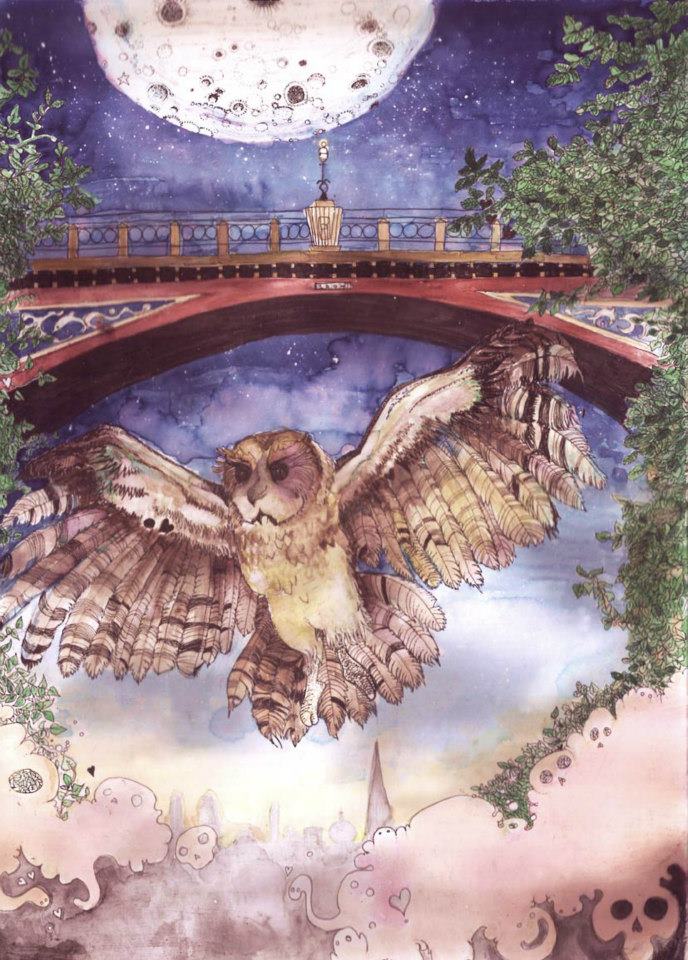
Illustration by Marga Duggan. All Rights Reserved.
Owl flying under the ‘suicide bridge’, Archway Road, Highgate. I never see them, but I hear them.
mouchette
Final scene from Robert Bresson’s 1967 film.
“The small town is plagued with alcoholism, marital infidelity, unbridled masculinity, violence, and moral ambivalence. Mouchette’s father and brother, we have already seen, operate by selling liquor on the black market, with complicit police that turn an indifferent eye to a crate left behind. They, like other townsfolk, are paid in shots of alcohol, consumed without speech. Following Sunday mass, the village parishioners leave church and hastily head to the bar before the bells cease to toll. Mouchette’s dying mother has to hide gin from her abusive spouse. Even the town’s interdependent poacher/warden pair, Arsène and Mathieu, bring an end to their cat-and-mouse charade in the woods by sharing a drink from Arsène’s canteen full of gin. The motif of alcohol and its abuse stands as a distinctive mark of the moral decay of Mouchette’s society; however, the corruption of this town is not limited to alcoholism… Indeed, Mouchette’s society is one of extreme decadence and lawlessness, one that is ripe for a scapegoat upon whose back it can collectively discharge the burden of its vice and one from which the victim will gladly depart.”
Read more about the film HERE.
the soul’s path is in the ear
“When I was fourteen, I discovered the sound of iniquity on a long-playing record for the blind from the Library of Congress. I listened to Paradise Lost, and sometimes after hours of playing the story of Satan I’d walk to the driveway’s edge and feel the elaborate work of sunlight and wind and imagine, the way only a teenager can, the falling of Satan in a blackness so pure you could feel it in the bones of your face… I’d discovered the gift of Milton: the soul’s path is in the ear – not the mirror.”
~ Stephen Kuusisto, from Eavesdropping: A Memoir of Blindness and Listening (W. W. Norton & Company, 2006)
jung on the human psyche and healing the soul
Anyone who wants to know the human psyche will learn next to nothing from experimental psychology. He would be better advised to abandon exact science, put away his scholar’s gown, bid farewell to his study, and wander with human heart throughout the world. There in the horrors of prisons, lunatic asylums and hospitals, in drab suburban pubs, in brothels and gambling-hells, in the salons of the elegant, the stock exchanges, socialist meetings, churches, revivalist gatherings and ecstatic sects, through love and hate, through the experience of passion in every form in his own body, he would reap richer stores of knowledge than text-books a foot thick could give him, and he will know how to doctor the sick with a real knowledge of the human soul.
~ C.G. Jung
a special message from jimmy rage
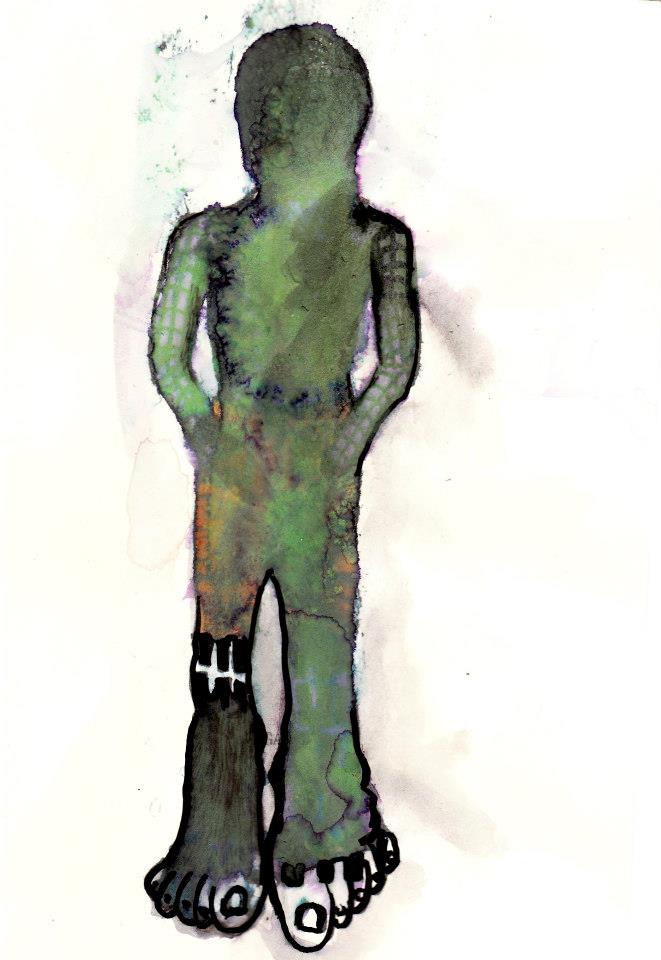 each and every one one of us has a book of narratives, that we read write and become part of. each chapter verse and paragraph tells our stories and as time passes, we become familiar with our own characters and our own cast of characters become familiar with us.
there is the longing, the dreaming, the ambition, the beauty and the ugliness and above all, there is the love.. the love of others, the love of others like self and the love of self..
the hardest part though, is to be and become part of the narrative..beauty.. to not negate from its positivity its validity as a document to the light rays streaming through our windows of hope and courage to go forward.
the sun rises and sets in a distant sky, as trees bend, bow, blow leaves, jingling. we are hushed into our own simplicities, the grace of intelligence..
man woman or child is the subtotal of a life lived and hoped for.. the narrative of distant and close dreams are but moments, in our own being, where we are awake and know and overstand that it is in the power of our being that we learn that our own empowerment is the storehouse.. that we are capable of more than the small parts that make up the whole.
love, romance, career, children are all part of the course of our own destined future, but the inner self, the inner voice is the calling to follow your own path, all love, and in doing so .. this becomes a mantra, a calling even..
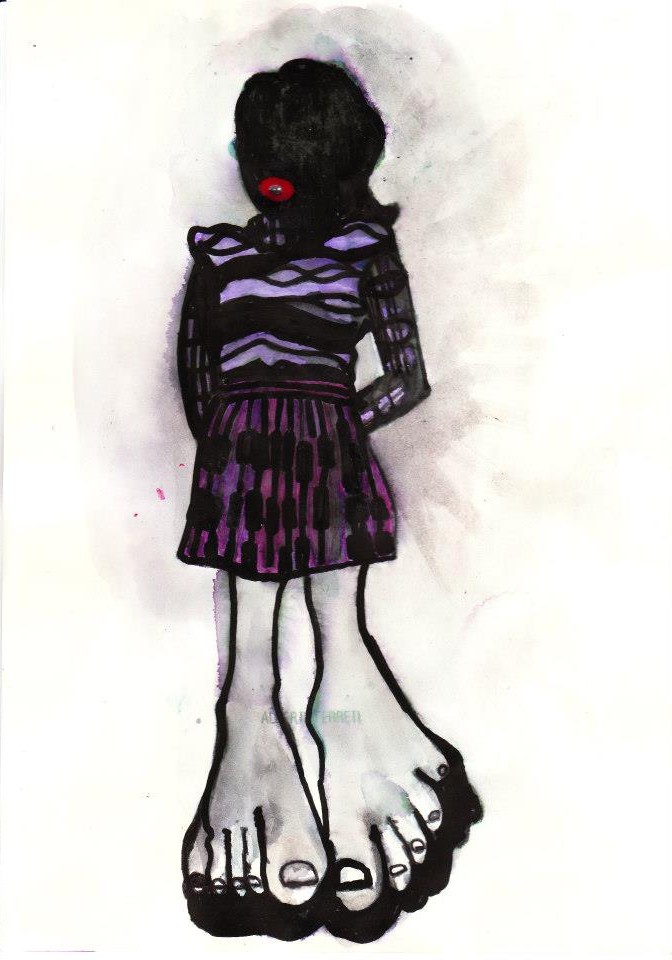
la double vie de veronique
The marionette scene from Krzysztof Kieslowski’s The Double Life of Veronique (1991). Watch the full film HERE.
“The director’s international breakthrough remains one of his most beloved films, a ravishing, mysterious rumination on identity, love, and human intuition. Irène Jacob is incandescent as both Weronika, a Polish choir soprano, and her double, Véronique, a French music teacher. Though unknown to each other, the two women share a mysterious and emotional bond that transcends language and geography, which Kieslowski details in gorgeous reflections, colours, and movements. Aided by Slawomir Idziak’s shimmering cinematography and Zbigniew Preisner’s haunting, operatic score, Kieslowski creates one of cinema’s most purely metaphysical works. The Double Life of Veronique is an unforgettable symphony of feeling.
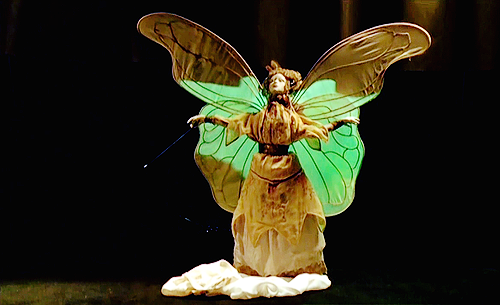
“Krzysztof Kieslowski focuses on identity using actress Irene Jacobs in the dual role of French music teacher Veronique and Polish soprano Weronika – both born on the same day. Metaphysically they are aware of each other’s counterpart – this harkens back to the director’s penchant for fate, chance and circumstance,and we envision a possible meeting of the intertwined souls… Our unspoken desire for a mirrored being – who can non-verbally share our most intimate loves and joys – is the ultimate expression of personal support… Overall, an ambiguous and enigmatic offering, this is a film that clings to you for years after viewing. A true masterpiece of cinema.”
~ Gary W. Tooze
paul sharits – n:o:t:h:i:n:g
A portion of the opening movement of Paul Sharits’ 1968 film.
N:O:T:H:I:N:G is a film deplenished of all, of any signified stance and involved only in the manner of film itself. Just the drawing of a bulb, the projector light and a chair remain in the space of the screen. But these are just random disruptions of monochrome frames.
The whole film is built as a vibration of rhythms, ‘energy-colour’, based on the structure of the Tibetan mandala of five Dyani Bouddhas. Formally the composition is centred on the psychic flickering caused by four symbolic colours: white, yellow, red and green. The more the film is next to the centre that is the centre of the mandala, the empty point, the more the monochrome frames flicker faster, up to invert the speed in the second part of the film (bearing off the centre), the retrograde of the first one. Sharits constructed the structure of the film about the ‘Om’ Nembutsu droning: nevertheless the film can be considered as the visual translation of this sound.
“The screen, illuminated by Paul Sharits’ N:O:T:H:I:N:G, seems to assume a spherical shape, at times – due, I think, to a pearl-like quality of light his flash-frames create… a baroque pearl, one might say – wondrous!… One of the most beautiful films I’ve seen.” – Stan Brakhage
“You are pulled into the world of color, your color senses are expanded, enriched. You become aware of changes, of tones around your own daily reality. Your vision is changed. You begin to see light on objects around you… Your experience range is expanded. You have gained a new insight. You have become a richer human being.” – Jonas Mekas
waiting to exhale

*.* Love’s Secret Domain, 2004. Self-portrait manipulated with MS Photo Editor.
“I think,” Tehanu said in her soft, strange voice, “that when I die, I can breathe back the breath that made me live. I can give back to the world all that I didn’t do. All that I might have been and couldn’t be. All the choices I didn’t make. All the things I lost and spent and wasted. I can give them back to the world. To the lives that haven’t been lived yet. That will be my gift back to the world that gave me the life I did live, the love I loved, the breath I breathed.”
~ Ursula K. Le Guin – from The Dispossessed
swans – mind/body/light/sound (1995)
Throw your mind away
Fall into the sea
There’s nothing solid here
Dissolve your body today
There’s a sun in the sky
We’re in the atmosphere
Throw yourself in the sea
There’s nothing solid down here
Mind/body/light/sound
Mindless, bodyless, soundless light
This ordinary night
This ordinary day
They’re twisted out of shape
Then they disintegrate
Cool water runs through the ground
The ocean blends with the air
Throw yourself in the fire
There’s nothing solid around here
Mind/body/light/sound
Mindless, bodyless, soundless light
The world was over today
The time is already gone
Throw your mind in the sea
Eternity doesn’t last very long
There’s some people on earth
They live in separate minds
Dissolve your body today,
There is no more outside
Mind/body/light/sound
Mindless, bodyless, soundless light
jiddu krishnamurti on observing ourselves in space and time
“When the observer is the observed, and the observer has always acted as though the observed is something different from himself, then he could act. But, when he realises that the observer IS the observed, all action ceases on his part… and, therefore, all effort. And therefore there is no fear at all. This requires a great deal of inward inquiry, inward observation, step by step without coming to any conclusion.
“Why do you choose; what is the necessity of choice? If you see something very clearly (as we just now saw what freedom implied, and that the mind is only free when it can see the total) … when you see that clearly, there is no choice. It’s only the confused mind that chooses. Awareness takes place only when there is no choice, or when you are aware of all the conflicting choices, all the conflicting desires, the strains… Just to observe all this movement of contradiction… and, knowing that the observer is the observed, that therefore in that process there is no choice at all, but only watching what IS.
“And that’s entirely different from concentration. Awareness brings a quality of attention in which there is neither the observer nor the observed. When you really attend, completely attend, like now, if you are really listening, there is neither the listener nor the speaker. And that state of attention brings about an extraordinary sense of freshness, a quality of newness to the mind…”
thoughts on meaningful work, 14 november 2012, 5:38 a.m.
What follows is something I wanted to blog from Turkey in November but was unable to due to lack of an internet connection at the time. I woke up very early one morning, typed it into my phone’s notes app, half asleep, and promptly forgot about it. The incredibly tedious work I am currently doing (editing an MSc thesis on anthropometric measurements for office chairs) reminded me of its existence. So, two months later, here it is.
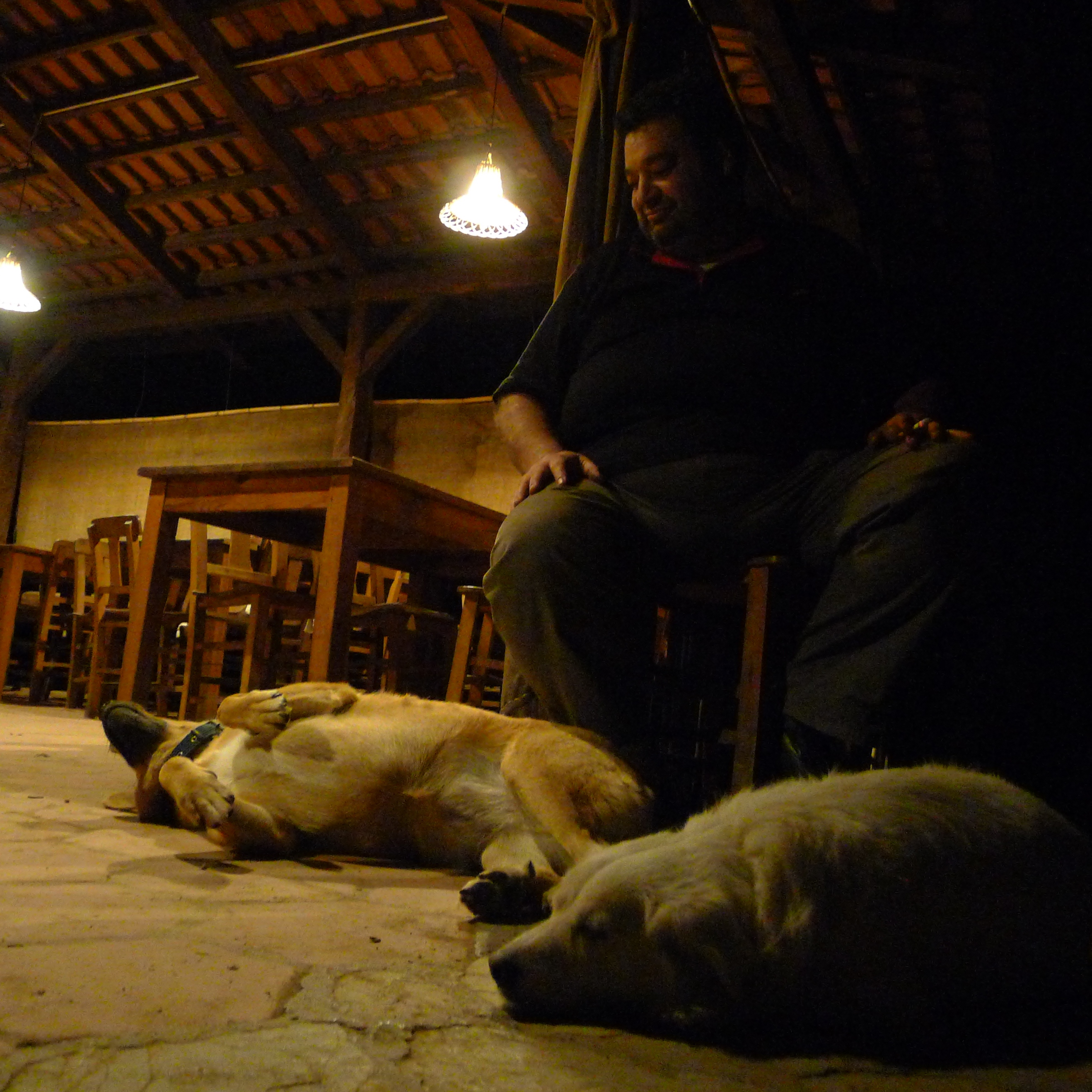
Arif Cerit with the farm dogs, Shanslar (Lucky) and Beyaz (White), at Pastoral Vadi. Photo: Rosemary Lombard.
Last night I had a profound conversation, in my bad Turkish and his bad English, with Arif Cerit, a guy who lives at Pastoral Vadi, the organic/permaculture farm near Fethiye in South-Western Turkey which I am visiting – working in exchange for food and a bed. It’s a very comfortable bed, in a neat, well-appointed cottage designed and built of cob (straw and mud) five years ago by Ahmet Kizen, an architect passionate about sustainable living and ecotourism who bought this farm 14 years ago and opened it to visitors about 7 years back. No maintenance has been necessary since the cottage was built, I’m told. The thick walls keep it cool during the day and surprisingly warm at night.
So, back to what I wanted to blog about, which has resonated for me with my friend P‘s latest gier on Facebook, which involves a sort of Dada/absurdist attempt to animalise interactions. Having been away and in limited contact with everyone, I haven’t had a chance to ask him more about it, but, basically, instead of clicking “like”, he types animal noises. “Baaa, baaa”, mostly. For me it draws attention to the essentially animal nature of human interaction, which we have become unconscious of and detached from, as we live large swathes of our lives online, “denatured”, unquestioning. “Like” has become a capricious yet ubiquitous form of social capital. Facebook’s shady manipulation of this currency of late has triggered consternation and outrage. They’ve put in place algorithms that restrict the “organic” (terms such as “organic” and “viral” in the world of virtual memes are interesting in their ironic detachment!) reach of posts on the network, requiring one to pay (“real” money) to secure an audience greater than an arbitrary sliver of the profiles to whom one is connected… Just when I thought it was because I only had a sliver of die-hards who actually enjoyed what I post anymore, I realised that most of my Facebook friends no longer see my updates in their news feeds. What a relief (?). The virtual landscape increasingly resembles a targeted marketing environment more than it does a communal hangout, a place for exchanging ideas and thoughts, as it used to. Now it’s mostly about Profit. By monetising the prominence of posts, equal access is effectively being stifled. Concomitantly, freedom of association and meaningful interaction are withering.
That’s another aside, or, rather, more context. ANYWAY. So, what I gleaned from my conversation with big, friendly Arif was that he had been a taxi driver with a fleet of cars in the west coast city of Izmir for 21 years, before dropping everything and moving here to the farm. He sold his business, gave the money to his brothers and left it all behind.
He says that the city is a big jungle, very dark, very dense, very dangerous, full of artifice and chemical poisons. People are a species of animal, he says, like all animals… In cities you have to be a predator to do well. If you are not a predator, you have to live your life very small, like a rat, to survive. Your mind is very important, he says. The chasing after money and things that you need to do to live in the city takes up all your time and your thoughts. Money is a cancer. TV is the morphine you need to kill the pain at the end of the day: the pain of your mind being eaten away.
Out here on the farm, life is real, he says. There is space, there is ground, and air, and the smell of greenness. Animals who are not predators can live happily, widely, openly, productively.
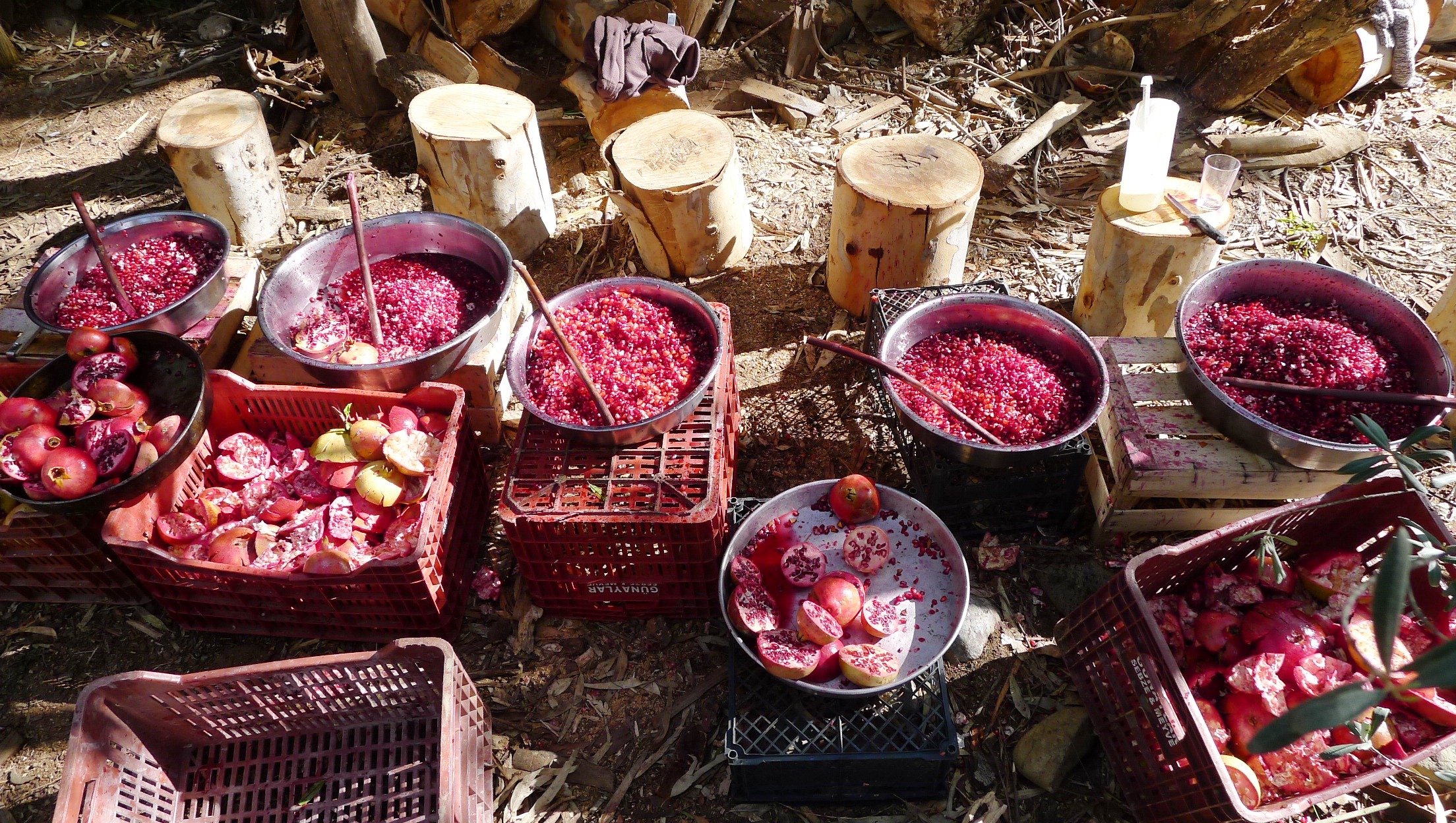
Processing pomegranates by hand to make nar ekshili sos (pomegranate reduction). Photo: Rosemary Lombard
Sticky, crimson pomegranate juice is running down my arms and dripping off my elbows. I’m stained with the joy of manual labour. It’s so satisfying, this repetitive bashing of crates and crates of halved fruit to knock out the arils, then the squeezing in a bag to extract the juice, which is then boiled over a fire for ten hours to reduce it to a dark, tart syrup, then strained through muslin into bottles. It’s slow-going, messy, tiring work. I have blisters, purple palms. But, at the end of each day, I can see the results of my time spent. It’s nothing like the virtual world of work I mostly inhabit, where I shut down my computer and a sense of the hours and hours I have spent shunting pixels around evaporates.
For so long now, my life has felt paper-thin, no, thinner, as if I barely cast even a shadow of influence in the world, and I realise now that it is largely because of the intangible nature of the work I have been doing, which mostly involves cleaning, tidying and correcting other people’s writing, or recording their work, or facilitating their conversations… It’s all work towards actualising goals that I have deemed worthwhile; nonetheless, these are goals which are not my own. I have tried to frame them as my own, tried to see my part in the whole as indispensable, my purpose as contiguous with that of the projects’, my place as “a tiny cog in the great wheel of evolution” – that was how Billy Wilder put it, writing the words of Ninotchka played by Greta Garbo in Ernst Lubitsch’s wonderful 1939 satire of the same name.
Alas, my heart just hasn’t been convinced. I haven’t been able to shake this unbearable sense of lightness, of the unnecessary breaths I’m taking, of the lack of any other humans who truly require or desire my existence, irreplaceably, here on Earth. All this needs to change if I am to remain sane when I get back. Living with a heavenly purpose is too far beyond me. I’d be satisfied to have done with consumption, thanks. I started this blog in an attempt to make something indelible of the ephemeral. I need to do more. I’m starving.
“If I had an orchard, I’d work till I was sore.” ~ Fleet Foxes – “Helplessness Blues“.

Sweet! A break to drink some freshly-squeezed pomegranate juice. Photo: Rosemary Lombard
apples
 Life will break you. Nobody can protect you from that, and living alone won’t either, for solitude will also break you with its yearning. You have to love. You have to feel. It is the reason you are here on earth. You are here to risk your heart. You are here to be swallowed up. And when it happens that you are broken, or betrayed, or left, or hurt, or death brushes near, let yourself sit by an apple tree and listen to the apples falling all around you in heaps, wasting their sweetness. Tell yourself you tasted as many as you could.
~ Louise Erdrich (The Painted Drum)
maya deren/alexander hammid – meshes of the afternoon
Meshes of the Afternoon (1943) is a short experimental film directed by wife and husband team, Maya Deren and Alexander Hammid. The film’s narrative is circular, and repeats a number of psychologically symbolic images, including a flower on a long driveway, a key falling, a door unlocked, a knife in a loaf of bread, a mysterious Grim Reaper-like cloaked figure with a mirror for a face, a phone off the hook and an ocean. Through creative editing, distinct camera angles, and slow motion, this surrealist film depicts a world in which it is more and more difficult to catch reality.
“This film is concerned with the interior experiences of an individual. It does not record an event which could be witnessed by other persons. Rather, it reproduces the way in which the subconscious of an individual will develop, interpret and elaborate an apparently simple and casual incident into a critical emotional experience.”
— Maya Deren on Meshes of the Afternoon, from DVD release Maya Deren: Experimental Films 1943–58.
The film was originally silent – the soundtrack, by Deren’s third husband, Teiji Ito, was only added in 1959.
audre lorde on the erotic
The erotic is a resource within each of us that lies in a deeply female and spiritual plane, firmly rooted in the power of our unexpressed or unrecognised feeling…
Of course, women so empowered are dangerous. So we are taught to separate the erotic from most vital areas of our lives other than sex…
The principal horror of any system which defines the good in terms of profit rather than in terms of human need, or which defines human need to exclusion of the psychic and emotional components of that need — the principal horror of such a system is that it robs our work of its erotic value, its erotic power and life appeal and fulfilment. Such a system reduces work to a travesty of necessities, a duty by which we earn bread or oblivion for ourselves and those we love. But this is tantamount to blinding a painter and then telling her to improve her work, and to enjoy the act of painting. It is not only next to impossible, it is also profoundly cruel.
. . . [O]nce we begin to feel deeply all the aspects of our lives, we begin to demand from ourselves and from our life-pursuits that they feel in accordance with that joy which we know ourselves to be capable of. Our erotic knowledge empowers us, becomes a lens through which we scrutinize all aspects of our existence, forcing us to evaluate those aspects honestly in terms of their relative meaning within our lives…
During World War II, we bought sealed plastic packets of white, uncolored margarine, with a tiny, intense pellet of yellow coloring perched like a topaz just inside the clear skin of the bag. We would leave the margarine out for a while to soften, and then we would pinch the little pellet to break it inside the bag, releasing the rich yellowness into the soft pale mass of margarine. Then, taking it carefully between our fingers, we would knead it gently back and forth, over and over, until the color had spread throughout the whole pound bag of margarine, thoroughly coloring it.
I find the erotic such a kernel within myself. When released from its intense and constrained pellet, it flows through and colors my life with a kind of energy that heightens and sensitizes and strengthens all my experience.
Lorde, Audre. “Uses of the Erotic: The Erotic as Power.” Sister Outsider: Essays and Speeches. Freedom, CA: Crossing Press, 1984. 53-59.
tale of tales (skazka skazok)
Astoundingly beautiful animation masterpiece by Yuri Norstein (USSR,1979, 28 min).
From Wikipedia:
Tale of Tales, like Tarkovsky’s Mirror, attempts to structure itself like a human memory. Memories are not recalled in neat chronological order; instead, they are recalled by the association of one thing with another, which means that any attempt to put memory on film cannot be told like a conventional narrative. The film is thus made up of a series of related sequences whose scenes are interspersed between each other. One of the primary themes involves war, with particular emphasis on the enormous losses the Soviet Union suffered on the Eastern Front during World War II. Several recurring characters and their interactions make up a large part of the film, such as the poet, the little girl and the bull, the little boy and the crows, the dancers and the soldiers, and especially the little grey wolf (Russian: се́ренький волчо́к, syeryenkiy volchok). Another symbol connecting nearly all of these different themes are green apples (which may symbolise life, hope, or potential).
Yuriy Norshteyn wrote in Iskusstvo Kino magazine that the film is “about simple concepts that give you the strength to live.”
that very night in max’s room a forest grew . . . and the walls became the world all around
rosemary for remembrance
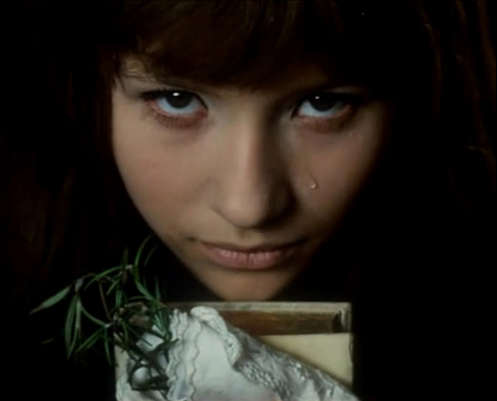
Jaroslava Schallerová in a still from “Valerie a Týden Divu” (Valerie & Her Week of Wonders). Director: Jaromil Jires, 1970
WATCH IT. It’s utterly beautiful.
nora keyes – tomb song
Nora Keyes – Songs to Cry by for the Golden Age of Nothing
the raincoats – adventures close to home (1979)
Passion that shouts
Red with anger
I lost myself
Through alleys of mysteries
I went up and down
like a demented train
Don’t take it personal
I choose my own fate
I follow love
I follow hate
Searching for something
that makes hearts move
I found myself
But my best possession
walked into the shade
and threatened to drift away
Don’t take it personal
I choose my own fate
I follow love
I follow hate
For all of myself
I left you behind as if I could
possessed by Quixote’s dream
Went to fight dragons in the land of concrete
Don’t take it personal
I choose my own fate
I follow love
I follow hate
Rolling in pain
discovered what hurts
and tasted hell
infatuated by madness
I danced in flames
and drank in the depth of love
anaïs nin on unbearable lightness
“I am the most tired woman in the world. I am tired when I get up. Life requires an effort I cannot make. Please give me that heavy book. I need to put something heavy like that on top of my head. I have to place my feet under the pillows always, so as to be able to stay on earth. Otherwise I feel myself going away, going away at a tremendous speed, on account of my lightness… As soon as I utter a phrase my sincerity dies, becomes a lie whose coldness chills me. Don’t say anything, because I see that you understand me, and I am afraid of your understanding. I have such a fear of finding another like myself, and such a desire to find one! I am so utterly lonely, but I also have such a fear that my isolation be broken through, and I no longer be the head and ruler of my universe. I am in great terror of your understanding by which you penetrate into my world; and then I stand revealed and I have to share my kingdom with you.”
~ Anaïs Nin
patti smith – within you without you
Beatles cover off the album Twelve (Columbia, 2008).
re: god and human freedom
a conversation between cherry bomb and aryan kaganof
—
On Nov 20, 2007 10:14 PM, Rosemary Lombard wrote:
http://www.religion-online.org/showchapter.asp?title=2285&C=2159
came across this while reading around transcendence/immanence
a fascinating philosophical article
on god and human freedom
comes at christian scripture, existentialism, marxism
from an ENTIRELY different angle to the traditional church
very unorthodox
yet still from a christ-focused perspective
thought you’d also find it interesting
esp how it might relate to your youniverse
“ama et fac quod vis”
(love, and do what you will)
– st augustine
[although the he-personification of god
and use of ‘man’ to mean generic ‘human’ irks me a bit,
i see the publication’s date was 1970, so it’s alright ;]
—
Nov 21, 2007
poem for rose, paradoxically
Filed under: kagapoems, poetry, paradoxism — ABRAXAS @ 10:24 am
i stumbled upon
myself stumbling upon
the difference between transcendence and immanence
my stumbling was the means by which i knew
there was an i to stumble
upon that which was there to be stumbled upon
immanence implied that i was everything that i stumbled upon
and everything i stumbled upon was me
transcendence granted me existence outside of what i stumbled upon
and that my being might exist outside of knowing
what was unknowable was how to unstumble
and thus in my unstumbling upon
myself unstumbling
i became unme
now immanence implied that everything unme
could be unstumbled upon and that everything that could be unstumbled upon is in unme
whereas transcendence seemed to be saying that unme is also outside of unstumbling
and therefore could not be unstumbled upon
here i found a contradiction
because if it is only possible to stumble upon something outside of me
then surely it is impossible to unstumble upon something inside of unme
unless of course my stumbling upon
myself stumbling upon
was in fact inside of me
meaning that there is no difference between transcendence and immanence
hence god’s indifference
to the problem
—
On Nov 21, 2007 11:59 PM, Rosemary Lombard wrote:
yes
this is our business
does the ground worry
if a seed is growing or withering away?
or how often a wayfarer stumbles?
the substrate whereby
we are
is god
within with without
us
our embrace of existence lies in union
love is the yes to life
love is the blossom of anti-entropy

Carly’s loving hands (2008). Photo by Rosemary Lombard
on incarnation and sacrifice
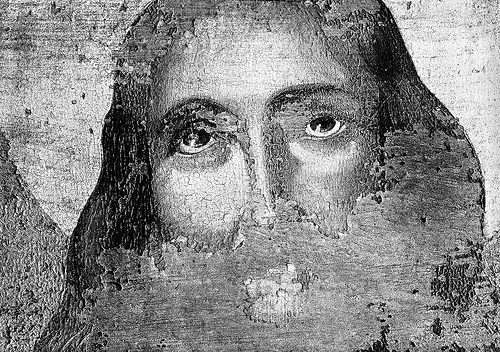
But supposing God became a man – suppose our human nature which can suffer and die was amalgamated with God’s nature in one person – then that person could help us. He could surrender His will, and suffer and die, because He was man; and He could do it perfectly because He was God. You and I can go through this process only if God does it in us; but God can only do it if He becomes man. Our attempts at this dying will succeed only if we men share in God’s dying, just as our thinking can succeed only because it is a drop out of the ocean of God’s intelligence: but we cannot share God’s dying unless God dies; and God cannot die except by being a man. That is the sense in which He pays our debt, and suffers for us what He Himself need not suffer at all.
~ C.S. Lewis, Mere Christianity
 fleurmach