louise bourgeois on the difficulty of expression

How are you going to turn this around and make the stone say what you want when it is there to say “no” to everything? It forbids you. You want a hole, it refuses to make a hole. You want it smooth, it breaks under the hammer. It is the stone that is aggressive. It is a constant source of refusal. You have to win the shape…

Gaston Bachelard would explain this by saying that the thing that had to be said was so difficult and so painful that you have to hack it out of yourself and so you hack it out of the material, a very, very hard material.

I read Bachelard when I was over seventy-five. If I had read Bachelard before, I would have been a different person, I would not have been divided inside since I would have taken the materials, with their different characters, and I would have been more friendly towards them. In the past, every time somebody asked me about materials, I used to answer, “What interests me is what I want to say and I will battle with any material to express accurately what I want to say.” But the medium is always a matter of makeshift solutions. That is, you try everything, you use every material around, and usually they repulse you. Finally, you get one that will work for you. And it is usually the softer ones–lead, plaster, malleable things. That is to say that you start with the harder thing and life teaches you that you had better buckle down, be contented with softer things, softer ways.
__
Excerpted from Louise Bourgeois’ Destruction of the Father / Reconstruction of the Father: Writings and Interviews 1923-1997.

Louise Bourgeois with soft head sculpture, 2009.

Louise Bourgeois with soft head sculpture, 2009.

More about Louise Bourgeois’ soft sculpture faces and the restorative act of joining things together HERE.

alden wood – radical intersections: the rise of atonal music and the invisible committee’s “the coming insurrection”

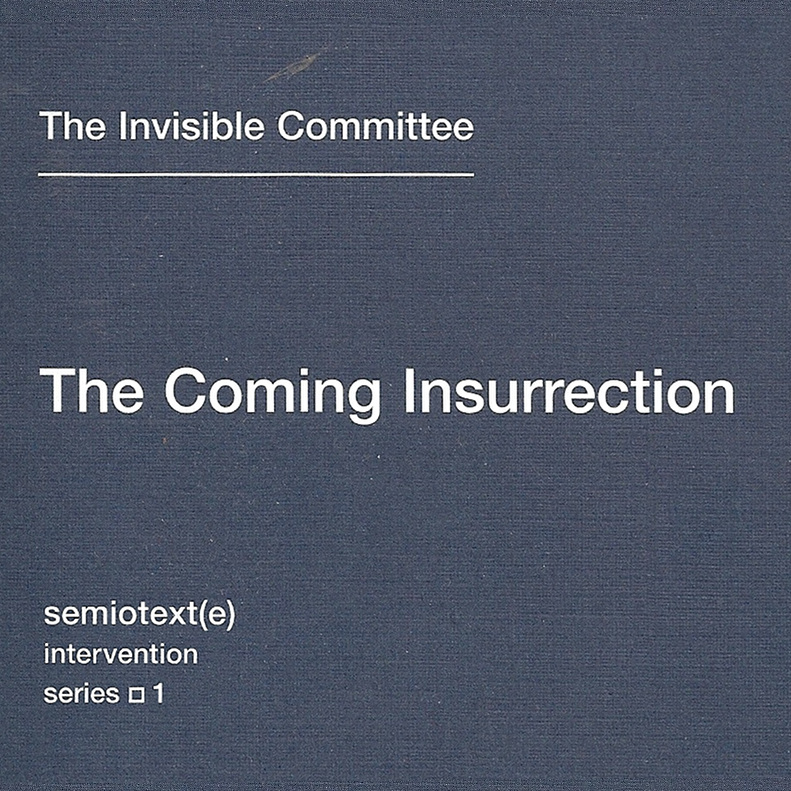
the-coming-insurrectionThe Coming Insurrection, a notorious 2007 ultra-left polemical tract written by a collective of French anti-state communists writing under the group-moniker The Invisible Committee, posits a conception of insurrection as the creation of new collective ontologies through acts of radical social rupture. Eschewing the orthodox Marxist line that revolution is something temporally removed from the present, towards which pro-revolutionaries must organize and work, The Invisible Committee’s use of insurrection claims it as an antagonistic challenge to late-capitalism firmly grounded in its own immediacy. Communism is therefore made immediate, and it is willed into being by insurrectionary acts of social rupture.

While much has been written on the debt that The Invisible Committee owes to French strains of ultra-left anti-state communism, Michel Foucault, Gilles Deleuze, Giorgio Agamben, Situationism, and the Italian Autonomia movement of the 1970s, their implicit nod to the sociopolitical themes of music has been largely ignored. By subtly claiming that insurrection spreads by resonance and that such proliferation “takes the shape of a music,” The Invisible Committee allows for the interpretation of its “coming insurrection” as an inherently musical act. Using a historical reading of the shift from tonality to atonality in Western art music, as exemplified by Arnold Schoenberg, Alden Wood’s interpretation of The Coming Insurrection aims at imbuing its explicitly political premises with a more thorough exploration of its implicit musical qualities.

Published in Interdisciplinary Humanities Vol. 30 pp. 57-65, 2013.

Read this essay HERE, and The Coming Insurrection HERE.

maya deren – ritual in transfigured time (1946)

https://youtu.be/bKyYI7i3FVM

Originally a silent film, this soundtrack was added by Nikos Kokolakis in 2015 – turn the sound off if you prefer.

About  her fourth complete film, Ritual in Transfigured Time (1946), Maya Deren writes: “A ritual is an action that seeks the realisation of its purpose through the exercise of form… In this sense ritual is art; and even historically, all art derives from ritual. In ritual, the form is the meaning. More specifically, the quality of movement is not merely a decorative factor; it is the meaning itself of the movement. In this sense, this film is dance […] It’s an inversion towards life, the passage from sterile winter into fertile spring; mortality into immortality; the child-son into the man-father; or, as in this film, the widow into the bride”.
– Maya Deren: Chamber Films, program notes for a presentation, 1960


opening tomorrow: lerato shadi – noka ya bokamoso

lerato shadi
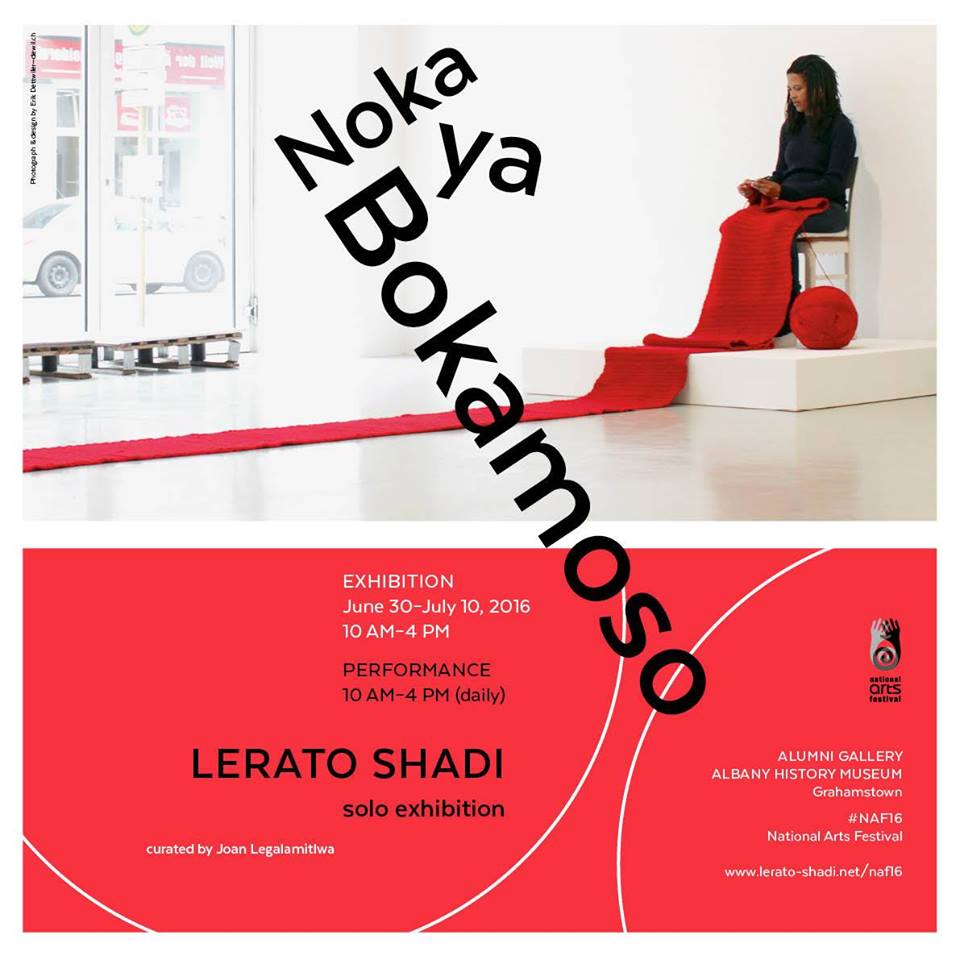
NOKA YA BOKAMOSO: A SOLO EXHIBITION BY LERATO SHADI

2016 National Arts Festival – Grahamstown
Alumni Gallery, Albany History Museum
30 June – 10 July

Lerato Shadi invites you to her latest solo exhibition and debut National Arts Festival appearance, Noka Ya Bokamoso. This exhibition by the Mahikeng born, Berlin based video and performance artist is one of the six visual art showcases chosen for the main programme.

The exhibition features four of Shadi’s latest works; two performative installations Makhubu and Mosako Wa Nako as well as two video works Sugar & Salt and Untitled.

Curator, Joan Legalamitlwa says,

“The works on the show were purposefully selected as they weave together history as told by and through the Black female body, in its truest and sincerest form, as it should be. Noka Ya Bokamoso is about the Black subject being in control of its own narrative and also about encouraging the visitors to do some introspection when it comes to matters of identity and representation.”

Makhubu is a work performed in the days preceding the festival, executed in absence of an audience. This performance involves Shadi arduously writing in concentric circles with a red pencil, then erasing the writing, leaving traces of the text on the wall and red remnants of the rubber eraser on the floor. This work looks at the historical erasure of the Black subject within the context of Grahamstown’s problematic history as well as historic erasure in the national narrative and how that has impacted on the kinds of stories that we currently tell. The absence of an audience becomes a corporeal metaphor, emphasising the ways in which South Africans, continue to construct a sense of nationhood unaware of significant violent acts that have shaped them.

For Mosako Wa Nako, Shadi will be seated one end of the gallery space for an uninterrupted six hours a day, over the eleven days of the Festival, crocheting what looks like be a red woollen carpet. Sugar & Salt, a video work featuring Shadi and her mother consuming a mineral in the form of salt and a carbohydrate in the form of sugar, makes references to the complexities and intricacies of mother-daughter relationships.

Untitled, Shadi’s latest video work, having its world premiere at the National Arts Festival, will be shot on location in her home village of Lotlhakane, in June 2016. The work consists of a two channel video work conceptualised in three parts: the first deals with the utmost extremes of individual resistance; the second deals with how Shadi experiences the impact of colonial language; the final part is an allegory of resistance.

Shadi’s work explores problematic assumptions projected onto the Black female body and how performance, video and installation create a space for artists to engage with those preconceived notions, making the body both visible and invisible. Using time, repetitive actions as well as stillness, she questions, ‘How does one create oneself?’ rather than allowing others or history to shape one’s person.

The key aim of Noka Ya Bokamoso is to re-center Shadi’s works to its primary audience – the South African audience. Shadi has practiced and exhibited in New York, Bern, Dakar, Moscow and Scotland and now seeks to utilise her work to foster and encourage dialogue around questions of historical knowledge production and its inclusion and exclusion of certain subjects. Her ultimate goal is that she, along with her audiences, will be encouraged not only to consume, but consciously engage in the processes of unearthing subsumed histories and producing critical knowledge.

Lerato Shadi lives and works in Berlin. She completed a BFA in Fine Art from the University of Johannesburg. She was included in The Generational: ‘Younger Than Jesus’ artists directory published by the New Museum, New York. In 2010 she was awarded a Pro Helvetia residency in Bern. In the same year she had her solo exhibition Mosako Wa Seipone at Goethe on Main in Johannesburg. From 2010 to 2012 she was a member of the Bag Factory artist studios in Johannesburg. In 2012 her work was featured at the Dak’art Biennale in Dakar, Senegal and in the III Moscow International Biennale. She is a fellow of Sommerakademie 2013 (Zentrum Paul Klee) and completed in the same year a residency program by invitation of INIVA at Hospitalfield (supported by ROSL). In 2014 she was awarded with the mart stam studio grant. She is currently completing her MFA at the Kunsthochschule Berlin Weissensee.

Noka Ya Bokamoso is made possible through the generous support of the National Arts Festival.

dora maar/man ray – the years lie in wait for you (1936)

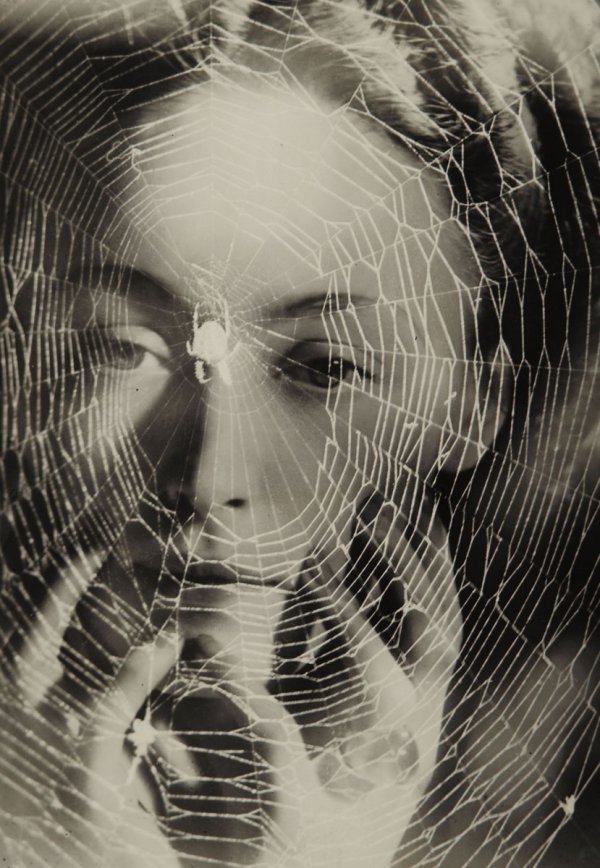
Dora Maar and Man Ray - 1936, The Years Lie in Wait for You - Spider - Nusch Eluard

Excerpt from an article by Aya Lurie, from the exhibition catalogue: “The Naked Eye – Surrealist Photography in the First Half of the 20th Century”, 2013:

The languishing face of a strikingly beautiful young woman is seen behind a spider web. Is she trapped behind the web? Is she trapped in it? The spider may be lying in wait for her, and maybe she is on the prowl, with her manicured feminine hands, which call to mind the articulated legs of a spider. Perhaps it is rather the lurking time, as indicated by the title of the photograph, that threatens youth and beauty, serving as a reminder of their ephemerality.

The association between the woman and the spider dates back to Greek mythology, where it is embodied in the figure of Arachne, a weaver who made Athena jealous enough to turn her into a spider.1

In the history of culture, the figure of the “spider-woman” has come to be identified with the femme fatale — the archetype of the woman who leads to the downfall of the man attracted to her. In this context, Arachne is presented as a patient plotter who spins a web of schemes to trap and devour the reckless male.2  Dr. Ruth Markus, in her essay about the representations of the castrating woman in Surrealist art, ties the female praying mantis with the female “Black Widow” spider, which characteristically devour their males during or directly after the sexual act. She explains the Surrealist interest in the mantis and similar insects in that they represent the two primordial Freudian instincts: Eros and Thanatos.3

Dora Maar linked the photographed portrait by Man Ray with a manipulated image of a cobweb, to create the effect of transparent contours on the woman’s face in the final print. The resulting photomontage thus fuses the woman’s figure with the spider and its web. The Surrealists were drawn to the mimetic ability of various animals to camouflage themselves in nature, and created many works in which flora, fauna, and the inanimate merge and assimilate into one another.4 In the spirit of pantheist romanticism, this capacity was taken to represent an aspiration to eliminate the boundaries between man and nature, to the point of total fusion with the cosmos, which leads to absolute void. It is, in fact, a yearning for a primordial unconscious state, an existential state which precedes consciousness.

In the photograph in question, the paths of two of the most fascinating women who operated among the Surrealists cross. Photographer Dora Maar (born as Henrietta Theodora Markovitch) was a talented artist in her own right, but her fame came mainly from her relationship with Pablo Picasso, her partner, who often depicted her figure. In addition, Maar also modeled for Man Ray in some of his prime photographs…

… The model in Maar’s photograph is Nusch Éluard (1906–1946, née Maria Benz), a German show dancer who, in 1934, married poet Paul Éluard, one of the kingpins of Surrealism, after his first wife, Gala, left him for Salvador Dalí… Nusch Éluard also served as inspiration for her husband’s poetic work, and he combined her photographs in his books of poetry as elaboration and illustration for the written text.

In 1935, daring nude photographs of Nusch were included in his book Facile. Following her sudden death in 1946, at the age of 40, her portrait, taken by Dora Maar (with which she constructed the montage here), was included in a book by her husband in her memory, Le temps débordé (Time Overflows). The portrait, this time without cobweb,[fig. 3] accompanied the poem “Ecstasy” in which Éluard praises and mourns his wife: “I am in front of this feminine land / Like a child in front of the fire / Smiling vaguely with tears in my eyes / […] / I am in front of this feminine land / Like a branch in the fire.”5

  1. See Ovid’s Metamorphoses, books 6–10, ed. William S. Anderson (Norman, Oklahoma: University of Oklahoma Press, 1972), pp. 15-22.
  2. See Doron Lurie, cat. Femme Fatale (Tel Aviv Museum of Art, 2006), p. 108 [Hebrew].
  3. Ruth Markus, “Surrealism’s Praying Mantis and Castrating Woman”, Woman’s Art Journal, vol. 21:1 (Spring/Summer, 2000), pp. 33-39.
  4. Ibid.
  5. Paul Éluard, “Ecstasy,” trans. A. S. Kline, 2001. http://www.poetryintranslation.com/PITBR/French/Eluard.htm.

simone weil – beauty

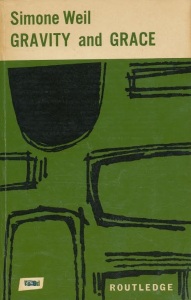
simone weil gravity and graceBeauty is the harmony of chance and the good.

Beauty is necessity which, while remaining in conformity with its own law and with that alone, is obedient to the good.

The subject of science is the beautiful (that is to say order, proportion, harmony) in so far as it is suprasensible and necessary.
The subject of art is sensible and contingent beauty discerned through the network of chance and evil.

The beautiful in nature is a union of the sensible impression and of the sense of necessity. Things must be like that (in the first place), and, precisely, they are like that.

Beauty captivates the flesh in order to obtain permission to pass right to the soul.

Among other unions of contraries found in beauty there is that of the instantaneous and the eternal.

The beautiful is that which we can contemplate. A statue, a picture which we can gaze at for hours.
The beautiful is something on which we can fix our attention. Gregorian music. When the same things are sung for hours each day and every day, whatever falls even slightly short of supreme excellence becomes unendurable and is eliminated.

The Greeks looked at their temples. We can endure the statues in the Luxembourg because we do not look at them. A picture such as one could place in the cell of a criminal sentenced to solitary confinement for life without it being an atrocity, on the contrary.

Only drama without movement is truly beautiful. Shakespeare’s tragedies are second-class with the exception of Lear. Those of Racine, third-class except for Phèdre. Those of Corneille of the nth class.

A work of art has an author and yet, when it is perfect, it has something which is essentially anonymous about it. It imitates the anonymity of divine art. In the same way the beauty of the world proves there to be a God who is personal and impersonal at the same time and is neither the one nor the other separately.

The beautiful is a carnal attraction which keeps us at a distance and implies a renunciation. This includes the renunciation of that which is most deep-seated, the imagination. We want to eat all the other objects of desire. The beautiful is that which we desire without wishing to eat it. We desire that it should be.

We have to remain quite still and unite ourselves with that which we desire yet do not approach. We unite ourselves to God in this way: we cannot approach him.

Distance is the soul of the beautiful.

The attitude of looking and waiting is the attitude which corresponds with the beautiful. As long as one can go on conceiving, wishing, longing, the beautiful does not appear. That is why in all beauty we find contradiction, bitterness and absence which are irreducible.

Poetry: impossible pain and joy. A poignant touch, nostalgia. Such is Provençal and English poetry. A joy which by reason of its unmixed purity hurts, a pain which by reason of its unmixed purity brings peace.

Beauty: a fruit which we look at without trying to seize it.

The same with an affliction which we contemplate without drawing back.

A double movement of descent: to do again, out of love, what gravity does. Is not the double movement of descent the key to all art?*

This movement of descent, the mirror of grace, is the essence of all music. All the rest only serves to enshrine it.
The rising of the notes is a purely sensorial rising. The descent is at the same time a sensorial descent and a spiritual rising. Here we have the paradise which every being longs for: where the slope of nature makes us rise towards the good.

In everything which gives us the pure authentic feeling of beauty there really is the presence of God. There is as it were an incarnation of God in the world and it is indicated by beauty.
The beautiful is the experimental proof that the incarnation is possible.
Hence all art of the highest order is religious in essence. (That is what people have forgotten today.) A Gregorian melody is as powerful a witness as the death of a martyr.

If the beautiful is the real presence of God in matter and if contact with the beautiful is a sacrament in the full sense of the word, how is it that there are so many perverted aesthetes? Nero. Is it like the hunger of those who frequent black masses for the consecrated hosts? Or is it, more probably, because these people do not devote themselves to what is genuinely beautiful, but to a bad imitation? For, just as there, is an art which is divine, so there is one which is demoniacal. It was no doubt the latter that Nero loved. A great deal of our art is of the devil.
A person who is passionately fond of music may quite well be a perverted person—but I should find it hard to believe this of any one who thirsted for Gregorian chanting. [hahaha!]

We must certainly have committed crimes which have made us accursed, since we have lost all the poetry of the universe.

Art has no immediate future because all art is collective and there is no more collective life (there are only dead collections of people), and also because of this breaking of the true pact between the body and the soul. Greek art coincided with the beginning of geometry and with athleticism, the art of the Middle Ages with the craftsmen’s guilds, the art of the Renaissance with the beginning of mechanics, etc. … Since 1914 there has been a complete cut. Even comedy is almost impossible. There is only room for satire (when was it easier to understand Juvenal?).

Art will never be reborn except from amidst a general anarchy— it will be epic no doubt, because affliction will have simplified a great many things… Is it therefore quite useless for you to envy Leonardo or Bach. Greatness in our times must take a different course. Moreover it can only be solitary, obscure and without an echo… (but without an echo, no art).

__
* Descendit ad inferos… So, in another order, great art redeems gravity by espousing it out of love. [Editor’s note.]
__
Excerpted from Simone Weil‘s Gravity and Grace. First French edition 1947. Translated by Emma Crawford. English language edition 1963. Routledge and Kegan Paul, London.

new order – power, corruption and lies (1983)

https://youtu.be/8ahU-x-4Gxw

Peter Saville on his album cover artwork:

“The title seemed Machiavellian. So I went to the National Gallery looking for a Renaissance portrait of a dark prince. In the end, it was too obvious and I gave up for the day and bought some postcards from the shop. I was with my girlfriend at the time, who saw me holding a postcard of the Fantin-Latour painting of flowers and said, ‘You are not thinking of that for the cover?’ It was a wonderful idea. Flowers suggested the means by which power, corruption and lies infiltrate our lives. They’re seductive. Tony Wilson had to phone the gallery director for permission to use the image. In the course of the conversation, he said, ‘Sir, whose painting is it?’ To which the answer was, ‘It belongs to the people of Britain.’ Tony’s response was, ‘I believe the people want it.’ And the director said, ‘If you put it like that, Mr Wilson, I’m sure we can make an exception in this case.’”

(From HERE.)

luigi russolo – serenade for intonarumori and instruments (1921)

mechanical musichttps://youtu.be/8GpN5FHO60c

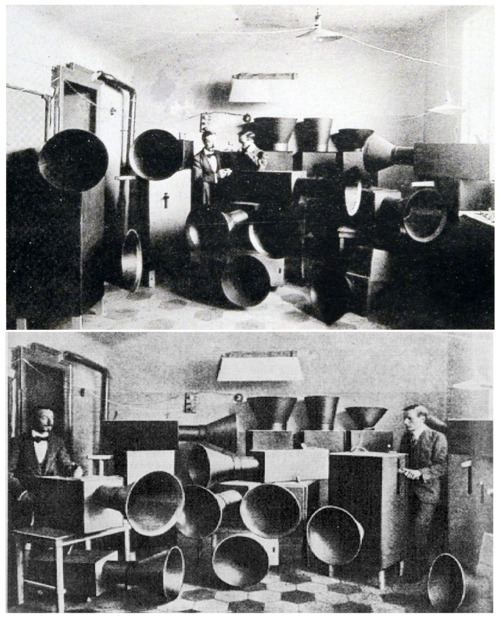
Russolo designed and constructed a number of noise-generating devices called Intonarumori, and assembled a noise orchestra to perform with them. A performance of his “Gran Concerto Futuristico” (1917) was met with strong disapproval and violence from the audience, as Russolo himself had predicted. None of his intoning devices have survived, though recently some have been reconstructed and used in performances. (Check this out!) Although Russolo’s works bear little resemblance to modern noise music, his pioneering creations cannot be overlooked as an essential stage in the evolution of the several genres in this category. Many artists are now familiar with Russolo’s Art of Noises manifesto.

At first the art of music sought purity, limpidity and sweetness of sound. Then different sounds were amalgamated, care being taken, however, to caress the ear with gentle harmonies. Today music, as it becomes continually more complicated, strives to amalgamate the most dissonant, strange and harsh sounds. In this way we come ever closer to noise-sound.

Antonio Russolo, another Italian Futurist composer and Luigi’s brother, produced a recording of two works featuring the original Intonarumori. The phonograph recording, made in 1921, included works entitled “Corale” and “Serenata”, which combined conventional orchestral music set against the sound of the noise machines. It is the only surviving contemporaneous sound recording of Luigi Russolo’s noise music.

Russolo intonorumori

Russolo, Piatti and the intonarumori

SOURCE: Good old Wikipedia.

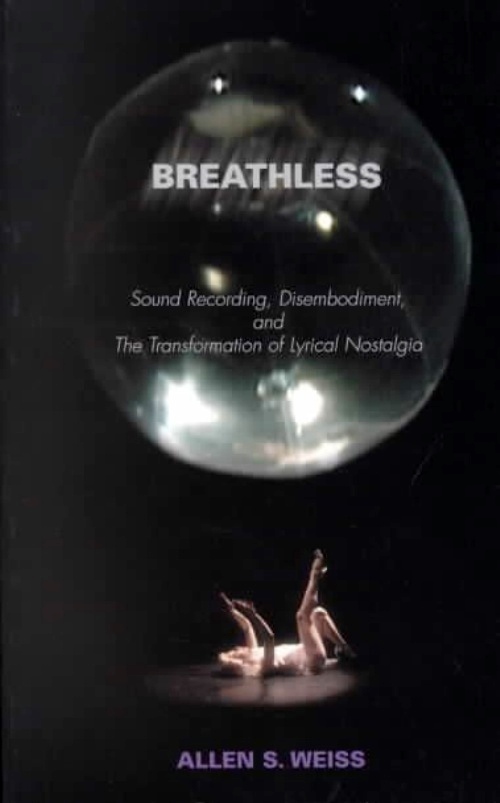
breathless: sound recording, disembodiment, and the transformation of lyrical nostalgia – allen s. weiss

How sound recording’s uncanny confluence of human and machine would transform our expectations of mourning and melancholia, transfiguring our intimate relation to death.

Currently sitting with this book in my reading queue… i.e. trying to wait until I have read the stuff I need to prioritise before diving into it, but having peeped the PDF I’m struggling to!

Breathless explores early sound recording and the literature that both foreshadowed its invention and was contemporaneous with its early years, revealing the broad influence of this new technology at the very origins of Modernism. Through close readings of works by Edgar Allan Poe, Stéphane Mallarmé, Charles Cros, Paul Valéry, Villiers de L’Isle-Adam, Jules Verne, and Antonin Artaud, Allen S. Weiss shows how sound recording’s uncanny confluence of human and machine would transform our expectations of mourning and melancholia, transfiguring our intimate relation to death. Interdisciplinary, the book bridges poetry and literature, theology and metaphysics. As Breathless shows, the symbolic and practical roles of poetry and technology were transformed as new forms of nostalgia and eroticism arose.

breathless

“By suggesting that sound recording changes the very notion of textuality at a key inflection point in Modernism, Weiss literally turns the field of cultural studies on its ear.” (Gregory Whitehead, co-editor of Wireless Imagination: Sound, Radio and the Avant-Garde)

“The extremely important, cogent analysis adds immeasurably to our knowledge of cultural production in the critical years between early modern lyric and our own post-modern, post-lyric age.” (Lawrence R. Schehr, Professor of French, University of Illinois)

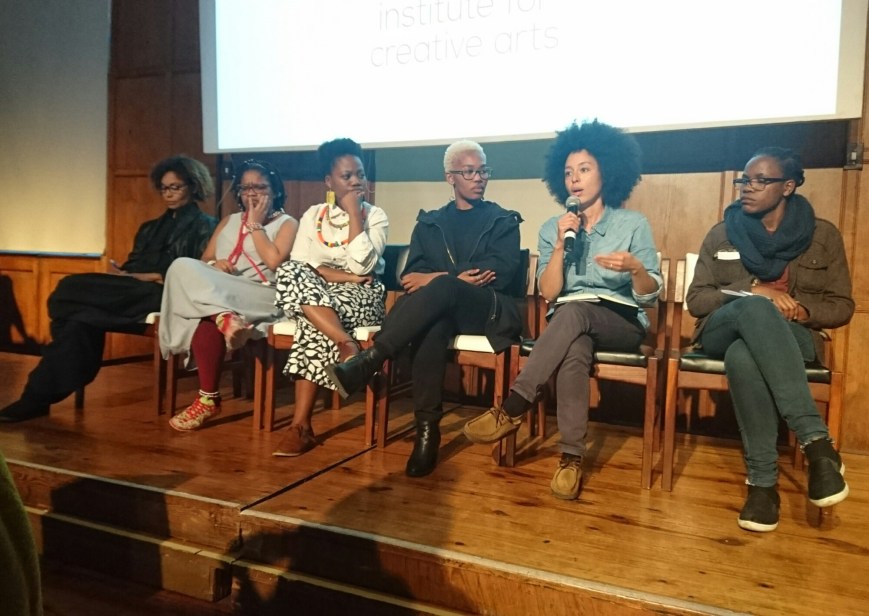
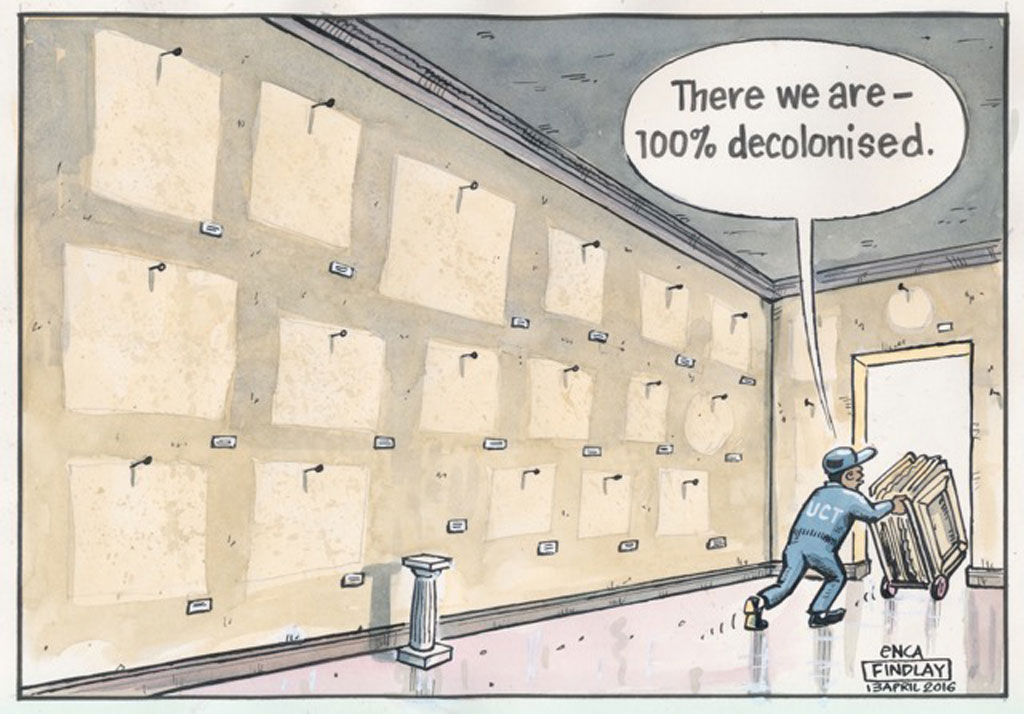
ica 3rd space symposium at uct

image

L-R: jackï job, Dee Moholo, Koleka Putuma, Khanyi Mbongwa (Vasiki), Ilze Wolff, Lois Anguria

The most decolonised academic space I have yet had the joy of experiencing. The conference continues today. If you’re in Cape Town, come. It’s free!
HERE is the programme. 🌸

reconciliation’s waste: heritage and waste in post-apartheid south africa

Analysis by Duane Jethro, one of my colleagues at the Archive and Public Culture Research Initiative.

guestauth0r's avatarDiscard Studies

By Duane Jethro

Svetlana Boym argues that ruins “make us think of the past that could have been and the future that never took place”. She turns the idea about the link between the past and the future around, and suggests we can use ruined or wasted things for clues about society in the present. In this piece I want to think about what certain ways of talking about waste and ruins in South Africa can tell us about pasts that never came to be and futures that never took place.

To do so means briefly thinking about heritage and reconciliation. Heritage, or the singling out of certain histories and people for commemoration, is connected to the idea of reconciliation, because in South Africa, it was meant to do the work of bringing South Africans together as a nation. Through new museums, statues and memorials, heritage would help overcome the long…

View original post 837 more words

eliane radigue – transamorem-transmortem (1973)

ARP Synthesizer. Composed in 1973. Released on Important Records in 2011.

“Before the greatest achievement.
Before the greatest detachment.
At the limit of the frontier space of the unconscious – tuned waves – “consonant things vibrate together”.
Where does the change happen? In the inner field of perception or the exterior reality of moving things in the course of becoming.
And time is no longer an obstacle, but the means by which the possible is achieved.”

– Eliane Radigue – June 20, 1973

Continue reading

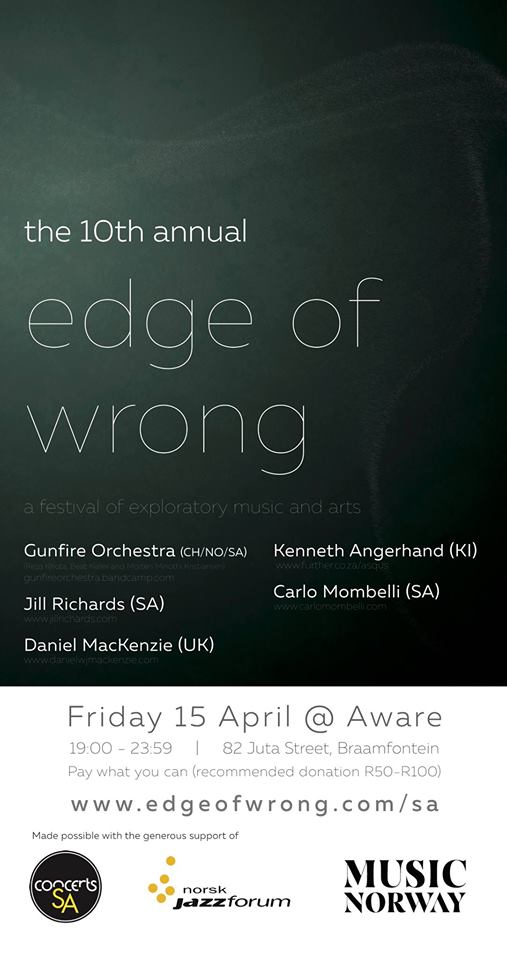
edge of wrong festival – 10th anniversary this month

As part of the Edge of Wrong organising team, I’d like to invite you to join us for our tenth annual music festival, happening in Cape Town on the 22nd and 23rd of April (with a mini edition in Johannesburg on 15th April) and featuring an array of international and local artists presenting a wide range of experimental, uncompromising and dangerous music.edge of wrong 2016

In celebration of our first ten years of existence, during which time we have hosted more than 30 cutting-edge events, we’ve compiled an extra-eclectic line-up of South African and Norwegian musicians, including Daniel MacKenzie, Gunfire Orchestra (Reza Khota, Beat Keller and Morten Minothi Kristiansen), Arnfinn Killingtveit, Kenneth Angerhand and Amantha, Ad undas, Mark Fransman, Darren English, Brendon Bussy, Justin Allart and Hezron Chetty.

Expect everything from feedback guitar and malfunctioning drum machines to improv violin, dance-controlled piano and walls of screeching noise from hand-built instruments.

▀▀▀▀▀▀▀▀▀▀▀▀▀▀▀▀▀▀▀▀▀▀▀▀▀▀

__VENUES, LINE-UPS, COST, ETC.:

*** FRIDAY 22nd ***
Atlantic House
1 Perth Rd, Maitland, CT
http://www.atlantichouse.co/
Doors open at 7pm, music starts at 8pm
Pay what you can – recommended contribution R50-R100

PERFORMING:
∞ Brendon Bussy (SA)
∞ Daniel W J Mackenzie (UK)
∞ Ad undas (NO)
∞ Kenneth Angerhand with Amantha23 (KI)
∞ Arnfinn Killingtveit (NO)

*** SATURDAY 23rd ***
Moholo Live House
42 Ncumo Rd, Harare Square, Harare, Khayelitsha, CT
Doors open at 7pm, music starts at 8pm
Pay what you can – recommended contribution R50-R100
https://www.facebook.com/MoholoLiveHouse

PERFORMING:
∞ Gunfire Orchestra (NO/SA)
∞ HORNS NOISE (NO/SA)
∞ Swamps up Nostrils (NO/SA)
∞ Hezron Chetty (SA)

*** SUNDAY 24th ***
Music Hacker Lab – details to be confirmed!

GENERAL INFO: Right of admission reserved. Drinks will be available for purchase at the venues. Cellphones to be switched off during performances.

Performing in Johannesburg on the 15th are:

* Gunfire Orchestra (Reza Khota, Beat Keller and Morten Minothi Kristiansen) (https://gunfireorchestra.bandcamp.com/) (NO/SA)
* Kenneth Angerhand (www.further.co.za/asqus) (KI)
* Jill Richards (www.jillrichards.com) (SA)
* Carlo Mombelli (www.carlomombelli.com) (SA)
* Daniel MacKenzie (www.danielwjmackenzie.com) (UK)