Song produced and mixed by Hernán A. Ambrogi
Video shooting and editing by Fusée Dorée.
http://www.facebook.com/fuseedoree
Song produced and mixed by Hernán A. Ambrogi
Video shooting and editing by Fusée Dorée.
http://www.facebook.com/fuseedoree
Including wonderful commentary from Tricky, Peter Gabriel, David Gilmour, John Lydon, Tori Amos, Natasha Khan, St Vincent, Neil Gaiman, Brett Anderson, and some fascinating archive.
 I think it’s an imperialist idea with massive blind spots.
I think creativity, and the making of artefacts, is a product of cultures in general, and the Western sense of “Art” is a product of massive surplus over and above the meeting of needs for artefacts.
The idea of it as a “high” expression of culture has spread with imperialism, as did the idea of a “national culture” being expressed through literature. It is as Western as the English language, and carries with it the same kinds of embedded privilege, in terms of it being a “text” which privileges European concerns. It is impossible to “speak” art without its European history being part of the discussion.
I think that much like European history has been selectively “rewritten” to seem to be a continuous, meaningful story from prehistory to Modern America, so has art history.
It’s great to have it around. Certainly I like it. But to engage in it without confronting its lies and limitations is like living inside the bubble of white privilege without standing back to look at its impact on the world in general, and see who gets favoured by its discourses of “natural” “genius” and “talent” (as opposed to “first-language” familiarity), compared with who gets punished and dumped outside its magic circle like so much human trash.
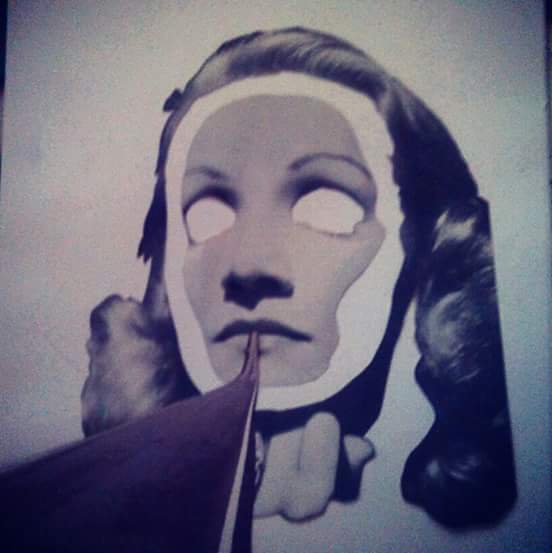
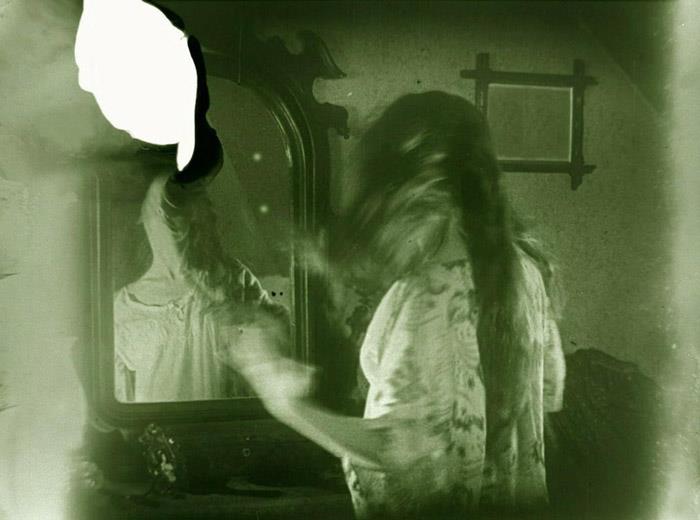
Using as her source material a segment of 1970s European softcore pornography, Naomi Uman created this derived piece by painstakingly removing the female from each frame using bleach and nail polish remover, thus presenting the viewer with a bizarre, ghostly effect of a figure; a blank void of a woman.
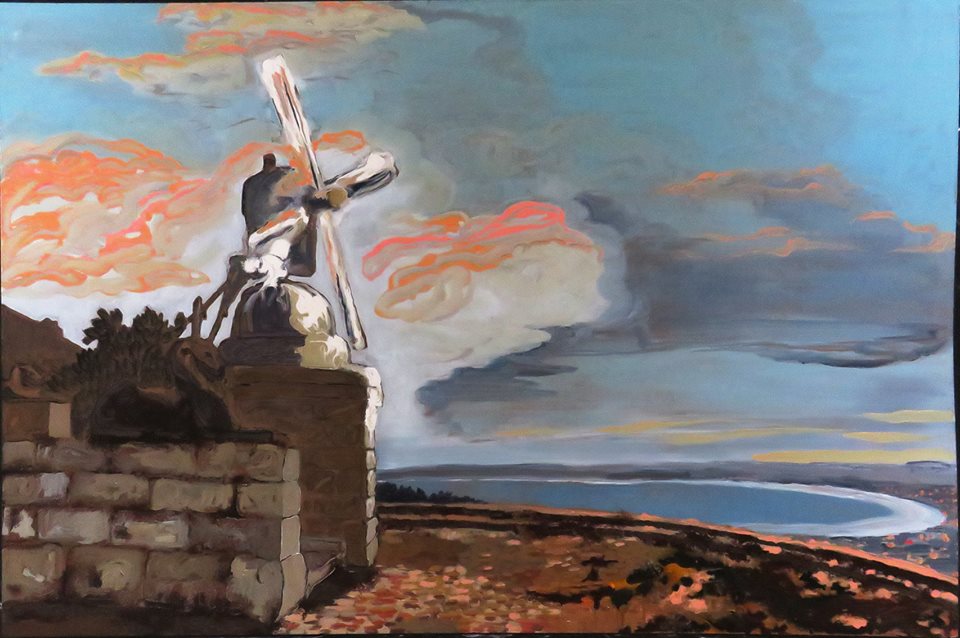
“The Historic Panic Mill”. Lizza Littlewort. 2015.
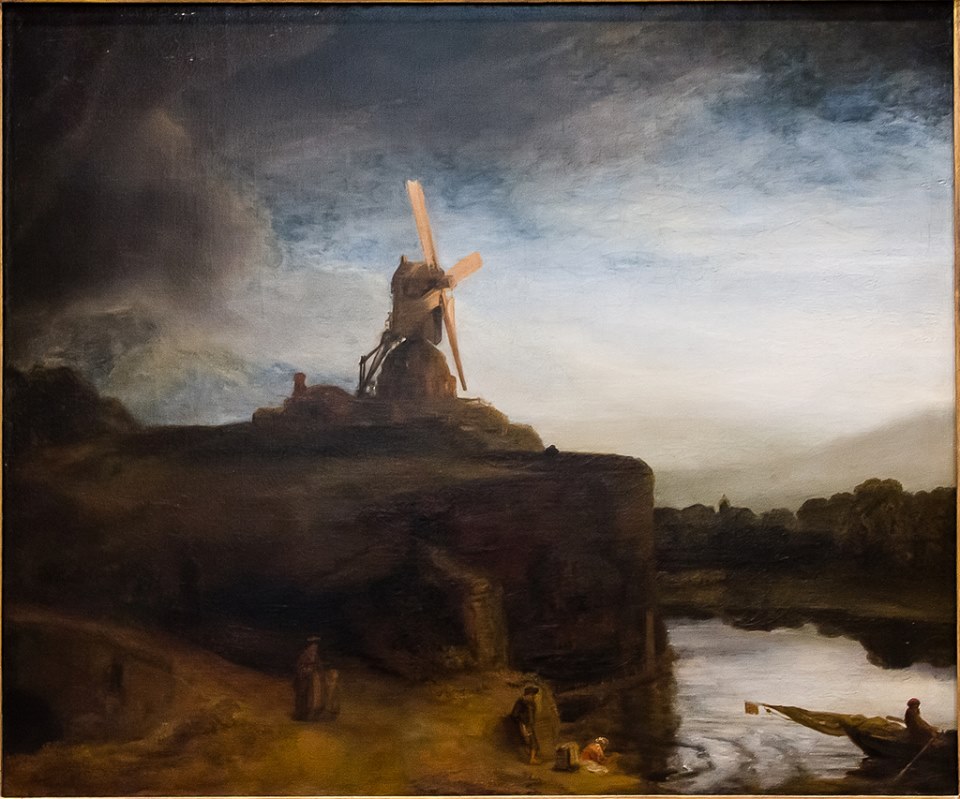
“The Mill”. Rembrandt Harmenszoon van Rijn. 1645/48.
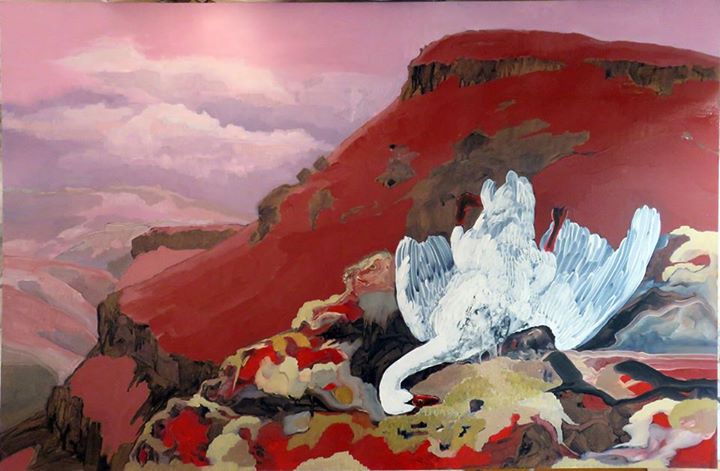
Lizza Littlewort – “Still Life with White Hyperbole”. 2015.
This is an adaptation from a still life by someone I’m actually descended from, whose son (or grandson, not sure) came out here as a PA to Simon van der Stel and apparently was the most corrupt, heinous motherfucker you could imagine. It’s very hard to get a straight answer from anyone in my family, but one distant uncle who I chatted to on the phone told me that because he could prove his direct descent he was allowed into the basement of the Rijks Museum where they kept all the family info. He said this guy was so corrupt that he was, individually, the reason for the first slave rebellion at the Cape. So it’s like an actual time warp of history. Except of course when I research when the slave rebellions were, none of the dates tie up. But of course there must be so many of these hideous occurrences which we no longer even know about.
Here’s the painting, by Jacob Jacobsz. De Wet (Jacob de Wet II):
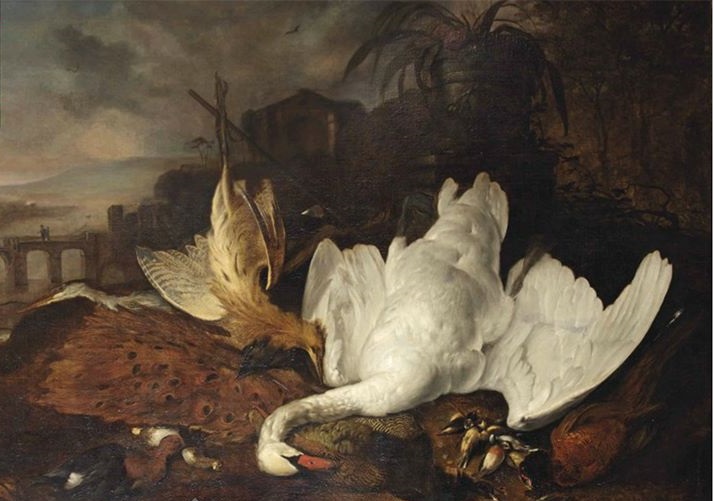
Jacob de Wet II (Haarlem 1640/2-1697 Amsterdam). An Italianate river landscape with a swan, a Eurasian bittern, a peacock, a pheasant and other birds before a stone vase on a pedestal. Oil on canvas, 153.6 x 217.5 cm.
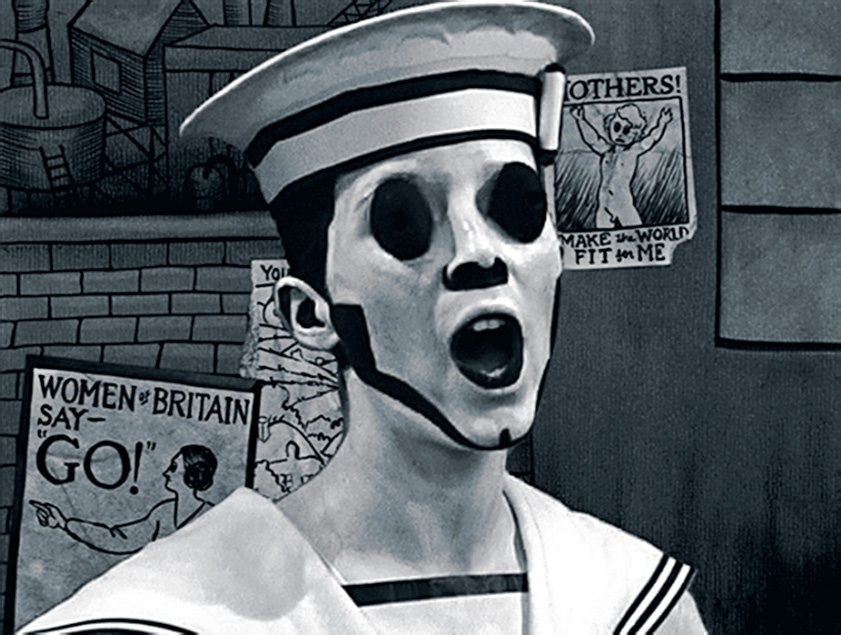
Filmed in 2011 at Mary Reid Kelley’s home and studio in Saratoga Springs, New York, the video artist and painter discusses her video work “You Make Me Iliad” (2010). In researching the lives and experiences of women who lived during the first World War, Reid Kelley was struck by how few first-hand accounts she was able to uncover. Mary Reid Kelley explains her attempts to reconstitute an experience that would have otherwise been lost to history by creating an imagined narrative involving a prostitute, a soldier, and a medical officer.
In black-and-white videos and drawings filled with punning wordplay and political strife, Mary Reid Kelley presents her take on the clash between utopian ideologies and the realities of women’s lives in the struggle for liberation. Performing scripted narratives in rhyming verse— featuring characters such as nurses, soldiers, prostitutes, and saltimbanques—Reid Kelley playfully jumbles historical periods to trace the ways in which present concerns are rooted in the past.
Watch an excerpt from another of Reid Kelley’s works, Sadie the Saddest Sadist on Reid Kelley’s website.
Sadie, the Saddest Sadist (7 minutes, 23 seconds), 2009, is set in Great Britain in 1915, according to a free booklet that includes the video’s lyrics. The title character, a munitions worker, wants to learn a trade “so [she] could be a traitor.” She meets Jack, a sailor (played by Reid Kelley in drag), and with “passions inflamed,” she requests rousing war stories. His sung reply: “Calm down sweetheart / Britannia rules the waves.” In pledging herself to him, she offers her “surplus devotion,” and after their off-camera tryst, she sings, “The stains on my sheets / will come out with some lemon / I know that you care / by these Marx on my Lenin.” Live action alternates with stop-motion animation in which dancing refrigerator magnet-style letters spell out the dialogue or toy with it, as when “surplus devotion” is anagrammatized into “spurs devolution.”…
… Reid Kelley’s interest seems to be primarily in historical material, expressed in details such as the patriotic flyers that hang on the walls behind Sadie and Jack when they meet, which urge citizens to conserve food and to fight for king and country. Her fine ear for popular verse makes Reid Kelley’s work rich fun for those who are, as Jack describes himself, “verbally inclined.”
Source: http://www.artinamericamagazine.com/reviews/mary-reid-kelley/
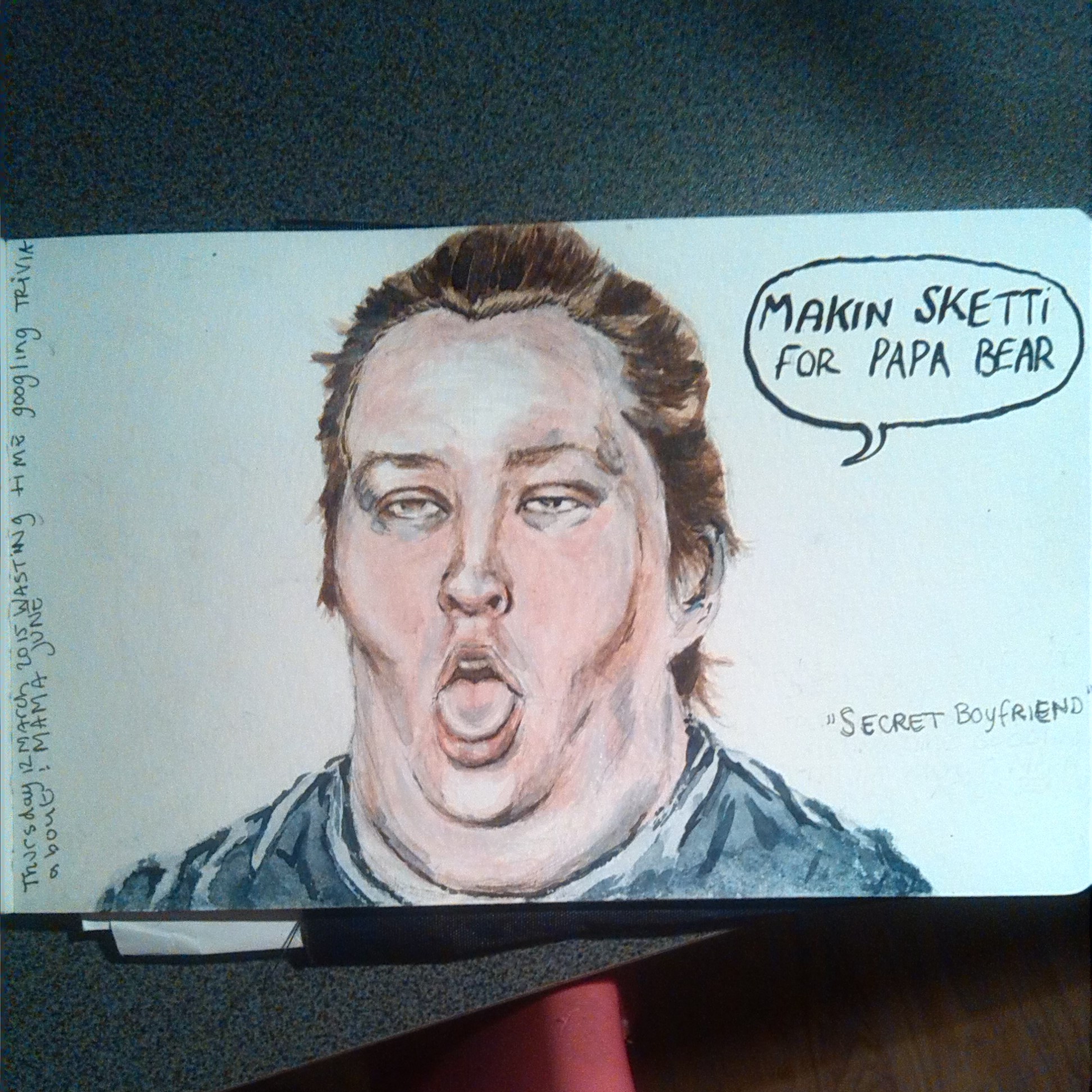
Made the mistake to read this small article about:”mama june”, last week. The start of a small “mama june obsession”.
I’m on the organising team for the Edge of Wrong. Join us in Cape Town next week – it’s going to be an exhilarating ride!
It’s been a busy six months for EOW. Last October’s event saw noise artists, opera singers, free jazz, chiptunes and the sound of the Ebola genome perform at a metalworks. In January, we hosted a performance of Terry Riley’s In C for two laptops, improvised analogue synth, a postrock/drone quintet, and a memorable moment under a highway bridge with cello and saxophone accompanying traffic noise.
Now, we invite you to join us for our flagship event, the annual Edge of Wrong festival: five days from 25 to 29 March 2015, featuring a diverse range of international and local artists, each of whom epitomises our ethos of encouraging experimental, uncompromising, dangerous music.
This year, the line-up includes cutting-edge Norwegian performers Vilde Sandve Alnæs, Inga Margrete Aas, Harald Fetveit and Morten Minothi Kristiansen (founder and chief provocateur of Edge of Wrong), along with improv jazz outfit As Is, Juliana Venter and her motorbike ensemble, EOW stalwart Dizu Plaatjies and his Souls of Ancient Fish project (with Ruben Mowszowski and Maxim Starke), the Darkroom Contemporary dance troupe, Gugulethu’s jazzy G-Clef, US field recording artist Erik Deluca and EOW co-organiser Aragorn23 on custom electronics and live data manipulation.
The festival will unfold over several days at a number of venues (including a spontaneous flashmob orchestra in the central city which you can join) so be sure to check out the details on our Facebook event page. You can choose between buying tickets for individual events or an all-access pass for the week.
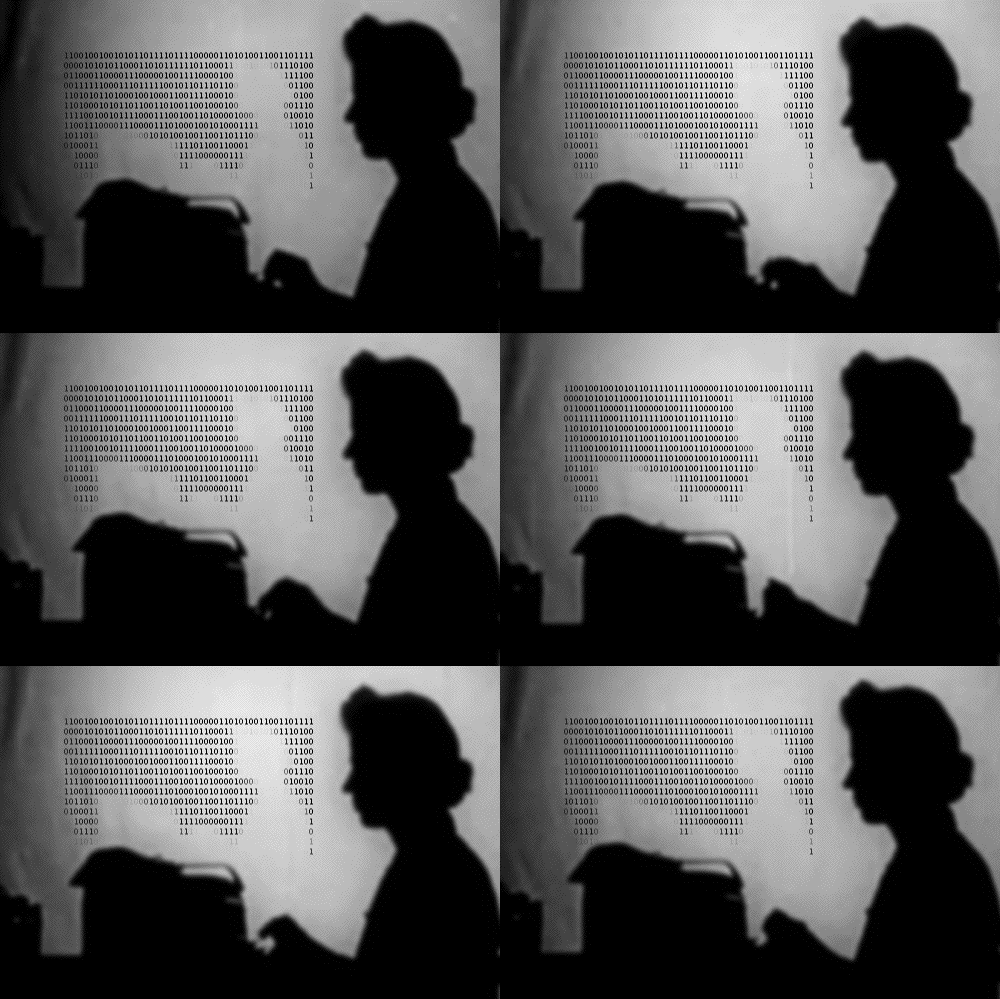
Zero One – Bill Domonkos, 2012.
Bill Domonkos is a filmmaker, GIF maker and stereoscopist. His work has been shown internationally in cinemas, film festivals, galleries and museums.
Watch Felix Laband’s brilliant set at the 2015 Cape Town Electronic Music Festival on 8 February (click the hyperlink – the darn embed function doesn’t seem to work properly on WordPress).
Felix opens this particular “Deaf Safari” with a dodgy old recording (that I think I actually gave him!), of Marais and Miranda entertaining a frightfully colonial white 1950s audience with their “knowledge” of “Hottentot” and “Zooloo” linguistics. With a subversive stammer, it segues into an hour-long journey of cut-up sounds and visuals.
Laband displays fluent familiarity with and yet alienation from spectacular capitalist consumer tropes. The oversaturated bricolage of radio preachers, politicians, porn, pulp cinema, big game and exoticised cultural representations is absurd and defaced: eyeless, toothless, festering with skulls. Sound and visuals work in counterpoint: horny assemblages dripping blood and infection; a snatch of Cat Power’s languid “Satisfaction”. His work foregrounds our mindless addiction to and manipulation by these fragments bouncing off the walls onto one another, their banality dismembered, dislocated, demented, discordant, decaying.
A voice in Queen’s English: “I was wondering what it is that you don’t want to remember so badly… To put it another way, what are you trying to forget?”
The response, implied in the guitar run sampled from Nico’s “These Days”: “Please don’t confront me with my failures… I had not forgotten them.”
Felix forces us to examine ourselves honestly. This I love most deeply about what he does: he will not allow us to forget, nor feign ignorance. There are naive melodies, but there is no innocence, no deafness nor blindness. We are taken through his cabinet of jabbering apparitions, racist, patriarchal horror haunting every suburban corner, lullabies, toyi-toyi chants… The valley of the shadow of death… We are not tourists. This is our own back yard. We stare the nightmares down, bopping in slo-mo. The voices persist, demand acknowledgement until they dissolve. It’s a kind of exorcism.
And beyond that, always, despite all the schizophrenic folly and sadness, hope and jubilation live on in the unfinished refrains of blues ghosts captured long ago on wax… Vera Hall, Stack O’Lee, prisoners and murderers alike now free… and there is space to breathe, place to be here now, without judgement… we are bathed in grace and exquisite melody. This is strong muti for South Africans’ sickness.
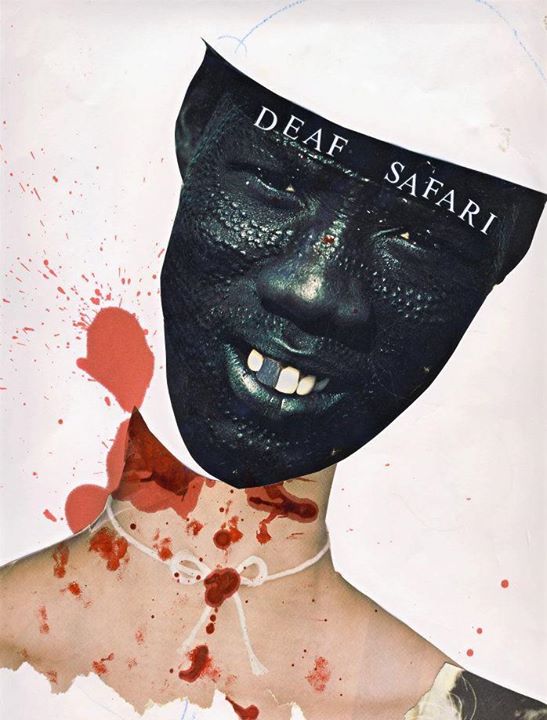
Collage: Felix Laband
I can’t wait for his new album, and I highly recommend that you see him live if you get the chance: he’s on form like never before and it’s a profound trip.
P.S. Read Sean O’Toole’s great interview piece for Mahala on Felix’s return (his new album, Deaf Safari, is set for release next month, after an almost decade-long gestation).

Life does not die. From Lesley’s ‘The Troyeville Bedtime Story’ Tumblr.http://troyevillebedtimestory.tumblr.com/
Lesley Perkes, Joburg’s and Art’s fiercest warrior, has left Troyeville. In the only way she ever would.
But life does not die. Art does not die. And Lesley’s art and life certainly never will. And Joburg never will; because Lesley would never let it. All we can do is continue her work, her energy, her passion, her life, her chutzpah.
When I messaged her after hearing about the cancer and told her I was devastated, she responded: “Don’t be devastated. I’m going to be fine.” Her strength, humour, indefatigable idealistic realism and feistiness implore us to respond to this in the same spirit.
Sleep well, Lesley. You are the Troyeville Bedtime Story, and we will read you like all good oral traditions to generations to come.
Much love to you, Les,
to Chili, Marta, Sonja, the sisters, the Joburg family

From: https://germainedelarch.wordpress.com/2015/02/13/life-does-not-die-art-does-not-die-joburg-will-not-die-a-tribute-to-the-life-of-lesley-perkes-lespersonas/
The real in us is silent; the acquired is talkative.
— Kahlil Gibran, from Sand and Foam (1926). You can read the full text HERE.
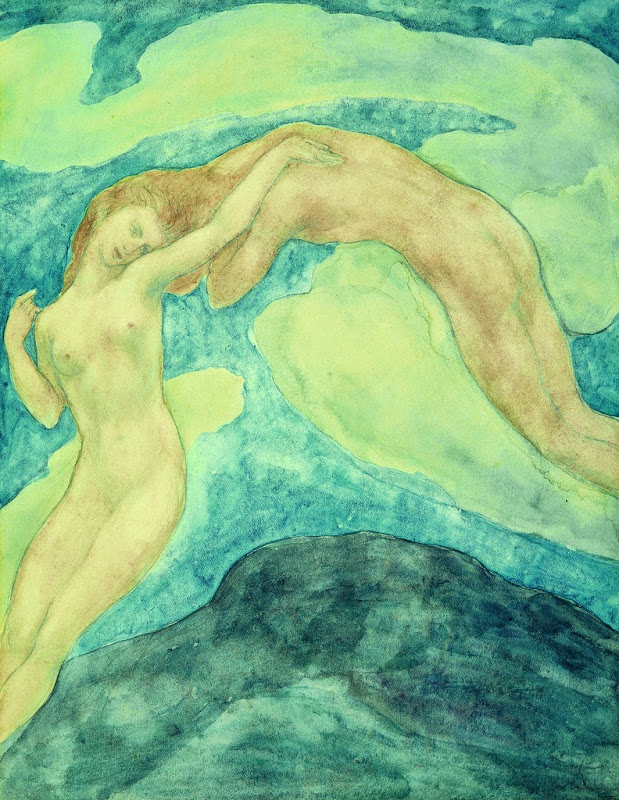
Kahlil Gibran: “The Summit” from Sand and Foam, c. 1925, Watercolor and pencil on paper, 11 x 8 1/2 inches, Telfair Museums, Gift of Mary Haskell, 1950.
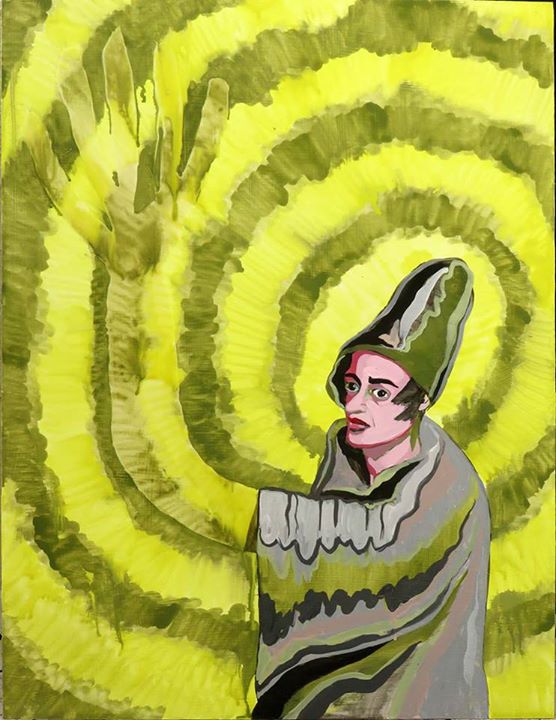
“The Invisible Hand of the Market.” Lizza Littlewort, 2014.
Just another sorry tale of appropriation:
Evidence that Marcel Duchamp may have stolen his most famous work, Fountain, from a woman poet has been in the public domain for many years. But the art world as a whole—museums, academia and the market—has persistently refused to acknowledge this fact.
The Museum of Modern Art (MoMA) in New York is the latest eminent body to bury its head in the sand. It has just published a new edition of Calvin Tomkins’s 1996 life of Duchamp, updated by its author. Ann Temkin, MoMA’s chief curator of painting and sculpture, praises Tomkins in her introduction for his “thorough research”. But Tomkins avoids addressing the implications of the question marks over the origins of the work that Duchamp himself raised in 1917.
Irene Gammel and Glyn Thompson have revealed the truth of his much earlier private account that he did not submit the urinal to the Society of Independent Artists exhibition in New York in 1917. Nevertheless, Duchamp’s late, fictional story is still taught in every class and recited in every book…

Should museums re-label the work Fountain as “a replica, appropriated by Marcel Duchamp (1887-1968), of an original by Baroness Elsa von Freytag-Loringhoven (1874-1927)”? Photo: Felix Clay
… Duchamp wrote to his sister, a nurse in war-torn Paris, telling her that “one of my female friends under a masculine pseudonym, Richard Mutt, sent in a porcelain urinal as a sculpture”. The explosive contents of this letter did not enter the public domain until 1983 when the missive was published in the Archives of American Art Journal.
The mere fact that Duchamp referred to the urinal as a sculpture suggests that it could not have been his, since by 1913, prompted by the work of the wealthy, chess-playing writer Raymond Roussel, he had stopped creating art. His Roussel-inspired “Readymades” were elaborate, personal rebuses to be read, not viewed.
The literary historian Irene Gammel was the first to discover who Duchamp’s “female friend” was. She was born Else Plötz in Germany in 1874, the daughter of a builder and local politician who philandered freely and beat her mother. Afflicted with syphilis, her mother attempted suicide and died later in an institution. As Elsa put it, she “left me her heritage… to fight”.
Elsa first married the leading Jugendstil architect August Endell, then Felix Paul Greve, the translator of Oscar Wilde, who faked his own suicide to escape his creditors and fled with Elsa to America. Her third marriage was to Leopold Karl Friedrich Baron von Freytag-Loringhoven, the impoverished son of a German aristocrat who had also escaped to America to avoid debts. He soon vanished with Elsa’s paltry savings but left her with a title and entrée into artistic circles in New York.
Elsa simultaneously inspired and repelled all who came into contact with her, from Ezra Pound to Ernest Hemingway. Nevertheless The Little Review treated her as a star and published her poems alongside excerpts from James Joyce’s Ulysses. Elsa’s genius was to find new ways to break out of the social straightjacket that bound women so that she could fight her mother’s battle in public, whenever and wherever she wanted, not when men told her she could.
In October 1917, the painter George Biddle described her room in New York filled with “odd bits of ironware, automobile tiles… ash cans, every conceivable horror, which to her tortured yet highly sensitive perception, became objects of formal beauty… it had to me quite as much authenticity as, for instance, Brancusi’s studio in Paris.”
Elsa was a poet of found objects, but she didn’t leave them as they were—she transformed them into works of art.
Elsa exploded in fury when the US declared war on her motherland, on Good Friday, 6 April 1917. Her target was the Society of Independent Artists, whose representatives had consistently cold-shouldered her. We believe she submitted an upside-down urinal, signed R. Mutt in a script similar to the one she sometimes used for her poems.
Armut—the homophone of R. Mutt—has many resonances in German. It is used in common phrases to mean “poverty”, and in some contexts “intellectual poverty”. Elsa’s submission was a double-pronged attack. The society was hoist by its own petard, for in accepting the entry it would demonstrate its inability to distinguish a work of art from an everyday object, but in rejecting it, it would break its own rule that the definition of what was art should be left to the submitting artist. Hence the “intellectual poverty” of its stance.
The urinal was Elsa’s declaration of war against a man’s war—an extraordinary visual assault on all that men stood for. As a sculpture of a transformed everyday object, it deserves to rank alongside Picasso’s Bull’s Head, 1942, made of bicycle handlebars and a saddle, and Dali’s Lobster Telephone, 1936.
If Duchamp did not submit the urinal, why would he pretend later that he did? After Elsa died in 1927, forgotten and in abject poverty, Duchamp began to let his name be associated with the urinal, and by 1950, four years after the death of Alfred Stieglitz, who photographed the original Fountain, he began to assume its authorship…
… When the mood took him, Duchamp could be honest about his dishonesty. In an interview in 1962, he told William Seitz: “I insist every word I am telling you now is stupid and wrong.” Why, then, has the art world persisted in believing an account grounded in the myths he promulgated?
—
Sélavy, baby… Read the full article HERE.
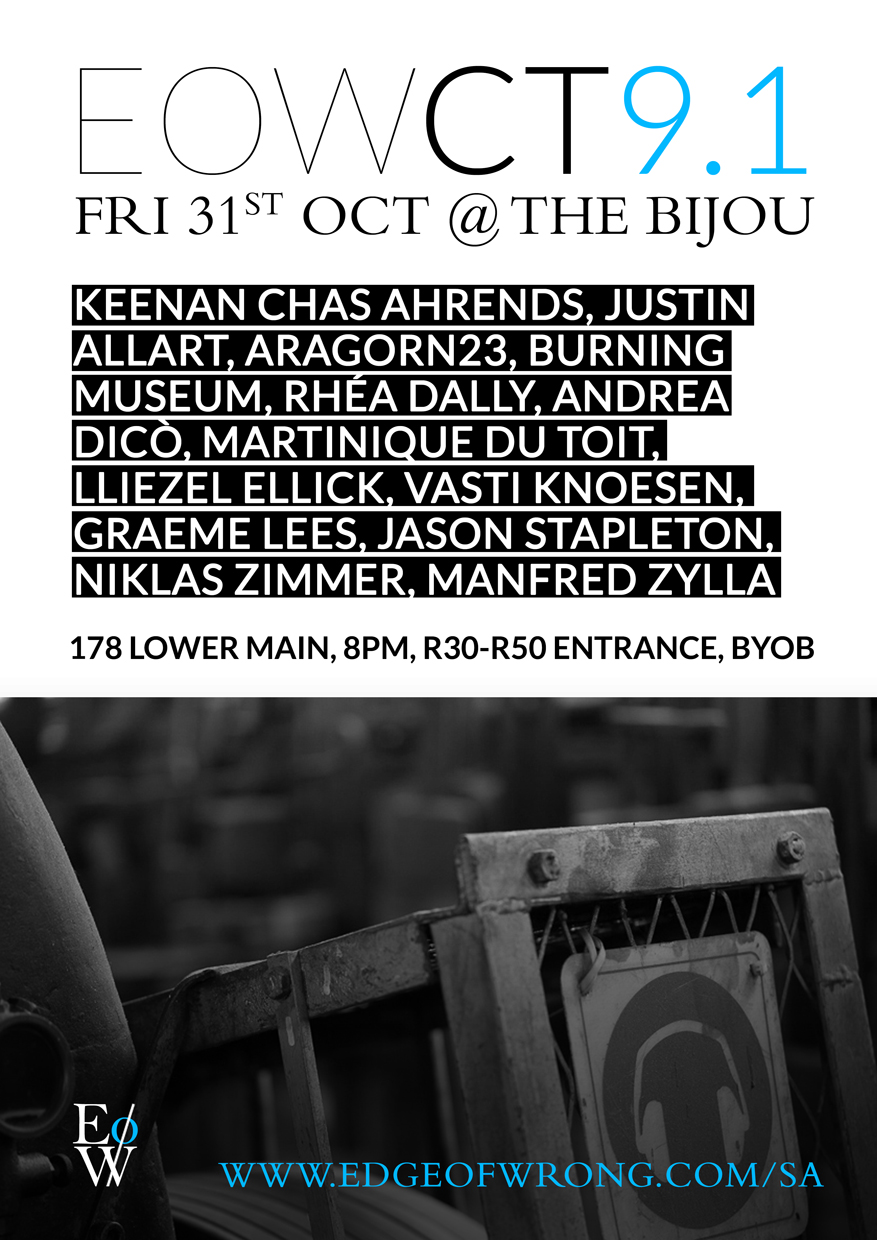
I’m part of the South African curatorial/organising team for this series of collaborative multi-medium performances. If you’re in Cape Town, check EOW 9.1 out tomorrow night.
It will involve an insane mash-up of guitarists, violinists, opera singers, noise musicians, circuitbenders, chiptunists, avant-percussionists, pianists, body modification, visuals generated from cellular automata, experimental improv dance, provocative video art and the livecoded sound of the Ebola genome…
More information HERE.
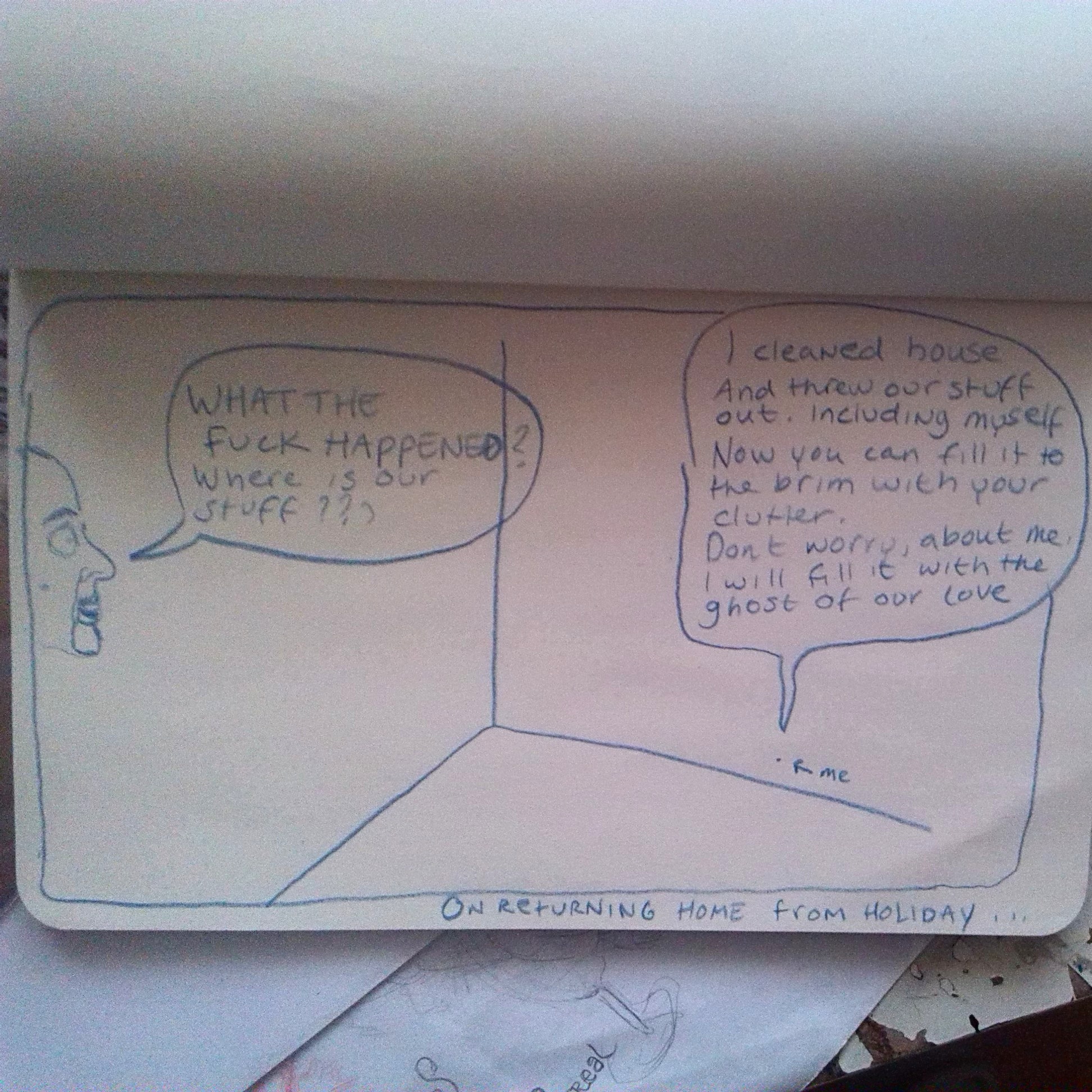
Doodle..
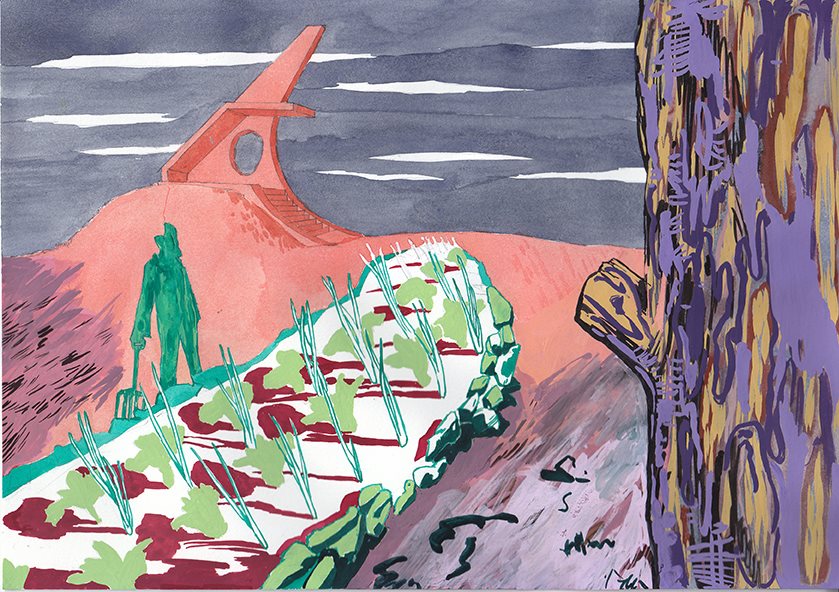
“Neo-Utopian Mashup 2: The Project”. Lizza Littlewort, 2014.
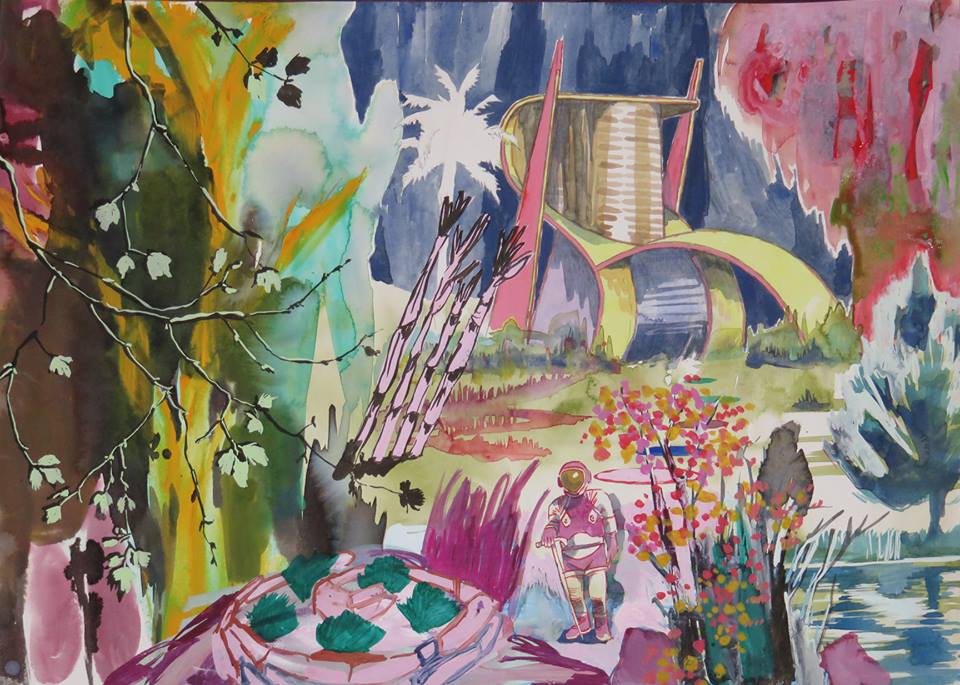
“Neo-Utopian Sublime”. Lizza Littlewort, 2014.
Image: Eric Rondpierre
Self knowledge is not fully possible for human beings. We do not reside in a body, a mind or a world where it is achievable or, from the point of being interesting, even desirable. Half of what lies in the heart and mind is potentiality, resides in the darkness of the unspoken and unarticulated and has not yet come into being: this hidden unspoken half of a person will supplant and subvert any present understandings we have about ourselves. Human beings are always, and always will be, a frontier between what is known and what is not known. The act of turning any part of the unknown into the known is simply an invitation for an equal measure of the unknown to flow in and reestablish that frontier: to reassert the far horizon of an individual life; to make us what we are – that is – a moving edge between what we know about ourselves and what we are about to become. What we are actually about to become or are afraid of becoming always trumps and rules over what we think we are already…
— David Whyte, 2014. Excerpted from “Self Knowledge”, from the upcoming book of essays CONSOLATIONS: The Solace, Nourishment and Underlying Meaning in Everyday Words.

“My name is Amy Leibrand. I reside deep in the suburbs of Columbus, Ohio. I am a science writer. This is just a fancy way of saying I take data and summarize it.”
Read more of this interview and see more of her work and some of her compositing techniques HERE.
Amy’s own website is also well worth checking out, HERE. This is excerpted from her artist’s statement:
“My work shifts between visceral, uncomfortable, intimate self-portraits and surreal travel narratives; by nature, I am a wanderer, both in body and in mind. Colossal legs that dwarf a desert, forest, mountain landscape reveal the discomfort I feel in my surroundings, and the endless search for satisfaction, perhaps even a nod to escape. Turning the camera on myself, self-portraits illustrate the endless conflict between internal and external dialogue: pretty versus ugly, fearless versus cowardly, and so on. Using subtle odd, dreamlike, humoristic and disturbing elements, my intent is to objectify not only my own emotions, but those of the viewer. I want the viewer to become part of my work, as their reaction has as much to do with the art as the artwork itself.”

The wonderful Jun Togawa, Japan’s Bjork-before-there-was-Bjork (although comparisons can be reductive, she’s cut from similar revolutionary woman cloth), with her band Yapoos, off their 1987 album, ヤプーズ計画 (Yapoos Plan). And this video is incredible.
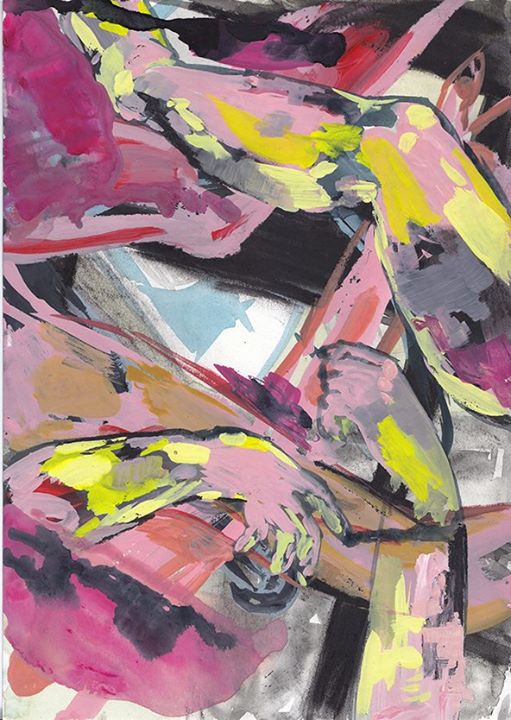
“Such a long way to Cecily Brown.” Lizza Littlewort, 2014.
Animator Nina Paley, she of the wonderful public domain film Sita Sings the Blues (WATCH IT, please, if you haven’t yet!), also made another short cartoon a while back*, this one caricaturing the ongoing conflict in the Middle East.
So, who’s killing who? Nina has provided a handy guide to the various historical groups HERE.
*Please do note that this was made in 2012, before the most recent turn of events.
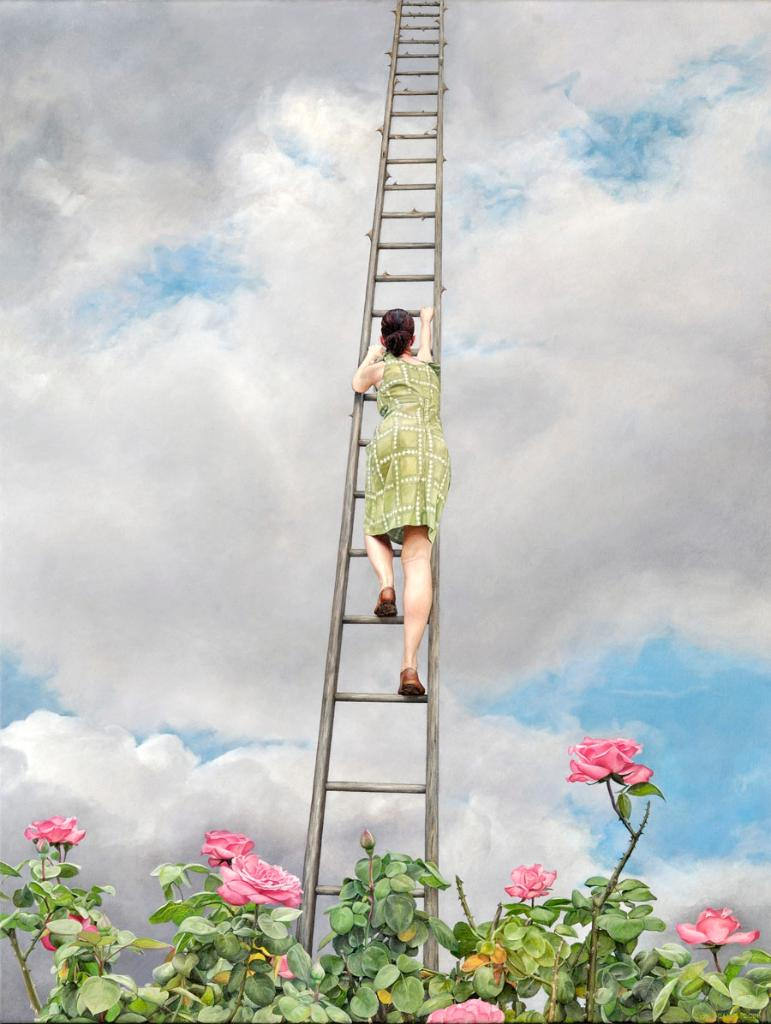
Lisa Adams – “Rose Garden”, 2008.
Check out more of this self-taught Australian artist’s darkly surreal work HERE.
(My gratitude to Joey Hamilton for the introduction!)
 fleurmach