From the album Poppycock, set to Dream of a Rarebit Fiend, a 1906 Edison reel.
From the album Poppycock, set to Dream of a Rarebit Fiend, a 1906 Edison reel.
A-side of a 12″ produced by Ted Milton and Steve Beresford, and released on Embryo Records.
Oh YES! From her upcoming album My Woman, to be released on Jagjaguwar on 2 September 2016.
Russian director Andrei Tarkovsky’s film from 1983. I’m not going to link to any analysis here because to do so would narrow the interpretive possibilities of this opaque, allegorical masterpiece. Very superficially, though, the storyline is about a writer who, trapped by his fame and an unhappy marriage, seeks out his cultural past in Italy. Here he meets a local pariah who declares that the world is coming to an end. The writer finds this prophecy curiously more alluring than the possibility of a dead-end future. Nostalghia won the Grand Prix de Creation and the International Critics Prize at the 1984 Cannes Film Festival.
You can pick (slightly crappy) subtitles in several languages.
This is so perfectly dystopian. From Commissioned Music (1995).
“This was Blixa Bargeld’s first solo album, where he positioned himself as an independent artist beyond the context of Einstürzende Neubauten – as a musician with an extraordinary feeling for sounds and their effects, with a bold sense of design and a strong intuition for the complex relationship between visual and musical inventions.”

Photo: Paul Botes, M&G
“Quite simply – and this is what I wish to discuss tonight in relation to the question of rage and violence – we are living in different times. Or at least, our time is disjointed, out of sync, plagued by a generational fault line that scrambles historicity.
“The spectre of revolution, of radical change, is in young peoples’ minds and politics, and it is almost nowhere in the politics of the anti-apartheid generation. In fact, even as they criticised young people just five years earlier for being apathetic and depoliticized, they have now thought student activists misguided, uninformed, and mad.
“You would think that it might be possible to resolve this difference in time by means of a careful reading of what is called the ‘objective conditions for revolution’: are we in fact in a time in which revolution is immanent? No matter the subjective experience of time – there must be a way of determining who has the better bearing on history, who can tell the time. What time is it? Yet to tell the time is a complex matter in this society.
“We are, to some degree, post-apartheid, but in many ways not at all. We are living in a democracy that is at the same time violently, pathologically unequal. Protest action against the government – huge amounts of it, what in most other places would signal the beginning of radical change – often flips into a clamour for favour from that very government. Our vacillations, contradictions and anachronisms are indication that what time it is, is open to interpretation.
“I want to argue that the comrades I have worked with in the student movement are not so much mad as they are time-travellers. Or rather, that their particular, beautiful madness is to have recognised and exploited the ambivalence of our historical moment to push into the future. They have been working on the project of historical dissonance, of clarifying the untenable status quo of the present by forcing an awareness of a time when things are not this way. They have seen things many have yet to see. They have been experimenting with hallucinating a new time…”
__
Read the rest of this paper, delivered at the 13th annual Ruth First Memorial Lecture at Wits University in Johannesburg last night.
Hans Richter’s 1927 short Dadaist masterpiece: Ghosts Before Breakfast, re-scored.
“This film initially had a soundtrack which was lost when the original print was destroyed by the Nazis as ‘degenerate art’.
This music – with Jacques Van Rhijn on clarinet, Don Brosnan on bass, Jed Woodhouse on drums, Clive Painter on guitar – was recorded at Clive’s prior to the sessions for our re-score of Richter’s full length magnum opus: Dreams That Money Can Buy for the British Film Institute in 2005.
(Turn off the sound if you want to hear it as Richter didn’t really intend it.)”
Akira Rabelais, one of my best Myspace discoveries – remember that strange place? I love this video, too, which was not available back then – one simply couldn’t stream hour-long films online. Get the album Eisoptrophobia (which is a term for the fear of one’s own image in reflection) HERE.
A short film about Michiel Kruger, who despite being blind, has set and broken various sports records the last 56 years. At the age of 70 he still holds 2 world records and runs a piano tuning business in Bloemfontein.
Director – Elmi Badenhorst
Camera and Edit – Jaco Bouwer
Music Composition – Braam Du Toit
Script and concept – Annelize Frost and Elmi Badenhorst
Ruan Scott – Subtitles
Directed by Naomi Yang of Galaxie 500 and Damon & Naomi, this video feels haunted by Maya Deren.
Here endeth tonight’s time capsule.
1992 was also the year I got glandular fever (Epstein-Barr virus), which was to lead to three years spent mostly in bed, ill with chronic fatigue syndrome/M.E., physically broken and depressed as fuck, while everyone else my age got on with having teenage fun. The radio literally saved my life.
The album version of this song was released by Fleetwood Mac on Mirage in 1982, and my dad had it on a tape in his car for most of the ’80s.
But this, this is something else.


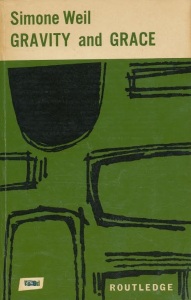 Human life is impossible. But it is only affliction which makes us feel this.
The impossibility of good: ‘Good comes out of evil, evil out of good, and when will it all end?’
The good is impossible. But man always has enough imagination at his disposal to hide from himself in each particular case the impossibility of good (it is enough if for each event which does not crush us ourselves we can veil part of the evil and add a fictitious good—and some people manage to do this even if they are crushed themselves).
Man’s imagination at the same time prevents him from seeing ‘how much the essence of the necessary differs from that of the good,’ and prevents him from allowing himself really to meet God who is none other than the good itself—the good which is found nowhere in this world.
Desire is impossible: it destroys its object. Lovers cannot be one, nor can Narcissus be two. Don Juan, Narcissus. Because to desire something is impossible, we have to desire what is nothing.
Our life is impossibility, absurdity. Everything we want contradicts the conditions or the consequences attached to it, every affirmation we put forward involves a contradictory affirmation, all our feelings are mixed up with their opposites. It is because we are a contradiction—being creatures—being God and infinitely other than God.
Contradiction alone is the proof that we are not everything. Contradiction is our wretchedness, and the sense of our wretchedness is the sense of reality. For we do not invent our wretchedness. It is true. That is why we have to value it. All the rest is imaginary.
Impossibility is the door of the supernatural. We can but knock at it. It is someone else who opens.
It is necessary to touch impossibility in order to come out of the dream world. There is no impossibility in dreams—only impotence.
‘Our Father, he who is in heaven.’ There is a sort of humour in that. He is your Father, but just try to go and look for him up there! We are quite as incapable of rising from the ground as an earth-worm. And how should he for his part come to us without descending? There is no way of imagining a contact between God and man which is not as unintelligible as the incarnation. The incarnation explodes this unintelligibility. It is the most concrete way of representing this impossible descent. Hence why should it not be the truth?
The links that we cannot forge are evidence of the transcendent.
We are beings with the faculty of knowing, willing and loving, and as soon as we turn our attention towards the objects of knowledge, will and love, we receive evidence that there is not one which is not impossible. Falsehood alone can veil such evidence. Consciousness of this impossibility forces us to long continually to grasp what cannot be grasped in all that we desire, know and will.
When something seems impossible to obtain despite every effort, it is an indication of a limit which cannot be passed on that plane and of the necessity for a change of level—a break in the ceiling. To wear ourselves out in efforts on the same level degrades us. It is better to accept the limit, to contemplate it and savour all its bitterness.
Error as an incentive, a source of energy. I think I see a friend. I run towards him. When I come a little nearer I see that it is someone else towards whom I am running—a stranger. In the same way we confuse the relative with the absolute—created things with God.
All particular incentives are errors. Only that energy which is not due to any incentive is good: obedience to God, which, since God is beyond all that we can imagine or conceive, means obedience to nothing. This is at the same time impossible and necessary—in other words it is supernatural.
A benefit (bienfait). A good action is such if in doing it we realise with our whole soul that such a thing as a benefit is absolutely impossible.
To do good. Whatever I do I know perfectly clearly that it is not good, for he who is not good cannot do good. And ‘God alone is good…’
On every occasion, whatever we do, we do evil, and an intolerable evil.
We must ask that all the evil we do may fall solely and directly on ourselves. That is the cross.
That action is good which we are able to accomplish while keeping our attention and intention totally directed towards pure and impossible goodness, without veiling from ourselves by any falsehood either the attraction or the impossibility of pure goodness.
In this way virtue is entirely analogous to artistic inspiration. The beautiful poem is the one which is composed while the attention is kept directed towards inexpressible inspiration, in so far as it is inexpressible.
__
Excerpted from Simone Weil‘s Gravity and Grace. First French edition 1947. Translated by Emma Crawford. English language edition 1963. Routledge and Kegan Paul, London.
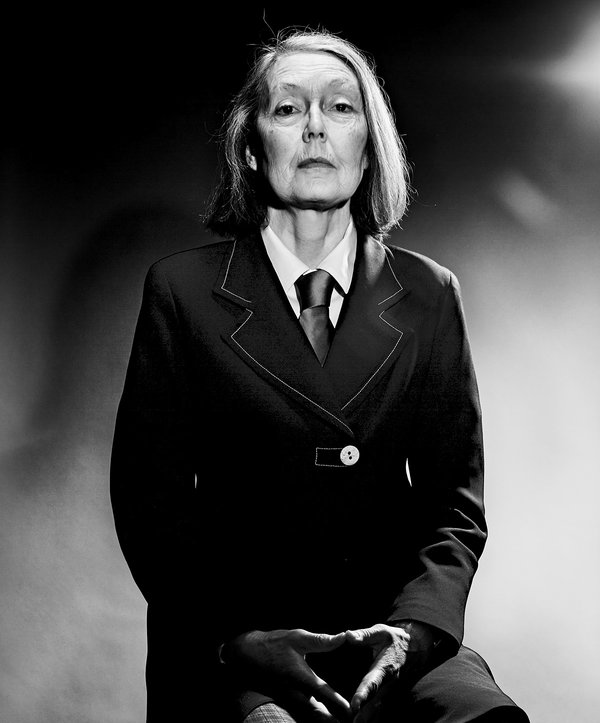 I want to make a praise of sleep. Not as a practitioner—I admit I have never been what is called “a good sleeper” and perhaps we can return later to that curious concept—but as a reader. There is so much sleep to read, there are so many ways to read it. In Aristotle’s view, sleep requires a “daimonic but not a divine” kind of reading. Kant refers to sleep’s content as “involuntary poetry in a healthy state.”
Keats wrote a “Sonnet to Sleep,” invoking its powers against the analytic of the day:
O soft embalmer of the still midnight!
. . . Then save me, or the passed day will shine
Upon my pillow, breeding many woes;
Save me from curious conscience, that still lords
Its strength for darkness, burrowing like a mole;
Turn the key deftly in the oiled wards,
And seal the hushed casket of my soul.
My intention in this essay is to burrow like a mole in different ways of reading sleep, different kinds of readers of sleep, both those who are saved, healthy, daimonic, good sleepers and those who are not. Keats ascribes to sleep an embalming action. This means two things: that sleep does soothe and perfume our nights; that sleep can belie the stench of death inborn in us. Both actions are salvific in Keats’ view. Both deserve (I think) to be praised.
My earliest memory is of a dream. It was in the house where we lived when I was three or four years of age. I dreamed I was asleep in the house in an upper room.
That I awoke and came downstairs and stood in the living room. The lights were on in the living room, although it was hushed and empty. The usual dark green sofa and chairs stood along the usual pale green walls. It was the same old living room as ever, I knew it well, nothing was out of place. And yet it was utterly, certainly, different. Inside its usual appearance the living room was as changed as if it had gone mad.
Later in life, when I was learning to reckon with my father, who was afflicted with and eventually died of dementia, this dream recovered itself to me, I think because it seemed to bespeak the situation of looking at a well-known face, whose appearance is exactly as it should be in every feature and detail, except that it is also, somehow, deeply and glowingly, strange.
The dream of the green living room was my first experience of such strangeness and I find it as uncanny today as I did when I was three. But there was no concept of madness or dementia available to me at that time. So, as far as I can recall, I explained the dream to myself by saying that I had caught the living room sleeping. I had entered it from the sleep side.And it took me years to recognize, or even to frame a question about, why I found this entrance into strangeness so
supremely consoling. For despite the spookiness, inexplicability and later tragic reference of the green living room, it was and remains for me a consolation to think of it lying there, sunk in its greenness, breathing its own order, answerable to no one, apparently penetrable everywhere and yet so perfectly disguised in all the propaganda of its own waking life as to become in a true sense something incognito at the heart of our sleeping house.
It is in these terms that I wish to praise sleep, as a glimpse of something incognito. Both words are important. Incognito means “unrecognized, hidden, unknown.”
Something means not nothing. What is incognito hides from us because it has something worth hiding, or so we judge. As an example of this judgment I shall cite for you two stanzas of Elizabeth Bishop’s poem “The Man-Moth.” The Man- Moth, she says, is a creature who lives most of the time underground but pays occasional visits to the surface of the earth, where he attempts to scale the faces of the buildings and reach the moon, for he understands the moon to be a hole at the top of the sky through which he may escape. Failing to attain the moon each time he falls back and returns to the pale subways of his underground existence.
Here is the poem’s third stanza:
Up the façades,
his shadow dragging like a photographer’s cloth behind him,
he climbs fearfully, thinking that this time he will manage
to push his small head through that round clean opening
and be forced through, as from a tube, in black scrolls on the light.
(Man, standing below him, has no such illusions).
But what the Man-Moth fears most he must do, although
he fails, of course, and falls back scared but quite unhurt.
The Man-Moth is not sleeping, nor is he a dream, but he may represent sleep itself—an action of sleep, sliding up the facades of the world at night on his weird quest. He harbours a secret content, valuable content, which is difficult to extract even if you catch him.
Here is the poem’s final stanza:
If you catch him,
hold up a flashlight to his eye. It’s all dark pupil,
an entire night itself, whose haired horizon tightens
as he stares back, and closes up the eye. Then from the lids
one tear, his only possession, like the bee’s sting, slips.
Slyly he palms it, and if you’re not paying attention
he’ll swallow it. However, if you watch, he’ll hand it over,
cool as from underground springs and pure enough to drink.
To drink the tear of sleep, to detach the prefix “un-” from its canniness and from its underground purposes, has been the project of many technologies and therapies—from the ancient temple of Asklepios at Epidauros, where sick people slept the night in order to dream their own cure, to the psychoanalytic algebras of Jacques Lacan, who understands sleep as a space from which the sleeper can travel in two directions, both of them a kind of waking.
If I were to praise either of these methods of healing I would do so on grounds of their hopefulness. Both Asklepiadic priests and Lacanian analysts posit a continuity between the realms of waking and sleeping, whereby a bit of something incognito may cross over from night to day and change the life of the sleeper. Here is an ancient account of one of the sleep cures at Epidauros:
There came as a suppliant to the god Asklepios a man who was so one eyed that on the left he had only lids, there was nothing, just emptiness. People in the temple laughed at him for thinking he would see with an eye that was not there. But in a vision that appeared to him as he slept, the god seemed to boil some medicine and, drawing apart the lids, poured it in. When day came the man went out, seeing with both eyes.
What could be more hopeful than this story of an empty eye filled with seeing as it sleeps? An analyst of the Lacanian sort might say that the one-eyed man has chosen to travel all the way in the direction of his dream and so awakes to a reality more real than the waking world. He dove into the nothingness of his eye and is awakened by too much light. Lacan would praise sleep as a blindness, which nonetheless looks back at us.
What does sleep see when it looks back at us? This is a question entertained by Virginia Woolf in To the Lighthouse, a novel that falls asleep for twenty-five pages in the middle. The story has three
parts. Parts I and III concern the planning and execution of a trip to the lighthouse by the Ramsay family.
Part II is told entirely from the sleep side. It is called “Time Passes.” It begins as a night that grows into many nights then turns into seasons and years. During this time, changes flow over the house of the story and penetrate the lives of the characters while they sleep. These changes are glimpsed
as if from underneath; Virginia Woolf ’s main narrative is a catalogue of silent bedrooms, motionless chests of drawers, apples left on the dining room table, the wind prying at a window blind, moonlight gliding on floorboards. Down across these phenomena come facts from the waking world, like swimmers stroking by on a night lake. The facts are brief, drastic and enclosed in square brackets.
For example:
[Mr. Ramsay, stumbling along a passage one dark morning, stretched his arms out, but Mrs. Ramsay having died rather suddenly the night before, his arms, though stretched out, remained empty.]
or:
[A shell exploded. Twenty or thirty young men were blown up in France, among them Andrew Ramsay, whose death, mercifully, was instantaneous.]
or:
[Mr. Carmichael brought out a volume of poems that spring, which had an unexpected success. The war, people said, had revived their interest in poetry.]
These square brackets convey surprising information about the Ramsays and their friends, yet they float past the narrative like the muffled shock of a sound heard while sleeping. No one wakes up. Night plunges on, absorbed in its own events. There is no exchange between night and its captives, no tampering with eyelids, no drinking the tear of sleep. Viewed from the sleep side, an empty eye socket is just a fact about a person, not a wish to be fulfilled, not a therapeutic challenge. Virginia Woolf offers us, through sleep, a glimpse of a kind of emptiness that interests her. It is the emptiness of things before we make use of them, a glimpse of reality prior to its efficacy.
Some of her characters also search for this glimpse while they are awake. Lily Briscoe, who is a painter in To the Lighthouse, stands before her canvas and ponders how “to get hold of that very jar on the nerves, the thing itself before it has been made anything.”
In a famous passage of her diaries, Virginia Woolf agrees with the aspiration:
If I could catch the feeling I would: the feeling of the singing of the real world, as one is driven by loneliness and silence from the habitable world.
What would the singing of the real world sound like? What would the thing itself look like? Such questions are entertained by her character Bernard, at the end of The Waves:
“So now, taking upon me the mystery of things, I could go like a spy without leaving this place, without stirring from my chair. . . . The birds sing in chorus; the house is whitened; the sleeper stretches; gradually all is astir. Light floods the room and drives shadow beyond shadow to where they hang in folds inscrutable. What does this central shadow hold? Something? Nothing? I do not know. . . .”
Throughout her fiction Virginia Woolf likes to finger the border between nothing and something. Sleepers are ideal agents of this work.
Read the rest of this brilliant essay: Every Exit is an Entrance from Anne Carson’s Decreation (2005).
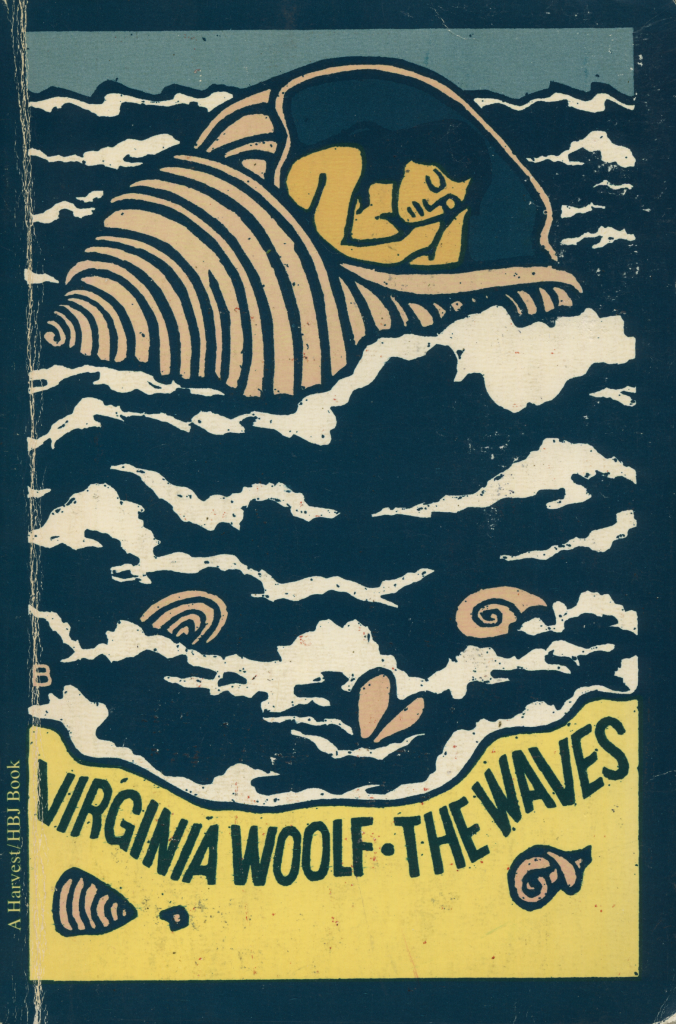 The roar of the traffic, the passage of undifferentiated faces, this way and that way, drugs me into dreams; rubs the features from faces. People might walk through me.
And what is this moment of time, this particular day in which I have found myself caught? The growl of traffic might be any uproar – forest trees or the roar of wild beasts. Time has whizzed back an inch or two on its reel; our short progress has been cancelled.
I think also that our bodies are in truth naked. We are only lightly covered with buttoned cloth; and beneath these pavements are shells, bones and silence.
— Virginia Woolf, from The Waves (1931).
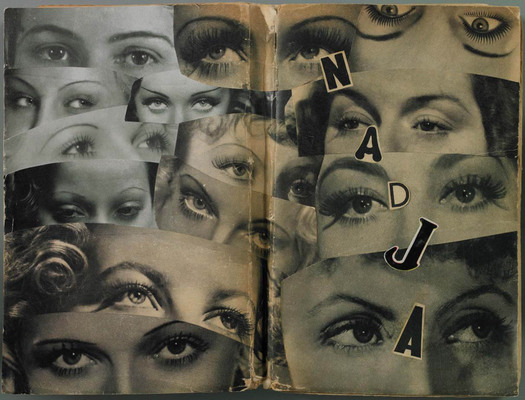
Cover of the 1928 Gallimard edition of Nadja, collaged over by Marcel Mariën, 1938.
The narrator, named André, ruminates on a number of Surrealist principles, before ultimately commencing (around a third of the way through the novel) on a narrative account, generally linear, of his brief ten day affair with the titular character Nadja. She is so named “because in Russian it’s the beginning of the word hope, and because it’s only the beginning,” but her name might also evoke the Spanish “Nadie,” which means “No one.” The narrator becomes obsessed with this woman with whom he, upon a chance encounter while walking through the street, strikes up conversation immediately. He becomes reliant on daily rendezvous, occasionally culminating in romance (a kiss here and there).
His true fascination with Nadja, however, is her vision of the world, which is often provoked through a discussion of the work of a number of Surrealist artists, including himself. While her understanding of existence subverts the rigidly authoritarian quotidian, it is later discovered that she is mad and belongs in a sanitarium. After Nadja reveals too many details of her past life, she in a sense becomes demystified, and the narrator realises that he cannot continue their relationship.
In the remaining quarter of the text, André distances himself from her corporeal form and descends into a meandering rumination on her absence, so much so that one wonders if her absence offers him greater inspiration than does her presence. It is, after all, the reification and materialisation of Nadja as an ordinary person that André ultimately despises and cannot tolerate to the point of inducing tears.
There is something about the closeness once felt between the narrator and Nadja that indicated a depth beyond the limits of conscious rationality, waking logic, and sane operations of the everyday. There is something essentially “mysterious, improbable, unique, bewildering” about her; this reinforces the notion that their propinquity serves only to remind André of Nadja’s impenetrability.
Her eventual recession into absence is the fundamental concern of this text, an absence that permits Nadja to live freely in André’s conscious and unconscious, seemingly unbridled, maintaining her paradoxical role as both present and absent. With Nadja’s past fixed within his own memory and consciousness, the narrator is awakened to the impenetrability of reality and perceives a particularly ghostly residue peeking from under its thin veil. Thus, he might better put into practice his theory of Surrealism, predicated on the dreaminess of the experience of reality within reality itself.
Read the book here: Andre Breton – Nadja.
Another of those touchstone albums I’ve had since my teens… I am starting to realise that they have stuck with me for subliminal reasons. They just fit. And they still do.
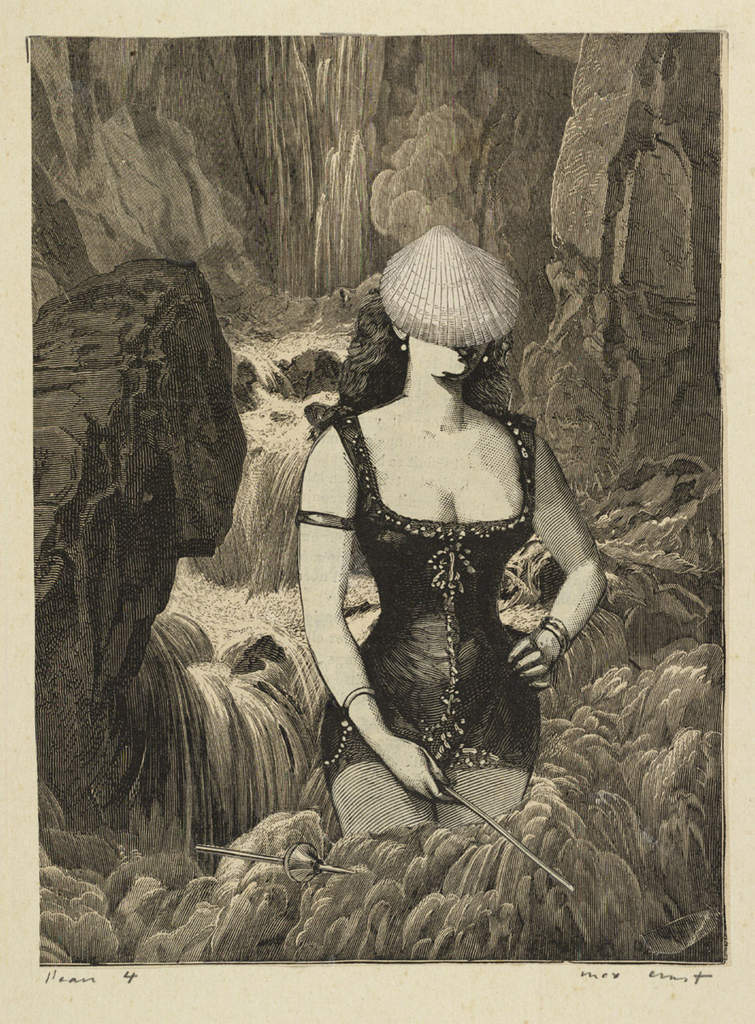
Max Ernst – collage from The Hundred Headless Woman (1929).
… There is always, in such movements, a moment when the original tension of the secret society must either explode in a matter-of-fact, profane struggle for power and domination, or decay as a public demonstration and be transformed. Surrealism is in this phase of transformation at present. But at the time when it broke over its founders as an inspiring dream wave, it seemed the most integral, conclusive, absolute of movements. Everything with which it came into contact was integrated. Life only seemed worth living where the threshold between waking and sleeping was worn away in everyone as by the steps of multitudinous images flooding back and forth, language only seemed itself where, sound and image, image and sound interpenetrated with automatic precision and such felicity that no chink was left for the penny-in-the-slot called ‘meaning’.
Image and language take precedence. Saint-Pol Roux, retiring to bed about daybreak, fixes a notice on his door: ‘Poet at work.’ Breton notes: ‘Quietly. I want to pass where no one yet has passed, quietly! After you, dearest language.’ Language takes precedence. Not only before meaning. Also before the self. In the world’s structure dream loosens individuality like a bad tooth. This loosening of the self by intoxication is, at the same time, precisely the fruitful, living experience that allowed these people to step outside the domain of intoxication.
This is not the place to give an exact definition of Surrealist experience. But anyone who has perceived that the writings of this circle are not literature but something else – demonstrations, watchwords, documents, bluffs, forgeries if you will, but at any rate not literature – will also know, for the same reason, that the writings are concerned literally with experiences, not with theories and still less with phantasms. And these experiences are by no means limited to dreams, hours of hashish eating, or opium smoking. It is a cardinal error to believe that, of ‘Surrealist experiences’, we know only the religious ecstasies or the ecstasies of drugs. The opium of the people, Lenin called religion, and brought the two things closer together than the Surrealists could have liked.
I shall refer later to the bitter, passionate revolt against Catholicism in which Rimbaud, Lautreamont, and Apollinaire brought Surrealism into the world. But the true creative overcoming of religious illumination certainly does not lie in narcotics. It resides in a profane illumination, ‘a materialistic, anthropological inspiration, to which hashish, opium, or whatever else can give an introductory lesson. (But a dangerous one; and the religious lesson is stricter.)
This profane illumination did not always find the Surrealists equal to it, or to themselves, and the very writings that proclaim it most powerfully, Aragon’s incomparable Paysan de Paris and Breton’s Nadja, show very disturbing symptoms of deficiency. For example, there is in Nadja an excellent passage on the ‘delightful days spent looting Paris under the sign of Sacco and Vanzetti’; Breton adds the assurance that in those days Boulevard Bonne-Nouvelle fulfilled the strategic promise of revolt ‘that had always been implicit in its name. But Madame Sacco also appears, not the wife of Fuller’s victim but avoyante, a fortune-teller who lives at 3 rue des Usines and tells Paul Eluard that he can expect no good from Nadja.
Now I concede that the breakneck career of Surrealism over rooftops, lightning conductors, gutters, verandas, weathercocks, stucco work – all ornaments are grist to the cat burglar’s mill- may have taken it also into the humid backroom of spiritualism. But I am not pleased to hear it cautiously tapping on the window-panes to inquire about its future. Who would not wish to see these adoptive children of revolution most rigorously severed from all the goings-on in the conventicles of down-at-heel dowagers, retired majors, and emigre profiteers?
In other respects Breton’s book illustrates well a number of the basic characteristics of this ‘profane illumination’. He calls Nadja ‘a book with a banging door’. (In Moscow I lived in a hotel in which almost all the rooms were occupied by Tibetan lamas who had come to Moscow for a congress of Buddhist churches. I was struck by the number of doors in the corridors that were always left ajar. What had at first seemed accidental began to be disturbing. I found out that in these rooms lived members of a sect who had sworn never to occupy closed rooms. The shock I had then must be felt by the reader of Nadja.)
To live in a glass house is a revolutionary virtue par excellence. It is also an intoxication, a moral exhibitionism, that we badly need. Discretion concerning one’s own existence, once an aristocratic virtue, has become more and more an affair of petty-bourgeois parvenus. Nadja has achieved the true, creative synthesis between the art novel and the roman-a-clef.
Moreover, one need only take love seriously to recognize in it, too – as Nadja also indicates – a ‘profane illumination’. ‘At just that time’ (i.e., when he knew Nadja), the author tells us, ‘I took a great interest in the epoch of Louis VII, because it was the time of the ‘courts of love’, and I tried to picture with great intensity how people saw life then.’ We have from a recent author quite exact information on Provencal love poetry, which comes surprisingly close to the Surrealist conception of love. ‘All the poets of the ‘new style’,’ Erich Auerback points out in his excellent Dante: Poet of the Secular World, ‘possess a mystical beloved, they all have approximately the same very curious experience of love; to them all Amor bestows or withholds gifts that resemble an illumination more than sensual pleasure; all arc subject to a kind of secret bond that determines their inner and perhaps also their outer-lives’. The dialectics of intoxication are indeed curious. Is not perhaps all ecstasy in one world humiliating sobriety in that complementary to it? What is it that courtly Minne seeks, and it, not love, binds Breton to the telepathic girl, if not to make chastity, too, a transport? Into a world that borders not only on tombs of the Sacred Heart or altars to the Virgin, but also on the morning before a battle or after a victory.
![Max Ernst - Une semaine de bonté [A Week of Kindness]. La clé des chants 1 [The Key of Songs 1] 1933](https://fleurmach.com/wp-content/uploads/2016/03/003_max_ernst_theredlist.jpg)
Max Ernst – Une semaine de bonté [A Week of Kindness]. La clé des chants 1 [The Key of Songs 1] 1933
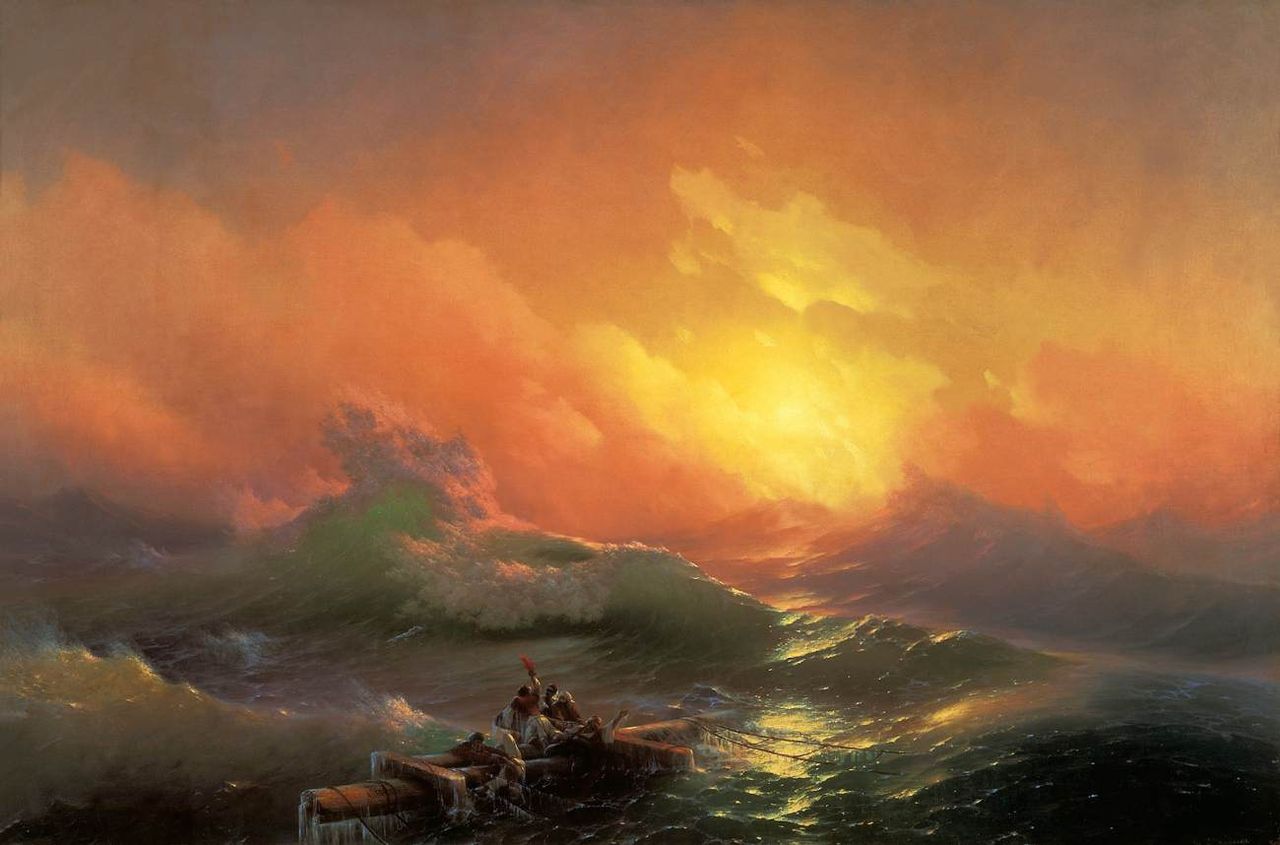
“Wave after wave, each mightier than the last,
Till last, a ninth one, gathering half the deep
And full of voices, slowly rose and plunged
Roaring, and all the wave was in a flame.”
From Alfred, Lord Tennyson’s Idylls of the King (1859).
1943.
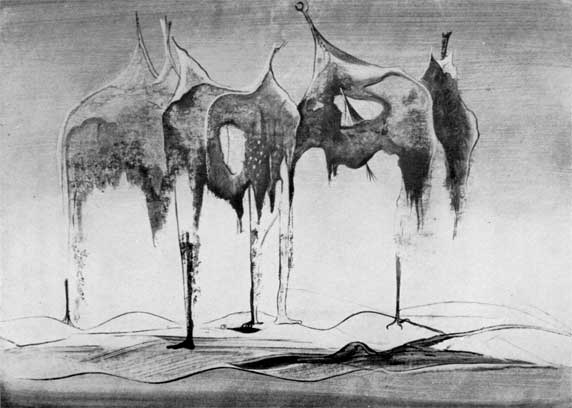
Edgar Jené. The Sea of Blood Covers the Land.
I am supposed to tell you some of the words I heard deep down in the sea where there is so much silence and so much happens. I cut my way through the objects and objections of reality and stood before the sea’s mirror surface. I had to wait until it burst open and allowed me to enter the huge crystal of the inner world. With the large lower star of disconsolate explorers shining above me, I followed Edgar Jené beneath his paintings.
Though I had known the journey would be strenuous, I worried when I had to enter one of the roads alone, without a guide. One of the roads! There were innumerable, all inviting, all offering me different new eyes to look at the beautiful wilderness on the other, deeper side of existence. No wonder that, in this moment when I still had my own stubborn old eyes, I tried to make comparisons in order to be able to choose. My mouth, however, placed higher than my eyes and bolder for having often spoken in my sleep, had moved ahead and mocked me: ‘Well, old identity monger, what did you see and recognize, you brave doctor of tautology? What could you recognize, tell me, along this unfamiliar road? An also-tree or almost-tree, right? And now you are mustering your Latin for a letter to old Linnaeus? You had better haul up a pair of eyes from the bottom of your soul and put them on your chest: then you’ll find out what is happening here.’
Now I am a person who likes simple words. It is true, I had realised long before this journey that there was much evil and injustice in the world I had now left, but I had believed I could shake the foundations if I called things by their proper names. I knew such an enterprise meant returning to absolute naïveté. This naïveté I considered as a primal vision purified of the slag of centuries of hoary lies about the world. I remember a conversation with a friend about Kleist’s Marionette Theatre. How could one regain that original grace, which would become the heading of the last and, I suppose, loftiest chapter in the history of mankind?
It was, my friend held, by letting reason purify our unconscious inner life that we could recapture the immediacy of the beginning – which would in the end give meaning to our life and make it worth living. In this view, beginning and end were one, and a note of mourning for original sin was struck. The wall which separates today from tomorrow must be torn down so that tomorrow could again be yesterday. But what must we actually do now, in our own time, to reach timelessness, eternity, the marriage of tomorrow-and-yesterday? Reason, he said, must prevail. A bath in the aqua regia of intelligence must give their true (primitive) meaning back to words, hence to things, beings, occurrences. A tree must again be a tree, and its branch, on which the rebels of a hundred wars have been hanged, must again flower in spring.
Here my first objection came up. It was simply this: I knew that anything that happened was more than an addition to the given, more than an attribute, more or less difficult to remove from the essence, that it changed the essence in its very being and thus cleared the way for ceaseless transformation.
My friend was stubborn. He claimed that even in the stream of human evolution he could distinguish the constants of the soul, know the limits of the unconscious. All we needed was for reason to go down into the deep and haul the water of the dark well up to the surface. This well, like any other, had a bottom one could reach, and if only the surface were ready to receive the water from the deep, the sun of justice shining, the job would be done. But how can we ever succeed, he said, if you and people like you never come out of the deep, never stop communing with the dark springs?
I saw that this reproach was aimed at my professing that, since we know the world and its institutions are a prison for man and his spirit, we must do all we can to tear down its walls. At the same time, I saw which course this knowledge prescribed. I realised that man was not only languishing in the chains of external life, but was also gagged and unable to speak – and by speaking I mean the entire sphere of human expression – because his words (gestures, movements) groaned under an age-old load of false and distorted sincerity. What could be more dishonest than to claim that words had somehow, at bottom, remained the same! I could not help seeing that the ashes of burned-out meanings (and not only of those) had covered what had, since time immemorial, been striving for expression in man’s inner most soul.
How could something new and pure issue from this? It may be from the remotest regions of the spirit that words and figures will come, images and gestures, veiled and unveiled as in a dream. When they meet in their heady course, and the spark of the wonderful is born from the marriage of strange and most strange, then I will know I am facing the new radiance. It will give me a dubious look because, even though I have conjured it up, it exists beyond the concepts of my wakeful thinking; its light is not daylight; it is inhabited by figures which I do not recognise, but know at first sight. Its weight has a different heaviness, its colour speaks to the new eyes which my closed lids have given one another; my hearing has wandered into my fingertips and learns to see; my heart, now that it lives behind my forehead, tastes the laws of a new, unceasing, free motion. I follow my wandering senses into this new world of the spirit and come to know freedom. Here, where I am free, I can see what nasty lies the other side told me. Continue reading
Warp Records, 1997. One of those albums I have never stopped listening to since it came out.
1. 00:00 Accidentals
2. 03:27 The Book Lovers
3. 08:17 Message from Home
4. 13:17 Phantom
5. 16:49 We’ve Got Time
6. 21:02 Living Room
7. 24:29 According to No Plan
8. 27:37 The World Backwards
9. 31:38 Lights Out
The imagination is continually at work filling up all the fissures through which grace might pass.
Every void (not accepted) produces hatred, sourness, bitterness, spite. The evil we wish for that which we hate, and which we imagine, restores the balance.
The militiamen of the Spanish Testament who invented victories in order to endure death: an example of imagination filling up the void. Although we should gain nothing by the victory, we can bear to die for a cause which is going to triumph, not for one which will be defeated. For something absolutely denuded of power, it would be superhuman (the disciples of Christ). The thought of death calls for a counterweight, and this counterweight—apart from grace—cannot be anything but a lie.
The imagination, filler up of the void, is essentially a liar. It does away with the third dimension, for only real objects have three dimensions. It does away with multiple relationships.
To try to define the things which, while they do indeed happen, yet remain in a sense imaginary. War. Crimes. Acts of revenge. Extreme affliction.
The crimes in Spain were actually perpetrated and yet they resembled mere acts of boastfulness.
Realities which have no more dimensions than a dream.
In the case of evil, as in that of dreams, there are not multiple readings.* Hence the simplicity of criminals.
Crimes flat like dreams on both sides: on the side of the executioner and on the side of the victim. What is more frightful than to die in a nightmare?
Compensations. Marius imagined future retribution. Napoleon thought of posterity. William II wanted a cup of tea. His imagination was not strongly enough attached to power to be able to span the years: it turned towards a cup of tea.
The adoration of the great by the people in the seventeenth century (La Bruyère). This was a result of imagination filling up the void, a result which has disappeared since money has been substituted for it. Two base results, but money the baser of the two.
In no matter what circumstances, if the imagination is stopped from pouring itself out we have a void (the poor in spirit).
In no matter what circumstances (but sometimes at the price of how great a degradation!) imagination can fill the void. This is why average human beings can become prisoners, slaves, prostitutes and pass through no matter what suffering without being purified.
We must continually suspend the work of the imagination filling the void within ourselves.
If we accept no matter what void, what stroke of fate can prevent us from loving the universe?
We have the assurance that, come what may, the universe is full.
__
* For the meaning of this word (lectures) in the vocabulary of Simone Weil, see later chapter on Readings.
__
Excerpted from Simone Weil‘s Gravity and Grace. First French edition 1947. Translated by Emma Crawford. English language edition 1963. Routledge and Kegan Paul, London.
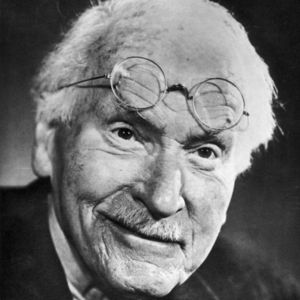 What can a man say about woman, his own opposite? I mean of course something sensible, that is outside the sexual program, free of resentment, illusion, and theory. Where is the man to be found capable of such superiority? Woman always stands just where the man’s shadow falls, so that he is only too liable to confuse the two. Then, when he tries to repair this misunderstanding, he overvalues her and believes her the most desirable thing in the world.
From Women In Europe (1927)
“The laws of macro- and microcosm are alike. Travel in the interior is as a voyage in outer space: we must in each case burst past the circumference of our surface – our here-space and now-time – and, cut loose from the anchorage of an absolute, fixed center, enter worlds where the relationship of parts is the sole gravity. When the sun sets, the stars become apparent; when our eyes close out the light to sleep, there rises in the night-eye the constellation by which sleep-walkers plot their incalculable accuracies. By day we move according to desire and decision; by night Noctambulo advances without moving, led by the twins Gemini (as the eyes are twins or as the I of night is twin to that of day). It is by the dark geometry of such celestial navigation that the day‘s erratic negotiations are corrected and reconciled into the total orbits of our lives.
The film is in the negative. The blackness of night erases all horizon and, released from the leveling pressure of this plane, the movements both of the dancers and of the camera become as four-dimensional and directional as those of birds in air or fish in water.”
– Maya Deren: Chamber Films, program notes for a presentation, 1960
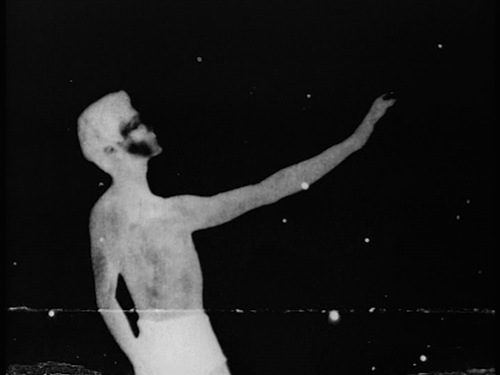
#Title: The Very Eye of Night
#Director: Maya Deren
#Year of Production: 1958
#Duration: 00:15:00
#Choregraphy: Antony Tudor, Metropolitan Opera Ballet School
#Dancers / Actors: Philp Salem, Rosemary Williams, Richard Englund, Richard Sandifer, Don Freisinger, Patricia Ferrier, Barbara Levin, Bud Bready, Genaro Gomez
#Camera: Maya Deren
#Editing: Maya Deren
#Foley Assistance: Harrison Starr
#Sound: Louis and Bebe Barron
#Music: Teiji Ito
 fleurmach