note to self (live at the blah blah bar)

A poem by Louise Westerhout, accompanied by Lliezel Ellick (cello) and Rosemary Lombard (autoharp), performed on 28 July 2016 at the Blah Blah Bar’s Open Mouth night.

Next time we’ll make sure we find a venue where rude men at the bar are not entitled to talk through performances…

the smiths – cemetry gates (1986)

A dreaded sunny day
So I meet you at the cemetry gates
Keats and Yeats are on your side
A dreaded sunny day
So I meet you at the cemetry gates
Keats and Yeats are on your side
While Wilde is on mine

So we go inside and we gravely read the stones
All those people, all those lives
Where are they now?
With loves, and hates
And passions just like mine
They were born
And then they lived
And then they died
It seems so unfair
I want to cry

You say: “‘Ere thrice the sun done salutation to the dawn
And you claim these words as your own
But I’ve read well, and I’ve heard them said
A hundred times (maybe less, maybe more)
If you must write prose/poems
The words you use should be your own
Don’t plagiarise or take “on loan”
‘Cause there’s always someone, somewhere
With a big nose, who knows
And who trips you up and laughs
When you fall
Who’ll trip you up and laugh
When you fall

You say: “‘Ere long done do does did”
Words which could only be your own
And then produce the text
From whence t’was ripped
(Some dizzy whore, 1804)

A dreaded sunny day
So let’s go where we’re happy
And I’ll meet you at the cemetry gates
Oh, Keats and Yeats are on your side
A dreaded sunny day
So let’s go where we’re wanted
And I’ll meet you at the cemetry gates
Keats and Yeats are on your side
But you lose
‘Cause weird lover Wilde is on mine

Sure!

hera lindsay bird – keats is dead so fuck me from behind (2016)

bird-1-250x250Keats is dead so fuck me from behind
Slowly and with carnal purpose
Some black midwinter afternoon
While all the children are walking home from school
Peel my stockings down with your teeth
Coleridge is dead and Auden too
Of laughing in an overcoat
Shelley died at sea and his heart wouldn’t burn
& Wordsworth……………………………………………..
They never found his body
His widow mad with grief, hammering nails into an empty meadow
Byron, Whitman, our dog crushed by the garage door
Finger me slowly
In the snowscape of your childhood
Our dead floating just below the surface of the earth
Bend me over like a substitute teacher
& pump me full of shivering arrows
O emotional vulnerability
Bosnian folk-song, birds in the chimney
Tell me what you love when you think I’m not listening
Wallace Stevens’s mother is calling him in for dinner
But he’s not coming, he’s dead too, he died sixty years ago
And nobody cared at his funeral
Life is real
And the days burn off like leopard print
Nobody, not even the dead can tell me what to do
Eat my pussy from behind
Bill Manhire’s not getting any younger

__
Read an interview with Hera Lindsay Bird at The Spinoff.

dora maar/man ray – the years lie in wait for you (1936)

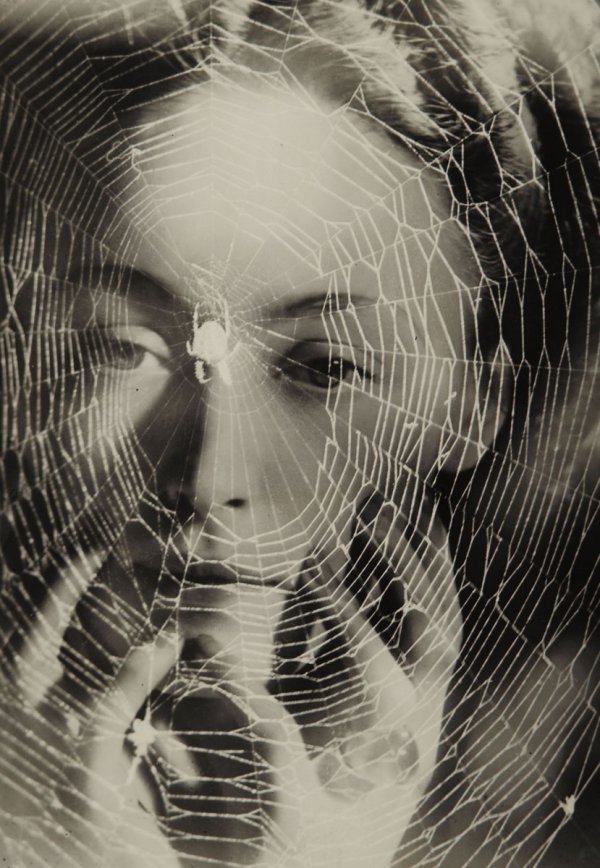
Dora Maar and Man Ray - 1936, The Years Lie in Wait for You - Spider - Nusch Eluard

Excerpt from an article by Aya Lurie, from the exhibition catalogue: “The Naked Eye – Surrealist Photography in the First Half of the 20th Century”, 2013:

The languishing face of a strikingly beautiful young woman is seen behind a spider web. Is she trapped behind the web? Is she trapped in it? The spider may be lying in wait for her, and maybe she is on the prowl, with her manicured feminine hands, which call to mind the articulated legs of a spider. Perhaps it is rather the lurking time, as indicated by the title of the photograph, that threatens youth and beauty, serving as a reminder of their ephemerality.

The association between the woman and the spider dates back to Greek mythology, where it is embodied in the figure of Arachne, a weaver who made Athena jealous enough to turn her into a spider.1

In the history of culture, the figure of the “spider-woman” has come to be identified with the femme fatale — the archetype of the woman who leads to the downfall of the man attracted to her. In this context, Arachne is presented as a patient plotter who spins a web of schemes to trap and devour the reckless male.2  Dr. Ruth Markus, in her essay about the representations of the castrating woman in Surrealist art, ties the female praying mantis with the female “Black Widow” spider, which characteristically devour their males during or directly after the sexual act. She explains the Surrealist interest in the mantis and similar insects in that they represent the two primordial Freudian instincts: Eros and Thanatos.3

Dora Maar linked the photographed portrait by Man Ray with a manipulated image of a cobweb, to create the effect of transparent contours on the woman’s face in the final print. The resulting photomontage thus fuses the woman’s figure with the spider and its web. The Surrealists were drawn to the mimetic ability of various animals to camouflage themselves in nature, and created many works in which flora, fauna, and the inanimate merge and assimilate into one another.4 In the spirit of pantheist romanticism, this capacity was taken to represent an aspiration to eliminate the boundaries between man and nature, to the point of total fusion with the cosmos, which leads to absolute void. It is, in fact, a yearning for a primordial unconscious state, an existential state which precedes consciousness.

In the photograph in question, the paths of two of the most fascinating women who operated among the Surrealists cross. Photographer Dora Maar (born as Henrietta Theodora Markovitch) was a talented artist in her own right, but her fame came mainly from her relationship with Pablo Picasso, her partner, who often depicted her figure. In addition, Maar also modeled for Man Ray in some of his prime photographs…

… The model in Maar’s photograph is Nusch Éluard (1906–1946, née Maria Benz), a German show dancer who, in 1934, married poet Paul Éluard, one of the kingpins of Surrealism, after his first wife, Gala, left him for Salvador Dalí… Nusch Éluard also served as inspiration for her husband’s poetic work, and he combined her photographs in his books of poetry as elaboration and illustration for the written text.

In 1935, daring nude photographs of Nusch were included in his book Facile. Following her sudden death in 1946, at the age of 40, her portrait, taken by Dora Maar (with which she constructed the montage here), was included in a book by her husband in her memory, Le temps débordé (Time Overflows). The portrait, this time without cobweb,[fig. 3] accompanied the poem “Ecstasy” in which Éluard praises and mourns his wife: “I am in front of this feminine land / Like a child in front of the fire / Smiling vaguely with tears in my eyes / […] / I am in front of this feminine land / Like a branch in the fire.”5

  1. See Ovid’s Metamorphoses, books 6–10, ed. William S. Anderson (Norman, Oklahoma: University of Oklahoma Press, 1972), pp. 15-22.
  2. See Doron Lurie, cat. Femme Fatale (Tel Aviv Museum of Art, 2006), p. 108 [Hebrew].
  3. Ruth Markus, “Surrealism’s Praying Mantis and Castrating Woman”, Woman’s Art Journal, vol. 21:1 (Spring/Summer, 2000), pp. 33-39.
  4. Ibid.
  5. Paul Éluard, “Ecstasy,” trans. A. S. Kline, 2001. http://www.poetryintranslation.com/PITBR/French/Eluard.htm.

birthday tulips from debbie pryor (2016)

I watched them dying slowly at my desk, which I hardly left for the week after my birthday (dissertation drang). And what a magnificent way to go. They DID so much in those last days. Most flowers sit still and wilt gently. Not tulips! Tulips grow to double their height in the first two days in a vase. You can hear them moving at night when it’s quiet. The leaves squeak as they unfurl. They dance and overflow the vase, leaning over your work audaciously. Then the buds begin to open wider, wider still, the petals curling back gracefully, turning inside out to reveal ripe, full stamens, spilling a profusion of pollen, yellow stains all across your papers… exquisite, defiant contortion. What a wonderful birthday gift at 38 – the opportunity to meditate on living and aging with self-possession and purpose. Thank you Debs. x

fb_img_1465892072481.jpgfb_img_1465892064709.jpg

alexis pauline gumbs – pulse (for the 50 and beyond)

A poem for those who died, shot in Pulse nightclub in Orlando this weekend past.

i was going to see you
i was going to dance
in the same place with you someday
i was going to pretend not to notice
how you and your friends smiled
when you saw me and my partner
trying to cumbia to bachata
but i was going to feel more free anyway
because you were smiling
and we were together
and you had your stomach out
and you felt beautiful in your sweat

i was going to smile when i walked by
i was going to hug you the first time
a friend of a friend introduced us
i was going to compliment your shoes
instead of writing you a love poem
i was going to smile every time i saw you
and struggle to remember your name

we were going to sing together
we were going to belt out Selena
i was going to mispronounce everything
except for amor
and ay ay ay
i was going to covet your confidence and your bracelet
i was going to be grateful for the sight of you
i was going scream YES!!! at nothing in particular
at everything especially
meaning you
meaning you beyond who i knew you to be

i was going to see you in hallways
and be too shy to say hello
you were going to come to the workshop
you were going to sign up for the workshop and not come
you were going to translate the webinar
even though my politics seemed out there

we were going to sign up for creating change the same day
and be reluctant about it for completely different reasons
we were going to watch the keynotes
and laugh at completely different times

i was going to hold your hand in a big activity
about the intimacy of strangers
about the strangeness of needing prayer
we were going to get the same automated voice message
when we complained that it was not what it should have been

we were going to be standing in the same line
for various overpriced drinks
during a shift change
i was going to breathe loudly so you would notice me
you were going to compliment my hair

it isn’t fair
because we were going to work
to beyonce and rihanna
and the rihanna’s and beyonce’s to come
and the beyonce’s and rihanna’s after that

we were going to not drink enough water
and stay out later than our immune systems could handle
we were going to sit in traffic in each others blindspots
listening to top 40 songs that trigger queer memories
just outside the scope of marketing predictions

we were going to get old and i was going to wonder
about the hint of a tattoo i could see under your sleeve
i was going to blink and just miss
the fought-for laughter lines around your liner-loved eyes

i was going to go out for my birthday
but i didn’t
and you did

we were going to be elders
just because we were still around
and i was going to listen to you on a panel
we didn’t feel qualified for
and hear you talk about your guilt
for still being alive
when so many of your friends were taken
by suicide
by AIDS
by racist police
and jealous ex-lovers
and poverty
and no access to healthcare
and how you had a stable job
you suffered at until the weekend
how you avoided the drama
and only went to the club at pride
and so here you were with no one to dance with anymore

i was going to see you and forget you
and only remember you in my hips
and how my smile came easier than clenching my teeth eventually
and how i finally learned whatever it is i still haven’t learned yet
i was going to hear you laugh and not know why
and not care

our ancestors fought for a future
and we were both going to be there
until we weren’t

and i don’t know if it would hurt more
to lose you later after knowing you
i don’t know if it would hurt more
to know you died on your own day
by your own hands
or any of the other systems
that stalk you and me and ours forever

i only know the pain that i am having
and that you are not here to share it
you are not here to bear it
you were going to pass me a candle at the next vigil

but now i am pulse

and now you
are flame.

a lacanian interpretation of sartre’s ‘erostratus’ (1939)

Read Jean Paul Sartre’s short story Erostratus, written the year after his famous NauseaHERE.

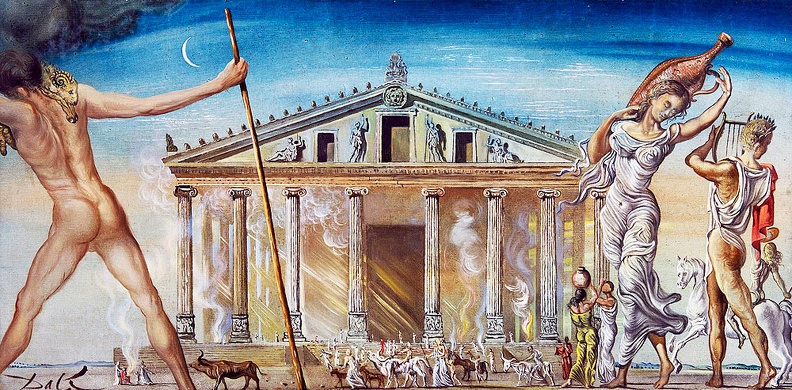
Salvador Dali – “Temple of Diana at Ephesus” (1942).

Jordan Alexander Hill on the story from a psychoanalytical perspective:

Jean-Paul Sartre’s “Erostratus” may be the shortest story in The Wall, yet it serves as a fitting psychoanalytic case-study. “Erostratus” tells the story of Paul Hilbert, a lonely man plagued by insecurity and sexual impotency, who attempts and ultimately fails to commit a heinous crime. Shortly into the story, it becomes clear that the crime is mostly an attempt to escape his mediocrity through an act of powerful self-assertion. We will look at this story not only through a traditional psychoanalytic lens, but also by applying important Lacanian principles. Sartre, who developed his own “existential” brand of psychoanalysis, surely wrote “Erostratus” to support certain phenomenological and ethical themes from Being and Nothingness—we’ll look at some of these perspectives. However, in many ways, we arrive at the deepest understanding of Hilbert and his motivations by bringing Lacanian theories into the discussion. In this paper, we first locate the basic existential and psychoanalytic themes that underpin “Erostratus”, in addition to looking at Lacan’s “mirror phase” and how this relates to Hilbert’s social development. “Erostratus” is essentially a story about narcissism, alienation, otherness, and desire. Lacan’s psychic structures—particularly the imaginary and symbolic orders—will give us a sense of where these emotions come from, how they affect our protagonist, and how they function in the larger narrative.

Like in many “existential” works, our protagonist is a bland working class guy with a routine existence and a mundane job. He has no friends to speak of and is a self-professed “anti-humanist”. As Hilbert’s impatience with his situation grows, he decides he must make a statement that will prove his anti-humanism and secure his name in the history books—he will murder six random people on a busy street in Paris. Hilbert is deeply moved by the ancient Greek story of “Erostratus,” which tells of a man who burned down the temple of Artemis at Ephesus to immortalize himself. What strikes him is that while nobody knows the name of the man who built the temple of Artemis, everyone remembers Erostratus, the man who destroyed it. The rest of the story follows Hilbert’s metamorphosis, as the day of his crime draws nearer. In what follows, Hilbert buys a gun and carries it around in public, becoming sexually aroused by the possibilities, and the power he now possesses. He becomes more and more obsessed with this power and even visits a prostitute, commanding her to walk around naked at gunpoint (he does this several times, each time ejaculating in his pants). As the day of his crime draws nearer, Hilbert spends his life savings on expensive meals and prostitutes, and even mails letters of his murderous intent to 102 famous French writers. Yet, in the end, Hilbert is incapable of following through. He winds up shooting only one man, a “big man”, and has a frantic meltdown in the street afterward. The story ends in a café lavatory, as Hilbert gives himself up to the police.

Let us first take a look at some of the elements that make up the “existential” composure of the story. Hilbert’s act of mailing letters to famous writers before committing his crime shows a deep insecurity over the potential legacy he wishes to leave. Hilbert must have others verify and be witness to his crime for the weight of his actions to seem real to him. In existential thought, this is an offense known as “being-for-others” (we’ll return to this later when we discuss Lacan). Hilbert no longer lives in a world where his actions and choices hold any real weight or significance. This lack of self-determination plunges Hilbert into a kind of moral nihilism, which only exacerbates his problems. Another significant element to note is the rise in power Hilbert feels as he buys a gun and brings it around with him wherever he goes. The angst or dread that follows—often described in existential circles as being a kind of “excitement or fear over the possibility of one’s own freedom”—is an important aspect of Hilbert’s condition. Furthermore, one would not have to use queer theory, nor is it beyond any stretch of the imagination, to assert that Sartre uses the gun here as a phallic symbol. For Hilbert, happiness truly is a warm gun, as the gun symbolizes the power he has always lacked socially and sexually. The fact that Hilbert makes prostitutes walk around naked at gun point, without letting them touch or look at him, is another teller. This voyeuristic behavior, according to Sartre, is a mechanism by which the individual avoids his or her own subjectivity—shirking responsibility—in order to live through the imagined subjectivity of another (Sartre, 1953, 244). Hilbert, it turns out, suffers in large part from a staggering lack of being (this “lack of being” doesn’t stem from any shortage of self-consciousness, but rather from a case of what I’ll call “mistaken identity,” in a Lacanian sense).

Hilbert’s crime, we come to find out, is not motivated by material gain or political ideology. What, then, is it motivated by? To start, let’s look at our protagonist’s own self-identification: Hilbert believes his crime is motivated by his “anti-humanism”. In the letter, he congratulates the famous authors for being humanists, for loving men. “You have humanism in your blood…” Hilbert writes, “You are delighted when your neighbor takes a cup from the table because there is a way of taking it which is strictly human… less supple, less rapid than that of a monkey”. He goes on to sarcastically praise the authors for relieving and consoling the masses. “People throw themselves greedily at your books… they think of a great love, which you bring them and that makes up for many things, for being ugly, for being cowardly, for being cuckolded, for not getting a raise on the first of January”. These sound like Hilbert’s own problems.

Later in the letter, Hilbert explains his own hatred of humanity. “I cannot love them… what attracts you to them disgusts me… men chewing slowly, all the while keeping an eye on everything, the left hand leafing through an economic review. Is it my fault I prefer to watch the sea-lions feeding?”. Given this, it would be a mistake to equate Hilbert’s anti-humanism to misanthropy. The word “misanthrope” is normally an intellectual self-label, which is defined by a general disgust with the thoughtlessness or lack of social awareness perceived in others. As Moliere notes in his Les Misanthrope: “I detest all men; Some because they are wicked and do evil, Others because they tolerate the wicked” (Moliere, I.i.). Hilbert, on the other hand, is not a misanthrope; he is a self-reflective watcher, a voyeur. And his anti-humanism—his “all-too-humanness” as he puts it it—seems to involve the hatred of those physical and emotional qualities which he observes in others, and which he himself cannot experience. Hilbert’s condition is strikingly similar to Sartre’s analysis of the poet Baudelaire. “For most of us,” Sartre contends, “it is enough to see the tree or house; we forget ourselves” (Sartre, 1950, 22). Baudelaire, however, “was the man who never forgot himself” (Sartre, 1950, 22). Hilbert, likewise, is too self-conscious to experience normal human emotions. He does not simply see things; but sees himself seeing things. As such, he has lost the unselfconscious grace and naturalness he so despises in others.

This deep self-consciousness, this narcissism, is something that alienates Hilbert, and makes normal communication with others almost impossible. If we asked Lacan, he would probably point us to the mirror phase and the imaginary order, which are both significant in Hilbert’s case. The mirror phase refers to a period in psychosexual development, when “the child for the first time becomes aware, through seeing its image in the mirror” (Homer 24). For Lacan, this marks the emergence of the ego, as the child realizes it can control the movements of this new image. This should not be confused with the advent of “selfhood,” but rather it is a moment of profound alienation, where we actually mistake this new mirror-image for our “self” (Homer 25).

Read more of this article HERE (and read the actual story HERE).

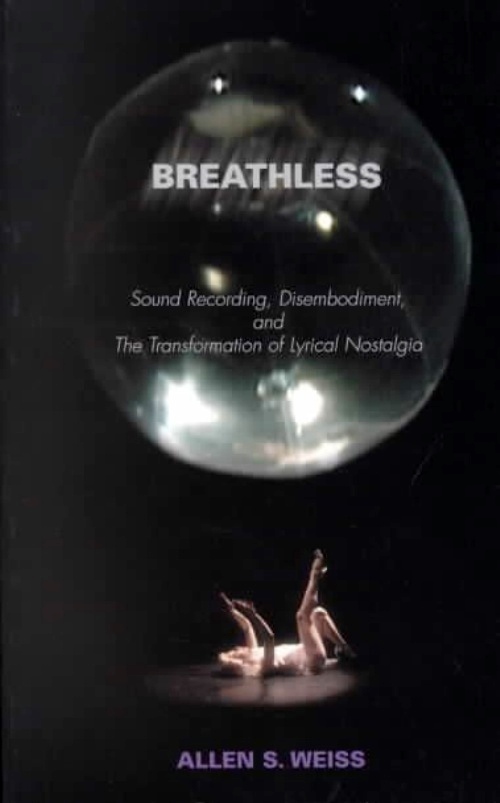
breathless: sound recording, disembodiment, and the transformation of lyrical nostalgia – allen s. weiss

How sound recording’s uncanny confluence of human and machine would transform our expectations of mourning and melancholia, transfiguring our intimate relation to death.

Currently sitting with this book in my reading queue… i.e. trying to wait until I have read the stuff I need to prioritise before diving into it, but having peeped the PDF I’m struggling to!

Breathless explores early sound recording and the literature that both foreshadowed its invention and was contemporaneous with its early years, revealing the broad influence of this new technology at the very origins of Modernism. Through close readings of works by Edgar Allan Poe, Stéphane Mallarmé, Charles Cros, Paul Valéry, Villiers de L’Isle-Adam, Jules Verne, and Antonin Artaud, Allen S. Weiss shows how sound recording’s uncanny confluence of human and machine would transform our expectations of mourning and melancholia, transfiguring our intimate relation to death. Interdisciplinary, the book bridges poetry and literature, theology and metaphysics. As Breathless shows, the symbolic and practical roles of poetry and technology were transformed as new forms of nostalgia and eroticism arose.

breathless

“By suggesting that sound recording changes the very notion of textuality at a key inflection point in Modernism, Weiss literally turns the field of cultural studies on its ear.” (Gregory Whitehead, co-editor of Wireless Imagination: Sound, Radio and the Avant-Garde)

“The extremely important, cogent analysis adds immeasurably to our knowledge of cultural production in the critical years between early modern lyric and our own post-modern, post-lyric age.” (Lawrence R. Schehr, Professor of French, University of Illinois)

the atemporality of “ruin porn”: the carcass & the ghost by sarah wanenchak

Max Liboiron's avatarDiscard Studies

*This post originally appeared on Cyborgology.

Photo by Matthew Christopher. www.abandonedamerica.usPhoto by Matthew Christopher.

Objects have lives. They are witness to things.
–This American Life, “The House on Loon Lake”

Atlantic Cities’ feature on the psychology of “ruin porn” is worth a look–in part because it’s interesting in itself, in part because it features some wonderful images, and in part because it has a great deal to do with both a piece I posted previously on Michael Chrisman’s photograph of a year and with the essay that piece referenced, Nathan Jurgenson’s take on the phenomenon of faux-vintage photography.

All of these pieces are, to a greater or lesser extent, oriented around a singular idea: atemporality – that the intermeshing and interweaving of the physical and digital causes us not only to experience both of those categories differently, but to perceive time itself differently; that for most of us, time is no longer a…

View original post 3,142 more words

simone weil – chance

simone weil gravity and graceThe beings I love are creatures. They were born by chance. My meeting with them was also by chance. They will die. What they think, do and say is limited and is a mixture of good and evil.
I have to know this with all my soul and not love them the less.
I have to imitate God who infinitely loves finite things in that they are finite things.

We want everything which has a value to be eternal. Now everything which has a value is the product of a meeting, lasts throughout this meeting and ceases when those things which met are separated. That is the central idea of Buddhism (the thought of Heraclitus). It leads straight to God.

Meditation on chance which led to the meeting of my father and mother is even more salutary than meditation on death.
Is there a single thing in me of which the origin is not to be found in that meeting? Only God. And yet again, my thought of God had its origin in that meeting.

Stars and blossoming fruit-trees: utter permanence and extreme fragility give an equal sense of eternity.

The theories about progress and the ‘genius which always pierces through’, arise from the fact that it is intolerable to suppose that what is most precious in the world should be given over to chance. It is because it is intolerable that it ought to be contemplated.
Creation is this very thing.
The only good which is not subject to chance is that which is outside the world.

The vulnerability of precious things is beautiful because vulnerability is a mark of existence.

The destruction of Troy. The fall of the petals from fruit trees in blossom. To know that what is most precious is not rooted in existence—that is beautiful. Why? It projects the soul beyond time.
The woman who wishes for a child white as snow and red as blood gets it, but she dies and the child is given over to a stepmother.

__
Excerpted from Simone Weil‘s Gravity and Grace. First French edition 1947. Translated by Emma Crawford. English language edition 1963. Routledge and Kegan Paul, London.

edge of wrong festival – 10th anniversary this month

As part of the Edge of Wrong organising team, I’d like to invite you to join us for our tenth annual music festival, happening in Cape Town on the 22nd and 23rd of April (with a mini edition in Johannesburg on 15th April) and featuring an array of international and local artists presenting a wide range of experimental, uncompromising and dangerous music.edge of wrong 2016

In celebration of our first ten years of existence, during which time we have hosted more than 30 cutting-edge events, we’ve compiled an extra-eclectic line-up of South African and Norwegian musicians, including Daniel MacKenzie, Gunfire Orchestra (Reza Khota, Beat Keller and Morten Minothi Kristiansen), Arnfinn Killingtveit, Kenneth Angerhand and Amantha, Ad undas, Mark Fransman, Darren English, Brendon Bussy, Justin Allart and Hezron Chetty.

Expect everything from feedback guitar and malfunctioning drum machines to improv violin, dance-controlled piano and walls of screeching noise from hand-built instruments.

▀▀▀▀▀▀▀▀▀▀▀▀▀▀▀▀▀▀▀▀▀▀▀▀▀▀

__VENUES, LINE-UPS, COST, ETC.:

*** FRIDAY 22nd ***
Atlantic House
1 Perth Rd, Maitland, CT
http://www.atlantichouse.co/
Doors open at 7pm, music starts at 8pm
Pay what you can – recommended contribution R50-R100

PERFORMING:
∞ Brendon Bussy (SA)
∞ Daniel W J Mackenzie (UK)
∞ Ad undas (NO)
∞ Kenneth Angerhand with Amantha23 (KI)
∞ Arnfinn Killingtveit (NO)

*** SATURDAY 23rd ***
Moholo Live House
42 Ncumo Rd, Harare Square, Harare, Khayelitsha, CT
Doors open at 7pm, music starts at 8pm
Pay what you can – recommended contribution R50-R100
https://www.facebook.com/MoholoLiveHouse

PERFORMING:
∞ Gunfire Orchestra (NO/SA)
∞ HORNS NOISE (NO/SA)
∞ Swamps up Nostrils (NO/SA)
∞ Hezron Chetty (SA)

*** SUNDAY 24th ***
Music Hacker Lab – details to be confirmed!

GENERAL INFO: Right of admission reserved. Drinks will be available for purchase at the venues. Cellphones to be switched off during performances.

Performing in Johannesburg on the 15th are:

* Gunfire Orchestra (Reza Khota, Beat Keller and Morten Minothi Kristiansen) (https://gunfireorchestra.bandcamp.com/) (NO/SA)
* Kenneth Angerhand (www.further.co.za/asqus) (KI)
* Jill Richards (www.jillrichards.com) (SA)
* Carlo Mombelli (www.carlomombelli.com) (SA)
* Daniel MacKenzie (www.danielwjmackenzie.com) (UK)

andre breton – nadja (1928)

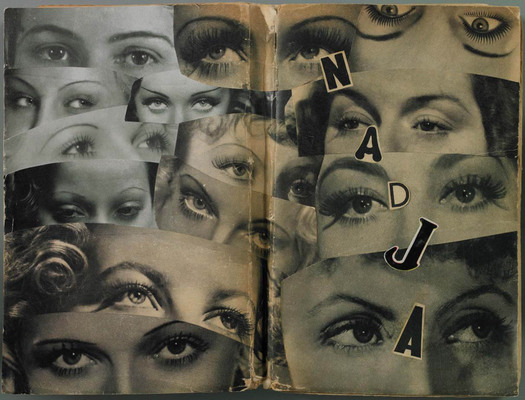
Cover of the 1928 Gallimard edition of Nadja, collaged over by Marcel Mariën, 1938.

Cover of the 1928 Gallimard edition of Nadja, collaged over by Marcel Mariën, 1938.

The narrator, named André, ruminates on a number of Surrealist principles, before ultimately commencing (around a third of the way through the novel) on a narrative account, generally linear, of his brief ten day affair with the titular character Nadja. She is so named “because in Russian it’s the beginning of the word hope, and because it’s only the beginning,” but her name might also evoke the Spanish “Nadie,” which means “No one.” The narrator becomes obsessed with this woman with whom he, upon a chance encounter while walking through the street, strikes up conversation immediately. He becomes reliant on daily rendezvous, occasionally culminating in romance (a kiss here and there).

His true fascination with Nadja, however, is her vision of the world, which is often provoked through a discussion of the work of a number of Surrealist artists, including himself. While her understanding of existence subverts the rigidly authoritarian quotidian, it is later discovered that she is mad and belongs in a sanitarium. After Nadja reveals too many details of her past life, she in a sense becomes demystified, and the narrator realises that he cannot continue their relationship.

In the remaining quarter of the text, André distances himself from her corporeal form and descends into a meandering rumination on her absence, so much so that one wonders if her absence offers him greater inspiration than does her presence. It is, after all, the reification and materialisation of Nadja as an ordinary person that André ultimately despises and cannot tolerate to the point of inducing tears.

There is something about the closeness once felt between the narrator and Nadja that indicated a depth beyond the limits of conscious rationality, waking logic, and sane operations of the everyday. There is something essentially “mysterious, improbable, unique, bewildering” about her; this reinforces the notion that their propinquity serves only to remind André of Nadja’s impenetrability.

Her eventual recession into absence is the fundamental concern of this text, an absence that permits Nadja to live freely in André’s conscious and unconscious, seemingly unbridled, maintaining her paradoxical role as both present and absent. With Nadja’s past fixed within his own memory and consciousness, the narrator is awakened to the impenetrability of reality and perceives a particularly ghostly residue peeking from under its thin veil. Thus, he might better put into practice his theory of Surrealism, predicated on the dreaminess of the experience of reality within reality itself.

Read the book here: Andre Breton – Nadja.