This fragment was filmed by Dick Jewell during the rehearsals for the recordings of Madala Kunene’s album Kon’ko Man in Johannesburg, 1995.
This fragment was filmed by Dick Jewell during the rehearsals for the recordings of Madala Kunene’s album Kon’ko Man in Johannesburg, 1995.
Released on Rough Trade in 1981, Deceit is a dark, intense post-punk classic. Band member Charles Hayward said of the zeitgeist that shaped the album:
“The whole speak, ‘Little Boy’, ‘Big Boy’, calling missiles cute little names. The whole period was mad! We had a firm belief that we were going to die and the record was made on those terms.… The whole thing was designed to express this sort of fear, angst, which the group was all about, really… Some of the album was really plush sounding, some dim and pokey. Sometimes it would sound like the machinery was breaking up. We deliberately would make it sound as though the record player was exploding.”
Read more about this brilliant album at DROWNED IN SOUND.
Track List
Sleep 0:00
Paper Hats 2:14
Triumph 8:17
S.P.Q.R. 11:12
Cenotaph 14:41
Shrink Wrap 19:20
Radio Prague 21:01
Makeshift Swahili 23:23
Independence 27:27
A New Kind Of Water 31:09
Hi Baku Shyo 36:06
__________________________________
Charles Hayward — Vocals, Bass Guitar, Keyboards, Drums, Tape Music
Gareth Williams — Vocals, Bass Guitar, Keyboards, Tape Music
Charles Bullen — Vocals, Clarinet, Guitar, Drums, Tape Music
David Cunningham — Production
Martin Frederick — Mixing
Laurie-Rae Chamberlain — Colour Xerography
Nicholas Goodall — Sleeve Photography Direction
Studio 54 — Sleeve Design
“Oy, to ne vecher” (Ой, то не вечер) is the incipit of a Russian folk song, also known as “The Cossack’s Parable” (Казачья Притча) or as “Stepan Razin’s Dream” (Сон Степана Разина). It was first published by composer Alexandra Zheleznova-Armfelt (1870–1933) in her collection Songs of the Ural Cossacks after her fieldwork in the Ural District during 1896–1897.
The original lyrics were in seven verses, with verse six making explicit that the dreamer is 17th century cossack rebel Stepan Razin. Razin has a dream, and his captain (esaul) interprets it as an omen of their defeat.
The song has been performed in several variants, sometimes expanded to up to eleven verses, but in the most common variant as sung by modern interpreters, it is reduced to four verses, removing the mention of Razin, and reducing the three omens in the dream to a single one.These lyrics may be translated thus:
Ah, it is not yet evening but I have taken a little nap, and a dream came to me. In the dream that came to me, it was as if my raven-black horse was playing about, dancing about, frisky beneath me. Ah, and evil winds came flying out of the east, and they ripped the black cap from that wild head of mine.
And the esaul* was a clever one, he was able to interpret my dream: “Ah, it will surely come off”, he said, “that wild head of yours”.
Source of information: Wikipedia.
*Esaul: a post and rank in prerevolutionary Russia in the cossack hosts after 1576.

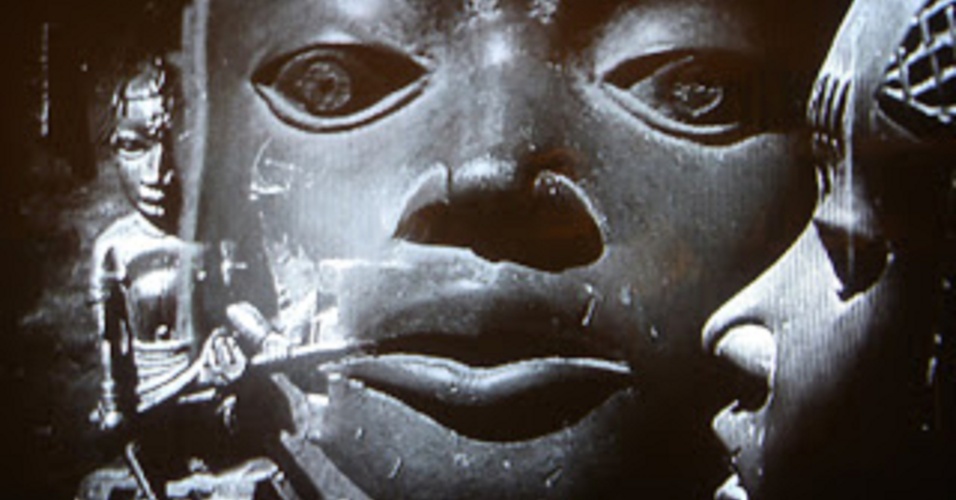
Photo: Chris Marker, “Staring Back”
“We want to see their suffering, serenity, humour, even though we don’t know anything about them.”
Directors: Alain Resnais & Chris Marker
Narrator – Jean Négroni
Music – Guy Bernard
A collaborative work by Resnais and Marker, this is a deeply felt study of African art and the decline it underwent as a result of its contact with Western civilization. The film was banned for more than a decade by French censors as an attack on French colonialism, and is now only available to watch in the shortened version I’ve posted here (turn on the subtitles on Youtube if you want English subtitling).
Statues Also Die traces the devastating impact of French colonialism on African art. As Resnais’ co-director, Chris Marker, stated, “We want to see their suffering, serenity, humor, even though we don’t know anything about them.” Their film shows what happens when art loses its connection to its cultural context of production. Witty, thoughtful commentary is combined with images of stark formal beauty in this outcry against the fate of an art once integral to communal life that became debased as it fell victim to the demands of a different system of knowledge and values.
From Wikipedia:
Statues Also Die (French: Les Statues meurent aussi) is a 1953 French essay film directed by Chris Marker and Alain Resnais, about historical African art and the effects colonialism has had on how it is perceived. The film won the 1954 Prix Jean Vigo. Because of its criticism of colonialism, the second half of the film was censored in France until the 1960s.
Synopsis
The film exhibits a series of sculptures, masks and other traditional art from Sub-Saharan Africa. The images are frequently set to music and cut to the music’s pace. The narrator focuses on the emotional qualities of the objects, and discusses the perception of African sculptures from a historical and contemporary European perspective. Only occasionally does the film provide the geographical origin, time period or other contextual information about the objects. The idea of a dead statue is explained as a statue which has lost its original significance and become reduced to a museum object, similarly to a dead person who can be found in history books. Interweaved with the objects are a few scenes of Africans performing traditional music and dances, as well as the death of a disemboweled gorilla.
During the last third of the film, the modern commercialisation of African culture is problematised. The film argues that colonial presence has compelled African art to lose much of its idiosyncratic expression, in order to appeal to Western consumers. A mention is made of how African currencies previously had been replaced by European. In the final segment, the film comments on the position of black Africans themselves in contemporary Europe and North America. Footage is seen from a Harlem Globetrotters basketball show, of the boxer Sugar Ray Robinson, and a jazz drummer intercut with scenes from a confrontation between police and labour demonstrators. Lastly the narrator argues that we should regard African and European art history as one inseparable human culture.
“The birds are chirping, to and fro
My love, have you forgotten me?
As water can’t cut through the sand
I can’t cut you from my memories
The bridge (between you and I) has broken
The pathway is gone, and the water is so very deep
How am I to find you on the other side, so far away?”
Chhoun Vanna was a Cambodian singer between the 1950s and ’70s. She and her sister Chhoun Malai survived the Khmer Rouge genocide.
Cambodian cover by Ros Sereysothea and Sinn Sisamouth of Creedence Clearwater Revival’s “Who’ll Stop The Rain?”. They died under unknown circumstances during the Khmer Rouge reign of terror, as did countless other artists and intellectuals murdered in Pol Pot’s Killing Fields, and this recording only survived on tapes smuggled out of the country.
“Long as I remember the rain been comin’ down.
Clouds of mystery pourin’ confusion on the ground.
Good men through the ages, tryin’ to find the sun;
And I wonder, still I wonder, who’ll stop the rain.”
Read more of their story HERE.
I hardly ever put on a cd or listen to an LP these days (last is prolly due to the fact,that I killed my speakers/amplifier). In fact i am totally addicted to the net when it comes to music. I also am an avid KCRW listener. I often tune in to Henry Rollins’s radio show on KCRW. Henry does all the searching, comes up with all the cool tunes from every genre all over the place and all I have to do is listen. It was due to his radio show that i started listening to Sinn Sisamouth. This led me to Ros Sereysothea. I am 100% fascinated with her singing and music.
For the last days, I keep playing over and over this on Spotify:’ ‘Dengue Fever Presents Electric Cambodia”. Sounds amazing,and wished that i could understand the language. All performers on this compilation are dead,or ”vanished”. Killed/died during the communist Khmer Rouge regime.
”Electric Cambodia may be one of the saddest and most enraging compilations released this year—not for the music, but for the history. The performers are dead, all dead, or “vanished” into the Killing Fields—murdered, presumably, although the how is a mystery. Did they die quickly or slowly? ” – read more of this review HERE.
Ros Sereysothea – Shave your Beard
 To research (English definition): “To search for something.”
Rechercher (French definition): “To search for, to look for” and also “to search again, to look for again”.
Both “search” and “research” are the same word in French, it seems. This makes sense: even if something was once common knowledge, after it is hidden it is no longer “there”; it has fallen from awareness. So you have to seek for it again, that which is not there. In “research”, you never know what is actually there until you find it, or there would be no need to look. You dis-cover it again, un-cover it anew.
Archives are fascinating places of preservation-with-intent to look in, and they are always tantalisingly incomplete, however exhaustive… But nothing beats the thrill of finding a treasure hoard saved by happenstance.
To “ondersoek” , in Afrikaans, is to look under other things… The term implies a palimpsestic patina, an accretion, a build-up of layers that must be lifted, peeled off to see underneath… the mother lode, the genealogy. Sometimes you know exactly what you are looking for; sometimes you don’t. You may only have a misty hope that there is anything there at all. It can be useful to lose focus, too, because you become open to other routes, other offshoots, that may take you further than your original hunch.
On Saturday, in a poky little shop in Kalk Bay, I found a trove of old sheet music: popular tunes from the 1920s and 1930s, the top few layers of it in torn, grubby disarray. A thrill ran through my fingertips as I started re-moving each sheet from the pile, putting it aside systematically. There was nothing of great interest until I got quite a way below the dusty surface layers, where most people’s patience obviously runs out (this is the trick with digging – to delve deeper, to expend more energy, more time than everyone else – om onder te soek, for there lies the gold). There was no way I could stop.
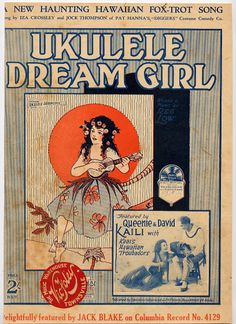
Buried in the pile, under piano exercise books, I found something that really astounded me… it almost made me shout for joy: many, many of the scores had ukulele chord diagrams on them! In all the popular sheet music I had ever been acquainted with before this, these diagrams were provided for guitar – with five lines for the five strings. These all had only four lines. It became clear to me on seeing this that, along with piano, ukulele was most likely the popular amateur instrument of choice back in the 1920s to 1940s, and not guitar. It makes sense when you listen to the jazziness of the pop arrangements of the time, and how well the chord progressions work technically with a ukulele’s tuning – GCEA. I would suppose that the guitar ousted the uke in popularity with the ascent of blues and rock and folk, in which different chords and tunings predominate, and for which the guitar’s EADGBE tuning is a more natural fit… How lovely to realise that this instrument I play very amateurishly, considered a funny curiosity by most these days, was accorded far more value in the past!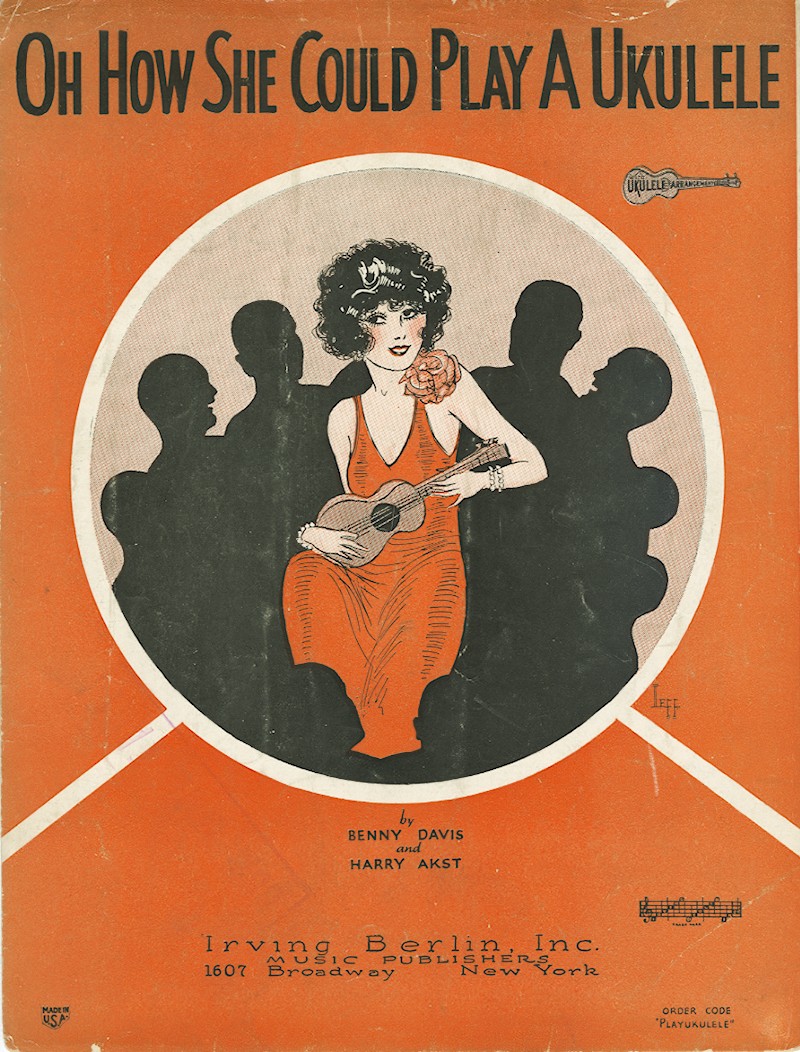
What this little discovery means for me, practically, is that I can now play all these very old jazzy tunes with no in-depth knowledge of musical theory. Even the songs I have never heard before can be found with a bit of effort on the internet, listened to, and re-played, provided someone else along the way has seen their value. As long as they were ever recorded, be it on wax cylinder or 78rpm, they may have been digitised. And, as they spin up on my hard drive, a vortex is created, opening a wormhole back to the instant that band played for the first time as the cylinder turned. And the song comes back from the dead as my fingers form the chord shapes, stutters back to life as I sing my breath into the words. Technology is powerful magic, all the more so when it takes account of its historicity.
Information technology is not only about making the future more slick and manageable; it is also about keeping the past accessible… Essentially it is about conquering linear time and space. The prolific recording of moments allows us to live unconstrained by the present moment and space we’re in, almost continuously if we so wish… (For example, people sit on Facebook as they are out for coffee with a friend. Once they have “checked in” at the cafe, they check out what other people are doing elsewhere on their phones, then frame themselves carefully for a photo in that space and capture the moment, uploading it to join the feed for others who are moving through spaces connected via radio waves to know about. Very little other than eating, drinking and self-referential preening is going on in most coffee spots.)
The sheer volume of recording that goes on now is unprecedented. Imagine reading Twitter logs in a century – every ordinary so-and-so with a Twitter account, with their own account of an event… The hyper(in)significance of every moment of our lives being documented is overwhelming to think about. How will historians of the future ever manage to filter out the noise from the signal and deduce anything?
Or, will the noise be the signal – the fragments the whole? How does this affect our memories, our critical faculties, our creativity, our relationships? New technologies confer on us immense power that should be used wisely and with sober discernment, not trivially… as that dumb what’s-her-face model Leandra found out last week when tweeting 140 racially offensive characters cost her her modelling career and dignity, with satisfying, devastating swiftness!
So, anyway, I pulled out a large wad of music sheets; slowly, carefully replaced what I didn’t take for someone else to find. Tried to conceal my excitement as I got to the till; thwacked the pile down and asked nonchalantly, “How much for this old stuff?”
“Two rand a sheet.” After counting to fifteen the old guy stopped and said “I can’t be bothered to count higher than fifteen – it’s yours for thirty bucks.”
I paid thirty rand for all of it. That’s less than a cocktail or a sandwich in the seaside cafes lining that road. So few people seem to see value in this stuff. Not even antique dealers. To them it’s just quaint ephemera.
Research involves following the intuition, the hunch that something lies hidden out of time, out of sight, out of mind: perhaps recorded imperfectly, decaying, deliberately saved. Or, like these priceless music sheets, just debris left in a place where it makes no sense to anyone who has stumbled across it yet… In danger of being lost forever if someone doesn’t come along with enough focused curiosity to re-cognise it as valuable, to think it back into meaningful connection with right now.
To me, the serendipity of finds like Saturday’s feels more than coincidental. If the person looking didn’t happen to be me there at that precise moment, it would probably have been a non-event. Even if it were the me of last year leafing through, I wouldn’t have known what I was looking for. Would have seen the music but not had a ukulele and maybe not noticed that the chord diagrams had only four strings, not five. The me of just a few months back would have seen the music with interest but not known the extent of the 78rpm archive online (having become aware of the degree of coverage of obscure songs through something I have been working on in the past month) and so left it because I didn’t know the songs and didn’t know there was a way to hear them. I don’t often look through second hand stores these days, broke as I am. On Saturday, something compelled me to step inside as I was passing. It felt as if me and the music were drawn together. It felt magical.
Chinese New Year today reminded me of this line, from Suede’s 1994 non-album single, Stay Together. I have the cassette single of this track in a box somewhere. Released on Nude Records, it was the last song put out by the band in its original line-up before Bernard Butler left (and I lost interest, because that alchemy that tends to arise out of creative friction in bands was gone). I must say that the video, which I saw for the first time now — we very rarely got to see “alternative” music videos on South African TV back then — is pretty crap compared to other Suede videos I have seen. Anyway. Here’s to the Year of the Horse being a vast improvement on the Year of the Snake just past.
Legendary American folk artist Pete Seeger has died at the age of 94. Here’s the New York Times’ eulogy, and one from the Huffington Post.
“Turn, Turn, Turn” is based on verses paraphrased from Ecclesiastes 3 in the Bible, widely believed to have been written by King Solomon around 1000 BCE. Pete Seeger put music to the words in 1959, recording his own version in 1962.
Miss Zingel, our sweet, slightly hippy music teacher at primary school during the last throes of 1980s apartheid, introduced us to this much-covered song, as well as to another of my favourites by Seeger/Malvina Reynolds, “Little Boxes”, which was released on CBS in 1963:
From one of my favourite albums of the last decade, Transfiguration of Vincent, released in 2003 (in fact, that’s more than a decade ago now, wow!). The title alludes to John Fahey’s 1965 album,The Transfiguration of Blind Joe Death, and also refers to the life and death of Vincent O’Brien, a close friend of Ward’s. Here’s a moving and informative interview with Ward from around the time of the album’s release.

Yesterday January 8 (a day too late), it was the birthday of Mr Bowie and also of Elvis (RIP).
Ross Campbell wrote this heartfelt song for our extraordinary, mercurial friend, the visionary artist and musician Alex van Heerden, who was killed five years ago this morning in a car accident. The hole he left will never be closed.
HERE is another tribute written by Righard Kapp at the time of Alex’s passing.
And here is Alex talking with his singular insight at a workshop on Cape music held in Basel in 2006:
For Rosemary Lombard (and Paul Simon)
This girl and this man sing together.
They are sitting on these steps,
which for them, which for me,
must also in some way be a stage,
scrim set and defined by a door shut behind
the camera’s squint squiz,
the gap between her space and his
grouted and flat,
locked like a spine snapped
between wings.
Complicating the exit.
It is early in the morning.
He has been asked to come and play music for,
no, with children. On television. On these stairs
which lead to the sort of porch (I write stoop)
that he has lately been avoiding.
But today he hovers near it, near her,
and says, and stops himself from saying,
that it was a brownstone (in my tongue,
a town house) like this where he’d first met his wife,
who tipped into him as stiff and iceless
as the drink he couldn’t buy her then.
He thought she would open up
as if an elevator in the building of conversation,
a device he could ride from across to sides
without ever having to construct a scaffold himself.
I’d say lift. He was wrong.
She divorced him a year before.
Now his problems are like his hair, parted.
He is 38.The girl is seven (or six).
They’ve asked her to come and sit,
to come and sing with him.
She says hello, ducks her head.
Small animal, small pump of blood
and possibility. She is made
of corduroy, he thinks, soft,
unmalleably furrowed. Without zip.
He can appreciate her wholeness,
he is weary of it.
He himself feels fetched,
feels stitched from thin material,
worrying at the connections.
You can see the marks of the alterations
he made, let others make, on his ancient guitar,
whose strings knot and flay where he has pulled at them.
This does not seem beautiful to him.
He won’t ever get another.
The song is about an event he refuses to explain
to the girl,
so he tries to only pronounce words like
“mamma” or “pyjama”,
leaving them placed sweet,
as if icing on a cake,
praying “Let her life lick past it”,
when, suddenly, she yells,
“Dance! Dance! Dance!”
The man is concerned, he interrupts her,
but she tries again, when the lenses turn,
this time pointing at him while humming,
“Look! I can see the bird!”
Two decades later, a friend will post this
link to my Facebook wall.
And I’ll think, “She wasn’t wrong at all!”
And I’ll think, “I’m nothing like you.”
—
This poem was first published on AERODROME. Thank you, Gen, for permission to post it on Fleurmach (and obviously for writing it! xx).
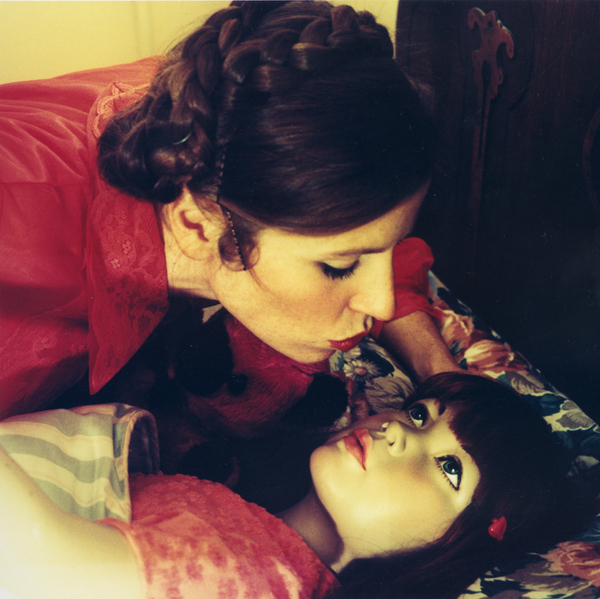
“A personal photography experience for public consumption.”
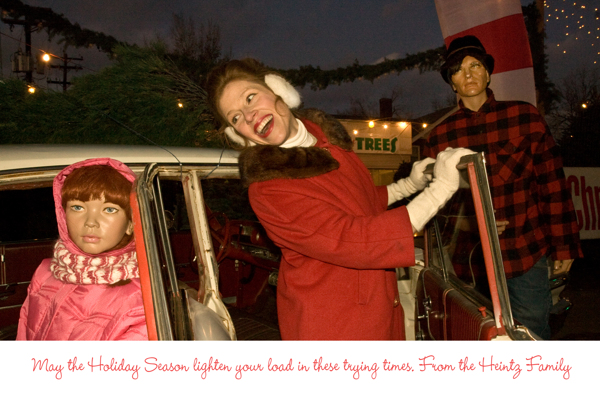
Suzanne Heintz calls herself “the modern day patron saint of single women”. She has the following to say about her ongoing photography project, the wondrously uncanny “Life Once Removed”:
What would drive you to pack a family of mannequins into your station wagon, and take them on a road trip? Enough pressure to conform will send anyone packing. That’s how I came to this personal project about what is essentially…Spinsterhood, and the American Way.
Well-meaning strangers, along with friends and family, would raise an eyebrow when the topic of my unmarried and childless status arose. Indicating with a small facial twitch, not only my audacious freakishness, but that I was a little old for such foolish thinking. I mean, come on, eggs don’t last forever!
But really, what was I supposed to do? You can’t just go out and buy a family. Or can you? I did. They are mannequins. The candy coated shell with nothing inside. We do all those family things, all the while capturing those Kodak Moments. Because it’s not really about the journey, or a genuine human connection, when your kids are screaming, “are we there yet?”, is it? It’s about the picture in front of the sign. “Get back in the car, we got the picture. Now, let’s go eat.”
We love and obey the formatted image of a well-lived life. So deeply ingrained is that strange auto-grin we put on when a camera is present. Do we live our lives with a keen awareness of how it feels, or just how it looks?
If I pass through life without checking off the boxes for a wedding ring and a baby carriage, I will be missing the photo album, but not not the point. When I take my photos, others stop and stare, then they ask, “why are you doing this?” They, at that moment, are starting to get the point too.
Check out more of Suzanne’s fantastical images HERE.

LABEL: ALGA MARGHEN (ITALY)
CATALOG #: ALGA 046LP
RELEASE DATE: 21 JANUARY 2014
Sounds of Silence is an anthology of some of the most intriguing silent tracks in recording history and includes rare works, among others, by Andy Warhol, John Lennon, Maurice Lemaitre, Sly & The Family Stone, Robert Wyatt, John Denver, Whitehouse, Orbital, Crass, Ciccone Youth, Afrika Bambaataa and of course, Yves Klein.
In their own quiet way, these silences speak volumes: they are performative, political, critical, abstract, poetic, cynical, technical, absurd. They can be intended as a memorial or a joke, a special offer, or something entirely undefined. The carefully-chosen silences of this anthology are intrinsically linked to the medium of reproduction itself and reveal its nude materiality. They expose their medium in all its facets and imperfections, including the effect of time and wear. At the most basic level, these silences are surfaces. And it is in their materiality that they distinguish themselves from the conceptual experiments of John Cage with “4’33”.
Since the 1950s, silence has found a place in the economic structure of the record industry and since then it would increasingly be appropriated by a vast array of artists in a vast array of contexts. Indeed, the silent tracks seem to know no boundaries. The LP presents the silences as they were originally recorded, preserving any imperfection that the hardware conferred upon the enterprise, without banning the possibility of being satisfying to the ear. The liner notes provide historical background for each track, revealing the stated (or presumed) motivations for these silences, while providing novel sound correspondences or interferences.
This album is meant to be played loud (or not), at any time, in any place: a true aural experience. Only 250 copies available for distribution, in a gatefold iconic sleeve. ORDER THE LP HERE.
“Summer is ready when you are.” Off the Breeders’ Last Splash album from 1993, on 4AD. HERE’s a review of the album, 20 years on.
I was reminded of this loopy video by the crazy Google weather app on my phone . It’s telling me the temperature right now is 18 degrees Celsius, with “light snow showers”. It is not snowing, nor has it ever snowed in this place, even in the dead of winter. It is unseasonally chilly and cloudy most of the time in KZN. Summer, I’m ready when you are. It’s mid-December, damnit.
Physically scratched out… I love the celluloid violence of this clip for Angel Olsen’s explosive new single, off her forthcoming album, Burn Your Fire for No Witness, due out in February 2014 on Jagjaguwar.
Excerpted from a thoughtful piece by Kayli Stollak, over at Hello Giggles.

Painting by Francine van Hove
Online we tell a golden version of our lives filled with accomplishments, strictly (and often unbelievably) fun times, and a never-ending well of wit. The glorified digital narrative that we construct of our lives worries me like a 1950’s housewife watching Elvis wiggle his hips on TV. Our modern-day record keeping seems wildly inaccurate to the truth of our inner lives. What is happening in our too-much-information-nation? But more importantly, what is happening with us? Behind all the selfies and sandwich shots, who are we?
In order to correct the imbalance of truth, I propose we start writing it down. We share so much of ourselves with the web, but do we take enough time accounting for our private lives in realm that is removed from the world of likes, comments and followers? The idea of keeping a journal is nothing new, but we’re living in a time where we could benefit from taking a personal inventory of who we are, lest we deceive our future selves through our revisionist digital autobiographies.
While our faces are buried in our phones, we risk missing the smaller details in life. If we don’t remember the bad, how can we possibly enjoy the good to the highest degree? With time, I’m concerned we’ll look back at our Facebook timelines and mistake the façade that we presented of ourselves as fact for who we actually were.
As a writer who spends a large (and probably unhealthy) amount of time writing about herself, I often hear the condemnation of navel gazing. Sure, it is narcissistic to think your life is exciting enough to put to paper, but is it really more self-centered than a side-angled pouty pose of you enjoying your fun-filled Saturday night in the club, posted to Instagram with hopes of garnering likes from your followers, confirming that, yes, you are hot? I would venture to say that the former is self-reflective and productive, while the latter is vapidity and belly-button eagle eye-ing at its worst.
I’m not recommending you go all “dear diary” and start documenting your daily rhythms by laboriously chronicling what you ate for breakfast, the jerk who cut you off on the freeway, or what your plans are for the weekend—if that works for you, do it, but there’s no need to pen a three volume memoir. What I’m championing is the process of jotting down your feelings, thoughts, conversations, inspirations, events that meant something to you now that you might benefit from reflecting on in the future. This is a dose of honesty for you today, in five months, in ten years, at 97. To look back on after your next break up, when you’re contemplating marriage, on your graduation, before a big interview, or simply on a rainy day.
Your notebook should be far from the manicured image you pimp out on Instagram, Facebook, OKCupid, etc. In Joan Didion’s 1966 essay “On Keeping a Notebook”, written before our over-stimulated minds were flooded with technology and its never-ending distractions, she explained, “We are not talking here about the kind of notebook that is patently for public consumption, a structural conceit for binding together a series of graceful pensées, we are talking about something private, about bits of the mind’s string too short to use, an indiscriminate and erratic assemblage with meaning only for its maker.”
For me, a piece of ‘mind string’ is the harmonica chords to ‘Piano Man’ scribbled in my notebook from 2008. A stranger might assume a bizarre Billy Joel fixation, but when I revisit them in my journal, the mess of notes and the triggered sound insist on memories of a motorcycle trip through Spain and feelings of maddening love. All you need is sentence, a word, a thought, and suddenly you remember who you actually were.
If I skip forward in my notebook to 2009 I stumble upon a string of doubts, the point where this love began to unravel. The same way the smell of sunscreen can instantly bring back memories of summer, a list labeled “Pros and Cons” reminds me of the creeping anxiety I felt for planning my future. My Facebook timeline, however, tells a different tale of a giddy girl with bangs who enjoys raves, beaches, and doing the limbo.
Didion advocated for the importance of preserving a part of yourself that in time you can return to. She wrote, “It all comes back. Perhaps it is difficult to see the value in having one’s self back in that kind of mood, but I do see it; I think we are well advised to keep on nodding terms with the people we used to be, whether we find them attractive company or not… We forget all too soon the things we thought we could never forget. We forget the loves and the betrayals alike, forget what we whispered and what screamed, forget who we were.”
Notebooks are fantastic tools for keeping in touch with our former selves that go far beyond the sculpted image we present on the web. I love delving back into my journals from middle school to the present, not because I’m a fan of the person I see there, but rather because I understand the benefit of knowing her.
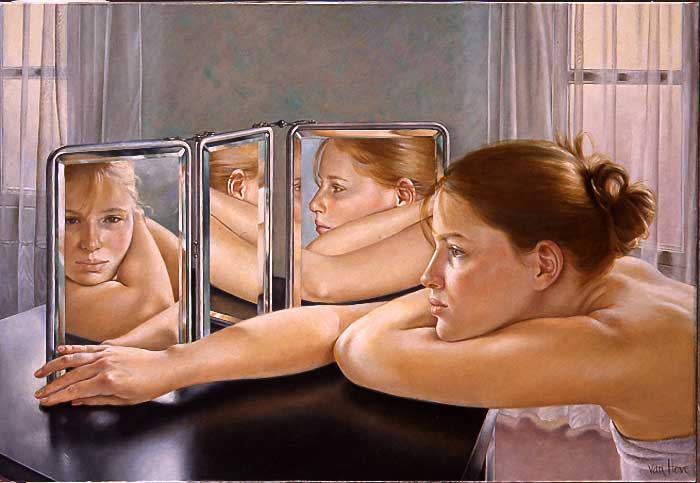
Painting by Francine van Hove
I want to yell at my thirteen year-old self to please take off that padded bra andstop being in such a rush to grow up. I want to hold my fourteen year-old self and explain to her that you are the company you keep and the sooner she starts loving herself the better. I want to bitch slap my sixteen year-old self, she was one angsty girl. I want to tell my seventeen year-old self not to mistake lust for love and to please stop talking to that boy in the band that told you he learned how to play “Brown-Eyed Girl” for you when, in fact, your eyes are green. I want to stay up all night talking to my twenty year-old self, feeding off her energy and drinking up her thirst for spontaneity. I want to see the world through her eyes, she reminds me to believe in magic. I want to whisper in the ear of my twenty-three year-old self, and tell her that soon enough she will see that it really was a means to an end. I want to tell my twenty-five year old self to trust her gut and not settle, I want to remind her what love looks like and tell her that this is not it. But I can’t tell her any of that. All I can do is learn from her mistakes, be reminded of what to hold meaning to, take note of her intuition, celebrate the coincidences, and enjoy all the beautiful moments and connections made.
Although I already know how most of the stories end, it’s important to track the progress I’ve made, reminding me who I am and who I was. To draw my own attention to the larger patterns my tendencies and predilections make when I can see them from a bird’s eye view. A notebook can serve as a wake up call on what I may be rightly or wrongly romanticizing and what I may be purposefully forgetting. Notebooks give us a shot at staying honest and in touch with ourselves, something I think we should strive to be in this digital age.
Read the full article HERE. Thanks to Stella for sharing it.

Photo: Adrian Steirn, 2011
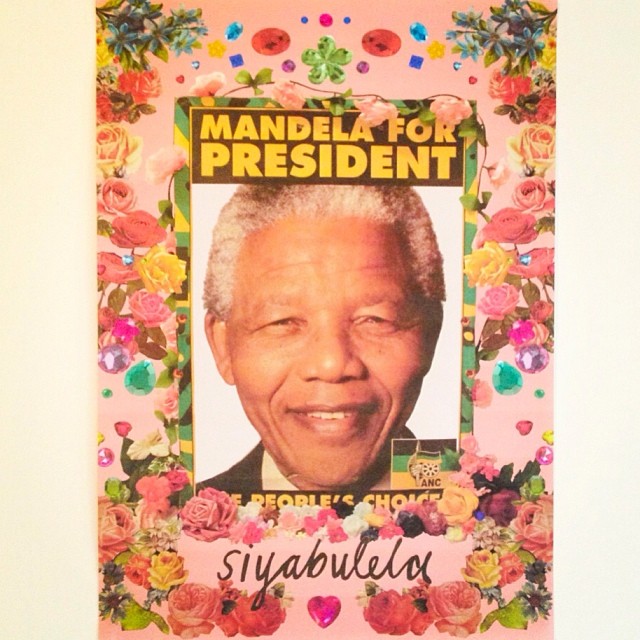
Some links and excerpts from commentary that I have found to be worth reading today (I’ll add to this whenever I come across anything interesting – if anyone reading this has suggestions, please pass them on too):
From “The Contradictions of Mandela” – Zakes Mda in the New York Times opinion pages:
The claim is that the settlement reached between the A.N.C. and the white apartheid government was a fraud perpetrated on the black people, who have yet to get back the land stolen by whites during colonialism. Mandela’s government, critics say, focused on the cosmetics of reconciliation, while nothing materially changed in the lives of a majority of South Africans.
This movement, though not representative of the majority of black South Africans who still adore Mandela and his A.N.C., is gaining momentum, especially on university campuses.
I understand the frustrations of those young South Africans and I share their disillusionment. I, however, do not share their perspective on Mandela. I saw in him a skillful politician whose policy of reconciliation saved the country from a blood bath and ushered it into a period of democracy, human rights and tolerance. I admired him for his compassion and generosity, values that are not usually associated with politicians. I also admired him for his integrity and loyalty.
But I fear that, for Mandela, loyalty went too far. The corruption that we see today did not just suddenly erupt after his term in office; it took root during his time. He was loyal to his comrades to a fault, and was therefore blind to some of their misdeeds.
Read the rest of what Mda has to say HERE.
—
From “Mandela’s Socialist Failure” – Slavoj Zizek in the New York Times opinion pages
In South Africa, the miserable life of the poor majority broadly remains the same as under apartheid, and the rise of political and civil rights is counterbalanced by the growing insecurity, violence, and crime. The main change is that the old white ruling class is joined by the new black elite. Secondly, people remember the old African National Congress which promised not only the end of apartheid, but also more social justice, even a kind of socialism. This much more radical ANC past is gradually obliterated from our memory. No wonder that anger is growing among poor, black South Africans.
South Africa in this respect is just one version of the recurrent story of the contemporary left. A leader or party is elected with universal enthusiasm, promising a “new world” — but, then, sooner or later, they stumble upon the key dilemma: does one dare to touch the capitalist mechanisms, or does one decide to “play the game”? If one disturbs these mechanisms, one is very swiftly “punished” by market perturbations, economic chaos, and the rest. This is why it is all too simple to criticize Mandela for abandoning the socialist perspective after the end of apartheid: did he really have a choice? Was the move towards socialism a real option?
It is easy to ridicule Ayn Rand, but there is a grain of truth in the famous “hymn to money” from her novel Atlas Shrugged: “Until and unless you discover that money is the root of all good, you ask for your own destruction. When money ceases to become the means by which men deal with one another, then men become the tools of other men. Blood, whips and guns or dollars. Take your choice – there is no other.” Did Marx not say something similar in his well-known formula of how, in the universe of commodities, “relations between people assume the guise of relations among things”?
In the market economy, relations between people can appear as relations of mutually recognized freedom and equality: domination is no longer directly enacted and visible as such. What is problematic is Rand’s underlying premise: that the only choice is between direct and indirect relations of domination and exploitation, with any alternative dismissed as utopian. However, one should nonetheless bear in mind the moment of truth in Rand’s otherwise ridiculously ideological claim: the great lesson of state socialism was effectively that a direct abolishment of private property and market-regulated exchange, lacking concrete forms of social regulation of the process of production, necessarily resuscitates direct relations of servitude and domination. If we merely abolish market (inclusive of market exploitation) without replacing it with a proper form of the Communist organization of production and exchange, domination returns with a vengeance, and with it direct exploitation.
The general rule is that, when a revolt begins against an oppressive half-democratic regime, as was the case in the Middle East in 2011, it is easy to mobilize large crowds with slogans which one cannot but characterize as crowd pleasers – for democracy, against corruption, for instance. But then we gradually approach more difficult choices: when our revolt succeeds in its direct goal, we come to realize that what really bothered us (our un-freedom, humiliation, social corruption, lack of prospect of a decent life) goes on in a new guise. The ruling ideology mobilizes here its entire arsenal to prevent us from reaching this radical conclusion. They start to tell us that democratic freedom brings its own responsibility, that it comes at a price, that we are not yet mature if we expect too much from democracy. In this way, they blame us for our failure: in a free society, so we are told, we are all capitalist investing in our lives, deciding to put more into our education than into having fun if we want to succeed…
… If we want to remain faithful to Mandela’s legacy, we should forget about celebratory crocodile tears and focus on the unfulfilled promises his leadership gave rise to. We can safely surmise that, on account of his doubtless moral and political greatness, he was at the end of his life also a bitter, old man, well aware how his very political triumph and his elevation into a universal hero was the mask of a bitter defeat. His universal glory is also a sign that he really didn’t disturb the global order of power.
Read Zizek’s full post HERE.
—
From “Nelson Mandela: The Crossing” – Richard Pithouse at SACSIS
[W]e need to be very clear that we did not undo many of the injustices that honed Mandela’s anger in the 1950s…
…But as Mandela returns from myth and into history we should not, amidst the humanizing details of his life as it was actually lived, or the morass into which the ANC has sunk, forget the principles for which he stood. We should not forget the bright strength of the Idea of Nelson Mandela.
Mandela was a revolutionary who was prepared to fight and to risk prison or death for his ideals – rational and humane ideals. In this age where empty posturing on Facebook or reciting banal clichés at NGO workshops is counted as militancy, where rhetoric often floats free of any serious attempts to organise or risk real confrontation, where the human is seldom the measure of the political, we would do well to recall Mandela as a man who brought principle and action together with resolute commitment.
Mandela was also a man whose ethical choices transcended rather than mirrored those of his oppressors. Amidst the on-going debasement of our political discourse into ever more crude posturing we would do well to remember that no radicalism can be counted as adequate to its situation if it allows that situation to constrain its vision and distort its conception of the ethical.
Read the full article by Pithouse HERE.
Excavating an ancient tomb in South Korea, archaeologists found the 4-centuries-old mummy of Eung-Tae Lee, who had died at the age of 30. Lying on his chest was this letter, written by his pregnant widow and addressed to the father of their unborn child:
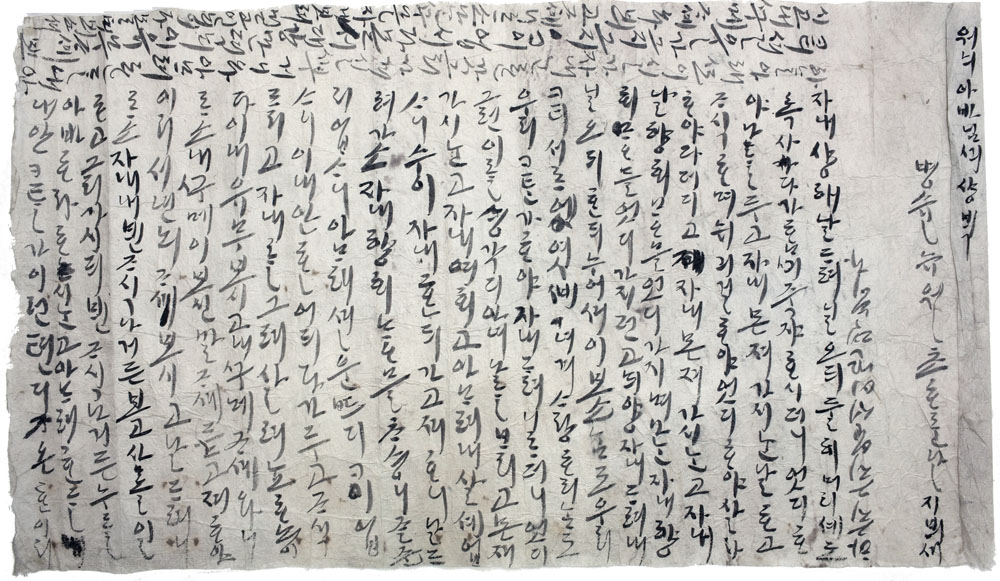
Source: Letters of Note
Transcript
To Won’s Father
June 1, 1586You always said, “Dear, let’s live together until our hair turns grey and die on the same day.” How could you pass away without me? Who should I and our little boy listen to and how should we live? How could you go ahead of me?
How did you bring your heart to me and how did I bring my heart to you? Whenever we lay down together you always told me, “Dear, do other people cherish and love each other like we do? Are they really like us?” How could you leave all that behind and go ahead of me?
I just cannot live without you. I just want to go to you. Please take me to where you are. My feelings toward you I cannot forget in this world and my sorrow knows no limit. Where would I put my heart in now and how can I live with the child missing you?
Please look at this letter and tell me in detail in my dreams. Because I want to listen to your saying in detail in my dreams I write this letter and put it in. Look closely and talk to me.
When I give birth to the child in me, who should it call father? Can anyone fathom how I feel? There is no tragedy like this under the sky.
You are just in another place, and not in such a deep grief as I am. There is no limit and end to my sorrows that I write roughly. Please look closely at this letter and come to me in my dreams and show yourself in detail and tell me. I believe I can see you in my dreams. Come to me secretly and show yourself. There is no limit to what I want to say and I stop here.
Source: Letters of Note
 When I was a girl, my life was music that was always getting louder.
Everything moved me.
A dog following a stranger. That made me feel so much.
A calendar that showed the wrong month. I could have cried over it.
I did.
Where the smoke from the chimney ended.
How an overturned bottle rested at the edge of a table.
I spent my life learning to feel less.
Every day I felt less.
Is that growing old? Or is it something worse?
You cannot protect yourself from sadness without protecting yourself from happiness.
— Jonathan Safran Foer, from Everything is Illuminated
Thanks to Lex for sharing this.
Happy birthday, Joni. An orchestral live performance in 2000 of her song that was first released in 1969.
(Thanks to Debbie Pryor for sharing this today.)

There is no man… however wise, who has not at some period of his youth said things, or lived in a way the consciousness of which is so unpleasant to him in later life that he would gladly, if he could, expunge it from his memory. And yet he ought not entirely to regret it, because he cannot be certain that he has indeed become a wise man—so far as it is possible for any of us to be wise—unless he has passed through all the fatuous or unwholesome incarnations by which that ultimate stage must be preceded.
I know that there are young fellows, the sons and grandsons of famous men, whose masters have instilled into them nobility of mind and moral refinement in their schooldays. They have, perhaps, when they look back upon their past lives, nothing to retract; they can, if they choose, publish a signed account of everything they have ever said or done; but they are poor creatures, feeble descendants of doctrinaires, and their wisdom is negative and sterile.
We are not provided with wisdom, we must discover it for ourselves, after a journey through the wilderness which no one else can take for us, an effort which no one can spare us, for our wisdom is the point of view from which we come at last to regard the world. The lives that you admire, the attitudes that seem noble to you, are not the result of training at home, by a father, or by masters at school, they have sprung from beginnings of a very different order, by reaction from the influence of everything evil or commonplace that prevailed around them. They represent a struggle and a victory.
— Marcel Proust, from Within a Budding Grove
Rock and Roll Heart traces Lou Reed’s career from the formation of the Velvet Underground to rock icon to his more recent artistic endeavours. Includes lots of rare and vintage footage along with interviews with David Bowie, John Cale, Patti Smith, Thurston Moore, David Byrne, Jim Carroll, Maureen Tucker, Suzanne Vega, Dave Stewart and Philip Glass. Directed by Timothy Greenfield-Sanders for American Masters and screened at the Sundance Film Festival in 1998.
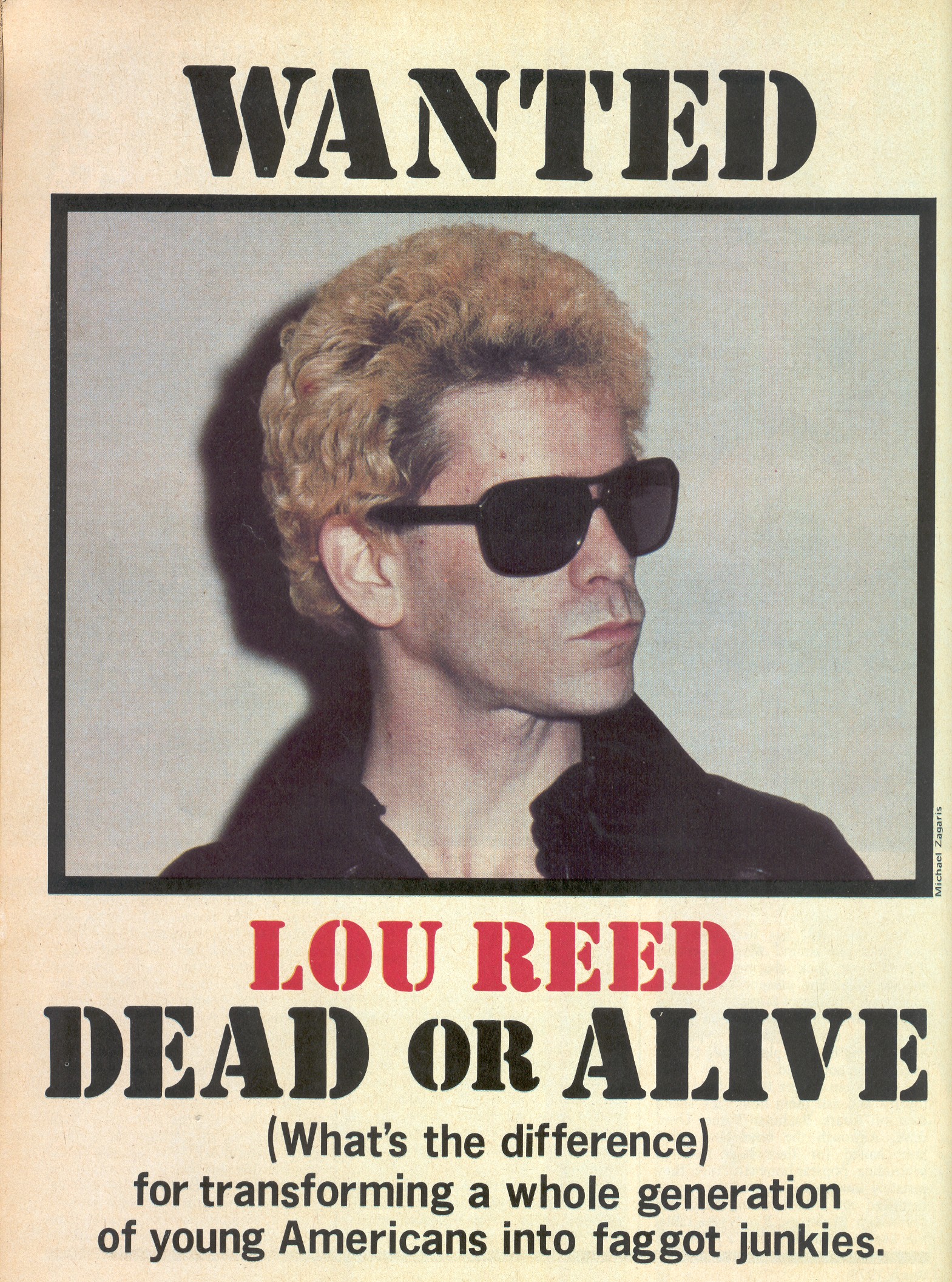
So, so sad to hear Lou is gone. I have no words to begin to describe how influential his work has been to me since I first heard the Velvet Underground at 14.
1988. Enigma Records. Essential.
00:00 Teen Age Riot
06:58 Silver Rocket
10:46 The Sprawl
18:29 ‘Cross the Breeze
25:29 Eric’s Trip
29:18 Total Trash
36:52 Hey Joni
41:14 Providence
43:56 Candle
48:55 Rain King
53:35 Kissability
56:44 Trilogy: a)The Wonder b)Hyperstation c)Eliminator Jr.
![[Juliette Gréco]](https://fleurmach.com/wp-content/uploads/2013/10/juliette-grc3a9co.jpg)
Juliette Gréco
― Nick Hornby, High Fidelity
The original version was off the 1990 album, Lovey.


 fleurmach