Directed by Naomi Yang of Galaxie 500 and Damon & Naomi, this video feels haunted by Maya Deren.
Directed by Naomi Yang of Galaxie 500 and Damon & Naomi, this video feels haunted by Maya Deren.
 Money, mechanization, algebra. The three monsters of contemporary civilization. Complete analogy.
Algebra and money are essentially levellers, the first intellectually, the second effectively.
About fifty years ago the life of the Provençal peasants ceased to be like that of the Greek peasants described by Hesiod. The destruction of science as conceived by the Greeks took place at about the same period. Money and algebra triumphed simultaneously.
The relation of the sign to the thing signified is being destroyed, the game of exchanges between signs is being multiplied of itself and for itself. And the increasing complication demands that there should be signs for signs… [Note that this comment comes decades before Baudrillard writes about simulacra in 1981.]
Among the characteristics of the modern world we must not forget the impossibility of thinking in concrete terms of the relationship between effort and the result of effort. There are too many intermediaries. As in the other cases, this relationship which does not lie in any thought, lies in a thing: money.
As collective thought cannot exist as thought, it passes into things (signs, machines…). Hence the paradox: it is the thing which thinks and the man who is reduced to the state of a thing.
There is no collective thought. On the other hand our science is collective like our technics. Specialization. We inherit not only results but methods which we do not understand. For the matter of that the two are inseparable, for the results of algebra provide methods for the other sciences.
To make an inventory or criticism of our civilization—what does that mean? To try to expose in precise terms the trap which has made man the slave of his own inventions. How has unconsciousness infiltrated itself into methodical thought and action?
To escape by a return to the primitive state is a lazy solution. We have to rediscover the original pact between the spirit and the world in this very civilization of which we form a part. But it is a task which is beyond our power on account of the shortness of life and the impossibility of collaboration and of succession. That is no reason for not undertaking it. The situation of all of us is comparable to that of Socrates when he was awaiting death in his prison and began to learn to play the lyre… At any rate we shall have lived…
The spirit, overcome by the weight of quantity, has no longer any other criterion than efficiency.
Modern life is given over to immoderation. Immoderation invades everything: actions and thought, public and private life.
The decadence of art is due to it. There is no more balance anywhere. The Catholic movement is to some extent in reaction against this; the Catholic ceremonies, at least, have remained intact. But then they are unrelated to the rest of existence.
Capitalism has brought about the emancipation of collective humanity with respect to nature. But this collective humanity has itself taken on with respect to the individual the oppressive function formerly exercised by nature.
This is true even with material things: fire, water etc. The community has taken possession of all these natural forces.
Question: can this emancipation, won by society, be transferred to the individual?
__
Excerpted from Simone Weil‘s Gravity and Grace. First French edition 1947. Translated by Emma Crawford. English language edition 1963. Routledge and Kegan Paul, London.
Beauty is the harmony of chance and the good.
Beauty is necessity which, while remaining in conformity with its own law and with that alone, is obedient to the good.
The subject of science is the beautiful (that is to say order, proportion, harmony) in so far as it is suprasensible and necessary.
The subject of art is sensible and contingent beauty discerned through the network of chance and evil.
The beautiful in nature is a union of the sensible impression and of the sense of necessity. Things must be like that (in the first place), and, precisely, they are like that.
Beauty captivates the flesh in order to obtain permission to pass right to the soul.
Among other unions of contraries found in beauty there is that of the instantaneous and the eternal.
The beautiful is that which we can contemplate. A statue, a picture which we can gaze at for hours.
The beautiful is something on which we can fix our attention. Gregorian music. When the same things are sung for hours each day and every day, whatever falls even slightly short of supreme excellence becomes unendurable and is eliminated.
The Greeks looked at their temples. We can endure the statues in the Luxembourg because we do not look at them. A picture such as one could place in the cell of a criminal sentenced to solitary confinement for life without it being an atrocity, on the contrary.
Only drama without movement is truly beautiful. Shakespeare’s tragedies are second-class with the exception of Lear. Those of Racine, third-class except for Phèdre. Those of Corneille of the nth class.
A work of art has an author and yet, when it is perfect, it has something which is essentially anonymous about it. It imitates the anonymity of divine art. In the same way the beauty of the world proves there to be a God who is personal and impersonal at the same time and is neither the one nor the other separately.
The beautiful is a carnal attraction which keeps us at a distance and implies a renunciation. This includes the renunciation of that which is most deep-seated, the imagination. We want to eat all the other objects of desire. The beautiful is that which we desire without wishing to eat it. We desire that it should be.
We have to remain quite still and unite ourselves with that which we desire yet do not approach. We unite ourselves to God in this way: we cannot approach him.
Distance is the soul of the beautiful.
The attitude of looking and waiting is the attitude which corresponds with the beautiful. As long as one can go on conceiving, wishing, longing, the beautiful does not appear. That is why in all beauty we find contradiction, bitterness and absence which are irreducible.
Poetry: impossible pain and joy. A poignant touch, nostalgia. Such is Provençal and English poetry. A joy which by reason of its unmixed purity hurts, a pain which by reason of its unmixed purity brings peace.
Beauty: a fruit which we look at without trying to seize it.
The same with an affliction which we contemplate without drawing back.
A double movement of descent: to do again, out of love, what gravity does. Is not the double movement of descent the key to all art?*
This movement of descent, the mirror of grace, is the essence of all music. All the rest only serves to enshrine it.
The rising of the notes is a purely sensorial rising. The descent is at the same time a sensorial descent and a spiritual rising. Here we have the paradise which every being longs for: where the slope of nature makes us rise towards the good.
In everything which gives us the pure authentic feeling of beauty there really is the presence of God. There is as it were an incarnation of God in the world and it is indicated by beauty.
The beautiful is the experimental proof that the incarnation is possible.
Hence all art of the highest order is religious in essence. (That is what people have forgotten today.) A Gregorian melody is as powerful a witness as the death of a martyr.
If the beautiful is the real presence of God in matter and if contact with the beautiful is a sacrament in the full sense of the word, how is it that there are so many perverted aesthetes? Nero. Is it like the hunger of those who frequent black masses for the consecrated hosts? Or is it, more probably, because these people do not devote themselves to what is genuinely beautiful, but to a bad imitation? For, just as there, is an art which is divine, so there is one which is demoniacal. It was no doubt the latter that Nero loved. A great deal of our art is of the devil.
A person who is passionately fond of music may quite well be a perverted person—but I should find it hard to believe this of any one who thirsted for Gregorian chanting. [hahaha!]
We must certainly have committed crimes which have made us accursed, since we have lost all the poetry of the universe.
Art has no immediate future because all art is collective and there is no more collective life (there are only dead collections of people), and also because of this breaking of the true pact between the body and the soul. Greek art coincided with the beginning of geometry and with athleticism, the art of the Middle Ages with the craftsmen’s guilds, the art of the Renaissance with the beginning of mechanics, etc. … Since 1914 there has been a complete cut. Even comedy is almost impossible. There is only room for satire (when was it easier to understand Juvenal?).
Art will never be reborn except from amidst a general anarchy— it will be epic no doubt, because affliction will have simplified a great many things… Is it therefore quite useless for you to envy Leonardo or Bach. Greatness in our times must take a different course. Moreover it can only be solitary, obscure and without an echo… (but without an echo, no art).
__
* Descendit ad inferos… So, in another order, great art redeems gravity by espousing it out of love. [Editor’s note.]
__
Excerpted from Simone Weil‘s Gravity and Grace. First French edition 1947. Translated by Emma Crawford. English language edition 1963. Routledge and Kegan Paul, London.
A poem for those who died, shot in Pulse nightclub in Orlando this weekend past.
i was going to see you
i was going to dance
in the same place with you someday
i was going to pretend not to notice
how you and your friends smiled
when you saw me and my partner
trying to cumbia to bachata
but i was going to feel more free anyway
because you were smiling
and we were together
and you had your stomach out
and you felt beautiful in your sweat
i was going to smile when i walked by
i was going to hug you the first time
a friend of a friend introduced us
i was going to compliment your shoes
instead of writing you a love poem
i was going to smile every time i saw you
and struggle to remember your name
we were going to sing together
we were going to belt out Selena
i was going to mispronounce everything
except for amor
and ay ay ay
i was going to covet your confidence and your bracelet
i was going to be grateful for the sight of you
i was going scream YES!!! at nothing in particular
at everything especially
meaning you
meaning you beyond who i knew you to be
i was going to see you in hallways
and be too shy to say hello
you were going to come to the workshop
you were going to sign up for the workshop and not come
you were going to translate the webinar
even though my politics seemed out there
we were going to sign up for creating change the same day
and be reluctant about it for completely different reasons
we were going to watch the keynotes
and laugh at completely different times
i was going to hold your hand in a big activity
about the intimacy of strangers
about the strangeness of needing prayer
we were going to get the same automated voice message
when we complained that it was not what it should have been
we were going to be standing in the same line
for various overpriced drinks
during a shift change
i was going to breathe loudly so you would notice me
you were going to compliment my hair
it isn’t fair
because we were going to work
to beyonce and rihanna
and the rihanna’s and beyonce’s to come
and the beyonce’s and rihanna’s after that
we were going to not drink enough water
and stay out later than our immune systems could handle
we were going to sit in traffic in each others blindspots
listening to top 40 songs that trigger queer memories
just outside the scope of marketing predictions
we were going to get old and i was going to wonder
about the hint of a tattoo i could see under your sleeve
i was going to blink and just miss
the fought-for laughter lines around your liner-loved eyes
i was going to go out for my birthday
but i didn’t
and you did
we were going to be elders
just because we were still around
and i was going to listen to you on a panel
we didn’t feel qualified for
and hear you talk about your guilt
for still being alive
when so many of your friends were taken
by suicide
by AIDS
by racist police
and jealous ex-lovers
and poverty
and no access to healthcare
and how you had a stable job
you suffered at until the weekend
how you avoided the drama
and only went to the club at pride
and so here you were with no one to dance with anymore
i was going to see you and forget you
and only remember you in my hips
and how my smile came easier than clenching my teeth eventually
and how i finally learned whatever it is i still haven’t learned yet
i was going to hear you laugh and not know why
and not care
our ancestors fought for a future
and we were both going to be there
until we weren’t
and i don’t know if it would hurt more
to lose you later after knowing you
i don’t know if it would hurt more
to know you died on your own day
by your own hands
or any of the other systems
that stalk you and me and ours forever
i only know the pain that i am having
and that you are not here to share it
you are not here to bear it
you were going to pass me a candle at the next vigil
but now i am pulse
and now you
are flame.
Here endeth tonight’s time capsule.
1992 was also the year I got glandular fever (Epstein-Barr virus), which was to lead to three years spent mostly in bed, ill with chronic fatigue syndrome/M.E., physically broken and depressed as fuck, while everyone else my age got on with having teenage fun. The radio literally saved my life.
This is the most irrepressible music I have heard in forever.
Dis ‘n roering! And how.
This keyboard!
“Listen; there was once a king on his throne anointed with great honour. He sent forth his dove into the world, which dropped the tiniest feather from its wing. The king raised the feather, blew on it, and commanded it to fly. The feather flew, not because of anything in itself, but because the air bore it along.
Thus am I: but a feather on the breath of God.”
– Hildegard of Bingen (1098 – 1179)
This extraordinarily gifted woman, born c. 1098 in Bermersheim, Germany, was given to the church at the age of eight. The tenth child of Hildebert of Bermersheim and Mechthild of Merxheim, she was promised as a tithe to the church from her birth and was later to become an abbess. She was a polymath: a visionary, a theologian, an early scientist and physician and a prodigious letter-writer who numbered kings, emperors and popes among her correspondents. There is a detailed Wikipedia entry about her HERE.

Illumination from the “Liber Scivias” shows Hildegard receiving a vision and dictating to her scribe.
That sample at the beginning is from Hildegard von Bingen’s “O Euchari in Leta Via”.
It doesn’t have to be
the blue iris, it could be
weeds in a vacant lot, or a few
small stones; just
pay attention, then patch
a few words together and don’t try
to make them elaborate, this isn’t
a contest but the doorway
into thanks, and a silence in which
another voice may speak.
From Thirst (Beacon Press, 2006).
 Virginia Woolf committed suicide in 1941 when the German bombing campaign against England was at its peak and when she was reading Freud whom she had staved off until then.
Edith Stein, recently and controversially beatified by the Pope, who had successfully worked to transform an existential vocabulary into a theological one, was taken to Auschwitz in August 1942.
Two years later Simone Weil died in a hospital in England—of illness and depression—determined to know what it is to know.
She, as much as Woolf and Stein, sought salvation in a choice of words.
But multiples succumb to the sorrow induced by an inexact vocabulary.
While a whole change in discourse is a sign of conversion, the alteration of a single word only signals a kind of doubt about the value of the surrounding words.
Poets tend to hover over words in this troubled state of mind. What holds them poised in this position is the occasional eruption of happiness.
While we would all like to know if the individual person is a phenomenon either culturally or spiritually conceived and why everyone doesn’t kill everyone else, including themselves, since they can—poets act out the problem with their words.
Why not say “heart-sick” instead of “despairing”?
Why not say “despairing” instead of “depressed”?
Is there, perhaps, a quality in each person—hidden like a laugh inside a sob—that loves even more than it loves to live?
If there is, can it be expressed in the form of the lyric line?
Dostoevsky defended his later religious belief, saying of his work, “Even in Europe there have never been atheistic expressions of such power. My hosannah has gone through a great furnace of doubt.”
According to certain friends, Simone Weil would have given everything she wrote to be a poet. It was an ideal but she was wary of charm and the inauthentic. She saw herself as stuck in fact with a rational prose line for her surgery on modern thought. She might be the archetypal doubter but the language of the lyric was perhaps too uncertain.
As far as we know she wrote a play and some poems and one little prose poem called Prologue.
Yet Weil could be called a poet, if Wittgenstein could, despite her own estimation of her writing, because of the longing for a conversion that words might produce.
In Prologue the narrator is an uprooted seeker who still hopes that a transformation will come to her from the outside. The desired teacher arrives bearing the best of everything, including delicious wine and bread, affection, tolerance, solidarity (people come and go) and authority. This is a man who even has faith and loves truth.
She is happy. Then suddenly, without any cause, he tells her it’s over. She is out on the streets without direction, without memory. Indeed she is unable to remember even what he told her without his presence there to repeat it, this amnesia being the ultimate dereliction.
If memory fails, then the mind is air in a skull.
This loss of memory forces her to abandon hope for either rescue or certainty.
And now is the moment where doubt—as an active function—emerges and magnifies the world. It eliminates memory. And it turns eyesight so far outwards, the vision expands. A person feels as if she is the figure inside a mirror, looking outwards for her moves. She is a forgery.
When all the structures granted by common agreement fall away and that “reliable chain of cause and effect” that Hannah Arendt talks about—breaks—then a person’s inner logic also collapses. She moves and sees at the same time, which is terrifying.
Yet strangely it is in this moment that doubt shows itself to be the physical double to belief; it is the quality that nourishes willpower, and the one that is the invisible engine behind every step taken.
Doubt is what allows a single gesture to have a heart.
In this prose poem Weil’s narrator recovers her balance after a series of reactive revulsions to the surrounding culture by confessing to the most palpable human wish: that whoever he was, he loved her.
Hope seems to resist extermination as much as a roach does.
Hannah Arendt talks about the “abyss of nothingness that opens up before any deed that cannot be accounted for.” Consciousness of this abyss is the source of belief for most converts. Weil’s conviction that evil proves the existence of God is cut out of this consciousness.
Her Terrible Prayer—that she be reduced to a paralyzed nobody—desires an obedience to that moment where coming and going intersect before annihilation.
And her desire: “To be only an intermediary between the blank page and the poem” is a desire for a whole-heartedness that eliminates personality.
Virginia Woolf, a maestro of lyric resistance, was frightened by Freud’s claustrophobic determinism since she had no ground of defense against it. The hideous vocabulary of mental science crushed her dazzling star-thoughts into powder and brought her latent despair into the open air.
Born into a family devoted to skepticism and experiment, she had made a superhuman effort at creating a prose-world where doubt was a mesmerizing and glorious force.
Anyone who tries, as she did, out of a systematic training in secularism, to forge a rhetoric of belief is fighting against the odds. Disappointments are everywhere waiting to catch you, and an ironic realism is always convincing.
Simone Weil’s family was skeptical too, and secular and attentive to the development of the mind. Her older brother fed her early sense of inferiority with intellectual put-downs. Later, her notebooks chart a superhuman effort at conversion to a belief in affliction as a sign of God’s presence.
Her prose itself is tense with effort. After all, to convert by choice (that is, without a blast of revelation or a personal disaster) requires that you shift the names for things, and force a new language out of your mind onto the page.
You have to make yourself believe. Is this possible? Can you turn “void” into “God” by switching the words over and over again?
Any act of self-salvation is a problem because of death which always has the last laugh, and if there has been a dramatic and continual despair hanging over childhood, then it may even be impossible.
After all, can you call “doubt” “bewilderment” and suddenly be relieved?
Not if your mind has been fatally poisoned. . . .
But even then, it seems the dream of having no doubt continues, finding its way into love and work where choices matter exactly as much as they don’t matter—at least when luck is working in your favor.
—
Fanny Howe, from Gone: Poems. Berkeley: University of California Press, 2003.

Charity Hamilton
The body is the canvas on which the female experience is painted and through which female identity is often understood. The female body is a slate on which a patriarchal story has been written, scarred onto the flesh.
For Simone Weil metaxu was simultaneously that which separated and connected, so for instance the wall between two prison cells cuts off the prisoners but was also the means by which they communicated by knocking on that wall. Could the body be that metaxu all at once separating us and connecting us to the Divine? The nature of metaxu is that it offers a route not just for the individual soul but for the souls of others to travel…
—
It’s all well and good to dust off a dead French Jewish Catholic not-quite-feminist-philosopher called Simone Weil and say ‘thanks, your theory of metaxu is great’, but what I want to know within the bones of my so-called soul is how this notion of metaxu can draw me into God, how can it liberate my sisters and how can it usher in the kingdom of the mother of all creation?
Human beings are created in the image of God and formed from the dust of the earth, and thus the body has an echoing significance throughout Christian history. The body is the perceived seat of what some describe as the fall, the locus of the incarnation, the home of crucifixion, the vessel of redemption, salvation and resurrection. The body is not an external meaningless diversion from the spiritual path; rather it is an incredibly important recurring theme both biblically and in Christian tradition and history. Bray and Colebrook state that,
The body is a negotiation with images, but it is also a negotiation with pleasures, pains, other bodies, space, visibility, and medical practice; no single event in this field can act as a general ground for determining the status of the body (Bray and Colebrook, 1998).
Yet more than all of this, the body is the place in which we dwell, it is all we have. As Elizabeth Moltmann Wendell says ‘I am my body’ (Moltmann-Wendell, 1994). For each of our sisters the body is the canvas on which the female experience is painted and through which female identity is often understood. It is on the stage of our female bodies that some of the most fixed church doctrines have been written and enacted. The female body is a slate on which a patriarchal story has been written, scarred onto the flesh. These bodies of ours are patriarchal constructs which must be liberated and re-adopted into the Christian story without the limitations of perceived notions or definitions of ‘gender’.
Isherwood and Stuart assert that ‘From the moment we are asked to believe that Eve was a rib removed from the side of Adam we understand that theology is based in the body and we are at a disadvantage!’ (Isherwood and Stuart, 1998: 15). The historical dichotomy between the Eve and the Mary constructions has led to a definitive inequality for women, both in terms of physical wellbeing and in terms of spiritual and psychological wellbeing. The choices for a woman to be the sin-formed, temptress Eve or the virginal pure vessel Mary are seen historically in the precarious place of women in the church and in society.
Elizabeth Stuart writes that ‘Women were regarded as being ensnared in their bodiliness to a far greater degree than men and they too had to be tamed and subdued for their own good and the good of the men they might tempt into sin’ (Stuart, 1996: 23). It is hardly surprising therefore that twentieth and twenty-first century feminist, womanist, mujerista and black theologians have worked hard to undo and re-express a theology of the body which offers a more authentic narrative of the relationship between the Divine and the physical which both liberates the female body and liberates God from the patriarchal box the Church has created around her.
…The female body can only be liberated from that patriarchal overwriting by writing its own narrative, much of which will be based upon experiences of being troubled. The true nature of the female body can only be revealed by a concerted effort to ‘re-own’ this body as our own not as we have been taught to understand it. This in turn means that the systems, doctrines and ‘ways of being’ which exist within the Church and society must be challenged and re-imagined from the perspective of the un-vocalized and troubled female narrative. In the sense that the female body has not really been ours, has not been an authentically female body and yet has the potential to be unlocked as such, it therefore makes for the perfect condition for metaxu, it is that thing which separates in its forms of oppression and connects in its potential liberation. It is at once a place where great evil has been wrought and a place of divine goodness. Weil writes of love that,
Creation is an act of love and it is perpetual. At each moment our existence is God’s love for us. But God can only love himself. His love for us is love for himself through us. Thus, he who gives us our being loves in us the acceptance of not being. Our existence is made up only of his waiting for our acceptance not to exist. He is perpetually begging from us that existence which he gives. He gives it to us in order to beg it from us (Weil, 2002: 28).
According to Weil, our very existence is from God and returns to God. I would argue that to be able to return this ‘not being’ to God, the body has to take some form of action, or have some form of action performed upon it to open a space in which our not being or not existing can be offered to God. It is this removal of our self which I argue can be interpreted as a removal of the socially created self to leave only the God part of ourselves, the authentic self that is God. The body is metaxu in that it is imperfect and yet perfect. The body is human and therefore unreal and socially recreated, yet the body is also created by God and God dwells within it. The female body is both imprisoned and is liberated. Its imprisonment is the very thing that enables it to unravel the layers of patriarchal construction to locate the God part and its imprisonment is the thing which allows for an authentic narrative to be written. The female body has to separate us from the Divine in order to connect us to the Divine.
Read the whole of this interesting paper by Charity Hamilton HERE.
All created things refuse to be for me as ends. Such is God’s extreme mercy towards me. And that very thing is what constitutes evil. Evil is the form which God’s mercy takes in this world.
This world is the closed door. It is a barrier. And at the same time it is the way through.
Two prisoners whose cells adjoin communicate with each other by knocking on the wall. The wall is the thing which separates them but it is also their means of communication. It is the same with us and God. Every separation is a link.
By putting all our desire for good into a thing we make that thing a condition of our existence. But we do not on that account make of it a good. Merely to exist is not enough for us.
The essence of created things is to be intermediaries. They are intermediaries leading from one to the other and there is no end to this. They are intermediaries leading to God. We have to experience them as such.
The bridges of the Greeks. We have inherited them but we do not know how to use them. We thought they were intended to have houses built upon them. We have erected skyscrapers on them to which we ceaselessly add storeys. We no longer know that they are bridges, things made so that we may pass along them, and that by passing along them we go towards God.
Only he who loves God with a supernatural love can look upon means simply as means.
Power (and money, power’s master key) is means at its purest. For that very reason, it is the supreme end for all those who have not understood.
This world, the realm of necessity, offers us absolutely nothing except means. Our will is for ever sent from one means to another like a billiard ball.
All our desires are contradictory, like the desire for food. I want the person I love to love me. If, however, he is totally devoted to me, he does not exist any longer, and I cease to love him. And as long as he is not totally devoted to me he does not love me enough. Hunger and repletion.
Desire is evil and illusory, yet without desire we should not seek for that which is truly absolute, truly boundless. We have to have experienced it. Misery of those beings from whom fatigue takes away that supplementary energy which is the source of desire.
Misery also of those who are blinded by desire. We have to fix our desire to the axis of the poles.
What is it a sacrilege to destroy? Not that which is base, for that is of no importance. Not that which is high, for, even should we want to, we cannot touch that. The metaxu. The metaxu form the region of good and evil.
No human being should be deprived of his metaxu, that is to say of those relative and mixed blessings (home, country, traditions, culture, etc.) which warm and nourish the soul and without which, short of sainthood, a human life is not possible.
The true earthly blessings are metaxu. We can respect those of others only in so far as we regard those we ourselves possess as metaxu. This implies that we are already making our way towards the point where it is possible to do without them. For example, if we are to respect foreign countries, we must make of our own country, not an idol, but a stepping-stone towards God.
All the faculties being freely exercised without becoming mixed, starting from a single, unique principle. It is the microcosm, the imitation of the world. Christ according to Saint Thomas. The just man of the Republic. When Plato speaks of specialization he speaks of the specialization of man’s faculties and not of the specialization of men; the same applies to hierarchy. The temporal having no meaning except by and for the spiritual, but not being mixed with the spiritual—leading to it by nostalgia, by reaching beyond itself. It is the temporal seen as a bridge, a metaxu. It is the Greek and Provençal vocation.
Civilization of the Greeks. No adoration of force. The temporal was only a bridge. Among the states of the soul they did not seek intensity but purity.
__
Excerpted from Simone Weil‘s Gravity and Grace. First French edition 1947. Translated by Emma Crawford. English language edition 1963. Routledge and Kegan Paul, London.
We are a part which has to imitate the whole.
The a¯tman. Let the soul of a man take the whole universe for its body. Let its relation to the whole universe be like that of a collector to his collection, or of one of the soldiers who died crying out ‘Long live the Emperor!’ to Napoleon. The soul transports itself outside the actual body into something else. Let it therefore transport itself into the whole universe.
We should identify ourselves with the universe itself. Everything that is less than the universe is subject to suffering.
Even though I die, the universe continues. That does not console me if I am anything other than the universe. If, however, the universe is, as it were, another body to my soul, my death ceases to have any more importance for me than that of a stranger. The same is true of my sufferings.
Let the whole universe be for me, in relation to my body, what the stick of a blind man is in relation to his hand. His sensibility is really no longer in his hand but at the end of the stick. An apprenticeship is necessary.
To limit one’s love to the pure object is the same thing as to extend it to the whole universe.
To change the relationship between ourselves and the world in the same way as, through apprenticeship, the workman changes the relationship between himself and the tool. Getting hurt: this is the trade entering into the body. May all suffering make the universe enter into the body.
Habit, skill: a transference of the consciousness into an object other than the body itself.
May this object be the universe, the seasons, the sun, the stars. The relationship between the body and the tool changes during apprenticeship. We have to change the relationship between our body and the world.
We do not become detached, we change our attachment. We must attach ourselves to the all.
We have to feel the universe through each sensation. What does it matter then whether it be pleasure or pain? If our hand is shaken by a beloved friend when we meet again after a long separation, what does it matter that he squeezes it hard and hurts us?
There is a degree of pain on reaching which we lose the world. But afterwards peace comes. And if the paroxysm returns, so does the peace which follows it. If we realize this, that very degree of pain turns into an expectation of peace, and as a result does not break our contact with the world.
Two tendencies with opposite extremes: to destroy the self for the sake of the universe, or to destroy the universe for the sake of the self. He who has not been able to become nothing runs the risk of reaching a moment when everything other than himself ceases to exist.
External necessity or an inner need as imperative as that of breathing. ‘Let us become the central breath.’ Even if a pain in our chest makes respiration extremely painful, we still breathe, we cannot help it.
We have to associate the rhythm of the life of the body with that of the world, to feel this association constantly and to feel also the perpetual exchange of matter by which the human being bathes in the world.
Things which nothing can take from a human being as long as he lives: in the way of movement over which his will has a hold, respiration; in the way of perception, space (even in a dungeon, even with our eyes blinded and our ear-drums pierced, as long as we live we are aware of space).
We have to attach to these things the thoughts which we desire that no circumstances should be able to deprive us of.
To love our neighbour as ourselves does not mean that we should love all people equally, for I do not have an equal love for all the modes of existence of myself. Nor does it mean that we should never make them suffer, for I do not refuse to make myself suffer. But we should have with each person the relationship of one conception of the universe to another conception of the universe, and not to a part of the universe.
Not to accept an event in the world is to wish that the world did not exist. That is within my power—for myself. If I wish it I obtain it. I am then an excrescence produced by the world.
Wishes in folklore: what makes wishes dangerous is the fact that they are granted. To wish that the world did not exist is to wish that I, just as I am, may be everything.
Would that the entire universe, from this pebble at my feet to the most distant stars, existed for me at every moment as much as Agnès did for Arnolphe or his money-box did for Harpagon. If I choose, the world can belong to me like the treasure does to the miser. But it is a treasure that does not increase.
This irreducible ‘I’ which is the irreducible basis of my suffering—I have to make this ‘I’ universal.
What does it matter that there should never be joy in me since there is perfect joy perpetually in God! And the same is true with regard to beauty, intelligence and all things.
To desire one’s salvation is wrong, not because it is selfish (it is not in man’s power to be selfish), but because it is an orientation of the soul towards a merely particular and contingent possibility instead of towards a completeness of being, instead of towards the good which exists unconditionally.
All that I wish for exists, or has existed, or will exist somewhere. For I am incapable of complete invention. In that case how should I not be satisfied?
Br . . . I could not prevent myself from imagining him living, imagining his house as a possible place for me to listen to his delightful conversation. Thus the consciousness of the fact of his death made a frightful desert. Cold with metallic coldness. What did it matter to me that there were other people to love? The love that I directed towards him, together with the outlines shaping in my mind of exchanges of ideas which could take place with no one else, were without an object. Now I no longer imagine him as alive and his death has ceased to be intolerable for me. The memory of him is sweet to me. But there are others whom I did not know then and whose death would affect me in the same way.
D . . . is not dead, but the friendship that I bore him is dead, and a like sorrow goes with it. He is no more than a shadow.
But I cannot imagine the same transformation for X . . ., Y . . ., Z . . ., who, nevertheless, so short a time ago did not exist in my consciousness.
Just as parents find it impossible to realize that three years ago their child was non-existent, I find it impossible to realize that I have not always known the beings I love.
I think I must love wrongly: otherwise things would not seem like this to me. My love would not be attached to a few beings. It would be extended to everything which is worthy of love.
‘Be ye perfect even as your Father who is in heaven. . . .’ Love in the same way as the sun gives light. Love has to be brought back to ourselves in order that it may be shed on all things. God alone loves all things and he only loves himself.
To love in God is far more difficult than we think.
I can taint the whole universe with my wretchedness without feeling it or collecting it together within myself.
We have to endure the discordance between imagination and fact. It is better to say ‘I am suffering’ than ‘this landscape is ugly’.
We must not want to change our own weight in the balance of the world—the golden balance of Zeus.
The whole cow gives milk although the milk is only drawn from the udder. In the same way the world is the producer of saintliness.
__
* The identification of the soul with the universe has no connexion here with pantheism. One can only fully accept the blind necessity which rules the universe by holding closely through love to the God who transcends the universe. Cf. above: ‘This world, in so far as it is quite empty of God, is God himself.’ [Editor’s note.]
__
Excerpted from Simone Weil‘s Gravity and Grace. First French edition 1947. Translated by Emma Crawford. English language edition 1963. Routledge and Kegan Paul, London.
 “Yet, no matter how deeply I go down into myself, my God is dark, and like a webbing made of a hundred roots that drink in silence. I know that my trunk rose from his warmth, but that’s all, because my branches hardly move at all near the ground, and just wave a little in the wind.”
― Rainer Maria Rilke
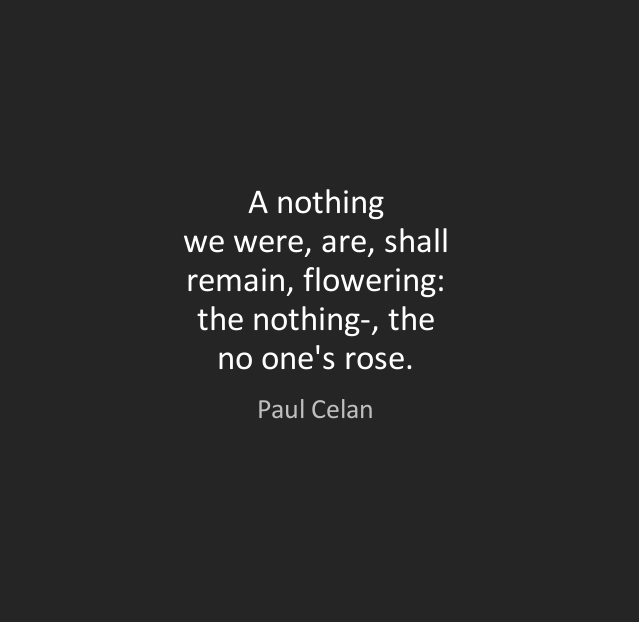
PSALM
No one kneads us again out of earth and clay,
no one incants our dust.
No one.
Blessed art thou, No One.
In thy sight would
we bloom.
In thy
spite.
A Nothing
we were, are now, and ever
shall be, blooming:
the Nothing-, the
No-One’s-Rose.
With
our pistil soul-bright,
our stamen heaven-waste,
our corona red
from the purpleword we sang
over, O over
the thorn.Paul Celan, “Psalm” from Selected Poems and Prose, translated by John Felstiner. Copyright © 2001 by John Felstiner.
We have to accomplish the possible in order to touch the impossible. The correct exercise (according to our duty) of the natural faculties of will, love and knowledge is, in relation to spiritual realities, exactly what the movement of the body is in relation to the perception of tangible objects. A paralyzed man lacks this perception.
The fulfilment of our strictly human duty is of the same order as correctness in the work of drafting, translating, calculating, etc. To be careless about this correctness shows a lack of respect for the object. The same thing applies to neglect of duty.
Those things which have to do with inspiration are the only ones which are the better for delay. Those which have to do with natural duty and the will cannot allow of delay.
Precepts are not given for the sake of being practised, but practice is prescribed in order that precepts may be understood. They are scales. One does not play Bach without having done scales. But neither does one play a scale merely for the sake of the scale.
Training. Every time we catch ourselves involuntarily indulging in a proud thought, we must for a few seconds turn the full gaze of our attention upon the memory of some humiliation in our past life, choosing the most bitter, the most intolerable we can think of.
We must not try to change within ourselves or to efface desires and aversions, pleasures and sorrows. We must submit to them passively, just as we do to the impressions we receive from colours, according no greater credit to them than in the latter case. If my window is red I cannot, though I should reason day and night for a whole year, see my room as anything but pink. I know, moreover, that it is necessary, just and right that I should see it thus. At the same time, as far as information about my room goes, I only accord to the pink colour a credit limited by my knowledge of its relation to the window. I must accept in this way and no other the desires and aversions, pleasures and sorrows of every kind which I find within me.
On the other hand, as we have also a principle of violence in us—that is to say the will—we must also, in a limited measure, but to the full extent of that measure, use this violent principle in a violent way; we must compel ourselves by violence to act as though we had not a certain desire or aversion, without trying to persuade our sensibility—compelling it to obey. This causes it to revolt and we have to endure this revolt passively, taste of it, savour it, accept it as something outside ourselves, as the pink colour of the room with the red window.
Each time that we do violence to ourselves in this spirit we make an advance, slight or great but real, in the work of training the animal within us.
Of course if this violence we do ourselves is really to be of use in our training it must only be a means. When a man trains a dog to perform tricks he does not beat it for the sake of beating it, but in order to train it, and with this in view he only hits it when it fails to carry out a trick. If he beats it without any method he ends by making it unfit for any training, and that is what the wrong sort of asceticism does.
Violence against ourselves is only permissible when it is based on reason (with a view to carrying out what we clearly consider to be our duty)—or when it is enjoined on us through an irresistible impulsion on the part of grace (but then the violence does not come from ourselves).
The source of my difficulties lies in the fact that, through exhaustion and an absence of vital energy, I am below the level of normal activity. And if something takes me and raises me up I am lifted above it. When such moments come it would seem to me a calamity to waste them in ordinary activities. At other times, I should have to do violence to myself with a violence which I cannot succeed in mustering.
I could consent to the anomaly of behaviour resulting from this; but I know, or I believe I know, that I should not do so. It involves crimes of omission towards others. And as for myself, it imprisons me.
What method is there then?
I must practise transforming the sense of effort into a passive sense of suffering. Whatever I may have to bear, when God sends me suffering, I am inescapably forced to suffer all that there is to suffer. Why, when it comes to duty, should I not in like manner do all that there is to be done?
Mountains, rocks, fall upon us and hide us far from the wrath of the Lamb. At the present moment I deserve this wrath.
I must not forget that according to Saint John of the Cross the inspirations which turn us from the accomplishment of easy and humble obligations come from the side of evil.
Duty is given us in order to kill the self—and I allow so precious an instrument to grow rusty.
We must do our duty at the prescribed time in order to believe in the reality of the external world. We must believe in the reality of time. Otherwise we are in a dream.
It is years since I recognized this defect in myself and recognized its importance, and all this time I have done nothing to get rid of it. What excuse can I find?
Has it not been growing in me since I was ten years old? But however great it may be, it is limited. That is enough. If it is great enough to take from me the possibility of wiping it out during this life and so attaining to the state of perfection, that must be accepted just as it is, with an acceptance that is full of love. It is enough that I know that it exists, that it is evil and that it is finite. But to know each of these three things effectively and to know them all three together implies the beginning and the uninterrupted continuation of the process of wiping out. If this process does not begin to show itself, it is a sign that I do not know in truth the very thing that I am writing.
The necessary energy dwells in me, since I live by means of it. I must draw it relentlessly out of myself, even though I should die in so doing.
Uninterrupted interior prayer is the only perfect criterion of good and evil. Everything which does not interrupt it is permitted, everything which interrupts it is forbidden. It is impossible to do harm to others when we act in a state of prayer—on condition that it is true prayer. But before reaching that stage, we must have worn down our own will against the observance of rules.
Hope is the knowledge that the evil we bear within us is finite, that the slightest turning of the will towards good, though it should last but an instant, destroys a little of it, and that, in the spiritual realm, everything good infallibly produces good. Those who do not know this are doomed to the torture of the Danaïds.
Good infallibly produces good, and evil evil, in the purely spiritual realm. On the other hand, in the natural realm, that of psychology included, good and evil reciprocally produce each other. Accordingly we cannot have security until we have reached the spiritual realm—precisely the realm where we can obtain nothing by our own efforts, where we must wait for everything to come to us from outside.
__
1 ‘If thou wilt thou canst make me clean’ (Gospel text).
__
Excerpted from Simone Weil‘s Gravity and Grace. First French edition 1947. Translated by Emma Crawford. English language edition 1963. Routledge and Kegan Paul, London.
The album version of this song was released by Fleetwood Mac on Mirage in 1982, and my dad had it on a tape in his car for most of the ’80s.
But this, this is something else.
We know by means of our intelligence that what the intelligence does not comprehend is more real than what it does comprehend.
Faith is the experience that intelligence is enlightened by love.
Only, intelligence has to recognize by the methods proper to it, that is to say by verification and demonstration, the pre-eminence of love. It must not yield unless it knows why, and it must know this quite precisely and clearly. Otherwise its submission is a mistake and that to which it submits itself is something other than supernatural love. For example it may be social influence.
In the intellectual order, the virtue of humility is nothing more nor less than the power of attention.
The wrong humility leads us to believe that we are nothing in so far as we are ourselves—in so far as we are certain particular human beings.
True humility is the knowledge that we are nothing in so far as we are human beings as such, and, more generally, in so far as we are creatures.
The intelligence plays a great part in this. We have to form a conception of the universal.
When we listen to Bach or to a Gregorian melody, all the faculties of the soul become tense and silent in order to apprehend this thing of perfect beauty—each after its own fashion—the intelligence among the rest. It finds nothing in this thing it hears to affirm or deny, but it feeds upon it.
Should not faith be an adherence of this kind?
The mysteries of faith are degraded if they are made into an object of affirmation and negation, when in reality they should be an object of contemplation.
The privileged rôle of the intelligence in real love comes from the fact that it is inherent in the nature of intelligence to become obliterated through the very fact that it is exercised. I can make efforts to discover truths, but when I have them before me they exist and I do not count.
There is nothing nearer to true humility than intelligence. It is impossible to be proud of our intelligence at the moment when we are really exercising it. Moreover, when we do exercise it we are not attached to it, for we know that even if we became an idiot the following instant and remained so for the rest of our life, the truth would continue unchanged.
The mysteries of the Catholic faith are not intended to be believed by all the parts of the soul. The presence of Christ in the host is not a fact of the same kind as the presence of Paul’s soul in Paul’s body (actually both are completely incomprehensible, but not in the same way). The Eucharist should not then be an object of belief for the part of me which apprehends facts. That is where Protestantism is true. But this presence of Christ in the host is not a symbol, for a symbol is the combination of an abstraction and an image, it is something which human intelligence can represent to itself, it is not supernatural. There the Catholics are right, not the Protestants. Only with that part of us which is made for the supernatural should we adhere to these mysteries.
The rôle of the intelligence—that part of us which affirms and denies and formulates opinions—is merely to submit. All that I conceive of as true is less true than those things of which I cannot conceive the truth, but which I love. Saint John of the Cross calls faith a night. With those who have had a Christian education, the lower parts of the soul become attached to these mysteries when they have no right to do so. That is why such people need a purification of which Saint John of the Cross describes the stages. Atheism and incredulity constitute an equivalent of this purification.
The desire to discover something new prevents people from allowing their thoughts to dwell on the transcendent, undemonstrable meaning of what has already been discovered. My total lack of talent which makes such a desire out of the question for me is a great favour I have received. The recognized and accepted lack of intellectual gifts compels the disinterested use of the intelligence.
The object of our search should not be the supernatural, but the world. The supernatural is light itself: if we make an object of it we lower it.
The world is a text with several meanings, and we pass from one meaning to another by a process of work. It must be work in which the body constantly bears a part, as, for example, when we learn the alphabet of a foreign language: this alphabet has to enter into our hand by dint of forming the letters. If this condition is not fulfilled, every change in our way of thinking is illusory.
We have not to choose between opinions. We have to welcome them all but arrange them vertically, placing them on suitable levels.
Thus: chance, destiny, Providence.
Intelligence can never penetrate the mystery, but it, and it alone, can judge of the suitability of the words which express it. For this task it needs to be keener, more discerning, more precise, more exact and more exacting than for any other.
The Greeks believed that only truth was suitable for divine things—not error nor approximations. The divine character of anything made them more exacting with regard to accuracy. (We do precisely the opposite, warped as we are by the habit of propaganda.) It was because they saw geometry as a divine revelation that they invented a rigorous system of demonstration…
In all that has to do with the relations between man and the supernatural we have to seek for a more than mathematical precision; this should be more exact than science.1
We must suppose the rational in the Cartesian sense, that is to say mechanical rule or necessity in its humanly demonstrable form, to be everywhere it is possible to suppose it, in order to bring to light that which lies outside its range.
The use of reason makes things transparent to the mind. We do not, however, see what is transparent. We see that which is opaque through the transparent—the opaque which was hidden when the transparent was not transparent. We see either the dust on the window or the view beyond the window, but never the window itself. Cleaning off the dust only serves to make the view visible. The reason should be employed only to bring us to the true mysteries, the true undemonstrables, which are reality. The uncomprehended hides the incomprehensible and should on this account be eliminated.
Science, today, will either have to seek a source of inspiration higher than itself or perish.
Science only offers three kinds of interest: (1) Technical applications, (2) A game of chess, (3) A road to God. (Attractions are added to the game of chess in the shape of competitions, prizes and medals.)
Pythagoras. Only the mystical conception of geometry could supply the degree of attention necessary for the beginning of such a science. Is it not recognized, moreover, that astronomy issues from astrology and chemistry from alchemy? But we interpret this filiation as an advance, whereas there is a degradation of the attention in it. Transcendental astrology and alchemy are the contemplation of eternal truths in the symbols offered by the stars and the combinations of substances. Astronomy and chemistry are degradations of them. When astrology and alchemy become forms of magic they are still lower degradations of them. Attention only reaches its true dimensions when it is religious.
Galileo. Having as its principle unlimited straight movement and no longer circular movement, modern science could no longer be a bridge towards God.
The philosophical cleansing of the Catholic religion has never been done. In order to do it it would be necessary to be inside and outside.
__
1 Here again is one of those contradictions which can only be resolved in the realm of the inexpressible: the mystic life, which only arises from the divine arbitrariness, is nevertheless subject to the most severe rules. Saint John of the Cross was able to give a geometric plan of the journey of the soul towards God. [Editor’s note.]
__
Excerpted from Simone Weil‘s Gravity and Grace. First French edition 1947. Translated by Emma Crawford. English language edition 1963. Routledge and Kegan Paul, London.
This track comes from her brilliant 2012 album, Ekstasis, which you can listen to HERE. Video directed by Jose Wolff.
“The first thing that came to mind was an image that gradually deteriorates with visual noise, echoing the sonic noise present in the song. We go from lightness to darkness, away from a structured, fabricated place and into raw territory.” – Jose Wolff – August 2012
We do not have to understand new things, but by dint of patience, effort and method to come to understand with our whole self the truths which are evident.
Stages of belief. The most commonplace truth when it floods the whole soul, is like a revelation.
We have to try to cure our faults by attention and not by will.
The will only controls a few movements of a few muscles, and these movements are associated with the idea of the change of position of nearby objects. I can will to put my hand flat on the table. If inner purity, inspiration or truth of thought were necessarily associated with attitudes of this kind, they might be the object of will. As this is not the case, we can only beg for them. To beg for them is to believe that we have a Father in heaven. Or should we cease to desire them? What could be worse? Inner supplication is the only reasonable way, for it avoids stiffening muscles which have nothing to do with the matter. What could be more stupid than to tighten up our muscles and set our jaws about virtue, or poetry, or the solution of a problem? Attention is something quite different.
Pride is a tightening up of this kind. There is a lack of grace (we can give the word its double meaning here) in the proud man. It is the result of a mistake.
Attention, taken to its highest degree, is the same thing as prayer. It presupposes faith and love.
Absolutely unmixed attention is prayer.
If we turn our mind towards the good, it is impossible that little by little the whole soul will not be attracted thereto in spite of itself.
Extreme attention is what constitutes the creative faculty in man and the only extreme attention is religious. The amount of creative genius in any period is strictly in proportion to the amount of extreme attention and thus of authentic religion at that period.
The wrong way of seeking. The attention fixed on a problem. Another phenomenon due to horror of the void. We do not want to have lost our labour. The heat of the chase. We must not want to find: as in the case of an excessive devotion, we become dependent on the object of our efforts. We need an outward reward which chance sometimes provides and which we are ready to accept at the price of a deformation of the truth.
It is only effort without desire (not attached to an object) which infallibly contains a reward.
To draw back before the object we are pursuing. Only an indirect method is effective. We do nothing if we have not first drawn back.
By pulling at the bunch, we make all the grapes fall to the ground.
There are some kinds of effort which defeat their own object (example: the soured disposition of certain pious females, false asceticism, certain sorts of self-devotion, etc.). Others are always useful, even if they do not meet with success.
How are we to distinguish between them? Perhaps in this way: some efforts are always accompanied by the (false) negation of our inner wretchedness; with others the attention is continually concentrated on the distance there is between what we are and what we love.
Love is the teacher of gods and men, for no one learns without desiring to learn. Truth is sought not because it is truth but because it is good.
Attention is bound up with desire. Not with the will but with desire—or more exactly, consent.
We liberate energy in ourselves, but it constantly reattaches itself. How are we to liberate it entirely? We have to desire that it should be done in us—to desire it truly—simply to desire it, not to try to accomplish it. For every attempt in that direction is vain and has to be dearly paid for. In such a work all that I call ‘I’ has to be passive. Attention alone—that attention which is so full that the ‘I’ disappears—is required of me. I have to deprive all that I call ‘I’ of the light of my attention and turn it on to that which cannot be conceived.
The capacity to drive a thought away once and for all is the gateway to eternity. The infinite in an instant.
As regards temptations, we must follow the example of the truly chaste woman who, when the seducer speaks to her, makes no answer and pretends not to hear him.
We should be indifferent to good and evil but, when we are indifferent, that is to say when we project the light of our attention equally on both, the good gains the day. This phenomenon comes about automatically. There lies the essential grace. And it is the definition, the criterion of good.
A divine inspiration operates infallibly, irresistibly, if we do not turn away our attention, if we do not refuse it. There is not a choice to be made in its favour, it is enough not to refuse to recognize that it exists.
The attention turned with love towards God (or in a lesser degree, towards anything which is truly beautiful) makes certain things impossible for us. Such is the non-acting action of prayer in the soul. There are ways of behaviour which would veil such attention should they be indulged in and which, reciprocally, this attention puts out of the question.
As soon as we have a point of eternity in the soul, we have nothing more to do but to take care of it, for it will grow of itself like a seed. It is necessary to surround it with an armed guard, waiting in stillness, and to nourish it with the contemplation of numbers, of fixed and exact relationships.
We nourish the changeless which is in the soul by the contemplation of that which is unchanging in the body.
Writing is like giving birth: we cannot help making the supreme effort. But we also act in like fashion. I need have no fear of not making the supreme effort—provided only that I am honest with myself and that I pay attention.
The poet produces the beautiful by fixing his attention on something real. It is the same with the act of love. To know that this man who is hungry and thirsty really exists as much as I do— that is enough, the rest follows of itself.
The authentic and pure values—truth, beauty and goodness— in the activity of a human being are the result of one and the same act, a certain application of the full attention to the object.
Teaching should have no aim but to prepare, by training the attention, for the possibility of such an act. All the other advantages of instruction are without interest.
Studies and faith. Prayer being only attention in its pure form and studies being a form of gymnastics of the attention, each school exercise should be a refraction of spiritual life. There must be method in it. A certain way of doing a Latin prose, a certain way of tackling a problem in geometry (and not just any way) make up a system of gymnastics of the attention calculated to give it a greater aptitude for prayer.
Method for understanding images, symbols, etc. Not to try to interpret them, but to look at them till the light suddenly dawns.
Generally speaking, a method for the exercise of the intelligence, which consists of looking.
Application of this rule for the discrimination between the real and the illusory. In our sense perceptions, if we are not sure of what we see we change our position while looking, and what is real becomes evident. In the inner life, time takes the place of space. With time we are altered, and, if as we change we keep our gaze directed towards the same thing, in the end illusions are scattered and the real becomes visible. This is on condition that the attention be a looking and not an attachment.
When a struggle goes on between the will attached to some obligation and a bad desire, there is a wearing away of the energy attached to good. We have to endure the biting of the desire passively, as we do a suffering which brings home to us our wretchedness, and we have to keep our attention turned towards the good. Then the quality of our energy is raised to a higher degree. We must steal away the energy from our desires by taking away from them their temporal orientation.
Our desires are infinite in their pretensions but limited by the energy from which they proceed. That is why with the help of grace we can become their master and finally destroy them by attrition. As soon as this has been clearly understood, we have virtually conquered them, if we keep our attention in contact with this truth.
Video meliora … In such states, it seems as though we were thinking of the good, and in a sense we are doing so, but we are not thinking of its possibility.
It is incontestable that the void which we grasp with the pincers of contradiction is from on high, for we grasp it the better the more we sharpen our natural faculties of intelligence, will and love. The void which is from below is that into which we fall when we allow our natural faculties to become atrophied.
Experience of the transcendent: this seems contradictory, and yet the transcendent can be known only through contact since our faculties are unable to invent it.
Solitude. Where does its value lie? For in solitude we are in the presence of mere matter (even the sky, the stars, the moon, trees in blossom), things of less value (perhaps) than a human spirit. Its value lies in the greater possibility of attention. If we could be attentive to the same degree in the presence of a human being…
We can only know one thing about God—that he is what we are not. Our wretchedness alone is an image of this. The more we contemplate it, the more we contemplate him.
Sin is nothing else but the failure to recognize human wretchedness. It is unconscious wretchedness and for that very reason guilty wretchedness. The story of Christ is the experimental proof that human wretchedness is irreducible, that it is as great in the absolutely sinless man as in the sinner. But in him who is without sin it is enlightened…
The recognition of human wretchedness is difficult for whoever is rich and powerful because he is almost invincibly led to believe that he is something. It is equally difficult for the man in miserable circumstances because he is almost invincibly led to believe that the rich and powerful man is something.
It is not the fault which constitutes mortal sin, but the degree of light in the soul when the fault, whatever it may be, is accomplished.
Purity is the power to contemplate defilement.
Extreme purity can contemplate both the pure and the impure; impurity can do neither: the pure frightens it, the impure absorbs it. It has to have a mixture.
__
Excerpted from Simone Weil‘s Gravity and Grace. First French edition 1947. Translated by Emma Crawford. English language edition 1963. Routledge and Kegan Paul, London.
Something wonderful I came across HERE this week while trying to find Rock Rose essential oil online.
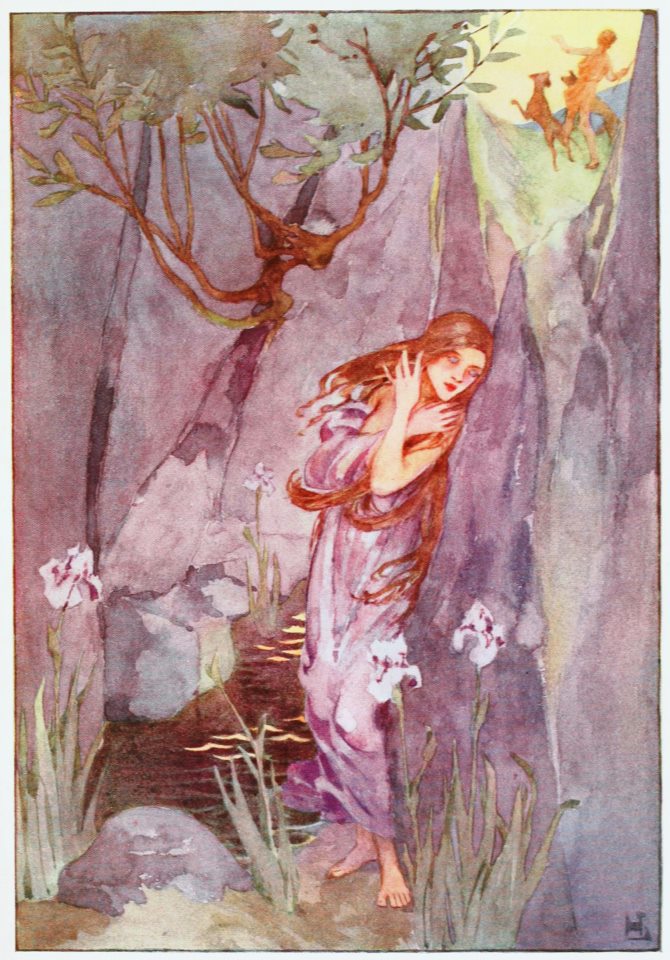
Echo and Narcissus. Helen Stratton, 1915.
The daffodil has been adopted by both the American Cancer Society, and the Madame Curie Society, for whom it symbolizes simultaneously hope and disease. The Greeks today call N. tazetta Dakrakia, “Little Tear Drops,” as this flower’s association with grief and the dead is both exceedingly ancient, and modern.
The legend of Echo’s fertility daemon Narcissus, who pined to death desiring his own reflection, is parallelled by similar flower boys such as Adonis “the scentless rose” (i.e., a windflower or anemone) who was the slain beloved of both Aphrodite and Persephone; and Hyacinthus, the slain catamite of Zeus and Apollo; and the hidden son of Aphrodite, Hermaphroditus, cavern-raised in secret by naiads of Cybele’s Mount Ida. He came to the Fountain of Queen Salmacis, to whom boxwood and clinging ivy was sacred, and he became one with Salmacis after drinking of her mystic waters, achieving a unity which Narcissus appears likewise but unsuccessfully to have sought.
Like these others, Narcissus is fundamentally impotent or sexless, though erotically appealing to goddesses or nymphs and even to the more masculine gods. We are reminded that Cybele’s boy companion Attis, born of an almond tree was, like Narcissus, sexually incapable – indeed was literally unmanned. Such sexless lads seem to originate in a very early level of myth when the Mother Goddess, being Absolute, had no actual consort, at a time when the male principle was at most a companion, son, or a priest who had unsexed himself.
Most such fertility daemons are straightforward “dying and reborn” grain-divinities, including even Jesus whose worshippers co-opted the daffodil as well as the lily as symbols of death and Easter resurrection. But Narcissus appears additionally to be partly related to a large number of female nymphs transformed directly into flowers, trees, or reeds to escape unwanted sexual encounters. Because there is something essentially female in his myth, he somewhat bridges the Attis or Galli type of mythology of self-castration, to the Daphne type of myth of nymphs escaping either lust or an unwanted marriage or the pursuit by unwanted rape by a god.
He loved his own reflection (which he mistook for female), then turned into the flower bearing his name, ignoring the erotic desires of Echo all the while. But in an alternative version, he had an incestuous affair with his twin sister, who subsequently died, and his obsession for his own reflection was due to his own resemblance to his beloved.
Echo herself had been cursed never to be able to seduce Narcissus directly, but only to repeat his words. She was, in essence, his reflection, so his sentiment that his reflection was female, or that it was his twin sister, was correct. But Echo herself is a dwindled form of a once very mighty Goddess of great antiquity, Akko, mother of all language, whose Voice was that which called forth creation at the beginning of time, and who bears a close association with the Cretan Crocus-goddess Kar.
We know that Echo’s worship was significant within the secretive rites of Demeter. One day was put aside to honor Echo during the Demeter Festival of Eleusis. The precise nature of worship at the Echo shrine was forbidden to be written down, and is today unknown. Her worship was also part of the cult of the Argive Hera; and while in Latin versions of her myth Echo angered Juno (Hera) by covering for Jove’s sundry sexual liaisons, within the Argive cult Echo was Hera’s beloved handmaiden. Echo’s central myth within this cult binds her to the erotic nature-divinity, Pan, to whom she was reluctantly betrothed, and by whom she bore a daughter, Jynx or Yunx, who cast a spell that caused Zeus to fall in love with Io, for which reason Hera turned Jynx into a wryneck bird.
Or Echo gave birth to Peitho, Goddess of Soft Speech or of Seductive Persuasion. Peitho was handmaiden to Aphrodite, and became the bride of Hermes. Peitho had her own cult in Athens, said to have been introduced to the city by none other than Theseus. She is given several genealogies and isn’t invariably a daughter of Echo, but the notion that she was Echo’s daughter was sensible in that both were associated with speaking.
Dionyssiaca calls Echo the Goddess Who Never Fails to Speak. Though in later tales this meant she was an annoying chatterbox, there is ample evidence that any negative connotation was imposed by rival cults, and that Echo was in her own right a powerful divinity. Her cult was always of a secretive kind associated with lustiness and death, and never spoken of outside the confines of secret initiations. She was depicted as an angel-like being with enormous wings hiding her mouth behind a veil, signifying secret wisdom; just such an image of Echo is shown at the top of this page, and she is clearly distinct from any sort of nymph.
As a Virgin Goddess, she rejected not only Pan, but also Poseidon who sent a flood up the mountains in pursuit of Echo. She even refused to attend the wedding of Dionysios because of her dislike of the marriage bed. It is an interesting aside that a surname for Dionysios, Antheus (“Flowery”), was an alternate name for Narcissus. Echo’s disdain for marriage would have been quite normal for huntress-goddesses or nymphs of Artemis, yet Echo may have taken her disdain for all things connubial to extremes, and insulted Dionysios when she refused to participate in the violent drunken dance of the maenadic Oreiades or Hill-nymphs at Dionysios’ wedding.
In none of her myths is Echo given a genealogy, very likely because she was part and parcel with the First Cause in that it was her Voice that called forth creation. But some have speculated she was a renegade Oreiad of Boeotia, and that she left her sister-band of the pines and oaks of the mountain forests to live alone in a deep cavern of an alpine cliff, in order to not be seen and courted by any man or god.
If she were indeed an Oreiad this would make her a sister of the Dactyls and Satyrs, perhaps even a sister of Pan. The Oreiades were sometimes likened “the female Dactyls” and were wedded to their brothers, the Dactyloi. The children of the Dactyls and Oreiades were the Curetes or Corybontes, who were priests of Cybele and defenders of infant Zeus, and were male equivalents to the raging maenads who danced madly and noisily about the hillsides.
The mother of the Oreiades and Dactyloi was the Titaness of radiant heat, Anchiale, sister of Prometheus. Their father was the Titan of hands Hekateros. The sons and daughters of Anchiale and Hekateros invented iron metallurgy and brought the Bronze Age to a close. These sons and daughters were also great artists of anything involving use of the hands, and as light-bearers were bringers of wisdom out of darkness. Though it was said that Echo was educated in the arts by the Muses, it may once have been that Echo instructed the Muses!
These Oreiades were of the same generation of divinity as the Olympians, although since these children of Anchilale secretly nurtured the infant Zeus in a mountain cavern in Crete, really they are older than the Olympians. Anchiale herself dwelt originally on Mount Ida in Crete, and later on the Phrygian Mt. Ida, which association identifies her most strongly as a byform of Cybele Idaea, greatest of the Great Goddesses, the mother of Zeus.
But it’s important to remember that Echo’s recurring association with the Oreiades never explicitly makes her one of them, and this may well be due to her having been known to be herself a Titaness of the first generation of divinity. Rather than being the Nymph of Mt. Helicon, she was an aspect of the All-Mother herself.
When Pan was spurned by Echo, he visited madness upon local goatherders and sent them raging up the mountain sides until they found Echo, ripping her to pieces and scattering her bones. The behavior of the goatherders was commonly assumed to be an activity of Dionysios’s maenads, and Echo’s fate both duplicates that of Dionysios in his infancy (when he was cut up then restored, sans penis, by Gaea) but also punishes Echo for refusing to dance the mad dance with the maeanadic Oreiades at Dionysios’s wedding.
Gaea gathered up the far-flung bones of Echo and buried her part by part in sundry cliff-faces, where not just her voice can still be heard, but where her spirit inspires poetic gift for any voice beautiful enough to sing inspired lyrics or comprehend the mystic meanings.
By all this we see that Echo had a large presence apart from the best-remembered tale of her downfall for loving Narcissus. But most revealing of her original nature is an ancient Greek assumption that she was Persephone’s personal messenger (as Hermes was the personal messenger of Zeus), and flew upon her dark wings between the living world and Thanatos bringing perfect knowledge to and from the underworld.
In this we find again the real nature of Echo, whose lips are veiled, for the secret knowledge cajoled from her is incorruptible. It was an oral tradition forbidden to be written, but she repeated it verbatim from Persephone the Maiden aspect of Hekate. This Echo is, then, the same as the Jewish Bat Kol, “Daughter Voice,” who brings news from God and repeats it verbatim in her soft womanly voice directly into the hearts and spirits of humanity. In times of need Bat Kol can be heard to speak from out of a fiery light. Echo is also encountered in Vedic religion as the Goddess Devaduti, the Divine Messenger, feminine power of communication without whom even the greatest of gods is mute.
This association of Echo with Persephone, or Black Aphrodite, feeds back to the mythology of the narcissus flower, which was sacred to Persephone. Persephone had been picking daffodils on the very day she was kidnapped into the underworld. These flowers did not formerly bow their heads, but do so now, for shame of their role in the kidnapping. A beautiful meadow of these flowers grew near the River Styx, bringing sunlight to that dark land; and during her captivity, Persephone often walked amidst these flowers.
From the lingering bits of a largely forgotten mythology, it seems probable that Echo worship regarded Her as the “spark” that dwells within each of us, that which Narcissus mistook for his twin sister, a beautiful maiden, or his soul. All the Greek words for Spirit or Soul are feminine words, and so in Greek myth the soul is often personified as a nymph or goddess, Psyche as lover of Eros being most famed of these. Not coincidentally, in Semitic and Sanskrit languages too, the words for Soul are invariably female names. The last great flourishing of Soul worship in western religion was classical gnosticism. Among Gnostics, a central idea was that Sophia (the Mother-goddess Wisdom) spun out from herself, without need of a consort, the whole of the life-force of the world, diminishing herself to become infused into the material world, the energizing power of all life. Such belief remains current in India among saktists or Kali worshippers.
So the diminished Echo is still really that earlier Creatrix trying to call out to humanity, to Narcissus, striving to correct the Error of Sophia and liberate us from the world of Matter by calling us back into the pre-created universe of light and unity. But because she is fused to us, we can never quite perceive Her as anything but a reflection of ourselves, an echo of our own voices, and we are undone by our own vanity and remain snared in the material realm.
A case of contradictories which are true. God exists: God does not exist. Where is the problem? I am quite sure that there is a God in the sense that I am quite sure my love is not illusory. I am quite sure that there is not a God in the sense that I am quite sure nothing real can be anything like what I am able to conceive when I pronounce this word. But that which I cannot conceive is not an illusion.
There are two atheisms of which one is a purification of the notion of God.
Perhaps every evil thing has a second aspect—a purification in the course of progress towards the good—and a third which is the higher good.
We have to distinguish carefully between these three aspects because it is very dangerous for thought and for the effective conduct of life to confuse them.
Of two men who have no experience of God, he who denies him is perhaps nearer to him than the other.
The false God who is like the true one in everything, except that we cannot touch him, prevents us from ever coming to the true one.
We have to believe in a God who is like the true God in everything, except that he does not exist, since we have not reached the point where God exists.
The errors of our time come from Christianity without the supernatural. Secularization is the cause—and primarily humanism.
Religion in so far as it is a source of consolation is a hindrance to true faith: in this sense atheism is a purification. I have to be atheistic with the part of myself which is not made for God. Among those men in whom the supernatural part has not been awakened, the atheists are right and the believers wrong.
A man whose whole family had died under torture, and who had himself been tortured for a long time in a concentration camp; or a sixteenth-century Indian, the sole survivor after the total extermination of his people. Such men if they had previously believed in the mercy of God would either believe in it no longer, or else they would conceive of it quite differently from before. I have not been through such things. I know, however, that they exist; so what is the difference?
I must move towards an abiding conception of the divine mercy, a conception which does not change whatever event destiny may send upon me and which can be communicated to no matter what human being.
__
*God does not in fact exist in the same way as created things which form the only object of experience for our natural faculties. Therefore, contact with supernatural reality is at first felt as an experience of nothingness. [Editor’s note.]
__
Excerpted from Simone Weil‘s Gravity and Grace. First French edition 1947. Translated by Emma Crawford. English language edition 1963. Routledge and Kegan Paul, London.
God can only be present in creation under the form of absence.
Evil is the innocence of God. We have to place God at an infinite distance in order to conceive of him as innocent of evil; reciprocally, evil implies that we have to place God at an infinite distance.
This world, in so far as it is completely empty of God, is God himself.
Necessity, in so far as it is absolutely other than the good, is the good itself. That is why all consolation in affliction separates us from love and from truth. That is the mystery of mysteries. When we touch it we are safe.
‘In the desert of the East…’ We have to be in a desert. For he whom we must love is absent.
He who puts his life into his faith in God can lose his faith. But he who puts his life in God himself will never lose it. To put our life into that which we cannot touch in any way… It is impossible. It is a death. That is what is required.
Nothing which exists is absolutely worthy of love. We must therefore love that which does not exist.
This non-existent object of love is not a fiction, however, for our fictions cannot be any more worthy of love than we are ourselves, and we are not worthy of it.
Consent to the good—not to any good which can be grasped or represented, but unconditional consent to the absolute good.
When we consent to something which we represent to ourselves as the good, we consent to a mixture of good and evil, and this consent produces good and evil: the proportion of good and evil in us does not change. On the other hand the unconditional consent to that good which we are not able and never will be able to represent to ourselves—such consent is pure good and produces only good, moreover, it is enough that it should continue for the whole soul to be nothing but good in the end.
Faith (when it is a question of a supernatural interpretation of the natural) is a conjecture by analogy based on supernatural experience. Thus those who have the privilege of mystical contemplation, having experienced the mercy of God, suppose that, God being mercy, the created world is a work of mercy. But as for obtaining evidence of this mercy directly from nature, it would be necessary to become blind, deaf and without pity in order to believe such a thing possible. Thus the Jews and Moslems, who want to find in nature the proofs of divine mercy, are pitiless. And often the Christians are as well.
That is why mysticism is the only source of virtue for humanity. Because when men do not believe that there is infinite mercy behind the curtain of the world, or when they think that this mercy is in front of the curtain, they become cruel.
There are four evidences of divine mercy here below: the favours of God to beings capable of contemplation (these states exist and form part of their experience as creatures); the radiance of these beings and their compassion, which is the divine compassion in them; the beauty of the world. The fourth evidence is the complete absence of mercy here below.1
Incarnation. God is weak because he is impartial. He sends sunshine and rain to good and evil alike. This indifference of the Father and the weakness of Christ correspond. Absence of God. The kingdom of heaven is like a grain of mustard seed… God changes nothing whatsoever. Christ was killed out of anger because he was only God.
If I thought that God sent me suffering by an act of his will and for my good, I should think that I was something, and I should miss the chief use of suffering which is to teach me that I am nothing. It is therefore essential to avoid all such thoughts, but it is necessary to love God through the suffering.
I must love being nothing. How horrible it would be if I were something! I must love my nothingness, love being a nothingness. I must love with that part of the soul which is on the other side of the curtain, for the part of the soul which is perceptible to consciousness cannot love nothingness. It has a horror of it. Though it may think it loves nothingness, what it really loves is something other than nothingness.
God sends affliction without distinction to the wicked and to the good, just as he sends the rain and the sunlight. He did not reserve the cross for Christ. He enters into contact with a human individual as such only through purely spiritual grace which responds to the gaze turned towards him, that is to say to the exact extent to which the individual ceases to be an individual. No event is a favour on the part of God—only grace is that.
Communion is good for the good and bad for the wicked. Hence, damned souls are in paradise, but for them paradise is hell.
The cry of suffering: ‘Why?’ This rings throughout the Iliad.
To explain suffering is to console it; therefore it must not be explained.
Herein lies the pre-eminent value of the suffering of those who are innocent. It bears a resemblance to the acceptance of the evil in creation by God who is innocent.
The irreducible character of suffering which makes it impossible for us not to have a horror of it at the moment when we are undergoing it is destined to bring the will to a standstill, just as absurdity brings the intelligence to a standstill, and absence love, so that man, having come to the end of his human faculties, may stretch out his arms, stop, look up and wait.
‘He will laugh at the trials of the innocent.’ Silence of God. The noises here below imitate this silence. They mean nothing.
It is when from the innermost depths of our being we need a sound which does mean something—when we cry out for an answer and it is not given us—it is then that we touch the silence of God.
As a rule our imagination puts words into the sounds in the same way as we idly play at making out shapes in wreaths of smoke; but when we are too exhausted, when we no longer have the courage to play, then we must have real words. We cry out for them. The cry tears our very entrails. All we get is silence.
After having gone through that, some begin to talk to themselves like madmen. Whatever they may do afterwards, we must have nothing but pity for them. The others, and they are not numerous, give their whole heart to silence.
__
1 It is precisely by this antithesis, this rending of our souls between the effects of grace within us and the beauty of the world around us, on the one hand, and the implacable necessity which rules the universe on the other, that we discern God as both present to man and as absolutely beyond all human measurement.
__
Excerpted from Simone Weil‘s Gravity and Grace. First French edition 1947. Translated by Emma Crawford. English language edition 1963. Routledge and Kegan Paul, London.
“Myself I long for love and light
But must it come so cruel, and oh so bright?”
From Songs of Love and Hate (Columbia,1971).
The beings I love are creatures. They were born by chance. My meeting with them was also by chance. They will die. What they think, do and say is limited and is a mixture of good and evil.
I have to know this with all my soul and not love them the less.
I have to imitate God who infinitely loves finite things in that they are finite things.
We want everything which has a value to be eternal. Now everything which has a value is the product of a meeting, lasts throughout this meeting and ceases when those things which met are separated. That is the central idea of Buddhism (the thought of Heraclitus). It leads straight to God.
Meditation on chance which led to the meeting of my father and mother is even more salutary than meditation on death.
Is there a single thing in me of which the origin is not to be found in that meeting? Only God. And yet again, my thought of God had its origin in that meeting.
Stars and blossoming fruit-trees: utter permanence and extreme fragility give an equal sense of eternity.
The theories about progress and the ‘genius which always pierces through’, arise from the fact that it is intolerable to suppose that what is most precious in the world should be given over to chance. It is because it is intolerable that it ought to be contemplated.
Creation is this very thing.
The only good which is not subject to chance is that which is outside the world.
The vulnerability of precious things is beautiful because vulnerability is a mark of existence.
The destruction of Troy. The fall of the petals from fruit trees in blossom. To know that what is most precious is not rooted in existence—that is beautiful. Why? It projects the soul beyond time.
The woman who wishes for a child white as snow and red as blood gets it, but she dies and the child is given over to a stepmother.
__
Excerpted from Simone Weil‘s Gravity and Grace. First French edition 1947. Translated by Emma Crawford. English language edition 1963. Routledge and Kegan Paul, London.
The contradictions the mind comes up against—these are the only realities: they are the criterion of the real. There is no contradiction in what is imaginary. Contradiction is the test of necessity.
Contradiction experienced to the very depths of the being tears us heart and soul: it is the cross.
When the attention has revealed the contradiction in something on which it has been fixed, a kind of loosening takes place. By persevering in this course we attain detachment.
The demonstrable correlation of opposites is an image of the transcendental correlation of contradictories.
All true good carries with it conditions which are contradictory and as a consequence is impossible. He who keeps his attention really fixed on this impossibility and acts will do what is good.
In the same way all truth contains a contradiction. Contradiction is the point of the pyramid.
The word good has not the same meaning when it is a term of the correlation good-evil as when it describes the very being of God.
The existence of opposite virtues in the souls of the saints: the metaphor of climbing corresponds to this. If I am walking on the side of a mountain I can see first a lake, then, after a few steps, a forest. I have to choose either the lake or the forest. If I want to see both lake and forest at once, I have to climb higher. Only the mountain does not exist. It is made of air. One cannot go up: it is necessary to be drawn.
An experimental ontological proof. I have not the principle of rising in me. I cannot climb to heaven through the air. It is only by directing my thoughts towards something better than myself that I am drawn upwards by this something. If I am really raised up, this something is real. No imaginary perfection can draw me upwards even by the fraction of an inch. For an imaginary perfection is automatically at the same level as I who imagine it—neither higher nor lower.
What is thus brought about by thought direction is in no way comparable to suggestion. If I say to myself every morning: ‘I am courageous, I am not afraid’, I may become courageous but with a courage which conforms to what, in my present imperfection, I imagine under that name, and accordingly my courage will not go beyond this imperfection. It can only be a modification on the same plane, not a change of plane.
Contradiction is the criterion. We cannot by suggestion obtain things which are incompatible. Only grace can do that. A sensitive person who by suggestion becomes courageous hardens himself; often he may even, by a sort of savage pleasure, amputate his own sensitivity. Grace alone can give courage while leaving the sensitivity intact, or sensitivity while leaving the courage intact.
Man’s great affliction, which begins with infancy and accompanies him till death, is that looking and eating are two different operations. Eternal beatitude is a state where to look is to eat. That which we look at here below is not real, it is a mere setting. That which we eat is destroyed, it is no longer real.
Sin has brought this separation about in us.
The natural virtues, if we give the word virtue its authentic meaning, that is to say if we exclude the social imitations of virtue, are only possible as permanent attributes for someone who has supernatural grace within him. Their duration is supernatural.
Opposites and contradictories. What the relation of opposites can do in the approach to the natural being, the unifying grasp of contradictory ideas can do in the approach to God.
A man inspired by God is a man who has ways of behaviour, thoughts and feelings which are bound together by a bond impossible to define.
Pythagorean idea: the good is always defined by the union of opposites. When we recommend the opposite of an evil we remain on the level of that evil. After we have put it to the test, we return to the evil. That is what the Gita calls ‘the aberration of opposites’. Marxist dialectic is based on a very degraded and completely warped view of this.
A wrong union of contraries. The imperialism of the working class developed by Marxism. Latin proverbs concerning the insolence of newly-freed slaves. Insolence and servility are aggravated by each other. Sincere anarchists, discerning, as through a mist, the principle of the union of opposites, thought that evil could be destroyed by giving power to the oppressed. An impossible dream.
What then differentiates the right from the wrong union of opposites?
Bad union of opposites (bad because fallacious) is that which is achieved on the same plane as the opposites. Thus the granting of domination to the oppressed. In this way we do not get free from the oppression-domination cycle.
The right union of opposites is achieved on a higher plane. Thus the opposition between domination and oppression is smoothed out on the level of the law—which is balance.
In the same way suffering (and this is its special function) separates the opposites which have been united in order to unite them again on a higher plane than that of their first union. The pulsation of sorrow-joy. But, mathematically, joy always triumphs.
Suffering is violence, joy is gentleness, but joy is the stronger.
The union of contradictories involves a wrenching apart. It is impossible without extreme suffering.
The correlation of contradictories is detachment. An attachment to a particular thing can only be destroyed by an attachment which is incompatible with it. That explains: ‘Love your enemies… He who hateth not his father and mother…’
Either we have made the contraries submissive to us or we have submitted to the contraries.
Simultaneous existence of incompatible things in the soul’s bearing; balance which leans both ways at once: that is saintliness, the actual realization of the microcosm, the imitation of the order of the world.
The simultaneous existence of opposite virtues in the soul—like pincers to catch hold of God.
We have to find out and formulate certain general laws relating to man’s condition, concerning which many profound observations throw light on particular cases.
Thus: that which is in every way superior reproduces that which is in every way inferior, but transposed.
Relationships of evil to strength and to being; and of good to weakness or nothingness.
Yet at the same time evil is privation. We have to elucidate the way contradictories have of being true.
Method of investigation: as soon as we have thought something, try to see in what way the contrary is true.1
Evil is the shadow of good. All real good, possessing solidity and thickness, projects evil. Only imaginary good does not project it.
As all good is attached to evil, if we desire the good and do not wish to spread the corresponding evil round us we are obliged, since we cannot avoid this evil, to concentrate it on ourselves.
Thus the desire for utterly pure good involves the acceptance of the last degree of affliction for ourselves.
If we desire nothing but good, we are opposing the law which links real good to evil as the object in the light is linked to its shadow, and, being opposed to one of the world’s universal laws, it is inevitable that we should fall into affliction.
The mystery of the cross of Christ lies in a contradiction, for it is both a free-will offering and a punishment which he endured in spite of himself. If we only saw in it an offering, we might wish for a like fate. But we are unable to wish for a punishment endured in spite of ourselves.
__
1 This aphorism gives us the key to the apparent contradictions scattered throughout the work of Simone Weil: love of tradition and detachment from the past, God conceived of as the supreme reality and as nothingness, etc. These contradictory ideas are true on different planes of existence and their oppo- sition is smoothed out on the level of supernatural love. Reason discerns the two ends of the chain but the centre which unites them is only accessible to undemonstrable intuition. [Editor’s note.]
__
Excerpted from Simone Weil‘s Gravity and Grace. First French edition 1947. Translated by Emma Crawford. English language edition 1963. Routledge and Kegan Paul, London.
This may be my favourite Prince-penned and -produced song. Such a warm, expansive, peaceful embrace.

 fleurmach