wislawa szymborska – consolation

Darwin.
They say he read novels to relax,
But only certain kinds:
nothing that ended unhappily.
If anything like that turned up,
enraged, he flung the book into the fire.

True or not,
I’m ready to believe it.

Scanning in his mind so many times and places,
he’d had enough of dying species,
the triumphs of the strong over the weak,
the endless struggles to survive,
all doomed sooner or later.
He’d earned the right to happy endings,
at least in fiction
with its diminutions.

Hence the indispensable
silver lining,
the lovers reunited, the families reconciled,
the doubts dispelled, fidelity rewarded,
fortunes regained, treasures uncovered,
stiff-necked neighbours mending their ways,
good names restored, greed daunted,
old maids married off to worthy parsons,
troublemakers banished to other hemispheres,
forgers of documents tossed down the stairs,
seducers scurrying to the altar,
orphans sheltered, widows comforted,
pride humbled, wounds healed over,
prodigal sons summoned home,
cups of sorrow thrown into the ocean,
hankies drenched with tears of reconciliation,
general merriment and celebration,
and the dog Fido,
gone astray in the first chapter,
turns up barking gladly
in the last.

“four corners” opening friday 28-03-2014

Opening this Friday, this film directed by Ian Gabriel looks like it should be interesting… and my old buddy Markus Wormstorm worked as composer on the soundtrack, which accesses a soundscape of ‘found’ and original South African music by talents as diverse as Felix LabandKhuli ChanaHemel Besem, Rattex, Jitsvinger, Cream, Kyle Shepherd and Isaac Mutant. I’m looking forward to checking it out.

thuli madonsela’s letter to her 16-year-old self

This letter to her 16-year-old self gives insight into Thuli Madonsela‘s life before she became South Africa’s formidable Public Protector – one of the few current SA government office bearers who retain any integrity. Read her report on the misuse of public funds at the private residence of President Jacob Zuma at Nkandla. You can tell between the lines of this letter that she had to learn early in life to be comfortable with making unpopular choices to be able to do the things she believed in.

The following is an extract from From Me to Me: Letters to my 16-and-a-half-year old self (Jacana Media, 2012), a collection of letters written by South Africans to their teenage selves.

26 April 2012

Dear Thuli

thuliIt is April 2012, 5 months before our big 5-0 birthday. I am your future. At the moment, you are 16-and-a half years old, doing grade 11, known as form four then, at Evelyn Baring High School in Swaziland, the year being 1979. You are wondering what you will be, caught between thoughts of pursuing medicine and law. Your pastor’s disapproving views on the latter are not in any way helpful. I know you are socially awkward, plagued by a nagging feeling of being unloved and ugly.

Perhaps this comes from being teased about your big head and, more recently, two of your academically inferior classmates have started taunting you, too. Having two sisters whose beauty is always noticed and praised has not helped either. Secure in your academic prowess – for which you are always praised at home and at school – you are regarded as helpful and relied on by your family, friends, teachers and your church. This makes you feel significant. You will excel, academically, throughout your life and this will bring you to where you are right now. I’m writing to tell you to relax because you are a perfect expression of God’s magnificence.

You are the mother of two wonderful children, a beautiful daughter Wenzile Una and a handsome son Mbusowabantu “Wantu” Fidel. Your fears of being unlovable were unfounded. You have been loved and supported beyond measure throughout your life. Today, you are the nation’s Public Protector – a very responsible position that helps curb excesses in the exercise of public power while enabling the people to exact justice for state wrongs. You had the privilege of playing some role in bringing about change in this country, including the drafting of the new constitution that saw Nelson Mandela become the first black President. Mama was right, education is the great leveler. I’m glad I listened to her.

You have experienced tough times and great times, been met with nurturers and detractors, but all these life lessons have been necessary to help you bloom. You have come to realize that you are perfect for your life’s purpose. You’ve always been a dreamer, an eternal optimist. Keep dreaming, for dreams have wings. But live consciously and take time to smell the roses otherwise life will pass you by, including the opportunity to appreciate the finite precious moments you will enjoy with your late partner, younger sisters and parents.

Above all, remember that love is everything and don’t forget to forgive yourself and others.

Love you unconditionally,

Thuli Nomkhosi Madonsela (Your older Self)

3600 a day – asanda kaka & valentina argirò

It is estimated that over 50% of South African women will be raped in their lifetime and that only 1 in 9 rapes are reported. It is also estimated that only 14% of perpetrators of reported rape are convicted in South Africa.

asanda kaka - 3600 per day2

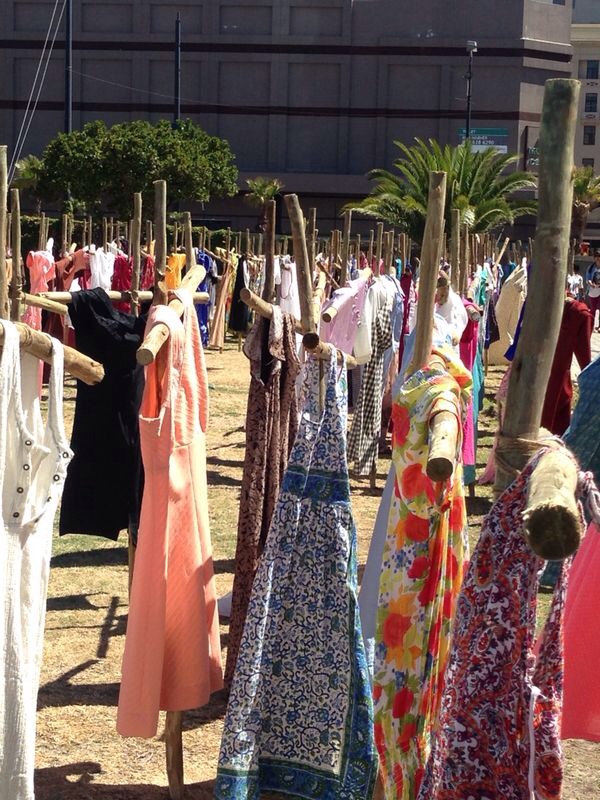
The installation “3600 A Day” at Infecting The City – Cape Town, 2014. Photo: Asanda Kaka

This past week, I experienced a powerfully evocative art installation by Asanda Kaka and Valentina Argirò addressing (no pun intended!) the silent magnitude of this scourge during Cape Town’s annual public arts festival, Infecting The City.

On approaching the rows of dresses hung on crosses, one’s face materialises in mirrors positioned in the “head” space above the dresses, making it impossible to distance one’s own body from the figures represented.

Venue: Cape Town Station
Date: 14 & 15 MARCH 2014

asanda kaka - 3600 per day

The installation “3600 A Day” at Infecting The City – Cape Town, March 2014. Photo: Asanda Kaka

ARTISTS’ STATEMENT

According to a report issued by UNISA, at least one rape case is reported every four minutes in South Africa – this translates into approximately 360 cases per day. 3600 A Day is an installation of women’s’ clothes, donated by women in support of the project. The exaggerated number of 3600 serves to highlight the magnitude of the problem and the number of unreported cases of violence against women and children. In a visual shock of magnitude, the installation warns against the normalisation of such violence.

Installed on crosses, the dresses represent the individual, yet also communal impact that abuse has on all women and children in this country. Reflected in the mirrors on top of the crosses are the faces of those who approach – possible victims, perpetrators or bystanders.

chelsea wolfe – halfsleeper (live)

All the things we yell don’t mean a thing
When we’re spinning out of darkened meadow wind
When we’re flying like we’re Mary’s angels through the shattered glass
When we find that tall dark shadow waiting there with outstretched hands
He has given me a dress of red and you a skin of gray
We’ll be twisting here for hours ’til the light will bring us day

And we’re spread across the open road
And we’re spread across the asphalt on the open road
And we’re streaming in the wind like cassette tape or jellyfish
Long dark veins and records playing memories

(Hear the album version HERE.)

“miners shot down” showing tonight in cape town

EVERYONE IN SOUTH AFRICA NEEDS TO SEE THIS FILM.

miners marikana

In August 2013, mineworkers in one of South Africa’s biggest platinum mines began a wildcat strike for better wages. Six days later the police used live ammunition to brutally suppress the strike, killing 34 and injuring many more. Using the point of view of the Marikana miners, Miners Shot Down follows the strike from day one, showing the courageous but isolated fight waged by a group of low-paid workers against the combined forces of the mining company Lonmin, the government and their allies in the National Union of Mineworkers. What emerges is a collusion at the top, spiraling violence and the country’s first post-apartheid massacre. South Africa will never be the same again.

Read more about this documentary HERE.

ken jacobs on the archive

“I wish more stuff was available in its raw state, as primary source material for anyone to consider, and to leave for others in just that way, the evidence uncontaminated by compulsive proprietary misapplied artistry, “editing”, the purposeful “pointing things out” that cuts a road straight and narrow through the cine-jungle; we barrel through thinking we’re going somewhere and miss it all. Better to just be pointed to the territory, to put in time exploring, roughing it, on our own. For the straight scoop we need the whole scoop, or no less than the clues entire and without rearrangement. O, for a Museum of Found Footage, or cable channel, library, a shit-museum of telling discards accessible to all talented viewers/auditors. A wilderness haven salvaged from Entertainment.”

— The impossible idealism of Ken Jacobs (check out his films on UBUWEB). This is a quote from the hand-illustrated programme of his 1989 retrospective, Films that Tell Time – see a PDF HERE.

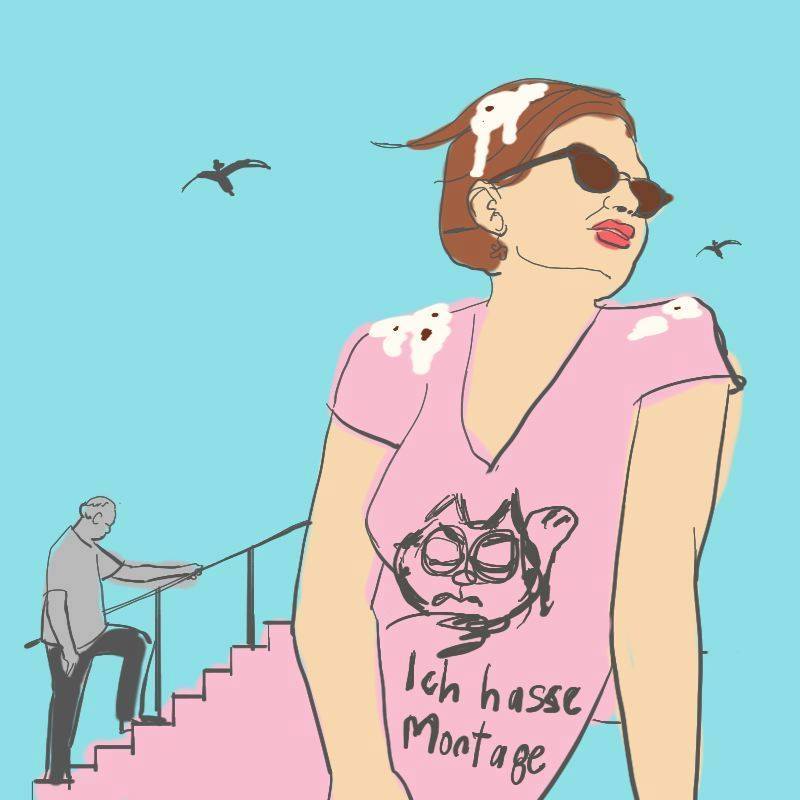
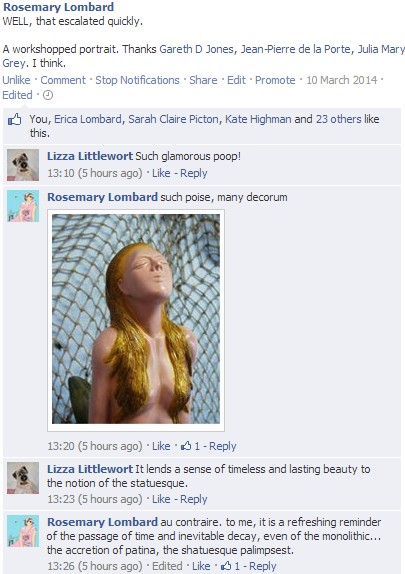
well, that escalated quickly.

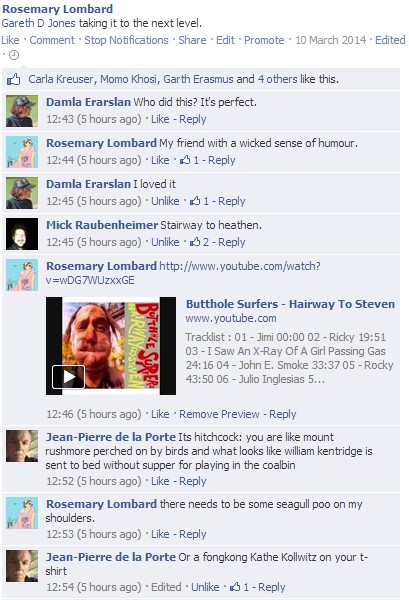
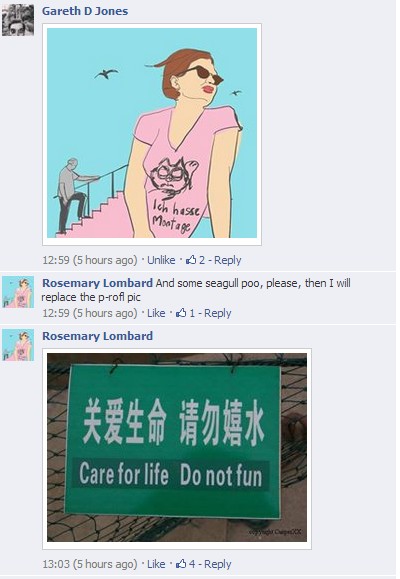
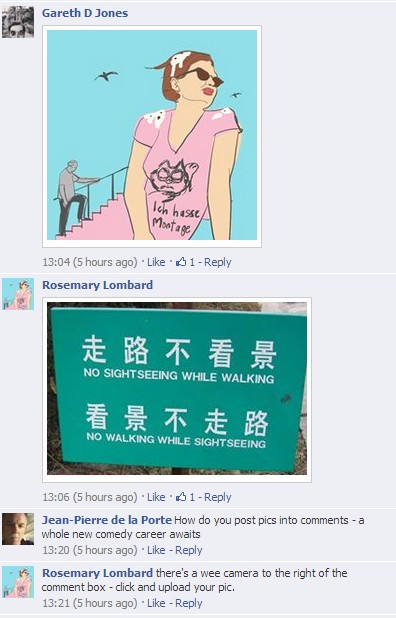
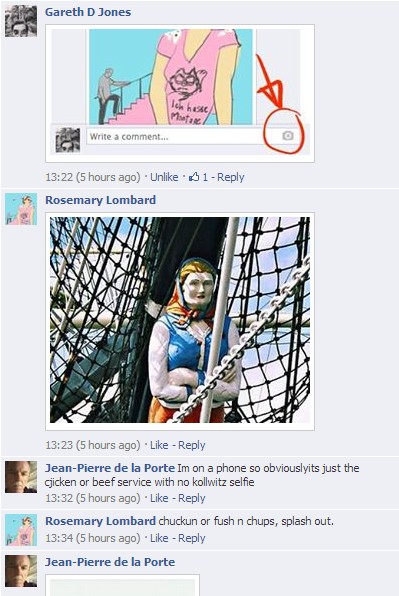
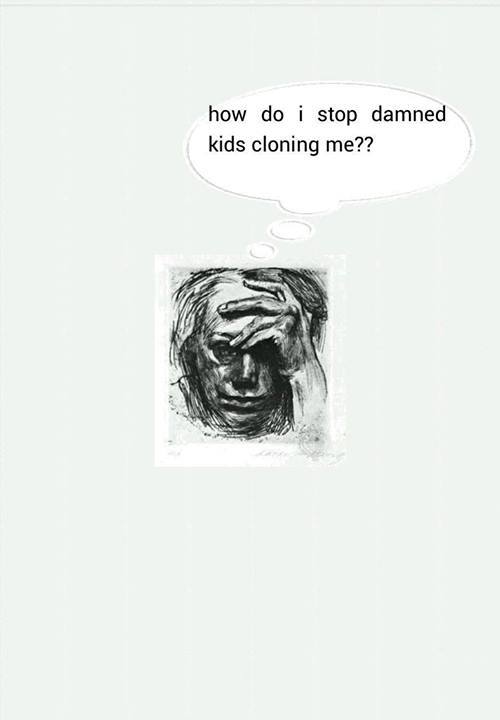
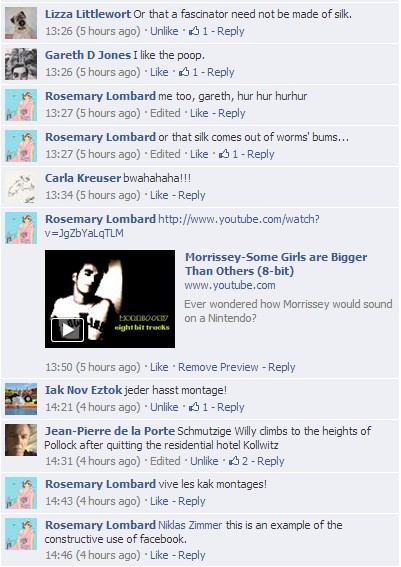
This is what Facebook is really for. Here is a funny conversation that evolved into a collaborative portrait in layers on my wall over a few hours today, a particularly suffocating Monday. I’m keeping this as a snapshot of what creative people used to do when bored silly with social media in 2014.

Photo by Julia Mary Grey, Kalk Bay harbour, Saturday 8 March, 2014

Photo by Julia Mary Grey, Kalk Bay harbour, Saturday 8 March, 2014

sea 1 comments

sea 2

By Gareth Jones,  in response to comments under the original image

sea 2a
sea 2b

sea 2c

sea 2d

By Jean-Pierre Delaporte

By Jean-Pierre de la Porte

http://youtu.be/IpZAWP-H9ws

sea 2e

Meanwhile, on another thread…

sea 3

By Gareth Jones, third iteration, after further comments under his first drawing

sea 3a

sea 3b

http://youtu.be/JgZbYaLqTLM

sea 3c

sea 3d

little willie john – my love is

William Edward John (November 15, 1937 – May 26, 1968), better known by his stage name Little Willie John, was an American R&B singer who performed in the 1950s and early 1960s. He is best known for his popular music chart hits, such as “Fever” in 1956 (later covered in 1958 by Peggy Lee).

Infamous for his short temper and propensity to abuse alcohol, Willie John was dropped by his record company in 1963. In 1966, he was convicted of manslaughter and sent to Washington State Penitentiary following a fatal knifing incident after a show in Seattle. He appealed against his conviction and was released while the case was reconsidered, during which time he recorded what was intended to be his comeback album, but owing to contractual wrangling and the decline of his appeal, it was not released until 2008. He died in 1968 at Washington State Penitentiary in Walla Walla, Washington. His official cause of death (at the age of just 30) was listed on the death certificate as a heart attack. (Info from Wikipedia.)

brigitte fontaine – dévaste-moi

Dévaste-moi, essouffle-moi, envahis-moi et pille-moi, dépense-moi, gaspille-moi
Saccage-moi, dilapide-moi, lapide-moi et râpe-moi, liquide-moi, émiette-moi
Ravage-moi et presse-moi et puis broie-moi et puis noie-moi et puis
bois-moi et cueille-moi
Colonise-moi, piétine-moi, déglutis-moi, extermine-moi, ravage-moi, délabre-moi
Ratisse-moi, corrode-moi, démantèle-moi, désintègre-moi, massacre-moi,
écrabouille-moi
Mais c’est qu’il le ferait la brute !

light from a dead star

“All these dead suns, these posthumous rays which take millions of light-years to reach us, asteroids, fragments of dead worlds, shattered and exploded, old moons, flawed and cankered, crusts, sores, blotches, cold lupus, devouring leprosy, sanies, and that last drop of pearl-like light, the purest of all, sweating at the highest point of the firmament and about to fall… is not a tear nor a dewdrop, but a drop of pus. The universe is in the process of decomposing and, like a cemetery, it swarms with becoming and smells good. The stars are unguent-bearing and throb feverishly; each ray carries seeds sown in the brain of man, and they are the seeds of destruction. Grey matter contains sunspots that eat into the whole circumference of the brain. It is an index of disintegration. Thought is a pestilence.”

— Blaise Cendrars, from Sky, the 1992 English translation of Le Lotissement du Ciel (1949).

Illustration: Fernand Léger, 1919

Illustration: Fernand Léger, 1919

Sky, the last of Cendrar’s four autobiographical volumes, is a collage of prose poetry, travel writing, reportage, detective story, and personal memoir.

“He recounts his adventures in Russia during the revolution of 1905, in the trenches of World War I (where he lost his right arm), in Brazil in the 1920s, and behind the lines during World War II. The two wars run throughout as a unifying thread. As the title announces, this is a memoir of the sky – of Cendrars’s love of birds, levitation, and aviation. The opening of the book finds Cendrars, the great adventurer and traveler, sailing back from Brazil to Paris with 250 multi-colored birds, hoping to bring at least one of them alive to a child he loves.

The second part moves back and forth between the author’s recollections of life as a war correspondent in 1940 and an encyclopedic discourse on levitation he wrote in search of a patron saint of aviation (perhaps as compensation for the death of his young son, Remy, who was a pilot during the war). With unmatched exuberance, Cendrars writes on poetry, myths, existentialism, his life in Paris between the wars with the painter Delaunay and the Dadaists, and his exotic adventuresin Brazil. His anecdotes of Russia, where he was a jeweller’s assistant, are compelling and funny. His fiercely imaginative stories, such as one about a Brazilian coffee plantation owner who, obsessed with his love for Sarah Bernhardt, retreats into the wilderness, are magical.”

(I found this review HERE.)

la fin du monde

Illustration: Fernand Léger

this heat – deceit (full album)

Released on Rough Trade in 1981, Deceit is a dark, intense post-punk classic. Band member Charles Hayward said of the zeitgeist that shaped the album:

“The whole speak, ‘Little Boy’, ‘Big Boy’, calling missiles cute little names. The whole period was mad! We had a firm belief that we were going to die and the record was made on those terms.… The whole thing was designed to express this sort of fear, angst, which the group was all about, really… Some of the album was really plush sounding, some dim and pokey. Sometimes it would sound like the machinery was breaking up. We deliberately would make it sound as though the record player was exploding.”

Read more about this brilliant album at DROWNED IN SOUND.

Track List

Sleep 0:00
Paper Hats 2:14
Triumph 8:17
S.P.Q.R. 11:12
Cenotaph 14:41
Shrink Wrap 19:20
Radio Prague 21:01
Makeshift Swahili 23:23
Independence 27:27
A New Kind Of Water 31:09
Hi Baku Shyo 36:06
__________________________________
Charles Hayward — Vocals, Bass Guitar, Keyboards, Drums, Tape Music
Gareth Williams — Vocals, Bass Guitar, Keyboards, Tape Music
Charles Bullen — Vocals, Clarinet, Guitar, Drums, Tape Music

David Cunningham — Production
Martin Frederick — Mixing
Laurie-Rae Chamberlain — Colour Xerography
Nicholas Goodall — Sleeve Photography Direction
Studio 54 — Sleeve Design

stepan razin’s dream (Казачья Притча)

Oy, to ne vecher” (Ой, то не вечер) is the incipit of a Russian folk song, also known as “The Cossack’s Parable” (Казачья Притча) or as “Stepan Razin’s Dream” (Сон Степана Разина). It was first published by composer Alexandra Zheleznova-Armfelt (1870–1933) in her collection Songs of the Ural Cossacks after her fieldwork in the Ural District during 1896–1897.

The original lyrics were in seven verses, with verse six making explicit that the dreamer is 17th century cossack rebel Stepan Razin. Razin has a dream, and his captain (esaul) interprets it as an omen of their defeat.

The song has been performed in several variants, sometimes expanded to up to eleven verses, but in the most common variant as sung by modern interpreters, it is reduced to four verses, removing the mention of Razin, and reducing the three omens in the dream to a single one.These lyrics may be translated thus:

Ah, it is not yet evening but I have taken a little nap, and a dream came to me. In the dream that came to me, it was as if my raven-black horse was playing about, dancing about, frisky beneath me.  Ah, and evil winds came flying out of the east, and they ripped the black cap from that wild head of mine.

And the esaul* was a clever one, he was able to interpret my dream: “Ah, it will surely come off”, he said, “that wild head of yours”.

Source of information: Wikipedia.

*Esaul: a post and rank in prerevolutionary Russia in the cossack hosts after 1576.

chris marker - staring back

Photo: Chris Marker, “Staring Back”

alain resnais/chris marker – statues also die (1953)

“We want to see their suffering, serenity, humour, even though we don’t know anything about them.”

Directors: Alain Resnais & Chris Marker
Narrator – Jean Négroni
Music – Guy Bernard

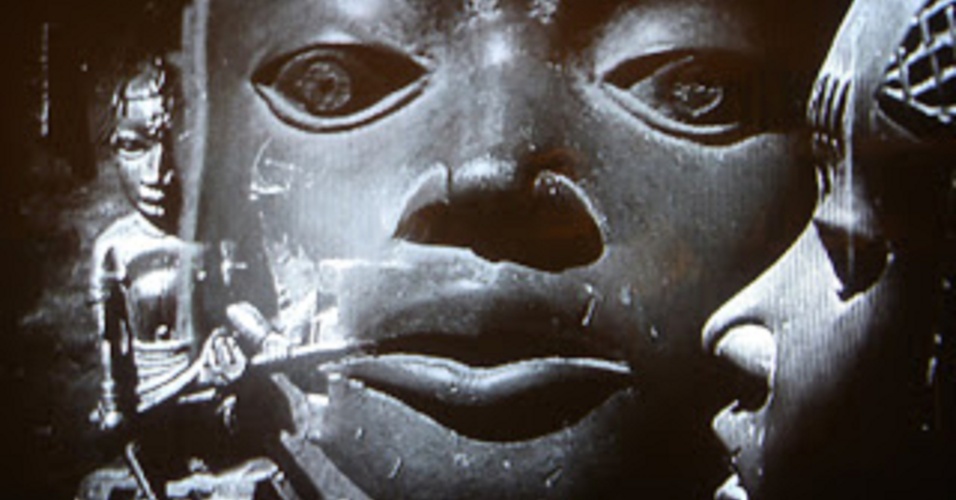
A collaborative work by Resnais and Marker, this is a deeply felt study of African art and the decline it underwent as a result of its contact with Western civilization. The film was banned for more than a decade by French censors as an attack on French colonialism, and is now only available to watch in the shortened version I’ve posted here (turn on the subtitles on Youtube if you want English subtitling).

Statues Also Die traces the devastating impact of French colonialism on African art. As Resnais’ co-director, Chris Marker, stated, “We want to see their suffering, serenity, humor, even though we don’t know anything about them.” Their film shows what happens when art loses its connection to its cultural context of production. Witty, thoughtful commentary is combined with images of stark formal beauty in this outcry against the fate of an art once integral to communal life that became debased as it fell victim to the demands of a different system of knowledge and values.

statues also die
From Wikipedia:

Statues Also Die (French: Les Statues meurent aussi) is a 1953 French essay film directed by Chris Marker and Alain Resnais, about historical African art and the effects colonialism has had on how it is perceived. The film won the 1954 Prix Jean Vigo. Because of its criticism of colonialism, the second half of the film was censored in France until the 1960s.

Synopsis

The film exhibits a series of sculptures, masks and other traditional art from Sub-Saharan Africa. The images are frequently set to music and cut to the music’s pace. The narrator focuses on the emotional qualities of the objects, and discusses the perception of African sculptures from a historical and contemporary European perspective. Only occasionally does the film provide the geographical origin, time period or other contextual information about the objects. The idea of a dead statue is explained as a statue which has lost its original significance and become reduced to a museum object, similarly to a dead person who can be found in history books. Interweaved with the objects are a few scenes of Africans performing traditional music and dances, as well as the death of a disemboweled gorilla.

During the last third of the film, the modern commercialisation of African culture is problematised. The film argues that colonial presence has compelled African art to lose much of its idiosyncratic expression, in order to appeal to Western consumers. A mention is made of how African currencies previously had been replaced by European. In the final segment, the film comments on the position of black Africans themselves in contemporary Europe and North America. Footage is seen from a Harlem Globetrotters basketball show, of the boxer Sugar Ray Robinson, and a jazz drummer intercut with scenes from a confrontation between police and labour demonstrators. Lastly the narrator argues that we should regard African and European art history as one inseparable human culture.

why monsanto is evil (it’s not science-fiction)

agent orange

HERE is an article discussing some of the non-“woo” (pseudo-scientific hippie freak-out) reasons why companies like Monsanto pushing genetically modified products are doing evil: the corporate imperatives and corruption surrounding the development of GMOs, how their use disempowers farmers (especially small farmers in non-first world contexts, although this article only talks about the USA) and what we can do about this deception being perpetrated against the world.

Apart from being economically unsustainable, there are also other compelling health-related reasons why GMOs are a bad idea, which don’t involve a non-specific, irrational fear of genetic mutations being dangerous to consume per se. For example, the seeds are engineered to be resistant to pesticides so that crops can be sprayed and only the weeds growing among the GM plants die. Studies have shown that GM food (or the meat of animals that ate GM food) can be contaminated by traces of the pesticides used during the plants’ growth, pesticides that are teratogenic (causing birth defects) and carcinogenic (causing cancer)  to humans. These modifications also lead to resistance in plants and insect pests – “superweeds” and “superbugs” that make sustainable farming more difficult.

If you are South African, please GO HERE to sign a petition as part of the formal public participation process against an application by multinational agricultural company Dow AgroSciences, a wholly owned subsidiary of the Dow Chemical Company, to import GM cottonseed products to South Africa, for use as food, animal feed and in processing. 

chhoun vanna – toa thea youm chlong (birds are singing but my lover won’t return)

“The birds are chirping, to and fro
My love, have you forgotten me?
As water can’t cut through the sand
I can’t cut you from my memories
The bridge (between you and I) has broken
The pathway is gone, and the water is so very deep
How am I to find you on the other side, so far away?”

Chhoun Vanna was a Cambodian singer between the 1950s and ’70s. She and her sister Chhoun Malai survived the Khmer Rouge genocide.

ros sereysothea – who’ll stop the rain?

Cambodian cover by Ros Sereysothea and Sinn Sisamouth of Creedence Clearwater Revival’s “Who’ll Stop The Rain?”. They died under unknown circumstances during the Khmer Rouge reign of terror,  as did countless other artists and intellectuals murdered in Pol Pot’s Killing Fields, and this recording only survived on tapes smuggled out of the country.

“Long as I remember the rain been comin’ down.
Clouds of mystery pourin’ confusion on the ground.
Good men through the ages, tryin’ to find the sun;
And I wonder, still I wonder, who’ll stop the rain.”

Read more of their story HERE.

ros sereysothea – i will starve myself to death/ shave your beard

I hardly ever put on a cd or listen to an LP these days (last is prolly due to the fact,that I killed my speakers/amplifier). In fact i am totally addicted to the net when it comes to music. I also am an avid KCRW listener. I often tune in to Henry Rollins’s radio show on KCRW. Henry does all the searching, comes up with all the cool tunes from every genre all over the place and all I have to do is listen. It was due to his radio show that i started listening to Sinn Sisamouth. This led me to Ros Sereysothea. I am 100% fascinated with her singing and music.

For the last days, I keep playing over and over this on Spotify:’ ‘Dengue Fever Presents Electric Cambodia”. Sounds amazing,and wished that i could understand the language. All performers on this compilation are dead,or ”vanished”. Killed/died during the communist Khmer Rouge regime.

”Electric Cambodia may be one of the saddest and most enraging compilations released this year—not for the music, but for the history. The performers are dead, all dead, or “vanished” into the Killing Fields—murdered, presumably, although the how is a mystery. Did they die quickly or slowly? ” – read more of this review HERE.

Ros Sereysothea – Shave your Beard

hannah arendt on the relationship between violence and power (1969)

To switch for a moment to conceptual language: Power is indeed of the essence of all government, but violence is not. Violence is by nature instrumental; like all means, it always stands in need of guidance and justification through the end it pursues. And what needs justification by something else cannot be the essence of anything. The end of war – end taken in its twofold meaning – is peace or victory; but to the question “And what is the end of peace?” there is no answer. Peace is an absolute, even though in recorded history periods of warfare have nearly always outlasted periods of peace. Power is in the same category; it is, as they say, “an end in itself.” (This, of course, is not to deny that governments pursue policies and employ their power to achieve prescribed goals. But the power structure itself precedes and outlasts all aims, so that power, far from being the means to an end, is actually the very condition enabling a group of people to think and act in terms of the means-end category.)

And since government is essentially organized and institutionalized power, the current question “What is the end of government?” does not make much sense either. The answer will be either question-begging – to enable men to live together – or dangerously utopian – to promote happiness or to realize a classless society or some other nonpolitical ideal, which if tried out in earnest cannot but end in some kind of tyranny.

Power needs no justification, being inherent in the very existence of political communities; what it does need is legitimacy. The common treatment of these two words as synonyms is no less misleading and confusing than the current equation of obedience and support. Power springs up whenever people get together and act in concert, but it derives its legitimacy from the initial getting together rather than from any action that then may follow. Legitimacy, when challenged, bases itself on an appeal to the past, while justification relates to an end that lies in the future.

assholesViolence can be justifiable, but it never will be legitimate. Its justification loses in plausibility the farther its intended end recedes into the future. No one questions the use of violence in self-defense, because the danger is not only clear but also present, and the end justifying the means is immediate.

Power and violence, though they are distinct phenomena, usually appear together. Wherever they are combined, power, we have found, is the primary and predominant factor. The situation, however, is entirely different when we deal with them in their pure states – as, for instance, with foreign invasion and occupation. We saw that the current equation of violence with power rests on government’s being understood as domination of man over man by means of violence. If a foreign conqueror is confronted by an impotent government and by a nation unused to the exercise of political power, it is easy for him to achieve such domination. In all other cases the difficulties are great indeed, and the occupying invader will try immediately to establish Quisling governments, that is, to find a native power base to support his dominion. The head-on clash between Russian tanks and the entirely nonviolent resistance of the Czechoslovak people is a textbook case of a confrontation between violence and power in their pure states. But while domination in such an instance is difficult to achieve, it is not impossible.

Violence, we must remember, does not depend on numbers or opinions, but on implements, and the implements of violence, as I mentioned before, like all other tools, increase and multiply human strength. Those who oppose violence with mere power will soon find that they are confronted not by men but by men’s artifacts, whose inhumanity and destructive effectiveness increase in proportion to the distance separating the opponents. Violence can always destroy power; out of the barrel of a gun grows the most effective command, resulting in the most instant and perfect obedience. What never can grow out of it is power.

desmond tutu condemns uganda’s proposed new anti-gay law

“We must be entirely clear about this: the history of people is littered with attempts to legislate against love or marriage across class, caste, and race. But there is no scientific basis or genetic rationale for love. There is only the grace of God. There is no scientific justification for prejudice and discrimination, ever. And nor is there any moral justification. Nazi Germany and apartheid South Africa, among others, attest to these facts.”

— Desmond Tutu reacting against the proposed enactment of homophobic legislation in Uganda. Read more about it HERE.

tutu

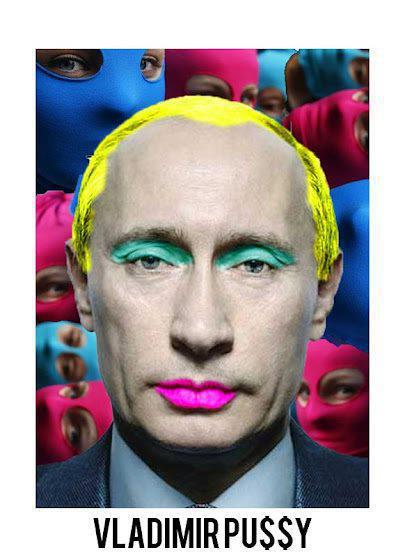
pussy riot – putin will teach you how to love

Released on 19 February 2014 – Translation of lyrics into English by Julia Ioffe*:

$50 billion and a rainbow ray
Rodnina and Kabayeva will pass you the torch
They’ll teach you to submit and cry in the camps
Fireworks for the bosses. Hail, Duce!

Sochi is blocked, Olympus is under surveillance
Special forces, weapons, crowds of cops
FSB — argument, Interior Ministry — Argument
On [state-owned] Channel 1 — applause

Putin will teach you to love the Motherland

In Russia, the spring can come suddenly
Greetings to the Messiah in the form of a volley from
Aurora, the prosecutor is determined to be rude
He needs resistance, not pretty eyes

A bird cage for protest, vodka, nesting doll
Jail for the Bolotnaya [activists], drinks, caviar
The Constitution is in a noose, [environmental activist] Vitishko is in jail
Stability, food packets, fence, watch tower

Putin will teach you to love the Motherland

They will turn off [opposition TV] Dozhd’s broadcast
The gay parade has been sent to the outhouse
A two-point bathroom is the priority
The verdict for Russia is jail for six years

Putin will teach you to love the Motherland

Motherland
Motherland
Motherland

* Read the original article with explanatory links on selected words for better understanding of the context HERE.

Free Pussy Riot

éléonore pourriat – oppressed majority (majorité opprimée)

What does a day in the life of a woman look like? Maybe it’s easier to see if the woman is a man. Oppressed Majority (2010) is a French short by Éléonore Pourriat which uses role reversals to shine a new light on the micro-aggressions and macro-aggressions that are an all-too-common part of the female experience. Via wifey.tv.