marchel duchamp took the credit for his friend elsa’s work

Just another sorry tale of appropriation:

Evidence that Marcel Duchamp may have stolen his most famous work, Fountain, from a woman poet has been in the public domain for many years. But the art world as a whole—museums, academia and the market—has persistently refused to acknowledge this fact.

The Museum of Modern Art (MoMA) in New York is the latest eminent body to bury its head in the sand. It has just published a new edition of Calvin Tomkins’s 1996 life of Duchamp, updated by its author. Ann Temkin, MoMA’s chief curator of painting and sculpture, praises Tomkins in her introduction for his “thorough research”. But Tomkins avoids addressing the implications of the question marks over the origins of the work that Duchamp himself raised in 1917.

Irene Gammel and Glyn Thompson have revealed the truth of his much earlier private account that he did not submit the urinal to the Society of Independent Artists exhibition in New York in 1917. Nevertheless, Duchamp’s late, fictional story is still taught in every class and recited in every book…

Should museums re-label the work Fountain as “a replica, appropriated by Marcel Duchamp (1887-1968), of an original by Baroness Elsa von Freytag-Loringhoven (1874-1927)”? Photo: Felix Clay

Should museums re-label the work Fountain as “a replica, appropriated by Marcel Duchamp (1887-1968), of an original by Baroness Elsa von Freytag-Loringhoven (1874-1927)”? Photo: Felix Clay

… Duchamp wrote to his sister, a nurse in war-torn Paris, telling her that “one of my female friends under a masculine pseudonym, Richard Mutt, sent in a porcelain urinal as a sculpture”. The explosive contents of this letter did not enter the public domain until 1983 when the missive was published in the Archives of American Art Journal.

The mere fact that Duchamp referred to the urinal as a sculpture suggests that it could not have been his, since by 1913, prompted by the work of the wealthy, chess-playing writer Raymond Roussel, he had stopped creating art. His Roussel-inspired “Readymades” were elaborate, personal rebuses to be read, not viewed.

The literary historian Irene Gammel was the first to discover who Duchamp’s “female friend” was. She was born Else Plötz in Germany in 1874, the daughter of a builder and local politician who philandered freely and beat her mother. Afflicted with syphilis, her mother attempted suicide and died later in an institution. As Elsa put it, she “left me her ­heritage… to fight”.

Elsa first married the leading Jugendstil architect August Endell, then Felix Paul Greve, the translator of Oscar Wilde, who faked his own suicide to escape his creditors and fled with Elsa to America. Her third marriage was to Leopold Karl Friedrich Baron von Freytag-Loringhoven, the impoverished son of a German aristocrat who had also escaped to America to avoid debts. He soon ­vanished with Elsa’s paltry savings but left her with a title and entrée into artistic circles in New York.

Elsa simultaneously inspired and repelled all who came into contact with her, from Ezra Pound to Ernest Hemingway. Nevertheless The Little Review treated her as a star and ­published her poems alongside excerpts from James Joyce’s Ulysses. Elsa’s genius was to find new ways to break out of the social straightjacket that bound women so that she could fight her mother’s battle in public, whenever and wherever she wanted, not when men told her she could.

In October 1917, the painter George Biddle described her room in New York filled with “odd bits of ­ironware, automobile tiles… ash cans, every conceivable horror, which to her tortured yet highly sensitive ­perception, became objects of formal beauty… it had to me quite as much authenticity as, for instance, Brancusi’s studio in Paris.”

Elsa was a poet of found objects, but she didn’t leave them as they were—she transformed them into works of art.

Elsa exploded in fury when the US declared war on her motherland, on Good Friday, 6 April 1917. Her ­target was the Society of Indepen­dent Artists, whose representatives had consistently cold-shouldered her. We believe she submitted an upside-down urinal, signed R. Mutt in a script similar to the one she sometimes used for her poems.

Armut—the homophone of R. Mutt—has many resonances in German. It is used in common phrases to mean “poverty”, and in some contexts “intellectual poverty”. Elsa’s submission was a double-pronged attack. The society was hoist by its own petard, for in accepting the entry it would demonstrate its inability to distinguish a work of art from an everyday object, but in rejecting it, it would break its own rule that the definition of what was art should be left to the submitting artist. Hence the “intellectual poverty” of its stance.

The urinal was Elsa’s declaration of war against a man’s war—an extraordinary visual assault on all that men stood for. As a sculpture of a transformed everyday object, it deserves to rank alongside Picasso’s Bull’s Head, 1942, made of bicycle ­handlebars and a saddle, and Dali’s Lobster Telephone, 1936.

If Duchamp did not submit the urinal, why would he pretend later that he did? After Elsa died in 1927, forgotten and in abject poverty, Duchamp began to let his name be associated with the urinal, and by 1950, four years after the death of Alfred Stieglitz, who photographed the original Fountain, he began to assume its authorship…

… When the mood took him, Duchamp could be honest about his dishonesty. In an interview in 1962, he told William Seitz: “I insist every word I am telling you now is stupid and wrong.” Why, then, has the art world persisted in believing an account grounded in the myths he promulgated?

Sélavy, baby… Read the full article HERE.
the goatman

combo

What is male sexuality, and will it always fuck you in the eye? Confronted by an eager male who intrudes into your space, the turn-on is the confidence, the turn-off is the arrogance. It’s great that the male is being forthright, but is he like this with just you, or every sexual object in his vicinity? If he fucks you, is he fucking you or his fantasy? My wife replied when I said I connect with her during sex, no, you connect with yourself ..

ravel – shéhérazade, part II – la flûte enchantée

(Bożena Bujnicka – soprano, Paweł Sommer – piano)
A song cycle by Ravel, first performed in 1904. More information about the composition can be found HERE.

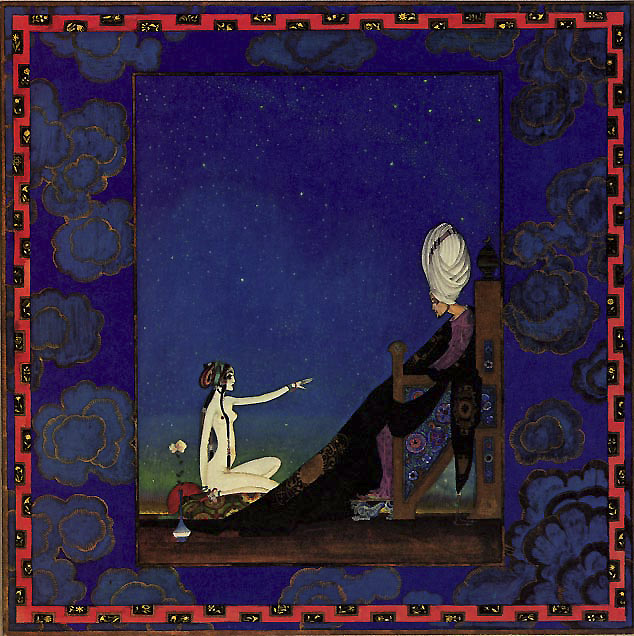
The shade is soft and my master sleeps
Wearing a conical hat of silk,
His long yellow nose in his white beard.
But me, I’m yet awake,
Listening to the melody of a flute outside
which pours forth, in turns, sadness and joy,
An air in turns languid or frivolous,
Which my darling love plays.
And when I approach the window,
It seems to me that each note flies
From the flute to my cheek
Like a mysterious kiss.

kay nielsen_arabian_nights

L’ombre est douce et mon maître dort
Coiffé d’un bonnet conique de soie
Et son long nez jaune en sa barbe blanche.
Mais moi, je suis éveillée encor
Et j’écoute au dehors
Une chanson de flûte où s’épanche
Tour à tour la tristesse ou la joie.
Un air tour à tour langoureux ou frivole
Que mon amoureux chéri joue,
Et quand je m’approche de la croisée
Il me semble que chaque note s’envole
De la flûte vers ma joue
Comme un mystérieux baiser.


insight into patriarchy…

… gained from storyboarding an endless stream of jock lager ads:

Where men are a caricature of manliness, their sexuality depends on them always being The Ones Who Know, who are worldly and can sum up reality in short, pithy bro-repartee (bropartee). To achieve this, they need to simplify reality into easy-to-read contrasts, with rules in big type, so they don’t have to suffer the shrivelling-dick humiliation of being faced with complexity.

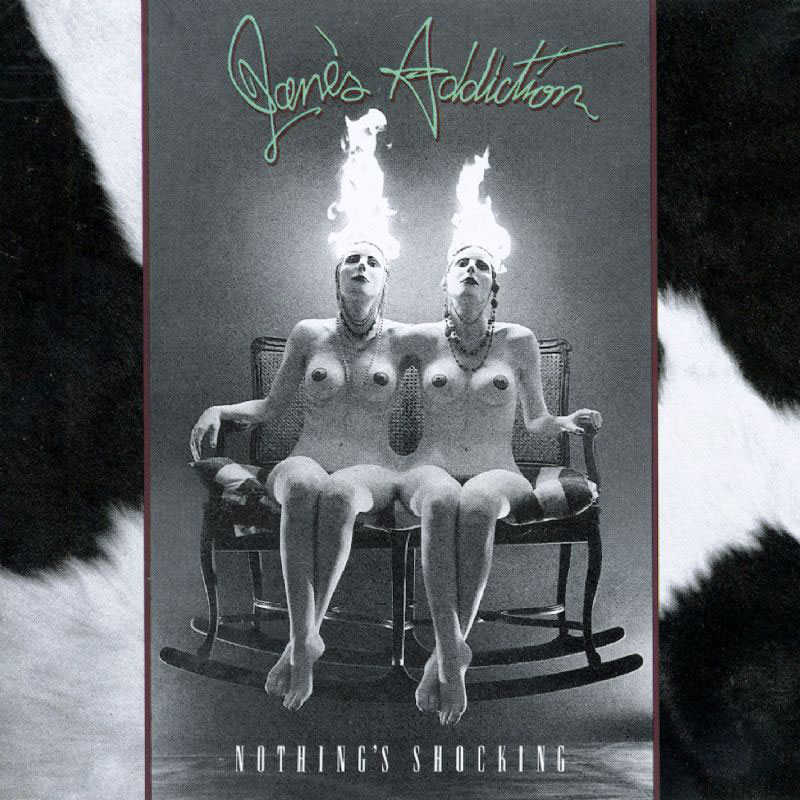
beer

on the vulgarity of “identity”

I feel with some passion that what we truly are is private, and almost infinitely complex, and ambiguous, and both external and internal, and double- or triple- or multiply natured, and largely mysterious even to ourselves; and furthermore that what we are is only part of us, because identity, unlike “identity”, must include what we do.

And I think that to find oneself and every aspect of this complexity reduced in the public mind to one property that apparently subsumes all the rest (“gay”, “black”, “Muslim”, whatever) is to be the victim of a piece of extraordinary intellectual vulgarity. Literally vulgar: from vulgus. It’s crowd-thought.

— Philip Pullman

kola boof

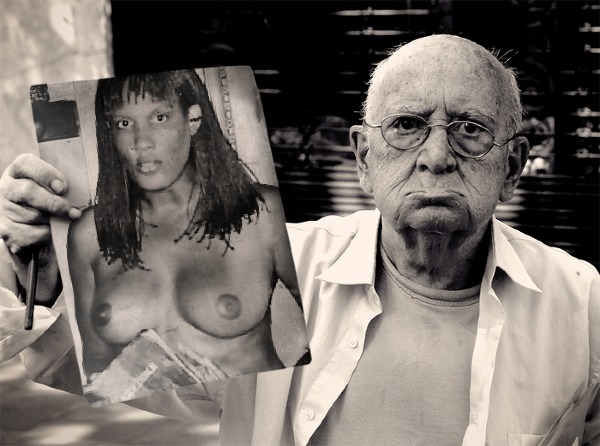
This Ohio bookseller refuses to carry African writer Kola Boof's novels because of nudity.

This Ohio bookseller refuses to carry African writer Kola Boof’s novels because of nudity.

“I don’t agree that I am controversial. What I feel is that most people are not critical thinkers.  The society tells them what to believe, what to think…and their knee jerk reactions are guided completely by that conditioning.  They usually realize later on that what I’m saying is not controversial… when they take time and think in depth.  Even if they don’t agree with me… they understand what I’m saying without all the claims of being shocked by controversy.  I’m not a controversial person if you’re a critical thinker.”

Check out Kola Boof’s website, where you can also read more of this interview.

joan didion, interviewed by linda kuehl in 1977

Here are some excerpts from an interview with Joan Didion that appeared in The Paris Review No. 74, Fall-Winter 1978. She talks about the performative violence of writing, and of the sometimes paralysing self-consciousness that attends it.

Reading her responses, I identified so personally that at points it felt like she could have been writing my own thoughts, down to the constrictions of that harsh Protestant ethic. But I’m not as strong as Joan. The nausea tends to silence me… except when it’s overwhelming: then, I vomit it out, sometimes all over unsuspecting passersby!

I especially liked what she says about how growing up in a dangerous landscape can affect one’s engagement with the world. I have often wondered whether I would be at all like I am if I hadn’t grown up in the turmoil of ’80s and ’90s South Africa. It wasn’t just about the weather, here.

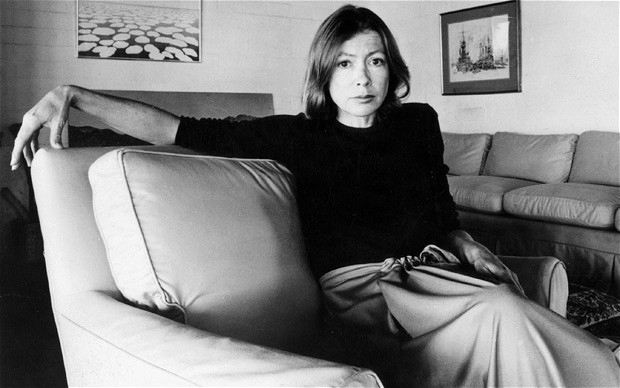
Joan Didion, 1977. Photo: REX FEATURES

Joan Didion, 1977. Photo: REX FEATURES

INTERVIEWER

You have said that writing is a hostile act; I have always wanted to ask you why.

JOAN DIDION

It’s hostile in that you’re trying to make somebody see something the way you see it, trying to impose your idea, your picture. It’s hostile to try to wrench around someone else’s mind that way. Quite often you want to tell somebody your dream, your nightmare. Well, nobody wants to hear about someone else’s dream, good or bad; nobody wants to walk around with it. The writer is always tricking the reader into listening to the dream.

INTERVIEWER

Are you conscious of the reader as you write? Do you write listening to the reader listening to you?

DIDION

Obviously I listen to a reader, but the only reader I hear is me. I am always writing to myself. So very possibly I’m committing an aggressive and hostile act toward myself.

INTERVIEWER

So when you ask, as you do in many nonfiction pieces, “Do you get the point?” you are really asking if you yourself get the point.

DIDION

Yes. Once in a while, when I first started to write pieces, I would try to write to a reader other than myself. I always failed. I would freeze up.

INTERVIEWER

You say you treasure privacy, that “being left alone and leaving others alone is regarded by members of my family as the highest form of human endeavor.” How does this mesh with writing personal essays, particularly the first column you did for Life where you felt it imperative to inform the reader that you were at the Royal Hawaiian Hotel in lieu of getting a divorce?

DIDION

I don’t know. I could say that I was writing to myself, and of course I was, but it’s a little more complicated than that. I mean the fact that eleven million people were going to see that page didn’t exactly escape my attention. There’s a lot of mystery to me about writing and performing and showing off in general. I know a singer who throws up every time she has to go onstage. But she still goes on.

INTERVIEWER

Did any writer influence you more than others?

DIDION

I always say Hemingway, because he taught me how sentences worked. When I was fifteen or sixteen I would type out his stories to learn how the sentences worked. I taught myself to type at the same time. A few years ago when I was teaching a course at Berkeley I reread A Farewell to Arms and fell right back into those sentences. I mean they’re perfect sentences. Very direct sentences, smooth rivers, clear water over granite, no sinkholes.

INTERVIEWER

You’ve called Henry James an influence.

DIDION

He wrote perfect sentences, too, but very indirect, very complicated. Sentences with sinkholes. You could drown in them. I wouldn’t dare to write one. I’m not even sure I’d dare to read James again. I loved those novels so much that I was paralyzed by them for a long time. All those possibilities. All that perfectly reconciled style. It made me afraid to put words down.

INTERVIEWER

I wonder if some of your nonfiction pieces aren’t shaped as a single Jamesian sentence.

DIDION

That would be the ideal, wouldn’t it. An entire piece—eight, ten, twenty pages—strung on a single sentence. Actually, the sentences in my nonfiction are far more complicated than the sentences in my fiction. More clauses. More semicolons. I don’t seem to hear that many clauses when I’m writing a novel.

INTERVIEWER

You have said that once you have your first sentence you’ve got your piece. That’s what Hemingway said. All he needed was his first sentence and he had his short story.

DIDION

What’s so hard about that first sentence is that you’re stuck with it. Everything else is going to flow out of that sentence. And by the time you’ve laid down the first two sentences, your options are all gone.

INTERVIEWER

The first is the gesture, the second is the commitment.

DIDION

Yes, and the last sentence in a piece is another adventure. It should open the piece up. It should make you go back and start reading from page one. That’s how it should be, but it doesn’t always work. I think of writing anything at all as a kind of high-wire act. The minute you start putting words on paper you’re eliminating possibilities. Unless you’re Henry James.

INTERVIEWER

I wonder if your ethic—what you call your “harsh Protestant ethic”—doesn’t close things up for you, doesn’t hinder your struggle to keep all the possibilities open.

DIDION

I suppose that’s part of the dynamic. I start a book and I want to make it perfect, want it to turn every color, want it to be the world. Ten pages in, I’ve already blown it, limited it, made it less, marred it. That’s very discouraging. I hate the book at that point. After a while I arrive at an accommodation: Well, it’s not the ideal, it’s not the perfect object I wanted to make, but maybe—if I go ahead and finish it anyway—I can get it right next time. Maybe I can have another chance.

INTERVIEWER

Have any women writers been strong influences?

DIDION

I think only in the sense of being models for a life, not for a style. I think that the Brontës probably encouraged my own delusions of theatricality. Something about George Eliot attracted me a great deal. I think I was not temperamentally attuned to either Jane Austen or Virginia Woolf.

INTERVIEWER

What are the disadvantages, if any, of being a woman writer?

DIDION

When I was starting to write—in the late fifties, early sixties—there was a kind of social tradition in which male novelists could operate. Hard drinkers, bad livers. Wives, wars, big fish, Africa, Paris, no second acts. A man who wrote novels had a role in the world, and he could play that role and do whatever he wanted behind it. A woman who wrote novels had no particular role. Women who wrote novels were quite often perceived as invalids. Carson McCullers, Jane Bowles. Flannery O’Connor, of course. Novels by women tended to be described, even by their publishers, as sensitive. I’m not sure this is so true anymore, but it certainly was at the time, and I didn’t much like it. I dealt with it the same way I deal with everything. I just tended my own garden, didn’t pay much attention, behaved—I suppose—deviously. I mean I didn’t actually let too many people know what I was doing.

INTERVIEWER

Advantages?

DIDION

The advantages would probably be precisely the same as the disadvantages. A certain amount of resistance is good for anybody. It keeps you awake.

INTERVIEWER

What misapprehensions, illusions and so forth have you had to struggle against in your life? In a commencement address you once said there were many.

DIDION

All kinds. I was one of those children who tended to perceive the world in terms of things read about it. I began with a literary idea of experience, and I still don’t know where all the lies are. For example, it may not be true that people who try to fly always burst into flames and fall. That may not be true at all. In fact people do fly, and land safely. But I don’t really believe that. I still see Icarus. I don’t seem to have a set of physical facts at my disposal, don’t seem to understand how things really work. I just have an idea of how they work, which is always trouble. As Henry James told us.

INTERVIEWER

You seem to live your life on the edge, or, at least, on the literary idea of the edge.

DIDION

Again, it’s a literary idea, and it derives from what engaged me imaginatively as a child. I can recall disapproving of the golden mean, always thinking there was more to be learned from the dark journey. The dark journey engaged me more. I once had in mind a very light novel, all surface, all conversations and memories and recollections of some people in Honolulu who were getting along fine, one or two misapprehensions about the past notwithstanding. Well, I’m working on that book now, but it’s not running that way at all. Not at all.

INTERVIEWER

It always turns into danger and apocalypse.

DIDION

Well, I grew up in a dangerous landscape. I think people are more affected than they know by landscapes and weather. Sacramento was a very extreme place. It was very flat, flatter than most people can imagine, and I still favor flat horizons. The weather in Sacramento was as extreme as the landscape. There were two rivers, and these rivers would flood in the winter and run dry in the summer. Winter was cold rain and tulle fog. Summer was 100 degrees, 105 degrees, 110 degrees. Those extremes affect the way you deal with the world. It so happens that if you’re a writer the extremes show up. They don’t if you sell insurance.

Reading the complete interview here: Joan Didion, The Art of Fiction No. 71.

3600 a day – asanda kaka & valentina argirò

It is estimated that over 50% of South African women will be raped in their lifetime and that only 1 in 9 rapes are reported. It is also estimated that only 14% of perpetrators of reported rape are convicted in South Africa.

asanda kaka - 3600 per day2

The installation “3600 A Day” at Infecting The City – Cape Town, 2014. Photo: Asanda Kaka

This past week, I experienced a powerfully evocative art installation by Asanda Kaka and Valentina Argirò addressing (no pun intended!) the silent magnitude of this scourge during Cape Town’s annual public arts festival, Infecting The City.

On approaching the rows of dresses hung on crosses, one’s face materialises in mirrors positioned in the “head” space above the dresses, making it impossible to distance one’s own body from the figures represented.

Venue: Cape Town Station
Date: 14 & 15 MARCH 2014

asanda kaka - 3600 per day

The installation “3600 A Day” at Infecting The City – Cape Town, March 2014. Photo: Asanda Kaka

ARTISTS’ STATEMENT

According to a report issued by UNISA, at least one rape case is reported every four minutes in South Africa – this translates into approximately 360 cases per day. 3600 A Day is an installation of women’s’ clothes, donated by women in support of the project. The exaggerated number of 3600 serves to highlight the magnitude of the problem and the number of unreported cases of violence against women and children. In a visual shock of magnitude, the installation warns against the normalisation of such violence.

Installed on crosses, the dresses represent the individual, yet also communal impact that abuse has on all women and children in this country. Reflected in the mirrors on top of the crosses are the faces of those who approach – possible victims, perpetrators or bystanders.

little willie john – my love is

William Edward John (November 15, 1937 – May 26, 1968), better known by his stage name Little Willie John, was an American R&B singer who performed in the 1950s and early 1960s. He is best known for his popular music chart hits, such as “Fever” in 1956 (later covered in 1958 by Peggy Lee).

Infamous for his short temper and propensity to abuse alcohol, Willie John was dropped by his record company in 1963. In 1966, he was convicted of manslaughter and sent to Washington State Penitentiary following a fatal knifing incident after a show in Seattle. He appealed against his conviction and was released while the case was reconsidered, during which time he recorded what was intended to be his comeback album, but owing to contractual wrangling and the decline of his appeal, it was not released until 2008. He died in 1968 at Washington State Penitentiary in Walla Walla, Washington. His official cause of death (at the age of just 30) was listed on the death certificate as a heart attack. (Info from Wikipedia.)

brigitte fontaine – dévaste-moi

Dévaste-moi, essouffle-moi, envahis-moi et pille-moi, dépense-moi, gaspille-moi
Saccage-moi, dilapide-moi, lapide-moi et râpe-moi, liquide-moi, émiette-moi
Ravage-moi et presse-moi et puis broie-moi et puis noie-moi et puis
bois-moi et cueille-moi
Colonise-moi, piétine-moi, déglutis-moi, extermine-moi, ravage-moi, délabre-moi
Ratisse-moi, corrode-moi, démantèle-moi, désintègre-moi, massacre-moi,
écrabouille-moi
Mais c’est qu’il le ferait la brute !

desmond tutu condemns uganda’s proposed new anti-gay law

“We must be entirely clear about this: the history of people is littered with attempts to legislate against love or marriage across class, caste, and race. But there is no scientific basis or genetic rationale for love. There is only the grace of God. There is no scientific justification for prejudice and discrimination, ever. And nor is there any moral justification. Nazi Germany and apartheid South Africa, among others, attest to these facts.”

— Desmond Tutu reacting against the proposed enactment of homophobic legislation in Uganda. Read more about it HERE.

tutu

pussy riot – putin will teach you how to love

Released on 19 February 2014 – Translation of lyrics into English by Julia Ioffe*:

$50 billion and a rainbow ray
Rodnina and Kabayeva will pass you the torch
They’ll teach you to submit and cry in the camps
Fireworks for the bosses. Hail, Duce!

Sochi is blocked, Olympus is under surveillance
Special forces, weapons, crowds of cops
FSB — argument, Interior Ministry — Argument
On [state-owned] Channel 1 — applause

Putin will teach you to love the Motherland

In Russia, the spring can come suddenly
Greetings to the Messiah in the form of a volley from
Aurora, the prosecutor is determined to be rude
He needs resistance, not pretty eyes

A bird cage for protest, vodka, nesting doll
Jail for the Bolotnaya [activists], drinks, caviar
The Constitution is in a noose, [environmental activist] Vitishko is in jail
Stability, food packets, fence, watch tower

Putin will teach you to love the Motherland

They will turn off [opposition TV] Dozhd’s broadcast
The gay parade has been sent to the outhouse
A two-point bathroom is the priority
The verdict for Russia is jail for six years

Putin will teach you to love the Motherland

Motherland
Motherland
Motherland

* Read the original article with explanatory links on selected words for better understanding of the context HERE.

Free Pussy Riot

éléonore pourriat – oppressed majority (majorité opprimée)

What does a day in the life of a woman look like? Maybe it’s easier to see if the woman is a man. Oppressed Majority (2010) is a French short by Éléonore Pourriat which uses role reversals to shine a new light on the micro-aggressions and macro-aggressions that are an all-too-common part of the female experience. Via wifey.tv.

umlilo – out of my face

Watch the brand new music video for Umlilo’s “Out of My Face”, the third single off the Shades of Kwaai EP. The song is produced by Umlilo (Siya Ngcobo) and mixed by Ross Dorkin.

Download the single HERE.
Download ‘Shades of Kwaai‘ for FREE.

— CREDITS —
Directed by: Tlhonepho Thobejane
Director of Photography: Christian Denslow
Styling: Art Mataruse
Lighting and Photography: Mads Norgaard
Edited by: Lukas Kuhne
Assistant Editor: Sisanda Msimang
Production Assistant: Zandile Mjekula
Umlilo costume design: Maxinne Friesnieg
Makeup: Charli JVR and Liandi Ahlers
Special thanks to the fierce all stars: Phoenix Norgaad, Soneda, Angelo Valerio, Devan Hendricks, Amogelang Lebethe, Zani Moleya and The Ragdollz (Alex Alfaro, Keelin Simmons, Wentzel Ryan, Darion Adams, Sheldon Michaels)

happy birthday, simone de beauvoir

When she does not find love, she may find poetry. Because she does not act, she observes, she feels, she records; a colour, a smile awakens profound echoes within her; her destiny is outside her, scattered in cities already built, on the faces of men already marked by life, she makes contact, she relishes with passion and yet in a manner more detached, more free, than that of a young man.

WALKABOUT tumblr_mb7ukzuYA71qe0eclo1_r4_500

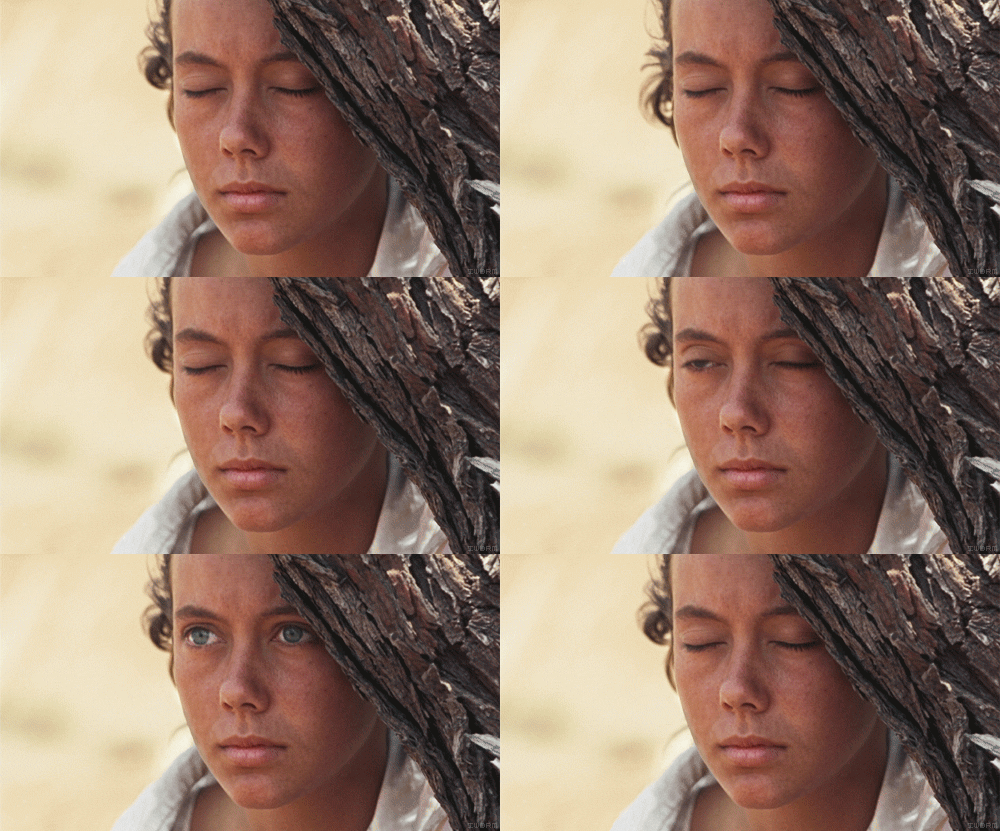
Jenny Agutter in “Walkabout” (Nicolas Roeg, 1971)

Being poorly integrated in the universe of humanity and hardly able to adapt herself therein, she, like the child, is able to see it objectively; instead of being interested solely in her grasp on things, she looks for their significance; she catches their special outlines, their unexpected metamorphoses. She rarely feels a bold creativeness, and usually she lacks the technique of self-expression; but in her conversation, her letters, her literary essays, her sketches, she manifests an original sensitivity.

The young girl throws herself into things with ardour, because she is not yet deprived of her transcendence; and the fact that she accomplishes nothing, that she is nothing, will make her impulses only the more passionate. Empty and unlimited, she seeks from within her nothingness to attain All.

― Simone de Beauvoir,  from The Second Sex (first published in French as Le Deuxième Sexe in 1949)
If you’re interested in reading this hugely influential text, you can find it online HERE.

suzanne heintz – life once removed

 “A personal photography experience for public consumption.”

suzanne heintz - 01

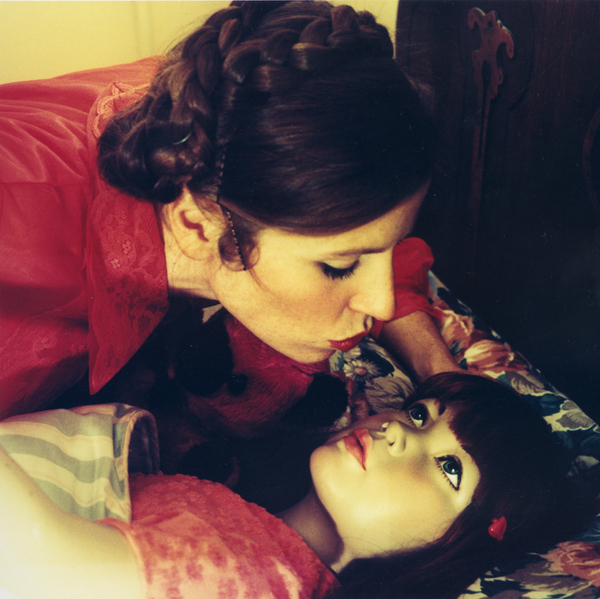
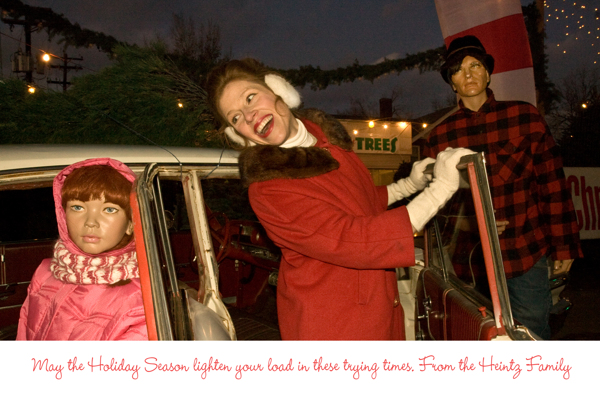
Suzanne Heintz calls herself “the modern day patron saint of single women”. She has the following to say about her ongoing photography project, the wondrously uncanny “Life Once Removed”:

What would drive you to pack a family of mannequins into your station wagon, and take them on a road trip? Enough pressure to conform will send anyone packing.  That’s how I came to this personal project about what is essentially…Spinsterhood, and the American Way.
Well-meaning strangers, along with friends and family, would raise an eyebrow when the topic of my unmarried and childless status arose.  Indicating with a small facial twitch, not only my audacious freakishness, but that I was a little old for such foolish thinking. I mean, come on, eggs don’t last forever!

suzanne heintz - 02But really, what was I supposed to do?  You can’t just go out and buy a family.  Or can you?  I did.  They are mannequins.  The candy coated shell with nothing inside.  We do all those family things, all the while capturing those Kodak Moments.  Because it’s not really about the journey, or a genuine human connection, when your kids are screaming, “are we there yet?”, is it?  It’s about the picture in front of the sign.  “Get back in the car, we got the picture.  Now, let’s go eat.”

We love and obey the formatted image of a well-lived life.  So deeply ingrained is that strange auto-grin we put on when a camera is present.  Do we live our lives with a keen awareness of how it feels, or just how it looks?
suzanne heintz - 03If I pass through life without checking off the boxes for a wedding ring and a baby carriage, I will be missing the photo album, but not not the point.  When I take my photos, others stop and stare, then they ask, “why are you doing this?”  They, at that moment, are starting to get the point too.

heintz family christmas 1

Check out more of Suzanne’s fantastical images HERE.

tori amos – if 6 was 9

A Jimi Hendrix cover, released on the limited edition UK CD single of “Cornflake Girl” in 1994. To date it is one of the few Amos recordings that has not been re-released in a collection or boxed set, or made available digitally — which is a shame, because it’s one of my favourite things she’s done.

a blanket for juliette

My sister Heather started crocheting this beautiful blanket at the age of 16 while pregnant with Juliette, spending hours of time in difficult reflection as her friends carried on being carefree teenagers. Heather has finally finished the blanket and handed it to Juliette, now 16 herself, who has also been going through an incredibly hard and painful time lately. Today Heather posted a couple of photographs on Facebook with the following caption:

“Labour of love for my big girl-child. Every stitch was done with you in mind. Tears and love and prayers are woven into the threads, my precious gift from God.”

My heart is swollen.

blanket for juliette