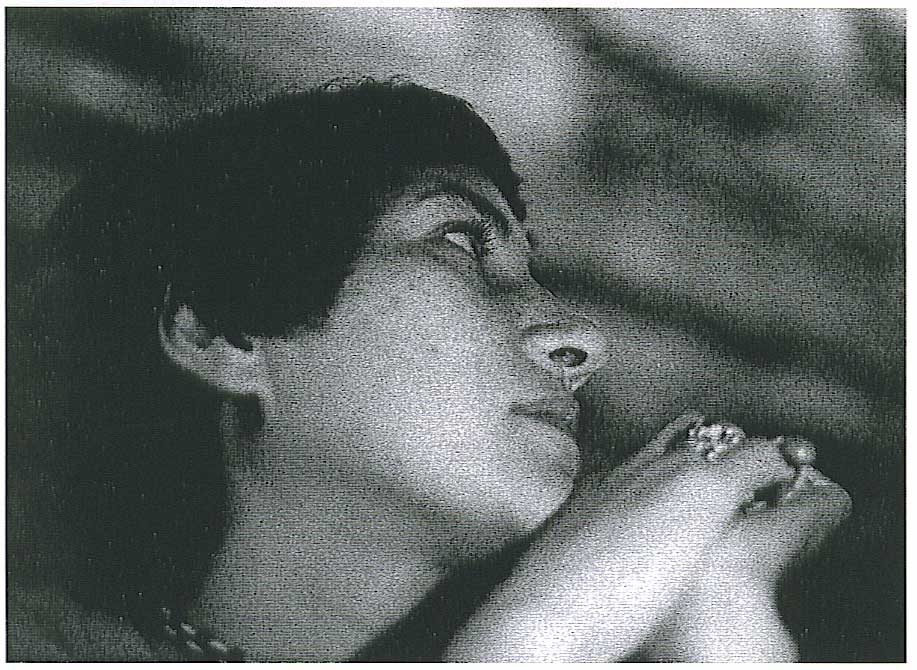
the boswell sisters – shine on, harvest moon (1931)

Recorded in New York on 27 August 1931 with the Dorsey Brothers Orchestra: Mannie Klein (tpt) Tommy Dorsey (tbn) Jimmy Dorsey (cl, as) unknown (vln) Martha Boswell (p) Eddie Lang (g) Joe Tarto (sb) Stan King (d)
E-37112-A Shine On, Harvest Moon (Norworth-Bayes) 3:08 Brunswick 6173, [BSC1], [NWST], [IGSOY], [IY], [ITG]
E-37113-A Heebie Jeebies (Atkins-Boswell) 2:37 Brunswick 6173, [BSC1], [NWST], [ELMB], [IY]

The Boswell Sisters were a close harmony singing group that attained prominence in the USA in the 1930s.

Sisters Martha Boswell (June 9, 1905 – July 2, 1958), Connee Boswell (December 3, 1907 – October 11, 1976), and Helvetia “Vet” Boswell (May 20, 1911 – November 12, 1988) were raised by a middle-class family on Camp Street in uptown New Orleans, Louisiana. They came to be well known in New Orleans while still in their early teens, making appearances in local theatres and radio, and their first recordings for Victor Records in 1925. However, the Boswell Sisters did not attain national attention until they moved to New York City in 1931 and started making national radio broadcasts. After a few recordings with Okeh Records in 1930, they made numerous recordings for Brunswick Records from 1931-1935. These Brunswick records are widely regarded as milestone recordings of vocal jazz.

Martha, Connie and Vet Boswell, New Orleans, 1925

Martha, Connee and Vet Boswell, New Orleans, 1925

Connee’s ingenious reworkings of the melodies and rhythms of popular songs, together with Glenn Miller’s hot arrangements, and first rate New York jazz musicians (including The Dorsey Brothers, Benny Goodman, Bunny Berigan, Fulton McGrath, Joe Venuti, Arthur Schutt, Eddie Lang, Joe Tarto, Manny Klein, Dick McDonough, and Carl Kress), made these recordings unlike any others. Melodies were rearranged and slowed down, major keys were changed to minor keys (sometimes in mid-song) and rhythmic changes were par for the course. Interestingly, the Boswell Sisters were among the very few performers allowed to make these changes to current popular tunes as during this era, music publishers and record companies pressured performers not to alter current popular song arrangements).

The Boswell Sisters were inducted into the Vocal Group Hall of Fame in 1998.

(Info from Youtube.)

kyle shepherd trio – die maan skyn so helder

“The moon’s shining so brightly tonight…”

Kyle Shepherd (piano, voice), Shane Cooper (double bass) and Jonno Sweetman (drums) perform a version of this subversive traditional Cape Goema song arranged by Kyle Shepherd. Recorded live at Welgemeend, Welgemeend Street, Gardens, Cape Town, South Africa on Friday 21 May 2009.

meghan judge – face deep (2013)

“Face Deep is an experimental, animated (stop motion) film that allows for a free-flow of thought and exploration of self within an otherwise overly produced, technical and character driven practice. This sequentially photographed film looks at animator as lead character, allowing internal personalities/burning stories to emerge on skin surface whilst a sense of play within the medium is explored.

By listening to the songs of local low-fi Cape Town band Tape Hiss and Sparkle on loop, the raw and honest lyrics/sounds from Simon Tamblyn lead the animator deeper into herself to explore her own raw and honest inner spaces. The film allows one orator to evoke new stories in another orator, and for their different methods of story telling (sound/visual) to co-exist together; sometimes it is another person’s truth that helps us explore our own.”

— Meghan Judge, Simon Tamblyn

More of Meghan’s work is HERE.

lesego rampolokeng with the kalahari surfers – end beginnings

“Liars rule the world…”

“Treason” and “End Beginnings” — tracks from the album End Beginnings (Shifty, 1991). This is the sound of South Africa in the late 1980s/early 1990s. Of course, I never got to hear this until years later.
Music: Warrick Sony
Words and voice: Lesego Rampolokeng

Download this album HERE.

end beginnings

tricky – hell is round the corner (1995)

From one of the most arresting albums of the twentieth century, Maxinquaye (Island Records, 1995). I bought this CD in my final year of high school, and spent hours and hours in its company over the next few years, lying prone, alone, on the floor, curtains drawn, drowning. The album’s fractured claustrophobia felt so exactly right for the time, particularly in South Africa… its heart of darkness festering quietly while the rainbow nationalist rhetoric raged outside.

“It was the most bizarre record I’ve ever worked on,” says Mark Saunders about Maxinquaye, the 1995 Tricky album that, with the exception of the previously released singles ‘Aftermath’ and ‘Ponderosa’, he co-produced with the artist, in addition to taking care of the engineering, programming and mixing. “It was a complete un-learning experience and it was also a total re-learning experience. Think of how to make a record, then forget everything you’ve learned and start completely backwards and upside down. I could write a book about Tricky. He’s such a great character.”

Read more about the highly unorthodox way in which Maxinquaye was made, HERE.

hélène cixous – the laugh of the medusa (1976)

Hello, reader :)

It’s Fleurmach’s first birthday! To celebrate, here is a ground-shifting text, a manifesto of sorts, from Hélène Cixous back in 1976 (the year punk broke). If you haven’t ever read Cixous (and even if you have, once upon a time), do yourself a favour and plough through this, SERIOUSLY. I tried to excerpt chunks from it (and may still), but decided that it’s really important and enriching to read the piece in its entirety.

Thank you all for your ongoing support and contributions to the Fleurmach community.

Much love,
Cherry Bomb
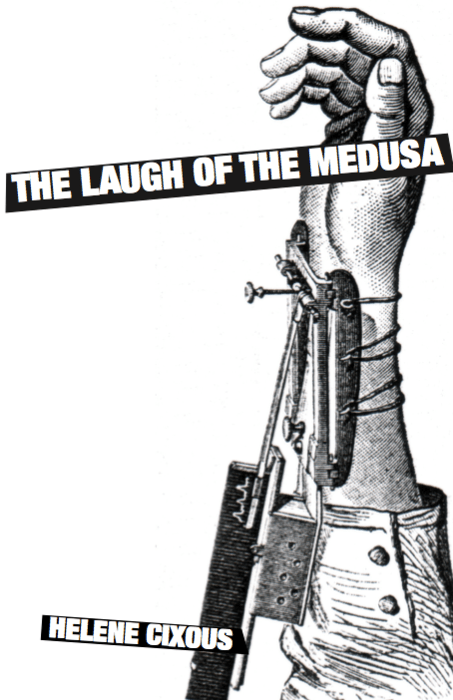
laugh of the medusa

I shall speak about women’s writing: about what it will do. Woman must write her self: must write about women and bring women to writing, from which they have been driven away as violently as from their bodies – for the same reasons, by the same law, with the same fatal goal.

Woman must put herself into the text – as into the world and into history – by her own movement.

The future must no longer be determined by the past. I do not deny that the effects of the past are still with us. But I refuse to strengthen them by repeating them, to confer upon them an irremovability the equivalent of destiny, to confuse the biological and the cultural. Anticipation is imperative.

Since these reflections are taking shape in an area just on the point of being discovered, they necessarily bear the mark of our time-a time during which the new breaks away from the old, and, more precisely, the (feminine) new from the old (la nouvelle de l’ancien). Thus, as there are no grounds for establishing a discourse, but rather an arid millennial ground to break, what I say has at least two sides and two aims: to break up, to destroy; and to foresee the unforeseeable, to project.

I write this as a woman, toward women. When I say “woman”, I’m speaking of woman in her inevitable struggle against conventional man; and of a universal woman subject who must bring women to their senses and to their meaning in history. But first it must be said that in spite of the enormity of the repression that has kept them in the “dark” – that dark which people have been trying to make them accept as their attribute – there is, at this time, no general woman, no one typical woman. What they have in common I will say. But what strikes me is the infinite richness of their individual constitutions: you can’t talk about a female sexuality, uniform, homogeneous, classifiable into codes – any more than you can talk about one unconscious resembling another.

Women’s imaginary is inexhaustible, like music, painting, writing: their stream of phantasms is incredible.

I have been amazed more than once by a description a woman gave me of a world all her own which she had been secretly haunting since early childhood. A world of searching, the elaboration of a knowledge, on the basis of a systematic experimentation with the bodily functions, a passionate and precise interrogation of her erotogeneity. This practice, extraordinarily rich and inventive, in particular as concerns masturbation, is prolonged or accompanied by a production of forms, a veritable aesthetic activity, each stage of rapture inscribing a resonant vision, a composition, something beautiful. Beauty will no longer be forbidden.

I wished that that woman would write and proclaim this unique empire so that other women, other unacknowledged sovereigns, might exclaim: I, too, overflow; my desires have invented new desires, my body knows unheard-of songs. Time and again I, too, have felt so full of luminous torrents that I could burst – burst with forms much more beautiful than those which are put up in frames and sold for a stinking fortune. And I, too, said nothing, showed nothing; I didn’t open my mouth, I didn’t repaint my half of the world. I was ashamed. I was afraid, and I swallowed my shame and my fear. I said to myself: You are mad! What’s the meaning of these waves, these floods, these outbursts?

Where is the ebullient, infinite woman who, immersed as she was in her naïveté, kept in the dark about herself, led into self-disdain by the great arm of parental-conjugal phallocentrism, hasn’t been ashamed of her strength? Who, surprised and horrified by the fantastic tumult of her drives (for she was made to believe that a well-adjusted normal woman has a … divine composure), hasn’t accused herself of being a monster?

Who, feeling a funny desire stirring inside her (to sing, to write, to dare to speak, in short, to bring out something new), hasn’t thought she was sick? Well, her shameful sickness is that she resists death, that she makes trouble.

And why don’t you write? Write! Writing is for you, you are for you; your body is yours, take it. I know why you haven’t written. (And why I didn’t write before the age of twenty-seven.) Because writing is at once too high, too great for you, it’s reserved for the great – that is, for “great men”; and it’s “silly.” Besides, you’ve written a little, but in secret. And it wasn’t good, because it was in secret, and because you punished yourself for writing, because you didn’t go all the way; or because you wrote, irresistibly, as when we would masturbate in secret, not to go further, but to attenuate the tension a bit, just enough to take the edge off. And then as soon as we come, we go and make ourselves feel guilty – so as to be forgiven; or to forget, to bury it until the next time.

Write, let no one hold you back, let nothing stop you: not man; not the imbecilic capitalist machinery, in which publishing houses are the crafty, obsequious relayers of imperatives handed down by an economy that works against us and off our backs; and not yourself.

Continue reading

rosalia chalia – i dreamt that i dwelt in marble halls (1901)

This is Rosalia Chalia (1863-1948) singing “I Dreamt That I Dwelt in Marble Halls” from the opera The Bohemian Girl, composed by MW Balfe in 1843, recorded on wax cylinder in 1901…

… And here’s the incomparable re-recording engineer and archivist Ward Marston talking about this forgotten Cuban soprano, and the physical realities of trying to rescue recordings of her from obscurity — fascinating:


kathleen ferrier – bist du bei mir

This recording was made in 1950.

When thou art near, I go with joy
To death and to my rest.
O how pleasant would my end be,
If your fair hands
Would close my faithful eyes.

Kathleen Mary Ferrier, CBE (22 April 1912 – 8 October 1953) was an English contralto singer who achieved an international reputation as a stage, concert and recording artist, with a repertoire extending from folksong and popular ballads to the classical works of Bach, Brahms, Mahler and Elgar. Her death from cancer, at the height of her fame, was a shock to the musical world and particularly to the general public, which was kept in ignorance of the nature of her illness until after her death.

“Bist du bei mir” (English: “be, thou, with me”) (BWV 508) is an aria in the Notebook for Anna Magdalena Bach. It was therefore attributed to Johann Sebastian Bach, but the melody is part of the Gottfried Heinrich Stölzel opera Diomedes, oder die triumphierende Unschuld that was performed in Bayreuth on November 16, 1718. The opera score is lost.

(Info taken from Wikipedia.)

victoria de los angeles – dido’s lament

Victoria de los Angeles sings “Thy hand Belinda… When I am laid in earth” from Dido and Aeneas by Henry Purcell (1695-1695) – recorded in 1965.
Derek Simpson, violincello
Colin Tilney, harpsichord
Ambrosian Singers
English Chamber Orchestra
Sir John Barbirolli, conductor

hideo shiraki quintet + 3 koto girls – sakura, sakura

Hideo Shiraki (drums), Terumasa Hino (trumpet), Takeru Muraoka (tenor sax, flute), Yuzuru Sera (piano), Hachiro Kurita (bass), Keiko Nosaka (koto), Kinuko Shurane (koto) and Sachiko Miyamoto (bass koto).

“Sakura” means cherry blossom – this flight of fancy is based on a traditional Japanese tune.

Recorded in Berlin on November 1, 1965 by Willi Fruth and Guenther Topel. Saba SB15064.

sathima bea benjamin – i’m glad there is you

Thank you for being here, Sathima. I am so grateful that I had the chance to meet you before you left… May you go in peace.

Sathima Bea Benjamin by Seton_pic_6

The track above comes from the album, A Morning in Paris, recorded in 1963 but only released in 1996.

Sathima Benjamin met Duke Ellington while he was in Zurich for a short engagement in February of 1963. Standing in the wings during most of the Ellington band’s performance, once the concert ended she insisted that Duke hear her husband Abdullah Ibrahim (then known as Dollar Brand)’s trio at the Club Africana, one of the few local jazz spots where the couple could work fairly regularly. Duke obliged and liked what he heard, but he also insisted that Benjamin sing for him. He adored her voice and promptly arranged for the couple to fly to Paris and record separate albums on the Reprise label (at the time, Ellington was the A&R man for Reprise Records). Ibrahim’s record, Duke Ellington Presents The Dollar Brand Trio, was released the following year and subsequently helped him build a following in Europe and the USA. Benjamin’s recording, unfortunately, languished in the vault because Reprise executives did not think she was “commercial” enough. It was eventually released under the title A Morning in Paris, but not until 1996.

Read about what made her so special yet kept her in obscurity HERE.