george formby – fanlight fanny

From the George Formby vehicle, Trouble Brewing (1939), also featuring Googie Withers, Gus McNaughton, Garry Marsh and Esma Cannon. This little number was composed by George Formby  with Harry Gifford and Fred E. Cliffe, and is full of his trademark innuendo delivered with fumbling, faux naïveté.

This Guardian review of a biography on Formby published in 2001 is worth taking a look at if you’re interested in the strange, sad man behind the goofy grin and banjolele.

éléonore pourriat – oppressed majority (majorité opprimée)

What does a day in the life of a woman look like? Maybe it’s easier to see if the woman is a man. Oppressed Majority (2010) is a French short by Éléonore Pourriat which uses role reversals to shine a new light on the micro-aggressions and macro-aggressions that are an all-too-common part of the female experience. Via wifey.tv.

sorry, you’re breaking up

brokenI learned the hard way, several times over, that attempting to help someone who can’t or won’t take responsibility for working on their own issues will never amount to anything positive. By doing this you enable the self-destructive behaviour to continue, and may very likely get hurt badly yourself.

happy birthday, simone de beauvoir

When she does not find love, she may find poetry. Because she does not act, she observes, she feels, she records; a colour, a smile awakens profound echoes within her; her destiny is outside her, scattered in cities already built, on the faces of men already marked by life, she makes contact, she relishes with passion and yet in a manner more detached, more free, than that of a young man.

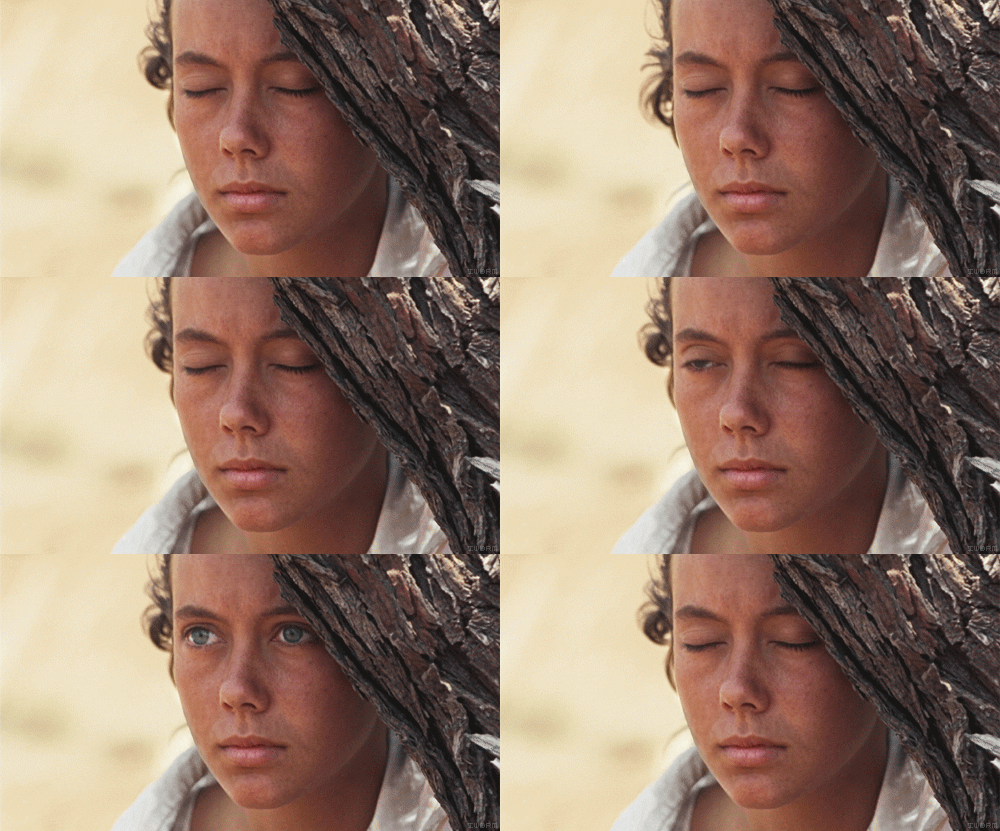
WALKABOUT tumblr_mb7ukzuYA71qe0eclo1_r4_500

Jenny Agutter in “Walkabout” (Nicolas Roeg, 1971)

Being poorly integrated in the universe of humanity and hardly able to adapt herself therein, she, like the child, is able to see it objectively; instead of being interested solely in her grasp on things, she looks for their significance; she catches their special outlines, their unexpected metamorphoses. She rarely feels a bold creativeness, and usually she lacks the technique of self-expression; but in her conversation, her letters, her literary essays, her sketches, she manifests an original sensitivity.

The young girl throws herself into things with ardour, because she is not yet deprived of her transcendence; and the fact that she accomplishes nothing, that she is nothing, will make her impulses only the more passionate. Empty and unlimited, she seeks from within her nothingness to attain All.

― Simone de Beauvoir,  from The Second Sex (first published in French as Le Deuxième Sexe in 1949)
If you’re interested in reading this hugely influential text, you can find it online HERE.

suzanne heintz – life once removed

 “A personal photography experience for public consumption.”

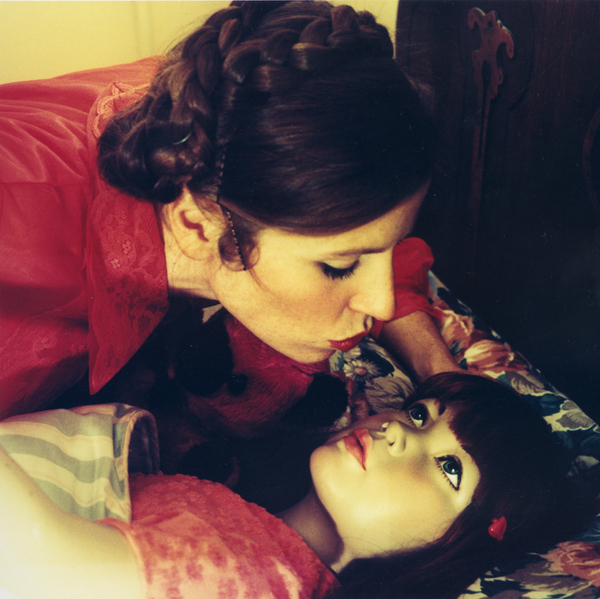
suzanne heintz - 01

Suzanne Heintz calls herself “the modern day patron saint of single women”. She has the following to say about her ongoing photography project, the wondrously uncanny “Life Once Removed”:

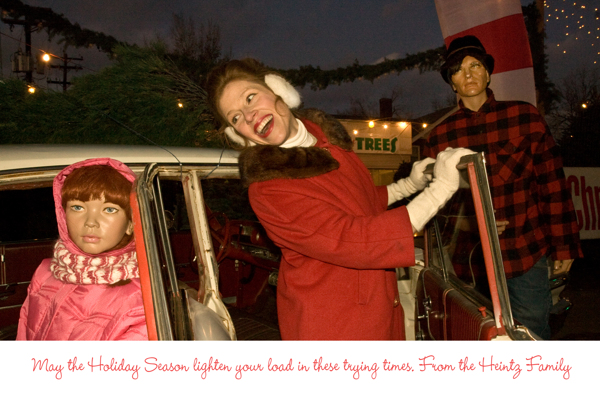
What would drive you to pack a family of mannequins into your station wagon, and take them on a road trip? Enough pressure to conform will send anyone packing.  That’s how I came to this personal project about what is essentially…Spinsterhood, and the American Way.
Well-meaning strangers, along with friends and family, would raise an eyebrow when the topic of my unmarried and childless status arose.  Indicating with a small facial twitch, not only my audacious freakishness, but that I was a little old for such foolish thinking. I mean, come on, eggs don’t last forever!

suzanne heintz - 02But really, what was I supposed to do?  You can’t just go out and buy a family.  Or can you?  I did.  They are mannequins.  The candy coated shell with nothing inside.  We do all those family things, all the while capturing those Kodak Moments.  Because it’s not really about the journey, or a genuine human connection, when your kids are screaming, “are we there yet?”, is it?  It’s about the picture in front of the sign.  “Get back in the car, we got the picture.  Now, let’s go eat.”

We love and obey the formatted image of a well-lived life.  So deeply ingrained is that strange auto-grin we put on when a camera is present.  Do we live our lives with a keen awareness of how it feels, or just how it looks?
suzanne heintz - 03If I pass through life without checking off the boxes for a wedding ring and a baby carriage, I will be missing the photo album, but not not the point.  When I take my photos, others stop and stare, then they ask, “why are you doing this?”  They, at that moment, are starting to get the point too.

heintz family christmas 1

Check out more of Suzanne’s fantastical images HERE.

the notebook: it’s ok to live life offline

Excerpted from a thoughtful piece by Kayli Stollak, over at Hello Giggles.

Painting by Francine van Hove

Painting by Francine van Hove

Online we tell a golden version of our lives filled with accomplishments, strictly (and often unbelievably) fun times, and a never-ending well of wit. The glorified digital narrative that we construct of our lives worries me like a 1950’s housewife watching Elvis wiggle his hips on TV. Our modern-day record keeping seems wildly inaccurate to the truth of our inner lives. What is happening in our too-much-information-nation? But more importantly, what is happening with us? Behind all the selfies and sandwich shots, who are we?

In order to correct the imbalance of truth, I propose we start writing it down. We share so much of ourselves with the web, but do we take enough time accounting for our private lives in realm that is removed from the world of likes, comments and followers? The idea of keeping a journal is nothing new, but we’re living in a time where we could benefit from taking a personal inventory of who we are, lest we deceive our future selves through our revisionist digital autobiographies.

While our faces are buried in our phones, we risk missing the smaller details in life. If we don’t remember the bad, how can we possibly enjoy the good to the highest degree? With time, I’m concerned we’ll look back at our Facebook timelines and mistake the façade that we presented of ourselves as fact for who we actually were.

As a writer who spends a large (and probably unhealthy) amount of time writing about herself, I often hear the condemnation of navel gazing. Sure, it is narcissistic to think your life is exciting enough to put to paper, but is it really more self-centered than a side-angled pouty pose of you enjoying your fun-filled Saturday night in the club, posted to Instagram with hopes of garnering likes from your followers, confirming that, yes, you are hot? I would venture to say that the former is self-reflective and productive, while the latter is vapidity and belly-button eagle eye-ing at its worst.

I’m not recommending you go all “dear diary” and start documenting your daily rhythms by laboriously chronicling what you ate for breakfast, the jerk who cut you off on the freeway, or what your plans are for the weekend—if that works for you, do it, but there’s no need to pen a three volume memoir. What I’m championing is the process of jotting down your feelings, thoughts, conversations, inspirations, events that meant something to you now that you might benefit from reflecting on in the future. This is a dose of honesty for you today, in five months, in ten years, at 97. To look back on after your next break up, when you’re contemplating marriage, on your graduation, before a big interview, or simply on a rainy day.

Your notebook should be far from the manicured image you pimp out on Instagram, Facebook, OKCupid, etc. In Joan Didion’s 1966 essay “On Keeping a Notebook”, written before our over-stimulated minds were flooded with technology and its never-ending distractions, she explained, “We are not talking here about the kind of notebook that is patently for public consumption, a structural conceit for binding together a series of graceful pensées, we are talking about something private, about bits of the mind’s string too short to use, an indiscriminate and erratic assemblage with meaning only for its maker.”

For me, a piece of ‘mind string’ is the harmonica chords to ‘Piano Man’ scribbled in my notebook from 2008. A stranger might assume a bizarre Billy Joel fixation, but when I revisit them in my journal, the mess of notes and the triggered sound insist on memories of a motorcycle trip through Spain and feelings of maddening love. All you need is sentence, a word, a thought, and suddenly you remember who you actually were.

If I skip forward in my notebook to 2009 I stumble upon a string of doubts, the point where this love began to unravel. The same way the smell of sunscreen can instantly bring back memories of summer,  a list labeled “Pros and Cons” reminds me of the creeping anxiety I felt for planning my future. My Facebook timeline, however, tells a different tale of a giddy girl with bangs who enjoys raves, beaches, and doing the limbo.

Didion advocated for the importance of preserving a part of yourself that in time you can return to. She wrote, “It all comes back. Perhaps it is difficult to see the value in having one’s self back in that kind of mood, but I do see it; I think we are well advised to keep on nodding terms with the people we used to be, whether we find them attractive company or not… We forget all too soon the things we thought we could never forget. We forget the loves and the betrayals alike, forget what we whispered and what screamed, forget who we were.”

Notebooks are fantastic tools for keeping in touch with our former selves that go far beyond the sculpted image we present on the web. I love delving back into my journals from middle school to the present, not because I’m a fan of the person I see there, but rather because I understand the benefit of knowing her.
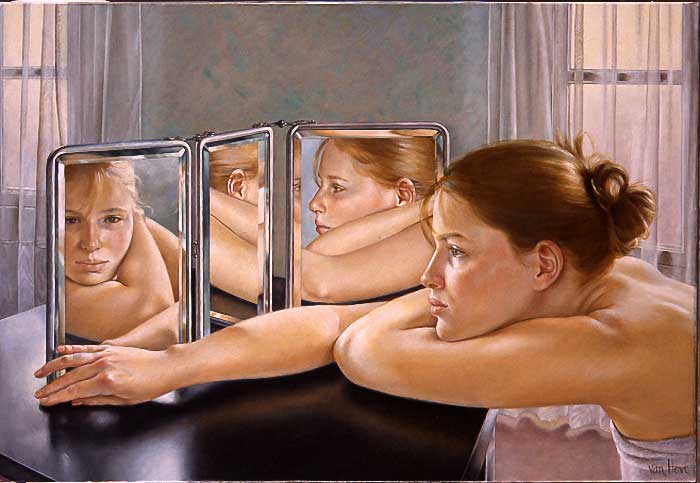
francine van hove 02

Painting by Francine van Hove

I want to yell at my thirteen year-old self to please take off that padded bra andstop being in such a rush to grow up. I want to hold my fourteen year-old self and explain to her that you are the company you keep and the sooner she starts loving herself the better. I want to bitch slap my sixteen year-old self, she was one angsty girl. I want to tell my seventeen year-old self not to mistake lust for love and to please stop talking to that boy in the band that told you he learned how to play “Brown-Eyed Girl” for you when, in fact, your eyes are green. I want to stay up all night talking to my twenty year-old self, feeding off her energy and drinking up her thirst for spontaneity. I want to see the world through her eyes, she reminds me to believe in magic. I want to whisper in the ear of my twenty-three year-old self, and tell her that soon enough she will see that it really was a means to an end. I want to tell my twenty-five year old self to trust her gut and not settle, I want to remind her what love looks like and tell her that this is not it. But I can’t tell her any of that. All I can do is learn from her mistakes, be reminded of what to hold meaning to, take note of her intuition, celebrate the coincidences, and enjoy all the beautiful moments and connections made.

Although I already know how most of the stories end, it’s important to track the progress I’ve made, reminding me who I am and who I was. To draw my own attention to the larger patterns my tendencies and predilections make when I can see them from a bird’s eye view. A notebook can serve as a wake up call on what I may be rightly or wrongly romanticizing and what I may be purposefully forgetting. Notebooks give us a shot at staying honest and in touch with ourselves, something I think we should strive to be in this digital age.

Read the full article HERE. Thanks to Stella for sharing it.

mort garson – i’ve been over the rainbow

The perfect song for South Africa today. From the album The Wozard Of Iz, released on A&M in 1968.

“Shit on your whole mortifying, imaginary, and symbolic theatre!”
― Gilles Deleuze/Felix Guattari – Anti-Oedipus: Capitalism and Schizophrenia

reflections on mandela’s legacy

mandela in the mirror

Photo: Adrian Steirn, 2011

Some links and excerpts from commentary that I have found to be worth reading today (I’ll add to this whenever I come across anything interesting – if anyone reading this has suggestions, please pass them on too):

From “The Contradictions of Mandela” –  Zakes Mda in the New York Times opinion pages:

The claim is that the settlement reached between the A.N.C. and the white apartheid government was a fraud perpetrated on the black people, who have yet to get back the land stolen by whites during colonialism. Mandela’s government, critics say, focused on the cosmetics of reconciliation, while nothing materially changed in the lives of a majority of South Africans.

This movement, though not representative of the majority of black South Africans who still adore Mandela and his A.N.C., is gaining momentum, especially on university campuses.

I understand the frustrations of those young South Africans and I share their disillusionment. I, however, do not share their perspective on Mandela. I saw in him a skillful politician whose policy of reconciliation saved the country from a blood bath and ushered it into a period of democracy, human rights and tolerance. I admired him for his compassion and generosity, values that are not usually associated with politicians. I also admired him for his integrity and loyalty.

But I fear that, for Mandela, loyalty went too far. The corruption that we see today did not just suddenly erupt after his term in office; it took root during his time. He was loyal to his comrades to a fault, and was therefore blind to some of their misdeeds.

Read the rest of what Mda has to say HERE.

From “Mandela’s Socialist Failure” – Slavoj Zizek in the New York Times opinion pages

In South Africa, the miserable life of the poor majority broadly remains the same as under apartheid, and the rise of political and civil rights is counterbalanced by the growing insecurity, violence, and crime. The main change is that the old white ruling class is joined by the new black elite. Secondly, people remember the old African National Congress which promised not only the end of apartheid, but also more social justice, even a kind of socialism. This much more radical ANC past is gradually obliterated from our memory. No wonder that anger is growing among poor, black South Africans.

South Africa in this respect is just one version of the recurrent story of the contemporary left. A leader or party is elected with universal enthusiasm, promising a “new world” — but, then, sooner or later, they stumble upon the key dilemma: does one dare to touch the capitalist mechanisms, or does one decide to “play the game”? If one disturbs these mechanisms, one is very swiftly “punished” by market perturbations, economic chaos, and the rest. This is why it is all too simple to criticize Mandela for abandoning the socialist perspective after the end of apartheid: did he really have a choice? Was the move towards socialism a real option?

It is easy to ridicule Ayn Rand, but there is a grain of truth in the famous “hymn to money” from her novel Atlas Shrugged: “Until and unless you discover that money is the root of all good, you ask for your own destruction. When money ceases to become the means by which men deal with one another, then men become the tools of other men. Blood, whips and guns or dollars. Take your choice – there is no other.” Did Marx not say something similar in his well-known formula of how, in the universe of commodities, “relations between people assume the guise of relations among things”?

In the market economy, relations between people can appear as relations of mutually recognized freedom and equality: domination is no longer directly enacted and visible as such. What is problematic is Rand’s underlying premise: that the only choice is between direct and indirect relations of domination and exploitation, with any alternative dismissed as utopian. However, one should nonetheless bear in mind the moment of truth in Rand’s otherwise ridiculously ideological claim: the great lesson of state socialism was effectively that a direct abolishment of private property and market-regulated exchange, lacking concrete forms of social regulation of the process of production, necessarily resuscitates direct relations of servitude and domination. If we merely abolish market (inclusive of market exploitation) without replacing it with a proper form of the Communist organization of production and exchange, domination returns with a vengeance, and with it direct exploitation.

The general rule is that, when a revolt begins against an oppressive half-democratic regime, as was the case in the Middle East in 2011, it is easy to mobilize large crowds with slogans which one cannot but characterize as crowd pleasers – for democracy, against corruption, for instance. But then we gradually approach more difficult choices: when our revolt succeeds in its direct goal, we come to realize that what really bothered us (our un-freedom, humiliation, social corruption, lack of prospect of a decent life) goes on in a new guise. The ruling ideology mobilizes here its entire arsenal to prevent us from reaching this radical conclusion. They start to tell us that democratic freedom brings its own responsibility, that it comes at a price, that we are not yet mature if we expect too much from democracy. In this way, they blame us for our failure: in a free society, so we are told, we are all capitalist investing in our lives, deciding to put more into our education than into having fun if we want to succeed…

… If we want to remain faithful to Mandela’s legacy, we should forget about celebratory crocodile tears and focus on the unfulfilled promises his leadership gave rise to. We can safely surmise that, on account of his doubtless moral and political greatness, he was at the end of his life also a bitter, old man, well aware how his very political triumph and his elevation into a universal hero was the mask of a bitter defeat. His universal glory is also a sign that he really didn’t disturb the global order of power.

Read Zizek’s full post HERE.

From “Nelson Mandela: The Crossing” –  Richard Pithouse at SACSIS

[W]e need to be very clear that we did not undo many of the injustices that honed Mandela’s anger in the 1950s…

…But as Mandela returns from myth and into history we should not, amidst the humanizing details of his life as it was actually lived, or the morass into which the ANC has sunk, forget the principles for which he stood. We should not forget the bright strength of the Idea of Nelson Mandela.

Mandela was a revolutionary who was prepared to fight and to risk prison or death for his ideals – rational and humane ideals. In this age where empty posturing on Facebook or reciting banal clichés at NGO workshops is counted as militancy, where rhetoric often floats free of any serious attempts to organise or risk real confrontation, where the human is seldom the measure of the political, we would do well to recall Mandela as a man who brought principle and action together with resolute commitment.

Mandela was also a man whose ethical choices transcended rather than mirrored those of his oppressors. Amidst the on-going debasement of our political discourse into ever more crude posturing we would do well to remember that no radicalism can be counted as adequate to its situation if it allows that situation to constrain its vision and distort its conception of the ethical.

Read the full article by Pithouse HERE.

stir it up, little darling (for thuli madonsela)

“Society is like a stew. If you don’t stir it up every once in a while then a layer of scum floats to the top.”

“My loyalties will not be bound by national borders, or confined in time by one nation’s history, or limited in the spiritual dimension by one language and culture. I pledge my allegiance to the damned human race, and my everlasting love to the green hills of Earth, and my intimations of glory to the singing stars, to the very end of space and time.”

— From Confessions of a Barbarian: Selections from the Journals of Edward Abbey, 1951-1989 (Boston: Little, Brown 1994).

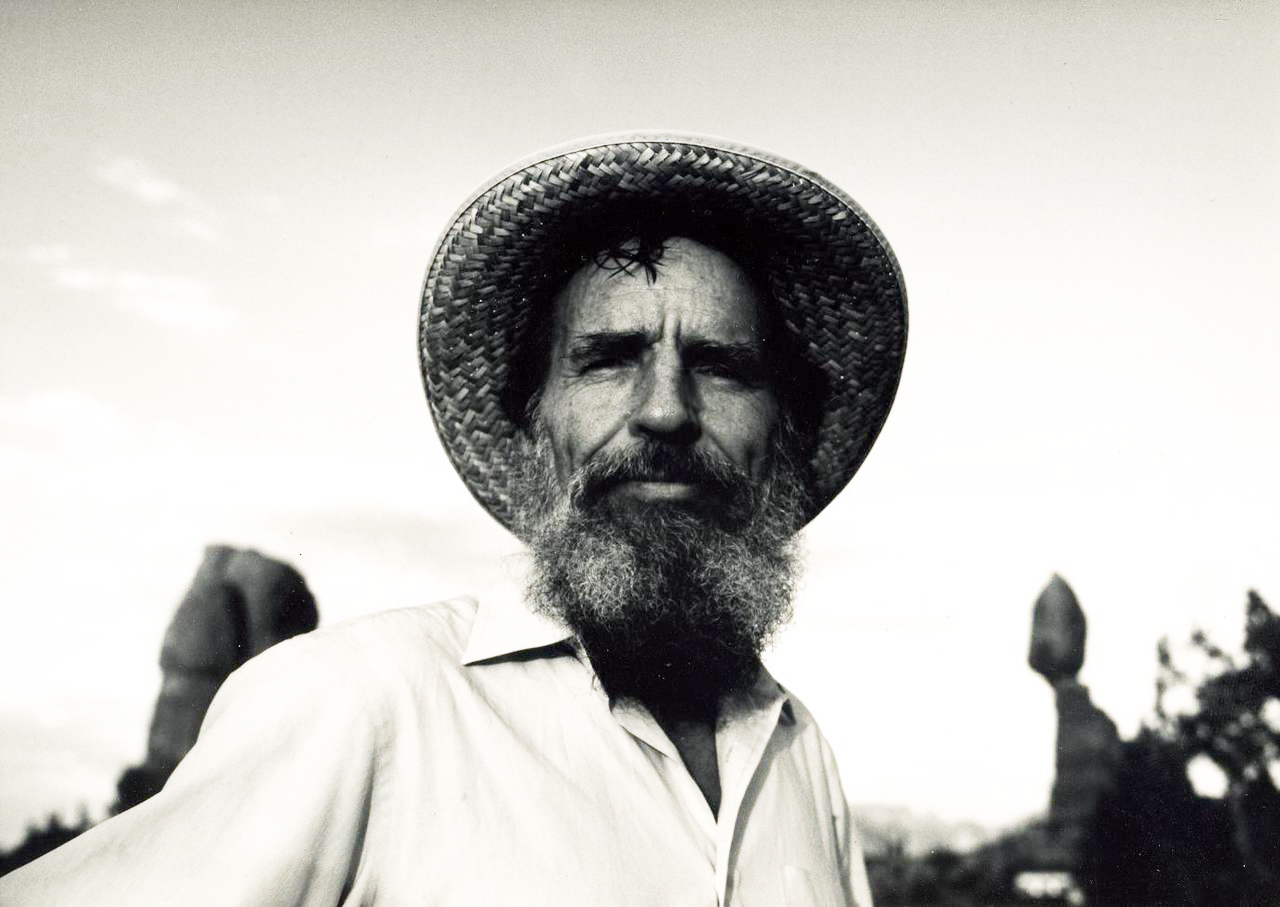
edward-abbey

marcel proust on attaining wisdom

swanning
There is no man… however wise, who has not at some period of his youth said things, or lived in a way the consciousness of which is so unpleasant to him in later life that he would gladly, if he could, expunge it from his memory. And yet he ought not entirely to regret it, because he cannot be certain that he has indeed become a wise man—so far as it is possible for any of us to be wise—unless he has passed through all the fatuous or unwholesome incarnations by which that ultimate stage must be preceded.

I know that there are young fellows, the sons and grandsons of famous men, whose masters have instilled into them nobility of mind and moral refinement in their schooldays. They have, perhaps, when they look back upon their past lives, nothing to retract; they can, if they choose, publish a signed account of everything they have ever said or done; but they are poor creatures, feeble descendants of doctrinaires, and their wisdom is negative and sterile.

We are not provided with wisdom, we must discover it for ourselves, after a journey through the wilderness which no one else can take for us, an effort which no one can spare us, for our wisdom is the point of view from which we come at last to regard the world. The lives that you admire, the attitudes that seem noble to you, are not the result of training at home, by a father, or by masters at school, they have sprung from beginnings of a very different order, by reaction from the influence of everything evil or commonplace that prevailed around them. They represent a struggle and a victory.

— Marcel Proust, from Within a Budding Grove

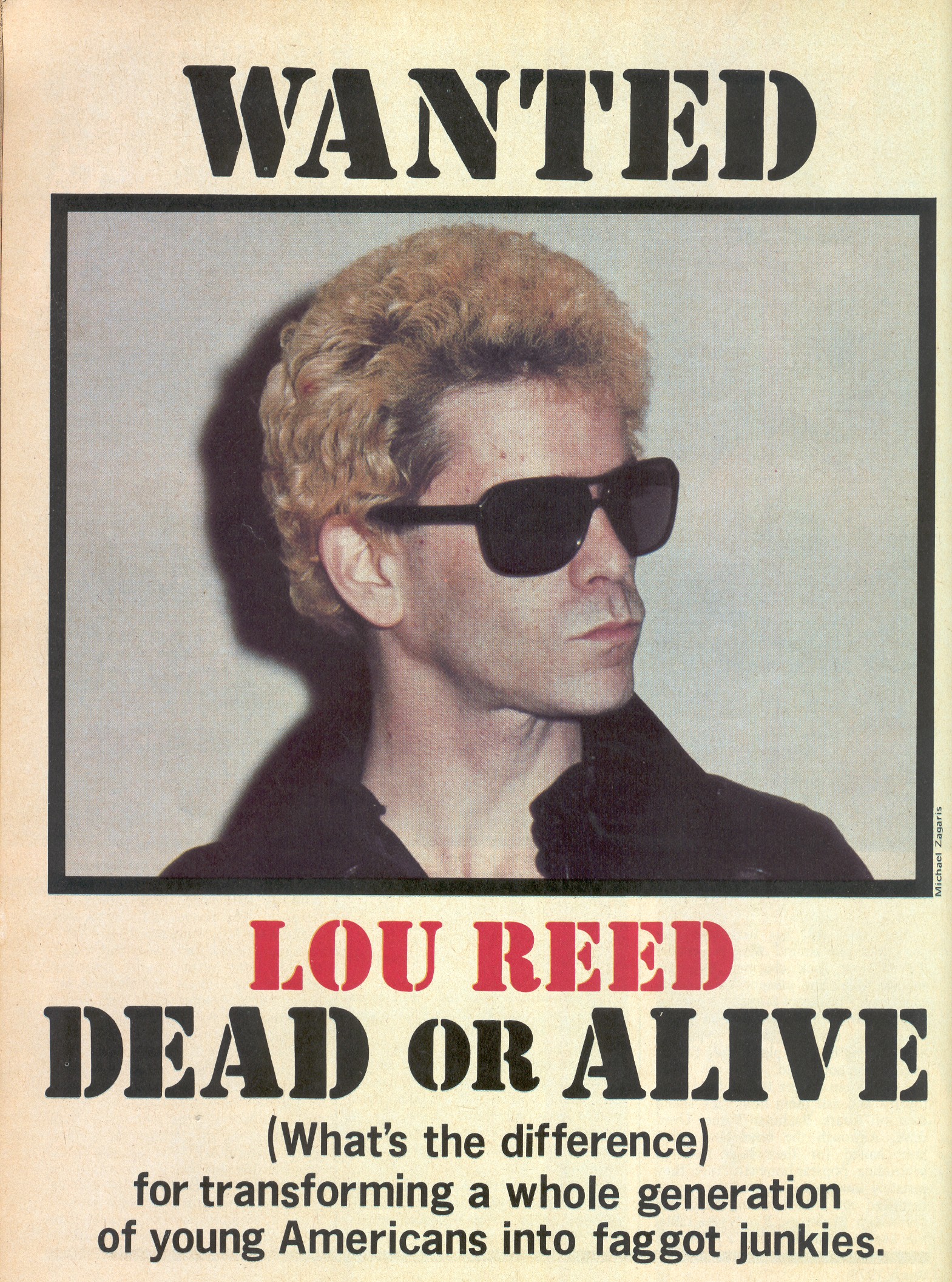
rock and roll heart – lou reed documentary

http://youtu.be/TjPuF-CYuic

Rock and Roll Heart traces Lou Reed’s career from the formation of the Velvet Underground to rock icon to his more recent artistic endeavours. Includes lots of rare and vintage footage along with interviews with David Bowie, John Cale, Patti Smith, Thurston Moore, David Byrne, Jim Carroll, Maureen Tucker, Suzanne Vega, Dave Stewart and Philip Glass. Directed by Timothy Greenfield-Sanders for American Masters and screened at the Sundance Film Festival in 1998.

Lou Reed Creem

ntozake shange – dark phrases

dark phrases of womanhood
of never havin been a girl
half-notes scattered
without rhythm/no tune
distraught laughter fallin
over a black girl’s shoulder
it’s funny/it’s hysterical
the melody-less-ness of her dance
don’t tell nobody don’t tell a soul
she’s dancin on beer cans & shingles

this must be the spook house
another song with no singers
lyrics/no voices
& interrupted solos
unseen performances

are we ghouls?
children of horror?
the joke?

don’t tell nobody don’t tell a soul
are we animals? have we gone crazy?

i can’t hear anythin
but maddening screams
& the soft strains of death
& you promised me
you promised me…
somebody/anybody
sing a black girl’s song
bring her out
to know herself
to know you
but sing her rhythms
carin/struggle/hard times
sing her song of life
she’s been dead so long
closed in silence so long
she doesn’t know the sound
of her own voice
her infinite beauty
she’s half-notes scattered
without rhythm/no tune
sing her sighs
sing the song of her possibilities
sing a righteous gospel
let her be born
let her be born
& handled warmly.

— from For Colored Girls Who Have Considered Suicide When the Rainbow is Enuf.  Macmillan Publishing, 1977. Shange was born Paulette L. Williams in Trenton, New Jersey. She later changed her name to isiXhosa/isiZulu – read more HERE.

nina simone – four women

http://youtu.be/Nf9Bj1CXPH8

Harlem Cultural Festival, 1969.

Thulani Davis writes of Nina Simone:

What Simone did for African American women was more liberating than the sweet elegance of her take on “I Love You, Porgy” (delivered without the fake dialect of all its predecessors), the thought-provoking militancy she added to spirituals like “Sinnerman,” or the wicked humor of “Old Jim Crow” and “Go Limp,” or the wonderfully ironic cover of Screamin’ Jay Hawkins’s kitsch hit, “I Put a Spell on You.”

First of all, her songs, whether covers or original compositions, always privileged the black woman’s point of view; they spoke for the dispossessed Sister Sadie who cleaned floors or raised children who would never in their lives again treat black women with respect.

Yes, you lied to me all these years/told me to wash and clean my ears/and talk real fine, just like a lady/and you’d stop calling me Sister Sadie.

“See Line Woman” viewed its exotic black female as an object of desire and admiration in a way unknown outside of the black poetry that was its source, or those raunchy blues songs that polite Negroes did not play, which nonetheless lauded the virtues of a full body and brown skin.

My skin is black/My arms are long/My hair is wooly/My back is strong/Strong enough to take the pain/Inflicted again and again/What do they call me?/My name is Aunt Sara. — “Four Women”

It was “Four Women,” an instantly accessible analysis of the damning legacy of slavery, that made iconographic the real women we knew and would become. For African American women it became an anthem affirming our existence, our sanity, and our struggle to survive a culture which regards us as anti-feminine. It acknowledged the loss of childhoods among African American women, our invisibility, exploitation, defiance, and even subtly reminded that in slavery and patriarchy, your name is what they call you. Simone’s final defiant scream of the name Peaches was our invitation to get over color and class difference and step with the sister who said:

My skin is brown/My manner is tough/I’ll kill the first mother I see/ My life has been rough/I’m awfully bitter these days/Because my parents were slaves.

For African American women artists of my generation, “Four Women” became the core of works to come, notably Julie Dash’s film of the same name, and it should be regarded a direct ancestor of Ntozake Shange’s For Colored Girls Who Have Considered Suicide When the Rainbow Is Enuf. This Simone song was a call heard by Alice Walker, Toni Cade Bambara, Gayl Jones, and countless artists who come to mind as women who gave us a whole generation of the stories of Aunt Sara, Safronia, Sweet Thing, and Peaches.

May the High Priestess’s cult widen to take in the unwise who made her as outrageous as she was.

Read the rest of this article over at The Village Voice.

sinéad o’connor’s letter to miley cyrus

“If you have an innocent heart you can’t recognise those who do not.”

Miley Cyrus recently claimed that her controversial video for Wrecking Ball was inspired by Sinéad O’Connor’s Nothing Compares 2 U. Hounded by journalists for her opinion, O’Connor felt compelled to respond, posting a strongly worded yet compassionate public letter warning Cyrus against allowing herself to be exploited. This is the full text, published on www.sineadoconnor.com.

miley1

Dear Miley,

I wasn’t going to write this letter, but today i’ve been dodging phone calls from various newspapers who wished me to remark upon your having said in Rolling Stone your Wrecking Ball video was designed to be similar to the one for Nothing Compares … So this is what I need to say … And it is said in the spirit of motherliness and with love.

I am extremely concerned for you that those around you have led you to believe, or encouraged you in your own belief, that it is in any way ‘cool’ to be naked and licking sledgehammers in your videos. It is in fact the case that you will obscure your talent by allowing yourself to be pimped, whether its the music business or yourself doing the pimping.

Nothing but harm will come in the long run, from allowing yourself to be exploited, and it is absolutely NOT in ANY way an empowerment of yourself or any other young women, for you to send across the message that you are to be valued (even by you) more for your sexual appeal than your obvious talent. I am happy to hear I am somewhat of a role model for you and I hope that because of that you will pay close attention to what I am telling you.

The music business doesn’t give a shit about you, or any of us. They will prostitute you for all you are worth, and cleverly make you think its what YOU wanted … and when you end up in rehab as a result of being prostituted, ‘they’ will be sunning themselves on their yachts in Antigua, which they bought by selling your body and you will find yourself very alone.

None of the men ogling you give a shit about you either, do not be fooled. Many’s the woman mistook lust for love. If they want you sexually that doesn’t mean they give a fuck about you. All the more true when you unwittingly give the impression you don’t give much of a fuck about yourself. And when you employ people who give the impression they don’t give much of a fuck about you either. No one who cares about you could support your being pimped … and that includes you yourself.

Yes, I’m suggesting you don’t care for yourself. That has to change. You ought be protected as a precious young lady by anyone in your employ and anyone around you, including you. This is a dangerous world. We don’t encourage our daughters to walk around naked in it because it makes them prey for animals and less than animals, a distressing majority of whom work in the music industry and it’s associated media.

You are worth more than your body or your sexual appeal. The world of showbiz doesn’t see things that way, they like things to be seen the other way, whether they are magazines who want you on their cover, or whatever … Don’t be under any illusions … ALL of them want you because they’re making money off your youth and your beauty … which they could not do except for the fact your youth makes you blind to the evils of show business. If you have an innocent heart you can’t recognise those who do not.

I repeat, you have enough talent that you don’t need to let the music business make a prostitute of you. You shouldn’t let them make a fool of you either. Don’t think for a moment that any of them give a flying fuck about you. They’re there for the money… we’re there for the music. It has always been that way and it will always be that way. The sooner a young lady gets to know that, the sooner she can be REALLY in control.

You also said in Rolling Stone that your look is based on mine. The look I chose, I chose on purpose at a time when my record company were encouraging me to do what you have done. I felt I would rather be judged on my talent and not my looks. I am happy that I made that choice, not least because I do not find myself on the proverbial rag heap now that I am almost 47 yrs of age … which unfortunately many female artists who have based their image around their sexuality, end up on when they reach middle age.

Real empowerment of yourself as a woman would be to in future refuse to exploit your body or your sexuality in order for men to make money from you. I needn’t even ask the question … I’ve been in the business long enough to know that men are making more money than you are from you getting naked. Its really not at all cool. And its sending dangerous signals to other young women. Please in future say no when you are asked to prostitute yourself. Your body is for you and your boyfriend. It isn’t for every spunk-spewing dirtbag on the net, or every greedy record company executive to buy his mistresses diamonds with.

As for the shedding of the Hannah Montana image … whoever is telling you getting naked is the way to do that does absolutely NOT respect your talent, or you as a young lady. Your records are good enough for you not to need any shedding of Hannah Montana. She’s waaaaaaay gone by now … Not because you got naked but because you make great records.

Whether we like it or not, us females in the industry are role models and as such we have to be extremely careful what messages we send to other women. The message you keep sending is that its somehow cool to be prostituted … its so not cool Miley … its dangerous. Women are to be valued for so much more than their sexuality. We aren’t merely objects of desire. I would be encouraging you to send healthier messages to your peers … that they and you are worth more than what is currently going on in your career. Kindly fire any motherfucker who hasn’t expressed alarm, because they don’t care about you.

one reason curiosity is good for you

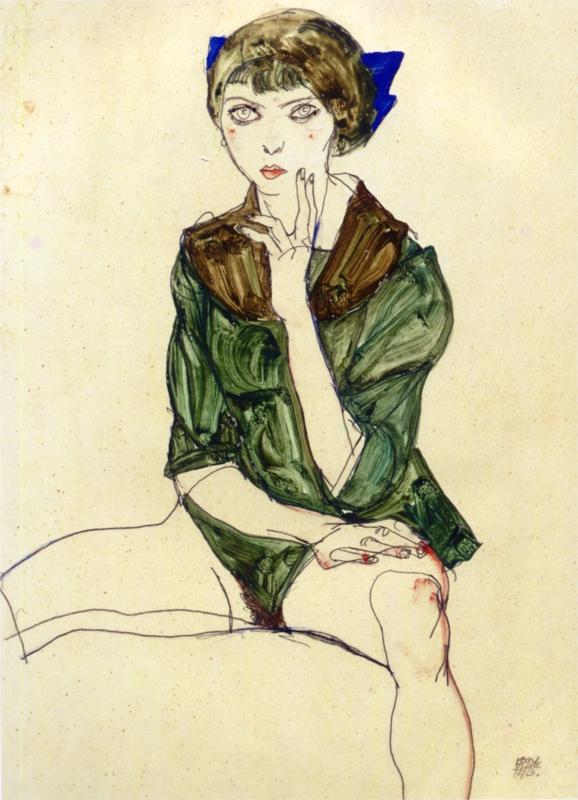
Egon Schiele - Sitting Woman in a Green Blouse. 1913

Egon Schiele – Sitting Woman in a Green Blouse. 1913

Truly happy people seem to have an intuitive grasp of the fact that sustained happiness is not just about doing things that you like. It also requires growth and adventuring beyond the boundaries of your comfort zone. Happy people, are, simply put, curious. In a 2007 study, Todd Kashdan and Colorado State psychologist Michael Steger found that when participants monitored their own daily activities, as well as how they felt, over the course of 21 days, those who frequently felt curious on a given day also experienced the most satisfaction with their life—and engaged in the highest number of happiness-inducing activities, such as expressing gratitude to a colleague or volunteering to help others.

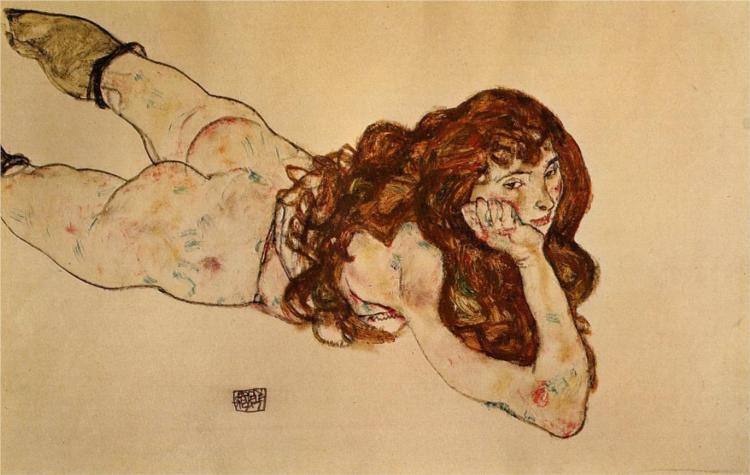
Yet curiosity—that pulsing, eager state of not knowing—is fundamentally an anxious state. When, for instance, psychologist Paul Silvia showed research participants a variety of paintings, calming images by Claude Monet and Claude Lorrain evoked happy feelings, whereas the mysterious, unsettling works by Egon Schiele and Francisco Goya evoked curiosity.

Egon Schiele, 1917

Egon Schiele, 1917

Curiosity, it seems, is largely about exploration—often at the price of momentary happiness. Curious people generally accept the notion that while being uncomfortable and vulnerable is not an easy path, it is the most direct route to becoming stronger and wiser. In fact, a closer look at the study by Kashdan and Steger suggests that curious people invest in activities that cause them discomfort as a springboard to higher psychological peaks.

Of course, there are plenty of instances in life where the best way to increase your satisfaction is to simply do what you know feels good, whether it’s putting your favourite song on the jukebox or making plans to see your best friend. But from time to time, it’s worth seeking out an experience that is novel, complicated, uncertain, or even upsetting—whether that means finally taking the leap and doing karaoke for the first time or hosting a screening of your college friend’s art-house film. The happiest people opt for both so that they can benefit, at various times, from each.

Read the whole article on Psychology Today, HERE.

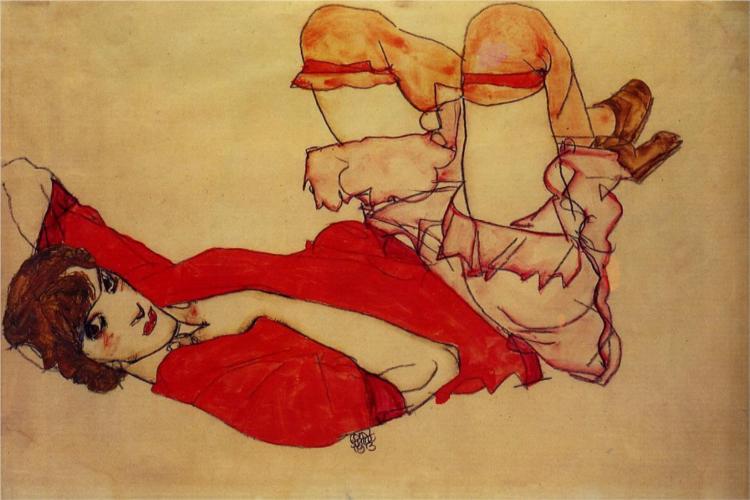
Egon Schiele - Wally with a Red Shirt. c. 1913

Egon Schiele – Wally with a Red Shirt. c. 1913

“danielle”

This is so trippy.

©2013 Anthony Cerniello

“I attempted to create a person in order to emulate the aging process. The idea was that something is happening but you can’t see it but you can feel it, like aging itself.”

Still Photographer: Keith Sirchio
Animator: Nathan Meier
Animator: Edmund Earle
Nuke Artist: George Cuddy
Music: Mark Reveley

Find out more about the creative process HERE.