“The mind which is most capable of receiving impressions is very often the least capable of drawing conclusions.”
— Virginia Woolf in The Second Common Reader
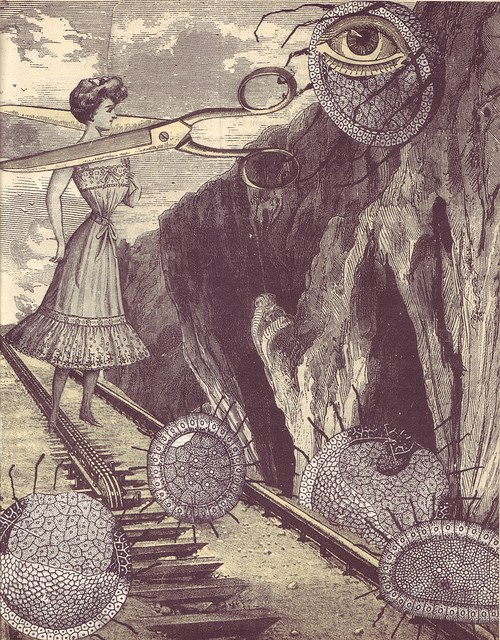
Adolf Hoffmeister (1902 – 1973) – Collage
“The mind which is most capable of receiving impressions is very often the least capable of drawing conclusions.”
— Virginia Woolf in The Second Common Reader
Adolf Hoffmeister (1902 – 1973) – Collage
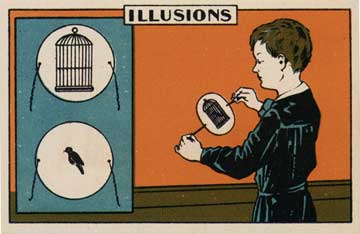
birdcage thaumatrope
[7 may 2012]
i am a dervish
a thaumaturge
i spin very fast
bore downwards
pour stuff out of the top of me churned rich like butter as i whirl
why do i spin so?
see
the thing about spinning
is that it is an oscillation between opposites that generates the movement
it’s how motors work
it’s how hard drives work
it’s how atoms work
the spin is ambi-valence made physical
attracted/repulsed/attracted/repulsed
so i am always moving fast yet can seem to be going nowhere
in my indecision, in the swinging tension between irreconcilable polar opposites
i can actually drill down deeper
because i am always spinning, seeing both sides almost, but not quite,
simultaneously
it’s impossible to see both sides simultaneously
but the quicker you are at seeing multiple perspectives
eddying off on fractal tangents
the faster you spin
(and the dizzier it can make you and others)
how do you solve a problem like maria?
i am not moving linearly
not climbing a ladder
it does not mean i am unproductive
it does not mean i am trapped
the hum is just my motor running at a higher frequency than the
general populace
a powerful magnet
drawing stuff in constantly
flipping it over and over
360 degrees of perspective, 365 days a year
a thaumatrope
it’s a funny thing
i can actually spin, physically, round and round for ages and not get dizzy
i think this is how i manage to get through life, mentally
i am mostly able to tune out the vertigo
i have learned
others can’t
they can’t take how fast i am going all the time
the spinning keeps me upright
in perpetual motion but never able to choose only one definite course
drawing straws
in perfect tension
twirling thread
spinning gold
activates
sigils
semiotics
polarity
magnetism
solenoids
speakers
the speed of sound
affects aerodynamics
flow
determinism and chaos
it’s all connected
all ways
in the dance of particles

[E]ffective differences pass between the lines, even though they are all immanent to one another, all entangled in one another. This is why the question of schizoanalysis or pragmatics, micropolitics itself, never consists in interpreting, but merely in asking what are your lines, individual or group, and what are the dangers on each.

JR around the pole at Desperado’s Saloon, Observatory, Cape Town, 15 May 2013. Photo: Rosemary Lombard
What are your rigid segments, your binary and overcoding machines? For even these are not given to you ready-made; we are not simply divided up by binary machines of class, sex, or age: there are others which we constantly shift, invent without realising it. And what are the dangers if we blow up these segments too quickly? Wouldn’t this kill the organism itself, the organism which possesses its own binary machines, even in its nerves and its brain?
What are your supple lines, what are your fluxes and thresholds? Which is your set of relative deterritorialisations and correlative reterritorialisations? And the distribution of black holes: which are the black holes of each one of us, where a beast lurks or a microfascism thrives?
— Deleuze and Guattari: Toward Freedom. Read more HERE.
Sent from my BlackBerry® wireless device
Julie Loen – Title Unknown
Erwin Raphael McManus – Where the Echoes Stop
I want to stand where the echoes stop.
Far past where sound has abandoned thought.
Where silence reigns over redundancy.
Where once well said is more than enough.I want to stand where the echoes stop.
Where words must be born to be heard.
Where speech is a gift and not a curse.
Where there is more of the unique and less of the mundane.I want to stand where the echoes stop.
Where meaning is rescued from noise…
Where conviction replaces thoughtless repetition…
Where what everyone is saying surrenders to what needs to be said.I want to stand where the echoes stop.
Where the shouting of the masses falls silent to the whisper of the one…
Where the voice of the majority submits to the voice of reason…
Where “they” do not exist; but “we” do.I want to stand where the echoes stop.
Where substance overthrows the superficial…
Where courage conquers compliance and conformity…
Where words do not travel farther than the person who speaks them.I want to stand where the echoes stop.
Where I only say what I believe.
Where I only repeat what changes me.
Where empty words finally rest in peace.“Be still and know that I am God…” — Psalm 46:10a

Manufacturing assembly line in China
For as soon as the distribution of labour comes into being, each man has a particular exclusive sphere of activity, which is forced upon him and from which he cannot escape. He is a hunter, a fisherman, a shepherd, or a critical critic and must remain so if he does not wish to lose his means of livelihood; while in communist society, where nobody has one exclusive sphere of activity but each can become accomplished in any branch he wishes, society regulates the general production and thus makes it possible for me to do one thing today and another tomorrow, to hunt in the morning, to fish in the afternoon, rear cattle in the evening, criticize after dinner, just as I have in mind, without ever becoming hunter, fisherman, shepherd or critic.
— From The German Ideology (1845).
Idleness, then, is so far from being the root of all evil that it is rather the true good. Boredom is the root of evil; it is that which must be held off.

Will Cotton: “Cotton Candy Clouds”.
Oil on Linen, 2004
Since boredom advances and boredom is the root of all evil, no wonder, then, that the world goes backwards, that evil spreads. This can be traced back to the very beginning of the world. The gods were bored; therefore they created human beings. Adam was bored because he was alone; therefore Eve was created. Since that moment, boredom entered the world and grew in quantity in exact proportion to the growth of population. Adam was bored alone; then Adam and Eve were bored en famille. After that, the population of the world increased and the nations were bored en masse. To amuse themselves, they hit upon the notion of building a tower so high that it would reach the sky. This notion is just as boring as the tower was high and is a terrible demonstration of how boredom had gained the upper hand. Then they were dispersed around the world, just as people now travel abroad, but they continued to be bored. And what consequences this boredom had: humankind stood tall and fell far, first through Eve, then from the Babylonian tower.
— From Either/Or (1843).

“The Communist Party” – A t-shirt design from http://www.threadless.com
“The fact is that labour is external to the worker, that is, it does not belong to his intrinsic nature. In his work, therefore, he does not affirm himself but denies himself, does not feel content but unhappy, does not develop freely his physical and mental energy but mortifies his body and his mind. The worker therefore only feels himself outside his work, and in his work feels outside himself.”
(From Estranged Labour, 1844)
“Capital is dead labour, that, vampire-like, only lives by sucking living labour, and lives the more, the more labour it sucks. The time during which the labourer works is the time during which the capitalist consumes the labour-power he has purchased of him. If the laborer consumes his disposable time for himself, he robs the capitalist.”
(From Capital, 1867)

Sketch of Søren Kierkegaard. Based on a sketch by Niels Christian Kierkegaard (1806-1882)
Hegel was the great system-maker. What others viewed as his grand achievement Kierkegaard viewed as his unforgivable crime, the attempt to rationally systematise the whole of existence. The whole of existence cannot be systematised, Kierkegaard insisted, because existence is not yet whole; it is incomplete and in a state of constant development. Hegel attempted to introduce mobility into logic, which, said Kierkegaard, is itself an error in logic. The greatest of Hegel’s errors, however, was his claim that he had established the objective theory of knowledge. Kierkegaard countered with the argument that subjectivity is truth. As he put it, “The objective uncertainty maintained in the most passionate spirit of dedication is truth, the highest truth for one existing.” … Kierkegaard, it remains to be said, is not a systematic theologian. We know what he thought of systems and system makers, of which Hegel was the prime example. There is hardly a page in his writings that does not prompt from the systematically minded reader a protest against disconnections and apparent contradictions. Like Flannery O’Connor, he shouted to the hard of hearing and drew startling pictures for the almost blind.
— Richard John Neuhaus, in Kierkegaard for Grownups (2004)

“Nobody is bored when he is trying to make something that is beautiful or to discover something that is true.”
— William Ralph Inge
Sadly, this is a far more profound symbolic critique of Roman Catholic oppression than anything FEMEN is ever likely to pull off (notwithstanding their tops)!
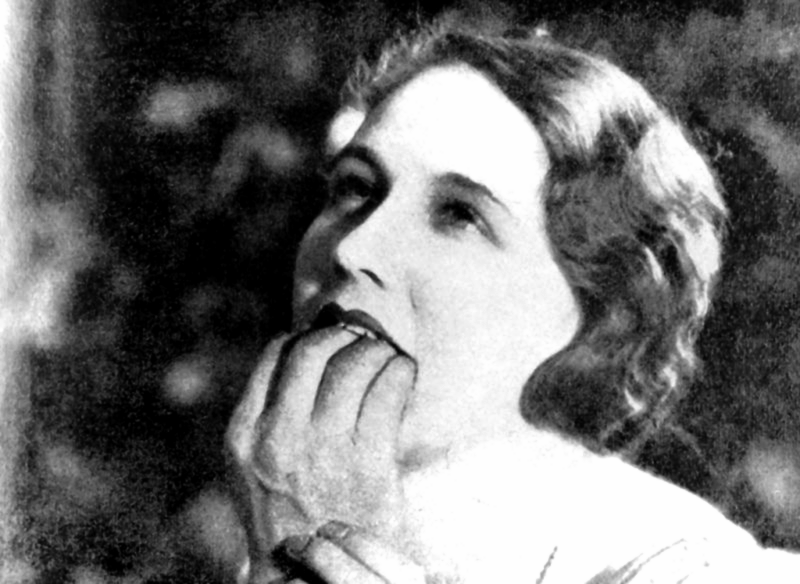 L’Age d’or or The Golden Age (1930), directed by Luis Buñuel, a French surrealist comedy, and one of the first films with synchronous sound ever made in France, was about the insanities of modern life, the hypocrisy of the sexual mores of bourgeois society and the value system of the Roman Catholic Church. Salvador Dalí and Buñuel wrote the screenplay together.
The BBC called it “an exhilarating, irrational masterpiece of censor-baiting chutzpah.”
Read more about the political project of surrealism HERE. Watch the film (in the original French) HERE – turn on the Youtube captions for English subtitles.
Regarding the response of the establishment to the film, from Wikipedia:
Upon receiving a cinematic exhibition permit from the Board of Censors, L’Âge d’or had its premiere presentation at Studio 28, Paris, on 29 November 1930. Later, on 3 December 1930, the great popular success of the film provoked attacks by the right-wing Ligue des Patriotes (League of Patriots), whose angry viewers took umbrage at the story told by Buñuel and Dalí. The reactionary French Patriots interrupted the screening by throwing ink at the cinema screen and assaulting viewers who opposed them; they then went to the lobby and destroyed art works by Dalí, Joan Miró, Man Ray, Yves Tanguy, and others. On 10 December 1930, the Prefect of Police of Paris, Jean Chiappe, arranged to have the film banned from further public exhibition after the Board of Censors re-reviewed the film.
A contemporary right-wing Spanish newspaper published a condemnation of the film and of Buñuel and Dalí, which described the content of the film as “…the most repulsive corruption of our age … the new poison which Judaism, Masonry, and rabid, revolutionary sectarianism want to use in order to corrupt the people”. In response, the de Noailles family withdrew L’Âge d’or from commercial distribution and public exhibition for more than forty years; nonetheless, three years later, in 1933, the film was privately exhibited at the Museum of Modern Art, in New York City. Forty-nine years later, from 1-15 November 1979, the film had its legal U.S. premiere at the Roxie Cinema in San Francisco.
The film critic Robert Short said that the scalp-decorated crucifix and the scenes of socially repressive violence, wherein the love-struck protagonist is manhandled by two men, indicate that the social and psychological repression of the libido and of romantic passion and emotion, by the sexual mores of bourgeois society and by the value system of the Roman Catholic Church, breed violence in the relations among people, and violence by men against women. The opening sequence of the film alludes to that interpretation, by Dalí and Buñuel, with an excerpt from a natural science film about the scorpion, which is a predatory arthropod whose tail is composed of five prismatic articulations that culminate in a stinger with which it injects venom to the prey. Film critic Ado Kyrou said that the five vignettes in the tale of L’Âge d’Or correspond to the five sections of the tail of the scorpion.
Only one man ever understood me, and he didn’t understand me.
— Johann Gottlieb Fichte
This was the commandment, ‘Thou shalt love thy neighbour as thyself,’ but when the commandment is rightly understood it also says the converse, ‘Thou shalt love thyself in the right way.’ If anyone, therefore, will not learn… to love himself in the right way, then neither can he love his neighbour; he may perhaps, as we say, ‘for life and death’ cling to one or several human beings, but this is by no means loving one’s neighbour. To love one’s self in the right way and to love one’s neighbour are absolutely analogous concepts, are at bottom one and the same.
~ Søren Kierkegaard, from Works of Love (1847)
 “I loathe the way the two cancers of sadism and masochism eat into the sexual life of humanity, so that the one lifts the lash and the other offers blood to the blow, and both are drunken with the beastly pleasure of misery and do not proceed with love’s business of building a shelter from the cruelty of the universe.”
— Rebecca West, Letter to a Grandfather (1933), pg 34.
Read more about the formidable Dame West HERE.
 Thanks to Abdul Dube for this.
“It Ain’t What You Do (It’s the Way That You Do It)” was a calypso song written by jazz musicians Melvin “Sy” Oliver and James “Trummy” Young, first recorded in 1939 by Jimmie Lunceford, Harry James, and Ella Fitzgerald.
This is a madly infectious ska-pop version recorded in 1982.
 “All things are in flux, which is just a balance between the downbeats and the upbeats, and if you are loose enough, you’ll get the dotted note… Otherwise you will fall from either one.”
— Efrain Toro
(Thanks Debbie Pryor for this!)
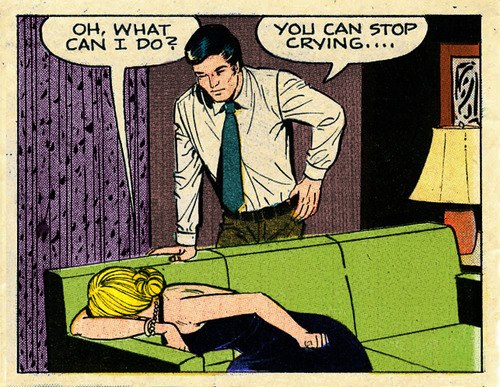
“The political arena leaves one no alternatives, one must be either a dunce or a rogue.”
— Emma Goldman

Illustration by Sarah Lazarovic
THINK first. More at http://longliveirony.com.
This piece by Justine Musk was first published HERE. Thanks to Emma Arogundade for sharing it on Facebook.
Justine Musk – “Well-behaved women seldom make history”: Redefining what it means to be bad
I posed topless for a female photographer who specializes in boudoir. I’m lying on the bed in a man’s velvet smoking jacket, hair blown across my face. I look at the camera. It’s a beautiful portrait (the photographer is very talented) and I’m proud of it. It reminds me slightly of Manet’s Olympia. That painting caused a scandal at the time (1863) — not because the subject was nude — but because of how she stares at the viewer instead of looking away demurely.
It’s that act of shameless eye contact that makes her – according to the moral dictates of the era — truly “bad”.

Édouard Manet – “Olympia” (1863)
I once said to someone, “I don’t know if I’m a good girl with a bad streak, or a bad girl with a good streak.” But I was being ironic. My real point was that, like any other woman (or man), I am both and neither.
In fact, it’s kind of amazing to me that the good girl/bad girl dichotomy still exists. It came up again when movie star Reese Witherspoon accepted an award on television and took her speech as an opportunity to slam other, younger women for being “bad”.
“I understand that it’s cool to be bad, I get it,” she said, in that tone of false camaraderie women sometimes use before they slip in the knife. “But it’s possible to make it in Hollywood without being on a reality show….And when I was coming up, a sex tape was something you hid under your bed…And when you take naked pictures of yourself, you hide your face! Hide your face!” She finished off by declaring that she was going to try to make it “cool” to be a “good girl”.
But imagine this:
Instead of criticizing the same young women for the same things that everybody else is already criticizing them for, she could have slammed reality shows for their misogynist (and monotonous) depiction of women.
She could have criticized the kind of media that turns a girl like Paris Hilton into a celebrity in the first place.
She could have pointed out how advertising – which is so very everywhere that we no longer notice it as we’re breathing it in – co-opts rebellion and sells it back to girls in the “you’ve come a long way, baby” pseudo-liberation supposedly found in a package of cigarettes.
She could have criticized a culture that trains girls to define themselves by their sexual appeal only to punish them for it.
She could have echoed Laurel Ulrich’s famous comment that “well-behaved women seldom make history” and pointed out that ‘bad’ doesn’t have to mean shallow and self-destructive. It can mean cutting against the traditional good-girl dictates of passive and pretty and pleasing and quiet. It can mean speaking up against the status quo, the double standard, the beauty myth. It can mean rejecting the idea that your moral nature depends not on what you do, but on what you don’t do (have sex).
It can mean revolution not rebellion.
She could have said: If you’re going to be ‘bad’, make it MEAN SOMETHING…other than self-sabotage.
Recently I was struck by two different dialogues on Facebook. One was about Charlie Sheen. The other was about Britney Spears. A man posted a status update about going to Sheen’s show, and the thread discussed how smart and funny and talented Sheen is and that despite the controversy and general hubbub, “he’s fine, he’s okay” and “a brilliant marketer” and “totally knows what he’s doing”.
Meanwhile, I’d posted a link to a Britney Spears video on my own Facebook page, partly because I’m fascinated by the way people react to her.
Britney immediately came under fire for being “a poor role model” to young girls everywhere.
No “brilliant marketer” comments for her.
Both Sheen and Spears have a noted history of drug use. Both are sexy and openly sexual. Both are, or have been, at the top of their professions. Both have undergone episodes of bizarre, even tragic behavior that is suggestive of addiction and mental illness.
Yet in the buzz around Charlie Sheen at the height of his notoriety, what I didn’t hear was anything about how he serves as a poor role model for boys.
This is interesting to me, because – unlike Britney, at least to my knowledge – Sheen has a documented history of domestic abuse.
As in: he hits women.
As in: he once shot a woman in the arm.
Let me repeat that: he freaking shot the woman.
But this is no big deal. It gets glossed over. Whenever I brought it up – in person or online – people would lift their virtual shoulders in a virtual shrug and move on.
(Possibly because the women involved were so easily characterized as ‘bad’ girls.
Which in the end comes down to this: slut.
Which means: vile and disposable.)
In comparison to Sheen, Britney did reveal her belly button at a young age. And that, of course, is a threat to civilization as we know it.
Spears is held up as a “poor role model” because we can perceive her as trashy and slutty and “asking for it”. Once you reduce a girl to her sexuality – and god knows that never ever happens in this culture – she becomes less than human, so you no longer have to treat her as a human. Which means the Charlie Sheens of the world – rich, powerful, white – can do with them as they please. If the girls get, you know, a little bit shot — well, it’s their own damn fault. That’s the message that some boys are absorbing from Sheen’s treatment of women and our celebration of him. That attitude, I suspect, will prove more dangerous to girls than any of Britney’s outfits or dance moves or little-girl singing voice.
There’s some irony in the fact that, like Britney, Reese Witherspoon got pregnant at a young age – but unlike Britney, who was married, Reese conceived out of wedlock and had a shotgun wedding.
Also, she said “motherfucker” on stage.
Also, she is still young — and divorced.
Also, she’s an actress (which used to be synonymous with prostitute).
Not so long ago, these things would have pegged her as morally defective. She wouldn’t technically qualify as a “good girl” (which means she’s probably “cooler” than she gives herself credit for).
But what Witherspoon seemed to be getting at in her declaration of herself as a “good girl” has to do with the idea of exposure. Whether it’s a reality TV show or an unfortunate cell phone picture, a good girl does not show herself to the world in this way — or if she does, she “hides her face”.
She guards her shame.
She never makes eye contact.
A “good” girl is not only virginal – and thus qualifies as morally sound, even if, like Jessica Wakefield in the Sweet Valley High novels, she’s kind of a sociopath – but modest and quiet. She covers up. She is seen – without being seen. She talks in a nice voice and smiles a lot. She’s the angel of the house, and stays in the house, which was the historical point of this exercise in the first place.
She’s not loud or opinionated, she doesn’t rock the boat, and she doesn’t draw attention to herself.
All of this is convenient for others. The funny thing about silence is how it tends to favor the dominating person or group. The dominating narrative, the ruling point of view, becomes a sort of truth by default: what we as a culture assume when we’re given no reason to assume otherwise.
It’s the winners who get to write history, after all. The others are silent or silenced.
Which is not my way of saying that appearing on reality TV isn’t a form of evil in its own right, or that a girl should take provocative pictures of herself and post them on the ‘Net. Neither is power so much as a mistaken idea about power (and perhaps too many shots of tequila): when the culture seems to be urging you in one direction (“it’s cool to be ‘bad’”) and you haven’t had time or experience to learn otherwise.
But there does seem to be a link between sexual expression and self-expression, in that a ‘good’ girl is not in full possession of either. Her body doesn’t belong to her: it ‘belongs’ to her father, to her future husband, to the government that decides if she can have an abortion or the religion that decides if she can use birth control.
Her voice doesn’t fully belong to her either: she has to be careful what she says, and how she says it, and who she might offend.
‘Goodness’, then, seems to involve an amputation of the self. You make yourself ‘good’ to be loved and accepted, and in the process sacrifice your authenticity. You give yourself away until you no longer know who you are – assuming you ever did.
I’m not sure what you actually get for this, in the end.
Fitting in, as the wonderful Brene Brown so astutely points out, is not the same as being accepted for who you are – in fact, the one renders the other impossible. Being trained to please and serve leaves you ripe for exploitation; the inability to assert your boundaries makes you easy to abuse in large and small ways.
“Raising a girl to be ‘nice’,” a therapist – a woman in her sixties, married and with daughters — once remarked to me, “is like sending her out into the world with one hand tied behind her back.” She should know. Many of these women turn up in her Beverly Hills office twenty years later: divorced, discarded, aging, with no ability to support themselves and no sense of who they are at core.
So honestly, in the year 2011, these are a girl’s options? She can be ‘bad’ (and disposable) or ‘good’ (and turned in on herself)?
I would like to think that there’s another option.
Not ‘bad’, maybe, but badass.
As in: you get to declare yourself. You get to express your sexuality any way you choose, whether it’s indulging or abstaining, and you’re responsible about it and willing to risk the emotional consequences. When you want or need to speak up — you speak up. You write or blog or paint or dance or study or put on puppet shows or raise your kids or start up your own company or nonprofit or do some combination thereof. You stand for what you believe in. You know what you believe in – and what you don’t. You own your life. You find your tribe. You look out for yourself (ie: you are ‘selfish’). And when you offend people, as anyone with an opinion is bound to do at some point — when people step into your space just to tell you that you suck — you shrug it off and move on, because you know disapproval won’t kill you.
You nurture the fire at your core.
I’m reading the book GAME FRAME, about the rise of social gaming, and came across the idea of “the magic circle”. The circle is the arena in which the game takes place. You step over some kind of threshold and into another world. You participate in a conflict that you recognize as artificial but, for a space of time, accept as reality. You willingly suspend your disbelief.
It struck me that we move in and out of different kinds of magic circles. There are games, yes, but also movies and theater and television and books. There are relationships that become their own world of intimacy. They form a private reality between you and your partner, in which you might ignore your actual experience to buy into an entrancement (“we are soulmates”) or belief system (“he is better and always right, and I am lesser and always wrong”).
And then there’s a magic circle that has to do with language and perception, with how we create our shared reality. The good girl/bad girl labeling strikes me as one of those. Instead of recognizing a woman as a complex and multi-dimensional being, instead of allowing her the flaws, mistakes and happy accidents that come with the trial-and-error process known as the human condition, we stomp her into a cartoon. We accept an artificial conflict (good girl vs bad girl) and make it important. We place her on a pedestal or in the dirt (or on the pedestal so we can knock her off later). We accept this as real instead of a game we can choose not to play.
You could say, instead: We’re all doing the best we can. We all do stupid things from time to time. But we won’t be distracted by this game of blaming and shaming each other. We’ll look to larger forces.
I like this video by Jeffrey Wright, in which he transfers the “willing suspension of disbelief” from the theater to the developing world, from acting to entrepreneurialism and social change.
With the power of your convictions, he says, with the ability to suspend your disbelief and act in the face of uncertainty, you have the chance to reshape reality.
Like Olympia staring out at the viewer — like Manet breaking the rules to paint her — you can reject the game and make a new one.
You can invent a new truth.
Olympia has come down to us through the ages. She refuses to “hide her face”. She is shamelessly comfortable in her own skin. She exudes a badass presence.
Her critics, now, are dust.
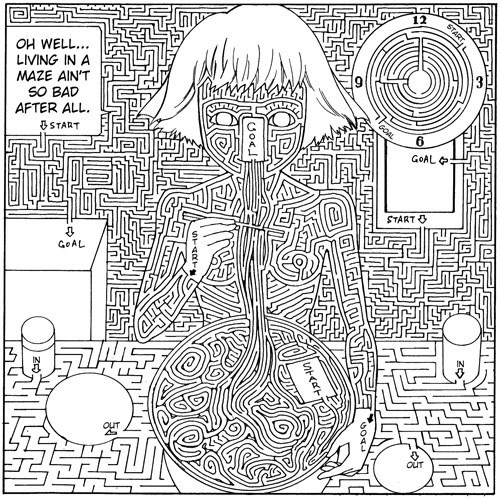
Shintaro Kago – “Living in a Maze”
We are motivated more by aversion to the unpleasant than by a will toward truth, freedom, or healing. We are constantly attempting to escape our life, to avoid rather than enter our pain, and we wonder why it is so difficult to be fully alive.
― Stephen Levine, from A Year to Live: How to Live This Year as If It Were Your Last
A principal fruit of friendship is the ease and discharge of the fullness and swellings of the heart, which passions of all kinds do cause and induce. We know diseases of stoppings and suffocations are the most dangerous in the body, and it is not much otherwise in the mind: you may take sarza to open the liver, steel to open the spleen, flowers of sulphur for the lungs, castoreum for the brain; but no receipt openeth the heart but a true friend, to whom you may impart griefs, joys, fears, hopes, suspicions, counsels, and whatsoever lieth upon the heart to oppress it, in a kind of civil shrift or confession.

…[C]ommunicating of a man’s self to his friend works two contrary effects, for it redoubleth joys, and cutteth griefs in halves. For there is no man that imparteth his joys to his friend, but he joyeth the more; and no man that imparteth his griefs to his friend, but he grieveth the less. So that it is in truth of operation upon a man’s mind, of like virtue as the alchemists use to attribute to their stone for man’s body, that it worketh all contrary effects, but still to the good and benefit of nature. But yet without praying in aid of alchemists, there is a manifest image of this in the ordinary course of nature. For in bodies, union strengtheneth and cherisheth any natural action, and on the other side weakeneth and dulleth any violent impression; and even so it is of minds…
…The second fruit of friendship is healthful and sovereign for the understanding, as the first is for the affections. For friendship maketh indeed a fair day in the affections, from storm and tempests; but it maketh daylight in the understanding, out of darkness, and confusion of thoughts. Neither is this to be understood only of faithful counsel, which a man receiveth from his friend; but before you come to that, certain it is that whosoever hath his mind fraught with many thoughts, his wits and understanding do clarify and break up, in the communicating and discoursing with another: he tosseth his thoughts more easily; he marshalleth them more orderly; he seeth how they look when they are turned into words; finally, he waxeth wiser than himself; and that more by an hour’s discourse, than by a day’s meditation…
… How many things are there which a man cannot, with any face or comeliness, say or do himself? A man can scarce allege his own merits with modesty, much less extol them; a man cannot sometimes brook to supplicate or beg; and a number of the like. But all these things are graceful in a friend’s mouth, which are blushing in a man’s own. So again, a man’s person hath many proper relations which he cannot put off. A man cannot speak to his son but as a father; to his wife but as a husband; to his enemy but upon terms: whereas a friend may speak as the case requires, and not as it sorteth with the person. But to enumerate these things were endless. I have given the rule, where a man cannot fitly play his own part; if he have not a friend, he may quit the stage.
Read the whole of this essay by Francis Bacon (the 16th century thinker) HERE.

Those only are happy (I thought) who have their minds fixed on some object other than their own happiness; on the happiness of others, on the improvement of mankind, even on some art or pursuit, followed not as a means, but as itself an ideal end. Aiming thus at something else, they find happiness by the way. The enjoyments of life (such was now my theory) are sufficient to make it a pleasant thing, when they are taken en passant, without being made a principal object. Once make them so, and they are immediately felt to be insufficient. They will not bear a scrutinizing examination.
Ask yourself whether you are happy, and you cease to be so. The only chance is to treat, not happiness, but some end external to it, as the purpose of life. Let your self-consciousness, your scrutiny, your self-interrogation, exhaust themselves on that; and if otherwise fortunately circumstanced you will inhale happiness with the air you breathe, without dwelling on it or thinking about it, without either forestalling it in imagination, or putting it to flight by fatal questioning.
― John Stuart Mill, Autobiography (1873). Read the rest of it HERE.

Marga Duggan – Highgate Woods (2011)
Refuse to fall down
If you cannot refuse to fall down,
refuse to stay down.
If you cannot refuse to stay down,
lift your heart toward heaven,
and like a hungry beggar,
ask that it be filled.
You may be pushed down.
You may be kept from rising.
But no one can keep you from lifting your heart
toward heaven
only you.
It is in the middle of misery
that so much becomes clear.
The one who says nothing good
came of this,
is not yet listening.
― Clarissa Pinkola Estés, The Faithful Gardener: A Wise Tale About That Which Can Never Die**
**Debbie Pryor, thank you for this.
 “If your daily life seems poor, do not blame it; blame yourself that you are not poet enough to call forth its riches; for the Creator, there is no poverty.”
~ Rainer Maria Rilke