manic street preachers – spectators of suicide (heavenly version)

“Democracy is an empty lie
Dead like our yesterdays tonight…”

Different, more jangly than the album version on Generation Terrorists (one of my “desert island” CDs in the ’90s, and ironically not available on Youtube due to label restrictions), this track appears on the NME compilation A Taste Of Heavenly, released in 2002. You can hear the album version HERE, or listen to the whole album from start to finish HERE.

rest in peace, pete seeger

Legendary American folk artist Pete Seeger has died at the age of 94. Here’s the New York Times’ eulogy, and one from the Huffington Post.

“Turn, Turn, Turn” is based on verses paraphrased from Ecclesiastes 3 in the Bible, widely believed to have been written by King Solomon around 1000 BCE. Pete Seeger put music to the words in 1959, recording his own version in 1962.

Miss Zingel, our sweet, slightly hippy music teacher at primary school during the last throes of 1980s apartheid, introduced us to this much-covered song, as well as to another of my favourites by Seeger/Malvina Reynolds, “Little Boxes”, which was released on CBS in 1963:

roald dahl – the sound machine (1949)

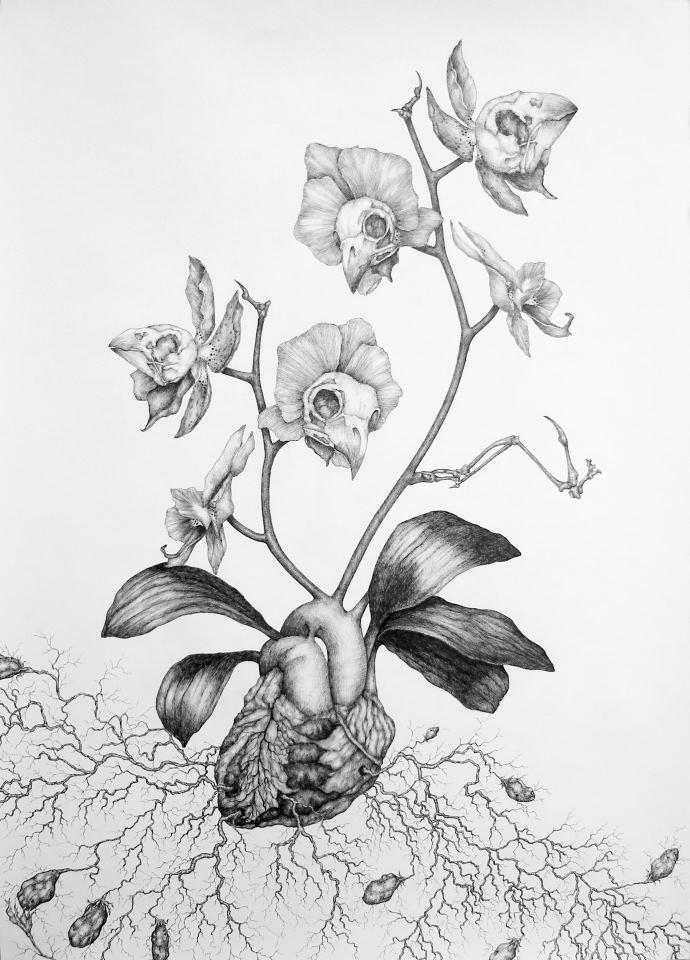
Kate Street - Orchis Nodulosa

Kate Street – Orchis Nodulosa

For a while longer, Klausner fussed about with the wires in the black box; then he straightened up and in a soft excited whisper said, “Now we’ll try again… We’ll take it out into the garden this time… and then perhaps, perhaps… the reception will be better. Lift it up now… carefully… Oh, my God, it’s heavy!”

He carried the box to the door, found that he couldn’t open the door without putting it down, carried it back, put it on the bench, opened the door, and then carried it with some difficulty into the garden. He placed the box carefully on a small wooden table that stood on the lawn. He returned to the shed and fetched a pair of earphones. He plugged the wire connections from the earphones into the machine and put the earphones over his ears. The movements of his hands were quick and precise. He was excited, and breathed loudly and quickly through his mouth. He kept on talking to himself with little words of comfort and encouragement, as though he were afraid–afraid that the machine might not work and afraid also of what might happen if it did. He stood there in the garden beside the wooden table, so pale, small and thin that he looked like an ancient, consumptive, bespectacled child.

The sun had gone down. There was no wind, no sound at all. From where he stood, he could see over a low fence into the next garden, and there was a woman walking down the garden with a flower-basket on her arm. He watched her for a while without thinking about her at all. Then he turned to the box on the table and pressed a switch on its front. He put his left hand on the volume control and his right hand on the knob that moved a needle across a large central dial, like the wavelength dial of a radio. The dial was marked with many numbers, in a series of bands, starting at 15,000 and going on up to 1,000,000. And now he was bending forward over the machine. His head was cocked to one side in a tense, listening attitude. His right hand was beginning to turn the knob.

The needle was travelling slowly across the dial, so slowly he could hardly see it move, and in the earphones he could hear a faint, spasmodic crackling. Behind this crackling sound he could hear a distant humming tone which was the noise of the machine itself, but that was all. As he listened, he became conscious of a curious sensation, a feeling that his ears were stretching out away from his head, that each ear was connected to his head by a thin stiff wire, like a tentacle, and that the wires were lengthening, that the ears were going up and up towards a secret and forbidden territory, a dangerous ultrasonic region where ears had never been before and had no right to be. The little needle crept slowly across the dial, and suddenly he heard a shriek, a frightful piercing shriek, and he jumped and dropped his hands, catching hold of the edge of the table.

He stared around him as if expecting to see the person who had shrieked. There was no one in sight except the woman in the garden next door, and it was certainly not she. She was bending down, cutting yellow roses and putting them in her basket. Again it came–a throatless, inhuman shriek, sharp and short, very clear and cold. The note itself possessed a minor, metallic quality that he had never heard before.

Klausner looked around him, searching instinctively for the source of the noise. The woman next door was the only living thing in sight. He saw her reach down; take a rose stem in the fingers of one hand and snip the stem with a pair of scissors. Again he heard the scream. It came at the exact moment when the rose stem was cut. At this point, the woman straightened up, put the scissors in the basket with the roses and turned to walk away.

“Mrs Saunders!” Klausner shouted, his voice shrill with excitement. “Oh, Mrs Saunders!” And looking round, the woman saw her neighbour standing on his lawn–a fantastic, arm-waving little person with a pair of earphones on his head–calling to her in a voice so high and loud that she became alarmed. “Cut another one! Please cut another one quickly!”

She stood still, staring at him. “Why, Mr Klausner,” she said, “What’s the matter?”

“Please do as I ask,” he said. “Cut just one more rose!”

Mrs Saunders had always believed her neighbour to be a rather peculiar person; now it seemed that he had gone completely crazy. She wondered whether she should run into the house and fetch her husband. No, she thought. No, he’s harmless. I’ll just humour him.

“Certainly, Mr Klausner, if you like,” she said.

She took her scissors from the basket, bent down and snipped another rose. Again Klausner heard that frightful, throatless shriek in the earphones; again it came at the exact moment the rose stem was cut. He took off the earphones and ran to the fence that separated the two gardens. “All right,” he said. “That’s enough. No more. Please, no more.”

The woman stood there, a yellow rose in one hand, clippers in the other, looking at him.”I’m going to tell you something, Mrs Saunders,” he said, “something that you won’t believe.” He put his hands on top of the fence and peered at her intently through his thick spectacles. “You have, this evening, cut a basketful of roses. You have, with a sharp pair of scissors, cut through the stems of living things, and each rose that you cut screamed in the most terrible way. Did you know that, Mrs Saunders?”

“No,” she said. “I certainly didn’t know that.”

“It happens to be true,” he said. He was breathing rather rapidly, but he was trying to control his excitement. “I heard them shrieking. Each time you cut one, I heard the cry of pain. A very high-pitched sound, approximately one hundred and thirty-two thousand vibrations a second. You couldn’t possibly have heard it yourself. But I heard it.”

“Did you really, Mr Klausner?” She decided she would make a dash for the house in about five seconds.

“You might say,” he went on, “that a rose bush has no nervous system to feel with, no throat to cry with. You’d be right. It hasn’t. Not like ours, anyway. But how do you know, Mrs Saunders”–and here he leaned far over the fence and spoke in a fierce whisper, “how do you know that a rose bush doesn’t feel as much pain when someone cuts its stem in two as you would feel if someone cut your wrist off with a garden shears? How do you know that? It’s alive, isn’t it?”

“Yes, Mr Klausner. Oh, yes and good night.”

Quickly she turned and ran up the garden to her house. Klausner went back to the table. He put on the earphones and stood for a while listening. He could still hear the faint crackling sound and the humming noise of the machine, but nothing more. He bent down and took hold of a small white daisy growing on the lawn. He took it between thumb and forefinger and slowly pulled it upward and sideways until the stem broke. From the moment that he started pulling to the moment when the stem broke, he heard–he distinctly heard in the earphones–a faint high-pitched cry, curiously inanimate.

He took another daisy and did it again. Once more he heard the cry, but he wasn’t sure now that it expressed pain. No, it wasn’t pain; it was surprise. Or was it? It didn’t really express any of the feelings or emotions known to a human being. It was just a cry, a neutral, stony cry–a single, emotionless note, expressing nothing. It had been the same with the roses. He had been wrong in calling it a cry of pain. A flower probably didn’t feel pain. It felt something else which we didn’t know about–something called tom or spun or plinuckment, or anything you like.

He stood up and removed the earphones. It was getting dark and he could see pricks of light shining in the windows of the houses all around him. Carefully he picked up the black box from the table, carried it into the shed and put it on the workbench. Then he went out, locked the door behind him and walked up to the house.

The next morning Klausner was up as soon as it was light. He dressed and went straight to the shed. He picked up the machine and carried it outside,clasping it to his chest with both hands, walking unsteadily under its weight. He went past the house, out through the front gate, and across the road to the park.There he paused and looked around him; then he went on until he came to a large tree, a beech tree, and he placed the machine on the ground close to the trunk of the tree.

Quickly he went back to the house and got an axe from the coal cellar and carried it across the road into the park. He put the axe on the ground beside the tree. Then he looked around him again, peering nervously through his thick glasses in every direction. There was no one about. It was six in the morning.He put the earphones on his head and switched on the machine. He listened for a moment to the faint familiar humming sound; then he picked up the axe, took a stance with his legs wide apart and swung the axe as hard as he could at the base of the tree trunk.

The blade cut deep into the wood and stuck there, and at the instant of impact he heard a most extraordinary noise in the earphones. It was a new noise, unlike any he had heard before–a harsh, noteless, enormous noise, a growling, low pitched, screaming sound, not quick and short like the noise of the roses, but drawn out like a sob lasting for fully a minute, loudest at the moment when the axe struck, fading gradually fainter and fainter until it was gone.


Excerpted from Roald Dahl’s short story, “The Sound Machine”, first published in The New Yorker on September 17, 1949.  Read the full story HERE.

sorry, you’re breaking up

brokenI learned the hard way, several times over, that attempting to help someone who can’t or won’t take responsibility for working on their own issues will never amount to anything positive. By doing this you enable the self-destructive behaviour to continue, and may very likely get hurt badly yourself.

words, words, words: on toxicity and abuse in online activism

“At its best, activism is not merely opposition to what is, it is also constructive of what will be. Ours is not a utopia of negatives– a world without this, without that, and so forth– but also a world of affirmatives and possibilities. This swirling gyre of rage and ressentiment is a terrible artefact of oppression, and one we ought not consign ourselves to. It is not a wormhole to liberation, however much we may wish it to be.”

Katherine Alejandra Cross's avatarCross With You

To all new readers: I’ve written a follow up to this article.

Not long ago my partner and I were seated in her car discussing the arbitrary nature of certain holidays and I opined, perhaps halfheartedly, that New Year’s was a worthwhile holiday simply for it being a useful vantage point for reflection, however arbitrary. It provides an overlook whence one can see a year of one’s life and world. A recent tranche of writing by severalprominentmembersof the trans and queer feminist gaming community has renewed my faith in that idea– with the overleaf of the year we suddenly find a great deal of penetrating insight into activist discourse and the risks incurred by our silence about certain excesses that have come to define us too often.

The wages of rage in our communities, and the often aimless, unchecked anger striking both within and without have…

View original post 3,749 more words

out of order

“A minute of silence in images for all the absent images, censored images, prostituted images, machinated images, delinquent images, buggered images, images beaten up by all the governments, televisions and westernized cinemas that rhyme information and repression with trash and culture.”

— Jean-Luc Godard – Le Gai Savoir (The Joy of Learning), 1969

“We can’t really understand. Of course. They’re speaking out of order.”

Continue reading

burial – come down to us

Beautiful video by Alexander Petrov set to this anthem, off Burial’s brand new EP, Rival Dealer, out now on Hyperdub. I looked Petrov up because his animation style reminded me of some of the work of another Russian master, Yuri Norstein – and, indeed, he was one of Norstein’s protégés at the Advanced School for Screenwriters and Directors in Moscow.

UPDATE 17/12/13: Looks like the person who put this lovely video together has been forced to take it down for copyright reasons. That’s just wrong. It was truly an inspired combination, and I don’t know how it would have hurt the sales of either the song or the animation. Anyway. You can stream the track without the video HERE.

Still from the Alexander Petrov footage that was paired with the song.

Still from the Alexander Petrov footage that was paired with the song.

A rare, candid message from the usually silent and mysterious William Bevan, a.k.a. Burial, on Rival Dealer (via Mary Anne Hobbs’ BBC radio show):

I put my heart into the new EP; I hope someone likes it. I wanted the tunes to be anti-bullying tunes that could maybe help someone to believe in themselves, to not be afraid, and to not give up, and to know that someone out there cares and is looking out for them. So it’s like an angel’s spell to protect them against the unkind people, the dark times, and the self-doubt.

the situation is clinical

somewhere in 2008 i sent friends and family a short account of a visit to hillbrows’ HIV testing site. to cut it short it was a nightmare, surreal. the counsellor sat me down, asked my age, the number of sexual partners blah blah. he then broke down HIV for me, this is what it is, blah. to tie a bow on it, dude then asked where my family was and if i had any younger siblings who would take care of me when i get too sick to do so. he hadn’t even drawn blood then. what followed was a small confrontation, he shut me up by stating, ‘i wouldn’t be so cocky before my ‘positive’ comes back.’

i took the test and walked down to the johannesburg art gallery. kay hassan eased my anger, his fathers’ music room reminded me of home, the people there who would have to take care of me if the clairvoyant counsellor had had a clearer crystal ball. i’d seen other counsellors before mr doom and gloom, they had been informative and quick to ease my nerves. he was a bad apple, i filed a complaint.prick

today i tried my local clinic on for size. with ‘kick start’ clinics closed i’ve struggled to find a testing site that’s free and near and last year i missed my december first test. woodstock community health centre sits just on the other side of mountain road. when electricians arrived too early for my husband to open for them, i ran home to open up and leave them with a short ‘to do’ before zipping back up the road to join the freebie queue. after my folder was called i waited a short 45 minutes (govt health care people, catch up) before i was asked to see a counsellor. as i stepped in another gentleman was called.

‘no, we’re not together,’ i offered.

‘yes, that’s fine. just both of you come in.’

‘oh, ok’

i’m in this weird room with a counsellor, a dude i met on the bench outside and i’m about to disclose my sexual history. i’m about to know how many people mr bench has been with. this is all too heady. i sit and giggle awkwardly. i’m thinking of my one night stands, i realize i don’t know as much about any of them as i’m about to find out about this stranger. i giggle some more then ask, ‘but how?’ at which i burst out laughing. the counsellor raises an eye brow, i cross and uncross my legs then clench my butt cheeks, got to stop laffing.

‘how old are you?’

the counsellor is barking at mr bench, who looks at me and i shrug my shoulders. a quiet knock introduces mr bench’s friend, his translator. the man is french. there’s four of us in the room and the translator is hot and about to find out i’m pretty easy and live around the corner. i need a smart phone. for ten minutes i sit listening as questions bounce from the counsellor to the translator and then finally to mr bench. it’s amusing, it’s someone else’s nightmare.

‘have you ever had anal sex?’

‘i’m sorry, i’m going to have to wait outside.’

my shoulders are shaking, my chest is tight. i am clenching an unclenching my fists. i’m biting at my lower lip and i want to punch the daylights out of our counsellor. my knees buckle a bit as i sit at the bench outside the office. i didn’t get mr bench’s name but i know a few things about him that should remain in the safety of ‘doctor patient privilege.’ i sat through it, i laughed about it. yes, i shouldn’t have been put in that position but it’s one thing to need a translator to buy milk and bread and quite another to have a second person know your status before you do. mr bench is just one dude, a home affairs glitch. shame. i’m just a sweet little asshole, who should have used better judgement. when they leave i can’t look either one in the eye, i’m ashamed and can’t wait to half die.

my turn comes and i ask the counsellor why they asked us both to come in.

‘it’s a faster turn around.’

if they prick us, do we not bleed?

mandela will never, ever be your minstrel

“… [P]erhaps the greatest tragedy of Mandela’s life isn’t that he spent almost thirty years jailed by well-heeled racists who tried to shatter millions of spirits through breaking his soul, but that there weren’t or aren’t nearly enough people like him.
Because that’s South Africa now, a country long ago plunged headfirst so deep into the sewage of racial hatred that, for all Mandela’s efforts, it is still retching by the side of the swamp. Just imagine if Cape Town were London.  Imagine seeing two million white people living in shacks and mud huts along the M25 as you make your way into the city, where most of the biggest houses and biggest jobs are occupied by a small, affluent to wealthy group of black people. There are no words for the resentment that would still simmer there.
Nelson Mandela was not a god, floating elegantly above us and saving us. He was utterly, thoroughly human, and he did all he did in spite of people like you. There is no need to name you because you know who you are, we know who you are, and you know we know that too. You didn’t break him in life, and you won’t shape him in death. You will try, wherever you are, and you will fail.”

Read the rest of the words at OKWONGA.COM.

for y’all celebrating thanksgiving

Uncanny scene from the film Beetlejuice (1989)in which a frightfully posh dinner is ruptured when the table is re-possessed by the voices of exploited plantation labourers, specifically via Harry Belafonte’s “Day-O”. One of Tim Burton’s most politically subversive moments.

on marching to a different tune

“They are really always saying the same thing. They don’t change; everybody else changes. They are accused of the most incompatible crimes, of egoism and a mania for power, indifference to the fate of their cause, fanaticism, triviality, lack of humour, buffoonery and irreverence. But they sound a certain note. Hence the great practical power of persistent radicals. To all appearance, nobody follows them, yet everyone believes them. They hold a tuning-fork and sound A, and everybody knows it really is A, though the time-honoured pitch is G flat.”

Isn’t this a good description of the effect of Pussy Riot performances? In spite of all accusations, you sound a certain note. It may appear that people do not follow you, but secretly, they believe you, they know you are telling the truth, or, even more, you are standing for truth.

— Slavoj Žižek, quoting political essayist John Jay Chapman (who was writing in 1900) in a recent letter to imprisoned Pussy Riot member, Nadezhda Tolokonnikova. Read more from their correspondence HERE.

Eve Warren - A Punk Prayer. Find out more HERE

Eve Warren – “A Punk Prayer”. Find out more about this work HERE.

on self-protection

dunceWhen I was a girl, my life was music that was always getting louder.
Everything moved me.
A dog following a stranger. That made me feel so much.
A calendar that showed the wrong month. I could have cried over it.
I did.
Where the smoke from the chimney ended.
How an overturned bottle rested at the edge of a table.
I spent my life learning to feel less.
Every day I felt less.
Is that growing old? Or is it something worse?
You cannot protect yourself from sadness without protecting yourself from happiness.

— Jonathan Safran Foer, from Everything is Illuminated

Thanks to Lex for sharing this.

baby huey – hard times

Baby Huey (born James Ramey, August 17, 1944 – October 28, 1970) was an American rock and soul singer, born in Richmond, Indiana. He was the frontman for the band Baby Huey & The Babysitters, whose single LP for Curtom Records in 1971 was influential in the development of hip hop music. Unfortunately, a fatal heart attack prevented him from seeing the release of the disc.

This is my favourite off the album:

lydia lunch – cesspool called history

Montage from film footage: Fingered and The Right Side of my Brain, attributed to Richard Kern, starring Lydia Lunch.
Music: “Cesspool Called History” (Lydia’s reciting over a version of the jazz standard, “Harlem Nocturne”), from the Lydia Lunch album, Hangover Hotel (self-released in 2001).

i’m heavy

I been to war,
It don’t get more hardcore
If you knew what I’ve seen
If you been where I been
I been hit by a car
And it threw me fuckin far
I pranged on Houghton Drive
And walked out still alive

I’m heavy
So don’t push your luck
And don’t give me kak
Cos I’m heavy, man
I’m heavy

I stood by the bed
Of my dad till he dead
I told him my life story
Didn’t spare him no the gory
I smoked heroin and crack
And managed to come back
I mainlined ketamine
And saw worlds I shouldn’t seen

I’m heavy
So don’t push your luck
And don’t give me kak
Cos I’m heavy, man
I’m heavy

I been stabbed I been burned
Tied up and spurned
Bitten and gored
Winded and floored
I was there when my boys they came into this world
On the other side of earth circumstance has them hurled
I known love known loss known many good connection
No way I can just pray for instant soul redemption

I’m heavy
So don’t push your luck
And don’t give me kak
Cos I’m heavy, man
I’m heavy

95 years since the end of world war 1 today

This version of the traditional song originally penned by J H McNaughton during the American Civil War was recorded by Jolie Holland for her Escondida album in 2004:

Here is the first known recorded version, by Buell Kazee, in 1928:

Today marks 95 years since the end of World War 1.

a new and alarming study on teens and sexual coercion

Excerpted from an article by Martha Kempner, published at RH Reality Check, October 9, 2013 – 12:43 pm

A new study finds that almost one in ten teens and young adults admit to forcing someone into some form of sexual activity. Even more surprising: 50 percent of perpetrators blame the victim for the incident. According to the study, “links between perpetration and violent sexual media are apparent.”

blurred-lines-screenshot-375x250

(RobinThickeVevo / YouTube)

A new study funded by the Centers for Disease Control and Prevention and published online in the Journal of the American Medical Association found that one in ten teens said they had coerced another person into some form of sexual activity. In an online survey in 2010 and 2011, researchers asked 1,058 young people ages 14 to 21 whether they had ever “kissed, touched, or done anything sexual with another person when that person did not want you to?” The results surprised even the lead researcher, Michele Ybarra, who told NPR, “I don’t get creeped out very often, but this was wow.”

This intense reaction stems from the fact that 9 percent of teens said they had coerced another person. Specifically, 8 percent said they had kissed or touched someone when they knew that person did not want to, 3 percent said they “got someone to give in to unwilling sex,” 3 percent said they attempted rape, and 2 percent said they actually raped someone. (This adds to more than 9 percent because young people could admit to more than one behavior.)…

… The authors also note that 50 percent of all perpetrators said that the victim was responsible for the sexual violence. Moreover, most perpetrators said no one ever found out about their actions. The authors conclude, “Because victim blaming appears to be common while perpetrators experiencing consequences is not, there is urgent need for high school (and middle school) programs aimed at supporting bystander intervention.”…

… The survey was conducted as part of an ongoing study called Growing Up With Media. In addition to asking about sexual coercion, respondents were asked about the media they watched. The study found that perpetrators tended to report more frequent exposure to media that depicted sexual and violent situations than those who had not coerced another person, but the results were not always statistically significant. Still, the authors conclude:

[L]inks between perpetration and violent sexual media are apparent, suggesting a need to monitor adolescents’ consumption of this material, particularly given today’s media saturation among the adolescent population.

Elizabeth Schroeder, the executive director of Answer, an organization that educates young people about sexuality and trains teachers, agrees that media consumption is part of the problem. She told RH Reality Check, “This study is extremely distressing, but unfortunately, not a surprise. Sexuality education rarely starts before high school, and by then young people have already received very distorted messages about sex, relationships, and boundaries from other sources such as the media, their peers, adults in their lives, and so on.” Schroeder added, “Age-appropriate lessons about relationships need to start in early childhood and continue throughout high school.”

Read the full article HERE.

the crystals – he hit me (and it felt like a kiss)

One of the most overtly disturbing of Phil Spector’s “wall of sound” productions, released in 1962 on Philles Records.

Dave Thompson writes of the single on AllMusic:

“He Hit Me (And It Felt Like A Kiss)” was written by Gerry Goffin and Carole King, after their live-in babysitter Eva Boyd (19-year-old singer Little Eva) returned from a weekend away with her boyfriend, covered in bruises. The boyfriend seemed to have spent the entire weekend hitting the girl but, when questioned about it, the girl didn’t bat an eyelid. He hit her because he loved her. And, in the song, because she deserved it.

It was a brutal song, as any attempt to justify such violence must be, and Spector’s arrangement only amplified its savagery, framing Barbara Alston’s lone vocal amid a sea of caustic strings and funereal drums, while the backing vocals almost trilled their own belief that the boy had done nothing wrong. In more ironic hands (and a more understanding age), “He Hit Me” might have passed at least as satire. But Spector showed no sign of appreciating that, nor did he feel any need to.

the-crystals-he-hit-me-and-it-felt-like-a-kiss-philles-collectables

a very bad hair day

phil spector

Filthy Phil Spector in the dock, on trial for murdering his girlfriend Lana Clarkson (via Warrick Sony). Just have to share some of the hil-hair-ious comments under the post on Facebook:

Kevin Breed – Wall of hair
Lizza Littlewort – Hairy Antoinette.
Merle Payne – Good Vrou.
Gary Herselman – Is that Phil wigging out again?
Warrick Sony – Phuckwit Phil at his murder of girlfriend trial
Charlie Hamilton – And inside there somewhere is the brain that started the ‘wall of sound’
Andrew Freedman – You are looking good sir ! All those cosmic sounds are taking effect ! Haribol
SJ Ryan – Things took a turn for the worse when he attacked the prosecutor with an afro comb
David Forbes – the evidence was hair-raising.
Merle Payne – Bad hair day.
Warrick Sony – Hair today gone tomorrow
Rosemary Lombard – Full Spectre
Lesley Perkes – hair lair there
Warrick Sony – wait for it… … Hair Traffic Controller
Warrick Sony – oh and the Eno song: “Burning Hairlines Give You so much more”