The world’s first “hotel” made entirely from cake is to welcome guests for one night only with room service in the form of vanilla sponge cushions and a hand-stitched meringue rug. The hotel within a hotel in Soho, central London, is the creation of more than 14 artists who spent 2,000 hours baking and 900 hours decorating with more than 600 kilos of sugar.
Guests will be encouraged to eat their way through windows and walls clad with 2,000 macaroons, a rug made from 1,081 meringues hand-stitched together, 20 kilos of marshmallow garlands, windowsills built entirely from fudge and a bath filled with caramel-coated popcorn.
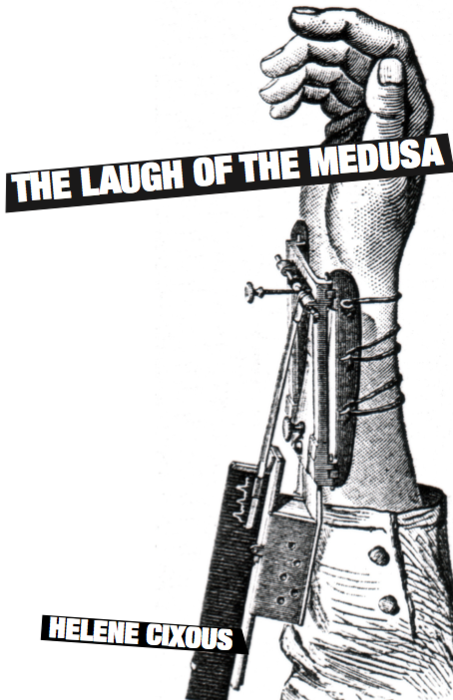
It’s Fleurmach’s first birthday! To celebrate, here is a ground-shifting text, a manifesto of sorts, from Hélène Cixous back in 1976 (the year punk broke). If you haven’t ever read Cixous (and even if you have, once upon a time), do yourself a favour and plough through this, SERIOUSLY. I tried to excerpt chunks from it (and may still), but decided that it’s really important and enriching to read the piece in its entirety.
Thank you all for your ongoing support and contributions to the Fleurmach community.
Much love, Cherry Bomb
I shall speak about women’s writing: about what it will do. Woman must write her self: must write about women and bring women to writing, from which they have been driven away as violently as from their bodies – for the same reasons, by the same law, with the same fatal goal.
Woman must put herself into the text – as into the world and into history – by her own movement.
The future must no longer be determined by the past. I do not deny that the effects of the past are still with us. But I refuse to strengthen them by repeating them, to confer upon them an irremovability the equivalent of destiny, to confuse the biological and the cultural. Anticipation is imperative.
Since these reflections are taking shape in an area just on the point of being discovered, they necessarily bear the mark of our time-a time during which the new breaks away from the old, and, more precisely, the (feminine) new from the old (la nouvelle de l’ancien). Thus, as there are no grounds for establishing a discourse, but rather an arid millennial ground to break, what I say has at least two sides and two aims: to break up, to destroy; and to foresee the unforeseeable, to project.
I write this as a woman, toward women. When I say “woman”, I’m speaking of woman in her inevitable struggle against conventional man; and of a universal woman subject who must bring women to their senses and to their meaning in history. But first it must be said that in spite of the enormity of the repression that has kept them in the “dark” – that dark which people have been trying to make them accept as their attribute – there is, at this time, no general woman, no one typical woman. What they have in common I will say. But what strikes me is the infinite richness of their individual constitutions: you can’t talk about a female sexuality, uniform, homogeneous, classifiable into codes – any more than you can talk about one unconscious resembling another.
Women’s imaginary is inexhaustible, like music, painting, writing: their stream of phantasms is incredible.
I have been amazed more than once by a description a woman gave me of a world all her own which she had been secretly haunting since early childhood. A world of searching, the elaboration of a knowledge, on the basis of a systematic experimentation with the bodily functions, a passionate and precise interrogation of her erotogeneity. This practice, extraordinarily rich and inventive, in particular as concerns masturbation, is prolonged or accompanied by a production of forms, a veritable aesthetic activity, each stage of rapture inscribing a resonant vision, a composition, something beautiful. Beauty will no longer be forbidden.
I wished that that woman would write and proclaim this unique empire so that other women, other unacknowledged sovereigns, might exclaim: I, too, overflow; my desires have invented new desires, my body knows unheard-of songs. Time and again I, too, have felt so full of luminous torrents that I could burst – burst with forms much more beautiful than those which are put up in frames and sold for a stinking fortune. And I, too, said nothing, showed nothing; I didn’t open my mouth, I didn’t repaint my half of the world. I was ashamed. I was afraid, and I swallowed my shame and my fear. I said to myself: You are mad! What’s the meaning of these waves, these floods, these outbursts?
Where is the ebullient, infinite woman who, immersed as she was in her naïveté, kept in the dark about herself, led into self-disdain by the great arm of parental-conjugal phallocentrism, hasn’t been ashamed of her strength? Who, surprised and horrified by the fantastic tumult of her drives (for she was made to believe that a well-adjusted normal woman has a … divine composure), hasn’t accused herself of being a monster?
Who, feeling a funny desire stirring inside her (to sing, to write, to dare to speak, in short, to bring out something new), hasn’t thought she was sick? Well, her shameful sickness is that she resists death, that she makes trouble.
And why don’t you write? Write! Writing is for you, you are for you; your body is yours, take it. I know why you haven’t written. (And why I didn’t write before the age of twenty-seven.) Because writing is at once too high, too great for you, it’s reserved for the great – that is, for “great men”; and it’s “silly.” Besides, you’ve written a little, but in secret. And it wasn’t good, because it was in secret, and because you punished yourself for writing, because you didn’t go all the way; or because you wrote, irresistibly, as when we would masturbate in secret, not to go further, but to attenuate the tension a bit, just enough to take the edge off. And then as soon as we come, we go and make ourselves feel guilty – so as to be forgiven; or to forget, to bury it until the next time.
Write, let no one hold you back, let nothing stop you: not man; not the imbecilic capitalist machinery, in which publishing houses are the crafty, obsequious relayers of imperatives handed down by an economy that works against us and off our backs; and not yourself.
Original version was from Emperor Tomato Ketchup (Duophonic, 1996) – but this is a incredibly immersive alternative version, and the video is the bomb, too (har har, sorry).
The third track on Side A of the VS album, released in 1982 on Ace Of Hearts Records – AHS 10010. Listen to the whole album HERE. If you are into post-punk, this is really one of the essential albums.
Released in 1987 on SST Records. Bloody great; prefigures the more spacey stuff to come on their next album, Daydream Nation.
1. Schizophrenia
2. (I Got A) Catholic Block
3. Beauty Lies in the Eye
4. Stereo Sanctity
5. Pipeline/Kill Time
6. Tuff Gnarl
7. Pacific Coast Highway
8. Hot Wire My Heart
9. Kotton Krown
10. White Kross
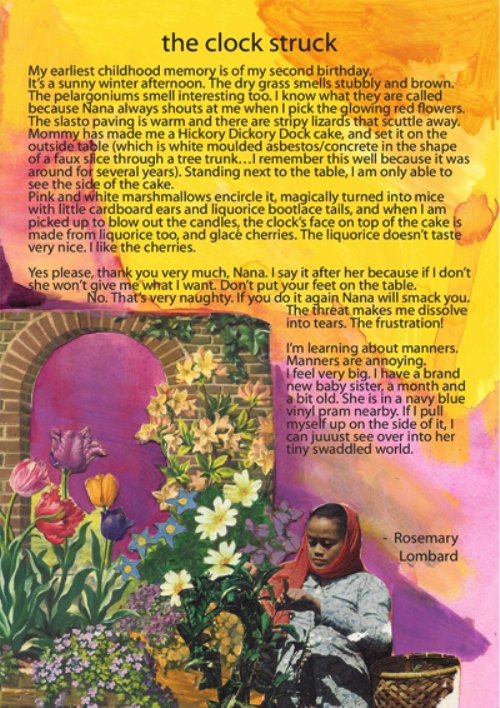
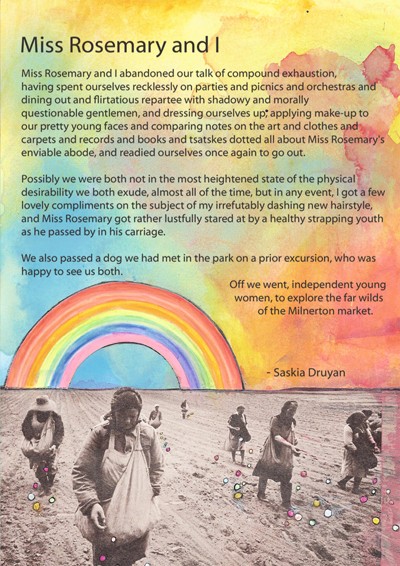
This is a page taken from FLEURZINE, a zine curated and illustrated by Julia Mary Grey. You can go and download this beautiful work of art for free on her site, HERE.
The name was inspired by Fleurmach, and six pieces of writing from this blog appear in the publication. This piece is by Fleurmach curator Cherry Bomb and was first posted HERE.
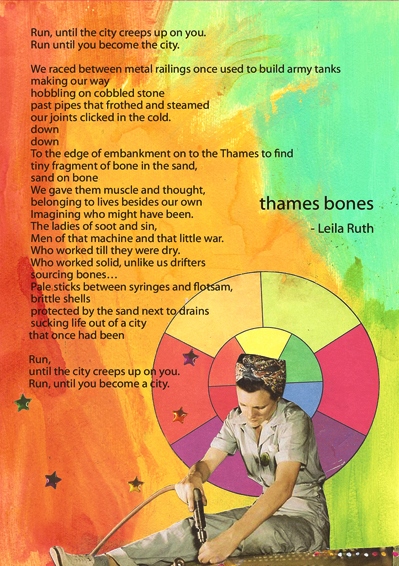
This is a page taken from FLEURZINE, a zine curated and illustrated by Julia Mary Grey. You can go and download this beautiful work of art for free on her site, HERE.
The name was inspired by Fleurmach, and six pieces of writing from this blog appear in the publication. This piece is by Fleurmach contributor NoHolyCows, and first appeared HERE.
Toby stares at them, fascinated: she’s never seen a liobam in the flesh, only pictures. Am I imagining things? she wonders. No, the liobams are actual. They must be zoo animals freed by one of the more fanatical sects in those last desperate days.
They don’t look dangerous, although they are. The lion-sheep splice was commissioned by the Lion Isaiahists in order to force the advent of the Peaceable Kingdom. They’d reasoned that the only way to fulfil the lion/lamb friendship prophecy without the first eating the second would be to meld the two of them together. But the result hadn’t been strictly vegetarian.
Still, the liobams seem gentle enough, with their curly golden hair and twirling tails. They’re nibbling flower heads, they don’t look up; yet she has the sense that they’re perfectly aware of her. Then the male opens its mouth, displaying its long, sharp canines, and calls. It’s an odd combination of baa and roar: a bloar, thinks Toby.
— from Margaret Atwood’s The Year of the Flood (Doubleday, 2009)
From this report/video, and several others like it from different sources, it appears that journalist Anderson Cooper and CNN have been caught staging fake news about Syria to justify military intervention.
The following was published on Intellihub.com on August 30, 2013:
“The primary “witness” that the mainstream media has been using as a source in Syria has been caught staging fake news segments. Recent video evidence proves that “Syria Danny”, the supposed activist who has been begging for military intervention on CNN, is really just a paid actor and a liar.
“While Assad is definitely a tyrant like any head of state, a US invasion of the country is a worst case scenario for the people living there. By pointing out that the mainstream media is orchestrating their entire coverage of this incident, we are not denying that there is a tremendous amount of death and violence in Syriaright now. However, we are showing that the mainstream media version of events is scripted and staged propaganda.”
The following video shows so-called activist/citizen journalist Danny Abdul-Dayem apparently contradicting himself while off air, and even asking crew members to “get the gunfire sounds ready” for his video conference with Anderson Cooper on CNN.
This is also not the first time that mainstream media reports have been exposed as propaganda, especially during times of war. Some of the most hyped news images of our time have actually been elaborate public relations stunts, designed as psychological warfare operations.
The article continues with further examples:
“No one in America can forget the image of Saddam Hussein’s statue being toppled and covered with an American flag, yet few people realize that this was a hoax, a staged psychological operation coordinated between the military and the media. In July of 2004 journalist Jon Elmer exposed an internal army study of the war showing that the statue scenario was indeed a set up.”
Elmer wrote: “the infamous toppling of the statue of Saddam Hussein in Firdos Square in central Baghdad on April 9, 2003 was stage-managed by American troops and not a spontaneous reaction by Iraqis. According to the study, a Marine colonel first decided to topple the statue, and an Army psychological operations unit turned the event into a propaganda moment… The Marines brought in cheering Iraqi children in order to make the scene appear authentic, the study said. Allegations that the event was staged were made in April of last year, mostly by opponents of the war, but were ignored or ridiculed by the US government and most visible media outlets.”
Read more about other allegedly staged newscasts HERE – I only say “allegedly” as I haven’t done enough research on this myself yet not to (the main problem being that I don’t speak Arabic and need proof that the translations are accurate); what I have seen so far is chillingly convincing, however.
This is Rosalia Chalia (1863-1948) singing “I Dreamt That I Dwelt in Marble Halls” from the opera The Bohemian Girl, composed by MW Balfe in 1843, recorded on wax cylinder in 1901…
… And here’s the incomparable re-recording engineer and archivist Ward Marston talking about this forgotten Cuban soprano, and the physical realities of trying to rescue recordings of her from obscurity — fascinating:
This is a page taken from FLEURZINE, a zine curated and illustrated by Julia Mary Grey. You can go and download this beautiful work of art for free on her site, HERE.
The name was inspired by Fleurmach, and six pieces of writing from this blog appear in the publication!
David Foster Wallace was arguably one of the most brilliant American writers of his generation. In this excerpt from a speech he gave, first published on the Guardian website a week after his death in 2008, he reflects on the difficulties of daily life and ‘making it to 30, or maybe 50, without wanting to shoot yourself in the head’. Read it below the jump or listen to the audio recording here:
There are these two young fish swimming along, and they happen to meet an older fish swimming the other way, who nods at them and says, “Morning, boys, how’s the water?” And the two young fish swim on for a bit, and then eventually one of them looks over at the other and goes, “What the hell is water?”
If you’re worried that I plan to present myself here as the wise old fish explaining what water is, please don’t be. I am not the wise old fish. The immediate point of the fish story is that the most obvious, ubiquitous, important realities are often the ones that are the hardest to see and talk about. Stated as an English sentence, of course, this is just a banal platitude – but the fact is that, in the day-to-day trenches of adult existence, banal platitudes can have life-or-death importance. That may sound like hyperbole, or abstract nonsense. So let’s get concrete …
A huge percentage of the stuff that I tend to be automatically certain of is, it turns out, totally wrong and deluded. Here’s one example of the utter wrongness of something I tend to be automatically sure of: everything in my own immediate experience supports my deep belief that I am the absolute centre of the universe, the realest, most vivid and important person in existence. We rarely talk about this sort of natural, basic self-centredness, because it’s so socially repulsive, but it’s pretty much the same for all of us, deep down. It is our default setting, hard-wired into our boards at birth. Think about it: there is no experience you’ve had that you were not at the absolute centre of. The world as you experience it is right there in front of you, or behind you, to the left or right of you, on your TV, or your monitor, or whatever. Other people’s thoughts and feelings have to be communicated to you somehow, but your own are so immediate, urgent, real – you get the idea. But please don’t worry that I’m getting ready to preach to you about compassion or other-directedness or the so-called “virtues”. This is not a matter of virtue – it’s a matter of my choosing to do the work of somehow altering or getting free of my natural, hard-wired default setting, which is to be deeply and literally self-centred, and to see and interpret everything through this lens of self.
By way of example, let’s say it’s an average day, and you get up in the morning, go to your challenging job, and you work hard for nine or ten hours, and at the end of the day you’re tired, and you’re stressed out, and all you want is to go home and have a good supper and maybe unwind for a couple of hours and then hit the rack early because you have to get up the next day and do it all again. But then you remember there’s no food at home – you haven’t had time to shop this week, because of your challenging job – and so now, after work, you have to get in your car and drive to the supermarket. It’s the end of the workday, and the traffic’s very bad, so getting to the store takes way longer than it should, and when you finally get there the supermarket is very crowded, because of course it’s the time of day when all the other people with jobs also try to squeeze in some grocery shopping, and the store’s hideously, fluorescently lit, and infused with soul-killing Muzak or corporate pop, and it’s pretty much the last place you want to be, but you can’t just get in and quickly out: you have to wander all over the huge, overlit store’s crowded aisles to find the stuff you want, and you have to manoeuvre your junky cart through all these other tired, hurried people with carts, and of course there are also the glacially slow old people and the spacey people and the kids who all block the aisle and you have to grit your teeth and try to be polite as you ask them to let you by, and eventually, finally, you get all your supper supplies, except now it turns out there aren’t enough checkout lanes open even though it’s the end-of-the-day rush, so the checkout line is incredibly long, which is stupid and infuriating, but you can’t take your fury out on the frantic lady working the register.
Anyway, you finally get to the checkout line’s front, and pay for your food, and wait to get your cheque or card authenticated by a machine, and then get told to “Have a nice day” in a voice that is the absolute voice of death, and then you have to take your creepy flimsy plastic bags of groceries in your cart through the crowded, bumpy, littery parking lot, and try to load the bags in your car in such a way that everything doesn’t fall out of the bags and roll around in the trunk on the way home, and then you have to drive all the way home through slow, heavy, SUV-intensive rush-hour traffic, etc, etc.
The point is that petty, frustrating crap like this is exactly where the work of choosing comes in. Because the traffic jams and crowded aisles and long checkout lines give me time to think, and if I don’t make a conscious decision about how to think and what to pay attention to, I’m going to be pissed and miserable every time I have to food-shop, because my natural default setting is the certainty that situations like this are really all about me, about my hungriness and my fatigue and my desire to just get home, and it’s going to seem, for all the world, like everybody else is just in my way, and who are all these people in my way? And look at how repulsive most of them are and how stupid and cow-like and dead-eyed and nonhuman they seem here in the checkout line, or at how annoying and rude it is that people are talking loudly on cell phones in the middle of the line, and look at how deeply unfair this is: I’ve worked really hard all day and I’m starved and tired and I can’t even get home to eat and unwind because of all these stupid goddamn people.
Or if I’m in a more socially conscious form of my default setting, I can spend time in the end-of-the-day traffic jam being angry and disgusted at all the huge, stupid, lane-blocking SUVs and Hummers and V12 pickup trucks burning their wasteful, selfish, 40-gallon tanks of gas, and I can dwell on the fact that the patriotic or religious bumper stickers always seem to be on the biggest, most disgustingly selfish vehicles driven by the ugliest, most inconsiderate and aggressive drivers, who are usually talking on cell phones as they cut people off in order to get just 20 stupid feet ahead in a traffic jam, and I can think about how our children’s children will despise us for wasting all the future’s fuel and probably screwing up the climate, and how spoiled and stupid and disgusting we all are, and how it all just sucks …
If I choose to think this way, fine, lots of us do – except that thinking this way tends to be so easy and automatic it doesn’t have to be a choice. Thinking this way is my natural default setting. It’s the automatic, unconscious way that I experience the boring, frustrating, crowded parts of adult life when I’m operating on the automatic, unconscious belief that I am the centre of the world and that my immediate needs and feelings are what should determine the world’s priorities. The thing is that there are obviously different ways to think about these kinds of situations. In this traffic, all these vehicles stuck and idling in my way: it’s not impossible that some of these people in SUVs have been in horrible car accidents in the past and now find driving so traumatic that their therapist has all but ordered them to get a huge, heavy SUV so they can feel safe enough to drive; or that the Hummer that just cut me off is maybe being driven by a father whose little child is hurt or sick in the seat next to him, and he’s trying to rush to the hospital, and he’s in a much bigger, more legitimate hurry than I am – it is actually I who am in his way.
Again, please don’t think that I’m giving you moral advice, or that I’m saying you’re “supposed to” think this way, or that anyone expects you to just automatically do it, because it’s hard, it takes will and mental effort, and if you’re like me, some days you won’t be able to do it, or you just flat-out won’t want to. But most days, if you’re aware enough to give yourself a choice, you can choose to look differently at this fat, dead-eyed, over-made-up lady who just screamed at her little child in the checkout line – maybe she’s not usually like this; maybe she’s been up three straight nights holding the hand of her husband who’s dying of bone cancer, or maybe this very lady is the low-wage clerk at the Motor Vehicles Dept who just yesterday helped your spouse resolve a nightmarish red-tape problem through some small act of bureaucratic kindness. Of course, none of this is likely, but it’s also not impossible – it just depends on what you want to consider. If you’re automatically sure that you know what reality is and who and what is really important – if you want to operate on your default setting – then you, like me, will not consider possibilities that aren’t pointless and annoying. But if you’ve really learned how to think, how to pay attention, then you will know you have other options. It will be within your power to experience a crowded, loud, slow, consumer-hell-type situation as not only meaningful but sacred, on fire with the same force that lit the stars – compassion, love, the sub-surface unity of all things. Not that that mystical stuff’s necessarily true: the only thing that’s capital-T True is that you get to decide how you’re going to try to see it. You get to consciously decide what has meaning and what doesn’t. You get to decide what to worship.
Because here’s something else that’s true. In the day-to-day trenches of adult life, there is no such thing as atheism. There is no such thing as not worshipping. Everybody worships. The only choice we get is what to worship. And an outstanding reason for choosing some sort of god or spiritual-type thing to worship – be it JC or Allah, be it Yahweh or the Wiccan mother-goddess or the Four Noble Truths or some infrangible set of ethical principles – is that pretty much anything else you worship will eat you alive. If you worship money and things – if they are where you tap real meaning in life – then you will never have enough. Never feel you have enough. It’s the truth. Worship your own body and beauty and sexual allure and you will always feel ugly, and when time and age start showing, you will die a million deaths before they finally plant you. On one level, we all know this stuff already – it’s been codified as myths, proverbs, clichés, bromides, epigrams, parables: the skeleton of every great story. The trick is keeping the truth up front in daily consciousness. Worship power – you will feel weak and afraid, and you will need ever more power over others to keep the fear at bay. Worship your intellect, being seen as smart – you will end up feeling stupid, a fraud, always on the verge of being found out.
The insidious thing about these forms of worship is not that they’re evil or sinful; it is that they are unconscious. They are default settings. They’re the kind of worship you just gradually slip into, day after day, getting more and more selective about what you see and how you measure value without ever being fully aware that that’s what you’re doing. And the world will not discourage you from operating on your default settings, because the world of men and money and power hums along quite nicely on the fuel of fear and contempt and frustration and craving and the worship of self. Our own present culture has harnessed these forces in ways that have yielded extraordinary wealth and comfort and personal freedom. The freedom to be lords of our own tiny skull-sized kingdoms, alone at the centre of all creation. This kind of freedom has much to recommend it. But there are all different kinds of freedom, and the kind that is most precious you will not hear much talked about in the great outside world of winning and achieving and displaying. The really important kind of freedom involves attention, and awareness, and discipline, and effort, and being able truly to care about other people and to sacrifice for them, over and over, in myriad petty little unsexy ways, every day. That is real freedom. The alternative is unconsciousness, the default setting, the “rat race” – the constant gnawing sense of having had and lost some infinite thing.
I know that this stuff probably doesn’t sound fun and breezy or grandly inspirational. What it is, so far as I can see, is the truth with a whole lot of rhetorical bullshit pared away. Obviously, you can think of it whatever you wish. But please don’t dismiss it as some finger-wagging Dr Laura sermon. None of this is about morality, or religion, or dogma, or big fancy questions of life after death. The capital-T Truth is about life before death. It is about making it to 30, or maybe 50, without wanting to shoot yourself in the head. It is about simple awareness – awareness of what is so real and essential, so hidden in plain sight all around us, that we have to keep reminding ourselves, over and over: “This is water, this is water.”
· Adapted from the commencement speech the author gave to a graduating class at Kenyon College, Ohio. First published on the Guardian website.
When thou art near, I go with joy
To death and to my rest.
O how pleasant would my end be,
If your fair hands
Would close my faithful eyes.
Kathleen Mary Ferrier, CBE (22 April 1912 – 8 October 1953) was an English contralto singer who achieved an international reputation as a stage, concert and recording artist, with a repertoire extending from folksong and popular ballads to the classical works of Bach, Brahms, Mahler and Elgar. Her death from cancer, at the height of her fame, was a shock to the musical world and particularly to the general public, which was kept in ignorance of the nature of her illness until after her death.
“Bist du bei mir” (English: “be, thou, with me”) (BWV 508) is an aria in the Notebook for Anna Magdalena Bach. It was therefore attributed to Johann Sebastian Bach, but the melody is part of the Gottfried Heinrich Stölzel opera Diomedes, oder die triumphierende Unschuld that was performed in Bayreuth on November 16, 1718. The opera score is lost.
Victoria de los Angeles sings “Thy hand Belinda… When I am laid in earth” from Dido and Aeneas by Henry Purcell (1695-1695) – recorded in 1965.
Derek Simpson, violincello
Colin Tilney, harpsichord
Ambrosian Singers
English Chamber Orchestra
Sir John Barbirolli, conductor
This is a page taken from FLEURZINE, a zine curated and illustrated by Julia Mary Grey. You can go and download this beautiful work of art for free on her site, HERE.
The name was inspired by Fleurmach, and six pieces of writing from this blog appear in the publication.
In this fascinating interview for Spinner, PJ Harvey describes the intensive process of anchoring down the words and forms of the songs in advance of recording her album, Let England Shake.
Midwinter spring is its own season
Sempiternal though sodden towards sundown,
Suspended in time, between pole and tropic.
When the short day is brightest, with frost and fire,
The brief sun flames the ice, on pond and ditches,
In windless cold that is the heart’s heat,
Reflecting in a watery mirror
A glare that is blindness in the early afternoon.
And glow more intense than blaze of branch, or brazier,
Stirs the dumb spirit: no wind, but pentecostal fire
In the dark time of the year. Between melting and freezing
The soul’s sap quivers. There is no earth smell
Or smell of living thing. This is the spring time
But not in time’s covenant. Now the hedgerow
Is blanched for an hour with transitory blossom
Of snow, a bloom more sudden
Than that of summer, neither budding nor fading,
Not in the scheme of generation.
Where is the summer, the unimaginable
Zero summer?
If you came this way,
Taking the route you would be likely to take
From the place you would be likely to come from,
If you came this way in may time, you would find the hedges
White again, in May, with voluptuary sweetness.
It would be the same at the end of the journey,
If you came at night like a broken king,
If you came by day not knowing what you came for,
It would be the same, when you leave the rough road
And turn behind the pig-sty to the dull facade
And the tombstone. And what you thought you came for
Is only a shell, a husk of meaning
From which the purpose breaks only when it is fulfilled
If at all. Either you had no purpose
Or the purpose is beyond the end you figured
And is altered in fulfilment. There are other places
Which also are the world’s end, some at the sea jaws,
Or over a dark lake, in a desert or a city—
But this is the nearest, in place and time,
Now and in England.
If you came this way,
Taking any route, starting from anywhere,
At any time or at any season,
It would always be the same: you would have to put off
Sense and notion. You are not here to verify,
Instruct yourself, or inform curiosity
Or carry report. You are here to kneel
Where prayer has been valid. And prayer is more
Than an order of words, the conscious occupation
Of the praying mind, or the sound of the voice praying.
And what the dead had no speech for, when living,
They can tell you, being dead: the communication
Of the dead is tongued with fire beyond the language of the living.
Here, the intersection of the timeless moment
Is England and nowhere. Never and always.
II
Ash on an old man’s sleeve
Is all the ash the burnt roses leave.
Dust in the air suspended
Marks the place where a story ended.
Dust inbreathed was a house-
The walls, the wainscot and the mouse,
The death of hope and despair,
This is the death of air.
There are flood and drouth
Over the eyes and in the mouth,
Dead water and dead sand
Contending for the upper hand.
The parched eviscerate soil
Gapes at the vanity of toil,
Laughs without mirth.
This is the death of earth.
Water and fire succeed
The town, the pasture and the weed.
Water and fire deride
The sacrifice that we denied.
Water and fire shall rot
The marred foundations we forgot,
Of sanctuary and choir.
This is the death of water and fire.
In the uncertain hour before the morning
Near the ending of interminable night
At the recurrent end of the unending
After the dark dove with the flickering tongue
Had passed below the horizon of his homing
While the dead leaves still rattled on like tin
Over the asphalt where no other sound was
Between three districts whence the smoke arose
I met one walking, loitering and hurried
As if blown towards me like the metal leaves
Before the urban dawn wind unresisting.
And as I fixed upon the down-turned face
That pointed scrutiny with which we challenge
The first-met stranger in the waning dusk
I caught the sudden look of some dead master
Whom I had known, forgotten, half recalled
Both one and many; in the brown baked features
The eyes of a familiar compound ghost
Both intimate and unidentifiable.
So I assumed a double part, and cried
And heard another’s voice cry: “What! are you here?”
Although we were not. I was still the same,
Knowing myself yet being someone other—
And he a face still forming; yet the words sufficed
To compel the recognition they preceded.
And so, compliant to the common wind,
Too strange to each other for misunderstanding,
In concord at this intersection time
Of meeting nowhere, no before and after,
We trod the pavement in a dead patrol.
I said: “The wonder that I feel is easy,
Yet ease is cause of wonder. Therefore speak:
I may not comprehend, may not remember.”
And he: “I am not eager to rehearse
My thoughts and theory which you have forgotten.
These things have served their purpose: let them be.
So with your own, and pray they be forgiven
By others, as I pray you to forgive
Both bad and good. Last season’s fruit is eaten
And the fullfed beast shall kick the empty pail.
For last year’s words belong to last year’s language
And next year’s words await another voice.
But, as the passage now presents no hindrance
To the spirit unappeased and peregrine
Between two worlds become much like each other,
So I find words I never thought to speak
In streets I never thought I should revisit
When I left my body on a distant shore.
Since our concern was speech, and speech impelled us
To purify the dialect of the tribe
And urge the mind to aftersight and foresight,
Let me disclose the gifts reserved for age
To set a crown upon your lifetime’s effort.
First, the cold fricton of expiring sense
Without enchantment, offering no promise
But bitter tastelessness of shadow fruit
As body and soul begin to fall asunder.
Second, the conscious impotence of rage
At human folly, and the laceration
Of laughter at what ceases to amuse.
And last, the rending pain of re-enactment
Of all that you have done, and been; the shame
Of things ill done and done to others’ harm
Which once you took for exercise of virtue.
Then fools’ approval stings, and honour stains.
From wrong to wrong the exasperated spirit
Proceeds, unless restored by that refining fire
Where you must move in measure, like a dancer.”
The day was breaking. In the disfigured street
He left me, with a kind of valediction,
And faded on the blowing of the horn.
III
There are three conditions which often look alike
Yet differ completely, flourish in the same hedgerow:
Attachment to self and to things and to persons, detachment
From self and from things and from persons; and, growing between them, indifference
Which resembles the others as death resembles life,
Being between two lives – unflowering, between
The live and the dead nettle. This is the use of memory:
For liberation – not less of love but expanding
Of love beyond desire, and so liberation
From the future as well as the past. Thus, love of a country
Begins as an attachment to our own field of action
And comes to find that action of little importance
Though never indifferent. History may be servitude,
History may be freedom. See, now they vanish,
The faces and places, with the self which, as it could, loved them,
To become renewed, transfigured, in another pattern.
Sin is Behovely, but
All shall be well, and
All manner of thing shall be well.
If I think, again, of this place,
And of people, not wholly commendable,
Of not immediate kin or kindness,
But of some peculiar genius,
All touched by a common genius,
United in the strife which divided them;
If I think of a king at nightfall,
Of three men, and more, on the scaffold
And a few who died forgotten
In other places, here and abroad,
And of one who died blind and quiet,
Why should we celebrate
These dead men more than the dying?
It is not to ring the bell backward
Nor is it an incantation
To summon the spectre of a Rose.
We cannot revive old factions
We cannot restore old policies
Or follow an antique drum.
These men, and those who opposed them
And those whom they opposed
Accept the constitution of silence
And are folded in a single party.
Whatever we inherit from the fortunate
We have taken from the defeated
What they had to leave us – a symbol:
A symbol perfected in death.
And all shall be well and
All manner of thing shall be well
By the purification of the motive
In the ground of our beseeching.
IV
The dove descending breaks the air
With flame of incandescent terror
Of which the tongues declare
The one dischage from sin and error.
The only hope, or else despair
Lies in the choice of pyre of pyre-
To be redeemed from fire by fire.
Who then devised the torment? Love.
Love is the unfamiliar Name
Behind the hands that wove
The intolerable shirt of flame
Which human power cannot remove.
We only live, only suspire
Consumed by either fire or fire.
V
What we call the beginning is often the end
And to make and end is to make a beginning.
The end is where we start from. And every phrase
And sentence that is right (where every word is at home,
Taking its place to support the others,
The word neither diffident nor ostentatious,
An easy commerce of the old and the new,
The common word exact without vulgarity,
The formal word precise but not pedantic,
The complete consort dancing together)
Every phrase and every sentence is an end and a beginning,
Every poem an epitaph. And any action
Is a step to the block, to the fire, down the sea’s throat
Or to an illegible stone: and that is where we start.
We die with the dying:
See, they depart, and we go with them.
We are born with the dead:
See, they return, and bring us with them.
The moment of the rose and the moment of the yew-tree
Are of equal duration. A people without history
Is not redeemed from time, for history is a pattern
Of timeless moments. So, while the light fails
On a winter’s afternoon, in a secluded chapel
History is now and England.
With the drawing of this Love and the voice of this Calling
We shall not cease from exploration
And the end of all our exploring
Will be to arrive where we started
And know the place for the first time.
Through the unknown, unremembered gate
When the last of earth left to discover
Is that which was the beginning;
At the source of the longest river
The voice of the hidden waterfall
And the children in the apple-tree
Not known, because not looked for
But heard, half-heard, in the stillness
Between two waves of the sea.
Quick now, here, now, always—
A condition of complete simplicity
(Costing not less than everything)
And all shall be well and
All manner of thing shall be well
When the tongues of flames are in-folded
Into the crowned knot of fire
And the fire and the rose are one.
“Little Gidding” is the fourth and final poem of T. S. Eliot‘s Four Quartets, a series of poems that discuss time, perspective, humanity, and salvation. It was first published in September 1942 after being delayed for over a year because of the air-raids on Great Britain during World War II and Eliot’s declining health. The title refers to a small Anglican community in Huntingdonshire, established by Nicholas Ferrar in the 17th century and scattered during the English Civil War.
The poem uses the combined image of fire and Pentecostal fire to emphasize the need for purification and purgation. According to the poet, humanity’s flawed understanding of life and turning away from God leads to a cycle of warfare, but this can be overcome by recognizing the lessons of the past. Within the poem, the narrator meets a ghost that is a combination of various poets and literary figures. Little Gidding focuses on the unity of past, present, and future, and claims that understanding this unity is necessary for salvation.
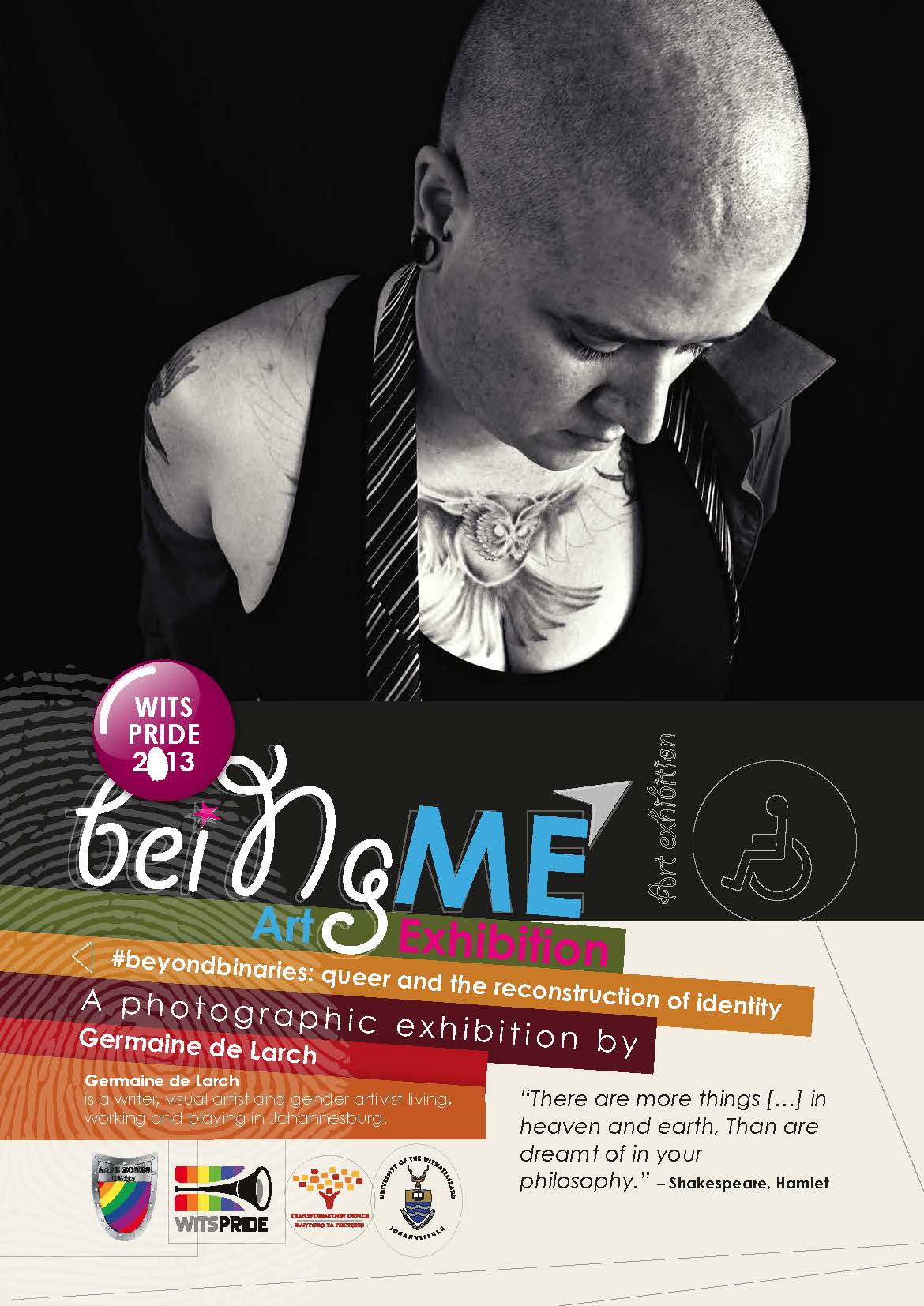
“There are more things […] in heaven and earth, Than are dreamt of in your philosophy.” – Shakespeare, Hamlet
These images are an artistic exploration and performance of being and experience beyond binaries. My vision for this project stems from the need to document the queer, carnivalesque space I have excavated for myself that exists beyond the constructs of reality, identity and gender as binaries, dualities and stereotypes. ‘#beyondbinaries: queer and the reconstruction of identity’ is an exploration, through self-portraits and portraits, of the contradictions, multiplicities and fluidity inherent in queer lived experience.
My work is, first and foremost, a vehicle through which I perform the continuing creative reconstruction of my self. It is a way for me to document who I am, who I am becoming, and provides me with a stage upon which to explore my self and my performance of continuously and unendingly recreating and reconstructing my fluid identity and gender identity. It is a stage from which I can share that de- and reconstruction with my audience.
My portraits tell the stories of those who use a similar stage to renegotiate and reconstruct their own identity. My images are a conscious choice to tell my own story and collaboratively tell the stories of my community, my city. My work is thus a collaboration with people and places on a journey of who they are, who are interested in playing with their identities, who want to explore the creative possibilities outside of the binaries, dualities and stereotypes constructed for us.
(Posted this first on Papanihil, a now-defunct blog I used to contribute to – on 29 June 2005)
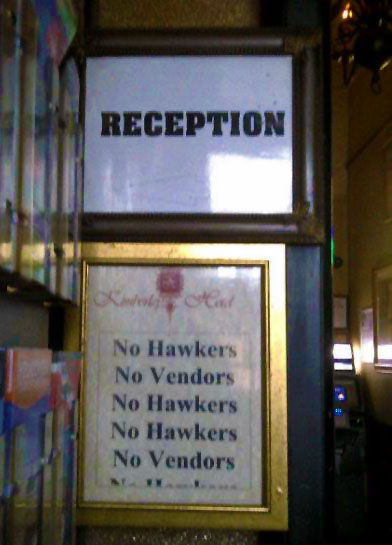
Kimberley Hotel Reception, 24 August 2013. Photo: Rosemary Lombard (with a Kakberry)
“Oh C’MONNN!” The driver in front of me hesitates as the light turns orange. Rearing to a halt, I yank up the handbrake and a woman’s waddling over, a wad of Big Issues clamped under one armpit, a limp bundle slipping sleeping from its swaddling under the other. My window’s half-open.
In one deft movement she hikes up low-slung child with elbow, thrusts out magazine with hand. I shake my head, smiling blankly; she jerks hers toward the May issue lying on my back seat, barely visible in the failing light.
“Hey M’am, that one’s too much old now!”
“Sorry, at the moment I really don’t have any money, Sisi – see, I’m working as a volunteer. I’m not being paid this month.” It’s so bloody cold with the window down.
“Ohh, okay,” she shrugs, arching an eyebrow (what incredible co-ords), “I understand… You working for free.” Her words puff out, grey and laconic, a dragon’s exhausted fumes. She smiles. “Hawu. But you too stupid.”
I grin back, stupidly. “You’re right, hey.” The light’s about to change. “Okay, byebye now. Next month, I hope…”
She steps back, the car bucking forward as I take my sheepish foot off the clutch just a little too quickly. At least I had a valid excuse.







 fleurmach