Felix’s new album, Deaf Safari, is out at last. Get it HERE!
Here’s an atmospheric outtake, not on the album:
Felix’s new album, Deaf Safari, is out at last. Get it HERE!
Here’s an atmospheric outtake, not on the album:
Curtis Mayfield into this:
Instrumental version of the track off Blue Lines (Circa Records, 1991). I love this video made by Gulo Ramishvili.
That outro…
From Back to the World (Curtom Records, 1973).
Forever kick-ass, this band. From Mountain Battles (4AD, 2008).
Chilling German expressionist dance performance of the dynamics of domestic violence, choreographed in 1977 by Pina Bausch, to Bartók’s opera Bluebeard’s Castle.
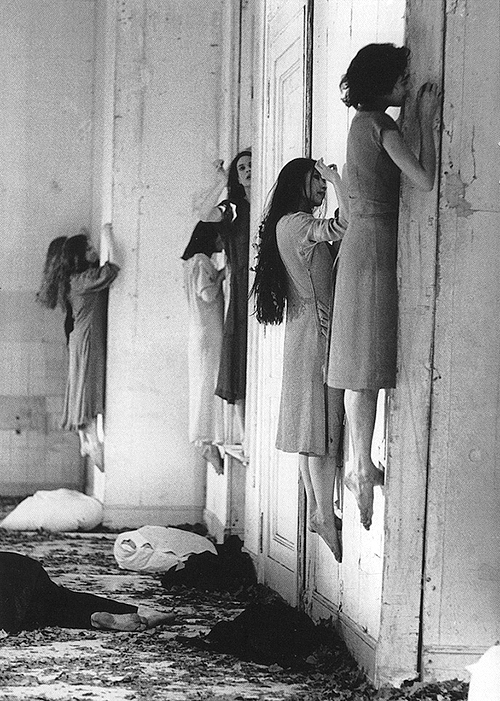
The Sylvia Plath story is told to girls who write.
They want us to think that to be a girl poet means you have to die.
Who is it that told me all girls who write must suicide?
I’ve another good one for you, we are turning cursive letters into
Knives.
Played on my gramophone!
Title: Indian Love Call/Nightmare
Artist: Artie Shaw
Cat No. B.8869
Label: HMV
Issue Date: Sept 1938
Song produced and mixed by Hernán A. Ambrogi
Video shooting and editing by Fusée Dorée.
http://www.facebook.com/fuseedoree
The final track on her beautiful album, Le Fil (2004).
| Quand Je Marche
Quand je marche, je marche. Quand je marche, je marche droit. Je suis ici. “Entends tu,” m’as-tu dit Je suis ici. Quand j’ai faim, tout me nourrit, |
When I Walk
When I walk, I walk. When I walk, I walk straight ahead. I’m here. “Can you hear it,” you said to me, I’m here. When I’m hungry, everything feeds me, |
The Frankie “Tram” Trumbauer Orchestra feat. Bix Beiderbecke – “Singin’ the Blues”, recorded in 1927. The first minute of the song is a sax solo by Trumbauer. The second minute is Bix’s cornet solo. The third minute features a short clarinet solo by Jimmy Dorsey, who was the clarinetist in Trumbauer’s Orchestra at that time. The guitarist on this track is Eddie Lang.
So good.
Yasuaki Shimizu – Kakashi
1. Suiren.
2. Kakashi.
3. Kono Yo Ni Yomeri #1
4. Semitori No Hi.
5. Kono Yo Ni Yomeri #2.
6. Yune Dewa.
7. Umi No Ue Kara.
8. Utukushiki Tennen.
Label: Better Days (2) – YF-7061-BD
Originally released in 1982: avant electronic, jazz, ethno minimal, chindon.
Yasuaki Shimizu: vocals, soprano, alto, tenor, baritone saxophone, clarinet, bass clarinet, drums, percussion, Aki Ikuta: guitar (7), contrabass (6), trap drum, contrabass drum, chanchiki, percussion (1, 2, 8), Hideo Yamaki: drums (1, 2, 8) Morio Watanabe : bass (1, 2, 7, 8), engawa, bells (8), Takayuki Hijikata: guitar (1), Masanori Sasaji: marimba (1), Dompei Kanezaki: trumpet (1, 8), Johnny: Frenchman, Irishman (1), Koji Yamaguchi: French horn (1), Mitsuru Orikasa: violoncello (1), Tomio Yajima: violoncello (2)
Including wonderful commentary from Tricky, Peter Gabriel, David Gilmour, John Lydon, Tori Amos, Natasha Khan, St Vincent, Neil Gaiman, Brett Anderson, and some fascinating archive.
Album: Change of the Century (1960)
Written by Ornette Coleman
Personnel:
Ornette Coleman — alto saxophone
Don Cherry — pocket trumpet
Charlie Haden — bass
Billy Higgins — drums
MAD.
Google Translate: Continental FY2014 for hot three brothers chopsticks Divine Comedy “Little Apple” Wang Rong “chick chick” Pang Mai Lang “My skateboard shoes”
My mind is fading, my body grows weak
Lips won’t form the words I speak…
Singer, 12-string guitarist, and banjo player of the New York 1960s folk revival, Karen Dalton is not widely known, despite counting the likes of Bob Dylan and Fred Neil among her acquaintances. She recorded only a few albums.
All songs are traditional:
“Blackwater Side” 0:00
“The Snow It Melts The Soonest” 3:50
“Willie O’Winsbury” 6:15
“Go Your Way” 11:47
“Thorneymoor Woods” 16:02
“The Cuckoo” 19:39
“Reynardine” 22:52
“Young Tambling” 25:52
“Living By The Water” 36:35
“Ma Bonny Lad” 40:28
The following is adapted from John Dougan of All Music Guide:
Anne Briggs was a singer of traditional English folk music, possessing as beautiful a voice as one could hope to have. She was the single most important influence on a group of female British folk singers including Sandy Denny, Maddy Prior, June Tabor, and Linda Thompson. Even Norma Waterson, herself a hugely important figure in the British folk revival of the mid-’60s, admits to being influenced by Briggs’ singing and notes that Anne Briggs singlehandedly changed the way that English women folk singers sang.
What makes this story so odd is that Anne Briggs’ entire recorded output consists of about 30 songs. She stopped singing at the age of 27, supposedly because she hated the sound of her recorded voice. As folk music became electrified and increasingly popular and bands such as Fairport Convention and Pentangle were reinventing the British folk tradition, and more and more women (Sandy Denny et al) were singing in a style started by Anne Briggs, her legend flourished, yet she still refused to sing. Read an interview with her HERE.
Funny story:
This is John Peel playing Fripp and Eno’s album backwards on BBC Radio One on 18th December 1973, without anyone in the studio knowing any difference. The story goes that Brian Eno was driving in his car, listening to Peel’s show, and he had the shock of his life when he heard Peel was playing his album backwards. He tried to phone the BBC to let Peel know that, but the BBC engineers thought it was an imposter playing a prank, therefore putting the phone down on him. Peel told his listeners at the end that it was an album worth buying, without realising he was playing it backwards!
P.S. Try playing this and the adjacent Japanese court music post simultaneously!
Ancient Japanese court music, recorded in 1972. Sublime.
A1 Hyōjō Netori
A2 Etenraku In Hyojo
A3 Etenraku In Banshkicho
A4 Etenraku In Oshikichō
A5 Bairo
B1 Sahō Taiheiraku (Kyū)
B2 Sahō Ranryō – Oh
B3 Uhō Genjōraku (Yatara Byōshi)
B4 Uhō Nasori (Ha)
B5 Uhō Nasori (Kyū)
Get this out-of-print recording HERE (look in the comments for the link).
More about Koos HERE (in Afrikaans). Definitely one of my favourite South African songwriters.
There were mountains to begin with
Silence shaped in giant
My voice would reach the highest
But you cannot tell this in English
An old man’s precise and attentive
My mother’s tongue my heart only sounds
As a girl I got lost in a cloud
But you cannot tell this in English
I balance an egg in a spoon
I’m never on time, it’s too late or too soon
In the night there is always the moon
That doesn’t speak in English
1966 Simon and Garfunkel cover.
The following essay is excerpted from Mladen Dolar’s book, A Voice and Nothing More (which I’m reading for my dissertation).
The voice did not figure as a major [western] philosophical topic until the 1960s, when Derrida and Lacan separately proposed it as a central theoretical concern. Dolar goes beyond Derrida’s idea of “phonocentrism” and revives and develops Lacan’s claim that the voice is one of the paramount embodiments of the psychoanalytic object (objet a). Dolar proposes that, apart from the two commonly understood uses of the voice as a vehicle of meaning and as a source of aesthetic admiration, there is a third level of understanding: the voice as an object that can be seen as the lever of thought. He investigates the object voice on a number of different levels–the linguistics of the voice, the metaphysics of the voice, the ethics of the voice (with the voice of conscience), the paradoxical relation between the voice and the body, the politics of the voice–and he scrutinizes the uses of the voice in Freud and Kafka. (There’s a great review by Christine Boyko-Head HERE.)
—
 Plutarch tells the story of a man who plucked a nightingale and finding but little to eat exclaimed: “You are just a voice and nothing more.”
There is a story that goes like this: In the middle of a war, in the middle of a battle, there is a company of Italian soldiers in the trenches. And there is an Italian commander who issues the command “Soldiers, attack!” But nothing happens, nobody moves. So the commander gets angry and shouts even louder “Soldiers, attack!” At which point there is a response, a voice rising from the trenches saying Che bella voce!
This story can serve as a good entry into the problem of the voice. On the first level this is a story of a failed interpellation. The soldiers fail to recognize themselves in the appeal, the call of the other, the call of duty, and they don’t act accordingly. Surely the fact that they are Italian soldiers plays a great role in it, they do act according to their image of not the most courageous soldiers in the world, as legend has it, and the story is most certainly not a model of political correctness, it indulges in tacit chauvinism and national stereotypes. So the command fails, the addressees don’t recognize themselves in the meaning being conveyed, they concentrate instead on the medium, which is the voice. The attention paid to the voice hinders the interpellation and the transmission of a symbolic mandate, the transmission of a mission.
But on a second level another interpellation works in the place of the failed one: if the soldiers don’t recognize themselves in their mission as the soldiers in the middle of a battle, they do recognize themselves as addressees of another message, they constitute a community as a response to the call, the community of people who can appreciate the aesthetics of a beautiful voice. Who can appreciate it when it is hardly the moment, and especially when it is hardly the moment to do so? So if in one respect they act as stereotypical Italian soldiers, they also act as stereotypical Italians in this other respect, namely as opera lovers. They constitute themselves as the community of “the friends of the Italian opera” (to take the immortal line from Some Like It Hot), living up to their reputation of connoisseurs, people of refined taste who have amply trained their ears with bel canto, so they can tell a beautiful voice when they hear one, even among the canon fire.
The soldiers have done the right thing, from our biased present perspective, at least in an incipient way, when they have concentrated on the voice instead of on the message, although, to be sure, for the wrong reasons. They are seized by a sudden aesthetic interest precisely when they would have had to attack, they concentrate on the voice because they have grasped the meaning all too well. But quite apart from their feigned artistic inclination they have also bungled the voice the moment they isolated it, they immediately turned it into an object of aesthetic pleasure, an object of veneration and worship, the bearer of a meaning beyond the ordinary meanings. The aesthetic concentration on the voice loses the voice precisely by turning it into a fetish-object.
I will try to argue that there is a third level: an object voice which doesn’t go up in smoke in conveyance of meaning and which doesn’t solidify either in an object of fetish reverence, but an object which functions as a blind spot in the call and a disturbance of aesthetic appreciation. One shows fidelity to the first by running to the attack, one shows fidelity to the second by running to the opera. But fidelity to the third is far more difficult to achieve. I will try to pursue it on three different levels: linguistics, ethics and politics. Continue reading
The road sings
When I leave
I take three steps…
The road is silent.
Gramophone recording 周璇-不要唱吧 (1947).
Bad translation:
Word you said too elegant
Turn, do not sing, do not sing!
Self-love and love
Sound they say is too nauseating
Easily and not great
Majestic and frightening
Solemn nobody loves it
Not to sing, do not sing!
Do not open so people curse
Do not open to avoid being criticized
Do not sing do not sing!
I’ve been listening to old Lata Mangeshkar records on my new, very old His Master’s Voice (model HMV 88a) gramophone. Indescribably magical, to listen to something powered only by the twist of your own wrist.
This song is from the film Dil Bhi Tera Hum Bhi Tere (1960).
Don’t call out to me in the stillness of the night
Don’t play that music which brings tears to my eyes
Don’t play it
Don’t call out to me
 fleurmach