Great Interview with Margaret Chardiet AKA “Pharmakon” in Santiago, Chile, September 02, 2015, for her South American Tour “Sacred Bones”.
Great Interview with Margaret Chardiet AKA “Pharmakon” in Santiago, Chile, September 02, 2015, for her South American Tour “Sacred Bones”.
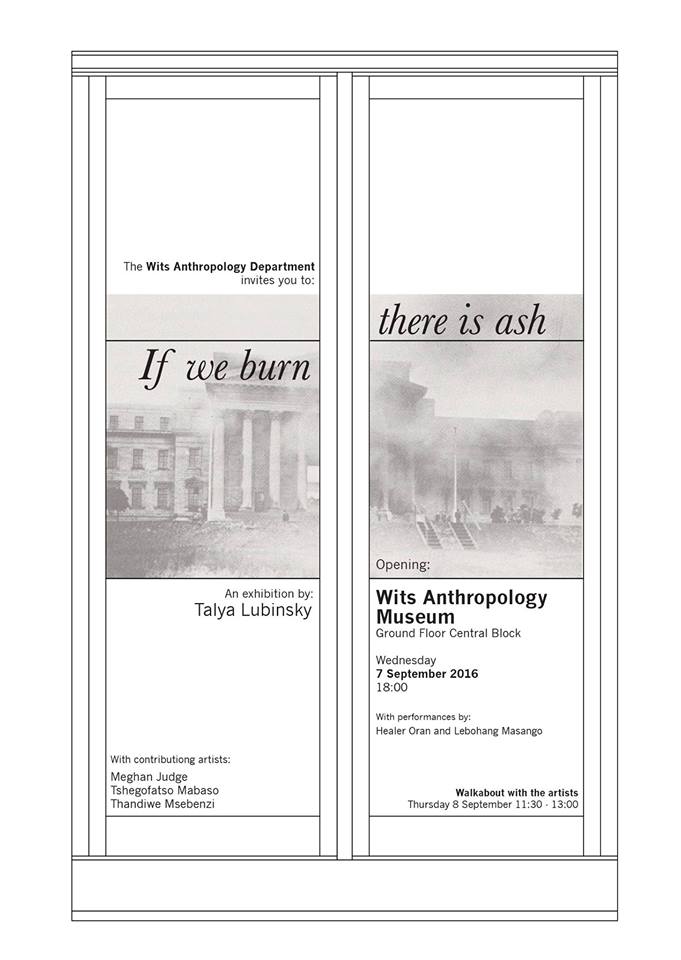
The Wits Anthropology Department is pleased to reopen its Museum collection with
If we burn there is ash
An exhibition by Talya Lubinsky
with contributing artists Meghan Judge, Tshegofatso Mabaso and Thandiwe Msebenzi
and performances by Lebohang Masango and Healer Oran
Wits Anthropology Museum
Wednesday 7 September 2016
18:00
Walkabout with the artists Thursday 8 September 11:30-13:00
All welcome
__
On Christmas Eve of 1931 a fire broke out at Wits University’s Great Hall. At the time, the façade of the Great Hall had been built, its stone pillars and steps creating a striking image of the university in the young colonial city. But the University had run out of funds, and the building that would become Central Block, had not yet been built. Erected behind the grand façade of the Great Hall were wooden shack-like structures, which burned in the fire. These wooden structures housed the collections of what is now called the Cullen Library, as well as the Ethnographic Museum’s collection. Initiated by Winifred Hoernle, head of the Ethnography Museum at the time, the collection was largely comprised of pieces of material culture sent to her from the British missionary, William Burton, while stationed in the ‘Congo’ region.
The fire burned hundreds of books, paintings and artefacts. Some of the only objects that survived the fire are clay burial bowls from the Burton collection. Able to withstand the heat precisely because of their prior exposure to fire, these bowls remain, but are blackened and broken by the 1931 fire.
The exhibition, If we burn, there is ash centres around this story as a place from which to think about the value of colonial collections of material culture. While the origins of the 1931 fire remain unknown, it nonetheless provides a space in which to think about the potentially generative qualities of fire.
Ash, the material remains of fire, however elusive, does not disappear. Even when things burn, they are never fully physically or ephemerally eliminated. Ash is not just the physical remains of that which has been burnt. It is also used as an ingredient in cement mixtures. It is literally transformed into a building material.
Using ash and cement as a poetic relation, this exhibition asks about the potentiality of burning in the project of building and growth. Ash and cement serve as a provocation on the question of what is to be done with the material remains of a violent colonial past.
__
For further information, please contact Talya Lubinsky (talya.lubinsky@gmail.com) or Kelly Gillespie (Kelly.Gillespie@wits.ac.za)
Russian director Andrei Tarkovsky’s film from 1983. I’m not going to link to any analysis here because to do so would narrow the interpretive possibilities of this opaque, allegorical masterpiece. Very superficially, though, the storyline is about a writer who, trapped by his fame and an unhappy marriage, seeks out his cultural past in Italy. Here he meets a local pariah who declares that the world is coming to an end. The writer finds this prophecy curiously more alluring than the possibility of a dead-end future. Nostalghia won the Grand Prix de Creation and the International Critics Prize at the 1984 Cannes Film Festival.
You can pick (slightly crappy) subtitles in several languages.
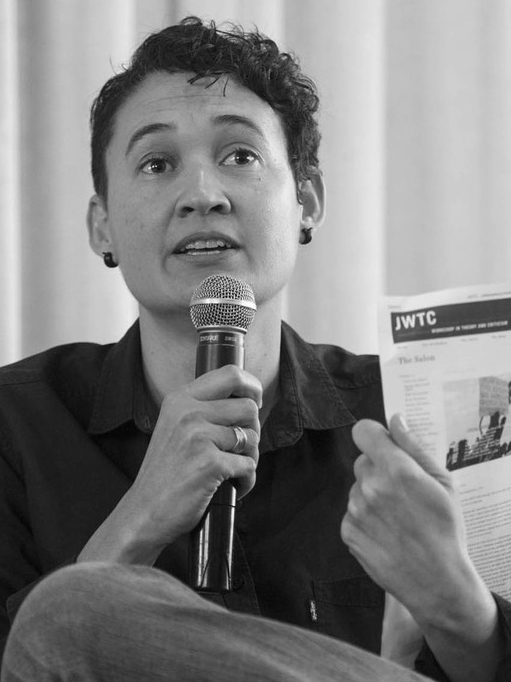
Photo: Paul Botes, M&G
“Quite simply – and this is what I wish to discuss tonight in relation to the question of rage and violence – we are living in different times. Or at least, our time is disjointed, out of sync, plagued by a generational fault line that scrambles historicity.
“The spectre of revolution, of radical change, is in young peoples’ minds and politics, and it is almost nowhere in the politics of the anti-apartheid generation. In fact, even as they criticised young people just five years earlier for being apathetic and depoliticized, they have now thought student activists misguided, uninformed, and mad.
“You would think that it might be possible to resolve this difference in time by means of a careful reading of what is called the ‘objective conditions for revolution’: are we in fact in a time in which revolution is immanent? No matter the subjective experience of time – there must be a way of determining who has the better bearing on history, who can tell the time. What time is it? Yet to tell the time is a complex matter in this society.
“We are, to some degree, post-apartheid, but in many ways not at all. We are living in a democracy that is at the same time violently, pathologically unequal. Protest action against the government – huge amounts of it, what in most other places would signal the beginning of radical change – often flips into a clamour for favour from that very government. Our vacillations, contradictions and anachronisms are indication that what time it is, is open to interpretation.
“I want to argue that the comrades I have worked with in the student movement are not so much mad as they are time-travellers. Or rather, that their particular, beautiful madness is to have recognised and exploited the ambivalence of our historical moment to push into the future. They have been working on the project of historical dissonance, of clarifying the untenable status quo of the present by forcing an awareness of a time when things are not this way. They have seen things many have yet to see. They have been experimenting with hallucinating a new time…”
__
Read the rest of this paper, delivered at the 13th annual Ruth First Memorial Lecture at Wits University in Johannesburg last night.
 … We set things aside without knowing we are doing so; that is precisely where the danger lies. Or, which is still worse, we set them aside by an act of the will, but by an act of the will that is furtive in relation to ourselves. Afterwards we do not any longer know that we have set anything aside. We do not want to know it, and, by dint of not wanting to know it, we reach the point of not being able to know it.
This faculty of setting things aside opens the door to every sort of crime. Outside those departments where education and training have forged solid links, it provides a key to absolute licence. That is what makes it possible for men to behave in such an incoherent fashion, particularly wherever the social, collective emotions play a part (war, national or class hatreds, patriotism for a party or a church). Whatever is surrounded with the prestige of the social element is set in a different place from other things and is exempt from certain connexions.
We also make use of this key when we give way to the allurements of pleasure.
I use it when, day after day, I put off the fulfillment of some obligation. I separate the obligation and the passage of time.
There is nothing more desirable than to get rid of this key. It should be thrown to the bottom of a well whence it can never again be recovered.
The ring of Gyges who has become invisible—this is precisely the act of setting aside: setting oneself aside from the crime one commits; not establishing the connexion between the two.
The act of throwing away the key, of throwing away the ring of Gyges—this is the effort proper to the will. It is the act by which, in pain and blindness, we make our way out of the cave. Gyges: ‘I have become king, and the other king has been assassinated.’ No connexion whatever between these two things. There we have the ring!
The owner of a factory: ‘I enjoy this and that expensive luxury and my workmen are miserably poor.’ He may be very sincerely sorry for his workmen and yet not form the connexion.
For no connexion is formed if thought does not bring it about. Two and two remain indefinitely as two and two unless thought adds them together to make them into four.
We hate the people who try to make us form the connexions we do not want to form.
Justice consists of establishing between analogous things connexions identical with those between similar terms, even when some of these things concern us personally and are an object of attachment for us.
This virtue is situated at the point of contact of the natural and the supernatural. It belongs to the realm of the will and of clear understanding, hence it is part of the cave (for our clarity is a twilight), but we cannot hold on to it unless we pass into the light.
__
Excerpted from Simone Weil‘s Gravity and Grace. First French edition 1947. Translated by Emma Crawford. English language edition 1963. Routledge and Kegan Paul, London.
This coming Tuesday, find out more about the extraordinary archive of photographs and live recordings made by Ian Bruce Huntley in the 1960s and early 1970s. In 2013 I was involved in putting this archive of recordings online, which you can explore HERE.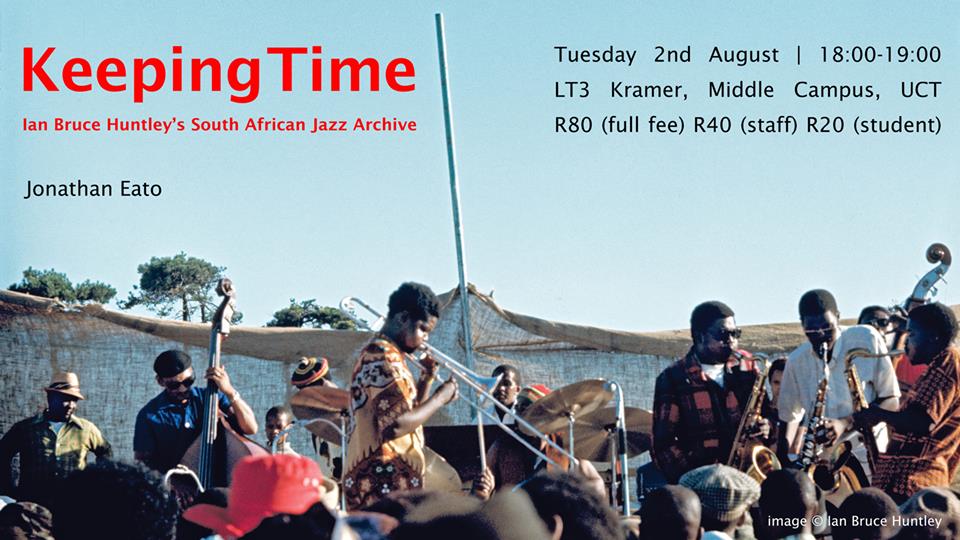
Keeping Time: Ian Bruce Huntley’s South African jazz archive
by Jonathan Eato
Ian Bruce Huntley is not a name that you’ll find readily in the burgeoning annals of South African jazz. Unless, that is, you talk to the dwindling generation of jazz musicians who were working in South Africa in the mid-1960s. Tete Mbambisa remembers Huntley as the man who ‘recorded our gold’, and this Huntley did through a series of remarkable photographic images and live audio recordings. Having privately preserved these records for over forty years, throughout the state repression of grand-apartheid and into the democratic era, they have recently been made available for the first time.
This talk will consider how, in the face of increasing political oppression, Huntley’s archive documented a community of vernacular intellectuals exploring and developing ideas in counterpoint to much commercially available South African jazz post-‘Pondo Blues’.
For more info:
email: ems@uct.ac.za
tel: 021 650 2888
Facebook event HERE.
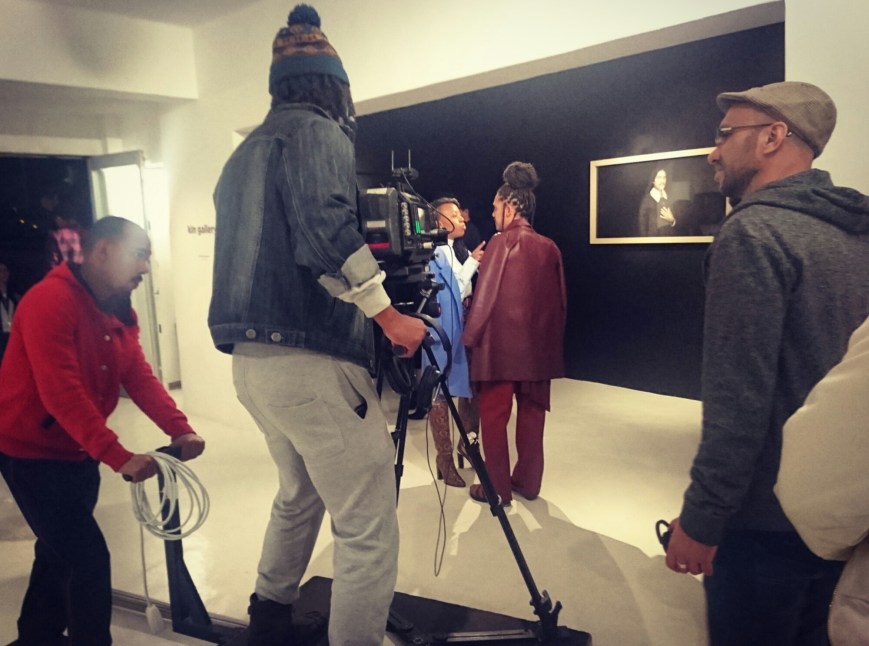
On set at Muti Films tonight.
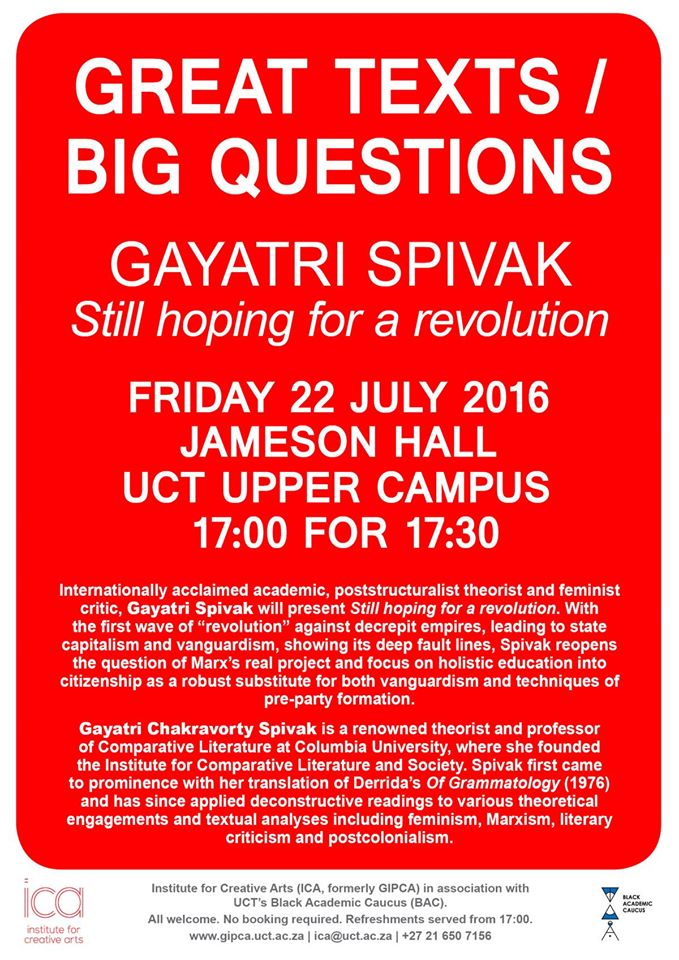
The Institute for Creative Arts is proud to present internationally renowned theorist, Professor Gayatri Spivak.
Gayatri Chakravorty Spivak is one of the most significant and influential literary theorists of our time.
Having first come to prominence with her translation of Derrida’s Of Grammatology in 1976, Spivak has since applied deconstructive readings to theoretical engagements and textual analyses including feminism, Marxism, literary criticism and postcolonialism – capturing complex theories that transgress disciplinary boundaries.
The Institute for Creative Arts (ICA, formerly GIPCA) in collaboration with UCT’s Black Academic Caucus (BAC) is honoured to present this esteemed academic and philosopher as part of the ICA’s Great Texts/Big Questions lecture series.
Of her address, entitled “Still hoping for a revolution”, Spivak writes:
Now that the first wave of “revolution” against decrepit empires, leading to state capitalism and vanguardism, is showing its deep fault lines, I reopen the question of Marx’s real project and focus on holistic education into citizenship – as the conjuncture has moved from the central agency of the industrial proletariat – as a robust substitute for both vanguardism and techniques of pre-party formation.
This is particularly interesting for me because I have myself learned from many mistakes made since 1992, when I presented the T.B. Davie Memorial Lecture in Cape Town on “Thinking Academic Freedom in Gendered Post-Coloniality.” The general response, as I heard it reported, was “we already do this.” Yet, in 2002, Joan Vincent included the piece in her The Anthropology of Politics: A Reader in Ethnography, Theory, and Critique, commenting that I had been “prescient.” I therefore hope that my audience, which will be different, will also have learned from past “mistakes.”
Gayatri Chakravorty Spivak is currently professor of Comparative Literature at Columbia University where she founded the Institute for Comparative Literature and Society. Her critical writings include Of Grammatology (1976), In Other Worlds: Essays in Cultural Politics (1987), The Post-Colonial Critic (1990), Thinking Academic Freedom in Gendered Post-Coloniality (1992), Outside in the Teaching Machine (1993), A Critique of Postcolonial Reason (1999), Death of a Discipline (2003), and Other Asias (2005).
The lecture, followed by an open question and answer session, will take place from 17:30 – 19:00 on Friday 22 July 2016 at Jameson Hall, University Avenue, University of Cape Town Upper Campus.
Refreshments will be served from 17:00.
No booking is necessary and all are welcome.
For more information, contact the ICA office: +27 21 650 7156 or ica@uct.ac.za
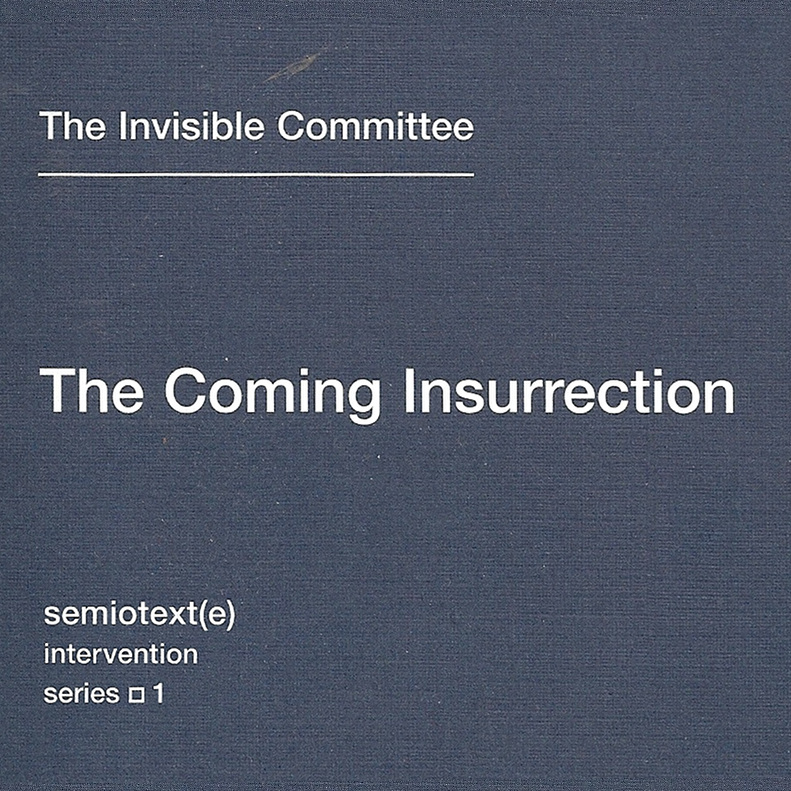 The Coming Insurrection, a notorious 2007 ultra-left polemical tract written by a collective of French anti-state communists writing under the group-moniker The Invisible Committee, posits a conception of insurrection as the creation of new collective ontologies through acts of radical social rupture. Eschewing the orthodox Marxist line that revolution is something temporally removed from the present, towards which pro-revolutionaries must organize and work, The Invisible Committee’s use of insurrection claims it as an antagonistic challenge to late-capitalism firmly grounded in its own immediacy. Communism is therefore made immediate, and it is willed into being by insurrectionary acts of social rupture.
While much has been written on the debt that The Invisible Committee owes to French strains of ultra-left anti-state communism, Michel Foucault, Gilles Deleuze, Giorgio Agamben, Situationism, and the Italian Autonomia movement of the 1970s, their implicit nod to the sociopolitical themes of music has been largely ignored. By subtly claiming that insurrection spreads by resonance and that such proliferation “takes the shape of a music,” The Invisible Committee allows for the interpretation of its “coming insurrection” as an inherently musical act. Using a historical reading of the shift from tonality to atonality in Western art music, as exemplified by Arnold Schoenberg, Alden Wood’s interpretation of The Coming Insurrection aims at imbuing its explicitly political premises with a more thorough exploration of its implicit musical qualities.
Published in Interdisciplinary Humanities Vol. 30 pp. 57-65, 2013.
Two Solutions for One Problem (Persian: دو راه حل برای يک مسئله , Dow Rahehal Baraye yek Massaleh) is an Iranian short film from 1975, directed by Abbas Kiarostami, who died yesterday.
During breaktime, Dara and Nader have an altercation about a torn exercise book that the former has given back to the latter. There are two possible outcomes, which the film shows one after the other.
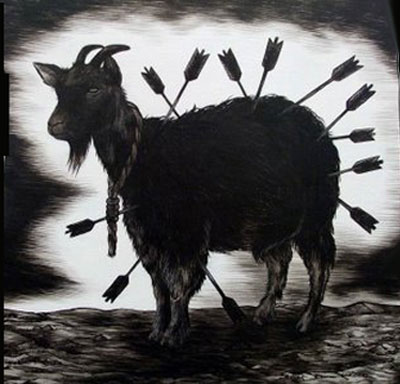
Quite apart from the barbarities and blood baths perpetrated by the Christian nations among themselves throughout European history, the European has also to answer for all the crimes he has committed against the dark-skinned peoples during the process of colonization.
In this respect the white man carries a very heavy burden indeed.
It shows us a picture of the common human shadow that could hardly be painted in blacker colors.
The evil that comes to light in man and that undoubtedly dwells within him is of gigantic proportions, so that for the Church to talk of original sin and to trace it back to Adam’s relatively innocent slip-up with Eve is almost a euphemism.
The case is far graver and is grossly underestimated.
Since it is universally believed that man is merely what his consciousness knows of itself, he regards himself as harmless and so adds stupidity to iniquity. He does not deny that terrible things have happened and still go on happening, but it is always “the others” who do them.
And when such deeds belong to the recent or remote past, they quickly and conveniently sink into the sea of forgetfulness, and that state of chronic woolly-mindedness returns which we describe as “normality.”
In shocking contrast to this is the fact that nothing has finally disappeared and nothing has been made good.
The evil, the guilt, the profound unease of conscience, the obscure misgiving are there before our eyes, if only we would see. Man has done these things; I am a man, who has his share of human nature; therefore I am guilty with the rest and bear unaltered and indelibly within me the capacity and the inclination to do them again at any time.
Even if, juristically speaking, we were not accessories to the crime, we are always, thanks to our human nature, potential criminals.
In reality we merely lacked a suitable opportunity to be drawn into the infernal melée. None of us stands outside humanity’s black collective shadow.
Whether the crime lies many generations back or happens today, it remains the symptom of a disposition that is always and everywhere present – and one would therefore do well to possess some “imagination in evil”, for only the fool can permanently neglect the conditions of his own nature.
In fact, this negligence is the best means of making him an instrument of evil.
Harmlessness and naïveté are as little helpful as it would be for a cholera patient and those in his vicinity to remain unconscious of the contagiousness of the disease.
On the contrary, they lead to projection of the unrecognized evil into the “other.”
This strengthens the opponent’s position in the most effective way, because the projection carries the fear which we involuntarily and secretly feel for our own evil over to the other side and considerably increases the formidableness of his threat.
What is even worse, our lack of insight deprives us of the capacity to deal with evil.
Here, of course, we come up against one of the main prejudices of the Christian tradition, and one that is a great stumbling block to our policies.
We should, so we are told, eschew evil and, if possible, neither touch nor mention it. For evil is also the thing of ill omen, that which is tabooed and feared.
This attitude towards evil, and the apparent circumventing of it, flatter the primitive tendency in us to shut our eyes to evil and drive it over some frontier or other, like the Old Testament scapegoat, which was supposed to carry the evil into the wilderness.
But if one can no longer avoid the realization that evil, without man’s ever having chosen it, is lodged in human nature itself, then it bestrides the psychological stage as the equal and opposite partner of good.
This realization leads straight to a psychological dualism, already unconsciously prefigured in the political world schism and in the even more unconscious dissociation in modern man himself. The dualism does not come from this realization; rather, we are in a split condition to begin with.
It would be an insufferable thought that we had to take personal responsibility for so much guiltiness. We therefore prefer to localize the evil with individual criminals or groups of criminals, while washing our hands in innocence and ignoring the general proclivity to evil.
This sanctimoniousness cannot be kept up, in the long run, because the evil, as experience shows, lies in man – unless, in accordance with the Christian view, one is willing to postulate a metaphysical principle of evil.
The great advantage of this view is that it exonerates man’s conscience of too heavy a responsibility and fobs it off on the devil, in correct psychological appreciation of the fact that man is much more the victim of his psychic constitution than its inventor.
Considering that the evil of our day puts everything that has ever agonized mankind in the deepest shade, one must ask oneself how it is that, for all our progress in the administration of justice, in medicine and in technology, for all our concern for life and health, monstrous engines of destruction have been invented which could easily exterminate the human race.
No one will maintain that the atomic physicists are a pack of criminals because it is to their efforts that we owe that peculiar flower of human ingenuity, the hydrogen bomb.
The vast amount of intellectual work that went into the development of nuclear physics was put forth by men who devoted themselves to their task with the greatest exertions and self-sacrifice and whose moral achievement could just as easily have earned them the merit of inventing something useful and beneficial to humanity.
But even though the first step along the road to a momentous invention may be the outcome of a conscious decision, here, as everywhere, the spontaneous idea – the hunch or intuition – plays an important part.
In other words, the unconscious collaborates too and often makes decisive contributions.
So it is not the conscious effort alone that is responsible for the result; somewhere or other the unconscious, with its barely discernible goals and intentions, has its finger in the pie.
If it puts a weapon in your hand, it is aiming at some kind of violence.
Knowledge of the truth is the foremost goal of science, and if in pursuit of the longing for light we stumble upon an immense danger, then one has the impression more of fatality than of premeditation.
It is not that present-day man is capable of greater evil than the man of antiquity or the primitive. He merely has incomparably more effective means with which to realize his proclivity to evil.
As his consciousness has broadened and differentiated, so his moral nature has lagged behind. That is the great problem before us today. Reason alone does not suffice.
— From The Undiscovered Self (1957).
Dylan described his reaction to hearing Hendrix’s version of his song: “It overwhelmed me, really. He had such talent, he could find things inside a song and vigorously develop them. He found things that other people wouldn’t think of finding in there. He probably improved upon it by the spaces he was using. I took license with the song from his version, actually, and continue to do it to this day.”
— “Interview with Dylan: 09/29/95”. Fort Lauderdale Sun Sentinel.
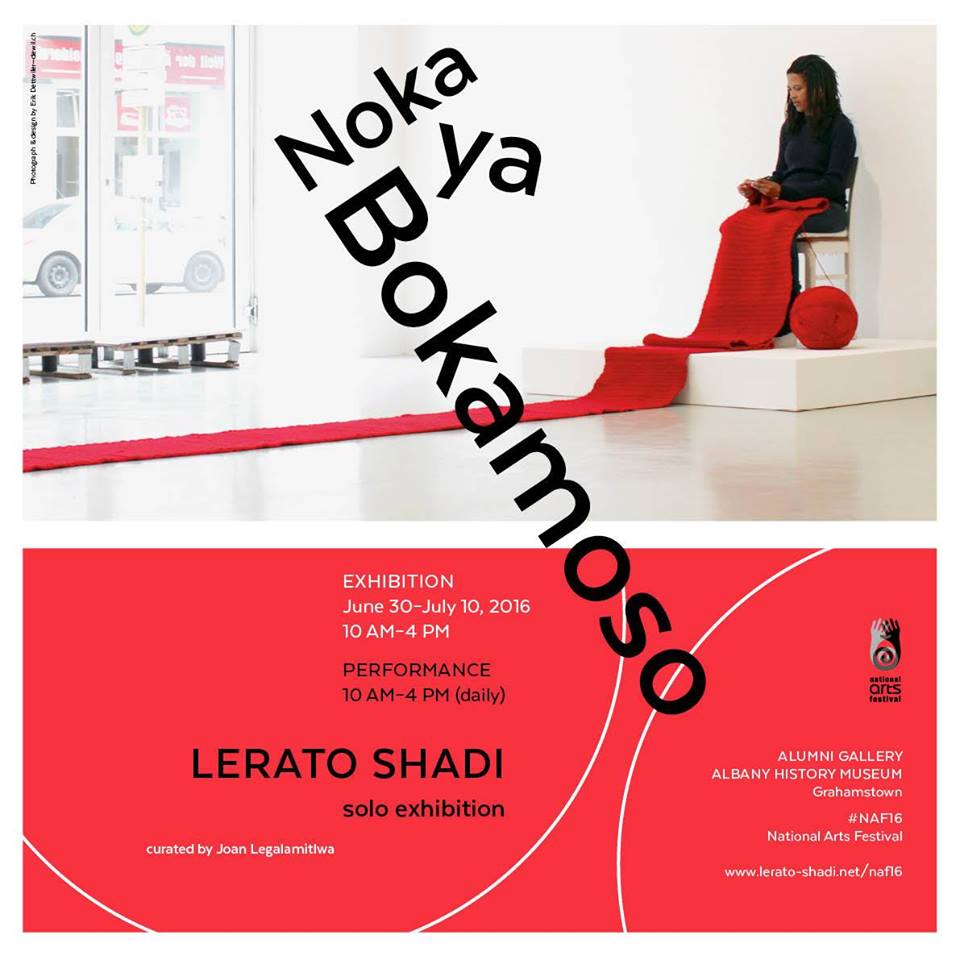
NOKA YA BOKAMOSO: A SOLO EXHIBITION BY LERATO SHADI
2016 National Arts Festival – Grahamstown
Alumni Gallery, Albany History Museum
30 June – 10 July
Lerato Shadi invites you to her latest solo exhibition and debut National Arts Festival appearance, Noka Ya Bokamoso. This exhibition by the Mahikeng born, Berlin based video and performance artist is one of the six visual art showcases chosen for the main programme.
The exhibition features four of Shadi’s latest works; two performative installations Makhubu and Mosako Wa Nako as well as two video works Sugar & Salt and Untitled.
Curator, Joan Legalamitlwa says,
“The works on the show were purposefully selected as they weave together history as told by and through the Black female body, in its truest and sincerest form, as it should be. Noka Ya Bokamoso is about the Black subject being in control of its own narrative and also about encouraging the visitors to do some introspection when it comes to matters of identity and representation.”
Makhubu is a work performed in the days preceding the festival, executed in absence of an audience. This performance involves Shadi arduously writing in concentric circles with a red pencil, then erasing the writing, leaving traces of the text on the wall and red remnants of the rubber eraser on the floor. This work looks at the historical erasure of the Black subject within the context of Grahamstown’s problematic history as well as historic erasure in the national narrative and how that has impacted on the kinds of stories that we currently tell. The absence of an audience becomes a corporeal metaphor, emphasising the ways in which South Africans, continue to construct a sense of nationhood unaware of significant violent acts that have shaped them.
For Mosako Wa Nako, Shadi will be seated one end of the gallery space for an uninterrupted six hours a day, over the eleven days of the Festival, crocheting what looks like be a red woollen carpet. Sugar & Salt, a video work featuring Shadi and her mother consuming a mineral in the form of salt and a carbohydrate in the form of sugar, makes references to the complexities and intricacies of mother-daughter relationships.
Untitled, Shadi’s latest video work, having its world premiere at the National Arts Festival, will be shot on location in her home village of Lotlhakane, in June 2016. The work consists of a two channel video work conceptualised in three parts: the first deals with the utmost extremes of individual resistance; the second deals with how Shadi experiences the impact of colonial language; the final part is an allegory of resistance.
Shadi’s work explores problematic assumptions projected onto the Black female body and how performance, video and installation create a space for artists to engage with those preconceived notions, making the body both visible and invisible. Using time, repetitive actions as well as stillness, she questions, ‘How does one create oneself?’ rather than allowing others or history to shape one’s person.
The key aim of Noka Ya Bokamoso is to re-center Shadi’s works to its primary audience – the South African audience. Shadi has practiced and exhibited in New York, Bern, Dakar, Moscow and Scotland and now seeks to utilise her work to foster and encourage dialogue around questions of historical knowledge production and its inclusion and exclusion of certain subjects. Her ultimate goal is that she, along with her audiences, will be encouraged not only to consume, but consciously engage in the processes of unearthing subsumed histories and producing critical knowledge.
Lerato Shadi lives and works in Berlin. She completed a BFA in Fine Art from the University of Johannesburg. She was included in The Generational: ‘Younger Than Jesus’ artists directory published by the New Museum, New York. In 2010 she was awarded a Pro Helvetia residency in Bern. In the same year she had her solo exhibition Mosako Wa Seipone at Goethe on Main in Johannesburg. From 2010 to 2012 she was a member of the Bag Factory artist studios in Johannesburg. In 2012 her work was featured at the Dak’art Biennale in Dakar, Senegal and in the III Moscow International Biennale. She is a fellow of Sommerakademie 2013 (Zentrum Paul Klee) and completed in the same year a residency program by invitation of INIVA at Hospitalfield (supported by ROSL). In 2014 she was awarded with the mart stam studio grant. She is currently completing her MFA at the Kunsthochschule Berlin Weissensee.
Noka Ya Bokamoso is made possible through the generous support of the National Arts Festival.
The following is excerpted from a feature essay on the LSE blog by Katie Collins, entitled “Woven into the Fabric of the Text: Subversive Material Metaphors in Academic Writing”. Collins proposes that we shift our thinking about academic writing from building metaphors – the language of frameworks, foundations and buttresses – to stitching, sewing and piecing. Needlecraft metaphors offer another way of thinking about the creative and generative practice of academic writing as decentred, able to accommodate multiple sources and with greater space for the feminine voice.
__
[W]hy do I regard switching from a metaphor of building to one of stitching as a subversive act? For several reasons. Throughout history, needlework has been a marker of femininity in its various iterations, a means to inculcate it, and something to sneer at as a way of shoring up women’s supposed inferiority. Theodore Roethke described women’s poetry as ‘the embroidering of trivial themes […] running between the boudoir and the alter, stamping a tiny foot against God…’ (165), for example. Women’s naturally nimble fingers were to be occupied; we were to be kept out of the way and out of trouble, shut in the top room of a circular tower and thus prevented from engaging in the masculine pursuits of politics, thinking, reading and writing and making Art (for a fascinating discussion on women, folk art and cultural femicide, I recommend this post by Dr Lucy Allen). The frills and fripperies our needles produced were ample evidence, should anyone require it, that we were frivolous creatures entirely unsuited to public life. Or so the story was. So using needlework metaphors in my academic writing blows a resonant raspberry to that notion, for one thing. But the subversion here is not as straightforward as reclamation, of presenting something usually disparaged as having value after all. Femininity and its inculcation is a displeasingly twisted yarn of benevolence and belittlement. The trick is to unpick the knots without snapping the thread and unravelling the beautiful work, to value that which has been constructed as feminine while at the same time escaping its constricting net.
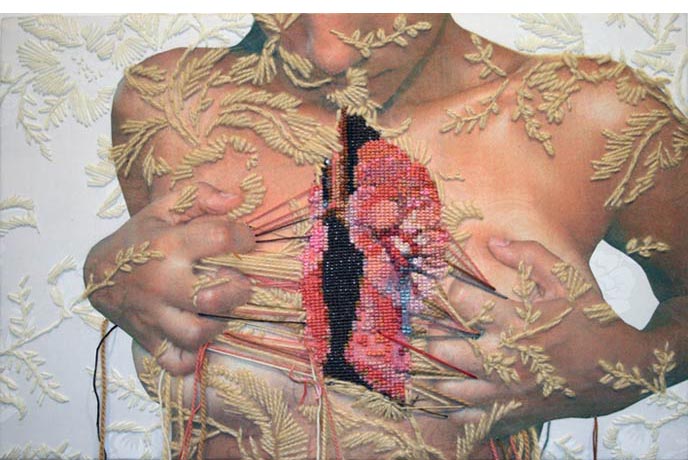
Ana Teresa Barboza – embroidery and photo transfer on fabric
Imagining academic writing as piecing fragments is one way of recognising that it can integrate all sorts of sources but, more significantly, piecing is also a decentred activity. When quilting, one can plan, cut and stitch many individual squares whenever there is a moment spare, before bringing them together to form the overall pattern, which is flat and in aesthetic terms may have no centre or many centres, and no predetermined start or end. This holds true both for the practice of quilting and how we might think differently about academic writing, with each contribution not a brick in a structured wall but a square ready to stitch onto other squares to make something expected or unexpected, the goal depth and intensity rather than progress (see Mara Witzling). There is sedition here in several senses. This way of imagining how writing works is not individualistic or competitive. Each voice is a thread, and only when they are woven together do they form a whole, as Ann Hamilton’s tapestries represent social collaboration and interconnectedness; many voices not one, cut from the same cloth or different.
But acknowledging that one might have to fit the work of writing around other things, a problem that has occupied me from the moment I became a mother, is a particularly rebellious act, I think. As Adrienne Rich expresses in the poem ‘Transcendental Etude’:
Vision begins to happen in such a life
as if a woman quietly walked away
from the argument and jargon in a room
and sitting down in the kitchen, began turning in her lap
bits of yarn, calico and velvet scraps,
laying them out absently on the scrubbed boards
in the lamplight, with small rainbow-colored shells
sent in cotton-wool from somewhere far away,
and skeins of milkweed from the nearest meadow –
original domestic silk, the finest findings.
This way of imagining academic writing as something that is part of life, rather than something apart, challenges the view of the scholar as the extraordinary, solitary genius who sits alone in his study day after day while the minutiae of clothing and food is organised for him, around him, despite him. But with metaphors that emphasise the piecing of fragments, both everyday and exceptional, we recognise a way of working in which every fragment that can be pieced together into a square is ‘the preservation of a woman’s voice’.
Read the whole of this great essay by Katie Collins HERE.
I sometimes fear that
people think that fascism arrives in fancy dress
worn by grotesques and monsters
as played out in endless re-runs of the Nazis.
Fascism arrives as your friend.
It will restore your honour,
make you feel proud,
protect your house,
give you a job,
clean up the neighbourhood,
remind you of how great you once were,
clear out the venal and the corrupt,
remove anything you feel is unlike you…
It doesn’t walk in saying,
“Our programme means militias, mass imprisonments, transportations, war and persecution.”

From HERE.
Money, mechanization, algebra. The three monsters of contemporary civilization. Complete analogy.
Algebra and money are essentially levellers, the first intellectually, the second effectively.
About fifty years ago the life of the Provençal peasants ceased to be like that of the Greek peasants described by Hesiod. The destruction of science as conceived by the Greeks took place at about the same period. Money and algebra triumphed simultaneously.
The relation of the sign to the thing signified is being destroyed, the game of exchanges between signs is being multiplied of itself and for itself. And the increasing complication demands that there should be signs for signs… [Note that this comment comes decades before Baudrillard writes about simulacra in 1981.]
Among the characteristics of the modern world we must not forget the impossibility of thinking in concrete terms of the relationship between effort and the result of effort. There are too many intermediaries. As in the other cases, this relationship which does not lie in any thought, lies in a thing: money.
As collective thought cannot exist as thought, it passes into things (signs, machines…). Hence the paradox: it is the thing which thinks and the man who is reduced to the state of a thing.
There is no collective thought. On the other hand our science is collective like our technics. Specialization. We inherit not only results but methods which we do not understand. For the matter of that the two are inseparable, for the results of algebra provide methods for the other sciences.
To make an inventory or criticism of our civilization—what does that mean? To try to expose in precise terms the trap which has made man the slave of his own inventions. How has unconsciousness infiltrated itself into methodical thought and action?
To escape by a return to the primitive state is a lazy solution. We have to rediscover the original pact between the spirit and the world in this very civilization of which we form a part. But it is a task which is beyond our power on account of the shortness of life and the impossibility of collaboration and of succession. That is no reason for not undertaking it. The situation of all of us is comparable to that of Socrates when he was awaiting death in his prison and began to learn to play the lyre… At any rate we shall have lived…
The spirit, overcome by the weight of quantity, has no longer any other criterion than efficiency.
Modern life is given over to immoderation. Immoderation invades everything: actions and thought, public and private life.
The decadence of art is due to it. There is no more balance anywhere. The Catholic movement is to some extent in reaction against this; the Catholic ceremonies, at least, have remained intact. But then they are unrelated to the rest of existence.
Capitalism has brought about the emancipation of collective humanity with respect to nature. But this collective humanity has itself taken on with respect to the individual the oppressive function formerly exercised by nature.
This is true even with material things: fire, water etc. The community has taken possession of all these natural forces.
Question: can this emancipation, won by society, be transferred to the individual?
__
Excerpted from Simone Weil‘s Gravity and Grace. First French edition 1947. Translated by Emma Crawford. English language edition 1963. Routledge and Kegan Paul, London.
A poem for those who died, shot in Pulse nightclub in Orlando this weekend past.
i was going to see you
i was going to dance
in the same place with you someday
i was going to pretend not to notice
how you and your friends smiled
when you saw me and my partner
trying to cumbia to bachata
but i was going to feel more free anyway
because you were smiling
and we were together
and you had your stomach out
and you felt beautiful in your sweat
i was going to smile when i walked by
i was going to hug you the first time
a friend of a friend introduced us
i was going to compliment your shoes
instead of writing you a love poem
i was going to smile every time i saw you
and struggle to remember your name
we were going to sing together
we were going to belt out Selena
i was going to mispronounce everything
except for amor
and ay ay ay
i was going to covet your confidence and your bracelet
i was going to be grateful for the sight of you
i was going scream YES!!! at nothing in particular
at everything especially
meaning you
meaning you beyond who i knew you to be
i was going to see you in hallways
and be too shy to say hello
you were going to come to the workshop
you were going to sign up for the workshop and not come
you were going to translate the webinar
even though my politics seemed out there
we were going to sign up for creating change the same day
and be reluctant about it for completely different reasons
we were going to watch the keynotes
and laugh at completely different times
i was going to hold your hand in a big activity
about the intimacy of strangers
about the strangeness of needing prayer
we were going to get the same automated voice message
when we complained that it was not what it should have been
we were going to be standing in the same line
for various overpriced drinks
during a shift change
i was going to breathe loudly so you would notice me
you were going to compliment my hair
it isn’t fair
because we were going to work
to beyonce and rihanna
and the rihanna’s and beyonce’s to come
and the beyonce’s and rihanna’s after that
we were going to not drink enough water
and stay out later than our immune systems could handle
we were going to sit in traffic in each others blindspots
listening to top 40 songs that trigger queer memories
just outside the scope of marketing predictions
we were going to get old and i was going to wonder
about the hint of a tattoo i could see under your sleeve
i was going to blink and just miss
the fought-for laughter lines around your liner-loved eyes
i was going to go out for my birthday
but i didn’t
and you did
we were going to be elders
just because we were still around
and i was going to listen to you on a panel
we didn’t feel qualified for
and hear you talk about your guilt
for still being alive
when so many of your friends were taken
by suicide
by AIDS
by racist police
and jealous ex-lovers
and poverty
and no access to healthcare
and how you had a stable job
you suffered at until the weekend
how you avoided the drama
and only went to the club at pride
and so here you were with no one to dance with anymore
i was going to see you and forget you
and only remember you in my hips
and how my smile came easier than clenching my teeth eventually
and how i finally learned whatever it is i still haven’t learned yet
i was going to hear you laugh and not know why
and not care
our ancestors fought for a future
and we were both going to be there
until we weren’t
and i don’t know if it would hurt more
to lose you later after knowing you
i don’t know if it would hurt more
to know you died on your own day
by your own hands
or any of the other systems
that stalk you and me and ours forever
i only know the pain that i am having
and that you are not here to share it
you are not here to bear it
you were going to pass me a candle at the next vigil
but now i am pulse
and now you
are flame.

Illustration by William Steig from Wilhelm Reich’s “Listen, Little Man” (1945)
LAW 1
NEVER OUTSHINE THE MASTER
Always make those above you feel comfortably superior. In your desire to please or impress them, do not go too far in displaying your talents or you might accomplish the opposite-inspire fear and insecurity. Make your masters appear more brilliant than they are and you will attain the heights of power.
LAW 2
NEVER PUT TOO MUCH TRUST IN FRIENDS, LEARN HOW TO USE ENEMIES
Be wary of friends-they will betray you more quickly, for they are easily aroused to envy. They also become spoiled and tyrannical. But hire a former enemy and he will be more loyal than a friend, because he has more to prove. In fact, you have more to fear from friends than from enemies. If you have no enemies, find a way to make them.
LAW 3
CONCEAL YOUR INTENTIONS
Keep people off-balance and in the dark, by never revealing the purpose behind your actions. If they have no clue what you are up to, they cannot prepare a defense. Guide them far enough down the wrong path, envelop them in enough smoke, and by the time they realize your intentions, it will be too late.
LAW 4
ALWAYS SAY LESS THAN NECESSARY
When you are trying to impress people with words, the more you say, the more common you appear, and the less in control. Even if you are saying something banal, it will seem original if you make it vague, open-ended, and sphinxlike. Powerful people impress and intimidate by saying less. The more you say, the more likely you are to say something foolish.
LAW 5
SO MUCH DEPENDS ON REPUTATION- GUARD IT WITH YOUR LIFE
Reputation is the cornerstone of power. Through reputation alone you can intimidate and win; once it slips, however, you are vulnerable, and will be attacked on all sides. Make your reputation unassailable. Always be alert to potential attacks and thwart them before they happen. Meanwhile, learn to destroy your enemies by opening holes in their own reputations. Then stand aside and let public opinion hang them.
LAW 6
COURT ATTENTION AT ALL COST
Everything is judged by its appearance; what is unseen counts for nothing. Never let yourself get lost in the crowd, then, or buried in oblivion. Stand out. Be conspicuous, at all cost. Make yourself a magnet of attention by appearing larger, more colorful, more mysterious than the bland and timid masses.
LAW 7
GET OTHERS TO DO THE WORK FOR YOU, BUT ALWAYS TAKE THE CREDIT
Use the wisdom, knowledge, and legwork of other people to further your own cause. Not only will such assistance save you valuable time and energy, it will give you a godlike aura of efficiency and speed. In the end your helpers will be forgotten and you will be remembered. Never do yourself what others can do for you.
LAW 8
MAKE OTHER PEOPLE COME TO YOU-USE BAIT IF NECESSARY
When you force the other person to act, you are the one in control. It is always better to make your opponent come to you, abandoning his own plans in the process. Lure him with fabulous gains-then attack. You hold the cards.
LAW 9
WIN THROUGH YOUR ACTIONS, NEVER THROUGH ARGUMENT
Any momentary triumph you think you have gained through argument is really a Pyrrhic victory: The resentment and ill will you stir up is stronger and lasts longer than any momentary change of opinion. It is much more powerful to get others to agree with you through your actions, without saying a word. Demonstrate, do not explicate.
LAW 10
INFECTION: AVOID THE UNHAPPY AND UNLUCKY
You can die from someone else’s misery-emotional states are as infectious as diseases. You may feel you are helping the drowning man but you are only precipitating your own disaster. The unfortunate sometimes draw misfortune on themselves; they will also draw it on you. Associate with the happy and fortunate instead.
LAW 11
LEARN TO KEEP PEOPLE DEPENDENT ON YOU
To maintain your independence you must always be needed and wanted. The more you are relied on, the more freedom you have. Make people depend on you for their happiness and prosperity and you have nothing to fear. Never teach them enough so that they can do without you.
LAW 12
USE SELECTIVE HONESTY AND GENEROSITY TO DISARM YOUR VICTIM
One sincere and honest move will cover over dozens of dishonest ones. Open-hearted gestures of honesty and generosity bring down the guard of even the most suspicious people. Once your selective honesty opens a hole in their armor, you can deceive and manipulate them at will. A timely gift-a Trojan horse-will serve the same purpose.
LAW 13
WHEN ASKING FOR HELP, APPEAL TO PEOPLE’S SELF-INTEREST, NEVER TO THEIR MERCY OR GRATITUDE
If you need to tum to an ally for help, do not bother to remind him of your past assistance and good deeds. He will find a way to ignore you. Instead, uncover something in your request, or in your alliance with him, that will benefit him, and emphasize it out of all proportion. He will respond enthusiastically when he sees some thing to be gained for himself.
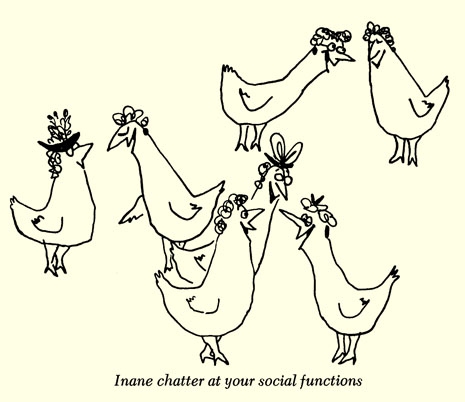
From Wilhelm Reich’s “Listen, Little Man” (1945)
LAW 14
POSE AS A FRIEND, WORK AS A SPY
Knowing about your rival is critical. Use spies to gather valuable information that will keep you a step ahead. Better still: Play the spy yourself. In polite social encounters, learn to probe. Ask indirect questions to get people to reveal their weaknesses and intentions. There is no occasion that is not an opportunity for artful spying.
LAW 15
CRUSH YOUR ENEMY TOTALLY
All great leaders since Moses have known that a feared enemy must be crushed completely. (Sometimes they have learned this the hard way.) If one ember is left alight, no matter how dimly it smolders, afire will eventually break out. More is lost through stopping halfway than through total annihilation: The enemy will recover, and will seek revenge. Crush him, not only in body but in spirit.
LAW 16
USE ABSENCE TO INCREASE RESPECT AND HONOR
Too much circulation makes the price go down: The more you are seen and heard from, the more common you appear. If you are already established in a group, temporary withdrawal from it will make you more talked about, even more admired. You must learn when to leave. Create value through scarcity.
LAW 17
KEEP OTHERS IN SUSPENDED TERROR: CULTIVATE AN AIR OF UNPREDICTABILITY
Humans are creatures of habit with an insatiable need to see familiarity in other people’s actions. Your predictability gives them a sense of control. Tum the tables: Be deliberately unpredictable. Behavior that seems to have no consistency or purpose will keep them off-balance, and they will wear themselves out trying to explain your moves. Taken to an extreme, this strategy can intimidate and terrorize.
LAW 18
DO NOT BUILD FORTRESSES TO PROTECT YOURSELF- ISOLATION IS DANGEROUS
The world is dangerous and enemies are everywhere-everyone has to protect themselves. A fortress seems the safest. But isolation exposes you to more dangers than it protects you from- it cuts you off from valuable information, it makes you conspicuous and an easy target. Better to circulate among people, find allies, mingle. You are shielded from your enemies by the crowd.
LAW 19
KNOW WHO YOU’RE DEALING WITH: DO NOT OFFEND THE WRONG PERSON
There are many different kinds of people in the world, and you can never assume that everyone will react to your strategies in the same way. Deceive or outmaneuver some people and they will spend the rest of their lives seeking revenge. They are wolves in lambs’ clothing. Choose your victims and opponents carefully, then never offend or deceive the wrong person.
LAW 20
DO NOT COMMIT TO ANYONE
It is the fool who always rushes to take sides. Do not commit to any side or cause but yourself. By maintaining your independence, you become the master of others-playing people against one another, making them pursue you.
LAW 21
PLAY A SUCKER TO CATCH A SUCKER: SEEM DUMBER THAN YOUR MARK
No one likes feeling stupider than the next person. The trick, then, is to make your victims feel smart-and not just smart, but smarter than you are. Once convinced of this, they will never suspect that you may have ulterior motives.
LAW 22
USE THE SURRENDER TACTIC: TRANSFORM WEAKNESS INTO POWER
When you are weaker, never fight for honor’s sake; choose surrender instead. Surrender gives you time to re cover, time to torment and irritate your conqueror, time to wait for his power to wane. Do not give him the satisfaction of fighting and defeating you- surrender first. By turning the other cheek you infuriate and unsettle him. Make surrender a tool of power.
LAW 23
CONCENTRATE YOUR FORCES
Conserve your forces and energies by keeping them concentrated at their strongest point. You gain more by finding a rich mine and mining it deeper, than by flitting from one shallow mine to another-intensity defeats extensity every time. When looking for sources of power to elevate you, find the one key patron, the fat cow who will give you milk for a long time to come.
LAW 24
PLAY THE PERFECT COURTIER
The perfect courtier thrives in a world where everything revolves around power and political dexterity. He has mastered the art of indirection; he flatters, yields to superiors, and asserts power over others in the most oblique and graceful manner. Learn and apply the laws of courtiership and there will be no limit to how far you can rise in the court.
LAW 25
RE-CREATE YOURSELF
Do not accept the rol.es that society foists on you. Re-create yourself by forging a new identity, one that commands attention and never bores the audience. Be the master of your own image rather than letting others define it for you. Incorporate dramatic devices into your public gestures and actions-your power will be enhanced and your character will seem larger than life.
LAW 26
KEEP YOUR HANDS CLEAN
You must seem a paragon of civility and efficiency: Your hands are never soiled by mistakes and nasty deeds. Maintain such a spotless appearance by using others as scapegoats and cat’s-paws to disguise your involvement.
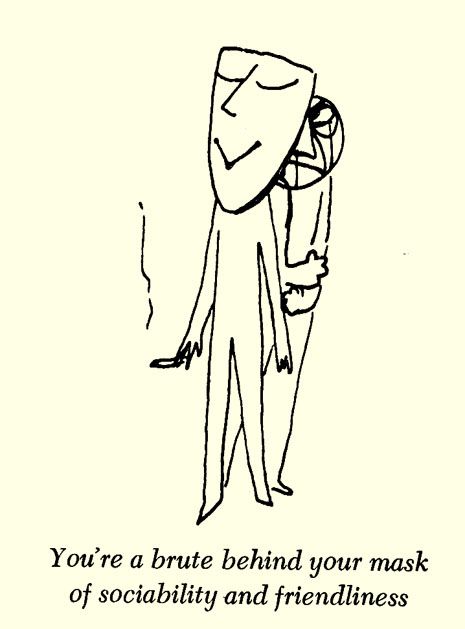
From Wilhelm Reich’s “Listen, Little Man” (1945)
LAW 27
PLAY ON PEOPLE’S NEED TO BELIEVE TO CREATE A CULTLIKE FOLLOWING
People have an overwhelming desire to believe in something. Become the focal point of such desire by offering them a cause, a new faith to follow. Keep your words vague but full of promise; emphasize enthusiasm over rationality and clear thinking. Give your new disciples rituals to perform, ask them to make sacrifices on your behalf. In the absence of organized religion and grand causes, your new belief system will bring you untold power.
LAW 28
ENTER ACTION WITH BOLDNESS
If you are unsure of a course of action, do not attempt it. Your doubts and hesitations will infect your execution. Timidity is dangerous: Better to enter with boldness. Any mistakes you commit through audacity are easily corrected with more audacity. Everyone admires the bold; no one honors the timid.
LAW 29
PLAN ALL THE WAY TO THE END
The ending is everything. Plan all the way to it, taking into account all the possible consequences, obstacles, and twists of fortune that might reverse your hard work and give the glory to others. By planning to the end you will not be overwhelmed by circumstances and you will know when to stop. Gently guide fortune and help determine the future by thinking far ahead.
LAW 30
MAKE YOUR ACCOMPLISHMENTS SEEM EFFORTLESS
Your actions must seem natural and executed with ease. All the toil and practice that go into them, and also all the clever tricks, must be concealed. When you act, act effortlessly, as if you could do much more. Avoid the temptation of revealing how hard you work-it only raises questions. Teach no one your tricks or they will be used against you.
LAW 31
CONTROL THE OPTIONS: GET OTHERS TO PLAY WITH THE CARDS YOU DEAL
The best deceptions are the ones that seem to give the other person a choice: Your victims feel they are in control, but are actually your puppets. Give people options that come out in your favor whichever one they choose. Force them to make choices between the lesser of two evils, both of which serve your purpose. Put them on the horns of a dilemma: They are gored wherever they turn.
LAW 32
PLAY TO PEOPLE’S FANTASIES
The truth is often avoided because it is ugly and unpleasant. Never appeal to truth and reality unless you are prepared for the anger that comes from disenchantment. Life is so harsh and distressing that people who can manufacture romance or conjure up fantasy are like oases in the desert: Everyone flocks to them. There is great power in tapping into the fantasies of the masses.
LAW 33
DISCOVER EACH MAN’S THUMBSCREW
Everyone has a weakness, a gap in the castle wall. That weakness is usually an insecurity, an uncontrollable emotion or need; it can also be a small secret pleasure. Either way, once found, it is a thumbscrew you can tum to your advantage.
LAW 34
BE ROYAL IN YOUR OWN FASHION: ACT LIKE A KING TO BE TREATED LIKE ONE
The way you carry yourself will often determine how you are treated: In the long run, appearing vulgar or common will make people disrespect you. For a king respects himself and inspires the same sentiment in others. By acting regally and confident of your powers, you make yourself seem destined to wear a crown.
LAW 35
MASTER THE ART OF TIMING
Never seem to be in a hurry-hurrying betrays a lack of control over yourself, and over time. Always seem patient, as if you know that everything will come to you eventually. Become a detective of the right moment; sniff out the spirit of the times, the trends that will carry you to power. Learn to stand back when the time is not yet ripe, and to strike fiercely when it has reached fruition.
LAW 36
DISDAIN THINGS YOU CANNOT HAVE: IGNORING THEM IS THE BEST REVENGE
By acknowledging a petty problem you give it existence and credibility. The more attention you pay an enemy, the stronger you make him; and a small mistake is often made worse and more visible when you try to fix it. It is sometimes best to leave things alone. If there is something you want but cannot have, show contempt for it. The less interest you reveal, the more superior you seem.
LAW 37
CREATE COMPELLING SPECTACLES
Striking imagery and grand symbolic gestures create the aura of power-everyone responds to them. Stage spectacles for those around you, then, full of arresting visuals and radiant symbols that heighten your presence. Dazzled by appearances, no one will notice what you are really doing.

From Wilhelm Reich’s “Listen, Little Man” (1945)
LAW 38
THINK AS YOU LIKE BUT BEHAVE LIKE OTHERS
If you make a show of going against the times, flaunting your unconventional ideas and unorthodox ways, people will think that you only want attention and that you look down upon them. They will find a way to punish you for making them feel inferior. It is far safer to blend in and nurture the common touch. Share your originality only with tolerant friends and those who are sure to appreciate your uniqueness.
LAW 39
STIR UP WATERS TO CATCH FISH
Anger and emotion are strategically counterproductive. You must always stay calm and objective. But if you can make your enemies angry while staying calm yourself, you gain a decided advantage. Put your enemies off-balance: Find the chink in their vanity through which you can rattle them and you hold the strings.
LAW 40
DESPISE THE FREE LUNCH
‘What is offered for free is dangerous-it usually involves either a trick or a hidden obligation. ‘What has worth is worth paying for. By paying your own way you stay clear of gratitude, guilt, and deceit. It is also often wise to pay the full price–there is no cutting corners with excellence. Be lavish with your money and keep it circulating, for generosity is a sign and a magnet for power.
LAW 41
AVOID STEPPING INTO A GREAT MAN’S SHOES
What happens first always appears better and more original than what comes after. If you succeed a great man or have a famous parent, you will have to accomplish double their achievements to outshine them. Do not get lost in their shadow, or stuck in a past not of your own making: Establish your own name and identity by changing course. Slay the overbearing father, disparage his legacy, and gain power by shining in your own way.
LAW 42
STRIKE THE SHEPHERD AND THE SHEEP WILL SCATTER
Trouble can often be traced to a single strong individual-the stirrer, the arrogant underling, the poisoner of goodwill. If you allow such people room to operate, others will succumb to their influence. Do not wait for the troubles they cause to multiply, do not try to negotiate with them-they are irredeemable. Neutralize their influence by isolating or banishing them. Strike at the source of the trouble and the sheep will scatter.
LAW 43
WORK ON THE HEARTS AND MINDS OF OTHERS
Coercion creates a reaction that will eventually work against you. You must seduce others into wanting to move in your direction. A person you have seduced becomes your loyal pawn. And the way to seduce others is to operate on their individual psychologies and weaknesses. Soften up the resistant by working on their emotions, playing on what they hold dear and what they fear. Ignore the hearts and minds of others and they will grow to hate you.
LAW 44
DISARM AND INFURIATE WITH THE MIRROR EFFECT
The mirror reflects reality, but it is also the perfect tool for deception: when you mirror your enemies, doing exactly as they do, they cannot figure out your strategy. The Mirror Effect mocks and humiliates them, making them overreact. By holding up a mirror to their psyches, you seduce them with the illusion that you share their values; by holding up a mirror to their actions, you teach them a lesson. Few can resist the power of the Mirror Effect.
LAW 45
PREACH THE NEED FOR CHANGE, BUT NEVER REFORM TOO MUCH AT ONCE
Everyone understands the need for change in the abstract, but on the day-to-day level people are creatures of habit. Too much innovation is traumatic, and will lead to revolt. If you are new to a position of power, or an outsider trying to build a power base, make a show of respecting the old way of doing things. If change is necessary, make it feel like a gentle improvement on the past.

From Wilhelm Reich’s “Listen, Little Man” (1945)
LAW 46
NEVER APPEAR TOO PERFECT
Appearing better than others is always dangerous, but most dangerous of all is to appear to have no faults or weaknesses. Envy creates silent enemies. It is smart to occasionally display defects, and admit to harmless vices, in order to deflect envy and appear more human and approachable. Only gods and the dead can seem perfect with impunity.
LAW 47
DO NOT GO PAST THE MARK YOU AIMED FOR: IN VICTORY, LEARN WHEN TO STOP
The moment of victory is often the moment of greatest peril. In the heat of victory, arrogance and overconfidence can push you past the goal you had aimed for, and by going too far, you make more enemies than you defeat. Do not allow success to go to your head. There is no substitute for strategy and careful planning. Set a goal, and when you reach it, stop.
LAW 48
ASSUME FORMLESSNESS
By taking a shape, by having a visible plan, you open yourself to attack. Instead of taking a form for your enemy to grasp, keep yourself adaptable and on the move. Accept the fact that nothing is certain and no law is fixed. The best way to protect yourself is to be as fluid and formless as water; never bet on stability or lasting order. Everything changes.
Society moulds human character and in turn human character reproduces social ideology en masse. Thus, in reproducing the negation of life inherent in social ideology, people reproduce their own suppression.
Those who are truly alive are kindly and unsuspecting in their human relationships and consequently endangered under present conditions. They assume that others think and act generously, kindly, and helpfully, in accordance with the laws of life. This natural attitude, fundamental to healthy children as well as to primitive man, inevitably represents a great danger in the struggle for a rational way of life as long as the emotional plague subsists, because the plague-ridden impute their own manner of thinking and acting to their fellow men.
A kindly man believes that all men are kindly, while one infected with the plague believes that all men lie and cheat and are hungry for power. In such a situation the living are at an obvious disadvantage. When they give to the plague-ridden, they are sucked dry, then ridiculed or betrayed.
Read the whole of Reich’s essay, “The Emotional Plague” HERE, and an “orgonomic” analysis of mass murders and their relationship to repression HERE (an interesting take in the light of the Orlando nightclub shooting this past weekend, although I completely disagree with the conclusions drawn by the author about what the USA should do about it! I think, frankly, that the USA has an enormous log in its own eye where repression is concerned.)

Diagram by Wilhelm Reich depicting his theory of the antithetical functional unity between instinct and defense, and illustrating specific impulses.

A scene from the movie Herostratus (1967), directed by experimental filmmaker Don Levy.
The plot of Herostratus is deceptively simple: A young poet, Max (Michael Gothard), is sick of being poor, unemployed and feeling inadequate and unnoticed and trapped by society. After a few setbacks early in the film, particularly when it comes to paying the rent to a landlady he can no longer avoid, Max decides to commit suicide by jumping off a tall building. But Max decides to make a point of his death instead, and enlists the help of Farson (Peter Stephens), a successful public relations ad man, who helps him turn his suicide, conceived as a sacrificial act of protest against modern society, into a media circus.
Farson does not actually believe Max will go through with the suicide, and decides to let Max spend time at his studio, and its there that Max falls in love with Farson’s assistant Clio (Gabriella Licudi), with whom he shares his first sexual experience. Farson encourages their coupling, believing it’ll end in tears and the young man’s mental torment will be something he can further exploit, but then everyone finds out just how bad of a poet Max really is, and they encourage him to kill himself, for real, and Max realizes that his reactionary gesture is being seen by everyone as simply a cry for attention.
Depressed by this last futile attempt to make himself understood, Max goes up to to the roof but his suicidal jump is stopped by a man who happens to be working on the roof that day — but during their struggle, the worker falls to his death, and Max escapes into the woods.
Herostratus, it should be noted, is titled for the Greek poet who sought to immortalize his own name by setting fire to the Temple of Artemis in Ephesus, in the fourth century B.C. His name was later stricken from all records until it was discovered that Alexander the Great was born the night Herostratus committed his fatal act.
This was Don Levy’s first feature film after having attending on a scholarship at Cambridge University, where he began a PhD study in Theoretical Chemical Physics. At some point Levy withdrew from his science courses and began focusing on creative endeavors, including painting and playing jazz and filmmaking. He moved over to the London-based Slade School of Fine Art, where he made a series of short science documentaries, including his most successful film, 1962’s Time Is, which explored the theories and conception of time.
James Quinn, then director of the British Film Institute, had worked with Levy onTime Is, helping him secure a grant to finish the film. He then helped the director obtain the funds — from the BFI Experimental Film Fund — to make another short film, but Levy soon found his ambitions were exceeding the budget as it expanded into a feature-length production, with additional funding coming from the BBC. That film was Herostratus, and it took five years to complete, but it was largely met with indifference, and was not the spectacular success that Levy (and Quinn) had hoped for. After a handful of initial screenings, including its premiere at London’s Institute of Contemporary Artst, in April 1968, Herostratus was shelved and virtually forgotten.
Levy’s artistic filmmaking style — juxtaposing images of postwar urban decay and burlesque stripteases with carcasses hanging in an abattoir — met largely with indifference from the public and from most film critics, even though later critics have pointed out that he did have some influence on his contemporaries, including Richard Lester and Stanley Kubrick, especially on the latter’s 1971 film Clockwork Orange.
The few surviving prints of Herostratus show it to be a flawed yet highly perceptive dissection of 1960s idealism, seduced by the Mephistophelian deception of market forces and the empty promise of mass media celebrity.
Helen Mirren’s singular contribution (about 54 minutes into the film) as “Advert Woman” provides one of the few dark moments of humor in an otherwise very dark film. In the scene, she is wearing rubber gloves for the filming of a commercial which is supposed to be a statement about consumerism, but we know what the real product is: the camera lingers lasciviously (as it will so often in her later career) over her cleavage. Once she’s delivered her lines, Gothard scoops her up and carries her off set. The scene is barely more than three minutes long.
He is vile. She handles him with brilliant wit and poise.
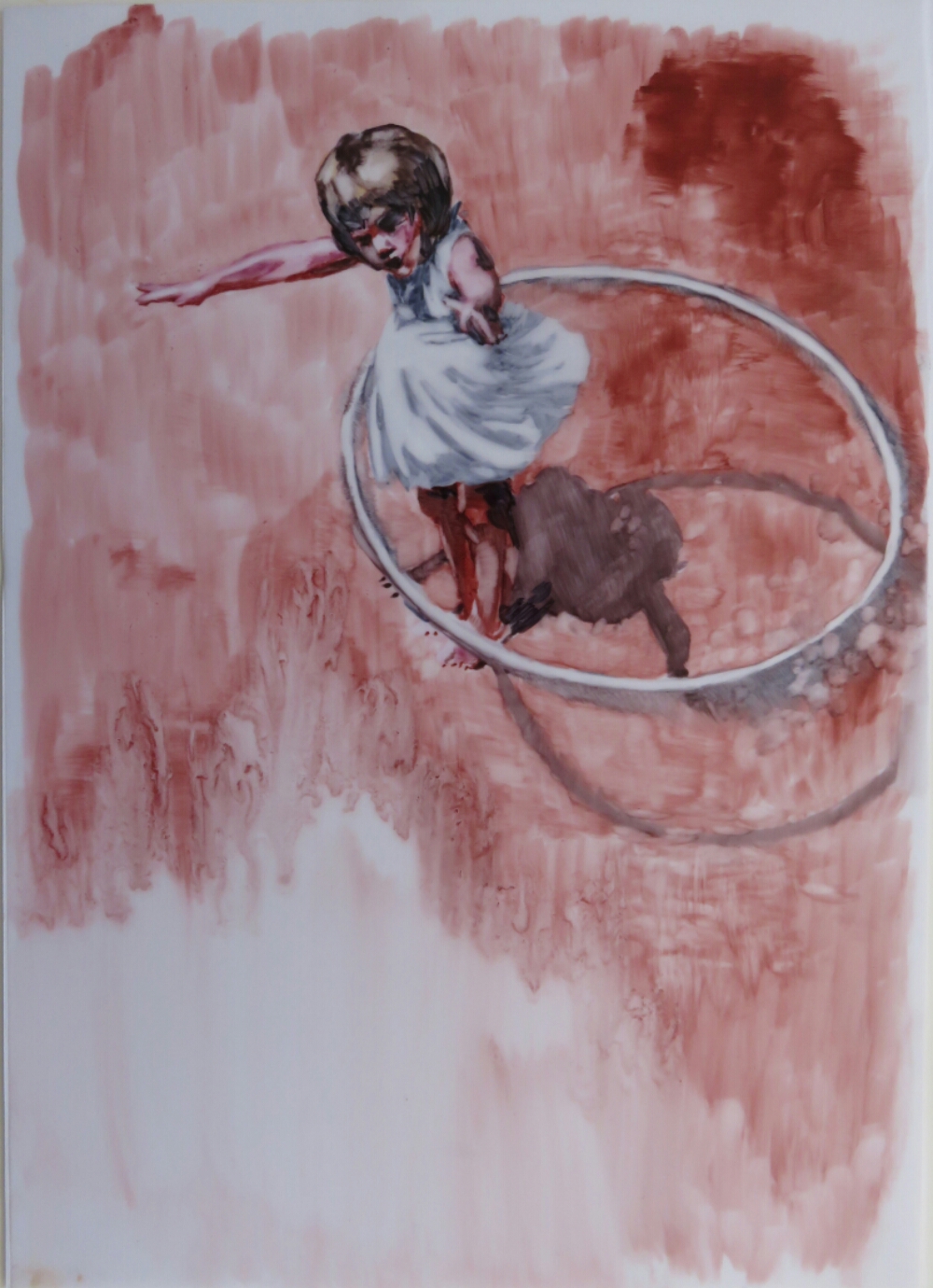


Charity Hamilton
The body is the canvas on which the female experience is painted and through which female identity is often understood. The female body is a slate on which a patriarchal story has been written, scarred onto the flesh.
For Simone Weil metaxu was simultaneously that which separated and connected, so for instance the wall between two prison cells cuts off the prisoners but was also the means by which they communicated by knocking on that wall. Could the body be that metaxu all at once separating us and connecting us to the Divine? The nature of metaxu is that it offers a route not just for the individual soul but for the souls of others to travel…
—
It’s all well and good to dust off a dead French Jewish Catholic not-quite-feminist-philosopher called Simone Weil and say ‘thanks, your theory of metaxu is great’, but what I want to know within the bones of my so-called soul is how this notion of metaxu can draw me into God, how can it liberate my sisters and how can it usher in the kingdom of the mother of all creation?
Human beings are created in the image of God and formed from the dust of the earth, and thus the body has an echoing significance throughout Christian history. The body is the perceived seat of what some describe as the fall, the locus of the incarnation, the home of crucifixion, the vessel of redemption, salvation and resurrection. The body is not an external meaningless diversion from the spiritual path; rather it is an incredibly important recurring theme both biblically and in Christian tradition and history. Bray and Colebrook state that,
The body is a negotiation with images, but it is also a negotiation with pleasures, pains, other bodies, space, visibility, and medical practice; no single event in this field can act as a general ground for determining the status of the body (Bray and Colebrook, 1998).
Yet more than all of this, the body is the place in which we dwell, it is all we have. As Elizabeth Moltmann Wendell says ‘I am my body’ (Moltmann-Wendell, 1994). For each of our sisters the body is the canvas on which the female experience is painted and through which female identity is often understood. It is on the stage of our female bodies that some of the most fixed church doctrines have been written and enacted. The female body is a slate on which a patriarchal story has been written, scarred onto the flesh. These bodies of ours are patriarchal constructs which must be liberated and re-adopted into the Christian story without the limitations of perceived notions or definitions of ‘gender’.
Isherwood and Stuart assert that ‘From the moment we are asked to believe that Eve was a rib removed from the side of Adam we understand that theology is based in the body and we are at a disadvantage!’ (Isherwood and Stuart, 1998: 15). The historical dichotomy between the Eve and the Mary constructions has led to a definitive inequality for women, both in terms of physical wellbeing and in terms of spiritual and psychological wellbeing. The choices for a woman to be the sin-formed, temptress Eve or the virginal pure vessel Mary are seen historically in the precarious place of women in the church and in society.
Elizabeth Stuart writes that ‘Women were regarded as being ensnared in their bodiliness to a far greater degree than men and they too had to be tamed and subdued for their own good and the good of the men they might tempt into sin’ (Stuart, 1996: 23). It is hardly surprising therefore that twentieth and twenty-first century feminist, womanist, mujerista and black theologians have worked hard to undo and re-express a theology of the body which offers a more authentic narrative of the relationship between the Divine and the physical which both liberates the female body and liberates God from the patriarchal box the Church has created around her.
…The female body can only be liberated from that patriarchal overwriting by writing its own narrative, much of which will be based upon experiences of being troubled. The true nature of the female body can only be revealed by a concerted effort to ‘re-own’ this body as our own not as we have been taught to understand it. This in turn means that the systems, doctrines and ‘ways of being’ which exist within the Church and society must be challenged and re-imagined from the perspective of the un-vocalized and troubled female narrative. In the sense that the female body has not really been ours, has not been an authentically female body and yet has the potential to be unlocked as such, it therefore makes for the perfect condition for metaxu, it is that thing which separates in its forms of oppression and connects in its potential liberation. It is at once a place where great evil has been wrought and a place of divine goodness. Weil writes of love that,
Creation is an act of love and it is perpetual. At each moment our existence is God’s love for us. But God can only love himself. His love for us is love for himself through us. Thus, he who gives us our being loves in us the acceptance of not being. Our existence is made up only of his waiting for our acceptance not to exist. He is perpetually begging from us that existence which he gives. He gives it to us in order to beg it from us (Weil, 2002: 28).
According to Weil, our very existence is from God and returns to God. I would argue that to be able to return this ‘not being’ to God, the body has to take some form of action, or have some form of action performed upon it to open a space in which our not being or not existing can be offered to God. It is this removal of our self which I argue can be interpreted as a removal of the socially created self to leave only the God part of ourselves, the authentic self that is God. The body is metaxu in that it is imperfect and yet perfect. The body is human and therefore unreal and socially recreated, yet the body is also created by God and God dwells within it. The female body is both imprisoned and is liberated. Its imprisonment is the very thing that enables it to unravel the layers of patriarchal construction to locate the God part and its imprisonment is the thing which allows for an authentic narrative to be written. The female body has to separate us from the Divine in order to connect us to the Divine.
Read the whole of this interesting paper by Charity Hamilton HERE.
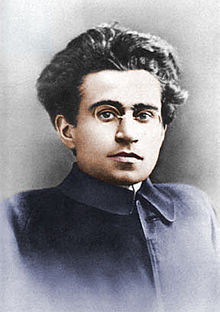 Give up to life your every action, your every ounce of faith. Throw all your best energies, sincerely and disinterestedly, into life. Immerse yourselves, living creatures that you are, in the live, pulsing tide of human existence, until you feel at one with it, until it floods through you, and you feel your individual personality as an atom within a body, a vibrating particle within a whole, a violin string which receives and echoes all the symphonies of history; of that history which, in this way, you are helping to create.
In spite of this utter abandonment of the self to the reality which surrounds it, in spite of this attempt to key your individuality into the complex play of universal causes and effects, you may still, suddenly, feel a sense that something is missing; you may become conscious of vague and indefinable needs, those needs which Schopenhauer termed metaphysical.
You are in the world, but you do not know why you are here. You act, but you do not know why. You are conscious of voids in your life; you desire some justification of your being, of your actions; and it seems to you that human reasons alone do not suffice. Tracing the causal links further and further back, you arrive at a point where, to co-ordinate, to regulate the movement, some supreme reason is necessary, some reason which lies beyond what is known and what is knowable. You are just like a man looking at the sky, who, as he moves further and further back through the space while science has mapped out for us, finds ever greater difficulties in his fantastic uncontrolled impulses.
But what can conquer them is the force of life itself; historical activity can annul them. They are simply the products of tradition, the instinctual vestiges of millennia of terror and of ignorance of the reality that surrounds us. Their origin can be traced. To explain them is to overcome them. To make them the object of history is to recognize their emptiness. And then one can return to the active life, and experience more authentically the reality of history. By bringing feeling, as well as fact, within the sphere of history, one can finally recognize that it is in history alone that the explanation of our existence lies. What can be historicized cannot be supernatural in origin, the vestige of some divine revelation. If something still remains inexplicable, that is due only to our cognitive deficiencies, to the still imperfect grasp of our intellect. Recognizing this may make us more humble, more modest, but it will not throw us into the arms of religion.
Our religion becomes, once again, history. Our faith becomes, once again, man, and man’s will and his capacity for action. We feel an enormous, an irresistible, force from our human past.
We recognize the good things it brings us, like the energetic certainty that what has been possible will be possible again; all the more so, in that we have become wise through the experience of others. But we also recognize the bad, like these inorganic vestiges of transcended states of mind. And this is why we inevitably feel ourselves to be in conflict with Catholicism; and this is why we call ourselves modern. Because, though we feel the past fuelling our struggle, it is a past that we have tamed; our servant, not our master; a past which illuminates and does not overshadow us.
Avanti, 29 August 1916
__
From Pre-Prison Writings, edited by Richard Bellamy. Cambridge Texts in the History of Political Thought, 1994, pp 13-14.
Album: Cut
Year: 1979

Undated photo of Virginia Woolf. (AP Photo)
I told you in the course of this paper that Shakespeare had a sister; but do not look for her in Sir Sidney Lee’s life of the poet. She died young – alas, she never wrote a word. She lies buried where the omnibuses now stop, opposite the Elephant and Castle. Now my belief is that this poet who never wrote a word and was buried at the crossroads still lives.
She lives in you and in me, and in many other women who are not here tonight, for they are washing up the dishes and putting the children to bed. But she lives; for great poets do not die; they are continuing presences; they need only the opportunity to walk among us in the flesh. This opportunity, as I think, it is now coming within your power to give her.
For my belief is that if we live another century or so – I am talking of the common life which is the real life and not of the little separate lives which we live as individuals – and have five hundred a year each of us and rooms of our own; if we have the habit of freedom and the courage to write exactly what we think; if we escape a little from the common sitting-room and see human beings not always in their relation to each other but in relation to reality; and the sky, too, and the trees or whatever it may be in themselves; if we look past Milton’s hogey, for no human being should shut out the view; if we face the fact, for it is a fact, that there is no arm to cling to, but that we go alone and that our relation is to the world of reality and not only to the world of men and women, then the opportunity will come and the dead poet who was Shakespeare’s sister will put on the body which she has so often laid down.
Drawing her life from the lives of the unknown who were her forerunners, as her brother did before her, she will be born. As for her coming without that preparation, without that effort on our part, without that determination that when she is born again she shall find it possible to live and write her poetry, that we cannot expect, for that would be impossible. But I maintain that she would come if we worked for her, and that so to work, even in poverty and obscurity, is worthwhile.
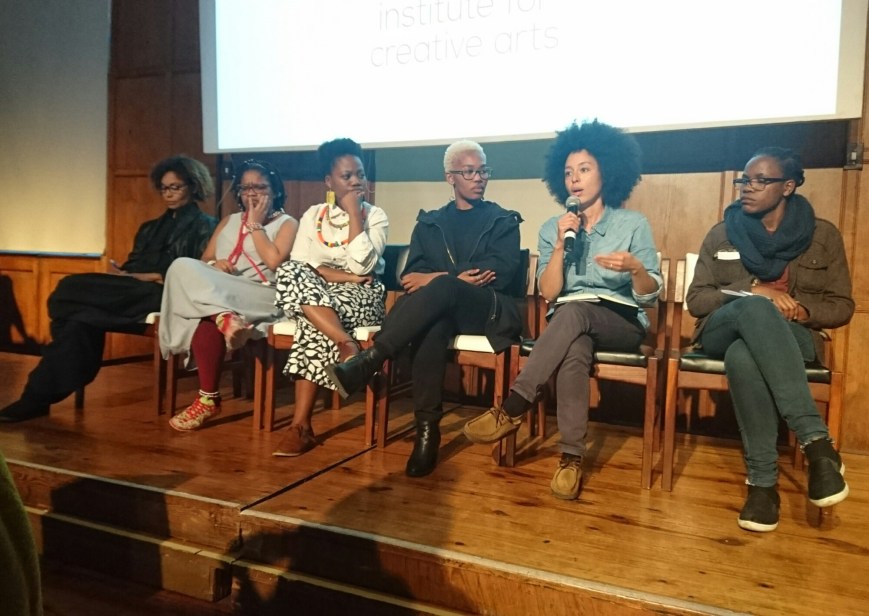
L-R: jackï job, Dee Moholo, Koleka Putuma, Khanyi Mbongwa (Vasiki), Ilze Wolff, Lois Anguria
The most decolonised academic space I have yet had the joy of experiencing. The conference continues today. If you’re in Cape Town, come. It’s free!
HERE is the programme. 🌸


 fleurmach