au revoir, alain resnais

“You never seem to be waiting for me, but we kept meeting at every turn of the paths. Behind every bush, at the foot of each statue, near every pond. It is as if it had been only you and I in all that garden.”

 From Last Year at Marienbad, 1961

mon oncle

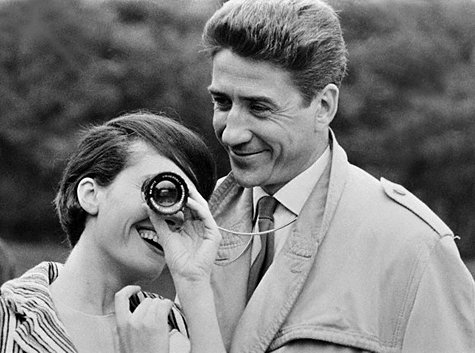
Alain Resnais and Delphine Seyrig on location shooting “Last Year At Marienbad.”

I made this in 2007 (hence the bad Youtube quality – compressed to all hell).

ros sereysothea – who’ll stop the rain?

Cambodian cover by Ros Sereysothea and Sinn Sisamouth of Creedence Clearwater Revival’s “Who’ll Stop The Rain?”. They died under unknown circumstances during the Khmer Rouge reign of terror,  as did countless other artists and intellectuals murdered in Pol Pot’s Killing Fields, and this recording only survived on tapes smuggled out of the country.

“Long as I remember the rain been comin’ down.
Clouds of mystery pourin’ confusion on the ground.
Good men through the ages, tryin’ to find the sun;
And I wonder, still I wonder, who’ll stop the rain.”

Read more of their story HERE.

ros sereysothea – i will starve myself to death/ shave your beard

I hardly ever put on a cd or listen to an LP these days (last is prolly due to the fact,that I killed my speakers/amplifier). In fact i am totally addicted to the net when it comes to music. I also am an avid KCRW listener. I often tune in to Henry Rollins’s radio show on KCRW. Henry does all the searching, comes up with all the cool tunes from every genre all over the place and all I have to do is listen. It was due to his radio show that i started listening to Sinn Sisamouth. This led me to Ros Sereysothea. I am 100% fascinated with her singing and music.

For the last days, I keep playing over and over this on Spotify:’ ‘Dengue Fever Presents Electric Cambodia”. Sounds amazing,and wished that i could understand the language. All performers on this compilation are dead,or ”vanished”. Killed/died during the communist Khmer Rouge regime.

”Electric Cambodia may be one of the saddest and most enraging compilations released this year—not for the music, but for the history. The performers are dead, all dead, or “vanished” into the Killing Fields—murdered, presumably, although the how is a mystery. Did they die quickly or slowly? ” – read more of this review HERE.

Ros Sereysothea – Shave your Beard

on buried treasure (5 june 2012)

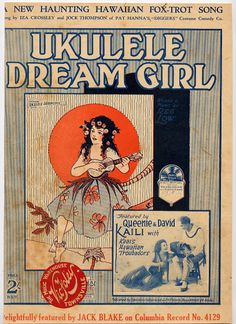
ukulele dream girlTo research (English definition): “To search for something.”

Rechercher (French definition): “To search for, to look for” and also “to search again, to look for again”.

Both “search” and “research” are the same word in French, it seems.  This makes sense: even if something was once common knowledge, after it is hidden it is no longer “there”; it has fallen from awareness. So you have to seek for it again, that which is not there. In “research”, you never know what is actually there until you find it, or there would be no need to look. You dis-cover it again, un-cover it anew.

Archives are fascinating places of preservation-with-intent to look in, and they are always tantalisingly incomplete, however exhaustive… But nothing beats the thrill of finding a treasure hoard saved by happenstance.

To “ondersoek” , in Afrikaans, is to look under other things… The term implies a palimpsestic patina, an accretion, a build-up of layers that must be lifted, peeled off to see underneath… the mother lode, the genealogy. Sometimes you know exactly what you are looking for; sometimes you don’t. You may only have a misty hope that there is anything there at all. It can be useful to lose focus, too, because you become open to other routes, other offshoots, that may take you further than your original hunch.

On Saturday, in a poky little shop in Kalk Bay, I found a trove of old sheet music: popular tunes from the 1920s and 1930s, the top few layers of it in torn, grubby disarray. A thrill ran through my fingertips as I started re-moving each sheet from the pile, putting it aside systematically. There was nothing of great interest until I got quite a way below the dusty surface layers, where most people’s patience obviously runs out (this is the trick with digging – to delve deeper, to expend more energy, more time than everyone else – om onder te soek, for there lies the gold). There was no way I could stop.

Buried in the pile, under piano exercise books, I found something that really astounded me… it almost made me shout for joy: many, many of the scores had ukulele chord diagrams on them! In all the popular sheet music I had ever been acquainted with before this, these diagrams were provided for guitar – with five lines for the five strings. These all had only four lines. It became clear to me on seeing this that, along with piano, ukulele was most likely the popular amateur instrument of choice back in the 1920s to 1940s, and not guitar. It makes sense when you listen to the jazziness of the pop arrangements of the time, and how well the chord progressions work technically with a ukulele’s tuning – GCEA. I would suppose that the guitar ousted the uke in popularity with the ascent of blues and rock and folk, in which different chords and tunings predominate, and for which the guitar’s EADGBE tuning is a more natural fit… How lovely to realise that this instrument I play very amateurishly, considered a funny curiosity by most these days, was accorded far more value in the past!oh how she could

What this little discovery means for me, practically, is that I can now play all these very old jazzy tunes with no in-depth knowledge of musical theory. Even the songs I have never heard before can be found with a bit of effort on the internet, listened to, and re-played, provided someone else along the way has seen their value. As long as they were ever recorded, be it on wax cylinder or 78rpm, they may have been digitised. And, as they spin up on my hard drive, a vortex is created, opening a wormhole back to the instant that band played for the first time as the cylinder turned. And the song comes back from the dead as my fingers form the chord shapes, stutters back to life as I sing my breath into the words. Technology is powerful magic, all the more so when it takes account of its historicity.

Information technology is not only about making the future more slick and manageable; it is also about keeping the past accessible… Essentially it is about conquering linear time and space. The prolific recording of moments allows us to live unconstrained by the present moment and space we’re in, almost continuously if we so wish… (For example, people sit on Facebook as they are out for coffee with a friend. Once they have “checked in” at the cafe, they check out what other people are doing elsewhere on their phones, then frame themselves carefully for a photo in that space and capture the moment, uploading it to join the feed for others who are moving through spaces connected via radio waves to know about. Very little other than eating, drinking and self-referential preening is going on in most coffee spots.)

The sheer volume of recording that goes on now is unprecedented. Imagine reading Twitter logs in a century – every ordinary so-and-so with a Twitter account, with their own account of an event… The hyper(in)significance of every moment of our lives being documented is overwhelming to think about. How will historians of the future ever manage to filter out the noise from the signal and deduce anything?

Or, will the noise be the signal – the fragments the whole? How does this affect our memories, our critical faculties, our creativity, our relationships? New technologies confer on us immense power that should be used wisely and with sober discernment, not trivially… as that dumb what’s-her-face model Leandra found out last week when tweeting 140 racially offensive characters cost her her modelling career and dignity, with satisfying, devastating swiftness!

So, anyway, I pulled out a large wad of music sheets; slowly, carefully replaced what I didn’t take for someone else to find. Tried to conceal my excitement as I got to the till; thwacked the pile down and asked nonchalantly, “How much for this old stuff?”

“Two rand a sheet.” After counting to fifteen the old guy stopped and said “I can’t be bothered to count higher than fifteen – it’s yours for thirty bucks.”

I paid thirty rand for all of it. That’s less than a cocktail or a sandwich in the seaside cafes lining that road. So few people seem to see value in this stuff. Not even antique dealers. To them it’s just quaint ephemera.

Research involves following the intuition, the hunch that something lies hidden out of time, out of sight, out of mind: perhaps recorded imperfectly, decaying, deliberately saved. Or, like these priceless music sheets, just debris left in a place where it makes no sense to anyone who has stumbled across it yet… In danger of being lost forever if someone doesn’t come along with enough focused curiosity to re-cognise it as valuable, to think it back into meaningful connection with right now.

To me, the serendipity of finds like Saturday’s feels more than coincidental. If the person looking didn’t happen to be me there at that precise moment, it would probably have been a non-event. Even if it were the me of last year leafing through, I wouldn’t have known what I was looking for. Would have seen the music but not had a ukulele and maybe not noticed that the chord diagrams had only four strings, not five. The me of just a few months back would have seen the music with interest but not known the extent of the 78rpm archive online (having become aware of the degree of coverage of obscure songs through something I have been working on in the past month) and so left it because I didn’t know the songs and didn’t know there was a way to hear them. I don’t often look through second hand stores these days, broke as I am. On Saturday, something compelled me to step inside as I was passing. It felt as if me and the music were drawn together. It felt magical.

roald dahl – the sound machine (1949)

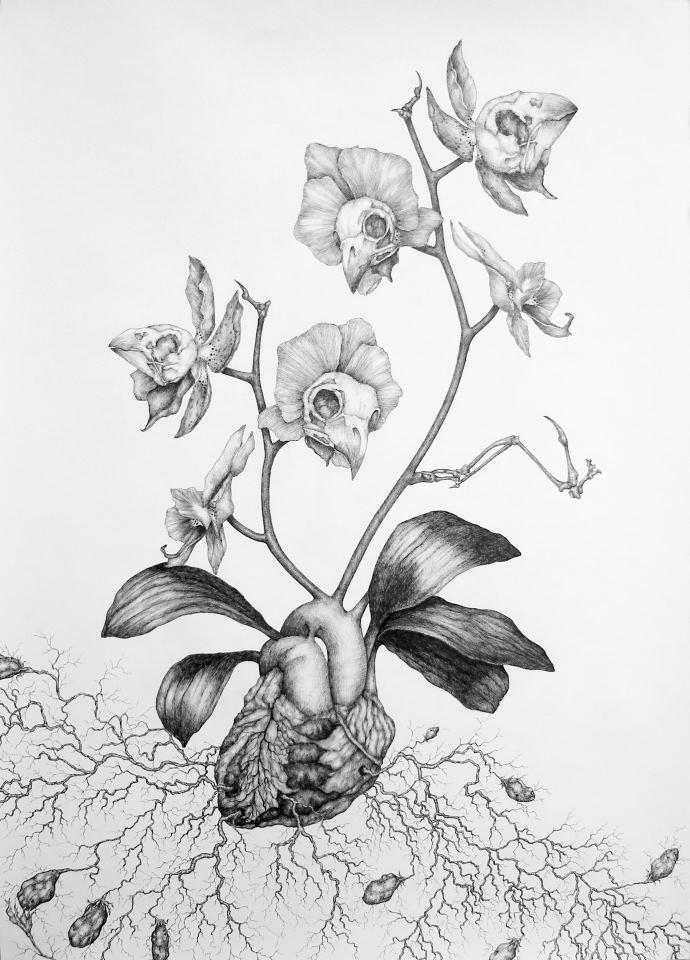
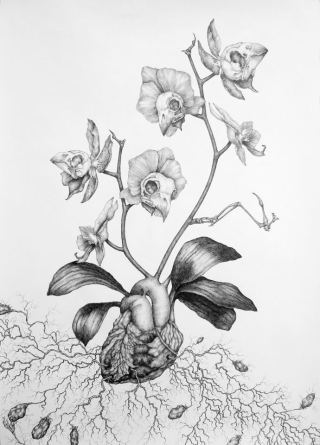
Kate Street - Orchis Nodulosa

Kate Street – Orchis Nodulosa

For a while longer, Klausner fussed about with the wires in the black box; then he straightened up and in a soft excited whisper said, “Now we’ll try again… We’ll take it out into the garden this time… and then perhaps, perhaps… the reception will be better. Lift it up now… carefully… Oh, my God, it’s heavy!”

He carried the box to the door, found that he couldn’t open the door without putting it down, carried it back, put it on the bench, opened the door, and then carried it with some difficulty into the garden. He placed the box carefully on a small wooden table that stood on the lawn. He returned to the shed and fetched a pair of earphones. He plugged the wire connections from the earphones into the machine and put the earphones over his ears. The movements of his hands were quick and precise. He was excited, and breathed loudly and quickly through his mouth. He kept on talking to himself with little words of comfort and encouragement, as though he were afraid–afraid that the machine might not work and afraid also of what might happen if it did. He stood there in the garden beside the wooden table, so pale, small and thin that he looked like an ancient, consumptive, bespectacled child.

The sun had gone down. There was no wind, no sound at all. From where he stood, he could see over a low fence into the next garden, and there was a woman walking down the garden with a flower-basket on her arm. He watched her for a while without thinking about her at all. Then he turned to the box on the table and pressed a switch on its front. He put his left hand on the volume control and his right hand on the knob that moved a needle across a large central dial, like the wavelength dial of a radio. The dial was marked with many numbers, in a series of bands, starting at 15,000 and going on up to 1,000,000. And now he was bending forward over the machine. His head was cocked to one side in a tense, listening attitude. His right hand was beginning to turn the knob.

The needle was travelling slowly across the dial, so slowly he could hardly see it move, and in the earphones he could hear a faint, spasmodic crackling. Behind this crackling sound he could hear a distant humming tone which was the noise of the machine itself, but that was all. As he listened, he became conscious of a curious sensation, a feeling that his ears were stretching out away from his head, that each ear was connected to his head by a thin stiff wire, like a tentacle, and that the wires were lengthening, that the ears were going up and up towards a secret and forbidden territory, a dangerous ultrasonic region where ears had never been before and had no right to be. The little needle crept slowly across the dial, and suddenly he heard a shriek, a frightful piercing shriek, and he jumped and dropped his hands, catching hold of the edge of the table.

He stared around him as if expecting to see the person who had shrieked. There was no one in sight except the woman in the garden next door, and it was certainly not she. She was bending down, cutting yellow roses and putting them in her basket. Again it came–a throatless, inhuman shriek, sharp and short, very clear and cold. The note itself possessed a minor, metallic quality that he had never heard before.

Klausner looked around him, searching instinctively for the source of the noise. The woman next door was the only living thing in sight. He saw her reach down; take a rose stem in the fingers of one hand and snip the stem with a pair of scissors. Again he heard the scream. It came at the exact moment when the rose stem was cut. At this point, the woman straightened up, put the scissors in the basket with the roses and turned to walk away.

“Mrs Saunders!” Klausner shouted, his voice shrill with excitement. “Oh, Mrs Saunders!” And looking round, the woman saw her neighbour standing on his lawn–a fantastic, arm-waving little person with a pair of earphones on his head–calling to her in a voice so high and loud that she became alarmed. “Cut another one! Please cut another one quickly!”

She stood still, staring at him. “Why, Mr Klausner,” she said, “What’s the matter?”

“Please do as I ask,” he said. “Cut just one more rose!”

Mrs Saunders had always believed her neighbour to be a rather peculiar person; now it seemed that he had gone completely crazy. She wondered whether she should run into the house and fetch her husband. No, she thought. No, he’s harmless. I’ll just humour him.

“Certainly, Mr Klausner, if you like,” she said.

She took her scissors from the basket, bent down and snipped another rose. Again Klausner heard that frightful, throatless shriek in the earphones; again it came at the exact moment the rose stem was cut. He took off the earphones and ran to the fence that separated the two gardens. “All right,” he said. “That’s enough. No more. Please, no more.”

The woman stood there, a yellow rose in one hand, clippers in the other, looking at him.”I’m going to tell you something, Mrs Saunders,” he said, “something that you won’t believe.” He put his hands on top of the fence and peered at her intently through his thick spectacles. “You have, this evening, cut a basketful of roses. You have, with a sharp pair of scissors, cut through the stems of living things, and each rose that you cut screamed in the most terrible way. Did you know that, Mrs Saunders?”

“No,” she said. “I certainly didn’t know that.”

“It happens to be true,” he said. He was breathing rather rapidly, but he was trying to control his excitement. “I heard them shrieking. Each time you cut one, I heard the cry of pain. A very high-pitched sound, approximately one hundred and thirty-two thousand vibrations a second. You couldn’t possibly have heard it yourself. But I heard it.”

“Did you really, Mr Klausner?” She decided she would make a dash for the house in about five seconds.

“You might say,” he went on, “that a rose bush has no nervous system to feel with, no throat to cry with. You’d be right. It hasn’t. Not like ours, anyway. But how do you know, Mrs Saunders”–and here he leaned far over the fence and spoke in a fierce whisper, “how do you know that a rose bush doesn’t feel as much pain when someone cuts its stem in two as you would feel if someone cut your wrist off with a garden shears? How do you know that? It’s alive, isn’t it?”

“Yes, Mr Klausner. Oh, yes and good night.”

Quickly she turned and ran up the garden to her house. Klausner went back to the table. He put on the earphones and stood for a while listening. He could still hear the faint crackling sound and the humming noise of the machine, but nothing more. He bent down and took hold of a small white daisy growing on the lawn. He took it between thumb and forefinger and slowly pulled it upward and sideways until the stem broke. From the moment that he started pulling to the moment when the stem broke, he heard–he distinctly heard in the earphones–a faint high-pitched cry, curiously inanimate.

He took another daisy and did it again. Once more he heard the cry, but he wasn’t sure now that it expressed pain. No, it wasn’t pain; it was surprise. Or was it? It didn’t really express any of the feelings or emotions known to a human being. It was just a cry, a neutral, stony cry–a single, emotionless note, expressing nothing. It had been the same with the roses. He had been wrong in calling it a cry of pain. A flower probably didn’t feel pain. It felt something else which we didn’t know about–something called tom or spun or plinuckment, or anything you like.

He stood up and removed the earphones. It was getting dark and he could see pricks of light shining in the windows of the houses all around him. Carefully he picked up the black box from the table, carried it into the shed and put it on the workbench. Then he went out, locked the door behind him and walked up to the house.

The next morning Klausner was up as soon as it was light. He dressed and went straight to the shed. He picked up the machine and carried it outside,clasping it to his chest with both hands, walking unsteadily under its weight. He went past the house, out through the front gate, and across the road to the park.There he paused and looked around him; then he went on until he came to a large tree, a beech tree, and he placed the machine on the ground close to the trunk of the tree.

Quickly he went back to the house and got an axe from the coal cellar and carried it across the road into the park. He put the axe on the ground beside the tree. Then he looked around him again, peering nervously through his thick glasses in every direction. There was no one about. It was six in the morning.He put the earphones on his head and switched on the machine. He listened for a moment to the faint familiar humming sound; then he picked up the axe, took a stance with his legs wide apart and swung the axe as hard as he could at the base of the tree trunk.

The blade cut deep into the wood and stuck there, and at the instant of impact he heard a most extraordinary noise in the earphones. It was a new noise, unlike any he had heard before–a harsh, noteless, enormous noise, a growling, low pitched, screaming sound, not quick and short like the noise of the roses, but drawn out like a sob lasting for fully a minute, loudest at the moment when the axe struck, fading gradually fainter and fainter until it was gone.


Excerpted from Roald Dahl’s short story, “The Sound Machine”, first published in The New Yorker on September 17, 1949.  Read the full story HERE.
m. ward – involuntary

From one of my favourite albums of the last decade, Transfiguration of Vincent, released in 2003 (in fact, that’s more than a decade ago now, wow!). The title alludes to John Fahey’s 1965 album,The Transfiguration of Blind Joe Death, and also refers to the life and death of Vincent O’Brien, a close friend of Ward’s. Here’s a moving and informative interview with Ward from around the time of the album’s release.

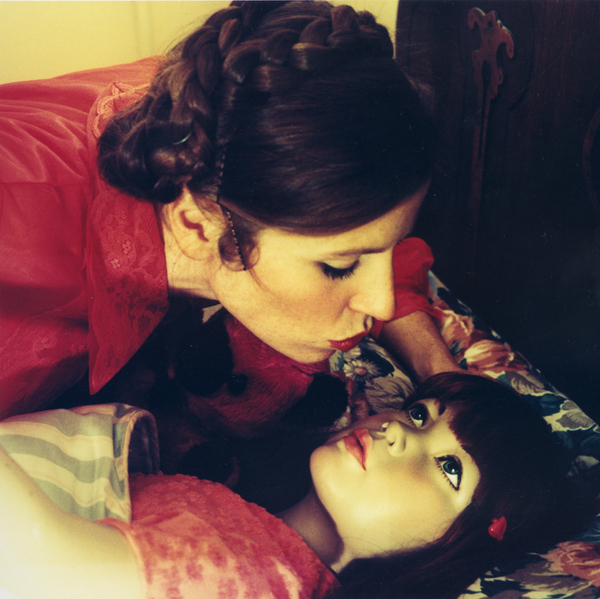
suzanne heintz – life once removed

 “A personal photography experience for public consumption.”

suzanne heintz - 01

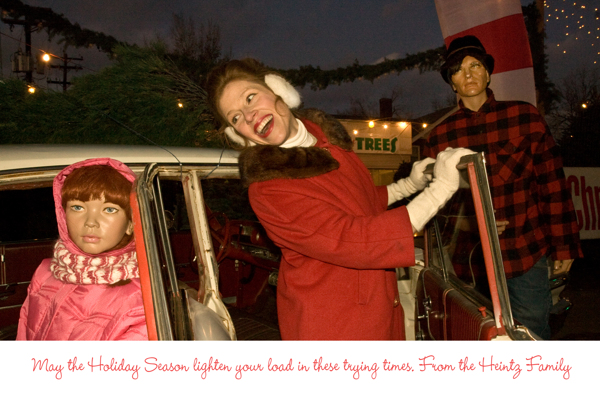
Suzanne Heintz calls herself “the modern day patron saint of single women”. She has the following to say about her ongoing photography project, the wondrously uncanny “Life Once Removed”:

What would drive you to pack a family of mannequins into your station wagon, and take them on a road trip? Enough pressure to conform will send anyone packing.  That’s how I came to this personal project about what is essentially…Spinsterhood, and the American Way.
Well-meaning strangers, along with friends and family, would raise an eyebrow when the topic of my unmarried and childless status arose.  Indicating with a small facial twitch, not only my audacious freakishness, but that I was a little old for such foolish thinking. I mean, come on, eggs don’t last forever!

suzanne heintz - 02But really, what was I supposed to do?  You can’t just go out and buy a family.  Or can you?  I did.  They are mannequins.  The candy coated shell with nothing inside.  We do all those family things, all the while capturing those Kodak Moments.  Because it’s not really about the journey, or a genuine human connection, when your kids are screaming, “are we there yet?”, is it?  It’s about the picture in front of the sign.  “Get back in the car, we got the picture.  Now, let’s go eat.”

We love and obey the formatted image of a well-lived life.  So deeply ingrained is that strange auto-grin we put on when a camera is present.  Do we live our lives with a keen awareness of how it feels, or just how it looks?
suzanne heintz - 03If I pass through life without checking off the boxes for a wedding ring and a baby carriage, I will be missing the photo album, but not not the point.  When I take my photos, others stop and stare, then they ask, “why are you doing this?”  They, at that moment, are starting to get the point too.

heintz family christmas 1

Check out more of Suzanne’s fantastical images HERE.

sounds of silence

sos
LABEL: ALGA MARGHEN (ITALY)
CATALOG #: ALGA 046LP
RELEASE DATE: 21 JANUARY 2014

Sounds of Silence is an anthology of some of the most intriguing silent tracks in recording history and includes rare works, among others, by Andy Warhol, John Lennon, Maurice Lemaitre, Sly & The Family Stone, Robert Wyatt, John Denver, Whitehouse, Orbital, Crass, Ciccone Youth, Afrika Bambaataa and of course, Yves Klein.

In their own quiet way, these silences speak volumes: they are performative, political, critical, abstract, poetic, cynical, technical, absurd. They can be intended as a memorial or a joke, a special offer, or something entirely undefined. The carefully-chosen silences of this anthology are intrinsically linked to the medium of reproduction itself and reveal its nude materiality. They expose their medium in all its facets and imperfections, including the effect of time and wear. At the most basic level, these silences are surfaces. And it is in their materiality that they distinguish themselves from the conceptual experiments of John Cage with “4’33”.

Since the 1950s, silence has found a place in the economic structure of the record industry and since then it would increasingly be appropriated by a vast array of artists in a vast array of contexts. Indeed, the silent tracks seem to know no boundaries. The LP presents the silences as they were originally recorded, preserving any imperfection that the hardware conferred upon the enterprise, without banning the possibility of being satisfying to the ear. The liner notes provide historical background for each track, revealing the stated (or presumed) motivations for these silences, while providing novel sound correspondences or interferences.

This album is meant to be played loud (or not), at any time, in any place: a true aural experience. Only 250 copies available for distribution, in a gatefold iconic sleeve. ORDER THE LP HERE.

for y’all celebrating thanksgiving

Uncanny scene from the film Beetlejuice (1989)in which a frightfully posh dinner is ruptured when the table is re-possessed by the voices of exploited plantation labourers, specifically via Harry Belafonte’s “Day-O”. One of Tim Burton’s most politically subversive moments.

on dreams and the reality of sadness

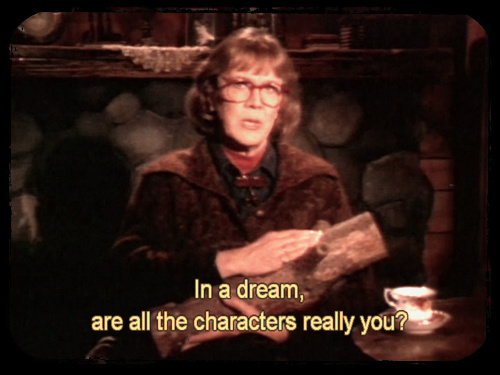
Log-lady-quote-3

Sometime ideas, like men, jump up and say ‘hello’. They introduce themselves, these ideas, with words. Are they words? These ideas speak so strangely. All that we see in this world is based on someone’s ideas. Some ideas are destructive, some are constructive. Some ideas can arrive in the form of a dream. I can say it again: some ideas arrive in the form of a dream…

… There is a sadness in this world, for we are ignorant of many things. Yes, we are ignorant of many beautiful things — things like the truth. So sadness, in our ignorance, is very real. The tears are real. What is this thing called a tear? There are even tiny ducts — tear ducts — to produce these tears should the sadness occur. Then the day when the sadness comes — then we ask: “Will this sadness which makes me cry — will this sadness that makes me cry my heart out — will it ever end?” The answer, of course, is yes. One day the sadness will end.

— David Lynch’s Log Lady, in Twin Peaks

how could you go ahead of me? (1586)

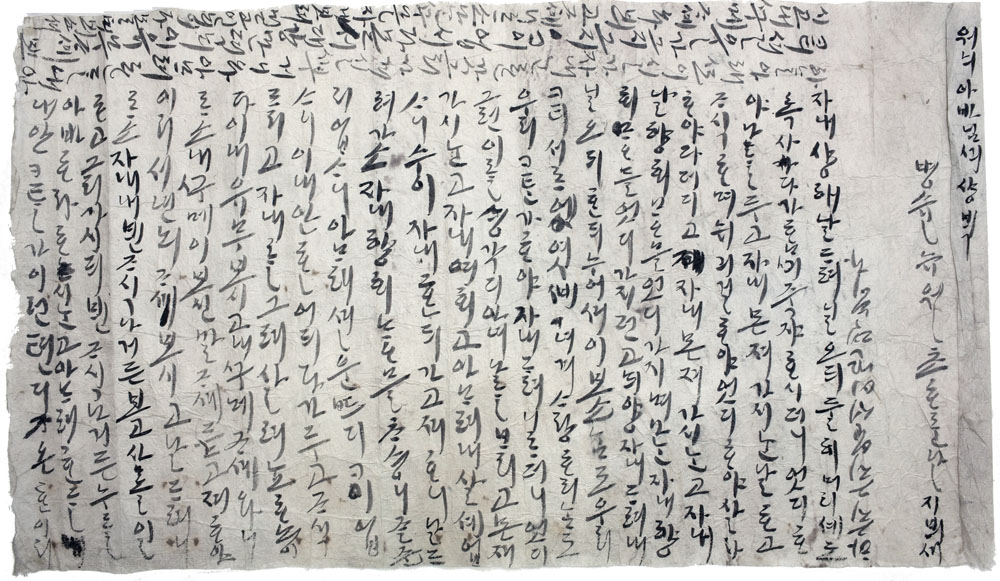
Excavating an ancient tomb in South Korea, archaeologists found the 4-centuries-old mummy of Eung-Tae Lee, who had died at the age of 30. Lying on his chest was this letter, written by his pregnant widow and addressed to the father of their unborn child:

mummy letter

Source: Letters of Note

Transcript

To Won’s Father
June 1, 1586

You always said, “Dear, let’s live together until our hair turns grey and die on the same day.” How could you pass away without me? Who should I and our little boy listen to and how should we live? How could you go ahead of me?

How did you bring your heart to me and how did I bring my heart to you? Whenever we lay down together you always told me, “Dear, do other people cherish and love each other like we do? Are they really like us?” How could you leave all that behind and go ahead of me?

I just cannot live without you. I just want to go to you. Please take me to where you are. My feelings toward you I cannot forget in this world and my sorrow knows no limit. Where would I put my heart in now and how can I live with the child missing you?

Please look at this letter and tell me in detail in my dreams. Because I want to listen to your saying in detail in my dreams I write this letter and put it in. Look closely and talk to me.

When I give birth to the child in me, who should it call father? Can anyone fathom how I feel? There is no tragedy like this under the sky.

You are just in another place, and not in such a deep grief as I am. There is no limit and end to my sorrows that I write roughly. Please look closely at this letter and come to me in my dreams and show yourself in detail and tell me. I believe I can see you in my dreams. Come to me secretly and show yourself. There is no limit to what I want to say and I stop here.

Source: Letters of Note

on the romance of records

[Juliette Gréco]

Juliette Gréco

“Is it wrong, wanting to be at home with your record collection? It’s not like collecting records is like collecting stamps, or beermats, or antique thimbles. There’s a whole world in here, a nicer, dirtier, more violent, more peaceful, more colourful, sleazier, more dangerous, more loving world than the world I live in; there is history, and geography, and poetry, and countless other things I should have studied at school, including music.”

― Nick Hornby, High Fidelity

ntozake shange – dark phrases

dark phrases of womanhood
of never havin been a girl
half-notes scattered
without rhythm/no tune
distraught laughter fallin
over a black girl’s shoulder
it’s funny/it’s hysterical
the melody-less-ness of her dance
don’t tell nobody don’t tell a soul
she’s dancin on beer cans & shingles

this must be the spook house
another song with no singers
lyrics/no voices
& interrupted solos
unseen performances

are we ghouls?
children of horror?
the joke?

don’t tell nobody don’t tell a soul
are we animals? have we gone crazy?

i can’t hear anythin
but maddening screams
& the soft strains of death
& you promised me
you promised me…
somebody/anybody
sing a black girl’s song
bring her out
to know herself
to know you
but sing her rhythms
carin/struggle/hard times
sing her song of life
she’s been dead so long
closed in silence so long
she doesn’t know the sound
of her own voice
her infinite beauty
she’s half-notes scattered
without rhythm/no tune
sing her sighs
sing the song of her possibilities
sing a righteous gospel
let her be born
let her be born
& handled warmly.

— from For Colored Girls Who Have Considered Suicide When the Rainbow is Enuf.  Macmillan Publishing, 1977. Shange was born Paulette L. Williams in Trenton, New Jersey. She later changed her name to isiXhosa/isiZulu – read more HERE.

the cure – a strange day

http://youtu.be/TyG3AtzN1OM

One of my favourites off Pornography (Fiction Records, 1982).

My head falls back
And the walls crash down
And the sky
And the impossible
Explode
Held for one moment, I remember a song
An impression of sound
Then everything is gone
Forever

lydia lunch – stares to nowhere

From her second solo album, 13.13, released on Ruby Records (a subsidiary of Slash Records) in 1982.

The plastic crumbles and the walls fall in
The sidewalk’s melting, I begin to spin
You know where I’m going and
You know where I’ve been
My mind’s exploding like it’s never been
The sidewalk’s melting, I begin to spin
I can’t look down, I might fall in