yoko

Oh, please don’t give me that!

Yes, I’m a witch,
I’m a bitch
I don’t care what you say,
My voice is real.
My voice speaks truth,
I don’t fit in your ways.

I’m not gonna die for you,
You might as well face the truth,
I’m gonna stick around for quite awhile.

We’re gonna say,
We’re gonna try,
We’re gonna try it our way.
We’ve been repressed,
We’ve been depressed,
Suppression all the way.

We’re not gonna die for you,
We’re not seeking vengeance,
But we’re not gonna kill ourselves for your convenience.

Each time we don’t say what we wanna say, we’re dying.
Each time we close our minds to how we feel, we’re dying.
Each time we gotta do what we wanna do, we’re living.
Each time were open to what we see and hear, we’re living.

We’ll free you from the ghettos of your minds,
We’ll free you from your fears and binds,
We know you want things to stay as it is,
It’s gonna change, baby.

It’s gonna change, baby doll,
It’s gonna change, honey ball,
It’s gonna change, sugar cane,
It’s gonna change, sweetie legs.
So don’t try to make cock-pecked people out of us.

niklas zimmer – thinking aloud through the archives that sound

Along with Niklas, I attended a fascinating workshop at UCT last month – these are his reflections:

From August 22 to 24 this year, the Archive and Public Culture research initiative hosted a workshop, led by research fellow Dr Anette Hoffmann, under the title ‘sound/archive/voice/object.’ True to the trans-disciplinary spirit of APC, the range of academic positions present was heterogeneous, but beyond that, this workshop attracted a significant set of participants from beyond the institution: over three days in the much-loved Jon Berndt thought space, the voices of radio activism, sound art, turntablism and composition for film and theatre cross-faded with those of ethnomusicology, social anthropology, fine art and historical studies.

Dr Hoffmann’s carefully staged set of daily readings, gentle chairing and inspiring listening experiences of samples of ethnographic phonograph-recordings from Berlin’s Lautarchiv enabled us to begin thinking through the subject of sound in all its complexity. While ‘visual culture’ with its associated tropes has become commonplace, the same cannot be said for ‘sonic’ or ‘aural culture’ – the need for understanding sound (historically, psychologically, physiologically, etc.) is immanent, particularly when dealing with records of human subject research in the archive.

‘… sound is a product of the human senses and not a thing in the world apart from humans. Sound is a little piece of the vibrating world.’ (Jonathan Sterne)

As with other investigations into reproduction technologies developed in the 19th century (such as photography), a detailed understanding of the political, scientific and cultural drives that gave birth to them in the first place is key to surfacing relevant, contemporary perspectives on the audio archive. Studies into sound – and in particular the ethnographic voice recording – have so far remained in relative specialist isolation. In contrast to this, studies of visuality – and in particular ethnographic photographic portraiture – have been gaining interdisciplinary popularity. Beyond the misalignments of comparison between the two, and despite the multitude of overlaps between the orders of the eye and the ear, it becomes clear that the realms of the aural (or sonic) and the visual do require different sets of analytical tools.

‘The vocabulary may well distinguish nuances of meaning, but words fail us when we are faced with the intimate shades of the voice, which infinitely exceed meaning. (…) faced with the voice, words structurally fail.’ (Mladen Dolar)

Passive hearing and active listening involve a complex range of affective and cognitive processes which are incomparable to those associated with any other sense (other than perhaps touch) – any discussion of differences in technology for the capture and representation of aural as opposed to visual phenomena can only be secondary to this. In the shared process of active listening at the beginning of each workshop morning, the group sensed its way into some of the qualities of sound, particularly those of the speaking voice. We discovered that we are able to hear much more than we tend to trust ourselves to. The ethnographic and linguistic phonographic recordings of prisoners of war in WWI Germany from the Humboldt University’s Lautarchiv in Berlin revealed to us as listeners a small, but powerful glimpse into the potential of a different way of working with archival material. Because the transcripts and translations of the recordings were withheld until after the first listening-through, we relied on our own emotional and intellectual inferences in order to engage the questions that these ‘sound objects’ from the past carried into our present space. Listening engages us in a different way of knowing, as Dr Hoffmann pointed out, and ‘if the process of enunciation points at the locus of subjectivity in language, then voice also sustains an intimate link with the very notion of the subject.’ (Mladen Dolar)

Generally, the bigger paradigm of any research interest will at first tend towards sacrificing the individual voice to generalisation and dissection rather than a ‘regime of care’ as Prof Hamilton would remind us: sounds, in particular human voices on record are always re-presented in a web of power-relations, some of which are near-impossible to address, let alone shift. This becomes most paradoxical in thinking though the subaltern speaking position in the archive, where not only the act of recording has been an act of violence, but where the act of listening itself can be an act of othering and continued silencing. In view of this (in sound of this?), the best possible approach to reaching the necessary ‘audio condition’ from which to push at the limits of subaltern positionalities in the archive seems to be continuum of analysis, a reverence paid to the minutiae of humanity in the material. This was a recurring moment, a leitmotiv in our three days of sound studies: only a wide range of disciplines working together can actually achieve the description of the necessary aspects (aesthetic, ethical, cultural, historical, political, psychological) from which to consider a relevant engagement with the archive that sounds.

the beautiful music all around us: field recordings and the american experience, by stephen wade

The Beautiful Music All Around Us presents the extraordinarily rich backstories of thirteen performances captured on Library of Congress field recordings between 1934 and 1942 in locations reaching from Southern Appalachia to the Mississippi Delta and the Great Plains. Including the children’s play song “Shortenin’ Bread,” the fiddle tune “Bonaparte’s Retreat,” the blues “Another Man Done Gone,” and the spiritual “Ain’t No Grave Can Hold My Body Down,” these performances were recorded in kitchens and churches, on porches and in prisons, in hotel rooms and school auditoriums. Documented during the golden age of the Library of Congress recordings, they capture not only the words and tunes of traditional songs but also the sounds of life in which the performances were embedded: children laugh, neighbors comment, trucks pass by.

Musician and researcher Stephen Wade sought out the performers on these recordings, their families, fellow musicians, and others who remembered them. He reconstructs the sights and sounds of the recording sessions themselves and how the music worked in all their lives. Some of these performers developed musical reputations beyond these field recordings, but for many, these tracks represent their only appearances on record: prisoners at the Arkansas State Penitentiary jumping on “the Library’s recording machine” in a rendering of “Rock Island Line”; Ora Dell Graham being called away from the schoolyard to sing the jump-rope rhyme “Pullin’ the Skiff”; Luther Strong shaking off a hungover night in jail and borrowing a fiddle to rip into “Glory in the Meetinghouse.”

Reflecting decades of research and detective work, the profiles and abundant photos in The Beautiful Music All Around Us bring to life largely unheralded individuals–domestics, farm laborers, state prisoners, schoolchildren, cowboys, housewives and mothers, loggers and miners–whose music has become part of the wider American musical soundscape. The book also includes an accompanying CD that presents these thirteen performances, songs and sounds of America in the 1930s and ’40s. By exploring how these singers and instrumentalists exerted their own creativity on inherited forms, “amplifying tradition’s gifts,” Wade shows how a single artist can make a difference within a democracy.

Musician, recording artist, and writer Stephen Wade is best known for his long-running stage performances of Banjo Dancing and On the Way Home. He also produced and annotated the Rounder CD collection that gave rise to this book, A Treasury of Library of Congress Field Recordings. Since 1996 his occasional commentaries on folksongs and traditional tunes have appeared on National Public Radio’s All Things Considered.

For more information, go to http://www.go.illinois.edu/StephenWade

*****
Video Produced by The Prairie Production Group
509 S. Country Fair Drive
Champaign, IL 61820
http://www.prairie-production.com

Videography and Editing by Sam Ambler

*****

global anti-fracking day is tomorrow, 22 september – get involved!

Andreas Spath, for News 24:

“On the same day that the South African government decided to lift the moratorium on fracking, the European Union’s environment directorate released a comprehensive 300-page report that identified the controversial method for mining natural gas in underground units of shale rock as a “high risk” to human health and the environment because of its potential to contaminate and deplete water resources, cause a loss of biodiversity, degrade air and land quality and trigger earthquakes.”

Earlier this month, the South African Cabinet endorsed the lifting of a moratorium on prospecting for shale gas, imposed in February last year in line with a report by government’s multi-disciplinary task team, which recommends only “normal” geological exploration, excluding fracking, be allowed, until the extent of the gas reserves are established.

Read this article from SACSIS if you don’t know the history of the fracking debate in South Africa, and this article from Science News if you need more scientific information on how fracking (shale gas extraction) affects the environment and people in its vicinity – which in South Africa’s case, would be the delicate, already arid Karoo.

Send a message to our government on Global Anti-Fracking day, September 22nd 2012, by joining other South Africans who are opposed to fracking, when they CALL FOR A PERMANENT BAN ON FRACKING in South Africa.

In Cape Town, we will meet in front of the gates of Parliament, corner of Plein Street and Roeland Street at 10h30. Bring your anti-fracking banners and posters! The event is open to everyone and supported by several organisations, including Earthlife Africa, SAFCEI, Southern Cape Land Committee, Environmental Monitoring Group, Coalition for Environmental Justice, Treasure the Karoo Action Group and others.

The speakers at the protest will be Muna Lakhani (ELA), Barry Wuganale (Ogoni Solidarity Forum), Thembeka Majali (Million Climate Jobs), Bishop Geoff Davies (SAFCEI), Mpumelelo Mhlalisi (CEJ), Priscilla de Wet (First Indigenous Women’s Movement) and Jonathan Deal (TKAG). Don’t miss it!

In solidarity with our protest, the SCLC are encouraging local Karoo communities (farm workers and dwellers and small-scale farmers in the Chris Hani, Cacadu and Central Karoo District Municipalities) to wear the Black Thursday Land Campaign T-shirts on the day. They will be distributing anti-fracking brochures and raise debate in the areas where they live.

In Prins Albert the trees will be wrapped in black fabric, with black wreaths on shop windows. Please contact Lisa Smith for more information and to see how you can get involved: lisass@intekom.co.za.

In Joburg, Earthlife Africa JHB will host a discussion on ‘Fracking and the implications for water in South Africa’ at the Greenhouse Project 14:00 – 16:00. Contact Judith@earthlife.co.za for more information.

Find the Global Frackdown activist toolkit HERE.


pamella dlungwana – sweets for thohoyandou

I was seven and she was six. She had came to visit, spend time with her big sister. I was too busy to spend all my days with her. She loved to play outside, roam the rivers and catch frogs and fireflies like she did at home with our sister and brother but that wasn’t my scene. She tried to teach me games, skipping rope, umagalobha and amatshe but I sucked at every one. I always wanted to be inside, alone. I felt bad, not being able to join in on her fun and so everyday I’d come home with a sherbet, a lollipop, something she could squeeze from a wrapper and eat in the dark. Ayanda would rush to the gate to greet me in the afternoon or I’d find her at the bus stop waiting to walk me home, her arms open for a hug. I thought at first that she was after the sweeties in my jumper but discovered that she was excited to have me back. This devotion was new to me. I didn’t know how to hug her back or say simple things like, “I’ll miss you” or “I love you too.”

In the evenings as she washed getting into her nightie I would tell my sister stories. I would lie to her and she would laugh. When I was attacked by a waif of a girl who took me for everything, I told my sister I had met a giant on my way home. I told her he had fangs. I said I’d fought him till he broke down and told me he had a sick child and so I decided to give him everything I had. She thought that I was brave, that I was kind. She told me this as she pressed toothpaste onto the brush, I stopped her before she could wet the brush, reached into the front pocket of my jumper and pressed two socks of sherbet into her wet palm. I leaned in and kissed someone else, for the first time in my life.

Today my sister is at the dentist. I can imagine her panic and fear but I’m glad she’s old enough to brave it on her own.

fabio selvatici – hope

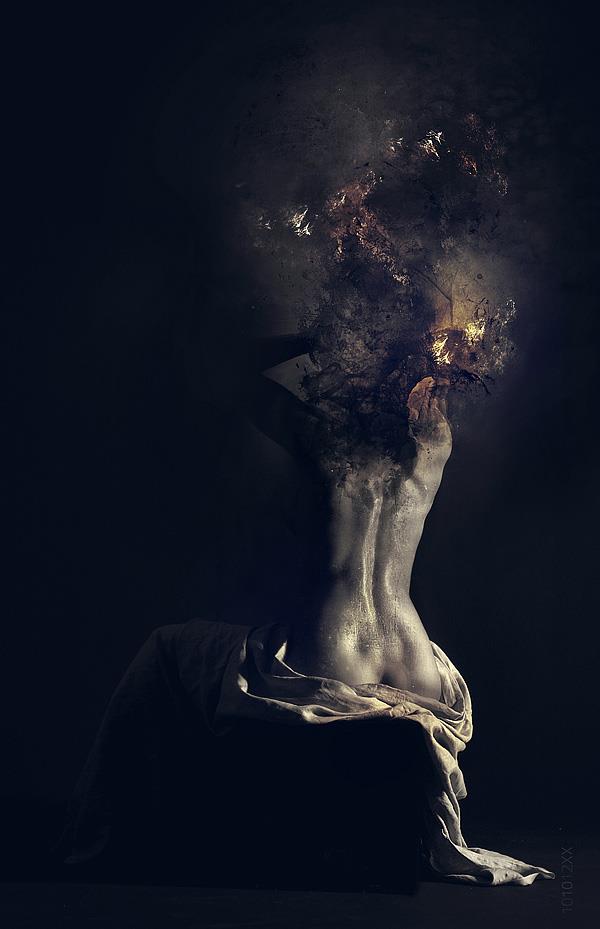
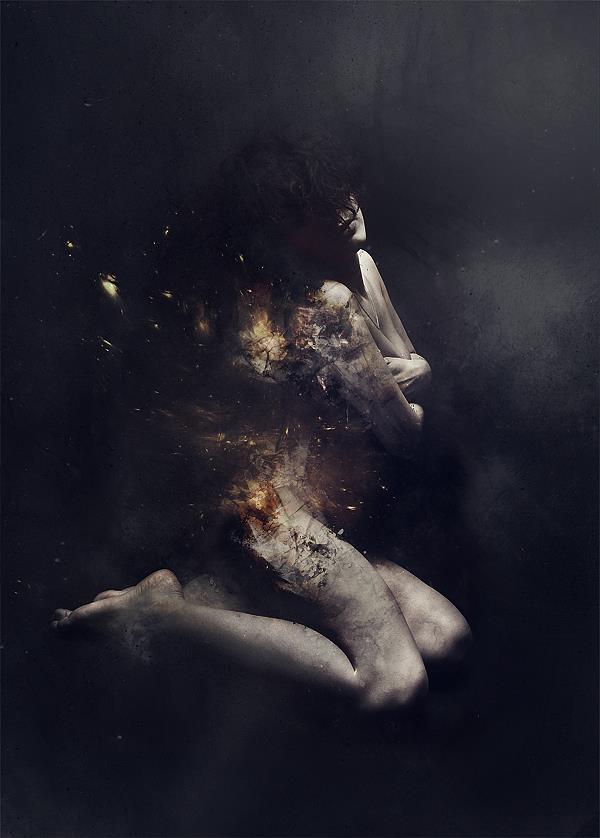
Fabio Selvatici – “Hope”
2010, from The Obscure Series
Photomanipulation

Born in Ferrara, Italy, in 1987, Fabio Selvatici is completely self-taught. Although his surrealistic images may appear to be ultra-realist paintings, they are actually intricately beautiful photo-manipulations. He uses traditional means such as acrylics and ink over previously digitally-altered images.

On his official website, Fabio says, about his use of both traditional and digital media, that “the combination of these techniques allows me to create effects of visual impact that act directly on the physicality of human subjects depicted, emphasizing them in a Gothic, deliberately grotesque and extreme style, invoking the inner drives of the human soul, the travails of the psyche and their inadequacy in relation to the claustrophobic environment that oppresses them.” (thanks to Golden Wolves for this information in English.) 

Explore Selvatici’s work further on his official site (in Italian).

ground beef

I binge on loneliness
Mining a tantrum of meat
I binge on loneliness
My heels, the hollow drum
Going through the dirt
Swallowing dark
I binge on loneliness
A mole, a minor disruption
A blemish
A bore
I binge on loneliness

vbi – chameleon girl (2009)

Chameleon girl,
you switch,
with each serial
killer moment,

A freckle-face, brown eyes soft
with endless promise,
Heels and stockings
in the glare of
the brake lights,

A sexy sneer on a culpable homicide,
Swallow my car-crash
under a blue cross,
soft skin plays over mine
in the morning.

Smells like the garden
of earthly delights,
a chorus of angels;
and demon-spurred riots.

I want to hold you in my arms,
but all it seems I can do is
write you songs.

I will collaborate on the mysteries,
with you take part in their downfall,
With you I am afraid
anything is possible.

I am a dangerous man,
I vanish like mist
in the face of
commitment.

But long after good and evil
and far beyond death do us part,
You’ll look around
and find that I’m still around

Track 3 from the album Severance by VBI. Music by Graeme Feltham. Words and Vocals by Martin Jacklin.  More HERE.

dummies

ScienceDaily (Sep. 18, 2012)

Pacifiers May Have Emotional Consequences for Boys

Pacifiers may stunt the emotional development of baby boys by robbing them of the opportunity to try on facial expressions during infancy.

Three experiments by a team of researchers led by psychologists from the University of Wisconsin-Madison tie heavy pacifier use as a young child to poor results on various measures of emotional maturity.

The study, published September 18 by the journal Basic and Applied Social Psychology, is the first to associate pacifiers with psychological consequences. The World Health Organization and American Academy of Pediatrics already call for limiting pacifier use to promote breast-feeding and because of connections to ear infections or dental abnormalities.

Humans of all ages often mimic — unwittingly or otherwise — the expressions and body language of the people around them.

“By reflecting what another person is doing, you create some part of the feeling yourself,” says Paula Niedenthal, UW-Madison psychology professor and lead author of the study. “That’s one of the ways we understand what someone is feeling — especially if they seem angry, but they’re saying they’re not; or they’re smiling, but the context isn’t right for happiness.”

Mimicry can be an important learning tool for babies.

“We can talk to infants, but at least initially they aren’t going to understand what the words mean,” Niedenthal says. “So the way we communicate with infants at first is by using the tone of our voice and our facial expressions.”

With a pacifier in their mouth, a baby is less able to mirror those expressions and the emotions they represent.

The effect is similar to that seen in studies of patients receiving injections of Botox to paralyze facial muscles and reduce wrinkles. Botox users experience a narrower range of emotions and often have trouble identifying the emotions behind expressions on other faces.

“That work got us thinking about critical periods of emotional development, like infancy,” says Niedenthal, whose work is supported by the French Agence Nationale de la Recherche. “What if you always had something in your mouth that prevented you from mimicking and resonating with the facial expression of somebody?”

The researchers found six- and seven-year-old boys who spent more time with pacifiers in their mouths as young children were less likely to mimic the emotional expressions of faces peering out from a video.

College-aged men who reported (by their own recollections or their parents’) more pacifier use as kids scored lower than their peers on common tests of perspective-taking, a component of empathy.

A group of college students took a standard test of emotional intelligence measuring the way they make decisions based on assessing the moods of other people. Among the men in the group, heavier pacifier use went hand-in-hand with lower scores.

“What’s impressive about this is the incredible consistency across those three studies in the pattern of data,” Niedenthal says. “There’s no effect of pacifier use on these outcomes for girls, and there’s a detriment for boys with length of pacifier use even outside of any anxiety or attachment issues that may affect emotional development.”

Girls develop earlier in many ways, according to Niedenthal, and it is possible that they make sufficient progress in emotional development before or despite pacifier use. It may be that boys are simply more vulnerable than girls, and disrupting their use of facial mimicry is just more detrimental for them.

“It could be that parents are inadvertently compensating for girls using the pacifier, because they want their girls to be emotionally sophisticated. Because that’s a girly thing,” Niedenthal says. “Since girls are not expected to be unemotional, they’re stimulated in other ways. But because boys are desired to be unemotional, when you plug them up with a pacifier, you don’t do anything to compensate and help them learn about emotions.”

Suggesting such a simple and common act has lasting and serious consequences is far from popular.

“Parents hate to have this discussion,” Niedenthal says. “They take the results very personally. Now, these are suggestive results, and they should be taken seriously. But more work needs to be done.”

Sussing out just why girls seem to be immune (or how they may compensate) is an important next step, as is an investigation of what Niedenthal calls “dose response.”

“Probably not all pacifier use is bad at all times, so how much is bad and when?” she asks. “We already know from this work that nighttime pacifier use doesn’t make a difference, presumably because that isn’t a time when babies are observing and mimicking our facial expressions anyway. It’s not learning time.”

But even with more research planned to further explain the new results, Niedenthal is comfortable telling parents to consider occasionally pocketing the pacifier.

“I’d just be aware of inhibiting any of the body’s emotional representational systems,” Niedenthal says. “Since a baby is not yet verbal — and so much is regulated by facial expression — at least you want parents to be aware of that using something like a pacifier limits their baby’s ability to understand and explore emotions. And boys appear to suffer from that limitation.”

University of Wisconsin-Madison. “Pacifiers may have emotional consequences for boys.ScienceDaily, 18 Sep. 2012. Web. 20 Sep. 2012.

jun togawa – suki suki daisuki (1985)

Without subtitles:

Translated lyrics (probably a bad translation):

My love is increasing and transcends common sense
The love in rose broke out like a mutation
Pure as to be able to call it violence
‘Je t’aime’ with great force that carved into Showa history

Kiss me like thumping, as blood clots on my lips
Hold me, as my ribs are breaking
I love you so much
I love you so much
I love you so much
Say you love me or I’ll kill you!

‘Eros’ breaks the daily life and is crystallizing
Repeating the affairs instinctively in the Avici hell
The intuitive cognition with anti-nihilism is a trigger for latent infant violence

Kiss me like thumping, as blood clots on my lips
Hold me, as my ribs are breaking
I love you so much
I love you so much
I love you so much
Say you love me or I’ll kill you!

With subtitles (they’re kinda distracting):

tracey emin

“Art is an extended act away from the being, art is something else. Not everything can be art, and just because you’re an artist doesn’t mean everything you touch is art. You have to decide and know what is art, and you have  to be separate from yourself.” -Tracey Emin

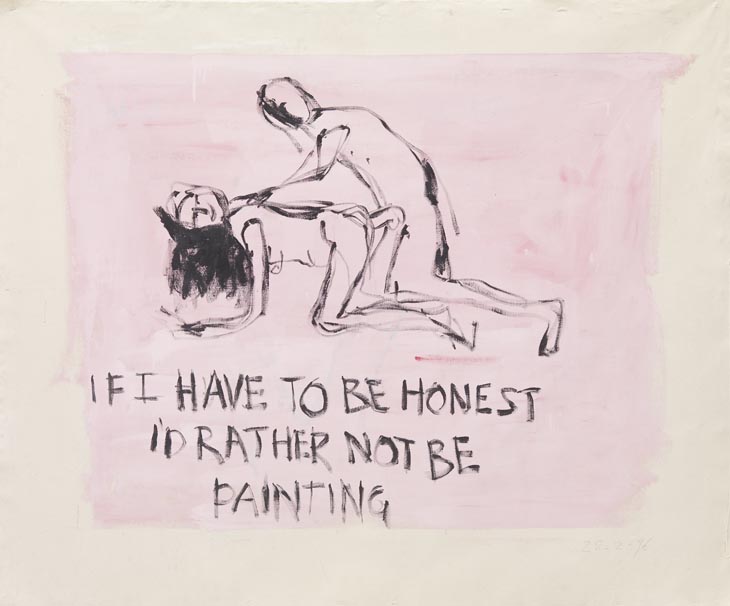
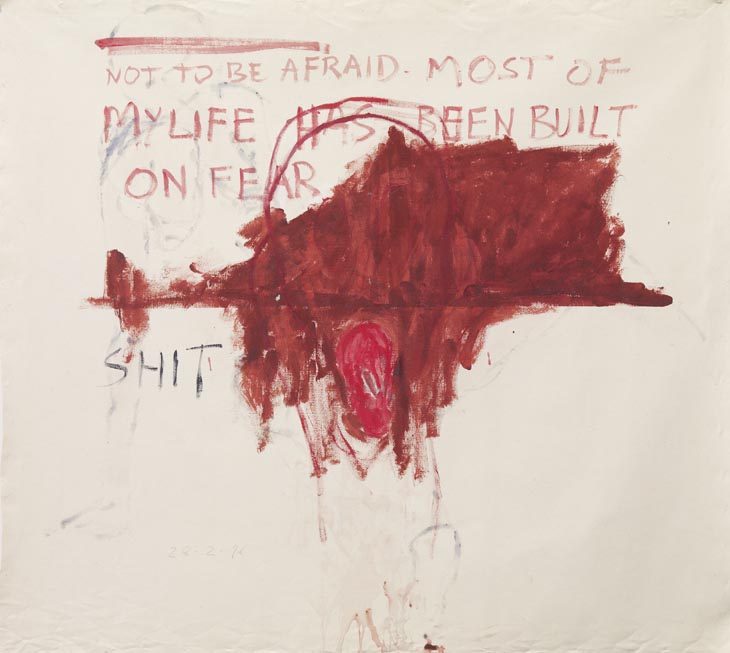
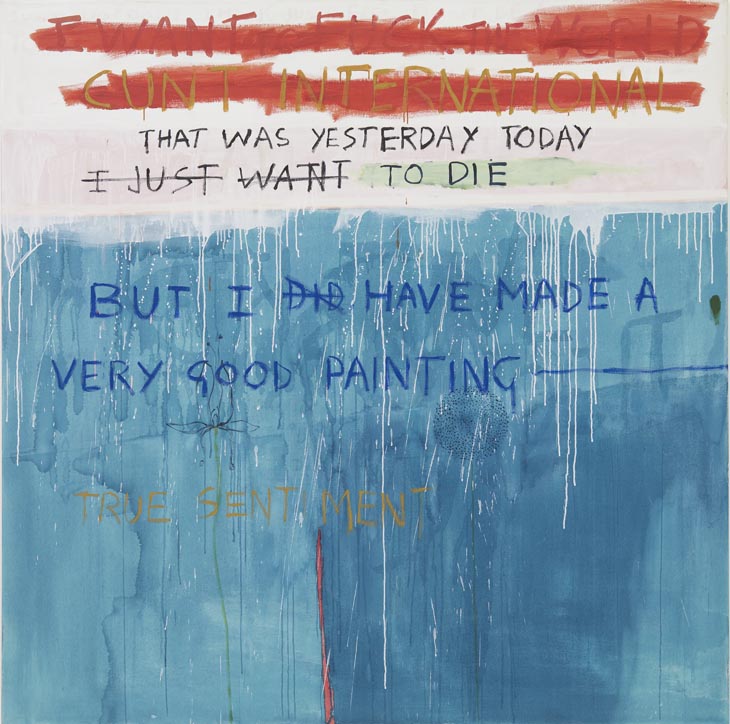
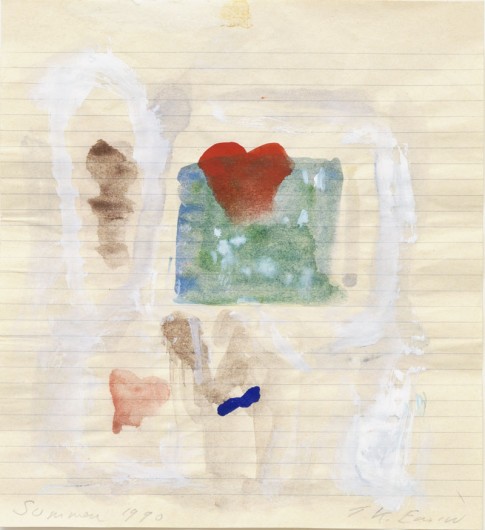
When I first came across the art of Tracey Emin, I wasn´t so sure how to feel about the way she sells herself/her art. She seemed to be so commercially inclined and I sort of judged her work, immediately questioning the integrity of her process and her pieces. The more I investigate her art, the more I fall in love with it.  It´s not only the confessional quality her works possess that resonates with me, it´s just the honesty, that raw, ugly honesty that most are so afraid to show.

“Emin exposes herself, her hopes, humiliations, failures and successes in an incredibly direct manner. Often tragic and frequently humorous, it is as if by telling her story and weaving it into the fiction of her art she somehow transforms it.” read more about Emin here.

Her website.

I’ve Got It All, 2000

Tracey Emin is almost always portrayed as a Diana-esque femme tragique. It’s rare to get a glimpse of the happy, successful, confident person she’s become. I’ve Got It All is a transient crowning glory: a shameless, two-fingers up to her critics. Emin’s triumphed over all, and has money up the whazoo to boot!

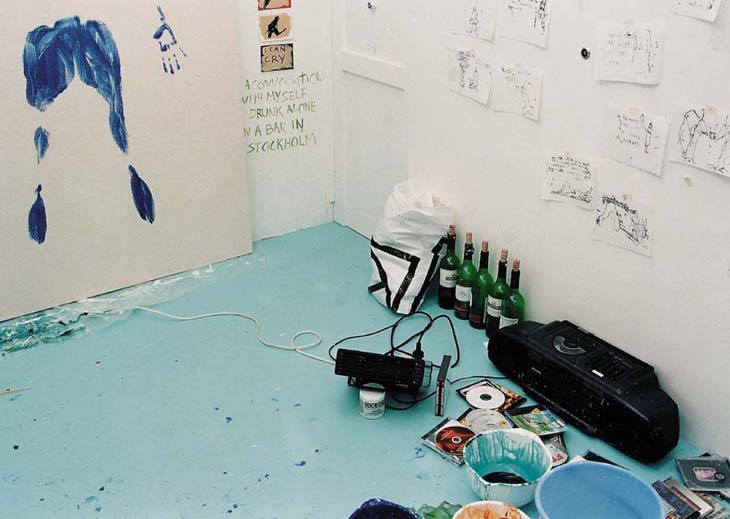
Installation including 14 paintings, 78 drawings, 5 body prints, various painted and personal items, furniture, CDs, newspapers, magazines, kitchen and food supplies. 1996

In 1974, Joseph Beuys did a performance called I Love America, and America Loves Me where he lived in a gallery with a wild coyote for seven days as a symbolic act of reconciliation with nature. In 1996, Tracey Emin lived in a locked room in a gallery for fourteen days, with nothing but a lot of empty canvases and art materials, in an attempt to reconcile herself with paintings. Viewed through a series of wide-angle lenses embedded in the walls, Emin could be watched, stark naked, shaking off her painting demons. Starting by making images like the artists she really admired (i.e. Egon Schiele, Edvard Munch, Yves Klein), Emin’s two-week art-therapy session resulted in a massive outpouring of autobiographical images, and the discovery of a style all her own. The room was extracted in its entirety, and now exists as an installation work.

Three above from Exorcism of the Last Painting I Ever Made

After My Abortion XII (1990) watercolour on paper, 10 x 8 in (25.5 x 20.4 cm)My bed, 1998

A consummate storyteller, Tracey Emin engages the viewer with her candid exploration of universal emotions. Well-known for her confessional art, Tracey Emin reveals intimate details from her life to engage the viewer with her expressions of universal emotions. Her ability to integrate her work and personal life enables Emin to establish an intimacy with the viewer.

Tracey shows us her own bed, in all its embarrassing glory. Empty booze bottles, fag butts, stained sheets, worn panties: the bloody aftermath of a nervous breakdown. By presenting her bed as art, Tracey Emin shares her most personal space, revealing she’s as insecure and imperfect as the rest of the world.

annie ross – twisted (1959)

In 1952, Ross met Prestige Records owner Bob Weinstock, who asked her to write lyrics to a jazz solo, in a similar way to King Pleasure, a practice which would later be known as vocalese. The next day, she presented him with “Twisted”, a treatment of saxophonist Wardell Gray‘s 1949 composition of the same name, a classic example of the genre. She later said of the inspiration for the song:

“The title was infinite possibilities. You could marry anything to it and it was the name signified, “Twisted.” And it just occurred to me that it would be good as a kind of song about an analyst.”

ted hughes, in a letter to his son

“The only calibration that counts is how much heart people invest, how much they ignore their fears of being hurt or caught out or humiliated. And the only thing people regret is that they didn’t live boldly enough, that they didn’t invest enough heart, didn’t love enough. Nothing else really counts at all.”