t.s. eliot – the cocktail party

TheCocktailPartyIt will do you no harm to find yourself ridiculous.
Resign yourself to be the fool you are.

You will find that you survive humiliation
And that’s an experience of incalculable value.

That is the worst moment, when you feel you have lost
The desires for all that was most desirable,
Before you are contented with what you can desire;
Before you know what is left to be desired;
And you go on wishing that you could desire
What desire has left behind. But you cannot understand.
How could you understand what it is to feel old?

We die to each other daily.
What we know of other people
Is only our memory of the moments
During which we knew them. And they have changed since then.
To pretend that they and we are the same
Is a useful and convenient social convention
Which must sometimes be broken. We must also remember
That at every meeting we are meeting a stranger.

There was a door
And I could not open it. I could not touch the handle.
Why could I not walk out of my prison?
What is hell? Hell is oneself.
Hell is alone, the other figures in it
Merely projections. There is nothing to escape from
And nothing to escape to. One is always alone.

Half the harm that is done in this world
Is due to people who want to feel important.
They don’t mean to do harm — but the harm does not interest them.
Or they do not see it, or they justify it
Because they are absorbed in the endless struggle
To think well of themselves.

There are several symptoms
Which must occur together, and to a marked degree,
To qualify a patient for my sanitorium:
And one of them is an honest mind. That is one of the causes of their suffering.

To men of a certain type
The suspicion that they are incapable of loving
Is as disturbing to their self-esteem
As, in cruder men, the fear of impotence.

I must tell you
That I should really like to think there’s something wrong with me —
Because, if there isn’t, then there’s something wrong
With the world itself — and that’s much more frightening!
That would be terrible.
So, I’d rather believe there’s something wrong with me, that could be put right.

Everyone’s alone — or so it seems to me.
They make noises, and think they are talking to each other;
They make faces, and think they understand each other.
And I’m sure they don’t. Is that a delusion?

Can we only love
Something created in our own imaginations?
Are we all in fact unloving and unloveable?
Then one is alone, and if one is alone
Then lover and beloved are equally unreal
And the dreamer is no more real than his dreams.

I shall be left with the inconsolable memory
Of the treasure I went into the forest to find
And never found, and which was not there
And is perhaps not anywhere? But if not anywhere
Why do I feel guilty at not having found it?

Disillusion can become itself an illusion
If we rest in it.

Two people who know they do not understand each other,
Breeding children whom they do not understand
And who will never understand them.

There is another way, if you have the courage.
The first I could describe in familiar terms
Because you have seen it, as we all have seen it,
Illustrated, more or less, in lives of those about us.
The second is unknown, and so requires faith —
The kind of faith that issues from despair.
The destination cannot be described;
You will know very little until you get there;
You will journey blind. But the way leads towards possession
Of what you have sought for in the wrong place.

We must always take risks. That is our destiny.

If we all were judged according to the consequences
Of all our words and deeds, beyond the intention
And beyond our limited understanding
Of ourselves and others, we should all be condemned.

Only by acceptance of the past will you alter its meaning.

All cases are unique, and very similar to others.

Every moment is a fresh beginning.

__
Excerpted from T.S. Eliot’s 1949 play, The Cocktail Party

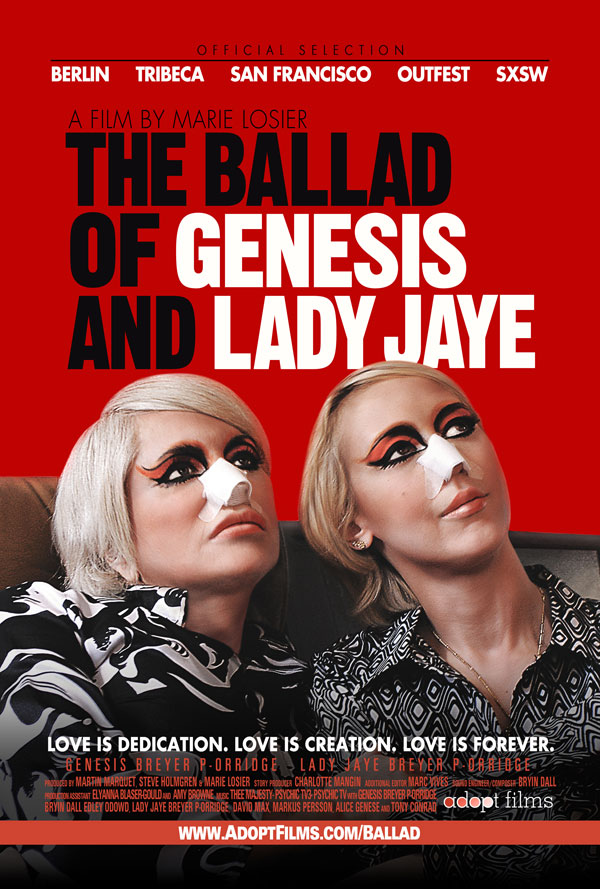
free screening tonight: the ballad of genesis and lady jaye

Screening today at 20h00 at Bolo’bolo, the new anarchist infoshop and vegan café at 76 Lower Main Road, Observatory, Cape Town.

An intimate, affecting portrait of the life and work of ground-breaking performance artist and music pioneer Genesis Breyer P-Orridge (Throbbing Gristle, Psychic TV) and his other half and collaborator, Lady Jaye, centred around the daring sexual transformations the pair underwent for their “Pandrogyne” project. Watch the trailer HERE.


ballad of genesis

Here’s a full synopsis:

Genesis P-Orridge has been one of the most innovative and influential figures in music and fine art for the last 30 years. A link between the pre- and post-punk eras, he is the founder of the legendary groups COUM Transmissions (1969-1976), Throbbing Gristle (1975-1981), and Psychic TV (1981 to present), all of which merged performance art with rock music. Celebrated by critics and art historians as a progenitor of “industrial music”, his innovations have transformed the character of rock and electronic music while his prodigious efforts to expand the boundaries of live performance have radically altered the way people experience sound in a concert setting.

But that’s just the preamble to the story. Defying artistic boundaries, Genesis has re-defined his art as a challenge to the limits of biology. In 2000, Genesis began a series of surgeries in order to more closely resemble his love, Lady Jaye (née Jacqueline Breyer), who remained his other half and artistic partner for nearly 15 years. It was the ultimate act of devotion, and Genesis’s most risky, ambitious, and subversive performance to date: he became a she in a triumphant act of artistic self-expression. Genesis called this project “Creating the Pandrogyne”. Influenced, like so much of Genesis  work, by Brion Gysin and William Burroughs  Cut Ups , it was an attempt to deconstruct two individual identities through the creation of an indivisible third.

This is a love story, and a portrait of two lives that illustrate the transformative powers of both love and art. Marie Losier brings to us the most intimate details of Genesis’s extraordinary, uncanny world. In warm and intimate images captured handheld, Losier crafts a labyrinthine mise-en-scene of interviews, home movies, and performance footage. The Ballad of Genesis and Lady Jaye documents a truly new brand of Romantic consciousness, one in defiance of the daily dehumanization of the body by the pervasive presence of advertising and pornography, conveying beauty, dignity and devotion from a perspective never before seen on film.

danielle leduc – the anti-preneur manifesto

adbusters_106_antripreneur_SI don’t want to be a designer, a marketer, an illustrator, a brander, a social media consultant, a multi-platform guru, an interface wizard, a writer of copy, a technological assistant, an applicator, an aesthetic king, a notable user, a profit-maximizer, a bottom-line analyzer, a meme generator, a hit tracker, a re-poster, a sponsored blogger, a starred commentator, an online retailer, a viral relayer, a handle, a font or a page. I don’t want to be linked in, tuned in, ‘liked’, incorporated, listed or programmed. I don’t want to be a brand, a representative, an ambassador, a bestseller or a chart-topper. I don’t want to be a human resource or part of your human capital.

I don’t want to be an entrepreneur of myself.

Don’t listen to the founders, the employers, the newspapers, the pundits, the editors, the forecasters, the researchers, the branders, the career counsellors, the prime minister, the job market, Michel Foucault or your haughty brother in finance – there’s something else!

I want to be a lover, a teacher, a wanderer, an assembler of words, a sculptor of immaterial, a maker of instruments, a Socratic philosopher and an erratic muse. I want to be a community centre  a piece of art, a wonky cursive script and an old-growth tree! I want to be a disrupter, a creator, an apocalyptic visionary, a master of reconfiguration, a hypocritical parent, an illegal download and a choose-your-own-adventure! I want to be a renegade agitator! A licker of ice cream! An organiser of mischief! A released charge! A double jump on the trampoline! A wayward youth! A volunteer! A partner.

I want to be a curator of myself, an anti-preneur, a person.

Unlimited availabilities. No followers required. Only friends.

~ Danielle Leduc

First published HERE (thanks to Emma Arogundade for sharing it on Facebook).
Note from the author:
I actually didn’t write this as an ‘anti-preneurial manifesto’ – it was more of a poetic rant written in frustration from combing through the online job market. I meant it as less of a takedown of capitalism and more of a critique of how we are told to sell ourselves as brands, to self-promote, in order to make it in this world, and as such we allow our job titles to define us to a certain extent. I think all of us are many of the things I listed towards the end, but these things don’t appear as marketable skills in a neoliberal economy with a tight and precarious job market. We are not our resumes, is all.

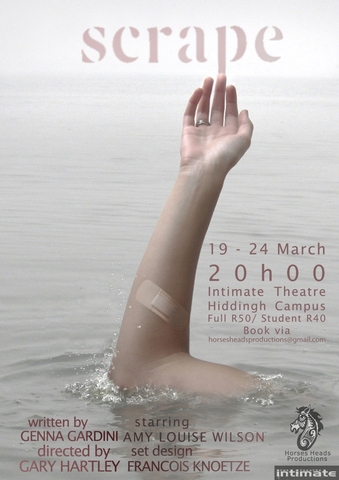
“scrape”: it’s brilliant – go and see it!

This play is on for two more nights at the Intimate Theatre on UCT’s Hiddingh Campus. I went last night. It is an absolute tour de force – insightful, brutal, awkward, compassionate, hilarious. If you are in Cape Town, GO, GO, GO!

SCRAPE_REAL_large

Scrape is the story of an everyday woman suffering from an unusual condition.

After falling and scraping herself, Beth discovers that not only does skin heal, it can sometimes do so with a vengeance.

This one-person show, performed by Amy Louise Wilson, is presented by writer Genna Gardini and director Gary Hartley. It features sound design by musician and performance artist SIYA IS YOUR ANARCHIST and set design by 2011 ABSA L’Atelier and Sasol New Signatures finalist Francois Knoetze.

Scrape is presented by the new theatre company Horses’ Heads Productions. The production will preview at the Intimate Theatre from 19 – 24 March 2013 and go on to feature as part of The Cape Town Edge programme at this year’s National Arts Festival. Scrape will then return to the Mother City for a run at The Alexander Bar in August 2013.

Scrape, 19 – 24 March 2013, 20:00
The Intimate Theatre on UCT’s Hiddingh Campus
R50 general/ R40 students
To book tickets, contact 0827765490 or horsesheadsproductions@gmail.com

Director:
Gary Hartley is a theatre-maker, performer and television producer based in Cape Town. In 2007 he graduated from Rhodes University with a distinction in Drama. His production, WinterSweet, made in collaboration with The Runaway Buni Collective and writer Genna Gardini, won a Standard Bank Ovation Encore prize at the 2012 National Arts Festival. He currently works as a writer and producer at Greenwall Productions and has produced for shows such as The Showbiz Report, The Close Up and Screentime with Nicky Greenwall.

Playwright:
Genna Gardini is a writer based in Cape Town. Her play WinterSweet was produced in collaboration with Gary Hartley and The Runaway Buni Collective for the 2012 National Arts Festival and won a Standard Bank Encore Ovation Award. She has curated The Readings Upstairs, a monthly series of play readings held upstairs at the Alexander Bar, since 2012. Her work as a poet has been published widely both locally and internationally. Gardini has presented papers at the 2012 AFTA Annual International Conference and GIPCA Directors and Directing: Playwrights Symposium. She also works as a freelance arts writer for various publications, including the Cape Times and Art South Africa magazine. She is currently completing her MA Theatre-making (Playwriting) at UCT.

Performer:
Amy Louise Wilson is an actress living in Cape Town. She has studied Acting and Contemporary Performance at Rhodes University; Processes of Performance and Shakespeare Studies at the University of Leeds and Theatre and Performance at the University of Cape Town. Recent performances include The Petticoat Chronicle (dir. Lynne Maree), Voiced (under Clare Stopford) and 2012’s Standard Bank Encore Ovation Award winning Wintersweet (dir. Robert Haxton). She will be presenting her paper ‘Performance, Persona and Identity in the work of Die Antwoord’ at the New Directions in South African Theatre Today: Circulation, Evolutions, Adaptations symposium in France later this year.

Set Designer:
Francois Knoetze is an artist based in Cape Town. Having recently completed his Honours in Fine Art at Rhodes University, he is currently pursuing his MFA at Michaelis. His work is multidisciplinary, incorporating performance, assemblage sculpture and film. In 2011 he was a finalist in both the Absa L’Atelier and Sasol New Signatures competitions. Last year he was named one of Art South Africa magazine’s Bright Young Things. He has been involved in numerous theatre productions as set designer and puppet-maker, including works by the UBOM! Eastern Cape Theatre Company.

Sound designer:
Writer, journalist, musician and filmmaker SIYA IS YOUR ANARCHIST has written for publications like the Sunday World, The Event and The Callsheet. He has performed at the National Arts Festival and written several plays. He has also worked for TV shows such as Rhythm City (E-TV), Font (SABC 3), Breaking New Ground (SABC 2). He directed an SABC2 documentary on Aids activist Zackie Achmat called His Husband in 2011 and has exhibited multi-media installations for Goodman Gallery Cape Town and GIPCA Live Art Festival. He now works for Entertainment Africa as a features writer and is combining writing, music, art and media for the release of his upcoming musical EP.

For more information, see:
Scrape Facebook event
Horses’ Heads Productions Facebook page:
Horses’ Heads Twitter

joan didion – on self respect

Once, in a dry season, I wrote in large letters across two pages of a notebook that innocence ends when one is stripped of the delusion that one likes oneself. Although now, some years later, I marvel that a mind on the outs with itself should have nonetheless made painstaking record of its every tremor, I recall with embarrassing clarity the flavor of those particular ashes. It was a matter of misplaced self-respect.

I had not been elected to Phi Beta Kappa. This failure could scarcely have been more predictable or less ambiguous (I simply did not have the grades), but I was unnerved by it; I had somehow thought myself a kind of academic Raskolnikov, curiously exempt from the cause-effect relationships which hampered others. Although even the humorless nineteen-year-old that I was must have recognized that the situation lacked real tragic stature, the day that I did not make Phi Beta Kappa nonetheless marked the end of something, and innocence may well be the word for it. I lost the conviction that lights would always turn green for me, the pleasant certainty that those rather passive virtues which had won me approval as a child automatically guaranteed me not only Phi Beta Kappa keys but happiness, honor, and the love of a good man; lost a certain touching faith in the totem power of good manners, clean hair, and proved competence on the Stanford-Binet scale. To such doubtful amulets had my self-respect been pinned, and I faced myself that day with the nonplussed apprehension of someone who has come across a vampire and has no crucifix at hand.

Although to be driven back upon oneself is an uneasy affair at best, rather like trying to cross a border with borrowed credentials, it seems to me now the one condition necessary to the beginnings of real self-respect. Most of our platitudes notwithstanding, self-deception remains the most difficult deception. The tricks that work on others count for nothing in that well-lit back alley where one keeps assignations with oneself; no winning smiles will do here, no prettily drawn lists of good intentions. One shuffles flashily but in vain through one’s marked cards the kindness done for the wrong reason, the apparent triumph which involved no real effort, the seemingly heroic act into which one had been shamed. The dismal fact is that self-respect has nothing to do with the approval of others – who we are, after all, deceived easily enough; has nothing to do with reputation, which, as Rhett Butler told Scarlett O’Hara, is something people with courage can do without.

To do without self-respect, on the other hand, is to be an unwilling audience of one to an interminable documentary that deals one’s failings, both real and imagined, with fresh footage spliced in for every screening. There’s the glass you broke in anger, there’s the hurt on X’s face; watch now, this next scene, the night Y came back from Houston, see how you muff this one. To live without self-respect is to lie awake some night, beyond the reach of warm milk, the Phenobarbital, and the sleeping hand on the coverlet, counting up the sins of commissions and omission, the trusts betrayed, the promises subtly broken, the gifts irrevocably wasted through sloth or cowardice, or carelessness. However long we postpone it, we eventually lie down alone in that notoriously uncomfortable bed, the one we make ourselves. Whether or not we sleep in it depends, of course, on whether or not we respect ourselves.

To protest that some fairly improbable people, some people who could not possibly respect themselves, seem to sleep easily enough is to miss the point entirely, as surely as those people miss it who think that self-respect has necessarily to do with not having safety pins in one’s underwear. There is a common superstition that “self-respect” is a kind of charm against snakes, something that keeps those who have it locked in some unblighted Eden, out of strange beds, ambivalent conversations, and trouble in general. It does not at all. It has nothing to do with the face of things, but concerns instead a separate peace, a private reconciliation. Although the careless, suicidal Julian English in Appointment in Samara and the careless, incurably dishonest Jordan Baker in The Great Gatsby seem equally improbably candidates for self-respect, Jordan Baker had it, Julian English did not. With that genius for accommodation more often seen in women than men, Jordan took her own measure, made her own peace, avoided threats to that peace: “I hate careless people,” she told Nick Carraway. “It takes two to make an accident.”

Like Jordan Baker, people with self-respect have the courage of their mistakes. They know the price of things. If they choose to commit adultery, they do not then go running, in an access of bad conscience, to receive absolution from the wronged parties; nor do they complain unduly of the unfairness, the undeserved embarrassment, of being named co-respondent. In brief, people with self-respect exhibit a certain toughness, a kind of mortal nerve; they display what was once called character, a quality which, although approved in the abstract, sometimes loses ground to other, more instantly negotiable virtues. The measure of its slipping prestige is that one tends to think of it only in connection with homely children and United States senators who have been defeated, preferably in the primary, for reelection. Nonetheless, character – the willingness to accept responsibility for one’s own life – is the source from which self-respect springs.

Self-respect is something that our grandparents, whether or not they had it, knew all about. They had instilled in them, young, a certain discipline, the sense that one lives by doing things one does not particularly want to do, by putting fears and doubts to one side, by weighing immediate comforts against the possibility of larger, even intangible, comforts. It seemed to the nineteenth century admirable, but not remarkable, that Chinese Gordon put on a clean white suit and held Khartoum against the Mahdi; it did not seem unjust that the way to free land in California involved death and difficulty and dirt. In a diary kept during the winter of 1846, an emigrating twelve-yaer-old named Narcissa Cornwall noted coolly: “Father was busy reading and did not notice that the house was being filled with strange Indians until Mother spoke out about it.” Even lacking any clue as to what Mother said, one can scarcely fail to be impressed by the entire incident: the father reading, the Indians filing in, the mother choosing the words that would not alarm, the child duly recording the event and noting further that those particular Indians were not, “fortunately for us,” hostile. Indians were simply part of the donnee.

In one guise or another, Indians always are. Again, it is a question of recognizing that anything worth having has its price. People who respect themselves are willing to accept the risk that the Indians will be hostile, that the venture will go bankrupt, that the liaison may not turn out to be one in which every day is a holiday because you’re married to me. They are willing to invest something of themselves; they may not play at all, but when they do play, they know the odds.

That kind of self-respect is a discipline, a habit of mind that can never be faked but can be developed, trained, coaxed forth. It was once suggested to me that, as an antidote to crying, I put my head in a paper bag. As it happens, there is a sound physiological reason, something to do with oxygen, for doing exactly that, but the psychological effect alone is incalculable: it is difficult in the extreme to continue fancying oneself Cathy in Wuthering Heights with one’s head in a Food Fair bag. There is a similar case for all the small disciplines, unimportant in themselves; imagine maintaining any kind of swoon, commiserative or carnal, in a cold shower.

But those small disciplines are valuable only insofar as they represent larger ones. To say that Waterloo was won on the playing fields of Eton is not to say that Napoleon might have been saved by a crash program in cricket; to give formal dinners in the rain forest would be pointless did not the candlelight flickering on the liana call forth deeper, stronger disciplines, values instilled long before. It is a kind of ritual, helping us to remember who and what we are. In order to remember it, one must have known it.

To have that sense of one’s intrinsic worth which constitutes self-respect is potentially to have everything: the ability to discriminate, to love and to remain indifferent. To lack it is to be locked within oneself, paradoxically incapable of either love or indifference. If we do not respect ourselves, we are the one hand forced to despise those who have so few resources as to consort with us, so little perception as to remain blind to our fatal weaknesses. On the other, we are peculiarly in thrall to everyone we see, curiously determined to live out – since our self-image is untenable – their false notion of us. We flatter ourselves by thinking this compulsion to please others an attractive trait: a gist for imaginative empathy, evidence of our willingness to give. Of course I will play Francesca to your Paolo, Helen Keller to anyone’s Annie Sullivan; no expectation is too misplaced, no role too ludicrous. At the mercy of those we cannot but hold in contempt, we play roles doomed to failure before they are begun, each defeat generating fresh despair at the urgency of divining and meeting the next demand made upon us.

It is the phenomenon sometimes called “alienation from self.” In its advanced stages, we no longer answer the telephone, because someone might want something; that we could say no without drowning in self-reproach is an idea alien to this game. Every encounter demands too much, tears the nerves, drains the will, and the specter of something as small as an unanswered letter arouses such disproportionate guilt that answering it becomes out of the question. To assign unanswered letters their proper weight, to free us from the expectations of others, to give us back to ourselves – there lies the great, the singular power of self-respect. Without it, one eventually discovers the final turn of the screw: one runs away to find oneself, and finds no one at home.

__

This essay first published 1961 in Vogue; reprinted 1968 in Slouching Toward Bethlehem, included in Didion, Collected Works (Norton, 2006).

alka yagnik and ila arun – choli ke peeche kya hai (english subtitles)

“This is a city of heartless beings; what can I do?”

This provocative song featured in the 1993 film, Khalnayak (Hindi = “Villain”), starring an incandescent Madhuri Dixit and Sanjay Dutt. It was a huge yet controversial hit, largely due to the erotic lyrics.

erica jong – becoming a nun

La Sucette - Cherry Bomb - 2007

“La Sucette” – Cherry Bomb, 2007
Digital photograph manipulated with Microsoft Photo Editor

On cold days
it is easy to be reasonable,
to button the mouth against kisses,
dust the breasts
with talcum powder
& forget
the red pulp meat
of the heart.

On those days
it beats
like a digital clock–
not a beat at all
but a steady whirring
chilly as green neon,
luminous as numerals in the dark,
cool as electricity.

& I think:
I can live without it all–
love with its blood pump,
sex with its messy hungers,
men with their peacock strutting,
their silly sexual baggage,
their wet tongues in my ear
& their words like little sugar suckers
with sour centers.

On such days
I am zipped in my body suit,
I am wearing seven league red suede boots,
I am marching over the cobblestones
as if they were the heads of men,

& I am happy
as a seven-year-old virgin
holding Daddy’s hand.

Don’t touch.
Don’t try to tempt me with your ripe persimmons.
Don’t threaten me with your volcano.
The sky is clearer when I’m not in heat,
& the poems
are colder.

Poem © Erica Mann Jong

“La Sucette” by Rosemary Lombard is licensed under a Creative Commons Attribution-NonCommercial-NoDerivs 3.0 Unported License.

how to stay sane: the art of revising your inner storytelling

A review by Maria Popova, from brainpickings.org.

“Our stories give shape to our inchoate, disparate, fleeting impressions of everyday life.”howtostaysane

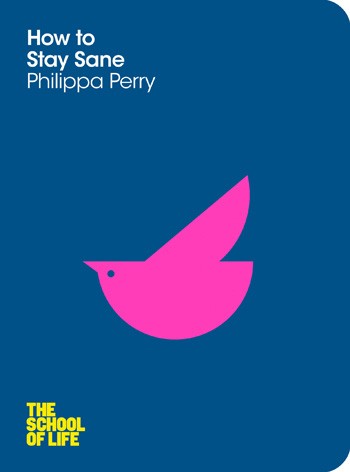
“[I] pray to Jesus to preserve my sanity,” Jack Kerouac professed in discussing his writing routine. But those of us who fall on the more secular end of the spectrum might need a slightly more potent sanity-preservation tool than prayer. That’s precisely what writer and psychotherapist Philippa Perry offers in How To Stay Sane (public library; UK), part of The School of Life’s wonderful series reclaiming the traditional self-help genre as intelligent, non-self-helpy, yet immensely helpful guides to modern living.

At the heart of Perry’s argument — in line with neurologist Oliver Sacks’s recent meditation on memory and how “narrative truth,” rather than “historical truth,” shapes our impression of the world — is the recognition that stories make us human and learning to reframe our interpretations of reality is key to our experience of life:

Our stories give shape to our inchoate, disparate, fleeting impressions of everyday life. They bring together the past and the future into the present to provide us with structures for working towards our goals. They give us a sense of identity and, most importantly, serve to integrate the feelings of our right brain with the language of our left.

[…]

We are primed to use stories. Part of our survival as a species depended upon listening to the stories of our tribal elders as they shared parables and passed down their experience and the wisdom of those who went before. As we get older it is our short-term memory that fades rather than our long-term memory. Perhaps we have evolved like this so that we are able to tell the younger generation about the stories and experiences that have formed us which may be important to subsequent generations if they are to thrive.

I worry, though, about what might happen to our minds if most of the stories we hear are about greed, war and atrocity.

Perry goes on to cite research indicating that people who watch television for more than four hours a day see themselves as far more likely to fall victim in a violent incident in the forthcoming week than their peers who watch less than two hours a day. Just like E. B. White advocated for the responsibility of the writer to “to lift people up, not lower them down,” so too is our responsibility as the writers of our own life-stories to avoid the well-documented negativity bias of modern media — because, as artist Austin Kleon wisely put it, “you are a mashup of what you let into your life.” Perry writes:

Be careful which stories you expose yourself to.

[…]

The meanings you find, and the stories you hear, will have an impact on how optimistic you are: it’s how we evolved. … If you do not know how to draw positive meaning from what happens in life, the neural pathways you need to appreciate good news will never fire up.

[…]

The trouble is, if we do not have a mind that is used to hearing good news, we do not have the neural pathways to process such news.

Yet despite the adaptive optimism bias of the human brain, Perry argues a positive outlook is a practice — and one that requires mastering the art of vulnerability and increasing our essential tolerance for uncertainty:

You may find that you have been telling yourself that practicing optimism is a risk, as though, somehow, a positive attitude will invite disaster and so if you practice optimism it may increase your feelings of vulnerability. The trick is to increase your tolerance for vulnerable feelings, rather than avoid them altogether.

[…]

Optimism does not mean continual happiness, glazed eyes and a fixed grin. When I talk about the desirability of optimism I do not mean that we should delude ourselves about reality. But practicing optimism does mean focusing more on the positive fall-out of an event than on the negative. … I am not advocating the kind of optimism that means you blow all your savings on a horse running at a hundred to one; I am talking about being optimistic enough to sow some seeds in the hope that some of them will germinate and grow into flowers.

Another key obstruction to our sanity is our chronic aversion to being wrong, entwined with our damaging fear of the unfamiliar. Perry cautions:

We all like to think we keep an open mind and can change our opinions in the light of new evidence, but most of us seem to be geared to making up our minds very quickly. Then we process further evidence not with an open mind but with a filter, only acknowledging the evidence that backs up our original impression. It is too easy for us to fall into the trap of believing that being right is more important than being open to what might be.

If we practice detachment from our thoughts we learn to observe them as though we are taking a bird’s eye view of our own thinking. When we do this, we might find that our thinking belongs to an older, and different, story to the one we are now living.

Perry concludes:

We need to look at the repetitions in the stories we tell ourselves [and] at the process of the stories rather than merely their surface content. Then we can begin to experiment with changing the filter through which we look at the world, start to edit the story and thus regain flexibility where we have been getting stuck.

Complement How To Stay Sane with radical psychoanalyst Wilhelm Reich’s 1948 list of the six rules for creative sanity.

shilpa ray with nick cave and warren ellis – pirate jenny

My favourite version of this Weill/Brecht classic, ever.

“Pirate Jenny” (German: “Seeräuberjenny”) is a well-known song from The Threepenny Opera by Kurt Weill, with lyrics by Bertolt Brecht. The English lyrics are by Marc Blitzstein. This cover by Shilpa Ray, Nick Cave and Warren Ellis was published in February 2013 on Sons of Rogues Gallery: Pirate Ballads, Sea Songs and Chanteys, a Hal Willner-produced compilation album of songs performed by a roster of artists which also includes Tom Waits, Shane MacGowan, Iggy Pop, Patti Smith, Macy Grey, Johnny Depp, Frank Zappa and Richard Thompson.

dirty girls

Shot in 1996 and edited in 2000, this is a short documentary about a group of 13-year-old riot grrrls who were socially ostracized at school by their peers and upperclassmen. Everyone in the schoolyard held strong opinions about these so-called “dirty girls,” and meanwhile the “dirty girls” themselves aimed to get their message across by distributing their zine across campus. Directed by Michael Lucid. Music: “Batmobile” by Liz Phair.

videodrome (david cronenberg, 1983)

The full movie is here:

(or was…)

Archival interview with David Cronenberg from Bombsite (1986)

Bette Gordon (BG) Are your nightmares like your movies? Do you actually see your movie images in your dreams?

David Cronenberg (DC) Rarely. My images come out of the process of making film. I do really think that movies work on the level of dream logic. However realistic or narrative they might like to think they are, they are dreamlike.

BG You, as a director, have an incredible ability to tap into the unconscious.

DC I was once on a talk show with a psychiatrist who worked at the Clark Institute with criminals. He had seen my film, Videodrome and said to me, “I’m almost afraid to be sitting here next to you.” He was totally mystified as to how I could empathize with those states of mind and he obviously, could not. It is mostly intuitive with me. One of the reasons I make a movie is that I’m then in a position where I have to analyze and I enjoy that process.

BG In They Came from Within there was a line of dialogue—”Man thinks too much, he’s lost touch with the body, with instincts. Too much brain and not enough guts.” Do you think the mind is stronger than the body?

DC No. I think the quote is particular to that film. What interests me is the mind/body schism.

BG What do you mean by mind/body schism?

DC I think the mind grows out of the body. I don’t believe in an afterlife. I don’t see the mind or the spirit or the soul continuing after our body dies. The mind and body are completely dependent and interrelated. The mind is somehow organic and physical. It’s only our perception and our culture that keeps them separate.

BG What about the mind creating its own monsters in a sense, that the monster comes from within the mind. Like in Dead Ringers for example, or in Videodrome where it’s the mind that is completely in charge of the body.

DC In as much as the mind is ever in charge of anything. I don’t think it is always in control.

BG Or in Scanners where through mind control, you can . . .

DC Affect the body. But you see, I think everybody does that. I don’t think it’s just Western culture, other cultures even accentuate it more by saying the body’s nothing; it’s only temporary and the mind and the spirit are eternal. I think that’s very destructive. It’s not true. All philosophical, metaphysical and religious forces should be concentrating on trying to form a perception and reality for ourselves that integrates the two. And that would include coming to terms with death as a physical event rather than trying to evade it.

BG So how would you come to terms with death?

DC There’s a Japanese religion that thinks of all of life as a preparation for death, which to the Western mind seems like a very morbid approach to life. But if you think of death as a true end of something, of a process, it makes perfect sense. There we get into the old idea of Western culture being death denying, but I actually think Eastern culture is too. Because they try to trivialize death as being not important.

BG So it falls somewhere between the two as being very important and not important at all.

DC One of the main subjects of all of my films is exactly that. In Dead Ringers you get a body split into two (the twins) with basically, one mind. Just doing that is like an experiment in a lab—which all my movies really are. I set out to see how they work, to illuminate something for myself by doing these experiments.

Videodrome – with James Woods and Debbie Harry

BG There is something about the medical profession in all of your films.

DC Scientists and doctors to me, are at the leading edge of what all human beings do all of the time; which is to change, everything. We’ve never been satisfied with what we’re given. We don’t accept the earth as a given. We change our body chemistry, our physiology, our biology, our biochemistry. We clear the forest, we build our own environment, we climate control it . . . And, the interface between that impulse and the human body often is doctors, biologists, and biochemists.

BG Were you a biochemist?

DC I did go into biochemistry at the University of Toronto. But when I came face to face with what science required, I realized that my temperament was much more suited to some form of art; writing or whatever. I didn’t think of film at the time. I found I would prefer to invent my own science rather than spend two years with rats in a lab getting results.

BG There’s an ambivalence for the medical/science profession in all of your films. You don’t really have villains in the film, nobody’s quite evil . . .

DC That’s right. It is ambivalence. Because I think that they’re heroic even when they’re crazed. I think that being crazed and obsessed is part of being heroic. You don’t get one without the other. Ambition is something else. It’s not ambition in the material sense. My characters are obsessed with discovery and that does excite me and I do identify with that. A good creative scientist is as good as a good creative artist. No question in my mind.

BG What is your notion of the hero? You said your characters are heroic even when they are crazed.

DC Yes, maybe even especially because they’re crazed. I’m obviously drawn to people as main characters who are not embedded so completely in their culture that they can’t see any . . . a visionary’s process . . . people who are jarred into being outside. Continue reading

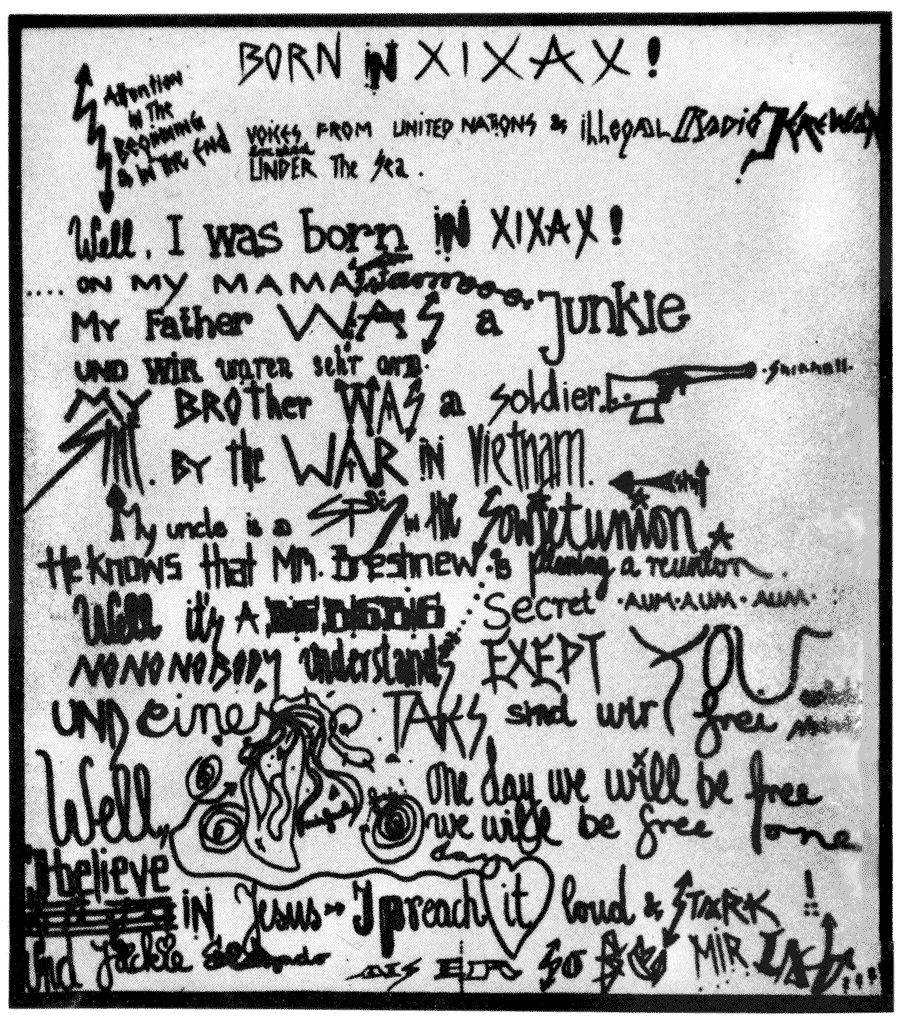
nina hagen – born in xixax (1982)

xixax

This is again radio Yerevan with… our news (claps)
Oh, I’m sorry, you should turn on the machine
This is radio Yerevan, (laughs)
my name is Hans Ivanovich (laughs) Hagen and this is…
The news (laughs)
Continue reading

fugazi – epic problem

From The Argument (2001).

congratulations. stop. wish i could be there. stop. tell me something i don’t know.
is there anything left to know? stop. stop. stop. stop. stop.
accessory, accessory, accessory, accessory, accessory, accessory
we regret to inform. stop. miss you dearly, signed sincerely. stop.
tell me something that i don’t know is there anything left to know?
stop. stop. stop. stop. stop. accessory, accessory, accessory, accessory, accessory, accessory to the time. time. time. time.

i’ve got this epic problem; this epic problem’s not a problem for me
and inside i know i’m broken, but i’m working as far as you can see
i’ve got this epic problem this epic problem’s not a problem for me
and inside i know i’m broken but i’m working as far as you can see
and outside it’s all production; it’s all illusion, it’s set scenery
i’ve got this epic problem; this epic problem’s not a problem for me

woman, object, corpse: killing women through media

Linda Stupart wrote this about Reeva Steenkamp, and also the YOU DECIDE billboard and corpses and objects and women.

Linda Stupart's avatarAfrica is a Country (Old Site)

Since Valentine’s Day everyone has been talking about the murder of Reeva Steenkamp, although rarely in those terms. We know that her boyfriend, Oscar Pistorius, shot her four times and killed her while she was behind a locked door in their bathroom in a gated estate. We know that he has a history of domestic violence, a penchant for shooting things. We know absolutely everything about his extensive sporting achievements. The main thing, however, that we know about Steenkamp is that she was a model, and that she was really hot. 

View original post 1,866 more words

missing, forever

missing cat head

I made this poster in reference to this one, but the events it describes are entirely true. My cat’s head was never found. That night, I think I lost a part of me too, though I didn’t realise it at the time: the part that trusted and expected people who said they loved me not to hurt me intentionally.

What made me realise how this all fitted together was a chain status update game that went around on Facebook a few weeks ago. My answers to the questions went like this:

Age I was given: 17 (I balked because it was a very heavy year for me, but here goes…)
Where I lived: Waterfall, a village in KZN a little north of the Comrades Marathon route, through the sugarcane fields (which are now Tuscan townships).
What I did: Wrote matric with the help of regular immunoglobulin injections and reflexology to stave off the Chronic Fatigue Syndrome/M.E.that I’d been severely ill with since 14 when I’d contracted Glandular Fever. Spent a lot of my study time taping songs off the radio. Went to Turkey on short term Rotary Exchange after finishing school.
Who had my heart: My cat, Jorgy, who had been my constant companion throughout my illness. He was killed while I was in Turkey. I’d broken up with my first boyfriend during matric trials – I couldn’t handle his obsessive, controlling demands for attention. He turned stalker on me, hanging around outside my house, phoning all the time, sending letters threatening suicide, warning me that I would be sorry if “I left him” and went to Turkey. A day or two before I got back, my family found the headless body of our beloved Jorgensen Fassbinder Kittyman Von Streichen Hashimoto Lighoré at the bottom of the garden, tossed over the fence. I wish I was making this up.

Age I am now: 34
Where I live: Oranjezicht, Cape Town
What I do: I excel at giving too much of a shit.
Who has my heart: My heart is a hot potato.
__
The shadow of this manifested down the years in relationships with a string of men who were deliberately unkind and dismissive to me too often; with me always holding on too long because I mistakenly identified their cruelty or disloyalty as evidence of their love for me in spite of what they judged to be my shortcomings. At the darkest junctures over those years, I actually believed that I might deserve the humiliation, the punishment; that I should be grateful anyone humoured me. If they weren’t critical or manipulative enough, if I didn’t have cause to be outraged by their mistreatment, to defend myself against their accusations, to demand consideration, recognition… then it didn’t feel like they could really care (how twisted is that?).

The men I fell most deeply for were never truly available or fully present, would leave me because they cared more about someone else, or were running for their own damaged reasons. I guess I only felt safe from being smothered when they had one foot outside the door, though I yearned with all my heart to be held unconditionally, the way I held them.

This delusion is broken and I am free of its bonds.

pablo neruda – too many names

32-Eruption

Albane Simon – ‘Eruption’

Mondays are meshed with Tuesdays
and the week with the whole year.
Time cannot be cut
with your weary scissors,
and all the names of the day
are washed out by the waters of night.

No one can claim the name of Pedro,
nobody is Rosa or Maria,
all of us are dust or sand,
all of us are rain under rain.
They have spoken to me of Venezuelas,
of Chiles and of Paraguays;
I have no idea what they are saying.
I know only the skin of the earth
and I know it is without a name.

When I lived amongst the roots
they pleased me more than flowers did,
and when I spoke to a stone
it rang like a bell.

It is so long, the spring
which goes on all winter.
Time lost its shoes.
A year lasts four centuries.

When I sleep every night,
what am I called or not called?
And when I wake, who am I
if I was not I while I slept?

This means to say that scarcely
have we landed into life
than we come as if new-born;
let us not fill our mouths
with so many faltering names,
with so many sad formalities,
with so many pompous letters,
with so much of yours and mine,
with so much signing of papers.

I have a mind to confuse things,
unite them, bring them to birth,
mix them up, undress them,
until the light of the world
has the oneness of the ocean,
a generous, vast wholeness,
a crackling, living fragrance.

anaïs nin on lou andreas-salomé and other remarkably rebellious women

Nin talks fondly about some of her favourite rebellious women, including psychoanalyst Lou Andreas-Salomé (who could hold her own with Rilke, Freud and Nietzsche) and Caresse Crosby, the infamous libertine, anti-war crusader and publisher, about being an artist and exploring psychological worlds, beyond judgement.

the rape of persephone (homeric hymn)

The Rape of Proserpina – Gian Lorenzo Bernini (1622)

I) HAIDES ABDUCTS PERSEPHONE
Homeric Hymn ii to Demeter (abridged) (trans. Evelyn White) (Greek epic circa 7th or 6th B.C.)

“[Demeter’s] trim-ankled daughter whom Aidoneus [Haides] rapt away, given to him by all-seeing Zeus the loud-thunderer. Apart from Demeter, lady of the golden sword and glorious fruits, she was playing with the deep-bosomed daughters of Okeanos and gathering flowers over a soft meadow, roses and crocuses and beautiful violets, irises also and hyacinths and the narcissus, which Gaia made to grow at the will of Zeus and to please Polydektor (the Host of Many), to be a snare for the bloom-like girl – a marvellous, radiant flower. It was a thing of awe whether for deathless gods or mortal men to see: from its root grew a hundred blooms and it smelled most sweetly, so that all wide heaven (Ouranos) above and the whole earth (Gaia) and the sea’s (Thalassa’s) salt swell laughed for joy.

And the girl was amazed and reached out with both hands to take the lovely toy: but the wide-pathed earth yawned there in the plain of Nysa, and the lord, Polydegmon (Host of Many), with his immortal horses sprang out upon her — the Son of Kronos, Polynomos (He who has many names). He caught her up reluctant on his golden car and bare her away lamenting.

Then she cried out shrilly with her voice, calling upon her father, [Zeus] the Son of Kronos, who is most high and excellent. But no one, either of the deathless gods or mortal men, heard her voice, nor yet the olive-trees bearing rich fruit: only tender-hearted Hekate, bright-coiffed, the daughter of Persaios, heard the girl from her cave, and the lord Helios (the Sun), Hyperion’s bright son, as she cried to her father, the Son of Kronos. But he was sitting aloof, apart from the gods, in his temple where many pray, and receiving sweet offerings from mortal men. So he [Haides], that Son of Kronos, Polynomos (of Many Names), Polysemantor (Ruler of Many) and Polydegmon (Host of Many), was bearing her away by leave of Zeus on his immortal chariot – his brother’s child and all unwilling.

And so long as she, the goddess, yet beheld earth and starry heaven and the strong-flowing sea where fishes shoal, and the rays of the sun, and still hoped to see her dear mother and the tribes of the eternal gods, so long hope claimed her great heart for all her trouble… and the heights of the mountains and the depths of the sea ran with her immortal voice: and her queenly mother heard her.

Continue reading

heavens to betsy – my red self/my secret (demo tape, 1992)

Heavens to Betsy was an American indie-punk band formed in Olympia, Washington in 1991. They were part of the DIY riot grrrl movement in the punk rock underground in the early 1990s, and were the first band of Sleater-Kinney vocalist/guitarist Corine Tucker. These two demos are intimate and powerful.

mouchette

Final scene from Robert Bresson’s 1967 film.

“The small town is plagued with alcoholism, marital infidelity, unbridled masculinity, violence, and moral ambivalence. Mouchette’s father and brother, we have already seen, operate by selling liquor on the black market, with complicit police that turn an indifferent eye to a crate left behind. They, like other townsfolk, are paid in shots of alcohol, consumed without speech. Following Sunday mass, the village parishioners leave church and hastily head to the bar before the bells cease to toll. Mouchette’s dying mother has to hide gin from her abusive spouse. Even the town’s interdependent poacher/warden pair, Arsène and Mathieu, bring an end to their cat-and-mouse charade in the woods by sharing a drink from Arsène’s canteen full of gin. The motif of alcohol and its abuse stands as a distinctive mark of the moral decay of Mouchette’s society; however, the corruption of this town is not limited to alcoholism… Indeed, Mouchette’s society is one of extreme decadence and lawlessness, one that is ripe for a scapegoat upon whose back it can collectively discharge the burden of its vice and one from which the victim will gladly depart.”

Read more about the film HERE.

a special message from jimmy rage

jimmy rage01each and every one one of us has a book of narratives, that we read write and become part of. each chapter verse and paragraph tells our stories and as time passes, we become familiar with our own characters and our own cast of characters become familiar with us.

there is the longing, the dreaming, the ambition, the beauty and the ugliness and above all, there is the love.. the love of others, the love of others like self and the love of self..

the hardest part though, is to be and become part of the narrative..beauty.. to not negate from its positivity its validity as a document to the light rays streaming through our windows of hope and courage to go forward.
the sun rises and sets in a distant sky, as trees bend, bow, blow leaves, jingling. we are hushed into our own simplicities, the grace of intelligence..

man woman or child is the subtotal of a life lived and hoped for.. the narrative of distant and close dreams are but moments, in our own being, where we are awake and know and overstand that it is in the power of our being that we learn that our own empowerment is the storehouse.. that we are capable of more than the small parts that make up the whole.

love, romance, career, children are all part of the course of our own destined future, but the inner self, the inner voice is the calling to follow your own path, all love, and in doing so .. this becomes a mantra, a calling even..

jimmy rage02

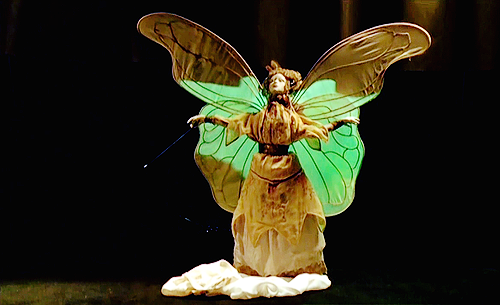
la double vie de veronique

The marionette scene from Krzysztof Kieslowski’s The Double Life of Veronique (1991). Watch the full film HERE.

“The director’s international breakthrough remains one of his most beloved films, a ravishing, mysterious rumination on identity, love, and human intuition. Irène Jacob is incandescent as both Weronika, a Polish choir soprano, and her double, Véronique, a French music teacher. Though unknown to each other, the two women share a mysterious and emotional bond that transcends language and geography, which Kieslowski details in gorgeous reflections, colours, and movements. Aided by Slawomir Idziak’s shimmering cinematography and Zbigniew Preisner’s haunting, operatic score, Kieslowski creates one of cinema’s most purely metaphysical works. The Double Life of Veronique is an unforgettable symphony of feeling.

veronique butterfly

“Krzysztof Kieslowski focuses on identity using actress Irene Jacobs in the dual role of French music teacher Veronique and Polish soprano Weronika – both born on the same day. Metaphysically they are aware of each other’s counterpart – this harkens back to the director’s penchant for fate, chance and circumstance,and we envision a possible meeting of the intertwined souls… Our unspoken desire for a mirrored being – who can non-verbally share our most intimate loves and joys – is the ultimate expression of personal support… Overall, an ambiguous and enigmatic offering, this is a film that clings to you for years after viewing. A true masterpiece of cinema.”
~ Gary W. Tooze

lipstiffie

Facebook status update, this evening:

Storyboarding is strangely interesting when it gives a view into how different nation-states construct and respond to sales stereotypes. I’m doing a lipstick ad for actual French people from Paris right now, and it is noticeably stripped of that subtext one inevitably finds in American or South African ads that says, “Don’t worry, she’s not dangerous and what she really wants is to be your submissive little wifey.” This ad would freeze the testicles off a Sarf-Effriken jock, even though all it’s about is glamour.

It’s odd, because it is all about women achieving an aesthetic perfection so intense they are geisha-like objects of contemplation, yet the glamour is also tangibly an end in itself which doesn’t necessarily include men. It’s not like we don’t already know this, but it brought to my attention that South African culture which considers itself sophisticated is not only colonial but downright rural. Sexuality is confined to breeding, like farmyard-style.

Comments:

Lynne: Sounds like fun for a change! X are you gonna buy the lipstick? X

Lizza: Being briefed for a storyboard doesn’t necessarily go as far as anyone telling me what the product is! This time I needed to be told what it looked like, but I didn’t get the brand. Probably a load of bollocks. For all I know this could be the French version of Sarie magazine – I really wouldn’t be able to spot the difference.

audre lorde on the erotic

The erotic is a resource within each of us that lies in a deeply female and spiritual plane, firmly rooted in the power of our unexpressed or unrecognised feeling…

Of course, women so empowered are dangerous. So we are taught to separate the erotic from most vital areas of our lives other than sex…

The principal horror of any system which defines the good in terms of profit rather than in terms of human need, or which defines human need to exclusion of the psychic and emotional components of that need — the principal horror of such a system is that it robs our work of its erotic value, its erotic power and life appeal and fulfilment. Such a system reduces work to a travesty of necessities, a duty by which we earn bread or oblivion for ourselves and those we love. But this is tantamount to blinding a painter and then telling her to improve her work, and to enjoy the act of painting. It is not only next to impossible, it is also profoundly cruel.

. . . [O]nce we begin to feel deeply all the aspects of our lives, we begin to demand from ourselves and from our life-pursuits that they feel in accordance with that joy which we know ourselves to be capable of. Our erotic knowledge empowers us, becomes a lens through which we scrutinize all aspects of our existence, forcing us to evaluate those aspects honestly in terms of their relative meaning within our lives…

During World War II, we bought sealed plastic packets of white, uncolored margarine, with a tiny, intense pellet of yellow coloring perched like a topaz just inside the clear skin of the bag. We would leave the margarine out for a while to soften, and then we would pinch the little pellet to break it inside the bag, releasing the rich yellowness into the soft pale mass of margarine. Then, taking it carefully between our fingers, we would knead it gently back and forth, over and over, until the color had spread throughout the whole pound bag of margarine, thoroughly coloring it.

I find the erotic such a kernel within myself. When released from its intense and constrained pellet, it flows through and colors my life with a kind of energy that heightens and sensitizes and strengthens all my experience.

Lorde, Audre. “Uses of the Erotic: The Erotic as Power.” Sister Outsider: Essays and Speeches. Freedom, CA: Crossing Press, 1984. 53-59.

danni diana on bogus muthi (and ad agencies)

A year or so ago, some colleagues of mine did a campaign for a film called Night Drive, which was a slashy, schlocky horror that centred on the body-parts-for-muthi trade. The campaign handed out a couple hundred pamphlets, in the style of those ridiculous pamphlets that offer penis enlargement, bad luck cure, womb cleaning etc that we see littered around town every day. The pamphlets offered money for body parts, and linked to a website that detailed the “doctor’s” cash-for-organs trade in more detail. The people who received the pamphlets went ape-shit, calls were made to the national media, everyone was pranked and much outrage ensued. The campaign was slammed by the Department of Health for trivialising a “Serious Problem”, and was pulled, effective immediately, complete with apology from the ad agency in question, and a promise to conduct an “internal disciplinary procedure”.

0141

Pamphlet collected in Durban by Rosemary Lombard, 2009

My question is, what exactly is being done about this serious problem? Why do people get up in arms about a cash-for-body-parts hoax, but think its OK (and hilarious) for there to be pamphlets offering safe abortions, womb cleaning, AIDS cures and a whole manner of sexual health treatment that is not only bogus, but seriously harmful to those who pursue it. What effort is being made by the Department of Health to shut down these “doctors”? Most disturbing is the discriminatory gender ideas at the root of these so called treatments. Muthi to “make lover have sex with you”, and treatment for women for, among other things “cleaner vaginas, more willingness to have sex.”

These charlatan muthi men make a mockery of traditional healing, and the pamphlets and posters not only mislead the poor, vulnerable and uneducated, but reinforce negative stereotypes about traditional healing and the communities that take advantage of them. Is any work being done to address this “Serious Problem”, or do people only care so long as the content of said media panders to savage stereotypes of murderous muthi men lurking in the shadows to chop your heart out?

Pamphlet collected in Durban by Rosemary Lombard, 2009

Pamphlet collected in Durban by Rosemary Lombard, 2009

the raincoats – adventures close to home (1979)

Passion that shouts
Red with anger
I lost myself
Through alleys of mysteries
I went up and down
like a demented train

Don’t take it personal
I choose my own fate
I follow love
I follow hate

Searching for something
that makes hearts move
I found myself
But my best possession
walked into the shade
and threatened to drift away

Don’t take it personal
I choose my own fate
I follow love
I follow hate

For all of myself
I left you behind as if I could
possessed by Quixote’s dream
Went to fight dragons in the land of concrete

Don’t take it personal
I choose my own fate
I follow love
I follow hate

Rolling in pain
discovered what hurts
and tasted hell
infatuated by madness
I danced in flames
and drank in the depth of love

the moscow coup attempt – sprout and the bean

Cover of Joanna Newsom’s song “Sprout and the Bean”, with vocals by Vera Ostrova — sans the shrillness of the original and with a beautiful video — off a 2010 compilation album called Versions of Joanna.

“And as I said, I slept as though dead, dreaming seamless dreams of lead.
When you go away, I am big-boned and fey in the dust of the day, in the dirt of the day.”