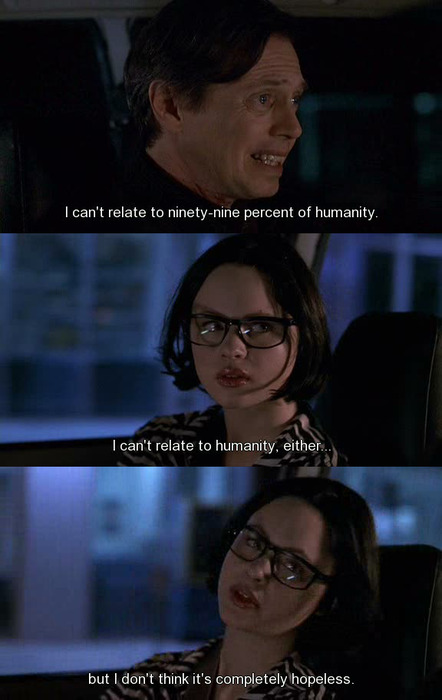
Steve Buscemi (Seymour) and Thora Birch (Enid) in the 2001 film adaptation of Daniel Clowes’ graphic novel, “Ghost World”.
Steve Buscemi (Seymour) and Thora Birch (Enid) in the 2001 film adaptation of Daniel Clowes’ graphic novel, “Ghost World”.
“A personal photography experience for public consumption.”
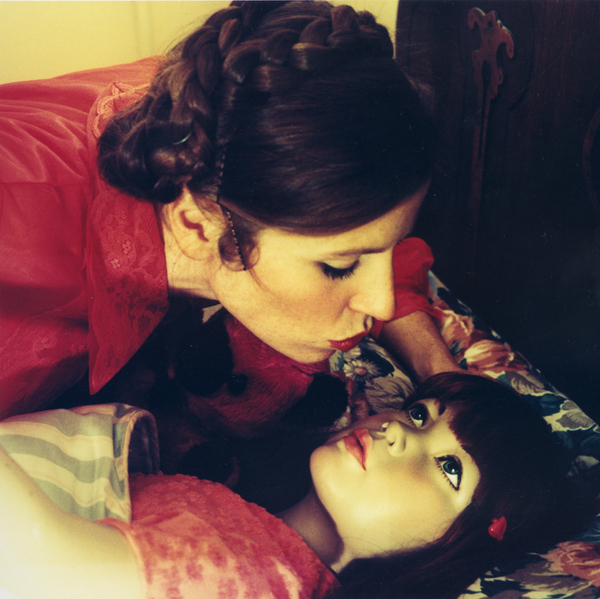
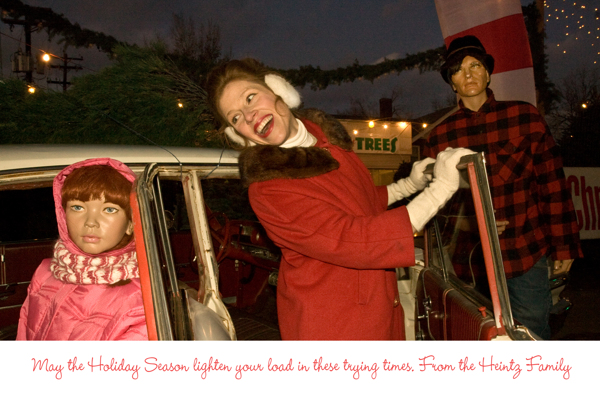
Suzanne Heintz calls herself “the modern day patron saint of single women”. She has the following to say about her ongoing photography project, the wondrously uncanny “Life Once Removed”:
What would drive you to pack a family of mannequins into your station wagon, and take them on a road trip? Enough pressure to conform will send anyone packing. That’s how I came to this personal project about what is essentially…Spinsterhood, and the American Way.
Well-meaning strangers, along with friends and family, would raise an eyebrow when the topic of my unmarried and childless status arose. Indicating with a small facial twitch, not only my audacious freakishness, but that I was a little old for such foolish thinking. I mean, come on, eggs don’t last forever!
But really, what was I supposed to do? You can’t just go out and buy a family. Or can you? I did. They are mannequins. The candy coated shell with nothing inside. We do all those family things, all the while capturing those Kodak Moments. Because it’s not really about the journey, or a genuine human connection, when your kids are screaming, “are we there yet?”, is it? It’s about the picture in front of the sign. “Get back in the car, we got the picture. Now, let’s go eat.”
We love and obey the formatted image of a well-lived life. So deeply ingrained is that strange auto-grin we put on when a camera is present. Do we live our lives with a keen awareness of how it feels, or just how it looks?
If I pass through life without checking off the boxes for a wedding ring and a baby carriage, I will be missing the photo album, but not not the point. When I take my photos, others stop and stare, then they ask, “why are you doing this?” They, at that moment, are starting to get the point too.
Check out more of Suzanne’s fantastical images HERE.

LABEL: ALGA MARGHEN (ITALY)
CATALOG #: ALGA 046LP
RELEASE DATE: 21 JANUARY 2014
Sounds of Silence is an anthology of some of the most intriguing silent tracks in recording history and includes rare works, among others, by Andy Warhol, John Lennon, Maurice Lemaitre, Sly & The Family Stone, Robert Wyatt, John Denver, Whitehouse, Orbital, Crass, Ciccone Youth, Afrika Bambaataa and of course, Yves Klein.
In their own quiet way, these silences speak volumes: they are performative, political, critical, abstract, poetic, cynical, technical, absurd. They can be intended as a memorial or a joke, a special offer, or something entirely undefined. The carefully-chosen silences of this anthology are intrinsically linked to the medium of reproduction itself and reveal its nude materiality. They expose their medium in all its facets and imperfections, including the effect of time and wear. At the most basic level, these silences are surfaces. And it is in their materiality that they distinguish themselves from the conceptual experiments of John Cage with “4’33”.
Since the 1950s, silence has found a place in the economic structure of the record industry and since then it would increasingly be appropriated by a vast array of artists in a vast array of contexts. Indeed, the silent tracks seem to know no boundaries. The LP presents the silences as they were originally recorded, preserving any imperfection that the hardware conferred upon the enterprise, without banning the possibility of being satisfying to the ear. The liner notes provide historical background for each track, revealing the stated (or presumed) motivations for these silences, while providing novel sound correspondences or interferences.
This album is meant to be played loud (or not), at any time, in any place: a true aural experience. Only 250 copies available for distribution, in a gatefold iconic sleeve. ORDER THE LP HERE.
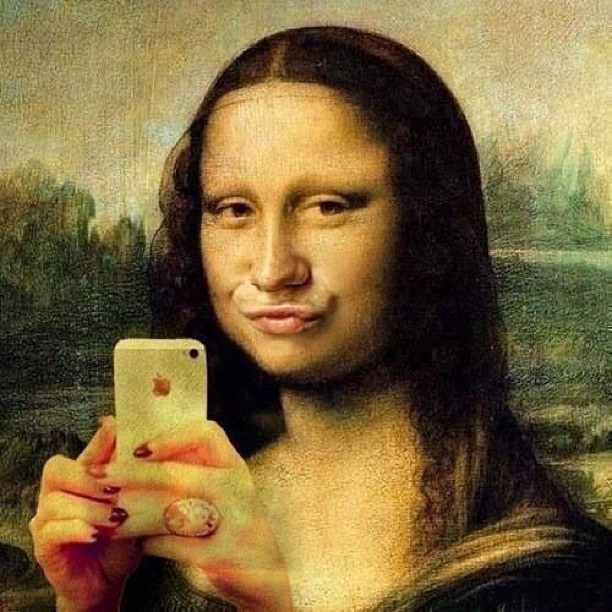
Excerpted from a thoughtful piece by Kayli Stollak, over at Hello Giggles.
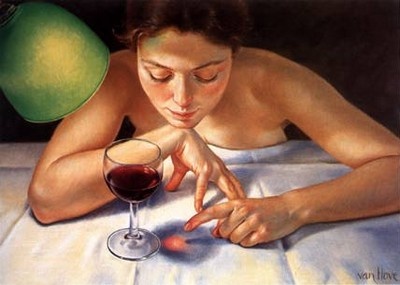
Painting by Francine van Hove
Online we tell a golden version of our lives filled with accomplishments, strictly (and often unbelievably) fun times, and a never-ending well of wit. The glorified digital narrative that we construct of our lives worries me like a 1950’s housewife watching Elvis wiggle his hips on TV. Our modern-day record keeping seems wildly inaccurate to the truth of our inner lives. What is happening in our too-much-information-nation? But more importantly, what is happening with us? Behind all the selfies and sandwich shots, who are we?
In order to correct the imbalance of truth, I propose we start writing it down. We share so much of ourselves with the web, but do we take enough time accounting for our private lives in realm that is removed from the world of likes, comments and followers? The idea of keeping a journal is nothing new, but we’re living in a time where we could benefit from taking a personal inventory of who we are, lest we deceive our future selves through our revisionist digital autobiographies.
While our faces are buried in our phones, we risk missing the smaller details in life. If we don’t remember the bad, how can we possibly enjoy the good to the highest degree? With time, I’m concerned we’ll look back at our Facebook timelines and mistake the façade that we presented of ourselves as fact for who we actually were.
As a writer who spends a large (and probably unhealthy) amount of time writing about herself, I often hear the condemnation of navel gazing. Sure, it is narcissistic to think your life is exciting enough to put to paper, but is it really more self-centered than a side-angled pouty pose of you enjoying your fun-filled Saturday night in the club, posted to Instagram with hopes of garnering likes from your followers, confirming that, yes, you are hot? I would venture to say that the former is self-reflective and productive, while the latter is vapidity and belly-button eagle eye-ing at its worst.
I’m not recommending you go all “dear diary” and start documenting your daily rhythms by laboriously chronicling what you ate for breakfast, the jerk who cut you off on the freeway, or what your plans are for the weekend—if that works for you, do it, but there’s no need to pen a three volume memoir. What I’m championing is the process of jotting down your feelings, thoughts, conversations, inspirations, events that meant something to you now that you might benefit from reflecting on in the future. This is a dose of honesty for you today, in five months, in ten years, at 97. To look back on after your next break up, when you’re contemplating marriage, on your graduation, before a big interview, or simply on a rainy day.
Your notebook should be far from the manicured image you pimp out on Instagram, Facebook, OKCupid, etc. In Joan Didion’s 1966 essay “On Keeping a Notebook”, written before our over-stimulated minds were flooded with technology and its never-ending distractions, she explained, “We are not talking here about the kind of notebook that is patently for public consumption, a structural conceit for binding together a series of graceful pensées, we are talking about something private, about bits of the mind’s string too short to use, an indiscriminate and erratic assemblage with meaning only for its maker.”
For me, a piece of ‘mind string’ is the harmonica chords to ‘Piano Man’ scribbled in my notebook from 2008. A stranger might assume a bizarre Billy Joel fixation, but when I revisit them in my journal, the mess of notes and the triggered sound insist on memories of a motorcycle trip through Spain and feelings of maddening love. All you need is sentence, a word, a thought, and suddenly you remember who you actually were.
If I skip forward in my notebook to 2009 I stumble upon a string of doubts, the point where this love began to unravel. The same way the smell of sunscreen can instantly bring back memories of summer, a list labeled “Pros and Cons” reminds me of the creeping anxiety I felt for planning my future. My Facebook timeline, however, tells a different tale of a giddy girl with bangs who enjoys raves, beaches, and doing the limbo.
Didion advocated for the importance of preserving a part of yourself that in time you can return to. She wrote, “It all comes back. Perhaps it is difficult to see the value in having one’s self back in that kind of mood, but I do see it; I think we are well advised to keep on nodding terms with the people we used to be, whether we find them attractive company or not… We forget all too soon the things we thought we could never forget. We forget the loves and the betrayals alike, forget what we whispered and what screamed, forget who we were.”
Notebooks are fantastic tools for keeping in touch with our former selves that go far beyond the sculpted image we present on the web. I love delving back into my journals from middle school to the present, not because I’m a fan of the person I see there, but rather because I understand the benefit of knowing her.
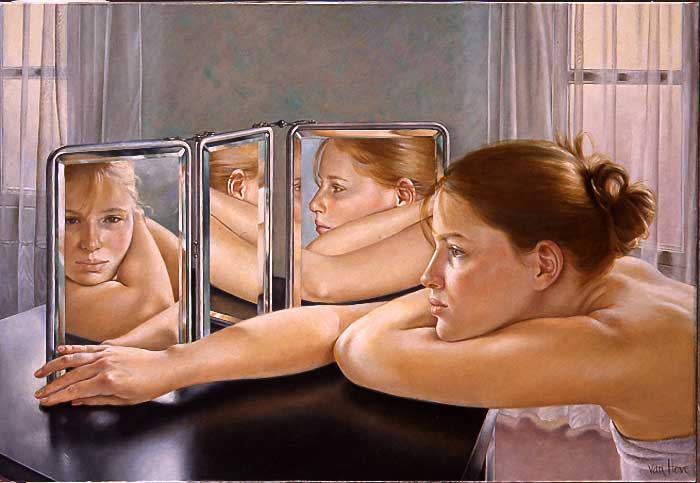
Painting by Francine van Hove
I want to yell at my thirteen year-old self to please take off that padded bra andstop being in such a rush to grow up. I want to hold my fourteen year-old self and explain to her that you are the company you keep and the sooner she starts loving herself the better. I want to bitch slap my sixteen year-old self, she was one angsty girl. I want to tell my seventeen year-old self not to mistake lust for love and to please stop talking to that boy in the band that told you he learned how to play “Brown-Eyed Girl” for you when, in fact, your eyes are green. I want to stay up all night talking to my twenty year-old self, feeding off her energy and drinking up her thirst for spontaneity. I want to see the world through her eyes, she reminds me to believe in magic. I want to whisper in the ear of my twenty-three year-old self, and tell her that soon enough she will see that it really was a means to an end. I want to tell my twenty-five year old self to trust her gut and not settle, I want to remind her what love looks like and tell her that this is not it. But I can’t tell her any of that. All I can do is learn from her mistakes, be reminded of what to hold meaning to, take note of her intuition, celebrate the coincidences, and enjoy all the beautiful moments and connections made.
Although I already know how most of the stories end, it’s important to track the progress I’ve made, reminding me who I am and who I was. To draw my own attention to the larger patterns my tendencies and predilections make when I can see them from a bird’s eye view. A notebook can serve as a wake up call on what I may be rightly or wrongly romanticizing and what I may be purposefully forgetting. Notebooks give us a shot at staying honest and in touch with ourselves, something I think we should strive to be in this digital age.
Read the full article HERE. Thanks to Stella for sharing it.
At last I’ve got around to posting something on Mixcloud again. Here’s a crazy pot-pourri of tunes with a French connection, compiled from selections for a set I played on the Wrong Rock Show back in August 2011.
Listen to Francophonics by Cherry Bomb on Mixcloud.
My sister Heather started crocheting this beautiful blanket at the age of 16 while pregnant with Juliette, spending hours of time in difficult reflection as her friends carried on being carefree teenagers. Heather has finally finished the blanket and handed it to Juliette, now 16 herself, who has also been going through an incredibly hard and painful time lately. Today Heather posted a couple of photographs on Facebook with the following caption:
“Labour of love for my big girl-child. Every stitch was done with you in mind. Tears and love and prayers are woven into the threads, my precious gift from God.”
My heart is swollen.

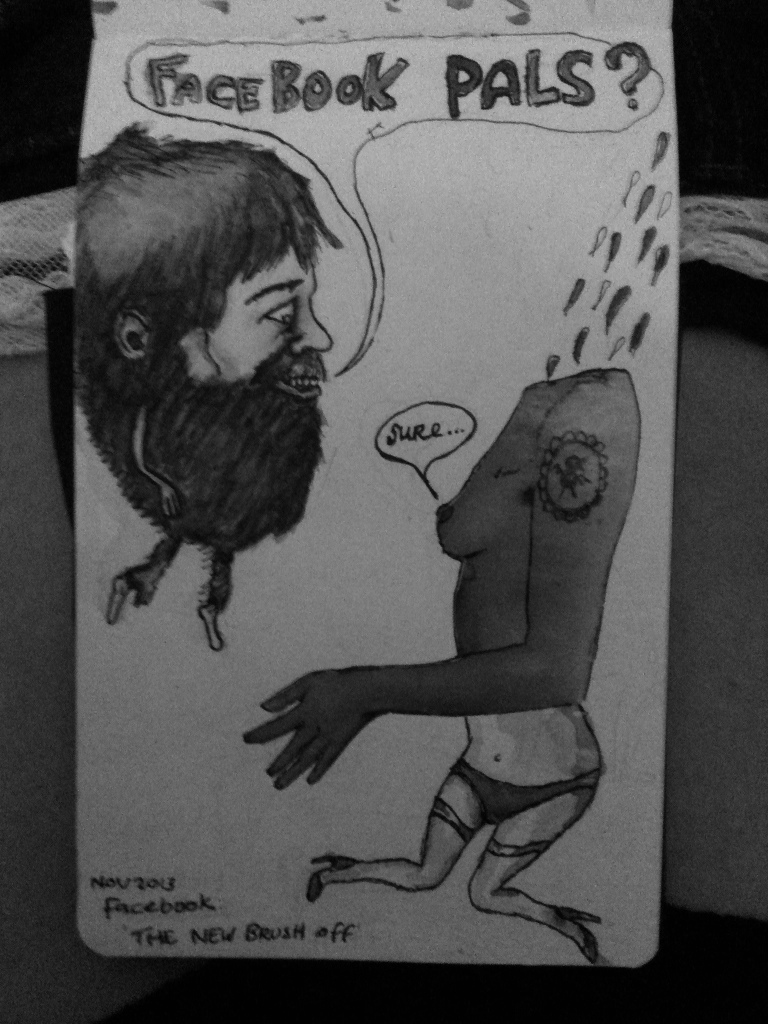
Diary. Nov 2013: Facebook..
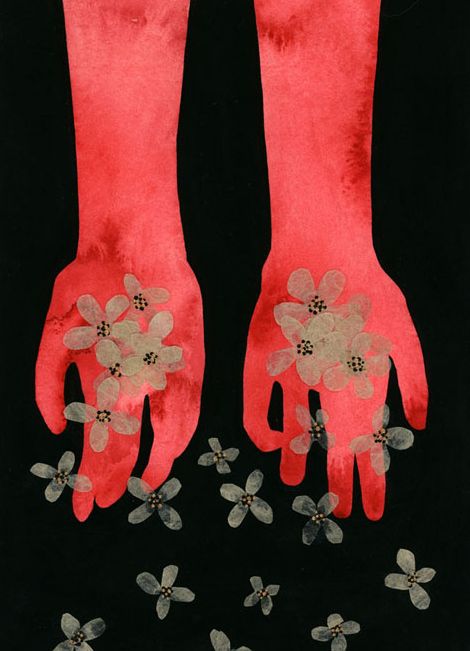
Dan-Ah Kim – Scatter (2013)
Check out more of Dan-Ah Kim’s surreal work HERE.
Rock and Roll Heart traces Lou Reed’s career from the formation of the Velvet Underground to rock icon to his more recent artistic endeavours. Includes lots of rare and vintage footage along with interviews with David Bowie, John Cale, Patti Smith, Thurston Moore, David Byrne, Jim Carroll, Maureen Tucker, Suzanne Vega, Dave Stewart and Philip Glass. Directed by Timothy Greenfield-Sanders for American Masters and screened at the Sundance Film Festival in 1998.
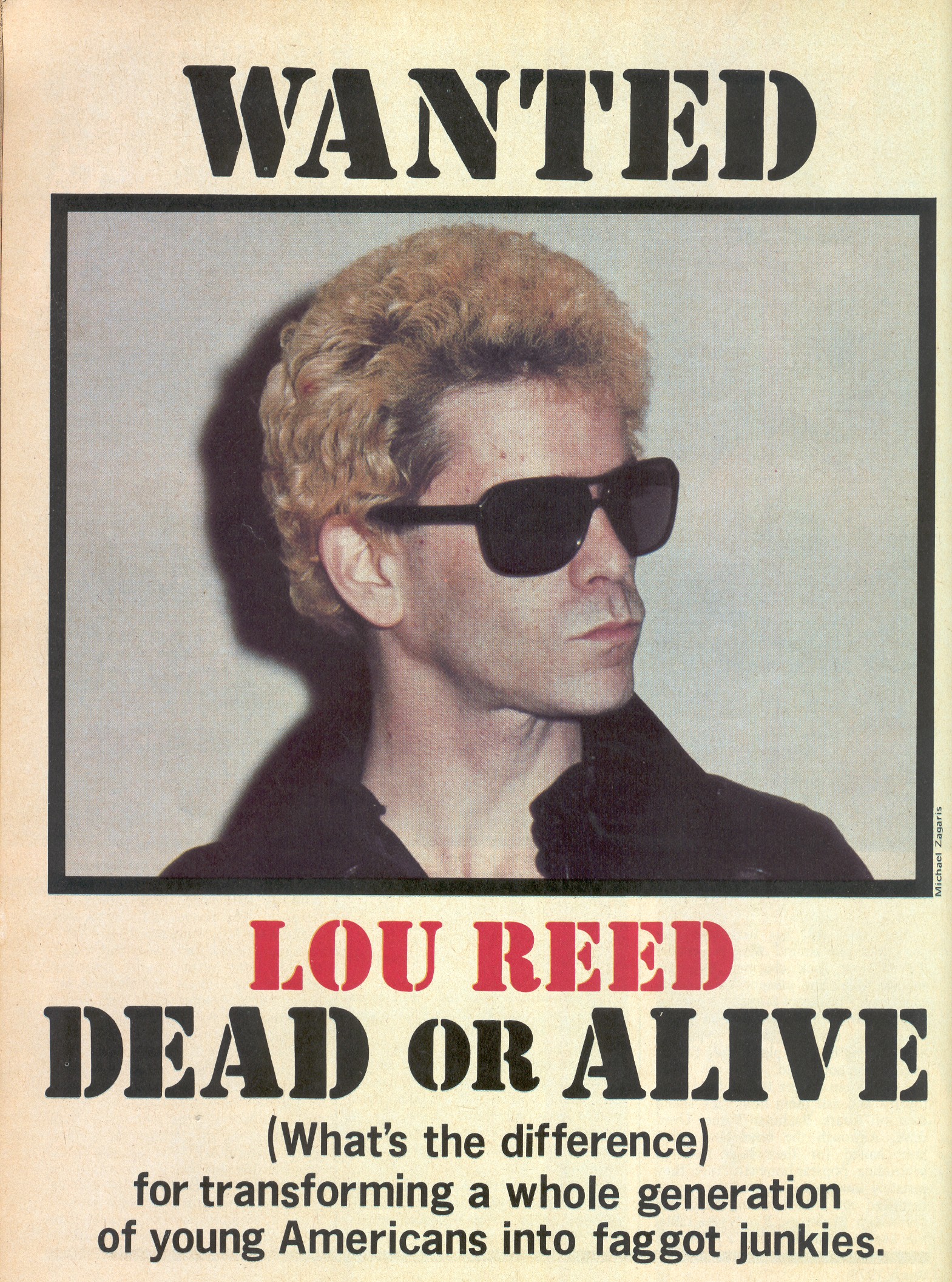
So, so sad to hear Lou is gone. I have no words to begin to describe how influential his work has been to me since I first heard the Velvet Underground at 14.
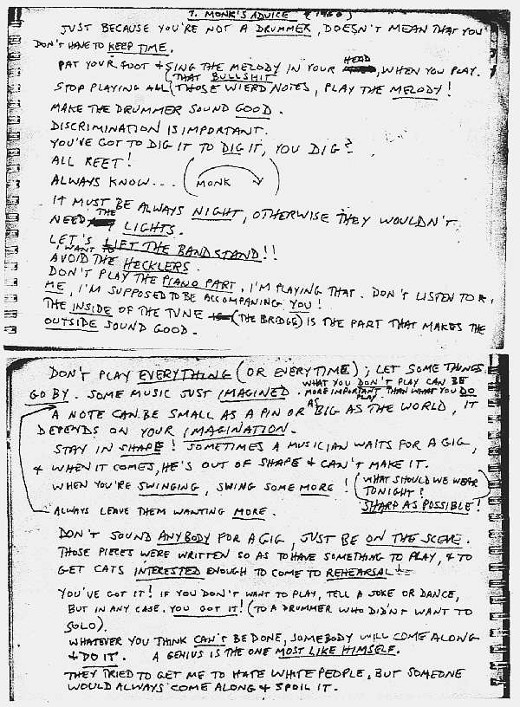
“Don’t play everything (or every time); let some things go by. Some music just imagined. What you don’t play can be more important than what you do.”
Found HERE.
Transcript after the jump. Continue reading
An incredibly lovely and inspiring comic by Bill Watterson (of Calvin and Hobbes fame).

“If you feel you’re standing on solid ground, you’re DEAD.”
— David Bowie, on the creative process
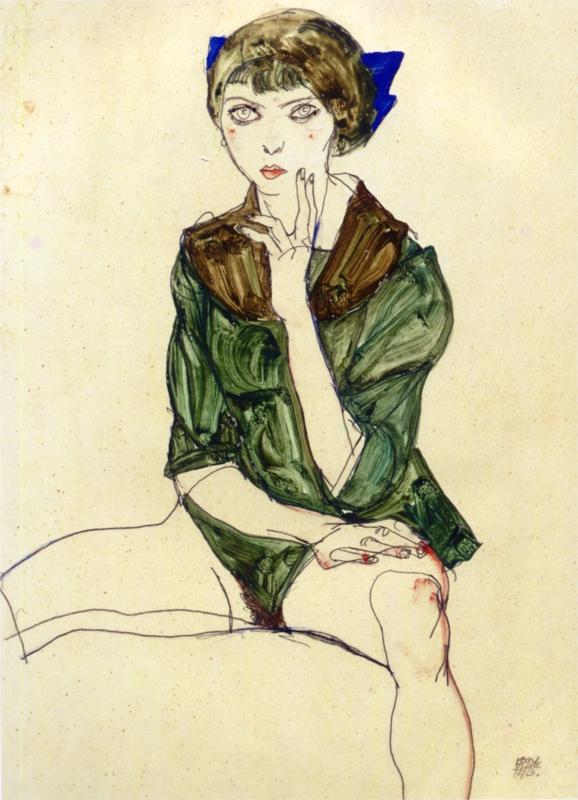
Egon Schiele – Sitting Woman in a Green Blouse. 1913
Truly happy people seem to have an intuitive grasp of the fact that sustained happiness is not just about doing things that you like. It also requires growth and adventuring beyond the boundaries of your comfort zone. Happy people, are, simply put, curious. In a 2007 study, Todd Kashdan and Colorado State psychologist Michael Steger found that when participants monitored their own daily activities, as well as how they felt, over the course of 21 days, those who frequently felt curious on a given day also experienced the most satisfaction with their life—and engaged in the highest number of happiness-inducing activities, such as expressing gratitude to a colleague or volunteering to help others.
Yet curiosity—that pulsing, eager state of not knowing—is fundamentally an anxious state. When, for instance, psychologist Paul Silvia showed research participants a variety of paintings, calming images by Claude Monet and Claude Lorrain evoked happy feelings, whereas the mysterious, unsettling works by Egon Schiele and Francisco Goya evoked curiosity.
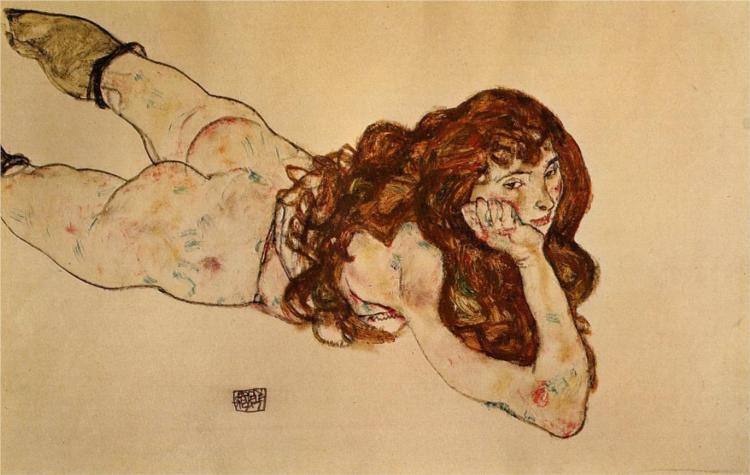
Egon Schiele, 1917
Curiosity, it seems, is largely about exploration—often at the price of momentary happiness. Curious people generally accept the notion that while being uncomfortable and vulnerable is not an easy path, it is the most direct route to becoming stronger and wiser. In fact, a closer look at the study by Kashdan and Steger suggests that curious people invest in activities that cause them discomfort as a springboard to higher psychological peaks.
Of course, there are plenty of instances in life where the best way to increase your satisfaction is to simply do what you know feels good, whether it’s putting your favourite song on the jukebox or making plans to see your best friend. But from time to time, it’s worth seeking out an experience that is novel, complicated, uncertain, or even upsetting—whether that means finally taking the leap and doing karaoke for the first time or hosting a screening of your college friend’s art-house film. The happiest people opt for both so that they can benefit, at various times, from each.
Read the whole article on Psychology Today, HERE.
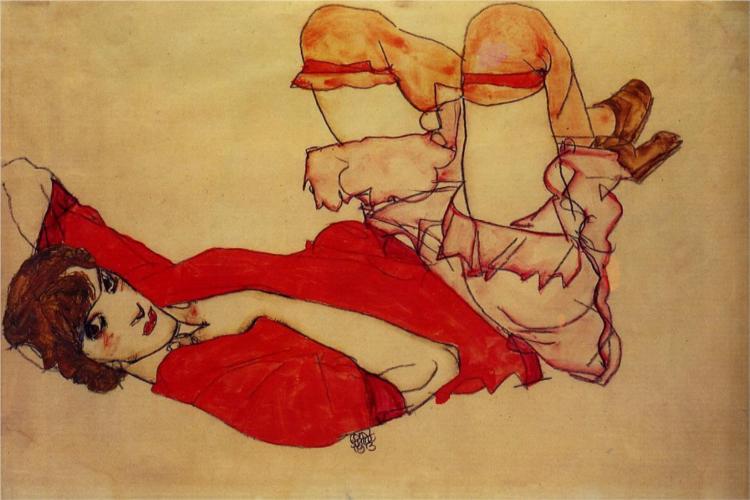
Egon Schiele – Wally with a Red Shirt. c. 1913

Gustav Klimt – “The Three Ages of Woman”
1
There was a time
only certainty gave me
any joy. Imagine —
certainty, a dead thing.
2
And then the world,
the experiment.
The obscene mouth
famished with love —
it is like love:
the abrupt, hard
certainty of the end —
3
In the center of the mind,
the hard pit,
the conclusion. As though
the fruit itself
never existed, only
the end, the point
midway between
anticipation and nostalgia —
4
So much fear.
So much terror of the physical world.
The mind frantic
guarding the body from
the passing, the temporary,
the body straining against it —
5
A peach on the kitchen table.
A replica. It is the earth,
the same
disappearing sweetness
surrounding the stone end,
and like the earth
available —
6
An opportunity
for happiness: earth
we cannot possess
only experience — And now
sensation: the mind
silenced by fruit —
7
They are not
reconciled. The body
here, the mind
separate, not
merely a warden:
it has separate joys.
It is the night sky,
the fiercest stars are its immaculate distinctions–
8
Can it survive? Is there
light that survives the end
in which the mind’s enterprise
continues to live: though
darting about the room,
above the bowl of fruit–
9
Fifty years. the night sky
filled with shooting stars.
Light, music
from far away — I must be
nearly gone. I must be
stone, since the earth
surrounds me —
10
There was
a peach in a wicker basket.
There was a bowl of fruit.
Fifty years. Such a long walk
from the door to the table.
__
From The Seven Ages (Ecco/Harper Collins, 2001)
This short film by Jory Hull was inspired by Kristin Hersh’s live multimedia performance adapted from her memoir, “Rat Girl” published by Penguin.
Thanks to Jamie Taylor for passing this on.
“skin and bones
blood and stones
feathered.”
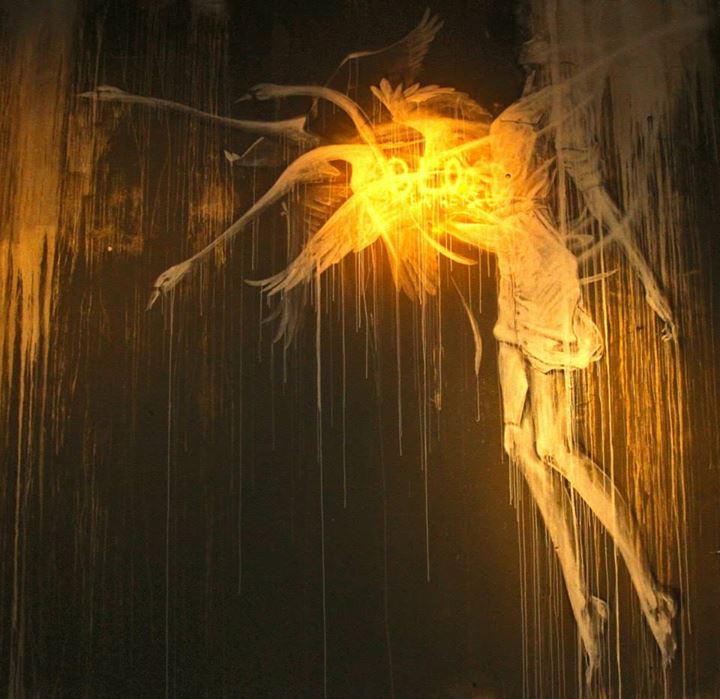
By South African artist Faith47 – NUART, Norway, 2013
Photo: Hendrik Haven
Check out more of Faith47’s beautiful, profound street art and paintings HERE.
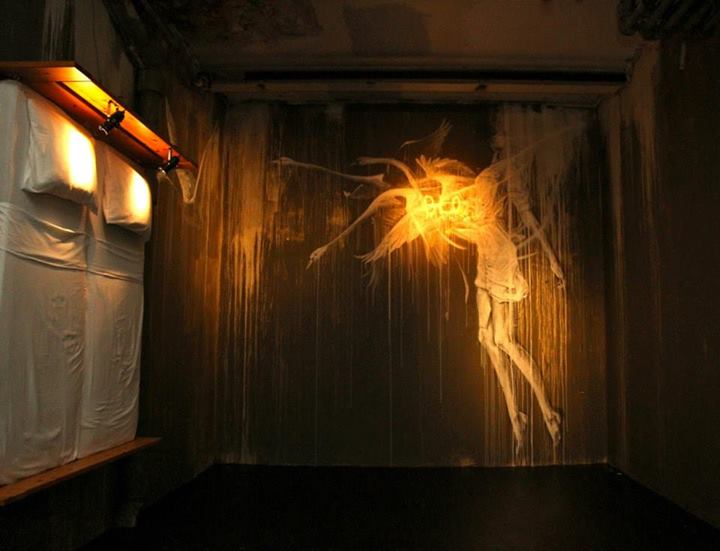
By South African artist Faith47 – NUART, Norway, 2013
Photo: Hendrik Haven
Animation by Steve Cutts, looking at humanity’s relationship with the natural world.
Music: “In the Hall of the Mountain King” by Edvard Grieg.
Trained as a sculptor as well as an animator, Piotr Dumala calls his innovative stop-motion technique in which an image is scratched into painted plaster, then painted over and the next image scratched on top “destructive animation”. He devised the method while studying art conservation at the Warsaw Academy of Fine Arts.
Crime and Punishment (Zbrodnia i Kara), Dumala’s expressionist half-hour long Dostoevsky adaptation, is a succession of shadowy, minimalist tableaux that emerge slowly from darkness and return to it. Stripping the Russian masterwork down to two scenes — the murder and Raskolnikov’s meeting of Sonia — Dumala interprets the novel’s themes with chiaroscuro intensity, choosing to highlight just a few strands of the story:
“It was not my aim to copy the book. I was really close to the book. I took one level of the book. It’s not possible to show everything from this book… This is about love and how obsession can destroy love. In our life we are under two opposite influences to be good or bad and to love or hate.”
In the worlds Dumala sketches, the lines between light and darkness are stark, but also shifting and mutable.
Read more about the background to Dumala and this film in Chris Robinson’s article for Animation World Magazine, HERE.
“Face Deep is an experimental, animated (stop motion) film that allows for a free-flow of thought and exploration of self within an otherwise overly produced, technical and character driven practice. This sequentially photographed film looks at animator as lead character, allowing internal personalities/burning stories to emerge on skin surface whilst a sense of play within the medium is explored.
By listening to the songs of local low-fi Cape Town band Tape Hiss and Sparkle on loop, the raw and honest lyrics/sounds from Simon Tamblyn lead the animator deeper into herself to explore her own raw and honest inner spaces. The film allows one orator to evoke new stories in another orator, and for their different methods of story telling (sound/visual) to co-exist together; sometimes it is another person’s truth that helps us explore our own.”
— Meghan Judge, Simon Tamblyn
More of Meghan’s work is HERE.
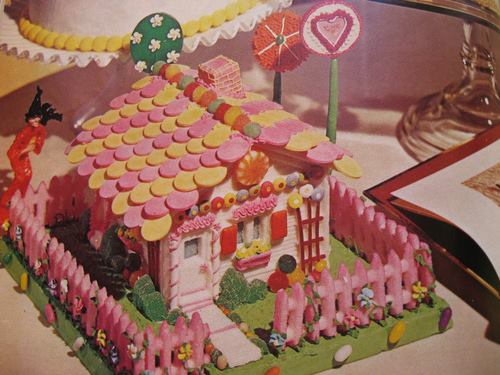

Cake Hotel – by Tate & Lyle
The world’s first “hotel” made entirely from cake is to welcome guests for one night only with room service in the form of vanilla sponge cushions and a hand-stitched meringue rug. The hotel within a hotel in Soho, central London, is the creation of more than 14 artists who spent 2,000 hours baking and 900 hours decorating with more than 600 kilos of sugar.
Guests will be encouraged to eat their way through windows and walls clad with 2,000 macaroons, a rug made from 1,081 meringues hand-stitched together, 20 kilos of marshmallow garlands, windowsills built entirely from fudge and a bath filled with caramel-coated popcorn.
The bedside table even features edible books.
Read more HERE!
Live performance, 28 July 2012, Madrid.
Anyone wanna update this with current news images?

Image: Sarah Sandin
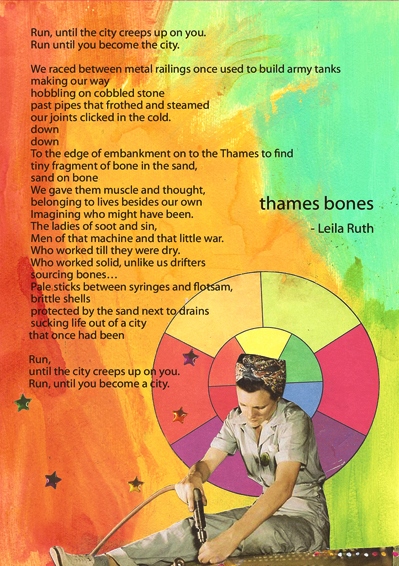
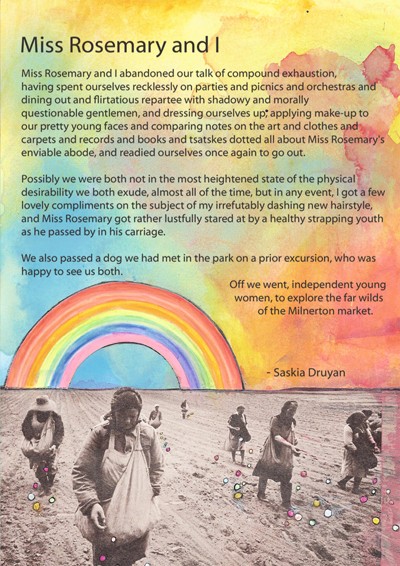 This is a page taken from FLEURZINE, a zine curated and illustrated by Julia Mary Grey. You can go and download this beautiful work of art for free on her site, HERE.
The name was inspired by Fleurmach, and six pieces of writing from this blog appear in the publication!
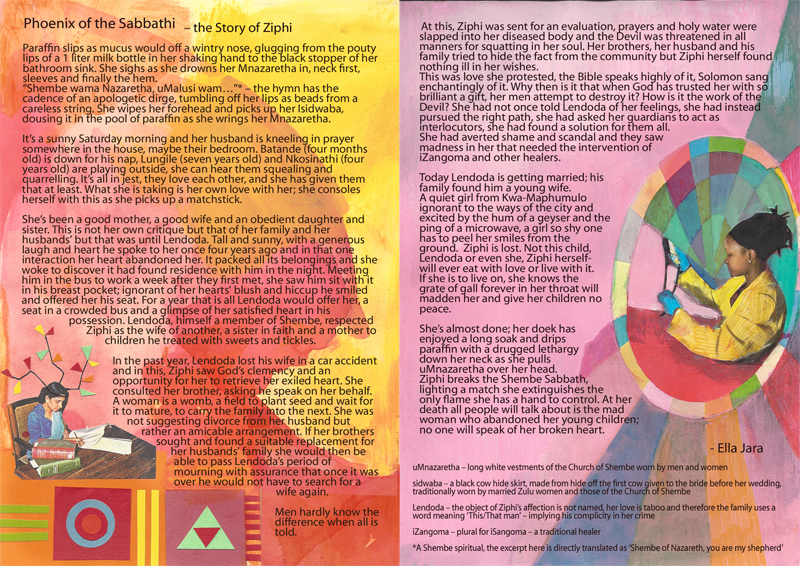
This is a page taken from FLEURZINE, a zine curated and illustrated by Julia Mary Grey. You can go and download this beautiful work of art for free on her site, HERE.
The name was inspired by Fleurmach, and six pieces of writing from this blog appear in the publication.

View from beneath of a woman with an umbrella in the rain. Japanese postcard, late Meiji era, 1908.
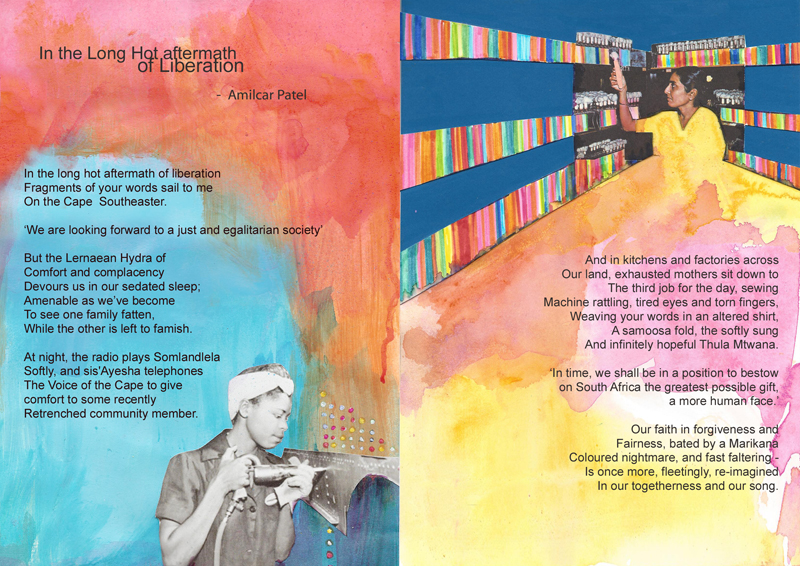
This is a page taken from FLEURZINE, a zine curated and illustrated by Julia Mary Grey. You can go and download this beautiful work of art for free on her site, HERE.
The name was inspired by Fleurmach, and six pieces of writing from this blog appear in the publication. This piece is by Fleurmach contributor NoHolyCows.
 This is a page taken from FLEURZINE, a zine curated and illustrated by Julia Mary Grey. You can go and download this beautiful work of art for free on her site, HERE.
The name was inspired by Fleurmach, and six pieces of writing from this blog appear in the publication!


 fleurmach