fela kuti & egypt 80 – beasts of no nation

This post goes out to FIFA president Sepp Blatter and all the people aligning themselves with various national football teams in the bizarre competitive spectacle that is the FIFA World Cup.

Happening this time round in Brazil, FIFA bleeds yet another host country’s economy dry, with the willing help of its own government – systematic violence, neo-colonial parasitism. Last time it was South Africa’s turn, and the effects are still being felt here.

BeastsOfNoNation

angel olsen – stars

This is one of those songs I have tried to write myself… and then I hear somebody else already has it nailed so articulately. Sucks. In the best way possible.

http://youtu.be/QA9TuQE1jbM

I think you’d like to see me lose my mind
You treat me like a child; I’m angry, blind
I feel so much at once that I could scream

I wish I had the voice of everything

To scream the animals, to scream the earth
To scream the stars out of our universe
To scream it all back into nothingness
To scream the feeling ’til there’s nothing left

I’ll close my eyes
I’ll close my eyes and try to leave the world
Well you could change my mind with just a smile
And just before I turn to leave I think
I could use the thoughts you’ve given me
Oh I could use the thoughts you’ve given me

To sing the animals, to sing the earth
To sing the stars into a universe
To sing it all back into something new
To sing for life, or myself and maybe you

Wish I had the voice of everything, sometimes
Wish I had the voice of everything

laurie anderson – the dream before (for walter benjamin)

http://youtu.be/fWuNEw0EHMc

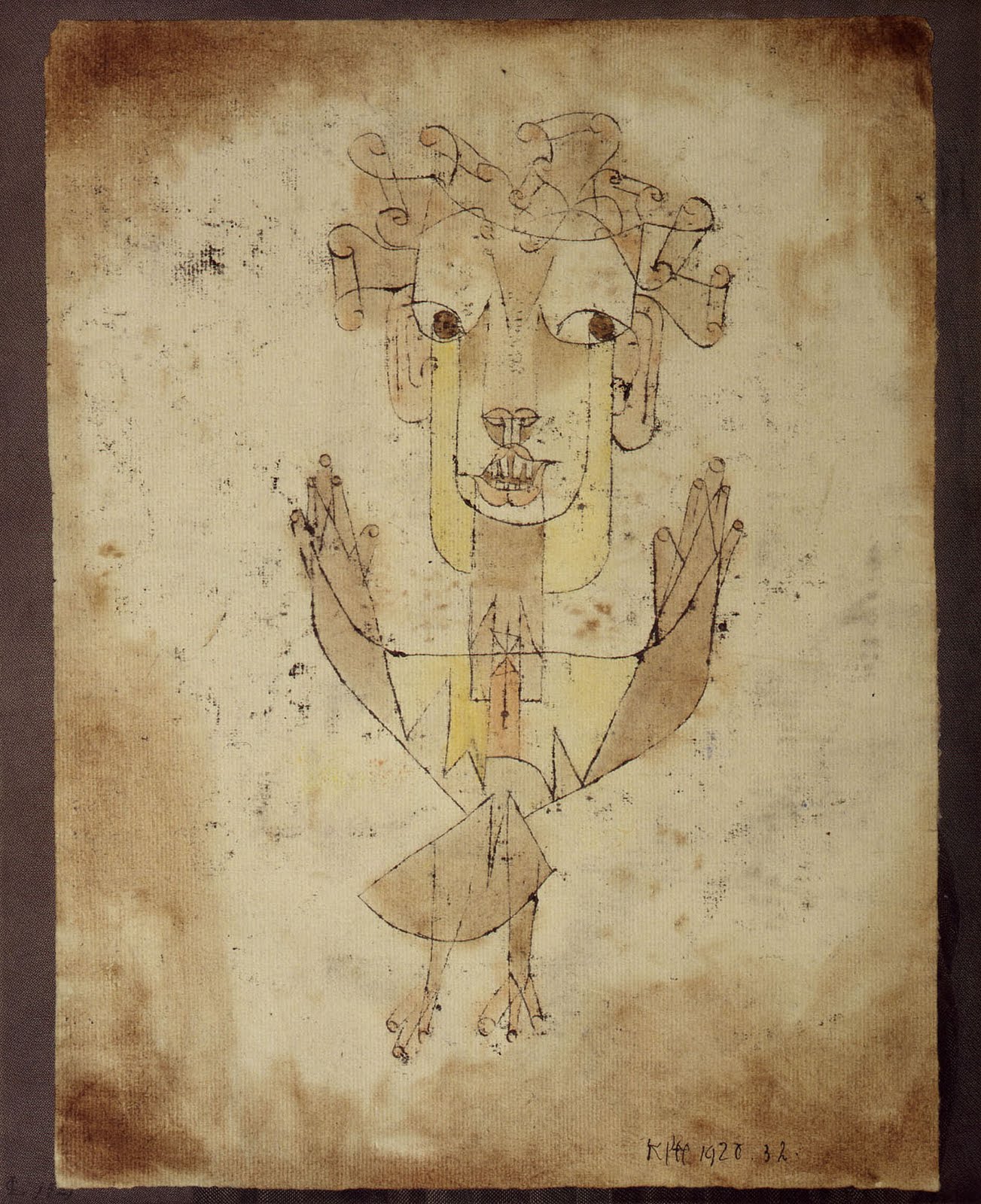
” A Paul Klee painting named Angelus Novus shows an angel looking as though he is about to move away from something he is fixedly contemplating. His eyes are staring, his mouth is open, his wings are spread. This is how one pictures the angel of history. His face is turned toward the past. Where we perceive a chain of events, he sees one single catastrophe which keeps piling wreckage upon wreckage and hurls it in front of his feet. The angel would like to stay, awaken the dead, and make whole what has been smashed. But a storm is blowing from Paradise; his wings are caught in it with such violence that the angel can no longer close them. The storm irresistibly propels him into the future to which his back is turned, while the pile of debris before him grows skyward. This storm is what we call progress.” 

— Walter Benjamin, 1940

paul-klee-angelus-novus

Paul Klee – Angelus Novus (1920)

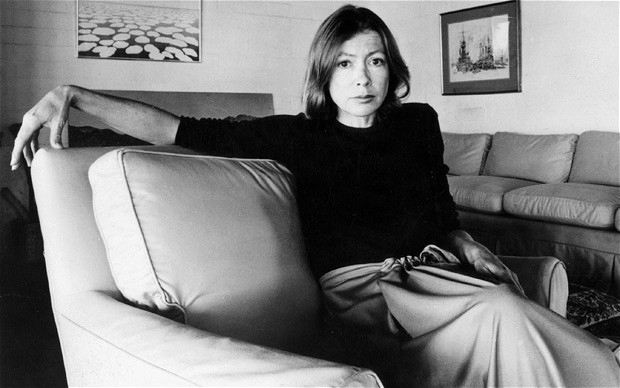
joan didion, interviewed by linda kuehl in 1977

Here are some excerpts from an interview with Joan Didion that appeared in The Paris Review No. 74, Fall-Winter 1978. She talks about the performative violence of writing, and of the sometimes paralysing self-consciousness that attends it.

Reading her responses, I identified so personally that at points it felt like she could have been writing my own thoughts, down to the constrictions of that harsh Protestant ethic. But I’m not as strong as Joan. The nausea tends to silence me… except when it’s overwhelming: then, I vomit it out, sometimes all over unsuspecting passersby!

I especially liked what she says about how growing up in a dangerous landscape can affect one’s engagement with the world. I have often wondered whether I would be at all like I am if I hadn’t grown up in the turmoil of ’80s and ’90s South Africa. It wasn’t just about the weather, here.

Joan Didion, 1977. Photo: REX FEATURES

Joan Didion, 1977. Photo: REX FEATURES

INTERVIEWER

You have said that writing is a hostile act; I have always wanted to ask you why.

JOAN DIDION

It’s hostile in that you’re trying to make somebody see something the way you see it, trying to impose your idea, your picture. It’s hostile to try to wrench around someone else’s mind that way. Quite often you want to tell somebody your dream, your nightmare. Well, nobody wants to hear about someone else’s dream, good or bad; nobody wants to walk around with it. The writer is always tricking the reader into listening to the dream.

INTERVIEWER

Are you conscious of the reader as you write? Do you write listening to the reader listening to you?

DIDION

Obviously I listen to a reader, but the only reader I hear is me. I am always writing to myself. So very possibly I’m committing an aggressive and hostile act toward myself.

INTERVIEWER

So when you ask, as you do in many nonfiction pieces, “Do you get the point?” you are really asking if you yourself get the point.

DIDION

Yes. Once in a while, when I first started to write pieces, I would try to write to a reader other than myself. I always failed. I would freeze up.

INTERVIEWER

You say you treasure privacy, that “being left alone and leaving others alone is regarded by members of my family as the highest form of human endeavor.” How does this mesh with writing personal essays, particularly the first column you did for Life where you felt it imperative to inform the reader that you were at the Royal Hawaiian Hotel in lieu of getting a divorce?

DIDION

I don’t know. I could say that I was writing to myself, and of course I was, but it’s a little more complicated than that. I mean the fact that eleven million people were going to see that page didn’t exactly escape my attention. There’s a lot of mystery to me about writing and performing and showing off in general. I know a singer who throws up every time she has to go onstage. But she still goes on.

INTERVIEWER

Did any writer influence you more than others?

DIDION

I always say Hemingway, because he taught me how sentences worked. When I was fifteen or sixteen I would type out his stories to learn how the sentences worked. I taught myself to type at the same time. A few years ago when I was teaching a course at Berkeley I reread A Farewell to Arms and fell right back into those sentences. I mean they’re perfect sentences. Very direct sentences, smooth rivers, clear water over granite, no sinkholes.

INTERVIEWER

You’ve called Henry James an influence.

DIDION

He wrote perfect sentences, too, but very indirect, very complicated. Sentences with sinkholes. You could drown in them. I wouldn’t dare to write one. I’m not even sure I’d dare to read James again. I loved those novels so much that I was paralyzed by them for a long time. All those possibilities. All that perfectly reconciled style. It made me afraid to put words down.

INTERVIEWER

I wonder if some of your nonfiction pieces aren’t shaped as a single Jamesian sentence.

DIDION

That would be the ideal, wouldn’t it. An entire piece—eight, ten, twenty pages—strung on a single sentence. Actually, the sentences in my nonfiction are far more complicated than the sentences in my fiction. More clauses. More semicolons. I don’t seem to hear that many clauses when I’m writing a novel.

INTERVIEWER

You have said that once you have your first sentence you’ve got your piece. That’s what Hemingway said. All he needed was his first sentence and he had his short story.

DIDION

What’s so hard about that first sentence is that you’re stuck with it. Everything else is going to flow out of that sentence. And by the time you’ve laid down the first two sentences, your options are all gone.

INTERVIEWER

The first is the gesture, the second is the commitment.

DIDION

Yes, and the last sentence in a piece is another adventure. It should open the piece up. It should make you go back and start reading from page one. That’s how it should be, but it doesn’t always work. I think of writing anything at all as a kind of high-wire act. The minute you start putting words on paper you’re eliminating possibilities. Unless you’re Henry James.

INTERVIEWER

I wonder if your ethic—what you call your “harsh Protestant ethic”—doesn’t close things up for you, doesn’t hinder your struggle to keep all the possibilities open.

DIDION

I suppose that’s part of the dynamic. I start a book and I want to make it perfect, want it to turn every color, want it to be the world. Ten pages in, I’ve already blown it, limited it, made it less, marred it. That’s very discouraging. I hate the book at that point. After a while I arrive at an accommodation: Well, it’s not the ideal, it’s not the perfect object I wanted to make, but maybe—if I go ahead and finish it anyway—I can get it right next time. Maybe I can have another chance.

INTERVIEWER

Have any women writers been strong influences?

DIDION

I think only in the sense of being models for a life, not for a style. I think that the Brontës probably encouraged my own delusions of theatricality. Something about George Eliot attracted me a great deal. I think I was not temperamentally attuned to either Jane Austen or Virginia Woolf.

INTERVIEWER

What are the disadvantages, if any, of being a woman writer?

DIDION

When I was starting to write—in the late fifties, early sixties—there was a kind of social tradition in which male novelists could operate. Hard drinkers, bad livers. Wives, wars, big fish, Africa, Paris, no second acts. A man who wrote novels had a role in the world, and he could play that role and do whatever he wanted behind it. A woman who wrote novels had no particular role. Women who wrote novels were quite often perceived as invalids. Carson McCullers, Jane Bowles. Flannery O’Connor, of course. Novels by women tended to be described, even by their publishers, as sensitive. I’m not sure this is so true anymore, but it certainly was at the time, and I didn’t much like it. I dealt with it the same way I deal with everything. I just tended my own garden, didn’t pay much attention, behaved—I suppose—deviously. I mean I didn’t actually let too many people know what I was doing.

INTERVIEWER

Advantages?

DIDION

The advantages would probably be precisely the same as the disadvantages. A certain amount of resistance is good for anybody. It keeps you awake.

INTERVIEWER

What misapprehensions, illusions and so forth have you had to struggle against in your life? In a commencement address you once said there were many.

DIDION

All kinds. I was one of those children who tended to perceive the world in terms of things read about it. I began with a literary idea of experience, and I still don’t know where all the lies are. For example, it may not be true that people who try to fly always burst into flames and fall. That may not be true at all. In fact people do fly, and land safely. But I don’t really believe that. I still see Icarus. I don’t seem to have a set of physical facts at my disposal, don’t seem to understand how things really work. I just have an idea of how they work, which is always trouble. As Henry James told us.

INTERVIEWER

You seem to live your life on the edge, or, at least, on the literary idea of the edge.

DIDION

Again, it’s a literary idea, and it derives from what engaged me imaginatively as a child. I can recall disapproving of the golden mean, always thinking there was more to be learned from the dark journey. The dark journey engaged me more. I once had in mind a very light novel, all surface, all conversations and memories and recollections of some people in Honolulu who were getting along fine, one or two misapprehensions about the past notwithstanding. Well, I’m working on that book now, but it’s not running that way at all. Not at all.

INTERVIEWER

It always turns into danger and apocalypse.

DIDION

Well, I grew up in a dangerous landscape. I think people are more affected than they know by landscapes and weather. Sacramento was a very extreme place. It was very flat, flatter than most people can imagine, and I still favor flat horizons. The weather in Sacramento was as extreme as the landscape. There were two rivers, and these rivers would flood in the winter and run dry in the summer. Winter was cold rain and tulle fog. Summer was 100 degrees, 105 degrees, 110 degrees. Those extremes affect the way you deal with the world. It so happens that if you’re a writer the extremes show up. They don’t if you sell insurance.

Reading the complete interview here: Joan Didion, The Art of Fiction No. 71.

belly – low red moon (slow dust version)

I don’t have a desert island list of records, but if I did, Belly’s Star (4AD, 1993) would almost certainly be on it… and this song is one of my favourites. I’m pretty sure I have posted it before on Fleurmach, so here’s a different, non-album version of this song, featured on the Slow Dust EP (4AD, 1992). It is missing the swells of organ that I love in the Star version. But, as a bonus, there’s a hidden track afterwards, a slowed, elliptical sliver of “Dusted”.

belinda carlisle – la luna

Lunar eclipse with a blood moon tonight…

I remember this song and video came out at the end of my Standard 4 year – the first year I had ever been to a proper teenage “disco” (how scary and thrilling). I remember thinking her thrashing around for the whole song in that bunched-up sheet was silly… And that she was in love with that poncy Amadeus guy was silly too. Lunatics. And yet the chorus would be going round and round in my head for months, entwined with an interminable summer holiday yearning for I-didn’t-quite-know-what. This and the Bangles’ Eternal Flame.

thuli madonsela’s letter to her 16-year-old self

This letter to her 16-year-old self gives insight into Thuli Madonsela‘s life before she became South Africa’s formidable Public Protector – one of the few current SA government office bearers who retain any integrity. Read her report on the misuse of public funds at the private residence of President Jacob Zuma at Nkandla. You can tell between the lines of this letter that she had to learn early in life to be comfortable with making unpopular choices to be able to do the things she believed in.

The following is an extract from From Me to Me: Letters to my 16-and-a-half-year old self (Jacana Media, 2012), a collection of letters written by South Africans to their teenage selves.

26 April 2012

Dear Thuli

thuliIt is April 2012, 5 months before our big 5-0 birthday. I am your future. At the moment, you are 16-and-a half years old, doing grade 11, known as form four then, at Evelyn Baring High School in Swaziland, the year being 1979. You are wondering what you will be, caught between thoughts of pursuing medicine and law. Your pastor’s disapproving views on the latter are not in any way helpful. I know you are socially awkward, plagued by a nagging feeling of being unloved and ugly.

Perhaps this comes from being teased about your big head and, more recently, two of your academically inferior classmates have started taunting you, too. Having two sisters whose beauty is always noticed and praised has not helped either. Secure in your academic prowess – for which you are always praised at home and at school – you are regarded as helpful and relied on by your family, friends, teachers and your church. This makes you feel significant. You will excel, academically, throughout your life and this will bring you to where you are right now. I’m writing to tell you to relax because you are a perfect expression of God’s magnificence.

You are the mother of two wonderful children, a beautiful daughter Wenzile Una and a handsome son Mbusowabantu “Wantu” Fidel. Your fears of being unlovable were unfounded. You have been loved and supported beyond measure throughout your life. Today, you are the nation’s Public Protector – a very responsible position that helps curb excesses in the exercise of public power while enabling the people to exact justice for state wrongs. You had the privilege of playing some role in bringing about change in this country, including the drafting of the new constitution that saw Nelson Mandela become the first black President. Mama was right, education is the great leveler. I’m glad I listened to her.

You have experienced tough times and great times, been met with nurturers and detractors, but all these life lessons have been necessary to help you bloom. You have come to realize that you are perfect for your life’s purpose. You’ve always been a dreamer, an eternal optimist. Keep dreaming, for dreams have wings. But live consciously and take time to smell the roses otherwise life will pass you by, including the opportunity to appreciate the finite precious moments you will enjoy with your late partner, younger sisters and parents.

Above all, remember that love is everything and don’t forget to forgive yourself and others.

Love you unconditionally,

Thuli Nomkhosi Madonsela (Your older Self)

stepan razin’s dream (Казачья Притча)

Oy, to ne vecher” (Ой, то не вечер) is the incipit of a Russian folk song, also known as “The Cossack’s Parable” (Казачья Притча) or as “Stepan Razin’s Dream” (Сон Степана Разина). It was first published by composer Alexandra Zheleznova-Armfelt (1870–1933) in her collection Songs of the Ural Cossacks after her fieldwork in the Ural District during 1896–1897.

The original lyrics were in seven verses, with verse six making explicit that the dreamer is 17th century cossack rebel Stepan Razin. Razin has a dream, and his captain (esaul) interprets it as an omen of their defeat.

The song has been performed in several variants, sometimes expanded to up to eleven verses, but in the most common variant as sung by modern interpreters, it is reduced to four verses, removing the mention of Razin, and reducing the three omens in the dream to a single one.These lyrics may be translated thus:

Ah, it is not yet evening but I have taken a little nap, and a dream came to me. In the dream that came to me, it was as if my raven-black horse was playing about, dancing about, frisky beneath me.  Ah, and evil winds came flying out of the east, and they ripped the black cap from that wild head of mine.

And the esaul* was a clever one, he was able to interpret my dream: “Ah, it will surely come off”, he said, “that wild head of yours”.

Source of information: Wikipedia.

*Esaul: a post and rank in prerevolutionary Russia in the cossack hosts after 1576.

chris marker - staring back

Photo: Chris Marker, “Staring Back”

on melancholia

“Melancholy, being a kind of vacatio, separation of soul from body, bestowed the gift of clairvoyance and premonition. In the classifications of the Middle Ages, melancholy was included among the seven forms of vacatio, along with sleep, fainting, and solitude. The state of vacatio is characterized by a labile link between soul and body which makes the soul more independent with regard to the sensible world and allows it to neglect its physical matrix in order, in some way, better to attend to its own business.”

— Ioan P. Couliano, from Eros and Magic in the Renaissance

inflamed

ExitDeer015

Exit-deer: “He left himself with frightening pace”

“Almost every day I can feel myself suffering mainly in the head, I can explain the pain to myself but knowing it comes from an inflammation of my imagination doesn’t prevent it being reality itself. What’s more I’d be crazy not to go crazy. We don’t know what an illness is. On awful hurts we plaster little old words, as if we could think hell with a paper bandage.”

― Hélène Cixous, Hyperdream

au revoir, alain resnais

“You never seem to be waiting for me, but we kept meeting at every turn of the paths. Behind every bush, at the foot of each statue, near every pond. It is as if it had been only you and I in all that garden.”

 From Last Year at Marienbad, 1961

mon oncle

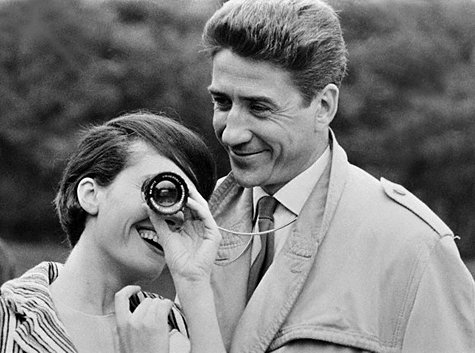
Alain Resnais and Delphine Seyrig on location shooting “Last Year At Marienbad.”

I made this in 2007 (hence the bad Youtube quality – compressed to all hell).

brian eno: imaginary landscapes (1989)

“I thought: I want to make a kind of music that had the long Now and the big Here in it, and for me that meant this idea of expanding the music out to the horizons. In terms of space, you were not aware of the edges of the music. I wanted to make a music where you just wouldn’t know what was music and what wasn’t… a music that included rather than excluded; a music that didn’t have a beginning and an end… This is the sense of making the Now longer.”

A 1989 documentary on Brian Eno’s work in ambient sound.


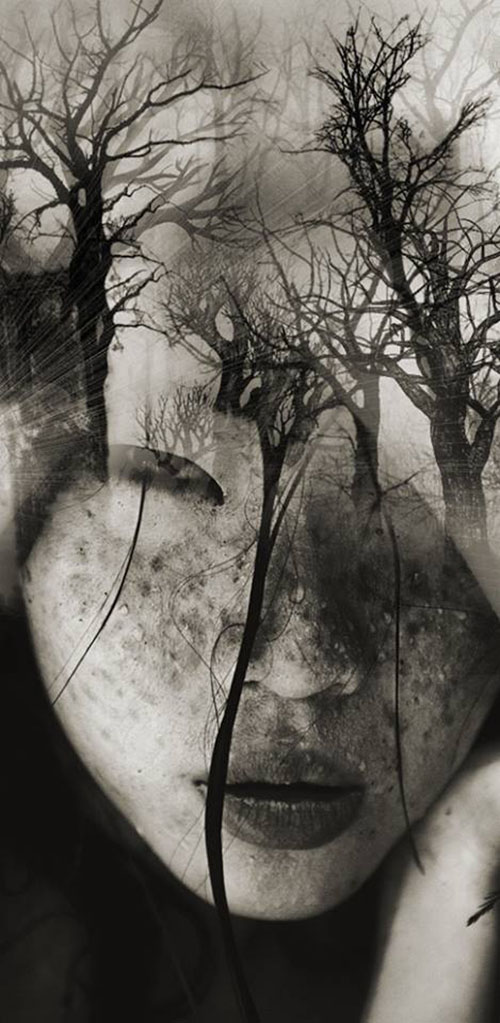
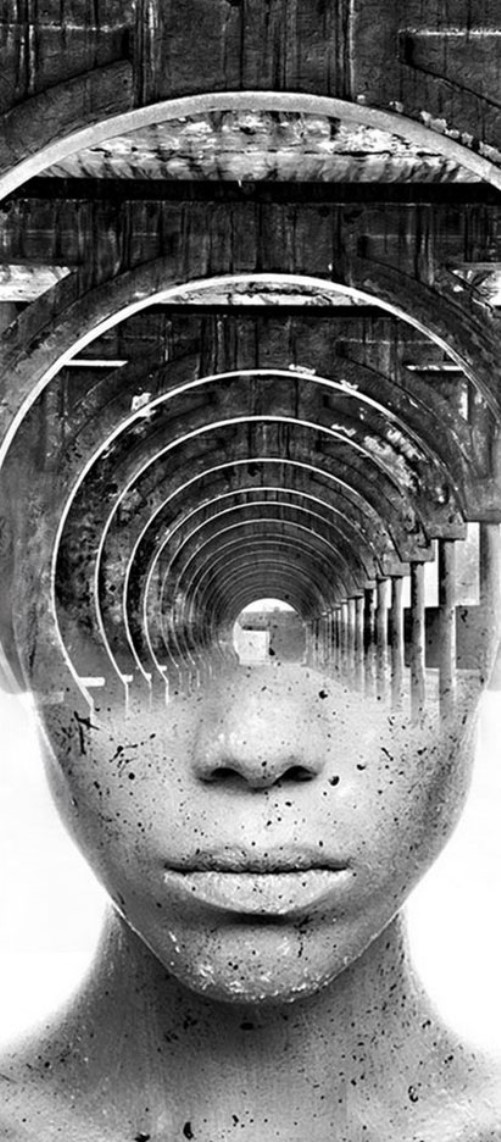
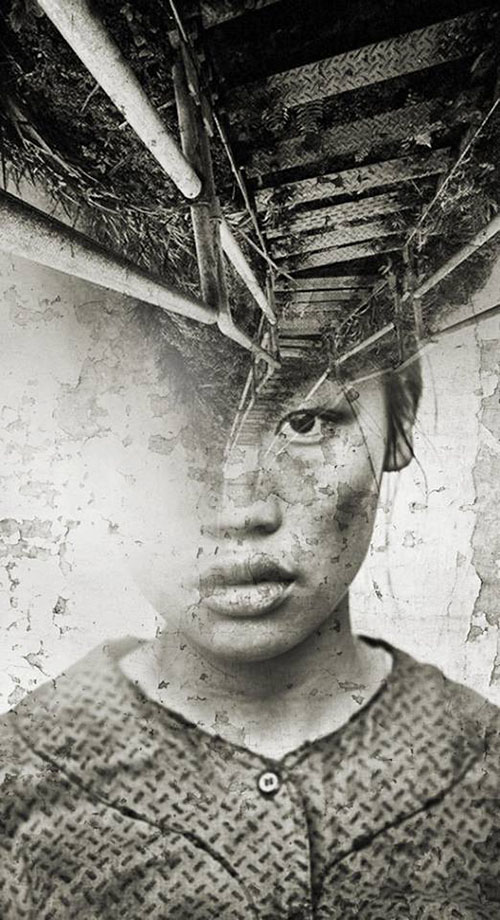
antonio mora – dream portraits

antonio mora 01Spanish artist Antonio Mora is a creative photographer who transforms simple portraits into dreamscapes filled with intriguing emotion. In the series entitled Dream Portraits, the artist blends two elements together to form an elegantly abstract fusion where distinct lines and shapes are no longer evident. The images feature hauntingly beautiful faces that emerge from misty black and white forms like tree branches, rivers, bridges and cloudy skies.

antonio mora 02

antonio mora 04

antonio mora 03

antonio mora 05

roald dahl – the sound machine (1949)

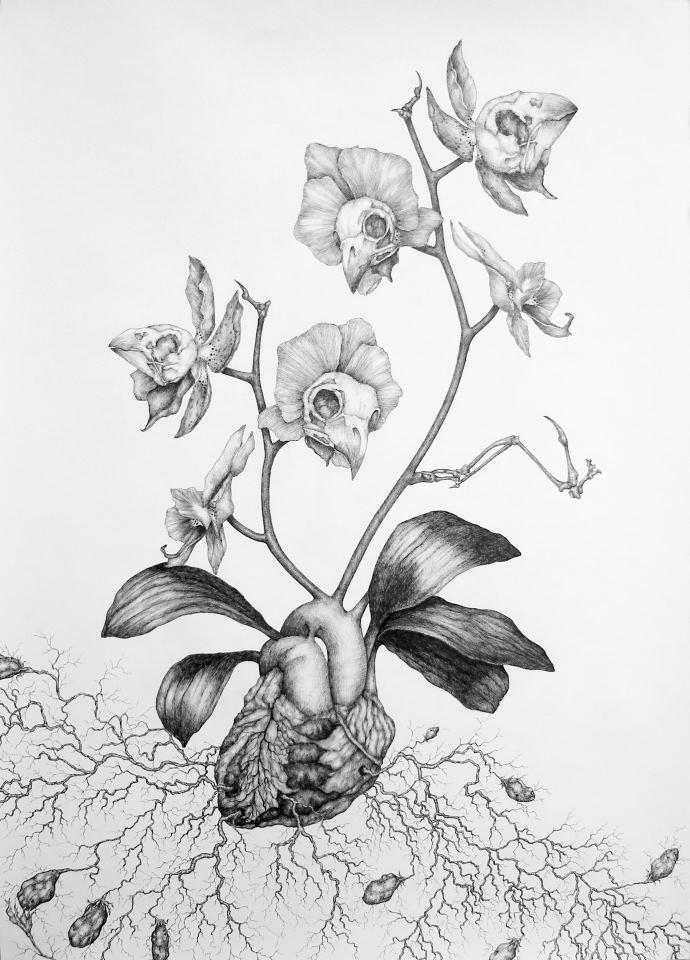
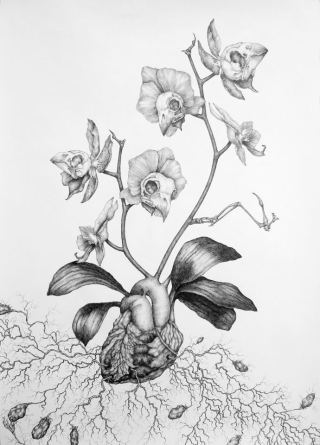
Kate Street - Orchis Nodulosa

Kate Street – Orchis Nodulosa

For a while longer, Klausner fussed about with the wires in the black box; then he straightened up and in a soft excited whisper said, “Now we’ll try again… We’ll take it out into the garden this time… and then perhaps, perhaps… the reception will be better. Lift it up now… carefully… Oh, my God, it’s heavy!”

He carried the box to the door, found that he couldn’t open the door without putting it down, carried it back, put it on the bench, opened the door, and then carried it with some difficulty into the garden. He placed the box carefully on a small wooden table that stood on the lawn. He returned to the shed and fetched a pair of earphones. He plugged the wire connections from the earphones into the machine and put the earphones over his ears. The movements of his hands were quick and precise. He was excited, and breathed loudly and quickly through his mouth. He kept on talking to himself with little words of comfort and encouragement, as though he were afraid–afraid that the machine might not work and afraid also of what might happen if it did. He stood there in the garden beside the wooden table, so pale, small and thin that he looked like an ancient, consumptive, bespectacled child.

The sun had gone down. There was no wind, no sound at all. From where he stood, he could see over a low fence into the next garden, and there was a woman walking down the garden with a flower-basket on her arm. He watched her for a while without thinking about her at all. Then he turned to the box on the table and pressed a switch on its front. He put his left hand on the volume control and his right hand on the knob that moved a needle across a large central dial, like the wavelength dial of a radio. The dial was marked with many numbers, in a series of bands, starting at 15,000 and going on up to 1,000,000. And now he was bending forward over the machine. His head was cocked to one side in a tense, listening attitude. His right hand was beginning to turn the knob.

The needle was travelling slowly across the dial, so slowly he could hardly see it move, and in the earphones he could hear a faint, spasmodic crackling. Behind this crackling sound he could hear a distant humming tone which was the noise of the machine itself, but that was all. As he listened, he became conscious of a curious sensation, a feeling that his ears were stretching out away from his head, that each ear was connected to his head by a thin stiff wire, like a tentacle, and that the wires were lengthening, that the ears were going up and up towards a secret and forbidden territory, a dangerous ultrasonic region where ears had never been before and had no right to be. The little needle crept slowly across the dial, and suddenly he heard a shriek, a frightful piercing shriek, and he jumped and dropped his hands, catching hold of the edge of the table.

He stared around him as if expecting to see the person who had shrieked. There was no one in sight except the woman in the garden next door, and it was certainly not she. She was bending down, cutting yellow roses and putting them in her basket. Again it came–a throatless, inhuman shriek, sharp and short, very clear and cold. The note itself possessed a minor, metallic quality that he had never heard before.

Klausner looked around him, searching instinctively for the source of the noise. The woman next door was the only living thing in sight. He saw her reach down; take a rose stem in the fingers of one hand and snip the stem with a pair of scissors. Again he heard the scream. It came at the exact moment when the rose stem was cut. At this point, the woman straightened up, put the scissors in the basket with the roses and turned to walk away.

“Mrs Saunders!” Klausner shouted, his voice shrill with excitement. “Oh, Mrs Saunders!” And looking round, the woman saw her neighbour standing on his lawn–a fantastic, arm-waving little person with a pair of earphones on his head–calling to her in a voice so high and loud that she became alarmed. “Cut another one! Please cut another one quickly!”

She stood still, staring at him. “Why, Mr Klausner,” she said, “What’s the matter?”

“Please do as I ask,” he said. “Cut just one more rose!”

Mrs Saunders had always believed her neighbour to be a rather peculiar person; now it seemed that he had gone completely crazy. She wondered whether she should run into the house and fetch her husband. No, she thought. No, he’s harmless. I’ll just humour him.

“Certainly, Mr Klausner, if you like,” she said.

She took her scissors from the basket, bent down and snipped another rose. Again Klausner heard that frightful, throatless shriek in the earphones; again it came at the exact moment the rose stem was cut. He took off the earphones and ran to the fence that separated the two gardens. “All right,” he said. “That’s enough. No more. Please, no more.”

The woman stood there, a yellow rose in one hand, clippers in the other, looking at him.”I’m going to tell you something, Mrs Saunders,” he said, “something that you won’t believe.” He put his hands on top of the fence and peered at her intently through his thick spectacles. “You have, this evening, cut a basketful of roses. You have, with a sharp pair of scissors, cut through the stems of living things, and each rose that you cut screamed in the most terrible way. Did you know that, Mrs Saunders?”

“No,” she said. “I certainly didn’t know that.”

“It happens to be true,” he said. He was breathing rather rapidly, but he was trying to control his excitement. “I heard them shrieking. Each time you cut one, I heard the cry of pain. A very high-pitched sound, approximately one hundred and thirty-two thousand vibrations a second. You couldn’t possibly have heard it yourself. But I heard it.”

“Did you really, Mr Klausner?” She decided she would make a dash for the house in about five seconds.

“You might say,” he went on, “that a rose bush has no nervous system to feel with, no throat to cry with. You’d be right. It hasn’t. Not like ours, anyway. But how do you know, Mrs Saunders”–and here he leaned far over the fence and spoke in a fierce whisper, “how do you know that a rose bush doesn’t feel as much pain when someone cuts its stem in two as you would feel if someone cut your wrist off with a garden shears? How do you know that? It’s alive, isn’t it?”

“Yes, Mr Klausner. Oh, yes and good night.”

Quickly she turned and ran up the garden to her house. Klausner went back to the table. He put on the earphones and stood for a while listening. He could still hear the faint crackling sound and the humming noise of the machine, but nothing more. He bent down and took hold of a small white daisy growing on the lawn. He took it between thumb and forefinger and slowly pulled it upward and sideways until the stem broke. From the moment that he started pulling to the moment when the stem broke, he heard–he distinctly heard in the earphones–a faint high-pitched cry, curiously inanimate.

He took another daisy and did it again. Once more he heard the cry, but he wasn’t sure now that it expressed pain. No, it wasn’t pain; it was surprise. Or was it? It didn’t really express any of the feelings or emotions known to a human being. It was just a cry, a neutral, stony cry–a single, emotionless note, expressing nothing. It had been the same with the roses. He had been wrong in calling it a cry of pain. A flower probably didn’t feel pain. It felt something else which we didn’t know about–something called tom or spun or plinuckment, or anything you like.

He stood up and removed the earphones. It was getting dark and he could see pricks of light shining in the windows of the houses all around him. Carefully he picked up the black box from the table, carried it into the shed and put it on the workbench. Then he went out, locked the door behind him and walked up to the house.

The next morning Klausner was up as soon as it was light. He dressed and went straight to the shed. He picked up the machine and carried it outside,clasping it to his chest with both hands, walking unsteadily under its weight. He went past the house, out through the front gate, and across the road to the park.There he paused and looked around him; then he went on until he came to a large tree, a beech tree, and he placed the machine on the ground close to the trunk of the tree.

Quickly he went back to the house and got an axe from the coal cellar and carried it across the road into the park. He put the axe on the ground beside the tree. Then he looked around him again, peering nervously through his thick glasses in every direction. There was no one about. It was six in the morning.He put the earphones on his head and switched on the machine. He listened for a moment to the faint familiar humming sound; then he picked up the axe, took a stance with his legs wide apart and swung the axe as hard as he could at the base of the tree trunk.

The blade cut deep into the wood and stuck there, and at the instant of impact he heard a most extraordinary noise in the earphones. It was a new noise, unlike any he had heard before–a harsh, noteless, enormous noise, a growling, low pitched, screaming sound, not quick and short like the noise of the roses, but drawn out like a sob lasting for fully a minute, loudest at the moment when the axe struck, fading gradually fainter and fainter until it was gone.


Excerpted from Roald Dahl’s short story, “The Sound Machine”, first published in The New Yorker on September 17, 1949.  Read the full story HERE.

m. ward – involuntary

From one of my favourite albums of the last decade, Transfiguration of Vincent, released in 2003 (in fact, that’s more than a decade ago now, wow!). The title alludes to John Fahey’s 1965 album,The Transfiguration of Blind Joe Death, and also refers to the life and death of Vincent O’Brien, a close friend of Ward’s. Here’s a moving and informative interview with Ward from around the time of the album’s release.

ross campbell – song for alex

Ross Campbell wrote this heartfelt song for our extraordinary, mercurial friend, the visionary artist and musician Alex van Heerden, who was killed five years ago this morning in a car accident. The hole he left will never be closed.

HERE is another tribute written by Righard Kapp at the time of Alex’s passing.

And here is Alex talking with his singular insight at a workshop on Cape music held in Basel in 2006:

genna gardini – goodbye to rosie

For Rosemary Lombard (and Paul Simon)

This girl and this man sing together.

They are sitting on these steps,
which for them, which for me,
must also in some way be a stage,
scrim set and defined by a door shut behind
the camera’s squint squiz,
the gap between her space and his
grouted and flat,
locked like a spine snapped
between wings.

Complicating the exit.

It is early in the morning.
He has been asked to come and play music for,
no, with children. On television. On these stairs
which lead to the sort of porch (I write stoop)
that he has lately been avoiding.
But today he hovers near it, near her,
and says, and stops himself from saying,
that it was a brownstone (in my tongue,
a town house) like this where he’d first met his wife,

who tipped into him as stiff and iceless
as the drink he couldn’t buy her then.
He thought she would open up
as if an elevator in the building of conversation,
a device he could ride from across to sides
without ever having to construct a scaffold himself.
I’d say lift. He was wrong.
She divorced him a year before.
Now his problems are like his hair, parted.

He is 38.The girl is seven (or six).
They’ve asked her to come and sit,
to come and sing with him.
She says hello, ducks her head.
Small animal, small pump of blood
and possibility. She is made
of corduroy, he thinks, soft,
unmalleably furrowed. Without zip.
He can appreciate her wholeness,

he is weary of it.
He himself feels fetched,
feels stitched from thin material,
worrying at the connections.
You can see the marks of the alterations
he made, let others make, on his ancient guitar,
whose strings knot and flay where he has pulled at them.
This does not seem beautiful to him.
He won’t ever get another.

The song is about an event he refuses to explain
to the girl,
so he tries to only pronounce words like
“mamma” or “pyjama”,
leaving them placed sweet,
as if icing on a cake,
praying “Let her life lick past it”,
when, suddenly, she yells,
“Dance! Dance! Dance!”

The man is concerned, he interrupts her,
but she tries again, when the lenses turn,
this time pointing at him while humming,
“Look! I can see the bird!”

Two decades later, a friend will post this
link to my Facebook wall.
And I’ll think, “She wasn’t wrong at all!”
And I’ll think, “I’m nothing like you.”


This poem was first published on AERODROME. Thank you, Gen, for permission to post it on Fleurmach (and obviously for writing it! xx).

suzanne heintz – life once removed

 “A personal photography experience for public consumption.”

suzanne heintz - 01

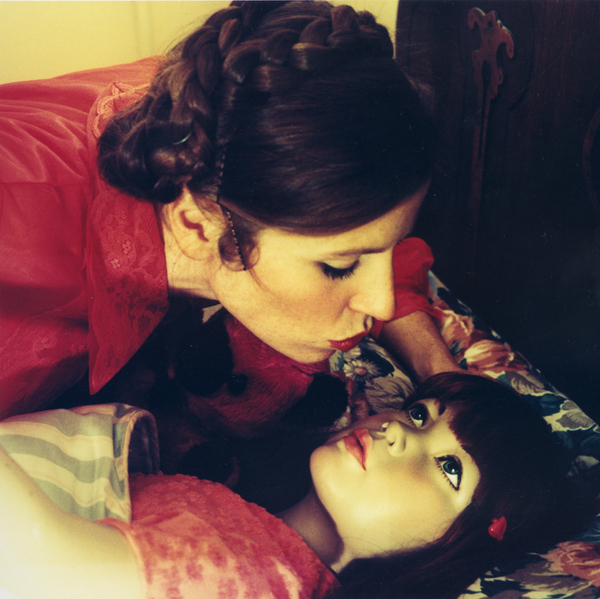
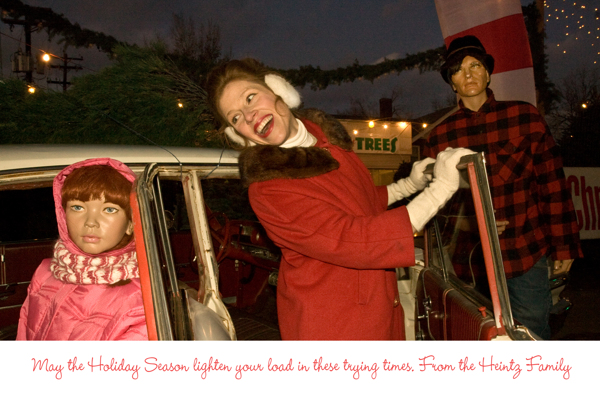
Suzanne Heintz calls herself “the modern day patron saint of single women”. She has the following to say about her ongoing photography project, the wondrously uncanny “Life Once Removed”:

What would drive you to pack a family of mannequins into your station wagon, and take them on a road trip? Enough pressure to conform will send anyone packing.  That’s how I came to this personal project about what is essentially…Spinsterhood, and the American Way.
Well-meaning strangers, along with friends and family, would raise an eyebrow when the topic of my unmarried and childless status arose.  Indicating with a small facial twitch, not only my audacious freakishness, but that I was a little old for such foolish thinking. I mean, come on, eggs don’t last forever!

suzanne heintz - 02But really, what was I supposed to do?  You can’t just go out and buy a family.  Or can you?  I did.  They are mannequins.  The candy coated shell with nothing inside.  We do all those family things, all the while capturing those Kodak Moments.  Because it’s not really about the journey, or a genuine human connection, when your kids are screaming, “are we there yet?”, is it?  It’s about the picture in front of the sign.  “Get back in the car, we got the picture.  Now, let’s go eat.”

We love and obey the formatted image of a well-lived life.  So deeply ingrained is that strange auto-grin we put on when a camera is present.  Do we live our lives with a keen awareness of how it feels, or just how it looks?
suzanne heintz - 03If I pass through life without checking off the boxes for a wedding ring and a baby carriage, I will be missing the photo album, but not not the point.  When I take my photos, others stop and stare, then they ask, “why are you doing this?”  They, at that moment, are starting to get the point too.

heintz family christmas 1

Check out more of Suzanne’s fantastical images HERE.