rainer maria rilke – from “requiem for a friend” (1908)

… That’s what you had to come back for: the lament that we omitted. Can you hear me? I would like to fling my voice out like a cloth over the fragments of your death, and keep pulling at it until it is torn to pieces, and all my words would have to walk around shivering, in the tatters of that voice; as if lament were enough.

But now I must accuse: not the man who withdrew you from yourself (I cannot find him; he looks like everyone), but in this one man, I accuse: all men. When somewhere, from deep within me, there arises the vivid sense of having been a child, the purity and essence of that childhood where I once lived: then I don’t want to know it. I want to form an angel from that sense and hurl him upward, into the front row of angels who scream out, reminding God.

For this suffering has lasted far too long; none of us can bear it; it is too heavy — this tangled suffering of spurious love which, building on convention like a habit, calls itself just, and fattens on injustice. Show me a man with a right to his possession. Who can possess what cannot hold its own self, but only, now and then, will blissfully catch itself, then quickly throw itself away, like a child playing with a ball. As little as a captain can hold the carved Nike facing outward from his ship’s prow when the lightness of her godhead suddenly lifts her up, into the bright sea-wind: so little can one of us call back the woman who, now no longer seeing us, walks on along the narrow strip of her existence as though by miracle, in perfect safety — unless, that is, he wishes to do wrong. For this is wrong, if anything is wrong: not to enlarge the freedom of a love with all the inner freedom one can summon. We need, in love, to practice only this: letting each other go. For holding on comes easily; we do not need to learn it.

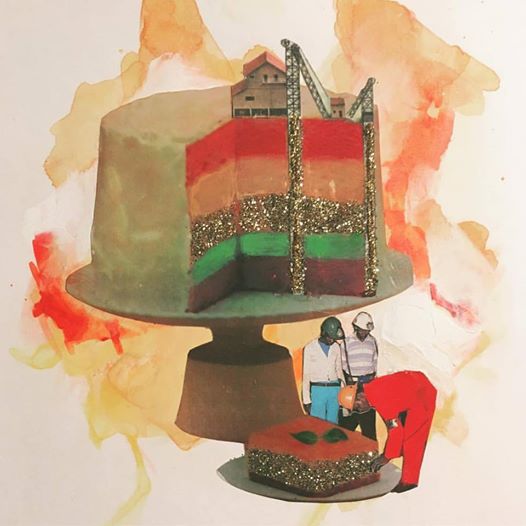
sulamith wolfling – the little mermaid

Are you still here? Are you standing in some corner? You knew so much of all this, you were able to do so much; you passed through life so open to all things, like an early morning. I know: women suffer; for love means being alone; and artists in their work sometimes intuit that they must keep transforming, where they love. You began both; both exist in that which any fame takes from you and disfigures. Oh you were far beyond all fame; were almost invisible; had withdrawn your beauty, softly, as one would lower a brightly colored flag on the gray morning after a holiday. You had just one desire: a year’s long work — which was never finished; was somehow never finished. If you are still here with me, if in this darkness there is still some place where your spirit resonates on the shallow sound waves stirred up by my voice: hear me: help me. We can so easily slip back from what we have struggled to attain, abruptly, into a life we never wanted; can find that we are trapped, as in a dream, and die there, without ever waking up. This can occur. Anyone who has lifted his blood into a years-long work may find that he can’t sustain it, the force of gravity is irresistible, and it falls back, worthless. For somewhere there is an ancient enmity between our daily life and the great work. Help me, in saying it, to understand it.

Do not return. If you can bear to, stay dead with the dead. The dead have their own tasks. But help me, if you can without distraction, since in me what is most distant sometimes helps.

[Translator: Stephen Mitchell]

the window – 29 january 2017

fb_img_1485619224214.jpg
Theatre Arts Admin Collective
Methodist Church Hall, Cnr Milton Road & Wesley Street, Observatory, Cape Town
Doors open 19:30
R50

20:00 – Main Hall – Lliezel Ellick / Roxanne De Freitas / Rosemary Lombard (vocal performance piece)
20:25 – Main Hall – Louise Westerhout /Keenan Chas Ahrends / Nicola van Straaten (word/sound/dance)
20:40 – Minor Hall – Inka Kendzia / Jessica Smith (video and live performance)
BREAK
21:00 – Main Hall – Rhea Dally / Justin Allart (sound/noise performance)
21:20 – Main Hall – Lucy Hazard / Puleng Lange-Stewart / Hannah Walton (video with spoken word performance)
21:35 – Minor Hall – FAITH XVII (video installation)
BREAK
22:00 – Main Hall – Chantelle Gray (performance piece)
22:20 – Main Hall – Debra Pryor / Mark O’ Donovan (performance piece)
Continuous – Meeting Room 1 – Sydelle Willow Smith (photography)
Continuous – Meeting Room 2 – Miranda Moss (installation)
___
THE WINDOW

A window I. A partition. A voyeuristic interface between spaces. A civilizing constraint. Gazing. At the window, through the window, beyond the window. The voyeuristic gaze: preconditioned values, assumptions, desire. The civilizing gaze: conditioning values, assumptions, desire. Gazing. An act of memorializing (it suggests spectatorship, a fetishistic surveying; it suggests participation: in memory, in meaning-making).

A window II. A framing device. Commonly used in art and cinema. To exaggerate part or parts of a figure (forms, tones, shapes, shadows). To recompose an image. To slice up the world into smaller, more wieldy frames. To elicit metaphorical interpretation. (The audience is prompted to step into a world of windows.)

A window III. The window. A composing stratagem. (A perspectival arrangement.) A voyeuristic interface between artist and audience. An invitation to interact with the unknown, the unknowable, the known known. It is not a linear perspective of space, but a cutting up of, slicing into, carving through. (It suggests the existence of another, entirely otherworldly, place.)
__

“A concept is a brick. It can be used to build a courthouse of reason. Or it can be thrown through the window.”
– Gilles Deleuze

god is busy with ghosts and grime

Processed with VSCO with c1 presetWhat world to which you do not belong
What barren place, what days are these
What awful thing has laid you down
Betwixt this bed alone, you sleep

In a room of ghosts and grime and sin
With no bedding to curl against your chest
To comfort skin and heart and head
Or find reprieve, remember this:

This world to which you do not belong
Is not of you or Her or He
But a world of them, the scribbled lines
of man and man, now man-machine

What of your bed amidst their house
Do you make it, leave it, invite them in?
Or do you tie the sheets and fashion means
To hang your life, go whispering

Along the corridors where they tried to kiss you
Beneath the beams of others gone
Below the words of men who missed you
And missed the most, your unborn son

What now, what world (you’re standing yet –
You’ve left the bed and room and curse)
“What will you have me do this time
What good is left, what use of verse?”

And yonder still, the One you seek
Forever held in suspension there
Just beyond and just ahead
The endless walk to God knows where

But now the ghosts and grime are yours
Not all have seen that bathroom floor,
Fewer still, been strapped to beds;
Freed their limbs and asked for more

Folly! You live; you’re safe and sound
And most of ghosts have long since left
This talk of lover and beloved, how,
When Aleppo burns, lovers bereft

Of beloved, once in bone and flesh
Oh God (for what is God but wonder)
In what world does hell come breathing thus?
Who tears such limbs and hearts asunder?

But this is mine (you speak of light)
And that is theirs, by karma dealt
If this were true (you once were them)
You’d fall to the floor with all you felt

And further into darkness go,
With mimicry of the darkest yet,
To give all that you could and all that you are
To pray in a place where light had left

Throw glitter, glitter at every bent
Hold lightly prayers for beloved thine
You ask for more but don’t malign
A God who’s busy with ghosts and grime.

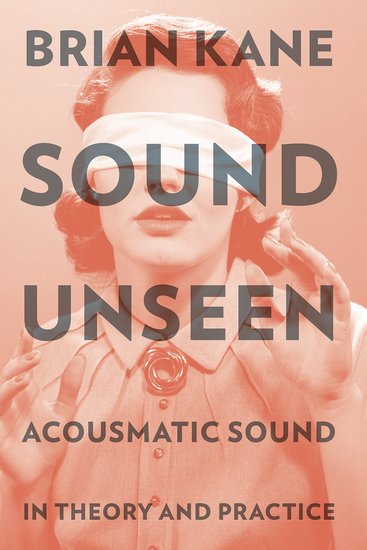
brian kane – sound unseen – acousmatic sound in theory and practice (2016)

sound unseenSound coming from outside the field of vision, from somewhere beyond, holds a privileged place in the Western imagination. When separated from their source, sounds seem to manifest transcendent realms, divine powers, or supernatural forces. According to legend, the philosopher Pythagoras lectured to his disciples from behind a veil, and two thousand years later, in the age of absolute music, listeners were similarly fascinated with disembodied sounds, employing various techniques to isolate sounds from their sources. With recording and radio came spatial and temporal separation of sounds from sources, and new ways of composing music.

Sound Unseen: Acousmatic Sound in Theory and Practice explores the phenomenon of acousmatic sound. An unusual and neglected word, “acousmatic” was first introduced into modern parlance in the mid-1960s by avant garde composer of musique concrète Pierre Schaeffer to describe the experience of hearing a sound without seeing its cause. Working through, and often against, Schaeffer’s ideas, Brian Kane presents a powerful argument for the central yet overlooked role of acousmatic sound in music aesthetics, sound studies, literature, philosophy and the history of the senses. Kane investigates acousmatic sound from a number of methodological perspectives — historical, cultural, philosophical and musical — and provides a framework that makes sense of the many surprising and paradoxical ways that unseen sound has been understood. Finely detailed and thoroughly researched, Sound Unseen pursues unseen sounds through a stunning array of cases — from Bayreuth to Kafka’s “Burrow,” Apollinaire to Zizek, music and metaphysics to architecture and automata, and from Pythagoras to the present-to offer the definitive account of acousmatic sound in theory and practice.

The first major study in English of Pierre Schaeffer’s theory of “acousmatics,” Sound Unseen is an essential text for scholars of philosophy of music, electronic music, sound studies, and the history of the senses.

You can get it here if you have $27.95.

arthur russell – this is how we walk on the moon (1980-something)

This song is just the best. It has helped me to keep putting one foot in front of the other on really difficult days.

Another Thought was originally released in 1994, just two years after Arthur Russell’s death from AIDS in 1992. At that time the enigmatic downtown NYC cellist/composer’s work appeared to be in danger of fading into obscurity, with nearly all of his recorded material either hopelessly out-of-print or unreleased entirely…

… As most of his fans have doubtless noticed by now, Russell was an artist whose career defies easy synopsis. Formally trained as a cellist, his music seemed to effortlessly draw links between the outwardly incompatible vocabularies of No Wave/post-punk, space disco, and avant-garde modern composition. So it is probably for the best that Another Thought was never intended as greatest hits package or a comprehensive career overview. The collection was instead compiled by producer Don Christensen from the countless hours of unreleased tapes that Russell had recorded over the final decade of his life. Most of this material consists of eccentric, deceptively simple solo pop songs for voice and cello. And as suggested by the album’s cover photo– which depicts Russell nonchalantly sporting a newspaper pirate hat– there’s a boyish innocence and playful romanticism to many of these tracks, resulting in some of the warmest and most intimate performances of his career.

Read the rest of this review.

john berger – ways of seeing (1972)

I cannot overstate how immensely John Berger contributed to awakening a critical understanding of Western cultural aesthetics and ethics in me. I feel deeply indebted. Here’s a wonderful recent interview with the man.

On this, his 90th birthday, I thought it fitting to look back on this BAFTA award-winning TV series from 1972, which rapidly became regarded as one of the most influential art programmes ever made. Ways of Seeing is a four-part BBC series of 30-minute films, created chiefly by writer John Berger and producer Mike Dibb. Berger’s scripts were adapted into a book of the same name.

The series and book critique traditional Western cultural aesthetics by raising questions about hidden ideologies in visual images. The series is partially a response to Kenneth Clark’s Civilisation series, which represents a more traditionalist view of the Western artistic and cultural canon.

In the first programme, Berger examines the impact of photography on our appreciation of art from the past.

The second programme deals with the portrayal of the female nude, an important part of the tradition of European art. Berger examines these paintings and asks whether they celebrate women as they really are or only as men would like them to be.

With the invention of oil paint around 1400, painters were able to portray people and objects with an unprecedented degree of realism, and painting became the ideal way to celebrate private possessions. In this programme, John Berger questions the value we place on that tradition.

In this programme, Berger analyses the images of advertising and publicity and shows how they relate to the tradition of oil painting – in moods, relationships and poses.

More John Berger on Fleurmach:

John Berger on being born a woman

John Berger – “Les Petites Chaises”

What I rail against, impotently, and wish I could embrace

faith47 & the grrrl – aqua regalia – projection mapping (2015)

A projection mapping sequence created as a collaboration between inka kendzia (the grrrl) and faith47.

Faith created a shrine-like installation made out of found objects. The mapping sequence was then projected on top of this shrine structure.

The projection was created specifically for the opening night of Faith’s Aqua Regalia exhibition in New York at the Jonathan Levine gallery in November 2015.

artist – faith47
animation and mapping – inka kendzia | the grrrl
music – fletcher beadon – fletcher in dub
filmed – zane meyer of chopemdownfilms

arundhati roy – excerpt from ‘war talk’ (2003)

Arundhati_RoyOur strategy should be not only to confront empire, but to lay siege to it. To deprive it of oxygen. To shame it. To mock it. With our art, our music, our literature, our stubbornness, our joy, our brilliance, our sheer relentlessness – and our ability to tell our own stories. Stories that are different from the ones we’re being brainwashed to believe.

The corporate revolution will collapse if we refuse to buy what they are selling – their ideas, their version of history, their wars, their weapons, their notion of inevitability. Remember this: We be many and they be few. They need us more than we need them.

Another world is not only possible, she is on her way. Maybe many of us won’t be here to greet her, but on a quiet day, if I listen very carefully, I can hear her breathing.

― Arundhati Roy, from War Talk (South End Press, 2003).

john perkins on empire’s power tools

“Fear and debt. The two most powerful tools of empire.”
– John Perkins

Image: #Umhlangano

Image: #Umhlangano

an excerpt from louise gluck’s ‘disruption, hesitation, silence’ (1995)

In my generation, most of the poets I admire are interested in length. By which I mean that they want to write long lines. long stanzas, long poems, poems which cover an extended sequence of events. To all this I feel an instant objection, whose sources I’m not confident I know. Some of the sources may lie in character, in my tendency to reject all ideas I didn’t think of first, which habit creates a highly charged adversarial relationship with the new. What is positive in this process is that it creates an obligation to articulate an argument.

What I share with my friends is ambition; what I dispute is its definition. I do not think that more information always makes a richer poem. I am attracted to ellipsis, to the unsaid, to suggestion, to eloquent, deliberate silence. The unsaid, for me, exerts great power: often I wish an entire poem could be made in this vocabulary. It is analogous to the unseen; for example, to the power of ruins, to works of art either damaged or incomplete. Such works inevitably allude to larger contexts; they haunt because they are not whole, though wholeness is implied: another time, a world in which they were whole, or were to have been whole, is implied. There is no moment in which their first home is felt to be the museum. A few years ago, I saw a show of Holbein drawings; most astonishing were those still in progress. Parts were entirely finished. And parts were sketched, a fluent line indicating arm or hand or hair, but the forms were not filled in. Holbein had made notes to himself: this sleeve blue, hair, auburn. Though the terms were other–not the color in the world, but the color in paint or chalk. 
What these unfinished drawings generated was a vivid sense of Holbein at work, at the sitting; to see them was to have a sense of being back in time, back in the middle of something. Certain works of art become artifacts. By works of art, I mean works in any medium. And certain works of art do not. 

It seems to me that what is wanted, in art, is to harness the power of the unfinished. All earthly experience is partial. Not simply because it is subjective, but because that which we do not know, of the universe, of mortality, is so much more vast than that which we do know. What is unfinished or has been destroyed participates in these mysteries. The problem is to make a whole that does not forfeit this power.

The argument for completion, for thoroughness, for exhaustive detail, is that it makes an art more potent because more exact–a closer recreation of the real. But the cult of exhaustive detail, of data, needs scrutiny. News stories are detailed. But they don’t seem, at least to me, at all real. Their thoroughness is a reprimand to imagination. And yet they don’t say this is what it was to be here.

I belong, so it appears, to a generation suspicious of the lyric, of brevity, of the deception of stopped time. And impatient with beauty, which is felt to be an inducement to stupor. Certainly there is stupor everywhere; it is an obvious byproduct of anxiety. But narrative poetry, or poetry packed with information, is not the single escape from the perceived constrictions of the lyric. A number of quite different writers practice in various ways another method.

angel olsen interview (august 2016)

Her new album is out today!

From the Pitchfork review:

“From the bracing incantations of 2012’s Half Way Home to Olsen’s folk-rock opus, 2014’s Burn Your Fire for No Witness, her name is now synonymous with a voice. Each note tells a story. Hers are tales of absolute yearning and resilience. They honor the romance of being alone in your head. Olsen has perfected the idea that it is still possible—if language is precise enough, if the truth of your music is as elemental as color or blood—to write oneself out of time. Her lyrics have the conviction of someone like Fiona Apple: a profoundly individual presence that centers, above all, on self-reliance, on searing autonomy, on the act of becoming.”

ann magnuson performs kate bush’s “wow” (c. 1997)

“In promotion of her fantastic “The Luv Show” CD (and in anticipation of her much later release, “Pretty Songs”), Ann Magnuson wowed the crowds at two live shows at Luna Park. Along with her own songs and a few other covers, she included this Kate Bush gem as one of the “pretty songs”…

Sadly, this was only 1997 or so…so this is recorded on a tape recorder and sounds a bit muddy. No matter. It’s still worth a listen. Enjoy.”

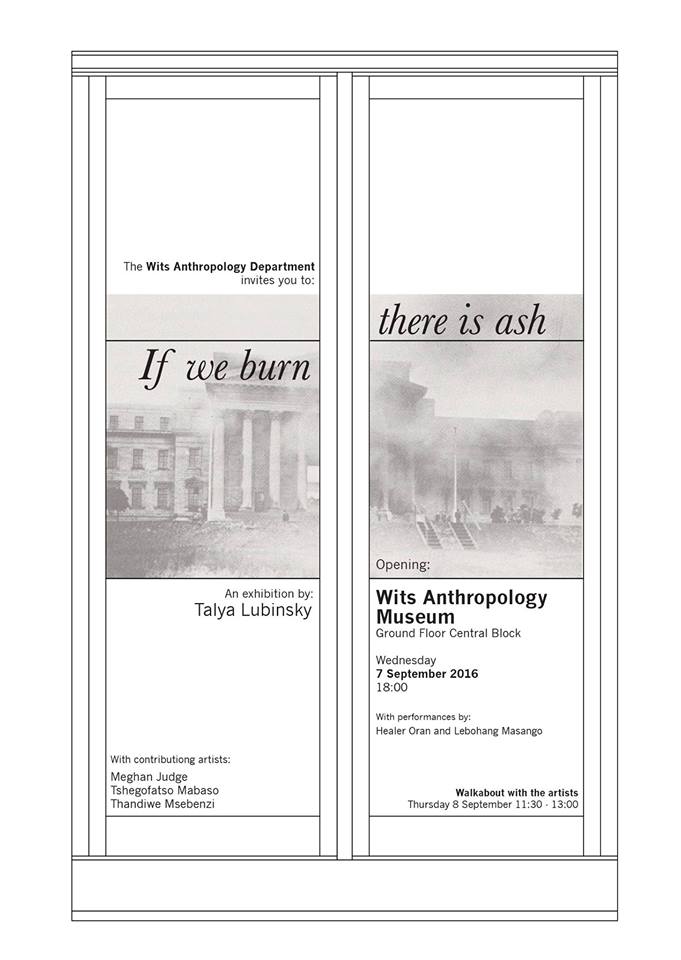
if we burn there is ash (7 september 2016)

if we burn there is ash

The Wits Anthropology Department is pleased to reopen its Museum collection with

If we burn there is ash

An exhibition by Talya Lubinsky
with contributing artists Meghan Judge, Tshegofatso Mabaso and Thandiwe Msebenzi
and performances by Lebohang Masango and Healer Oran

Wits Anthropology Museum
Wednesday 7 September 2016
18:00

Walkabout with the artists Thursday 8 September 11:30-13:00

All welcome

__
On Christmas Eve of 1931 a fire broke out at Wits University’s Great Hall. At the time, the façade of the Great Hall had been built, its stone pillars and steps creating a striking image of the university in the young colonial city. But the University had run out of funds, and the building that would become Central Block, had not yet been built. Erected behind the grand façade of the Great Hall were wooden shack-like structures, which burned in the fire. These wooden structures housed the collections of what is now called the Cullen Library, as well as the Ethnographic Museum’s collection. Initiated by Winifred Hoernle, head of the Ethnography Museum at the time, the collection was largely comprised of pieces of material culture sent to her from the British missionary, William Burton, while stationed in the ‘Congo’ region.

The fire burned hundreds of books, paintings and artefacts. Some of the only objects that survived the fire are clay burial bowls from the Burton collection. Able to withstand the heat precisely because of their prior exposure to fire, these bowls remain, but are blackened and broken by the 1931 fire.

The exhibition, If we burn, there is ash centres around this story as a place from which to think about the value of colonial collections of material culture. While the origins of the 1931 fire remain unknown, it nonetheless provides a space in which to think about the potentially generative qualities of fire.

Ash, the material remains of fire, however elusive, does not disappear. Even when things burn, they are never fully physically or ephemerally eliminated. Ash is not just the physical remains of that which has been burnt. It is also used as an ingredient in cement mixtures. It is literally transformed into a building material.

Using ash and cement as a poetic relation, this exhibition asks about the potentiality of burning in the project of building and growth. Ash and cement serve as a provocation on the question of what is to be done with the material remains of a violent colonial past.

__
For further information, please contact Talya Lubinsky (talya.lubinsky@gmail.com) or Kelly Gillespie (Kelly.Gillespie@wits.ac.za)

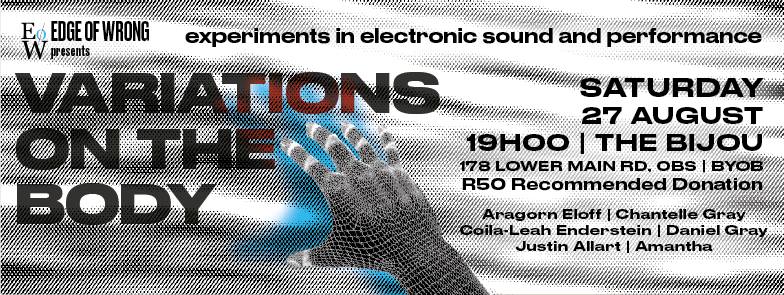
edge of wrong presents “variations on the body” – 27 august 2016

eow variations on the bodyPlease join us for an evening of experimental live music hosted by the Edge of Wrong and featuring performances from pianist Coila-Leah Enderstein, electronic musician Daniel Gray, noise maestro Justin Allart and movement-based composition artists Aragorn23, Chantelle Gray and Amantha.

Entrance is pay-what-you-can (recommended donation R50) and you can bring your own refreshments. Please make sure you arrive by 7:30 to minimise disruptions during performances.

___ ABOUT THE ARTISTS ___

Coila-Leah Enderstein is a classically trained pianist based in Cape Town. She’s into in experimental new music and interdisciplinary performance.

daniel gray is an artist from johannesburg and now lives in cape town. he is currently working as a high school maths teacher. he is interested in sound as image, dreams, collective improvisation and chance processes. in 2014-2016 he released an audiovisual album called “fantasmagoria”, a noise/peace album called “mssapessm”, took part in GIPCA live arts festival, performed around cape town, formed the now defunct subdwellers dj collective, started primitive ancestor records – a net label, to name a few of the many noisy endeavours. this will be the third edge of wrong event that he has participated in.

Justin Allart is a highly prolific experimental/noise musician who performs using a motley array of non-musical instruments. Expect sandpaper on turntables and effects pedals talking to themselves.

Aragorn23 is an experimental musician based in South Africa. His current work focuses on algorithmic and gestural composition and the use of the body as an instrument. He will be performing alongside collaborators Chantelle Gray and Amantha on the evening.

jacky bowring – a field guide to melancholy (2008)

“Melancholy is a twilight state; suffering melts into it and becomes a sombre joy. Melancholy is the pleasure of being sad.”
– Victor Hugo, Toilers of the Sea

Melancholy is ambivalent and contradictory. Although it seems at once a very familiar term, it is extraordinarily elusive and enigmatic. It is something found not only in humans – whether pathological, psychological, or a mere passing mood – but in landscapes, seasons, and sounds. They too can be melancholy. Batman, Pierrot, and Hamlet are all melancholic characters, with traits like darkness, unrequited longing, and genius or heroism. Twilight, autumn and minor chords are also melancholy, evoking poignancy and the passing of time.

How is melancholy defined? A Field Guide to Melancholy traces out some of the historic traditions of melancholy, most of which remain today, revealing it to be an incredibly complex term. Samuel Johnson’s definition, in his eighteenth century Dictionary of the English Language, reveals melancholy’s multi-faceted nature was already well established by then: ‘A disease, supposed to proceed from a redundance of black bile; a kind of madness, in which the mind is always fixed on one object; a gloomy, pensive, discontented temper.’2 All of these aspects – disease, madness and temperament – continue to coalesce in the concept of melancholy, and rather than seeking a definitive definition or chronology, or a discipline-specific account, this book embraces contradiction and paradox: the very kernel of melancholy itself.

As an explicit promotion of the ideal of melancholy, the Field Guide extols the benefits of the pursuit of sadness, and questions the obsession with happiness in contemporary society. Rather than seeking an ‘architecture of happiness’, or resorting to Prozac-with-everything, it is proposed that melancholy is not a negative emotion, which for much of history it wasn’t – it was a desirable condition, sought for its ‘sweetness’ and intensity. It remains an important point of balance – a counter to the ‘loss of sadness’. Not grief, not mourning, not sorrow, yet all of those things.

Melancholy is profoundly interdisciplinary, and ranges across fields as diverse as medicine, literature, art, design, psychology and philosophy. It is over two millennia old as a concept, and its development predates the emergence of disciplines.While similarly enduring concepts have also been tackled by a breadth of disciplines such as philosophy, art and literature, melancholy alone extends across the spectrum of arts and sciences, with significant discourses in fields like psychiatry, as much as in art. Concepts with such an extensive period of development (the idea of ‘beauty’ for example) tend to go through a process of metamorphosis and end up meaning something distinctly different.3 Melancholy has been surprisingly stable. Despite the depth and breadth of investigation, the questions, ideas and contradictions which form the ‘constellation’4 of melancholy today are not dramatically different from those at any time in its history. There is a sense that, as psychoanalytical theorist Julia Kristeva puts it, melancholy is ‘essential and trans-historical’.5

Melancholy is a central characteristic of the human condition, and Hildegard of Bingen, the twelfth century abbess and mystic, believed it to have been formed at the moment that Adam sinned in taking the apple – when melancholy ‘curdled in his blood’.6 Modern day Slovenian philosopher, Slavoj Žižek, also positions melancholy, and its concern with loss and longing, at the very heart of the human condition, stating ‘melancholy (disappointment with all positive, empirical objects, none of which can satisfy our desire) is in fact the beginning of philosophy.’7

The complexity of the idea of melancholy means that it has oscillated between attempts to define it scientifically, and its embodiment within a more poetic ideal. As a very coarse generalisation, the scientific/psychological underpinnings of melancholy dominated the early period, from the late centuries BC when ideas on medicine were being formulated, while in later, mainly post-medieval times, the literary ideal became more significant. In recent decades, the rise of psychiatry has re-emphasised the scientific dimensions of melancholy. It was never a case of either/or, however, and both ideals, along with a multitude of other colourings, have persisted through history.

The essential nature of melancholy as a bodily as well as a purely mental state is grounded in the foundation of ideas on physiology; that it somehow relates to the body itself. These ideas are rooted in the ancient notion of ‘humours’. In Greek and Roman times humoralism was the foundation for an understanding of physiology, with the four humours ruling the body’s characteristics.

Phlegm, blood, yellow bile and black bile were believed to be the four governing elements, and each was ascribed to particular seasons, elements and temperaments. This can be expressed via a tetrad, or four-cornered diagram.
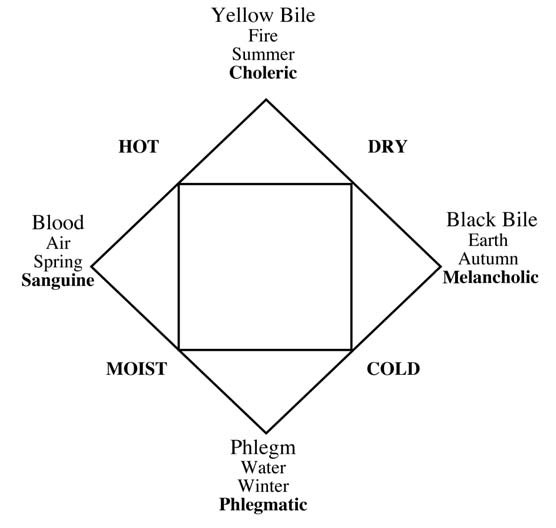
The Four Humours, adapted from Henry E Sigerist (1961) A History of Medicine, 2 vols New York: Oxford University Press, 2:232

The Four Humours, adapted from Henry E Sigerist (1961) “A History of Medicine”, 2 vols New York: Oxford University Press, 2:232

The four-part divisions of temperament were echoed in a number of ways, as in the work of Alkindus, the ninth century Arab philosopher, who aligned the times of the day with particular dispositions. The tetrad could therefore be further embellished, with the first quarter of the day sanguine, second choleric, third melancholic and finally phlegmatic. Astrological allegiances reinforce the idea of four quadrants, so that Jupiter is sanguine, Mars choleric, Saturn is melancholy, and the moon or Venus is phlegmatic. The organs, too, are associated with the points of the humoric tetrad, with the liver sanguine, the gall bladder choleric, the spleen melancholic, and the brain/ lungs phlegmatic.

Melancholy, then, is associated with twilight, autumn, earth, the spleen, coldness and dryness, and the planet Saturn. All of these elements weave in and out of the history of melancholy, appearing in mythology, astrology, medicine, literature and art.The complementary humours and temperaments were sometimes hypothesised as balances, so that the opposite of one might be introduced as a remedy for an excess of another. For melancholy, the introduction of sanguine elements – blood, air and warmth – could counter the darkness. This could also work at an astrological level, as in the appearance of the magic square of Jupiter on the wall behind Albrecht Dürer’s iconic engraving Melencolia I, (1514) – the sign of Jupiter to introduce a sanguine balance to the saturnine melancholy angel.
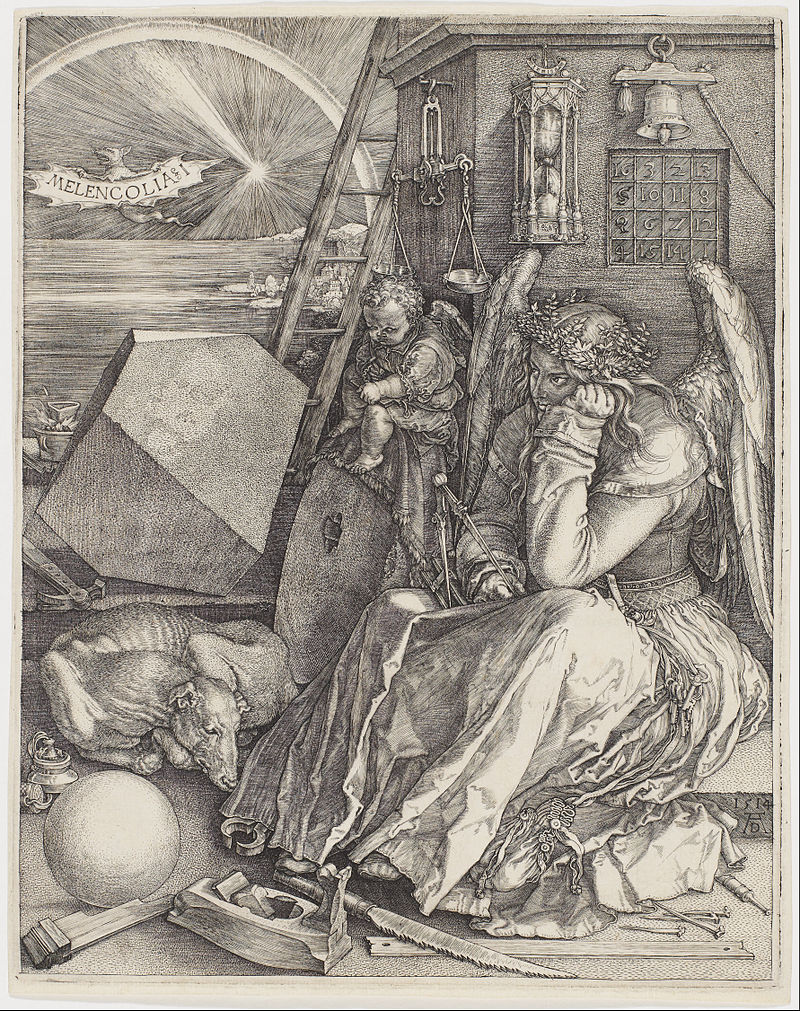
Albrecht Dürer – Melencolia 1. Engraving, 1514.

In this early phase of the development of humoral thinking a key tension arose, as on one hand it was devised as a means of establishing degrees of wellness, but on the other it was a system of types of disposition. As Klibansky, Panofsky and Saxl put it, there were two quite different meanings to the terms sanguine, choleric, phlegmatic and melancholy, as either ‘pathological states or constitutional aptitudes’.9 Melancholy became far more connected with the idea of illness than the other temperaments, and was considered a ‘special problem’.

The blurry boundary between an illness and a mere temperament was a result of the fact that many of the symptoms of ‘melancholia’ were mental, and thus difficult to objectify, unlike something as apparent as a disfigurement or wound. The theory of the humours morphed into psychology and physiognomy, with particular traits or appearances associated with each temperament.

Melancholy was aligned with ‘the lisping, the bald, the stuttering and the hirsute’, and ‘emotional disturbances’ were considered as indicators of ‘mental melancholy’.10 Hippocrates in his Aphorismata, or ‘Aphorisms’, in 400 BC noted, ‘Constant anxiety and depression are signs of melancholy.’ Two centuries later the physician Galen, in an uncharacteristically succinct summation, noted that Hippocrates was ‘right in summing up all melancholy symptoms in the two following: Fear and Depression.’11

The foundations of the ideas on melancholy are fraught with complexity and contradiction, and this signals the beginning of a legacy of richness and debate. We have a love-hate relationship with melancholy, recognising its potential, yet fearing its connotations. What is needed is some kind of guide book, to know how to recognise it, where to find it – akin to the Observer’s Guides, the Blue Guides, or Gavin Pretor-Pinney’s The Cloudspotter’s Guide. Yet, to attempt to write a guide to such an amorphous concept as melancholy is overwhelmingly impossible, such is the breadth and depth of the topic, the disciplinary territories, the disputes, and the extensive creative outpourings. There is a tremendous sense of the infinite, like staring at stars, or at a room full of files, a daunting multitude. The approach is, therefore, to adopt the notion of the ‘constellation’, and to plot various points and co-ordinates, a join-the-dots approach to exploration which roams far and wide, and connects ideas and examples in a way which seeks new combinations and sometimes unexpected juxtapositions.

A Field Guide to Melancholy is therefore in itself a melancholic enterprise: for the writer, and the reader, the very idea of a ‘field guide’ to something so contradictory, so elusive, embodies the impossibility and futility that is central to melancholy’s yearning. Yet, it is this intangible, potent possibility which creates melancholy’s magnetism, recalling Joseph Campbell’s version of the Buddhist advice to “joyfully participate in the sorrows of the world”.12

Notes
1. Victor Hugo, Toilers of the Sea, vol. 3, p.159.
2. Samuel Johnson, A Dictionary of the English Language, p.458, emphasis mine.
3. This constant shift in the development of concepts is well-illustrated by Umberto Eco (ed) (2004) History of Beauty, New York: Rizzoli, and his recent (2007) On Ugliness, New York: Rizzoli.
4. The term ‘constellation’ is Giorgio Agamben’s, and captures the sense of melancholy’s persistence as a collection of ideas, rather than one simple definition. See Giorgio Agamben, Stanzas:Word and Phantasm in Western Culture, p.19.
5. Julia Kristeva, Black Sun: Depression and Melancholia, p.258.
6. Raymond Klibansky, Erwin Panofsky and Fritz Saxl, Saturn and Melancholy: Studies in the History of Natural Philosophy, Religion and Art, p.79.
7. Slavoj Žižek, Did Somebody say Totalitarianism? Five Interventions on the (Mis)use of a Notion, p.148.
8. In Stanley W Jackson (1986), Melancholia and Depression: From Hippocratic Times to Modern Times, p.9.
9. Raymond Klibansky, Erwin Panofsky and Fritz Saxl, Saturn and Melancholy: Studies in the History of Natural Philosophy, Religion and Art, p.12.
10. ibid, p.15.
11. ibid, p.15, and n.42.
12. A phrase used by Campbell in his lectures, for example on the DVD Joseph Campbell (1998) Sukhavati. Acacia.
__
Excerpted from the introduction to Jacky Bowring’s A Field Guide to Melancholy, Oldcastle Books, 2008.